OBJECTIVE:  Students will become familiar with the different types of computer and how they have evolved through the years through lecture, classroom discussion and completion of a worksheets.
Types of Computers All computers have the same basic components. How are computers different? Size Cost Performance What are the different types of computers? Supercomputers Mainframes Minicomputers Professional Workstations Personal Computers
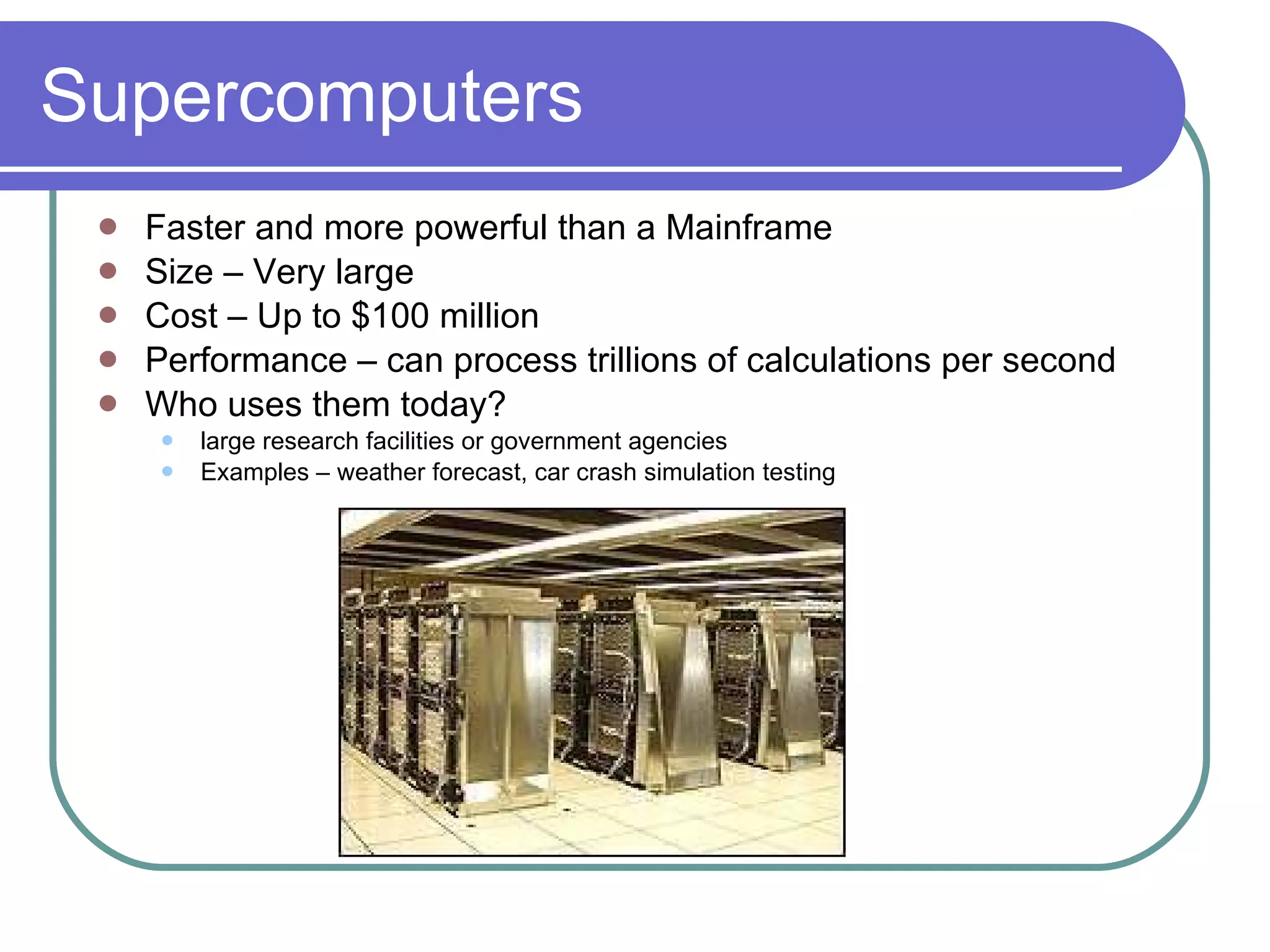
Supercomputers Faster and more powerful than a Mainframe  Size – Very large Cost – Up to $100 million Performance – can process trillions of calculations per second Who uses them today? large research facilities or government agencies Examples – weather forecast, car crash simulation testing
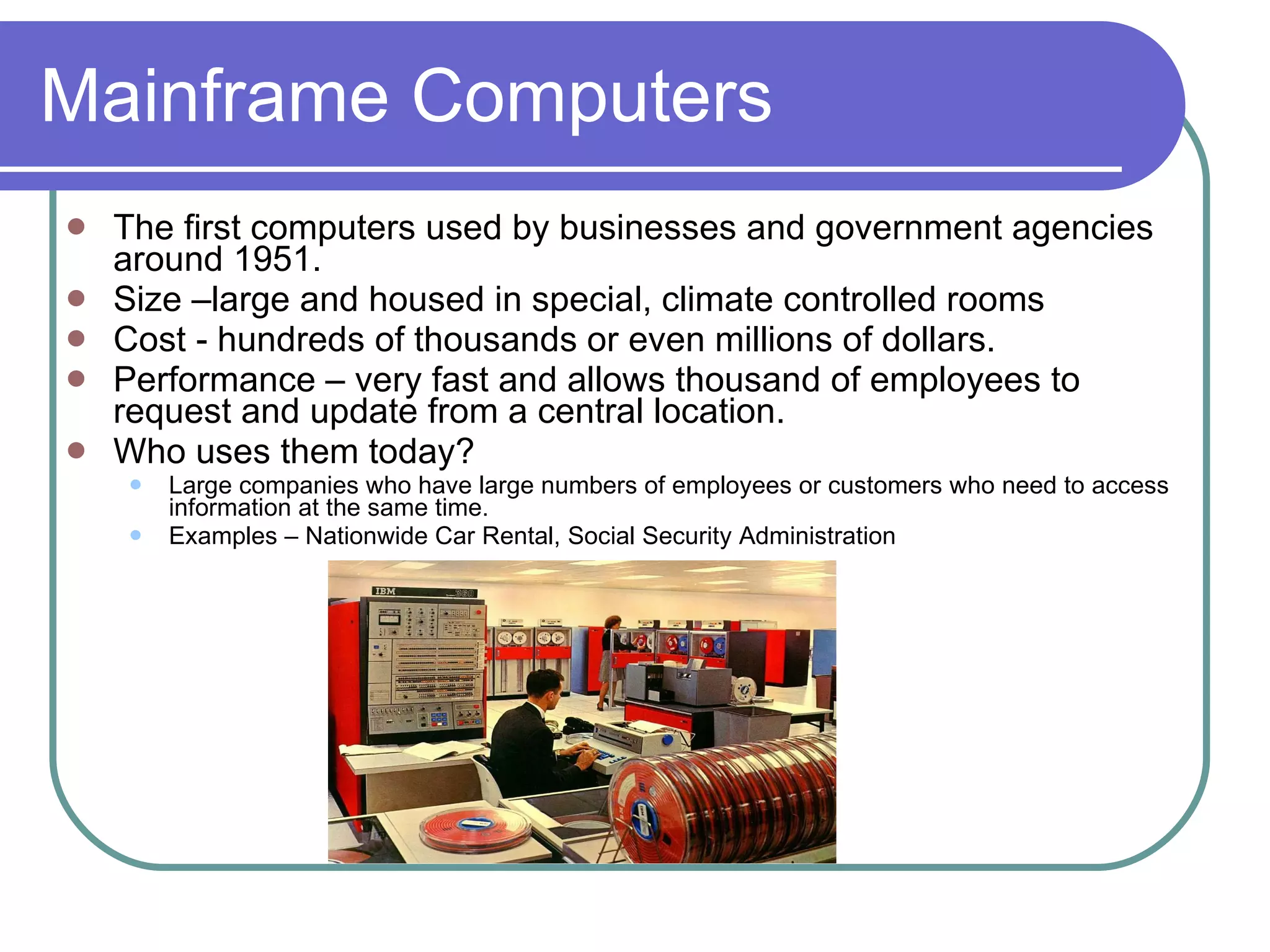
Mainframe Computers The first computers used by businesses and government agencies around 1951.  Size –large and housed in special, climate controlled rooms Cost - hundreds of thousands or even millions of dollars. Performance – very fast and allows thousand of employees to request and update from a central location. Who uses them today? Large companies who have large numbers of employees or customers who need to access information at the same time. Examples – Nationwide Car Rental, Social Security Administration
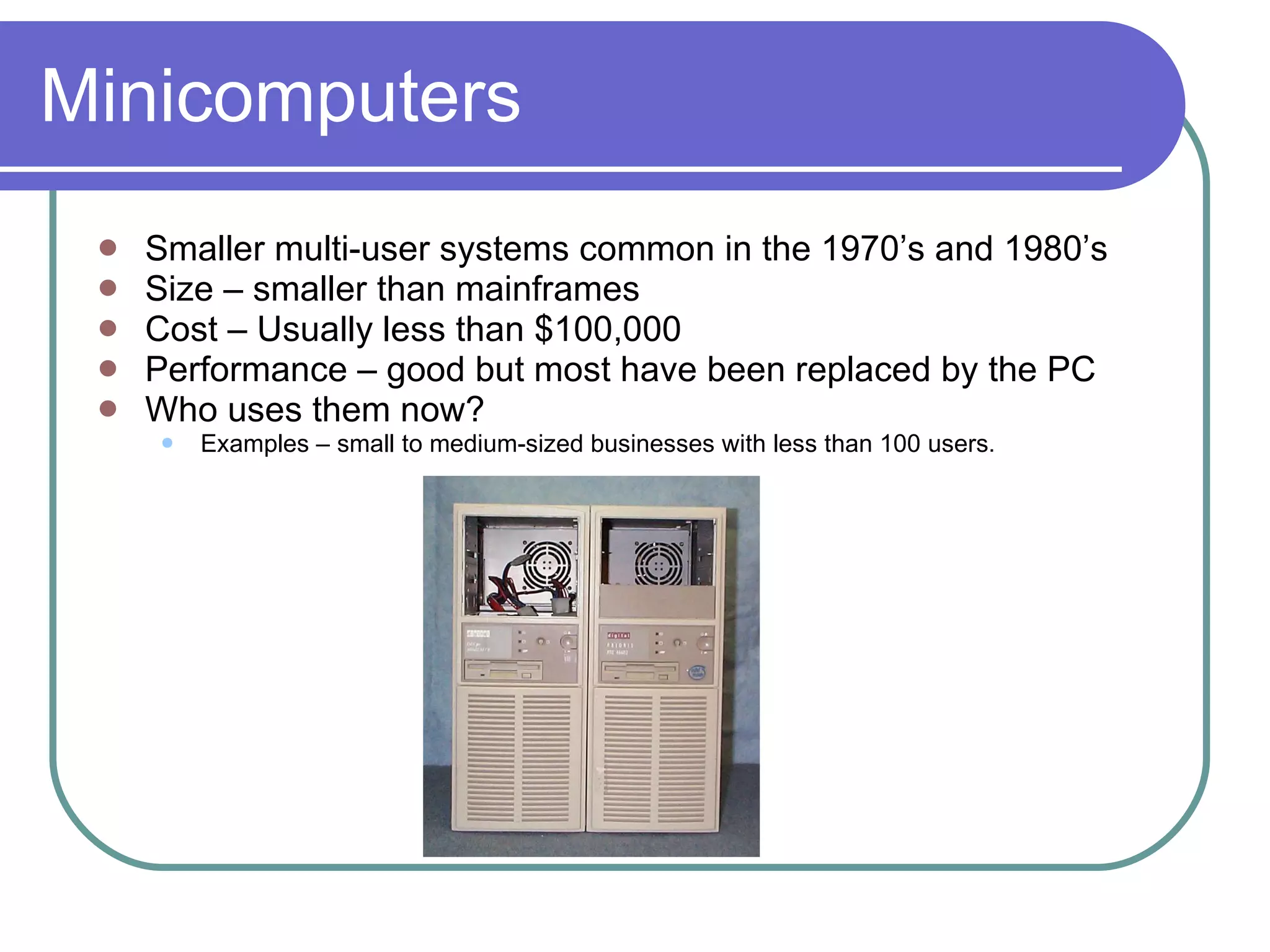
Minicomputers Smaller multi-user systems common in the 1970’s and 1980’s Size – smaller than mainframes Cost – Usually less than $100,000 Performance – good but most have been replaced by the PC Who uses them now? Examples – small to medium-sized businesses with less than 100 users.
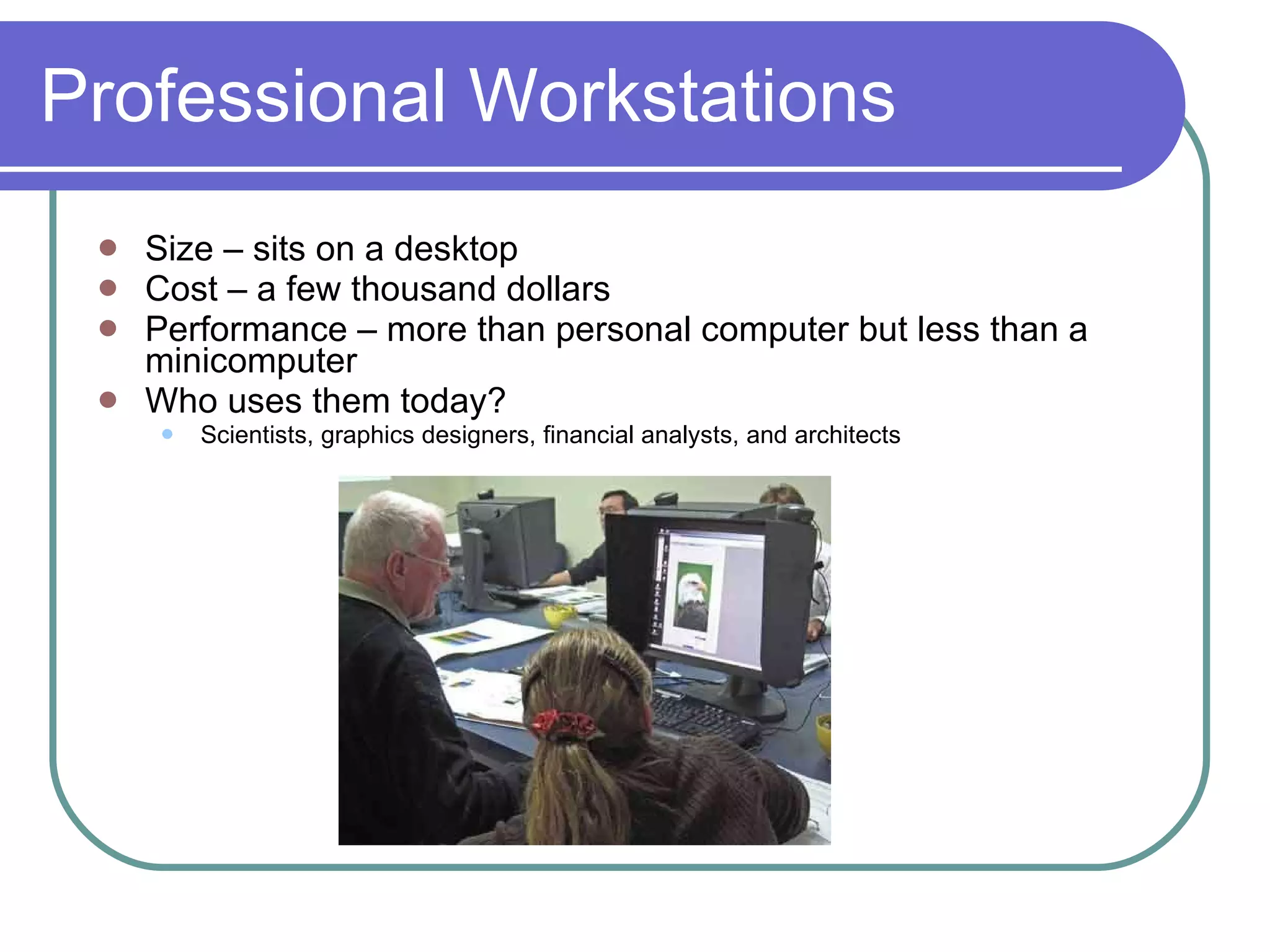
Professional Workstations Size – sits on a desktop Cost – a few thousand dollars Performance – more than personal computer but less than a minicomputer Who uses them today? Scientists, graphics designers, financial analysts, and architects
Personal Computer Who was first? Apple with the Apple I in 1976 (Steve Wozniak & Steve Jobs) Who was second? IBM in 1981 (Microsoft & IBM) Who was next? IBM-Compatibles such as Digital, HP, Dell Size – sits on a desktop Cost - $500 and up Performance – fast and continuing to get faster due to chip-making technology and miniaturization Who uses them today? Almost every business and individuals at home
Assignment Complete the “ Computer System Recommendations ” worksheet. You will turn it in as you leave today Use proper heading
Assignment Complete the handout as we go through the presentation
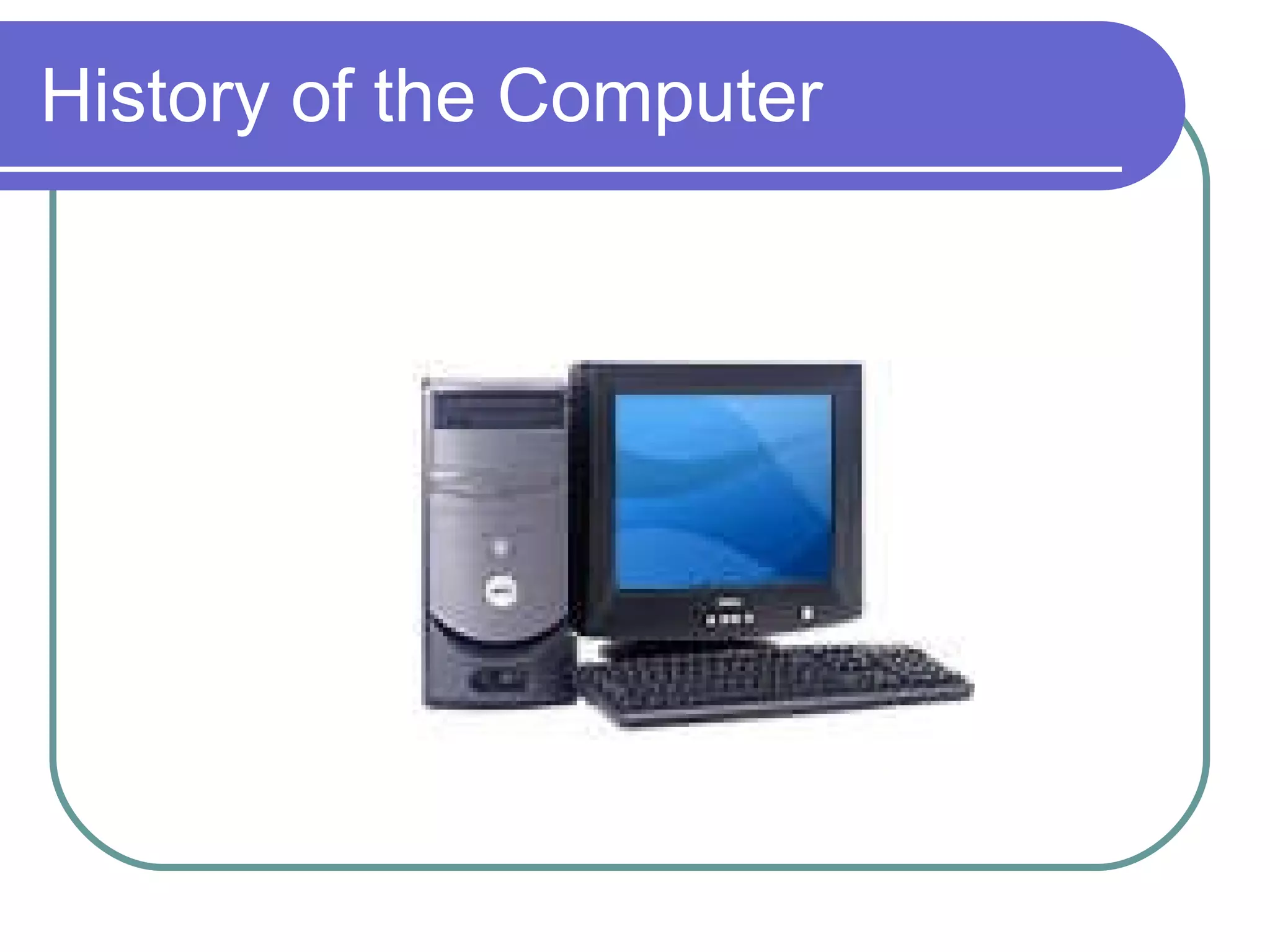
History of the Computer
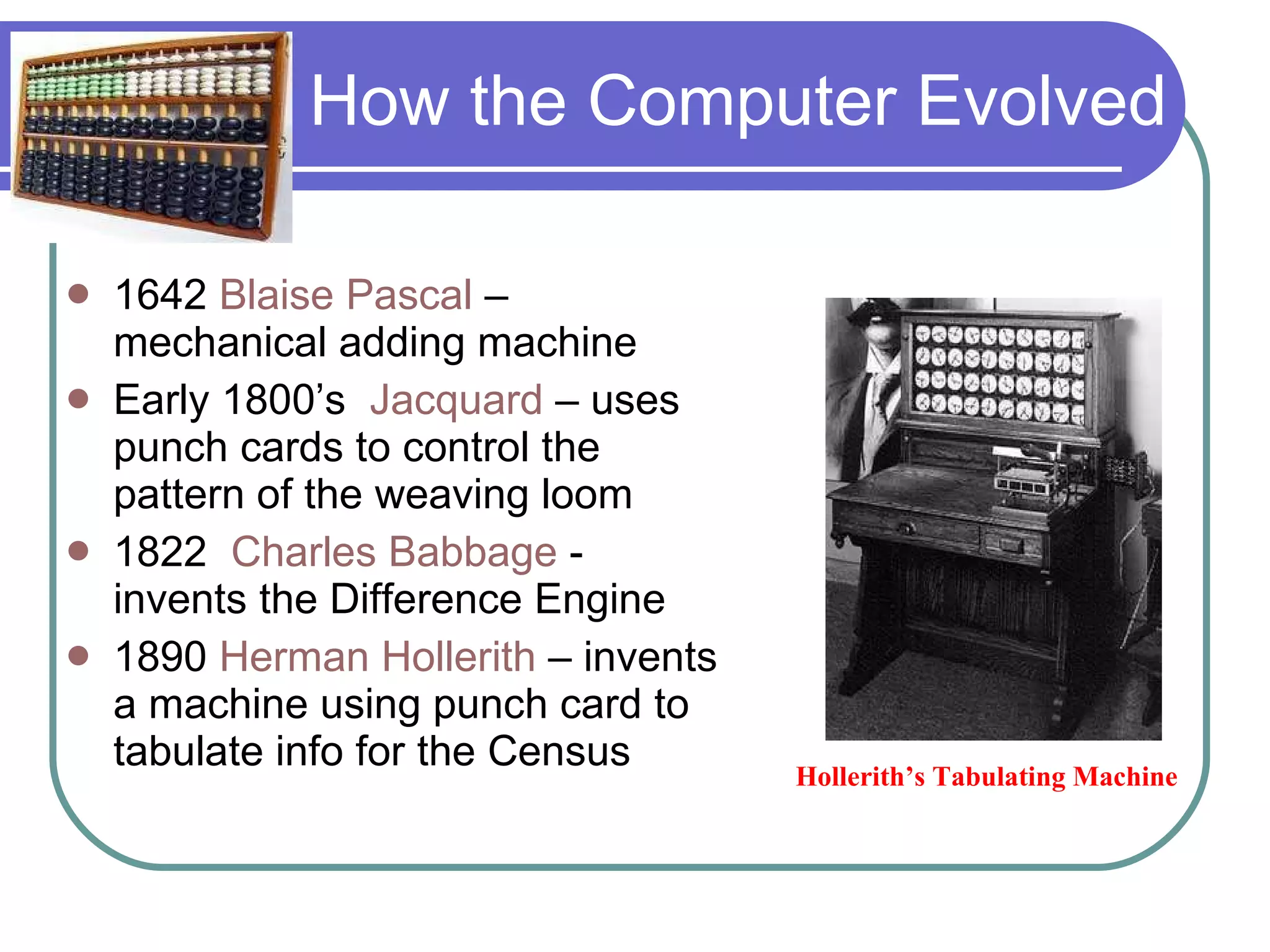
How the Computer Evolved 1642  Blaise Pascal  – mechanical adding machine Early 1800’s  Jacquard  – uses punch cards to control the pattern of the weaving loom 1822  Charles Babbage  - invents the Difference Engine 1890  Herman Hollerith  – invents a machine using punch card to tabulate info for the Census Hollerith’s Tabulating Machine
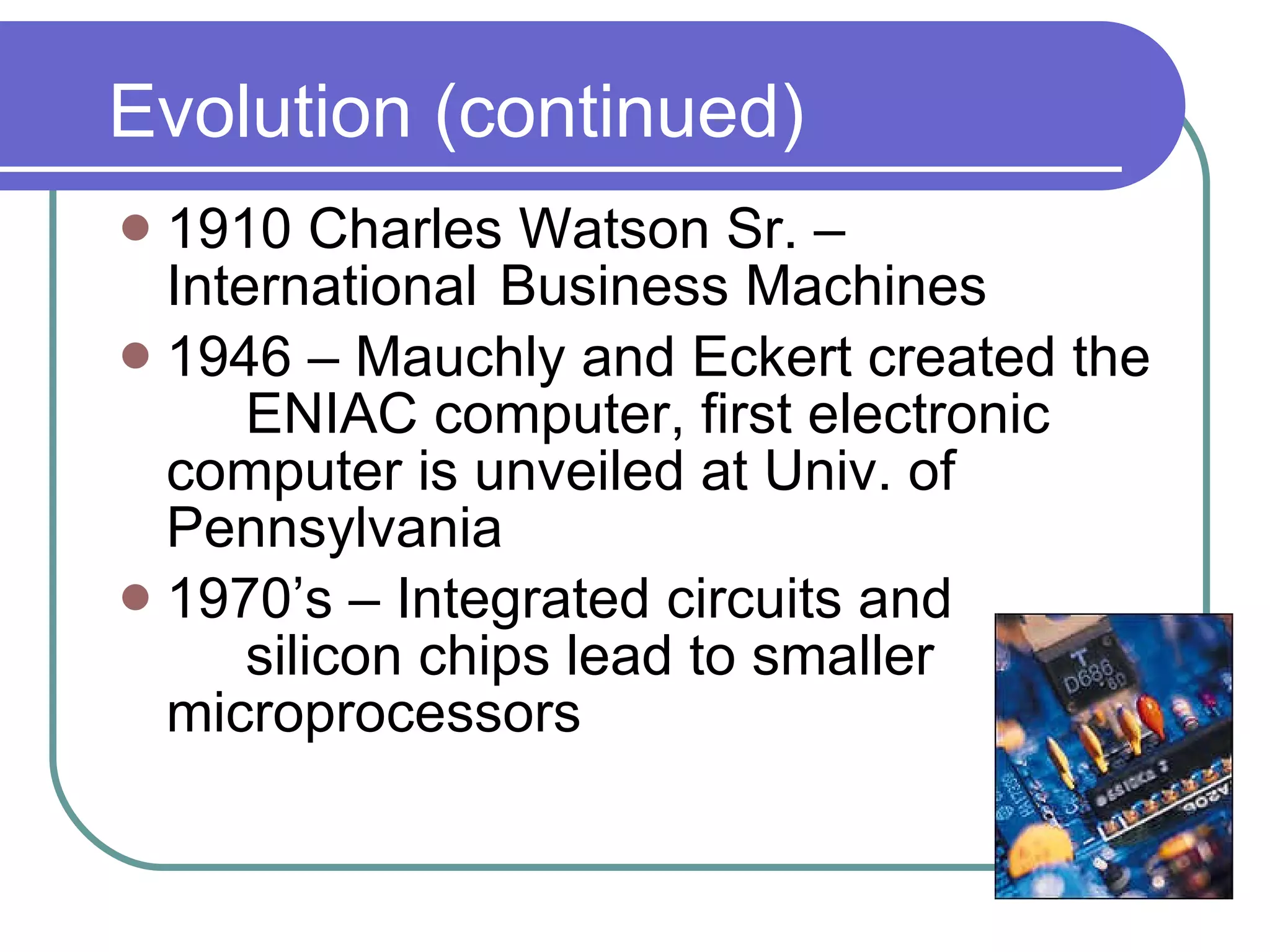
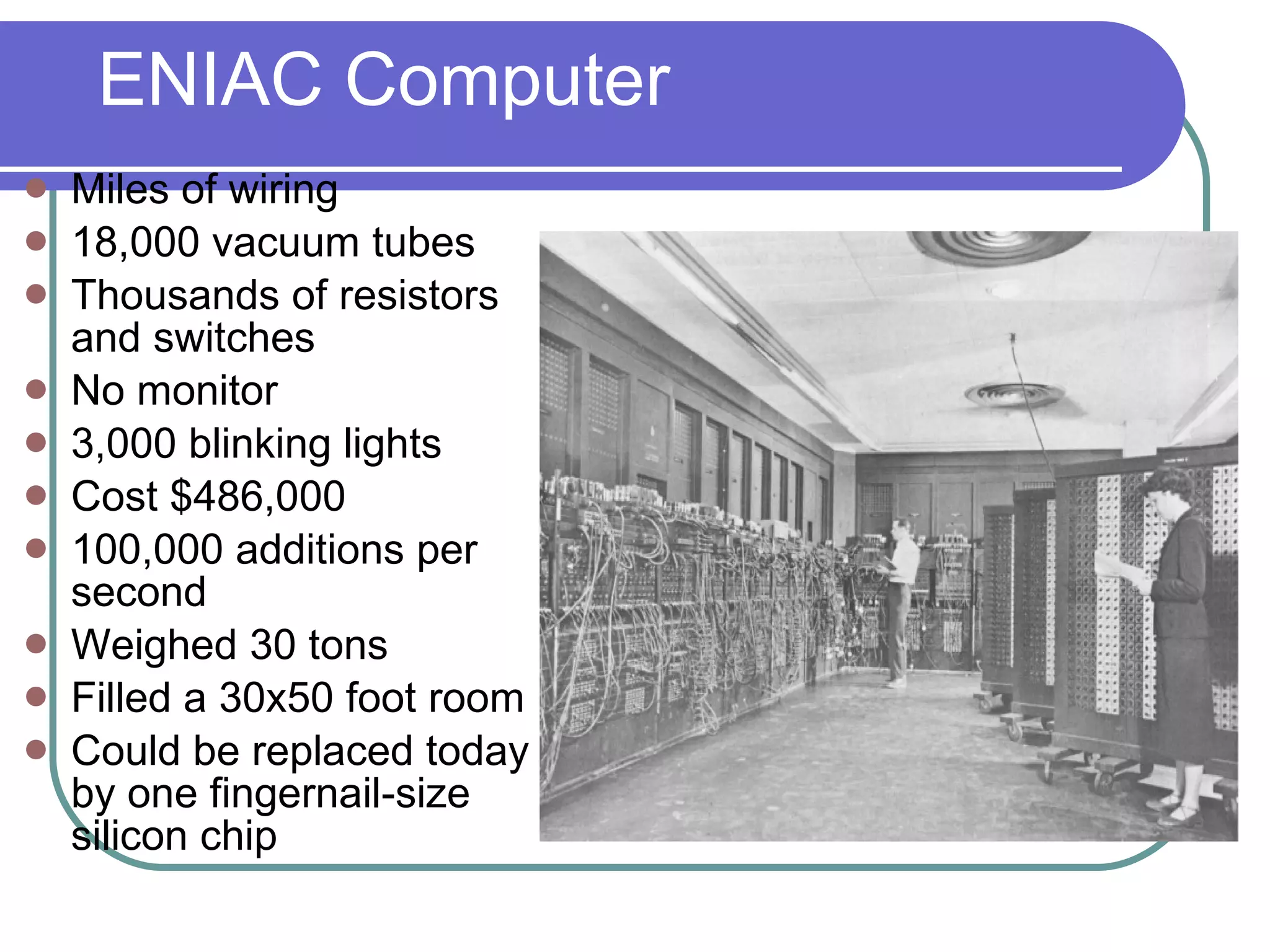
Evolution (continued) 1910 Charles Watson Sr. – International  Business Machines 1946 – Mauchly and Eckert created the  ENIAC computer, first electronic  computer is unveiled at Univ. of  Pennsylvania 1970’s – Integrated circuits and  silicon chips lead to smaller  microprocessors                                                   
ENIAC Computer Miles of wiring 18,000 vacuum tubes Thousands of resistors and switches No monitor 3,000 blinking lights Cost $486,000 100,000 additions per second Weighed 30 tons Filled a 30x50 foot room Could be replaced today by one fingernail-size silicon chip
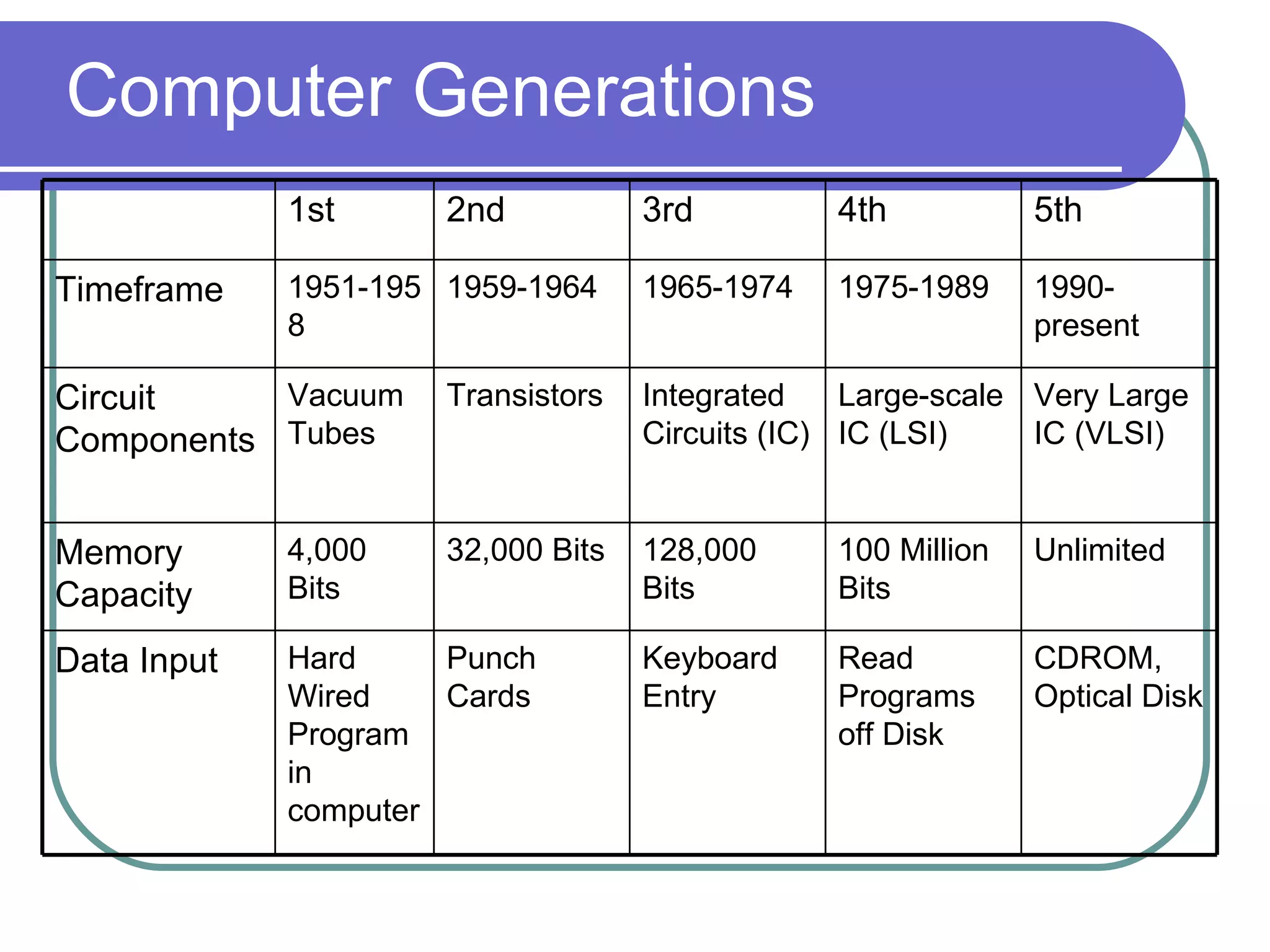
Computer Generations 1st 2nd 3rd 4th 5th Timeframe 1951-1958 1959-1964 1965-1974 1975-1989 1990-present Circuit Components Vacuum Tubes Transistors Integrated Circuits (IC) Large-scale IC (LSI) Very Large IC (VLSI) Memory Capacity 4,000 Bits 32,000 Bits 128,000 Bits 100 Million Bits Unlimited Data Input Hard Wired Program in computer Punch Cards Keyboard Entry Read Programs off Disk CDROM, Optical Disk
Computers Are Everywhere Laptop Computers Appliances Cars Medical Equipment Printers Game Consoles
Reflection What interesting/new thing(s) did you learn about computers today? How have computers/microelectronics changed our lives? Communicate Cook Entertainment Work

Various types of computers & history

  • 1.
    OBJECTIVE: Studentswill become familiar with the different types of computer and how they have evolved through the years through lecture, classroom discussion and completion of a worksheets.
  • 2.
    Types of ComputersAll computers have the same basic components. How are computers different? Size Cost Performance What are the different types of computers? Supercomputers Mainframes Minicomputers Professional Workstations Personal Computers
  • 3.
    Supercomputers Faster andmore powerful than a Mainframe Size – Very large Cost – Up to $100 million Performance – can process trillions of calculations per second Who uses them today? large research facilities or government agencies Examples – weather forecast, car crash simulation testing
  • 4.
    Mainframe Computers Thefirst computers used by businesses and government agencies around 1951. Size –large and housed in special, climate controlled rooms Cost - hundreds of thousands or even millions of dollars. Performance – very fast and allows thousand of employees to request and update from a central location. Who uses them today? Large companies who have large numbers of employees or customers who need to access information at the same time. Examples – Nationwide Car Rental, Social Security Administration
  • 5.
    Minicomputers Smaller multi-usersystems common in the 1970’s and 1980’s Size – smaller than mainframes Cost – Usually less than $100,000 Performance – good but most have been replaced by the PC Who uses them now? Examples – small to medium-sized businesses with less than 100 users.
  • 6.
    Professional Workstations Size– sits on a desktop Cost – a few thousand dollars Performance – more than personal computer but less than a minicomputer Who uses them today? Scientists, graphics designers, financial analysts, and architects
  • 7.
    Personal Computer Whowas first? Apple with the Apple I in 1976 (Steve Wozniak & Steve Jobs) Who was second? IBM in 1981 (Microsoft & IBM) Who was next? IBM-Compatibles such as Digital, HP, Dell Size – sits on a desktop Cost - $500 and up Performance – fast and continuing to get faster due to chip-making technology and miniaturization Who uses them today? Almost every business and individuals at home
  • 8.
    Assignment Complete the“ Computer System Recommendations ” worksheet. You will turn it in as you leave today Use proper heading
  • 9.
    Assignment Complete thehandout as we go through the presentation
  • 10.
  • 11.
    How the ComputerEvolved 1642 Blaise Pascal – mechanical adding machine Early 1800’s Jacquard – uses punch cards to control the pattern of the weaving loom 1822 Charles Babbage - invents the Difference Engine 1890 Herman Hollerith – invents a machine using punch card to tabulate info for the Census Hollerith’s Tabulating Machine
  • 12.
    Evolution (continued) 1910Charles Watson Sr. – International Business Machines 1946 – Mauchly and Eckert created the ENIAC computer, first electronic computer is unveiled at Univ. of Pennsylvania 1970’s – Integrated circuits and silicon chips lead to smaller microprocessors                                                   
  • 13.
    ENIAC Computer Milesof wiring 18,000 vacuum tubes Thousands of resistors and switches No monitor 3,000 blinking lights Cost $486,000 100,000 additions per second Weighed 30 tons Filled a 30x50 foot room Could be replaced today by one fingernail-size silicon chip
  • 14.
    Computer Generations 1st2nd 3rd 4th 5th Timeframe 1951-1958 1959-1964 1965-1974 1975-1989 1990-present Circuit Components Vacuum Tubes Transistors Integrated Circuits (IC) Large-scale IC (LSI) Very Large IC (VLSI) Memory Capacity 4,000 Bits 32,000 Bits 128,000 Bits 100 Million Bits Unlimited Data Input Hard Wired Program in computer Punch Cards Keyboard Entry Read Programs off Disk CDROM, Optical Disk
  • 15.
    Computers Are EverywhereLaptop Computers Appliances Cars Medical Equipment Printers Game Consoles
  • 16.
    Reflection What interesting/newthing(s) did you learn about computers today? How have computers/microelectronics changed our lives? Communicate Cook Entertainment Work