Contents
•   Todays Topic: Introduction to Computer Software

•   We will learn
       1.  What is software?
       2.  What is Hardware?
       3.  Types of Software
            System s/w, Application s/w, Open source &
             Proprietary s/w
       4. Examples of system Software
            Operating System, compiler, loader, linker, Interpreter
       5. Examples of Application Software
            Word processors, Spreadsheets, Presentation,
             Database systems
Introduction to
Computer Software
Software & Hardware?

• Computer Instructions or data, anything that can be
  stored electronically is Software.

•     Hardware is one that is tangible. The storage devices
    (Hard disk, CD’s etc.,), mouse, keyboard CPU and display
    devices (Monitor) are Hardware.

    For example: There is a problem in the Software implies
    – Problem with program or data
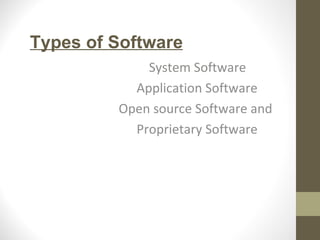
Types of Software
             System Software
           Application Software
         Open source Software and
           Proprietary Software
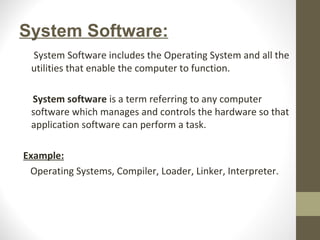
System Software:
 System Software includes the Operating System and all the
 utilities that enable the computer to function.

 System software is a term referring to any computer
 software which manages and controls the hardware so that
 application software can perform a task.

Example:
 Operating Systems, Compiler, Loader, Linker, Interpreter.
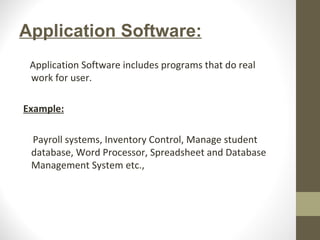
Application Software:
 Application Software includes programs that do real
 work for user.

Example:

 Payroll systems, Inventory Control, Manage student
 database, Word Processor, Spreadsheet and Database
 Management System etc.,
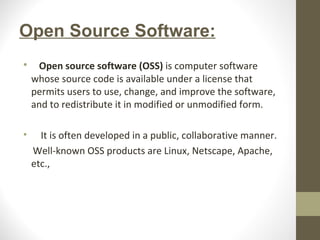
Open Source Software:
•    Open source software (OSS) is computer software
    whose source code is available under a license that
    permits users to use, change, and improve the software,
    and to redistribute it in modified or unmodified form.

•     It is often developed in a public, collaborative manner.
    Well-known OSS products are Linux, Netscape, Apache,
    etc.,
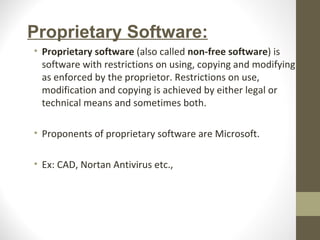
Proprietary Software:
• Proprietary software (also called non-free software) is
  software with restrictions on using, copying and modifying
  as enforced by the proprietor. Restrictions on use,
  modification and copying is achieved by either legal or
  technical means and sometimes both.

• Proponents of proprietary software are Microsoft.

• Ex: CAD, Nortan Antivirus etc.,
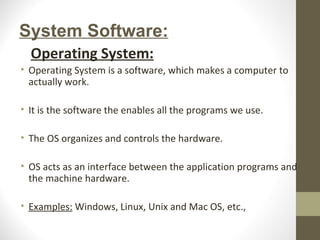
System Software:
  Operating System:
• Operating System is a software, which makes a computer to
  actually work.

• It is the software the enables all the programs we use.

• The OS organizes and controls the hardware.

• OS acts as an interface between the application programs and
  the machine hardware.

• Examples: Windows, Linux, Unix and Mac OS, etc.,
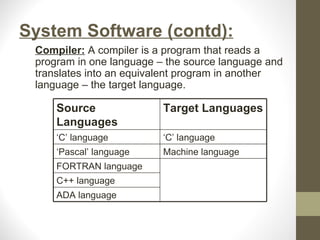
System Software (contd):
 Compiler: A compiler is a program that reads a
 program in one language – the source language and
 translates into an equivalent program in another
 language – the target language.

     Source               Target Languages
     Languages
     ‘C’ language         ‘C’ language
     ‘Pascal’ language    Machine language
     FORTRAN language
     C++ language
     ADA language
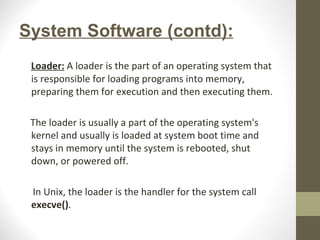
System Software (contd):
 Loader: A loader is the part of an operating system that
 is responsible for loading programs into memory,
 preparing them for execution and then executing them.

 The loader is usually a part of the operating system's
 kernel and usually is loaded at system boot time and
 stays in memory until the system is rebooted, shut
 down, or powered off.

 In Unix, the loader is the handler for the system call
 execve().
System Software (contd):
 Linker: A linker or link editor is a program that takes one
 or more objects generated by compilers and assembles
 them into a single executable program.

  Linkers can take objects from a collection called a
 library. The objects are program modules containing
 machine code and information for the linker.

 The linker takes care of arranging the objects in a
 program's address space.
System Software (contd):
 Interpreter: An interpreter is a computer
 program that translates and executes instructions
 written in a computer programming language line-
 by-line, unit by unit etc.,

  An interpreter needs to be able to analyze, or parse,
 instructions written in the source language.

  Example: Lisp systems, etc.,
Application Software:
  Word Processors:
 Word processing is a tool that helps user in creating, editing,
 and printing documents. Word processors will normally have
 the following capabilities built into them:
          • Spell checking
          • Standard layouts for normal documents
          • Have some characters appear in bold print, italics,
            or underlined
          • Center lines, make text line up on the left side of
            the paper, or the right side of the paper
          • Save the document so it can be used again
          • print the document.

Examples: WordPerfect and Microsoft Word
Application Software
(contd…):
 Spreadsheets:       The spreadsheet packages are
 designed to use numbers and formulas to do calculations
 with ease. Examples of spreadsheets include:
         • Budgets
         • Payrolls
         • Grade Calculations
         • Address Lists
 The most commonly used spreadsheet programs are
 Microsoft Excel and Lotus 123.
Application Software
(contd…):
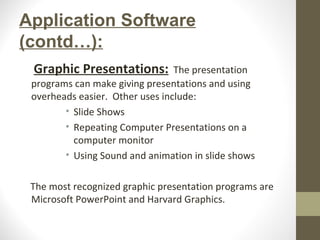
 Graphic Presentations:          The presentation
 programs can make giving presentations and using
 overheads easier. Other uses include:
        • Slide Shows
        • Repeating Computer Presentations on a
          computer monitor
        • Using Sound and animation in slide shows

 The most recognized graphic presentation programs are
 Microsoft PowerPoint and Harvard Graphics.
Application Software
(contd…):
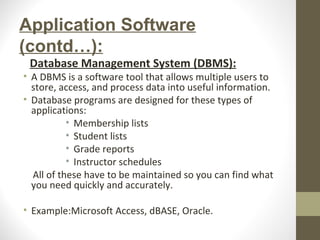
 Database Management System (DBMS):
• A DBMS is a software tool that allows multiple users to
  store, access, and process data into useful information.
• Database programs are designed for these types of
  applications:
           • Membership lists
           • Student lists
           • Grade reports
           • Instructor schedules
  All of these have to be maintained so you can find what
  you need quickly and accurately.

• Example:Microsoft Access, dBASE, Oracle.

Introduction to computer software12 9-07

  • 1.
    Contents • Todays Topic: Introduction to Computer Software • We will learn 1. What is software? 2. What is Hardware? 3. Types of Software  System s/w, Application s/w, Open source & Proprietary s/w 4. Examples of system Software  Operating System, compiler, loader, linker, Interpreter 5. Examples of Application Software  Word processors, Spreadsheets, Presentation, Database systems
  • 2.
  • 3.
    Software & Hardware? •Computer Instructions or data, anything that can be stored electronically is Software. • Hardware is one that is tangible. The storage devices (Hard disk, CD’s etc.,), mouse, keyboard CPU and display devices (Monitor) are Hardware. For example: There is a problem in the Software implies – Problem with program or data
  • 4.
    Types of Software System Software Application Software Open source Software and Proprietary Software
  • 5.
    System Software: SystemSoftware includes the Operating System and all the utilities that enable the computer to function. System software is a term referring to any computer software which manages and controls the hardware so that application software can perform a task. Example: Operating Systems, Compiler, Loader, Linker, Interpreter.
  • 6.
    Application Software: ApplicationSoftware includes programs that do real work for user. Example: Payroll systems, Inventory Control, Manage student database, Word Processor, Spreadsheet and Database Management System etc.,
  • 7.
    Open Source Software: • Open source software (OSS) is computer software whose source code is available under a license that permits users to use, change, and improve the software, and to redistribute it in modified or unmodified form. • It is often developed in a public, collaborative manner. Well-known OSS products are Linux, Netscape, Apache, etc.,
  • 8.
    Proprietary Software: • Proprietarysoftware (also called non-free software) is software with restrictions on using, copying and modifying as enforced by the proprietor. Restrictions on use, modification and copying is achieved by either legal or technical means and sometimes both. • Proponents of proprietary software are Microsoft. • Ex: CAD, Nortan Antivirus etc.,
  • 9.
    System Software: Operating System: • Operating System is a software, which makes a computer to actually work. • It is the software the enables all the programs we use. • The OS organizes and controls the hardware. • OS acts as an interface between the application programs and the machine hardware. • Examples: Windows, Linux, Unix and Mac OS, etc.,
  • 10.
    System Software (contd): Compiler: A compiler is a program that reads a program in one language – the source language and translates into an equivalent program in another language – the target language. Source Target Languages Languages ‘C’ language ‘C’ language ‘Pascal’ language Machine language FORTRAN language C++ language ADA language
  • 11.
    System Software (contd): Loader: A loader is the part of an operating system that is responsible for loading programs into memory, preparing them for execution and then executing them. The loader is usually a part of the operating system's kernel and usually is loaded at system boot time and stays in memory until the system is rebooted, shut down, or powered off. In Unix, the loader is the handler for the system call execve().
  • 12.
    System Software (contd): Linker: A linker or link editor is a program that takes one or more objects generated by compilers and assembles them into a single executable program. Linkers can take objects from a collection called a library. The objects are program modules containing machine code and information for the linker. The linker takes care of arranging the objects in a program's address space.
  • 13.
    System Software (contd): Interpreter: An interpreter is a computer program that translates and executes instructions written in a computer programming language line- by-line, unit by unit etc., An interpreter needs to be able to analyze, or parse, instructions written in the source language. Example: Lisp systems, etc.,
  • 14.
    Application Software: Word Processors: Word processing is a tool that helps user in creating, editing, and printing documents. Word processors will normally have the following capabilities built into them: • Spell checking • Standard layouts for normal documents • Have some characters appear in bold print, italics, or underlined • Center lines, make text line up on the left side of the paper, or the right side of the paper • Save the document so it can be used again • print the document. Examples: WordPerfect and Microsoft Word
  • 15.
    Application Software (contd…): Spreadsheets: The spreadsheet packages are designed to use numbers and formulas to do calculations with ease. Examples of spreadsheets include: • Budgets • Payrolls • Grade Calculations • Address Lists The most commonly used spreadsheet programs are Microsoft Excel and Lotus 123.
  • 16.
    Application Software (contd…): GraphicPresentations: The presentation programs can make giving presentations and using overheads easier. Other uses include: • Slide Shows • Repeating Computer Presentations on a computer monitor • Using Sound and animation in slide shows The most recognized graphic presentation programs are Microsoft PowerPoint and Harvard Graphics.
  • 17.
    Application Software (contd…): DatabaseManagement System (DBMS): • A DBMS is a software tool that allows multiple users to store, access, and process data into useful information. • Database programs are designed for these types of applications: • Membership lists • Student lists • Grade reports • Instructor schedules All of these have to be maintained so you can find what you need quickly and accurately. • Example:Microsoft Access, dBASE, Oracle.