Computerprogramming1st
assignment
1
Name: Taimur Muhammad
Class No: 12
Assignment No: 01
Subject: Computer programming
Topic: History and Types of Computer
Submitted to: Engineer Durr-e-Nayab
Dated: 24-10-2016
Computerprogramming1st
assignment
2
HISTORY OF COMPUTER
The computer as we know it today had its beginning
with a 19th century English mathematics professor
name Charles Babbage.
He designed the Analytical
Engine and this was the
Design that is the basic
framework of the computer.
Each generation lasted for a
certain period of time, and
each gave us either a new
and improved computer or
an improvement to the existing computer.
First Generation (1940-1956) Vacuum
Tubes:
The first computers used vacuum tubes for
circuitry and magnetic drums for memory, and
were often enormous, taking up entire rooms.
Computerprogramming1st
assignment
3
They were very expensive to operate and in
addition to using a great
Deal of electricity, the first
computers generated a lot
of heat, which was often
the cause of malfunctions
 EXAMPLE
The UNIVAC and ENIAC
computers are examples of
first-generation computing
devices.
Second Generation (1956-1963)
Transistors:
Transistors replace vacuum tubes and ushered in
the second generation of computers. The
transistor was invented in 1947 but did not see
widespread use in computers until the late 1950s.
The transistor was far superior to the vacuum
tube, allowing computers to become smaller,
faster, cheaper, more energy-efficient and more
Computerprogramming1st
assignment
4
reliable than their first-generation computers.
Second-generation
computers still relied
on punched cards
for input and
printouts for output.
Second-generation
computers moved from
cryptic binary machine
language to symbolic, or
assembly.
 EXAMPLES:
In the early 1960s,
the IBM 1401 and
Honeywell 400 were
examples
Third Generation(1964 -1971) Integrated
Circuits:
The development of the integrated circuit was the
hallmark of the third generation of computers.
Computerprogramming1st
assignment
5
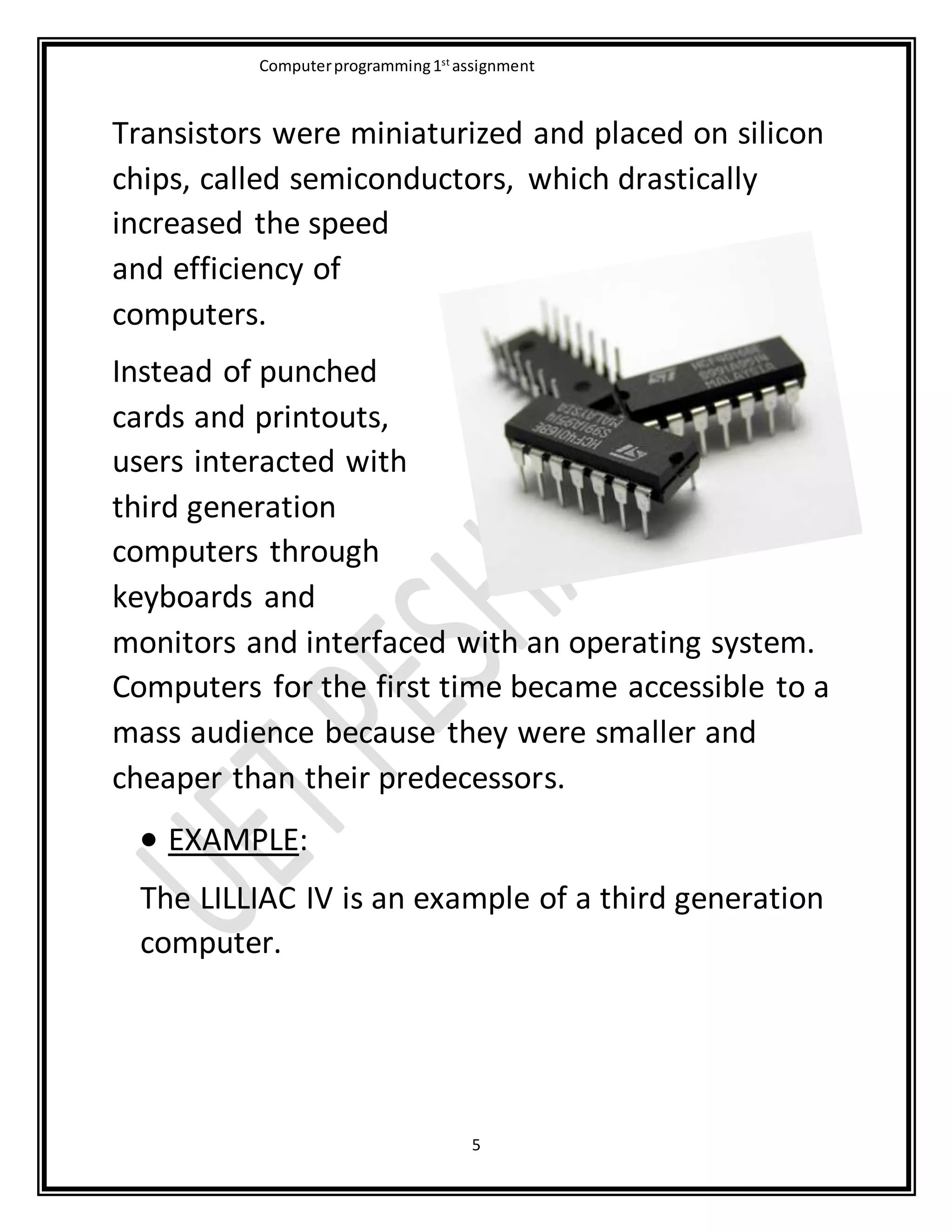
Transistors were miniaturized and placed on silicon
chips, called semiconductors, which drastically
increased the speed
and efficiency of
computers.
Instead of punched
cards and printouts,
users interacted with
third generation
computers through
keyboards and
monitors and interfaced with an operating system.
Computers for the first time became accessible to a
mass audience because they were smaller and
cheaper than their predecessors.
 EXAMPLE:
The LILLIAC IV is an example of a third generation
computer.
Computerprogramming1st
assignment
6
Fourth Generation (1971-Present)
Microprocessors:
The microprocessor brought the fourth
generation of computers, as thousands of
integrated circuits were built onto a single silicon
chip. What in the first generation filled an entire
room could now fit in the palm of the hand. The
Intel 4004 chip, developed in 1971, located all the
components of the computer—from the central
processing unit and memory to input/output
controls—on a single chip.
Microprocessors also moved out of the realm of
desktop computers and into many areas of life as
more and more everyday products began to use
microprocessors.
Computerprogramming1st
assignment
7
As these small computers became more powerful,
they could be linked together to form networks.
 EXAPLES:
This has resulted in new classes of machines
such as personal computers
Fifth Generation (Present and Beyond)
Artificial Intelligence:
Fifth generation computing devices, based on
artificial intelligence, are still in development,
though there are some applications, such as voice
recognition, that are being used today. The use of
parallel processing
and superconductors is
helping to make
artificial intelligence a
reality. Quantum
computation and
molecular and
Computerprogramming1st
assignment
8
nanotechnology will radically change the face of
computers in years to come. The goal of fifth-
generation computing is to develop devices that
respond to natural language input and are
capable of learning and self-organization.
TYPES OF COMPUTER
Computers can be broadly classified by their speed
and computing power.
The main four types are:
I. Supercomputer
II. Mainframe Computer
III. Minicomputer
IV. Microcomputer
Computerprogramming1st
assignment
9
Supercomputer:
The most powerful computers in terms of
performance and data processing are the
Supercomputers. These are specialized and task
specific computers used by large organizations.
These computers
are used for
research and
exploration
purposes, like
NASA uses
supercomputers
for launching
space shuttles,
controlling them and for
space exploration purpose.
 Uses of Supercomputers:
In Pakistan Supercomputers are used by
Educational Institutes like NUST for research
Computerprogramming1st
assignment
10
purposes. Pakistan Atomic Energy
commission.
 Popular Supercomputers:
IBM’s Sequoia, in United States
Fujitsu’s K Computer in Japan
IBM’s Mira in United States
Mainframe computer:
Although Mainframes are not as powerful as
supercomputers, but certainly they are quite
expensive nonetheless, and many large firms &
government organizations uses
Mainframes to run
their business
operations. The
Mainframe computers
can be accommodated
in large air-conditioned
rooms because of its
Computerprogramming1st
assignment
11
size. Super-computers are the fastest computers
with large data storage capacity, Mainframes can
also process & store large amount of data. Banks
educational institutions & insurance companies use
mainframe computers to store data about their
customers, students & insurance policy holders.
 Popular Mainframe computers:
Fujitsu’s ICL VME
Hitachi’s Z800
Minicomputer:
Minicomputers are used by small businesses &
firms. Minicomputers are also called as “Midrange
Computers”. These are small machines and can be
accommodated on a disk with not as processing and
data storage capabilities as super-computers &
Mainframes. These computers are not designed for
a single user. Individual departments of a large
company or organizations use
Minicomputers for specific purposes.
Computerprogramming1st
assignment
12
For example, a
production department
can use Mini-
computers for
monitoring certain
production process.
 Popular
Minicomputers:
K-202
Texas Instrument TI-990
SDS-92
IBM Midrange computers
Microcomputer:
Desktop computers, laptops, personal digital
assistant (PDA), tablets & smartphones are all types
of microcomputers. The micro-computers are
Computerprogramming1st
assignment
13
widely used & the fastest growing computers. These
computers are the cheapest among the other three
types of computers.
The Micro-computers
are specially designed
for general usage like
entertainment,
education and work
purposes. Well
known
manufacturers of
Micro-computer are
Dell, Apple, Samsung, and Sony & Toshiba.
 Popular Micro-computers:
Desktop computers, Gaming consoles, Sound &
Navigation system of a car, Netbooks, Notebooks,
PDA’s, Tablet PC’s, Smartphones, Calculators are all
type of Microcomputers.

computer history and generations

  • 1.
    Computerprogramming1st assignment 1 Name: Taimur Muhammad ClassNo: 12 Assignment No: 01 Subject: Computer programming Topic: History and Types of Computer Submitted to: Engineer Durr-e-Nayab Dated: 24-10-2016
  • 2.
    Computerprogramming1st assignment 2 HISTORY OF COMPUTER Thecomputer as we know it today had its beginning with a 19th century English mathematics professor name Charles Babbage. He designed the Analytical Engine and this was the Design that is the basic framework of the computer. Each generation lasted for a certain period of time, and each gave us either a new and improved computer or an improvement to the existing computer. First Generation (1940-1956) Vacuum Tubes: The first computers used vacuum tubes for circuitry and magnetic drums for memory, and were often enormous, taking up entire rooms.
  • 3.
    Computerprogramming1st assignment 3 They were veryexpensive to operate and in addition to using a great Deal of electricity, the first computers generated a lot of heat, which was often the cause of malfunctions  EXAMPLE The UNIVAC and ENIAC computers are examples of first-generation computing devices. Second Generation (1956-1963) Transistors: Transistors replace vacuum tubes and ushered in the second generation of computers. The transistor was invented in 1947 but did not see widespread use in computers until the late 1950s. The transistor was far superior to the vacuum tube, allowing computers to become smaller, faster, cheaper, more energy-efficient and more
  • 4.
    Computerprogramming1st assignment 4 reliable than theirfirst-generation computers. Second-generation computers still relied on punched cards for input and printouts for output. Second-generation computers moved from cryptic binary machine language to symbolic, or assembly.  EXAMPLES: In the early 1960s, the IBM 1401 and Honeywell 400 were examples Third Generation(1964 -1971) Integrated Circuits: The development of the integrated circuit was the hallmark of the third generation of computers.
  • 5.
    Computerprogramming1st assignment 5 Transistors were miniaturizedand placed on silicon chips, called semiconductors, which drastically increased the speed and efficiency of computers. Instead of punched cards and printouts, users interacted with third generation computers through keyboards and monitors and interfaced with an operating system. Computers for the first time became accessible to a mass audience because they were smaller and cheaper than their predecessors.  EXAMPLE: The LILLIAC IV is an example of a third generation computer.
  • 6.
    Computerprogramming1st assignment 6 Fourth Generation (1971-Present) Microprocessors: Themicroprocessor brought the fourth generation of computers, as thousands of integrated circuits were built onto a single silicon chip. What in the first generation filled an entire room could now fit in the palm of the hand. The Intel 4004 chip, developed in 1971, located all the components of the computer—from the central processing unit and memory to input/output controls—on a single chip. Microprocessors also moved out of the realm of desktop computers and into many areas of life as more and more everyday products began to use microprocessors.
  • 7.
    Computerprogramming1st assignment 7 As these smallcomputers became more powerful, they could be linked together to form networks.  EXAPLES: This has resulted in new classes of machines such as personal computers Fifth Generation (Present and Beyond) Artificial Intelligence: Fifth generation computing devices, based on artificial intelligence, are still in development, though there are some applications, such as voice recognition, that are being used today. The use of parallel processing and superconductors is helping to make artificial intelligence a reality. Quantum computation and molecular and
  • 8.
    Computerprogramming1st assignment 8 nanotechnology will radicallychange the face of computers in years to come. The goal of fifth- generation computing is to develop devices that respond to natural language input and are capable of learning and self-organization. TYPES OF COMPUTER Computers can be broadly classified by their speed and computing power. The main four types are: I. Supercomputer II. Mainframe Computer III. Minicomputer IV. Microcomputer
  • 9.
    Computerprogramming1st assignment 9 Supercomputer: The most powerfulcomputers in terms of performance and data processing are the Supercomputers. These are specialized and task specific computers used by large organizations. These computers are used for research and exploration purposes, like NASA uses supercomputers for launching space shuttles, controlling them and for space exploration purpose.  Uses of Supercomputers: In Pakistan Supercomputers are used by Educational Institutes like NUST for research
  • 10.
    Computerprogramming1st assignment 10 purposes. Pakistan AtomicEnergy commission.  Popular Supercomputers: IBM’s Sequoia, in United States Fujitsu’s K Computer in Japan IBM’s Mira in United States Mainframe computer: Although Mainframes are not as powerful as supercomputers, but certainly they are quite expensive nonetheless, and many large firms & government organizations uses Mainframes to run their business operations. The Mainframe computers can be accommodated in large air-conditioned rooms because of its
  • 11.
    Computerprogramming1st assignment 11 size. Super-computers arethe fastest computers with large data storage capacity, Mainframes can also process & store large amount of data. Banks educational institutions & insurance companies use mainframe computers to store data about their customers, students & insurance policy holders.  Popular Mainframe computers: Fujitsu’s ICL VME Hitachi’s Z800 Minicomputer: Minicomputers are used by small businesses & firms. Minicomputers are also called as “Midrange Computers”. These are small machines and can be accommodated on a disk with not as processing and data storage capabilities as super-computers & Mainframes. These computers are not designed for a single user. Individual departments of a large company or organizations use Minicomputers for specific purposes.
  • 12.
    Computerprogramming1st assignment 12 For example, a productiondepartment can use Mini- computers for monitoring certain production process.  Popular Minicomputers: K-202 Texas Instrument TI-990 SDS-92 IBM Midrange computers Microcomputer: Desktop computers, laptops, personal digital assistant (PDA), tablets & smartphones are all types of microcomputers. The micro-computers are
  • 13.
    Computerprogramming1st assignment 13 widely used &the fastest growing computers. These computers are the cheapest among the other three types of computers. The Micro-computers are specially designed for general usage like entertainment, education and work purposes. Well known manufacturers of Micro-computer are Dell, Apple, Samsung, and Sony & Toshiba.  Popular Micro-computers: Desktop computers, Gaming consoles, Sound & Navigation system of a car, Netbooks, Notebooks, PDA’s, Tablet PC’s, Smartphones, Calculators are all type of Microcomputers.