Medical TerminologyMedical Terminology
Copyright ©2011 All rights reserved.Florida State College of Jacksonville | Professor: Michael L. Whitchurch, MHS
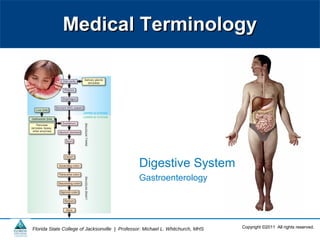
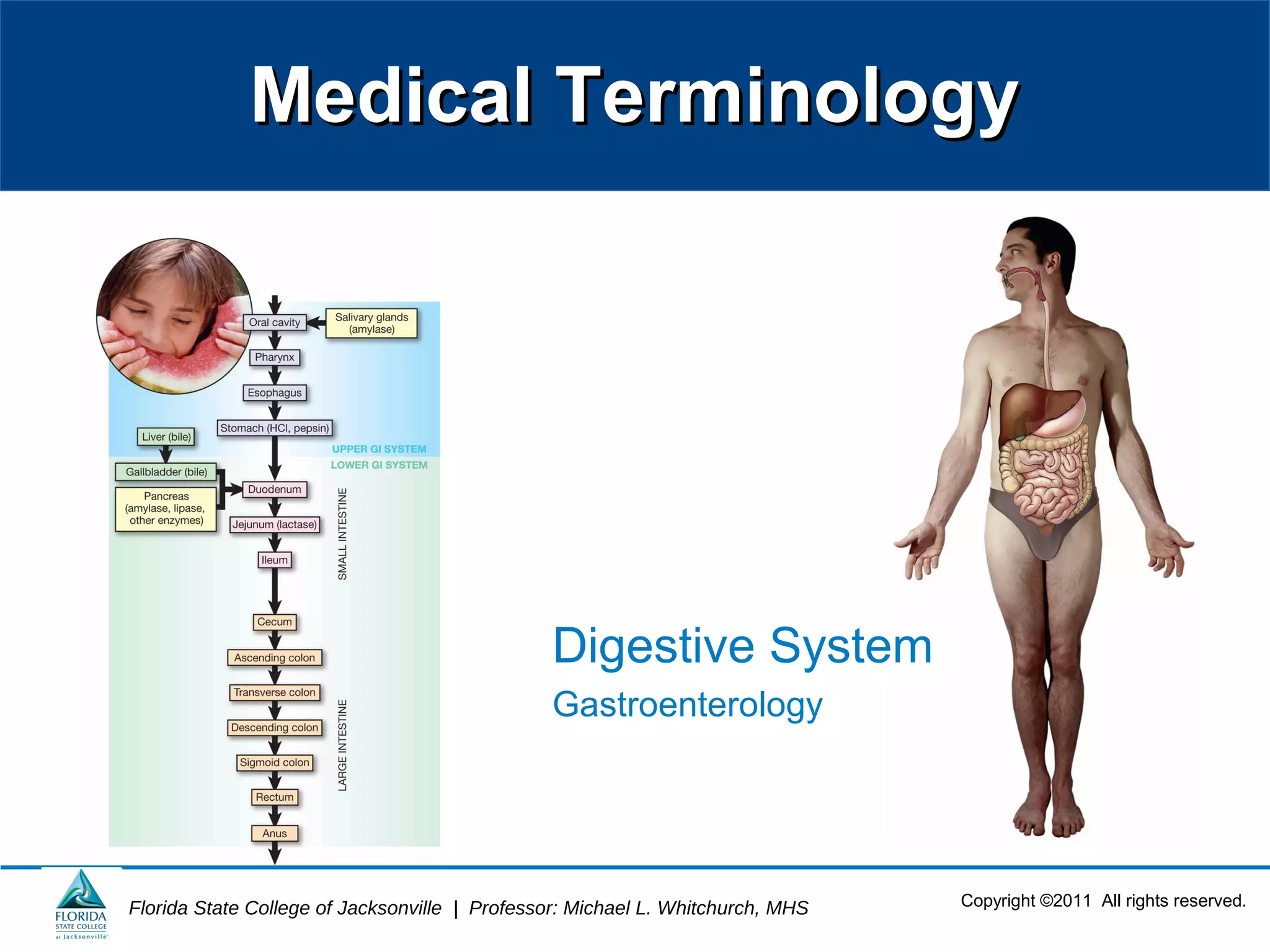
Digestive System
Gastroenterology
Copyright ©2011 All rights reserved.Florida State College of Jacksonville | Professor: Michael L. Whitchurch, MHS
Learning Objectives
1. Identify the structures of the gastrointestinal system.
2. Describe the process of digestion.
3. Describe common gastrointestinal diseases and conditions,
laboratory and diagnostic procedures, medical and surgical
procedures, and drug categories.
4. Give the medical meaning of word parts related to the
gastrointestinal system.
5. Build gastrointestinal words from word parts and divide and
define gastrointestinal words.
6. Spell and pronounce gastrointestinal words.
7. Analyze the medical content and meaning of a
gastroenterology report.
Copyright ©2011 All rights reserved.Florida State College of Jacksonville | Professor: Michael L. Whitchurch, MHS
Gastroenterology
• The medical specialty that studies the anatomy and
physiology of the gastrointestinal system and uses
• diagnostic tests
• medical and surgical procedures and
• drugs to treat gastrointestinal diseases
Copyright ©2011 All rights reserved.Florida State College of Jacksonville | Professor: Michael L. Whitchurch, MHS
Anatomy and Physiology
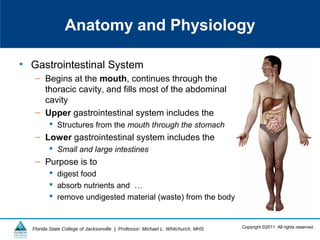
• Gastrointestinal System
– Begins at the mouth, continues through the
thoracic cavity, and fills most of the abdominal
cavity
– Upper gastrointestinal system includes the
 Structures from the mouth through the stomach
– Lower gastrointestinal system includes the
 Small and large intestines
– Purpose is to
 digest food
 absorb nutrients and …
 remove undigested material (waste) from the body
Copyright ©2011 All rights reserved.Florida State College of Jacksonville | Professor: Michael L. Whitchurch, MHS
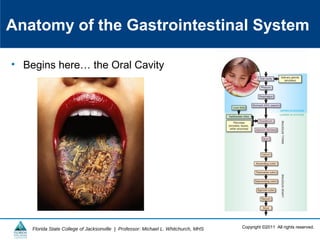
Anatomy of the Gastrointestinal System
• Begins here… the Oral Cavity
Copyright ©2011 All rights reserved.Florida State College of Jacksonville | Professor: Michael L. Whitchurch, MHS
Anatomy of the Gastrointestinal System
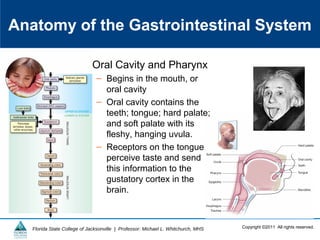
• Oral Cavity and Pharynx
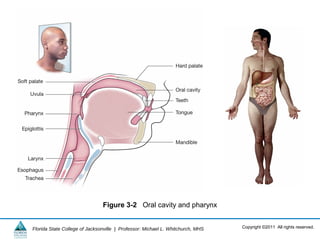
– Begins in the mouth, or
oral cavity
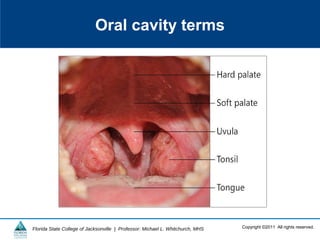
– Oral cavity contains the
teeth; tongue; hard palate;
and soft palate with its
fleshy, hanging uvula.
– Receptors on the tongue
perceive taste and send
this information to the
gustatory cortex in the
brain.
Copyright ©2011 All rights reserved.Florida State College of Jacksonville | Professor: Michael L. Whitchurch, MHS
Oral cavity terms
Copyright ©2011 All rights reserved.Florida State College of Jacksonville | Professor: Michael L. Whitchurch, MHS
Anatomy of the Gastrointestinal System
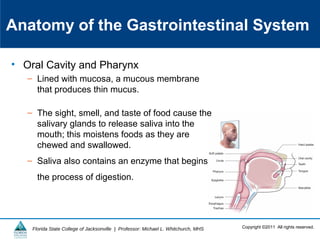
• Oral Cavity and Pharynx
– Lined with mucosa, a mucous membrane
that produces thin mucus.
– The sight, smell, and taste of food cause the
salivary glands to release saliva into the
mouth; this moistens foods as they are
chewed and swallowed.
– Saliva also contains an enzyme that begins
the process of digestion.
Copyright ©2011 All rights reserved.Florida State College of Jacksonville | Professor: Michael L. Whitchurch, MHS
Anatomy of the Gastrointestinal System
• Oral Cavity and Pharynx
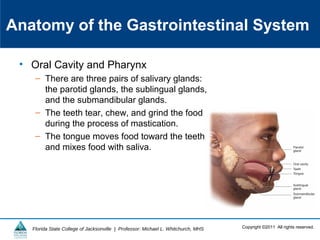
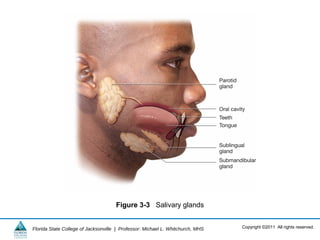
– There are three pairs of salivary glands:
the parotid glands, the sublingual glands,
and the submandibular glands.
– The teeth tear, chew, and grind the food
during the process of mastication.
– The tongue moves food toward the teeth
and mixes food with saliva.
Copyright ©2011 All rights reserved.Florida State College of Jacksonville | Professor: Michael L. Whitchurch, MHS
Figure 3-3 Salivary glands
Copyright ©2011 All rights reserved.Florida State College of Jacksonville | Professor: Michael L. Whitchurch, MHS
Anatomy of the Gastrointestinal System
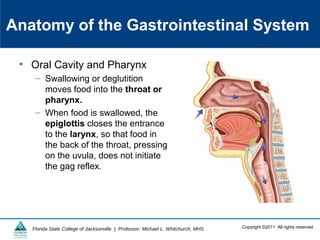
• Oral Cavity and Pharynx
– Swallowing or deglutition
moves food into the throat or
pharynx.
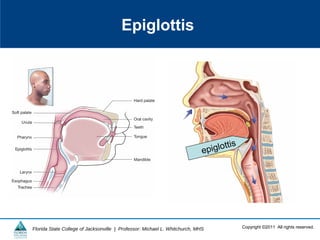
– When food is swallowed, the
epiglottis closes the entrance
to the larynx, so that food in
the back of the throat, pressing
on the uvula, does not initiate
the gag reflex.
Copyright ©2011 All rights reserved.Florida State College of Jacksonville | Professor: Michael L. Whitchurch, MHS
Epiglottis
epiglottis
Copyright ©2011 All rights reserved.Florida State College of Jacksonville | Professor: Michael L. Whitchurch, MHS
Figure 3-2 Oral cavity and pharynx
Copyright ©2011 All rights reserved.Florida State College of Jacksonville | Professor: Michael L. Whitchurch, MHS
Anatomy of the Gastrointestinal System
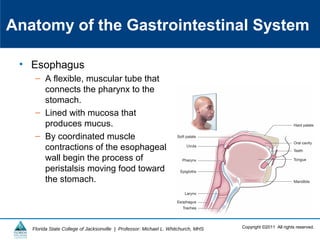
• Esophagus
– A flexible, muscular tube that
connects the pharynx to the
stomach.
– Lined with mucosa that
produces mucus.
– By coordinated muscle
contractions of the esophageal
wall begin the process of
peristalsis moving food toward
the stomach.
Copyright ©2011 All rights reserved.Florida State College of Jacksonville | Professor: Michael L. Whitchurch, MHS
Anatomy of the Gastrointestinal System
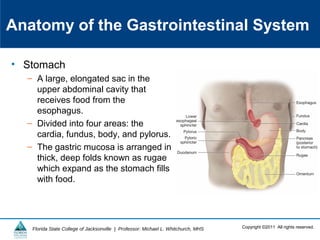
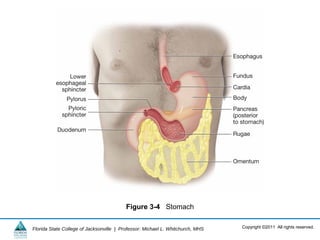
• Stomach
– A large, elongated sac in the
upper abdominal cavity that
receives food from the
esophagus.
– Divided into four areas: the
cardia, fundus, body, and pylorus.
– The gastric mucosa is arranged in
thick, deep folds known as rugae
which expand as the stomach fills
with food.
Copyright ©2011 All rights reserved.Florida State College of Jacksonville | Professor: Michael L. Whitchurch, MHS
Anatomy of the Gastrointestinal System
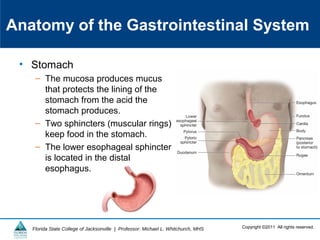
• Stomach
– The mucosa produces mucus
that protects the lining of the
stomach from the acid the
stomach produces.
– Two sphincters (muscular rings)
keep food in the stomach.
– The lower esophageal sphincter
is located in the distal
esophagus.
Copyright ©2011 All rights reserved.Florida State College of Jacksonville | Professor: Michael L. Whitchurch, MHS
Anatomy of the Gastrointestinal System
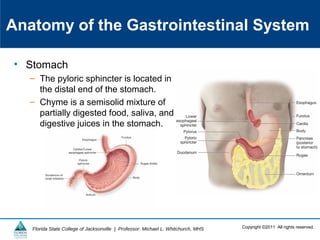
• Stomach
– The pyloric sphincter is located in
the distal end of the stomach.
– Chyme is a semisolid mixture of
partially digested food, saliva, and
digestive juices in the stomach.
Copyright ©2011 All rights reserved.Florida State College of Jacksonville | Professor: Michael L. Whitchurch, MHS
Figure 3-4 Stomach
Copyright ©2011 All rights reserved.Florida State College of Jacksonville | Professor: Michael L. Whitchurch, MHS
Anatomy of the Gastrointestinal System
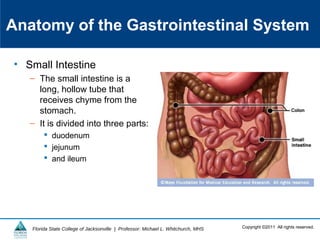
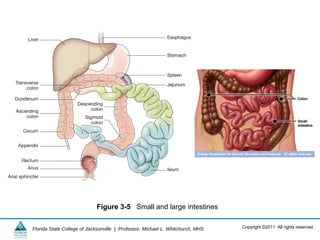
• Small Intestine
– The small intestine is a
long, hollow tube that
receives chyme from the
stomach.
– It is divided into three parts:
 duodenum
 jejunum
 and ileum
Copyright ©2011 All rights reserved.Florida State College of Jacksonville | Professor: Michael L. Whitchurch, MHS
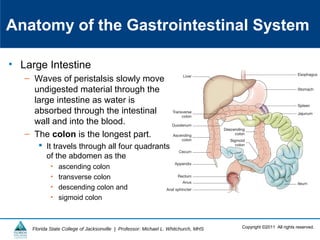
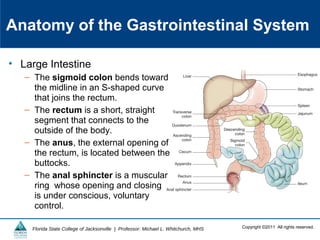
Figure 3-5 Small and large intestines
Copyright ©2011 All rights reserved.Florida State College of Jacksonville | Professor: Michael L. Whitchurch, MHS
Anatomy of the Gastrointestinal System
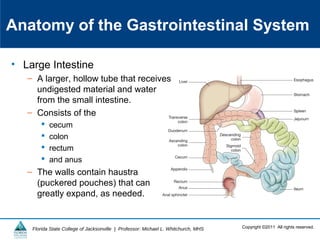
• Large Intestine
– A larger, hollow tube that receives
undigested material and water
from the small intestine.
– Consists of the
 cecum
 colon
 rectum
 and anus
– The walls contain haustra
(puckered pouches) that can
greatly expand, as needed.
Copyright ©2011 All rights reserved.Florida State College of Jacksonville | Professor: Michael L. Whitchurch, MHS
Anatomy of the Gastrointestinal System
• Large Intestine
– Waves of peristalsis slowly move
undigested material through the
large intestine as water is
absorbed through the intestinal
wall and into the blood.
– The colon is the longest part.
 It travels through all four quadrants
of the abdomen as the
• ascending colon
• transverse colon
• descending colon and
• sigmoid colon
Copyright ©2011 All rights reserved.Florida State College of Jacksonville | Professor: Michael L. Whitchurch, MHS
Anatomy of the Gastrointestinal System
• Large Intestine
– The sigmoid colon bends toward
the midline in an S-shaped curve
that joins the rectum.
– The rectum is a short, straight
segment that connects to the
outside of the body.
– The anus, the external opening of
the rectum, is located between the
buttocks.
– The anal sphincter is a muscular
ring whose opening and closing
is under conscious, voluntary
control.
Copyright ©2011 All rights reserved.Florida State College of Jacksonville | Professor: Michael L. Whitchurch, MHS
Anatomy of the Gastrointestinal System
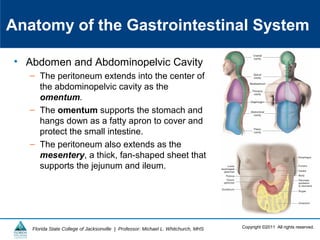
• Abdomen and Abdominopelvic Cavity
– The peritoneum extends into the center of
the abdominopelvic cavity as the
omentum.
– The omentum supports the stomach and
hangs down as a fatty apron to cover and
protect the small intestine.
– The peritoneum also extends as the
mesentery, a thick, fan-shaped sheet that
supports the jejunum and ileum.
Copyright ©2011 All rights reserved.Florida State College of Jacksonville | Professor: Michael L. Whitchurch, MHS
Anatomy of the Gastrointestinal System
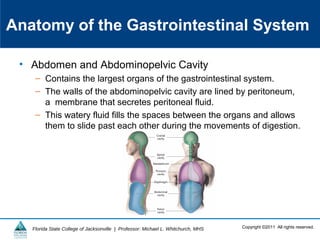
• Abdomen and Abdominopelvic Cavity
– Contains the largest organs of the gastrointestinal system.
– The walls of the abdominopelvic cavity are lined by peritoneum,
a membrane that secretes peritoneal fluid.
– This watery fluid fills the spaces between the organs and allows
them to slide past each other during the movements of digestion.
Copyright ©2011 All rights reserved.Florida State College of Jacksonville | Professor: Michael L. Whitchurch, MHS
Anatomy of the Gastrointestinal System
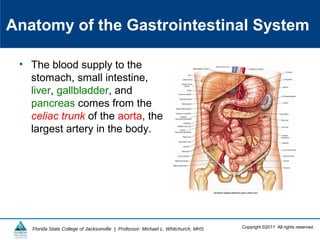
• The blood supply to the
stomach, small intestine,
liver, gallbladder, and
pancreas comes from the
celiac trunk of the aorta, the
largest artery in the body.
Copyright ©2011 All rights reserved.Florida State College of Jacksonville | Professor: Michael L. Whitchurch, MHS
Anatomy of the Gastrointestinal System
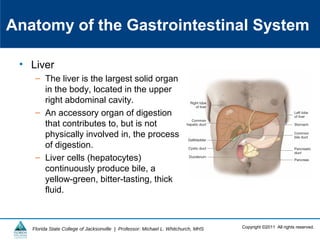
• Liver
– The liver is the largest solid organ
in the body, located in the upper
right abdominal cavity.
– An accessory organ of digestion
that contributes to, but is not
physically involved in, the process
of digestion.
– Liver cells (hepatocytes)
continuously produce bile, a
yellow-green, bitter-tasting, thick
fluid.
Copyright ©2011 All rights reserved.Florida State College of Jacksonville | Professor: Michael L. Whitchurch, MHS
Anatomy of the Gastrointestinal System
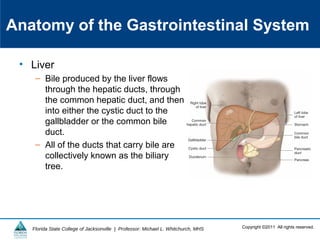
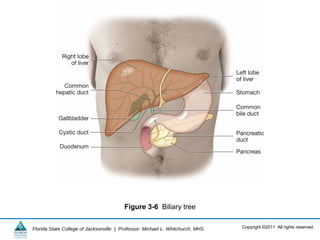
• Liver
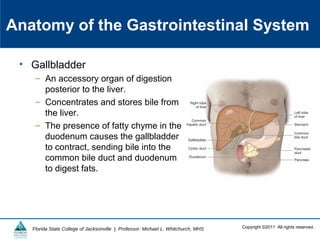
– Bile produced by the liver flows
through the hepatic ducts, through
the common hepatic duct, and then
into either the cystic duct to the
gallbladder or the common bile
duct.
– All of the ducts that carry bile are
collectively known as the biliary
tree.
Copyright ©2011 All rights reserved.Florida State College of Jacksonville | Professor: Michael L. Whitchurch, MHS
Figure 3-6 Biliary tree
Copyright ©2011 All rights reserved.Florida State College of Jacksonville | Professor: Michael L. Whitchurch, MHS
Anatomy of the Gastrointestinal System
• Gallbladder
– An accessory organ of digestion
posterior to the liver.
– Concentrates and stores bile from
the liver.
– The presence of fatty chyme in the
duodenum causes the gallbladder
to contract, sending bile into the
common bile duct and duodenum
to digest fats.
Copyright ©2011 All rights reserved.Florida State College of Jacksonville | Professor: Michael L. Whitchurch, MHS
Anatomy of the Gastrointestinal System
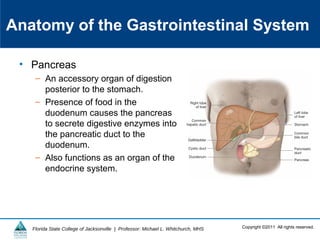
• Pancreas
– An accessory organ of digestion
posterior to the stomach.
– Presence of food in the
duodenum causes the pancreas
to secrete digestive enzymes into
the pancreatic duct to the
duodenum.
– Also functions as an organ of the
endocrine system.
Copyright ©2011 All rights reserved.Florida State College of Jacksonville | Professor: Michael L. Whitchurch, MHS
Physiology of Digestion
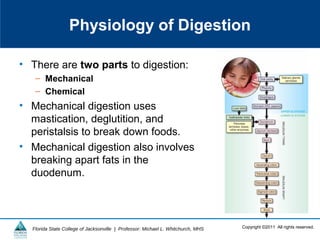
• There are two parts to digestion:
– Mechanical
– Chemical
• Mechanical digestion uses
mastication, deglutition, and
peristalsis to break down foods.
• Mechanical digestion also involves
breaking apart fats in the
duodenum.
Copyright ©2011 All rights reserved.Florida State College of Jacksonville | Professor: Michael L. Whitchurch, MHS
Physiology of Digestion
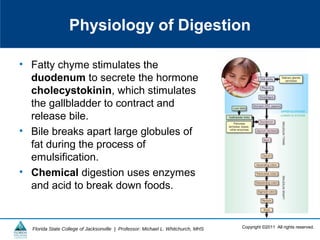
• Fatty chyme stimulates the
duodenum to secrete the hormone
cholecystokinin, which stimulates
the gallbladder to contract and
release bile.
• Bile breaks apart large globules of
fat during the process of
emulsification.
• Chemical digestion uses enzymes
and acid to break down foods.
Copyright ©2011 All rights reserved.Florida State College of Jacksonville | Professor: Michael L. Whitchurch, MHS
Physiology of Digestion
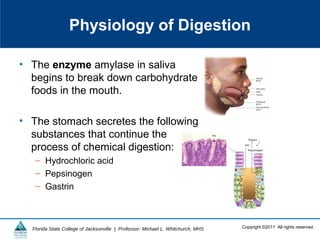
• The enzyme amylase in saliva
begins to break down carbohydrate
foods in the mouth.
• The stomach secretes the following
substances that continue the
process of chemical digestion:
– Hydrochloric acid
– Pepsinogen
– Gastrin
Copyright ©2011 All rights reserved.Florida State College of Jacksonville | Professor: Michael L. Whitchurch, MHS
Physiology of Digestion
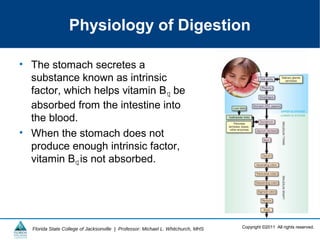
• The stomach secretes a
substance known as intrinsic
factor, which helps vitamin B12 be
absorbed from the intestine into
the blood.
• When the stomach does not
produce enough intrinsic factor,
vitamin B12 is not absorbed.
Copyright ©2011 All rights reserved.Florida State College of Jacksonville | Professor: Michael L. Whitchurch, MHS
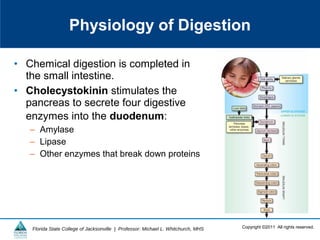
• Chemical digestion is completed in
the small intestine.
• Cholecystokinin stimulates the
pancreas to secrete four digestive
enzymes into the duodenum:
– Amylase
– Lipase
– Other enzymes that break down proteins
Physiology of Digestion
Copyright ©2011 All rights reserved.Florida State College of Jacksonville | Professor: Michael L. Whitchurch, MHS
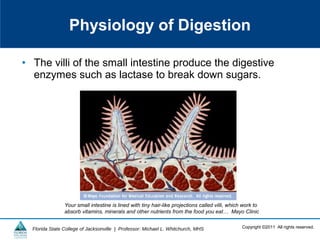
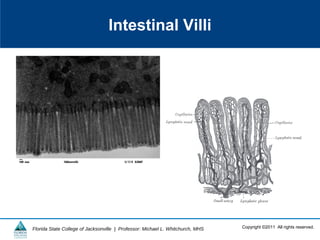
• The villi of the small intestine produce the digestive
enzymes such as lactase to break down sugars.
Physiology of Digestion
Your small intestine is lined with tiny hair-like projections called villi, which work to
absorb vitamins, minerals and other nutrients from the food you eat… Mayo Clinic
Copyright ©2011 All rights reserved.Florida State College of Jacksonville | Professor: Michael L. Whitchurch, MHS
Intestinal Villi
Copyright ©2011 All rights reserved.Florida State College of Jacksonville | Professor: Michael L. Whitchurch, MHS
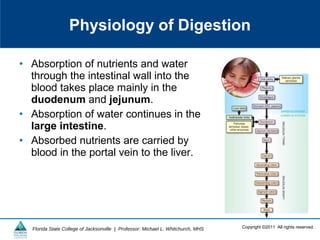
• Absorption of nutrients and water
through the intestinal wall into the
blood takes place mainly in the
duodenum and jejunum.
• Absorption of water continues in the
large intestine.
• Absorbed nutrients are carried by
blood in the portal vein to the liver.
Physiology of Digestion
Copyright ©2011 All rights reserved.Florida State College of Jacksonville | Professor: Michael L. Whitchurch, MHS
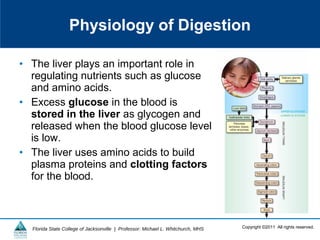
• The liver plays an important role in
regulating nutrients such as glucose
and amino acids.
• Excess glucose in the blood is
stored in the liver as glycogen and
released when the blood glucose level
is low.
• The liver uses amino acids to build
plasma proteins and clotting factors
for the blood.
Physiology of Digestion
Copyright ©2011 All rights reserved.Florida State College of Jacksonville | Professor: Michael L. Whitchurch, MHS
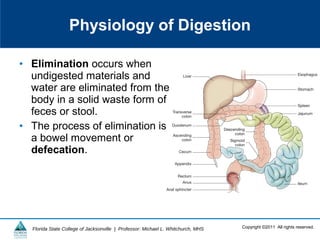
• Elimination occurs when
undigested materials and
water are eliminated from the
body in a solid waste form of
feces or stool.
• The process of elimination is
a bowel movement or
defecation.
Physiology of Digestion
Copyright ©2011 All rights reserved.Florida State College of Jacksonville | Professor: Michael L. Whitchurch, MHS
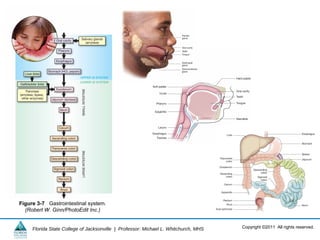
Figure 3-7 Gastrointestinal system.
(Robert W. Ginn/PhotoEdit Inc.)
Copyright ©2011 All rights reserved.Florida State College of Jacksonville | Professor: Michael L. Whitchurch, MHS
Diseases and Conditions
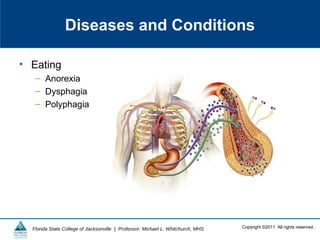
• Eating
– Anorexia
– Dysphagia
– Polyphagia
Copyright ©2011 All rights reserved.Florida State College of Jacksonville | Professor: Michael L. Whitchurch, MHS
Diseases and Conditions
• Mouth and Lips
– Cheilitis
– Sialolithiasis
– Stomatitis
– Glossitis
Figure 3-8 Glossitis
(Centers for Disease Control and Prevention [CDC]
Copyright ©2011 All rights reserved.Florida State College of Jacksonville | Professor: Michael L. Whitchurch, MHS
Figure 3-8 Glossitis
(Centers for Disease Control and Prevention [CDC])
Copyright ©2011 All rights reserved.Florida State College of Jacksonville | Professor: Michael L. Whitchurch, MHS
Diseases and Conditions
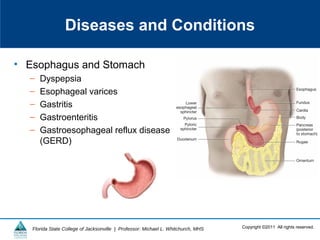
• Esophagus and Stomach
– Dyspepsia
– Esophageal varices
– Gastritis
– Gastroenteritis
– Gastroesophageal reflux disease
(GERD)
Copyright ©2011 All rights reserved.Florida State College of Jacksonville | Professor: Michael L. Whitchurch, MHS
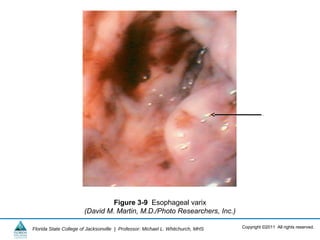
Figure 3-9 Esophageal varix
(David M. Martin, M.D./Photo Researchers, Inc.)
Copyright ©2011 All rights reserved.Florida State College of Jacksonville | Professor: Michael L. Whitchurch, MHS
Diseases and Conditions
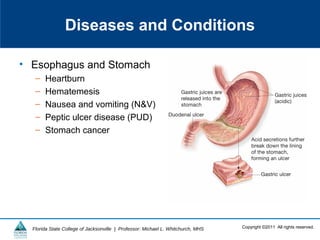
• Esophagus and Stomach
– Heartburn
– Hematemesis
– Nausea and vomiting (N&V)
– Peptic ulcer disease (PUD)
– Stomach cancer
Copyright ©2011 All rights reserved.Florida State College of Jacksonville | Professor: Michael L. Whitchurch, MHS
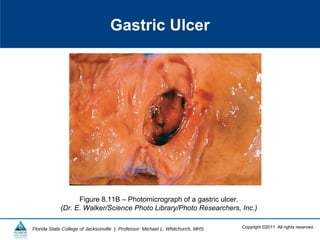
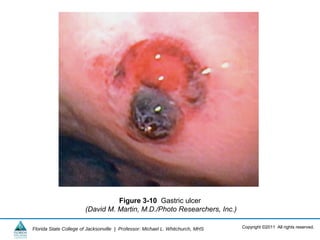
Gastric Ulcer
Figure 8.11B – Photomicrograph of a gastric ulcer.
(Dr. E. Walker/Science Photo Library/Photo Researchers, Inc.)
Copyright ©2011 All rights reserved.Florida State College of Jacksonville | Professor: Michael L. Whitchurch, MHS
Figure 3-10 Gastric ulcer
(David M. Martin, M.D./Photo Researchers, Inc.)
Copyright ©2011 All rights reserved.Florida State College of Jacksonville | Professor: Michael L. Whitchurch, MHS
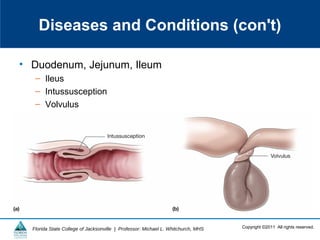
Diseases and Conditions (con't)
• Duodenum, Jejunum, Ileum
– Ileus
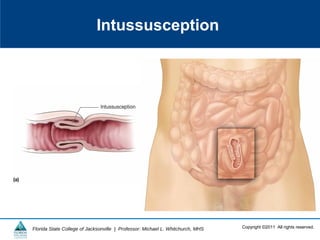
– Intussusception
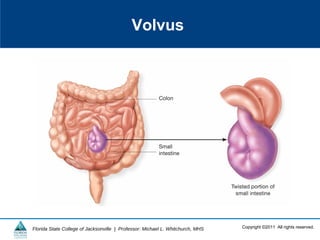
– Volvulus
Copyright ©2011 All rights reserved.Florida State College of Jacksonville | Professor: Michael L. Whitchurch, MHS
Volvus
Copyright ©2011 All rights reserved.Florida State College of Jacksonville | Professor: Michael L. Whitchurch, MHS
Intussusception
Copyright ©2011 All rights reserved.Florida State College of Jacksonville | Professor: Michael L. Whitchurch, MHS
Diseases and Conditions
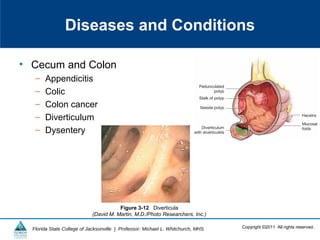
• Cecum and Colon
– Appendicitis
– Colic
– Colon cancer
– Diverticulum
– Dysentery
Figure 3-12 Diverticula
(David M. Martin, M.D./Photo Researchers, Inc.)
Copyright ©2011 All rights reserved.Florida State College of Jacksonville | Professor: Michael L. Whitchurch, MHS
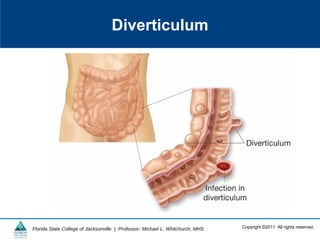
Diverticulum
Copyright ©2011 All rights reserved.Florida State College of Jacksonville | Professor: Michael L. Whitchurch, MHS
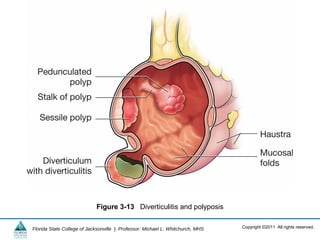
Figure 3-13 Diverticulitis and polyposis
Copyright ©2011 All rights reserved.Florida State College of Jacksonville | Professor: Michael L. Whitchurch, MHS
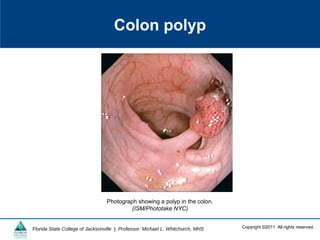
Colon polyp
Photograph showing a polyp in the colon.
(ISM/Phototake NYC)
Copyright ©2011 All rights reserved.Florida State College of Jacksonville | Professor: Michael L. Whitchurch, MHS
Diseases and Conditions
• Cecum and Colon
– Gluten enteropathy
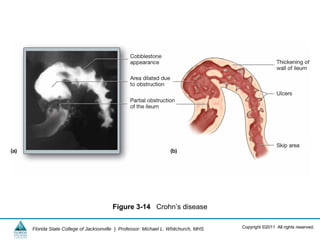
– Inflammatory bowel disease (IBD)
– Irritable bowel syndrome (IBS)
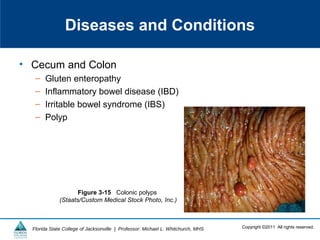
– Polyp
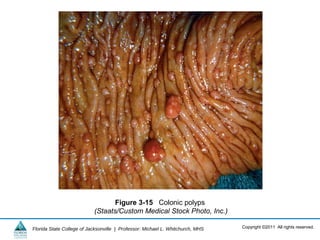
Figure 3-15 Colonic polyps
(Staats/Custom Medical Stock Photo, Inc.)
Copyright ©2011 All rights reserved.Florida State College of Jacksonville | Professor: Michael L. Whitchurch, MHS
Figure 3-14 Crohn’s disease
Copyright ©2011 All rights reserved.Florida State College of Jacksonville | Professor: Michael L. Whitchurch, MHS
Figure 3-15 Colonic polyps
(Staats/Custom Medical Stock Photo, Inc.)
Copyright ©2011 All rights reserved.Florida State College of Jacksonville | Professor: Michael L. Whitchurch, MHS
Diseases and Conditions
• Rectum and Anus
– Hemorrhoids
– Proctitis
– Rectocele
• Defecation and Feces
– Constipation
– Diarrhea
– Flatulence
– Hematochezia
– Incontinence
– Steatorrhea
Copyright ©2011 All rights reserved.Florida State College of Jacksonville | Professor: Michael L. Whitchurch, MHS
Diseases and Conditions
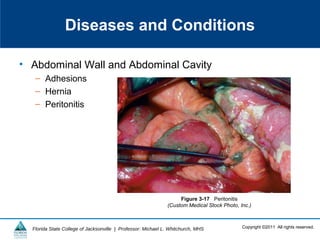
• Abdominal Wall and Abdominal Cavity
– Adhesions
– Hernia
– Peritonitis
Figure 3-17 Peritonitis
(Custom Medical Stock Photo, Inc.)
Copyright ©2011 All rights reserved.Florida State College of Jacksonville | Professor: Michael L. Whitchurch, MHS
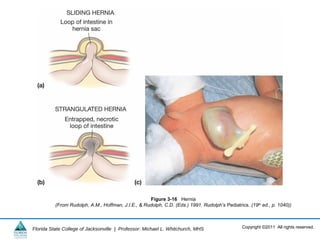
Figure 3-16 Hernia
(From Rudolph, A.M., Hoffman, J.I.E., & Rudolph, C.D. (Eds.) 1991. Rudolph’s Pediatrics. (19th ed., p. 1040))
Copyright ©2011 All rights reserved.Florida State College of Jacksonville | Professor: Michael L. Whitchurch, MHS
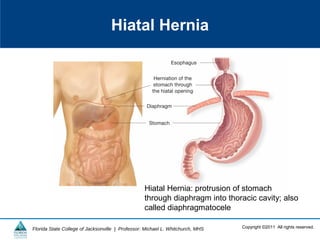
Hiatal Hernia
Hiatal Hernia: protrusion of stomach
through diaphragm into thoracic cavity; also
called diaphragmatocele
Copyright ©2011 All rights reserved.Florida State College of Jacksonville | Professor: Michael L. Whitchurch, MHS
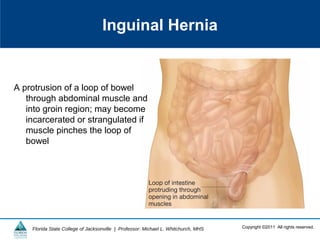
Inguinal Hernia
A protrusion of a loop of bowel
through abdominal muscle and
into groin region; may become
incarcerated or strangulated if
muscle pinches the loop of
bowel
Copyright ©2011 All rights reserved.Florida State College of Jacksonville | Professor: Michael L. Whitchurch, MHS
Diseases and Conditions
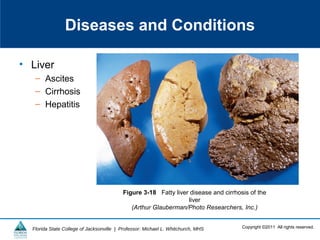
• Liver
– Ascites
– Cirrhosis
– Hepatitis
Figure 3-18 Fatty liver disease and cirrhosis of the
liver
(Arthur Glauberman/Photo Researchers, Inc.)
Copyright ©2011 All rights reserved.Florida State College of Jacksonville | Professor: Michael L. Whitchurch, MHS
Diseases and Conditions
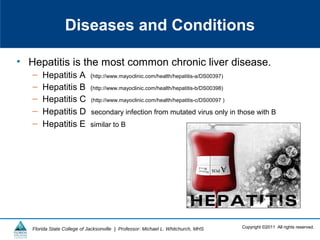
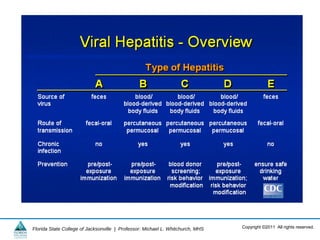
• Hepatitis is the most common chronic liver disease.
– Hepatitis A (http://www.mayoclinic.com/health/hepatitis-a/DS00397)
– Hepatitis B (http://www.mayoclinic.com/health/hepatitis-b/DS00398)
– Hepatitis C (http://www.mayoclinic.com/health/hepatitis-c/DS00097 )
– Hepatitis D secondary infection from mutated virus only in those with B
– Hepatitis E similar to B
Copyright ©2011 All rights reserved.Florida State College of Jacksonville | Professor: Michael L. Whitchurch, MHS
Diseases and Conditions
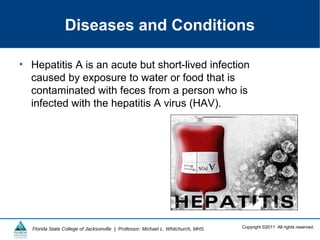
• Hepatitis A is an acute but short-lived infection
caused by exposure to water or food that is
contaminated with feces from a person who is
infected with the hepatitis A virus (HAV).
Copyright ©2011 All rights reserved.Florida State College of Jacksonville | Professor: Michael L. Whitchurch, MHS
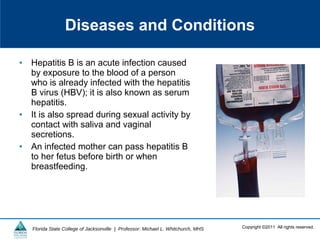
• Hepatitis B is an acute infection caused
by exposure to the blood of a person
who is already infected with the hepatitis
B virus (HBV); it is also known as serum
hepatitis.
• It is also spread during sexual activity by
contact with saliva and vaginal
secretions.
• An infected mother can pass hepatitis B
to her fetus before birth or when
breastfeeding.
Diseases and Conditions
Copyright ©2011 All rights reserved.Florida State College of Jacksonville | Professor: Michael L. Whitchurch, MHS
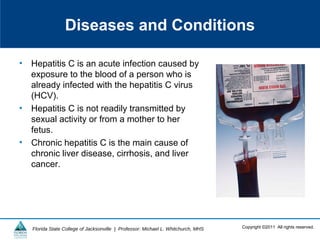
• Hepatitis C is an acute infection caused by
exposure to the blood of a person who is
already infected with the hepatitis C virus
(HCV).
• Hepatitis C is not readily transmitted by
sexual activity or from a mother to her
fetus.
• Chronic hepatitis C is the main cause of
chronic liver disease, cirrhosis, and liver
cancer.
Diseases and Conditions
Copyright ©2011 All rights reserved.Florida State College of Jacksonville | Professor: Michael L. Whitchurch, MHS
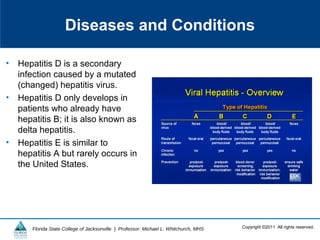
• Hepatitis D is a secondary
infection caused by a mutated
(changed) hepatitis virus.
• Hepatitis D only develops in
patients who already have
hepatitis B; it is also known as
delta hepatitis.
• Hepatitis E is similar to
hepatitis A but rarely occurs in
the United States.
Diseases and Conditions
Copyright ©2011 All rights reserved.Florida State College of Jacksonville | Professor: Michael L. Whitchurch, MHS
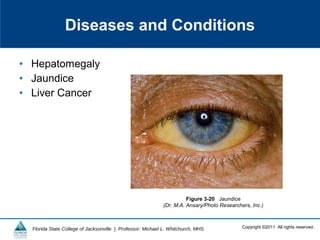
• Hepatomegaly
• Jaundice
• Liver Cancer
Diseases and Conditions
Figure 3-20 Jaundice
(Dr. M.A. Ansary/Photo Researchers, Inc.)
Copyright ©2011 All rights reserved.Florida State College of Jacksonville | Professor: Michael L. Whitchurch, MHS
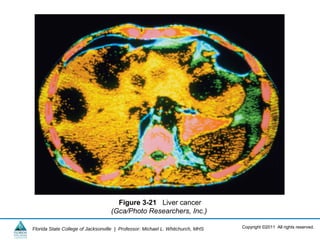
Figure 3-21 Liver cancer
(Gca/Photo Researchers, Inc.)
Copyright ©2011 All rights reserved.Florida State College of Jacksonville | Professor: Michael L. Whitchurch, MHS
Diseases and Conditions
• Gallbladder and Bile Ducts
– Cholangitis
– Cholecystitis
– Cholelithiasis
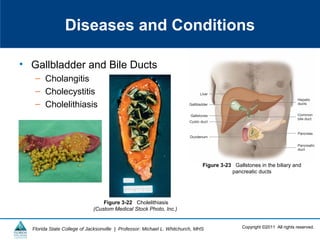
Figure 3-22 Cholelithiasis
(Custom Medical Stock Photo, Inc.)
Figure 3-23 Gallstones in the biliary and
pancreatic ducts
Copyright ©2011 All rights reserved.Florida State College of Jacksonville | Professor: Michael L. Whitchurch, MHS
Diseases and Conditions (con't)
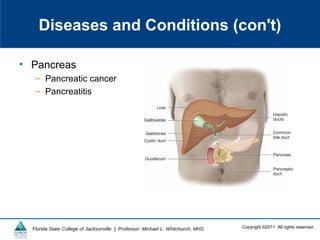
• Pancreas
– Pancreatic cancer
– Pancreatitis
Copyright ©2011 All rights reserved.Florida State College of Jacksonville | Professor: Michael L. Whitchurch, MHS
Laboratory and Diagnostic Procedures
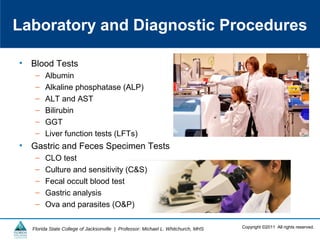
• Blood Tests
– Albumin
– Alkaline phosphatase (ALP)
– ALT and AST
– Bilirubin
– GGT
– Liver function tests (LFTs)
• Gastric and Feces Specimen Tests
– CLO test
– Culture and sensitivity (C&S)
– Fecal occult blood test
– Gastric analysis
– Ova and parasites (O&P)
Copyright ©2011 All rights reserved.Florida State College of Jacksonville | Professor: Michael L. Whitchurch, MHS
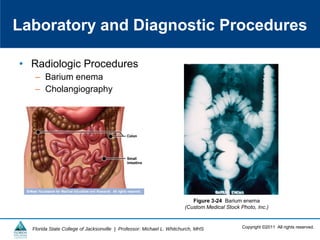
• Radiologic Procedures
– Barium enema
– Cholangiography
Laboratory and Diagnostic Procedures
Figure 3-24 Barium enema
(Custom Medical Stock Photo, Inc.)
Copyright ©2011 All rights reserved.Florida State College of Jacksonville | Professor: Michael L. Whitchurch, MHS
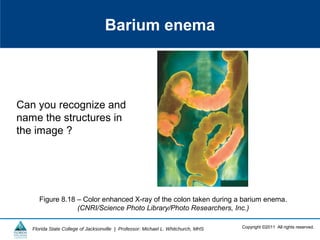
Barium enema
Figure 8.18 – Color enhanced X-ray of the colon taken during a barium enema.
(CNRI/Science Photo Library/Photo Researchers, Inc.)
Can you recognize and
name the structures in
the image ?
Copyright ©2011 All rights reserved.Florida State College of Jacksonville | Professor: Michael L. Whitchurch, MHS
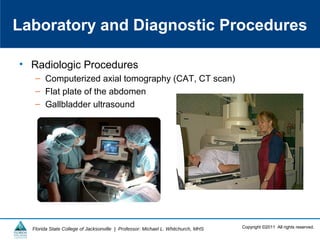
• Radiologic Procedures
– Computerized axial tomography (CAT, CT scan)
– Flat plate of the abdomen
– Gallbladder ultrasound
Laboratory and Diagnostic Procedures
Copyright ©2011 All rights reserved.Florida State College of Jacksonville | Professor: Michael L. Whitchurch, MHS
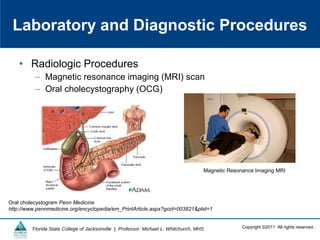
• Radiologic Procedures
– Magnetic resonance imaging (MRI) scan
– Oral cholecystography (OCG)
Laboratory and Diagnostic Procedures
Oral cholecystogram Penn Medicine
http://www.pennmedicine.org/encyclopedia/em_PrintArticle.aspx?gcid=003821&ptid=1
Magnetic Resonance Imaging MRI
Copyright ©2011 All rights reserved.Florida State College of Jacksonville | Professor: Michael L. Whitchurch, MHS
• Radiologic Procedures
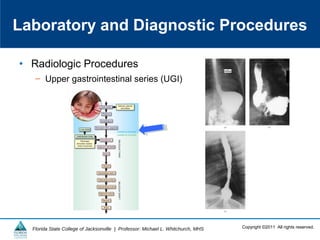
– Upper gastrointestinal series (UGI)
Laboratory and Diagnostic Procedures
Copyright ©2011 All rights reserved.Florida State College of Jacksonville | Professor: Michael L. Whitchurch, MHS
Medical and Surgical Procedures
• Medical Procedures
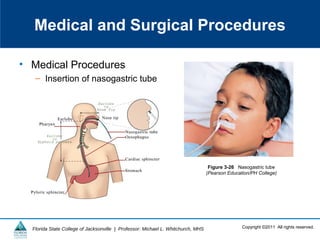
– Insertion of nasogastric tube
Figure 3-26 Nasogastric tube
(Pearson Education/PH College)
Copyright ©2011 All rights reserved.Florida State College of Jacksonville | Professor: Michael L. Whitchurch, MHS
Medical and Surgical Procedures
• Surgical Procedures
– Abdominocentesis
– Appendectomy
– Biopsy
– Bowel resection and anastomosis
– Cholecystectomy
– Choledocholithotomy
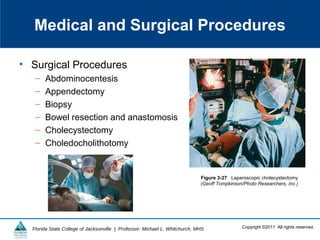
Figure 3-27 Laparoscopic cholecystectomy
(Geoff Tompkinson/Photo Researchers, Inc.)
Copyright ©2011 All rights reserved.Florida State College of Jacksonville | Professor: Michael L. Whitchurch, MHS
Medical and Surgical Procedures
• Surgical Procedures
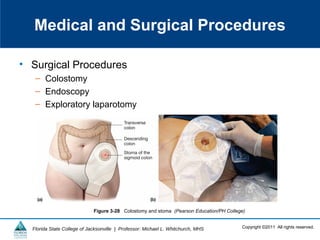
– Colostomy
– Endoscopy
– Exploratory laparotomy
Figure 3-28 Colostomy and stoma (Pearson Education/PH College)
Copyright ©2011 All rights reserved.Florida State College of Jacksonville | Professor: Michael L. Whitchurch, MHS
Medical and Surgical Procedures (con't)
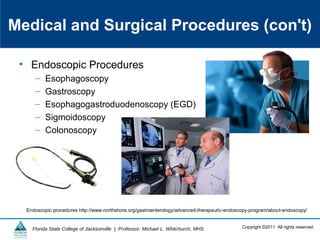
• Endoscopic Procedures
– Esophagoscopy
– Gastroscopy
– Esophagogastroduodenoscopy (EGD)
– Sigmoidoscopy
– Colonoscopy
Endoscopic procedures http://www.northshore.org/gastroenterology/advanced-therapeutic-endoscopy-program/about-endoscopy/
Copyright ©2011 All rights reserved.Florida State College of Jacksonville | Professor: Michael L. Whitchurch, MHS
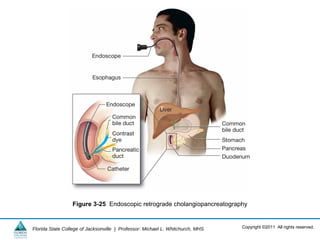
Figure 3-25 Endoscopic retrograde cholangiopancreatography
Copyright ©2011 All rights reserved.Florida State College of Jacksonville | Professor: Michael L. Whitchurch, MHS
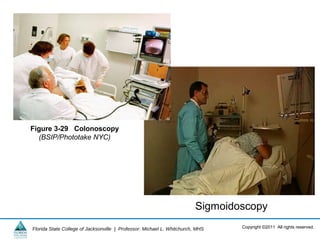
Figure 3-29 Colonoscopy
(BSIP/Phototake NYC)
Sigmoidoscopy
Copyright ©2011 All rights reserved.Florida State College of Jacksonville | Professor: Michael L. Whitchurch, MHS
Medical and Surgical Procedures
• Surgical Procedures
– Gastrectomy
– Gastroplasty
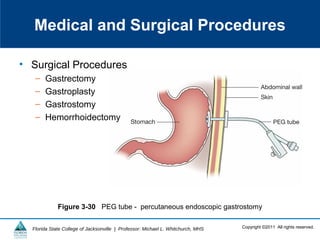
– Gastrostomy
– Hemorrhoidectomy
Figure 3-30 PEG tube - percutaneous endoscopic gastrostomy
Copyright ©2011 All rights reserved.Florida State College of Jacksonville | Professor: Michael L. Whitchurch, MHS
Medical and Surgical Procedures
• Surgical Procedures
– Herniorrhaphy
– Jejunostomy
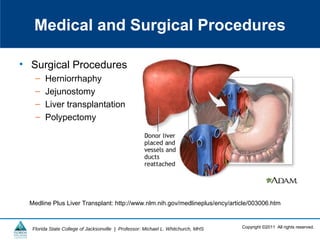
– Liver transplantation
– Polypectomy
Medline Plus Liver Transplant: http://www.nlm.nih.gov/medlineplus/ency/article/003006.htm
Copyright ©2011 All rights reserved.Florida State College of Jacksonville | Professor: Michael L. Whitchurch, MHS
Drug Categories
• These categories of drugs are used to treat
gastrointestinal diseases and conditions:
– Antacid drugs
– Antibiotic drugs
– Antidiarrheal drugs
– Antiemetic drugs
– H2 blocker drugs
– Laxative drugs
– Proton pump inhibitor drugs
Copyright ©2011 All rights reserved.Florida State College of Jacksonville | Professor: Michael L. Whitchurch, MHS
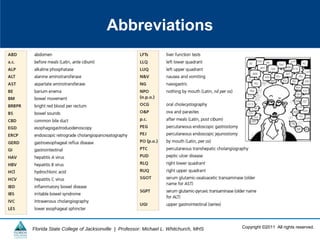
Abbreviations

Digestive System Terminology

  • 1.
    Medical TerminologyMedical Terminology Copyright©2011 All rights reserved.Florida State College of Jacksonville | Professor: Michael L. Whitchurch, MHS Digestive System Gastroenterology
  • 2.
    Copyright ©2011 Allrights reserved.Florida State College of Jacksonville | Professor: Michael L. Whitchurch, MHS Learning Objectives 1. Identify the structures of the gastrointestinal system. 2. Describe the process of digestion. 3. Describe common gastrointestinal diseases and conditions, laboratory and diagnostic procedures, medical and surgical procedures, and drug categories. 4. Give the medical meaning of word parts related to the gastrointestinal system. 5. Build gastrointestinal words from word parts and divide and define gastrointestinal words. 6. Spell and pronounce gastrointestinal words. 7. Analyze the medical content and meaning of a gastroenterology report.
  • 3.
    Copyright ©2011 Allrights reserved.Florida State College of Jacksonville | Professor: Michael L. Whitchurch, MHS Gastroenterology • The medical specialty that studies the anatomy and physiology of the gastrointestinal system and uses • diagnostic tests • medical and surgical procedures and • drugs to treat gastrointestinal diseases
  • 4.
    Copyright ©2011 Allrights reserved.Florida State College of Jacksonville | Professor: Michael L. Whitchurch, MHS Anatomy and Physiology • Gastrointestinal System – Begins at the mouth, continues through the thoracic cavity, and fills most of the abdominal cavity – Upper gastrointestinal system includes the  Structures from the mouth through the stomach – Lower gastrointestinal system includes the  Small and large intestines – Purpose is to  digest food  absorb nutrients and …  remove undigested material (waste) from the body
  • 5.
    Copyright ©2011 Allrights reserved.Florida State College of Jacksonville | Professor: Michael L. Whitchurch, MHS Anatomy of the Gastrointestinal System • Begins here… the Oral Cavity
  • 6.
    Copyright ©2011 Allrights reserved.Florida State College of Jacksonville | Professor: Michael L. Whitchurch, MHS Anatomy of the Gastrointestinal System • Oral Cavity and Pharynx – Begins in the mouth, or oral cavity – Oral cavity contains the teeth; tongue; hard palate; and soft palate with its fleshy, hanging uvula. – Receptors on the tongue perceive taste and send this information to the gustatory cortex in the brain.
  • 7.
    Copyright ©2011 Allrights reserved.Florida State College of Jacksonville | Professor: Michael L. Whitchurch, MHS Oral cavity terms
  • 8.
    Copyright ©2011 Allrights reserved.Florida State College of Jacksonville | Professor: Michael L. Whitchurch, MHS Anatomy of the Gastrointestinal System • Oral Cavity and Pharynx – Lined with mucosa, a mucous membrane that produces thin mucus. – The sight, smell, and taste of food cause the salivary glands to release saliva into the mouth; this moistens foods as they are chewed and swallowed. – Saliva also contains an enzyme that begins the process of digestion.
  • 9.
    Copyright ©2011 Allrights reserved.Florida State College of Jacksonville | Professor: Michael L. Whitchurch, MHS Anatomy of the Gastrointestinal System • Oral Cavity and Pharynx – There are three pairs of salivary glands: the parotid glands, the sublingual glands, and the submandibular glands. – The teeth tear, chew, and grind the food during the process of mastication. – The tongue moves food toward the teeth and mixes food with saliva.
  • 10.
    Copyright ©2011 Allrights reserved.Florida State College of Jacksonville | Professor: Michael L. Whitchurch, MHS Figure 3-3 Salivary glands
  • 11.
    Copyright ©2011 Allrights reserved.Florida State College of Jacksonville | Professor: Michael L. Whitchurch, MHS Anatomy of the Gastrointestinal System • Oral Cavity and Pharynx – Swallowing or deglutition moves food into the throat or pharynx. – When food is swallowed, the epiglottis closes the entrance to the larynx, so that food in the back of the throat, pressing on the uvula, does not initiate the gag reflex.
  • 12.
    Copyright ©2011 Allrights reserved.Florida State College of Jacksonville | Professor: Michael L. Whitchurch, MHS Epiglottis epiglottis
  • 13.
    Copyright ©2011 Allrights reserved.Florida State College of Jacksonville | Professor: Michael L. Whitchurch, MHS Figure 3-2 Oral cavity and pharynx
  • 14.
    Copyright ©2011 Allrights reserved.Florida State College of Jacksonville | Professor: Michael L. Whitchurch, MHS Anatomy of the Gastrointestinal System • Esophagus – A flexible, muscular tube that connects the pharynx to the stomach. – Lined with mucosa that produces mucus. – By coordinated muscle contractions of the esophageal wall begin the process of peristalsis moving food toward the stomach.
  • 15.
    Copyright ©2011 Allrights reserved.Florida State College of Jacksonville | Professor: Michael L. Whitchurch, MHS Anatomy of the Gastrointestinal System • Stomach – A large, elongated sac in the upper abdominal cavity that receives food from the esophagus. – Divided into four areas: the cardia, fundus, body, and pylorus. – The gastric mucosa is arranged in thick, deep folds known as rugae which expand as the stomach fills with food.
  • 16.
    Copyright ©2011 Allrights reserved.Florida State College of Jacksonville | Professor: Michael L. Whitchurch, MHS Anatomy of the Gastrointestinal System • Stomach – The mucosa produces mucus that protects the lining of the stomach from the acid the stomach produces. – Two sphincters (muscular rings) keep food in the stomach. – The lower esophageal sphincter is located in the distal esophagus.
  • 17.
    Copyright ©2011 Allrights reserved.Florida State College of Jacksonville | Professor: Michael L. Whitchurch, MHS Anatomy of the Gastrointestinal System • Stomach – The pyloric sphincter is located in the distal end of the stomach. – Chyme is a semisolid mixture of partially digested food, saliva, and digestive juices in the stomach.
  • 18.
    Copyright ©2011 Allrights reserved.Florida State College of Jacksonville | Professor: Michael L. Whitchurch, MHS Figure 3-4 Stomach
  • 19.
    Copyright ©2011 Allrights reserved.Florida State College of Jacksonville | Professor: Michael L. Whitchurch, MHS Anatomy of the Gastrointestinal System • Small Intestine – The small intestine is a long, hollow tube that receives chyme from the stomach. – It is divided into three parts:  duodenum  jejunum  and ileum
  • 20.
    Copyright ©2011 Allrights reserved.Florida State College of Jacksonville | Professor: Michael L. Whitchurch, MHS Figure 3-5 Small and large intestines
  • 21.
    Copyright ©2011 Allrights reserved.Florida State College of Jacksonville | Professor: Michael L. Whitchurch, MHS Anatomy of the Gastrointestinal System • Large Intestine – A larger, hollow tube that receives undigested material and water from the small intestine. – Consists of the  cecum  colon  rectum  and anus – The walls contain haustra (puckered pouches) that can greatly expand, as needed.
  • 22.
    Copyright ©2011 Allrights reserved.Florida State College of Jacksonville | Professor: Michael L. Whitchurch, MHS Anatomy of the Gastrointestinal System • Large Intestine – Waves of peristalsis slowly move undigested material through the large intestine as water is absorbed through the intestinal wall and into the blood. – The colon is the longest part.  It travels through all four quadrants of the abdomen as the • ascending colon • transverse colon • descending colon and • sigmoid colon
  • 23.
    Copyright ©2011 Allrights reserved.Florida State College of Jacksonville | Professor: Michael L. Whitchurch, MHS Anatomy of the Gastrointestinal System • Large Intestine – The sigmoid colon bends toward the midline in an S-shaped curve that joins the rectum. – The rectum is a short, straight segment that connects to the outside of the body. – The anus, the external opening of the rectum, is located between the buttocks. – The anal sphincter is a muscular ring whose opening and closing is under conscious, voluntary control.
  • 24.
    Copyright ©2011 Allrights reserved.Florida State College of Jacksonville | Professor: Michael L. Whitchurch, MHS Anatomy of the Gastrointestinal System • Abdomen and Abdominopelvic Cavity – The peritoneum extends into the center of the abdominopelvic cavity as the omentum. – The omentum supports the stomach and hangs down as a fatty apron to cover and protect the small intestine. – The peritoneum also extends as the mesentery, a thick, fan-shaped sheet that supports the jejunum and ileum.
  • 25.
    Copyright ©2011 Allrights reserved.Florida State College of Jacksonville | Professor: Michael L. Whitchurch, MHS Anatomy of the Gastrointestinal System • Abdomen and Abdominopelvic Cavity – Contains the largest organs of the gastrointestinal system. – The walls of the abdominopelvic cavity are lined by peritoneum, a membrane that secretes peritoneal fluid. – This watery fluid fills the spaces between the organs and allows them to slide past each other during the movements of digestion.
  • 26.
    Copyright ©2011 Allrights reserved.Florida State College of Jacksonville | Professor: Michael L. Whitchurch, MHS Anatomy of the Gastrointestinal System • The blood supply to the stomach, small intestine, liver, gallbladder, and pancreas comes from the celiac trunk of the aorta, the largest artery in the body.
  • 27.
    Copyright ©2011 Allrights reserved.Florida State College of Jacksonville | Professor: Michael L. Whitchurch, MHS Anatomy of the Gastrointestinal System • Liver – The liver is the largest solid organ in the body, located in the upper right abdominal cavity. – An accessory organ of digestion that contributes to, but is not physically involved in, the process of digestion. – Liver cells (hepatocytes) continuously produce bile, a yellow-green, bitter-tasting, thick fluid.
  • 28.
    Copyright ©2011 Allrights reserved.Florida State College of Jacksonville | Professor: Michael L. Whitchurch, MHS Anatomy of the Gastrointestinal System • Liver – Bile produced by the liver flows through the hepatic ducts, through the common hepatic duct, and then into either the cystic duct to the gallbladder or the common bile duct. – All of the ducts that carry bile are collectively known as the biliary tree.
  • 29.
    Copyright ©2011 Allrights reserved.Florida State College of Jacksonville | Professor: Michael L. Whitchurch, MHS Figure 3-6 Biliary tree
  • 30.
    Copyright ©2011 Allrights reserved.Florida State College of Jacksonville | Professor: Michael L. Whitchurch, MHS Anatomy of the Gastrointestinal System • Gallbladder – An accessory organ of digestion posterior to the liver. – Concentrates and stores bile from the liver. – The presence of fatty chyme in the duodenum causes the gallbladder to contract, sending bile into the common bile duct and duodenum to digest fats.
  • 31.
    Copyright ©2011 Allrights reserved.Florida State College of Jacksonville | Professor: Michael L. Whitchurch, MHS Anatomy of the Gastrointestinal System • Pancreas – An accessory organ of digestion posterior to the stomach. – Presence of food in the duodenum causes the pancreas to secrete digestive enzymes into the pancreatic duct to the duodenum. – Also functions as an organ of the endocrine system.
  • 32.
    Copyright ©2011 Allrights reserved.Florida State College of Jacksonville | Professor: Michael L. Whitchurch, MHS Physiology of Digestion • There are two parts to digestion: – Mechanical – Chemical • Mechanical digestion uses mastication, deglutition, and peristalsis to break down foods. • Mechanical digestion also involves breaking apart fats in the duodenum.
  • 33.
    Copyright ©2011 Allrights reserved.Florida State College of Jacksonville | Professor: Michael L. Whitchurch, MHS Physiology of Digestion • Fatty chyme stimulates the duodenum to secrete the hormone cholecystokinin, which stimulates the gallbladder to contract and release bile. • Bile breaks apart large globules of fat during the process of emulsification. • Chemical digestion uses enzymes and acid to break down foods.
  • 34.
    Copyright ©2011 Allrights reserved.Florida State College of Jacksonville | Professor: Michael L. Whitchurch, MHS Physiology of Digestion • The enzyme amylase in saliva begins to break down carbohydrate foods in the mouth. • The stomach secretes the following substances that continue the process of chemical digestion: – Hydrochloric acid – Pepsinogen – Gastrin
  • 35.
    Copyright ©2011 Allrights reserved.Florida State College of Jacksonville | Professor: Michael L. Whitchurch, MHS Physiology of Digestion • The stomach secretes a substance known as intrinsic factor, which helps vitamin B12 be absorbed from the intestine into the blood. • When the stomach does not produce enough intrinsic factor, vitamin B12 is not absorbed.
  • 36.
    Copyright ©2011 Allrights reserved.Florida State College of Jacksonville | Professor: Michael L. Whitchurch, MHS • Chemical digestion is completed in the small intestine. • Cholecystokinin stimulates the pancreas to secrete four digestive enzymes into the duodenum: – Amylase – Lipase – Other enzymes that break down proteins Physiology of Digestion
  • 37.
    Copyright ©2011 Allrights reserved.Florida State College of Jacksonville | Professor: Michael L. Whitchurch, MHS • The villi of the small intestine produce the digestive enzymes such as lactase to break down sugars. Physiology of Digestion Your small intestine is lined with tiny hair-like projections called villi, which work to absorb vitamins, minerals and other nutrients from the food you eat… Mayo Clinic
  • 38.
    Copyright ©2011 Allrights reserved.Florida State College of Jacksonville | Professor: Michael L. Whitchurch, MHS Intestinal Villi
  • 39.
    Copyright ©2011 Allrights reserved.Florida State College of Jacksonville | Professor: Michael L. Whitchurch, MHS • Absorption of nutrients and water through the intestinal wall into the blood takes place mainly in the duodenum and jejunum. • Absorption of water continues in the large intestine. • Absorbed nutrients are carried by blood in the portal vein to the liver. Physiology of Digestion
  • 40.
    Copyright ©2011 Allrights reserved.Florida State College of Jacksonville | Professor: Michael L. Whitchurch, MHS • The liver plays an important role in regulating nutrients such as glucose and amino acids. • Excess glucose in the blood is stored in the liver as glycogen and released when the blood glucose level is low. • The liver uses amino acids to build plasma proteins and clotting factors for the blood. Physiology of Digestion
  • 41.
    Copyright ©2011 Allrights reserved.Florida State College of Jacksonville | Professor: Michael L. Whitchurch, MHS • Elimination occurs when undigested materials and water are eliminated from the body in a solid waste form of feces or stool. • The process of elimination is a bowel movement or defecation. Physiology of Digestion
  • 42.
    Copyright ©2011 Allrights reserved.Florida State College of Jacksonville | Professor: Michael L. Whitchurch, MHS Figure 3-7 Gastrointestinal system. (Robert W. Ginn/PhotoEdit Inc.)
  • 43.
    Copyright ©2011 Allrights reserved.Florida State College of Jacksonville | Professor: Michael L. Whitchurch, MHS Diseases and Conditions • Eating – Anorexia – Dysphagia – Polyphagia
  • 44.
    Copyright ©2011 Allrights reserved.Florida State College of Jacksonville | Professor: Michael L. Whitchurch, MHS Diseases and Conditions • Mouth and Lips – Cheilitis – Sialolithiasis – Stomatitis – Glossitis Figure 3-8 Glossitis (Centers for Disease Control and Prevention [CDC]
  • 45.
    Copyright ©2011 Allrights reserved.Florida State College of Jacksonville | Professor: Michael L. Whitchurch, MHS Figure 3-8 Glossitis (Centers for Disease Control and Prevention [CDC])
  • 46.
    Copyright ©2011 Allrights reserved.Florida State College of Jacksonville | Professor: Michael L. Whitchurch, MHS Diseases and Conditions • Esophagus and Stomach – Dyspepsia – Esophageal varices – Gastritis – Gastroenteritis – Gastroesophageal reflux disease (GERD)
  • 47.
    Copyright ©2011 Allrights reserved.Florida State College of Jacksonville | Professor: Michael L. Whitchurch, MHS Figure 3-9 Esophageal varix (David M. Martin, M.D./Photo Researchers, Inc.)
  • 48.
    Copyright ©2011 Allrights reserved.Florida State College of Jacksonville | Professor: Michael L. Whitchurch, MHS Diseases and Conditions • Esophagus and Stomach – Heartburn – Hematemesis – Nausea and vomiting (N&V) – Peptic ulcer disease (PUD) – Stomach cancer
  • 49.
    Copyright ©2011 Allrights reserved.Florida State College of Jacksonville | Professor: Michael L. Whitchurch, MHS Gastric Ulcer Figure 8.11B – Photomicrograph of a gastric ulcer. (Dr. E. Walker/Science Photo Library/Photo Researchers, Inc.)
  • 50.
    Copyright ©2011 Allrights reserved.Florida State College of Jacksonville | Professor: Michael L. Whitchurch, MHS Figure 3-10 Gastric ulcer (David M. Martin, M.D./Photo Researchers, Inc.)
  • 51.
    Copyright ©2011 Allrights reserved.Florida State College of Jacksonville | Professor: Michael L. Whitchurch, MHS Diseases and Conditions (con't) • Duodenum, Jejunum, Ileum – Ileus – Intussusception – Volvulus
  • 52.
    Copyright ©2011 Allrights reserved.Florida State College of Jacksonville | Professor: Michael L. Whitchurch, MHS Volvus
  • 53.
    Copyright ©2011 Allrights reserved.Florida State College of Jacksonville | Professor: Michael L. Whitchurch, MHS Intussusception
  • 54.
    Copyright ©2011 Allrights reserved.Florida State College of Jacksonville | Professor: Michael L. Whitchurch, MHS Diseases and Conditions • Cecum and Colon – Appendicitis – Colic – Colon cancer – Diverticulum – Dysentery Figure 3-12 Diverticula (David M. Martin, M.D./Photo Researchers, Inc.)
  • 55.
    Copyright ©2011 Allrights reserved.Florida State College of Jacksonville | Professor: Michael L. Whitchurch, MHS Diverticulum
  • 56.
    Copyright ©2011 Allrights reserved.Florida State College of Jacksonville | Professor: Michael L. Whitchurch, MHS Figure 3-13 Diverticulitis and polyposis
  • 57.
    Copyright ©2011 Allrights reserved.Florida State College of Jacksonville | Professor: Michael L. Whitchurch, MHS Colon polyp Photograph showing a polyp in the colon. (ISM/Phototake NYC)
  • 58.
    Copyright ©2011 Allrights reserved.Florida State College of Jacksonville | Professor: Michael L. Whitchurch, MHS Diseases and Conditions • Cecum and Colon – Gluten enteropathy – Inflammatory bowel disease (IBD) – Irritable bowel syndrome (IBS) – Polyp Figure 3-15 Colonic polyps (Staats/Custom Medical Stock Photo, Inc.)
  • 59.
    Copyright ©2011 Allrights reserved.Florida State College of Jacksonville | Professor: Michael L. Whitchurch, MHS Figure 3-14 Crohn’s disease
  • 60.
    Copyright ©2011 Allrights reserved.Florida State College of Jacksonville | Professor: Michael L. Whitchurch, MHS Figure 3-15 Colonic polyps (Staats/Custom Medical Stock Photo, Inc.)
  • 61.
    Copyright ©2011 Allrights reserved.Florida State College of Jacksonville | Professor: Michael L. Whitchurch, MHS Diseases and Conditions • Rectum and Anus – Hemorrhoids – Proctitis – Rectocele • Defecation and Feces – Constipation – Diarrhea – Flatulence – Hematochezia – Incontinence – Steatorrhea
  • 62.
    Copyright ©2011 Allrights reserved.Florida State College of Jacksonville | Professor: Michael L. Whitchurch, MHS Diseases and Conditions • Abdominal Wall and Abdominal Cavity – Adhesions – Hernia – Peritonitis Figure 3-17 Peritonitis (Custom Medical Stock Photo, Inc.)
  • 63.
    Copyright ©2011 Allrights reserved.Florida State College of Jacksonville | Professor: Michael L. Whitchurch, MHS Figure 3-16 Hernia (From Rudolph, A.M., Hoffman, J.I.E., & Rudolph, C.D. (Eds.) 1991. Rudolph’s Pediatrics. (19th ed., p. 1040))
  • 64.
    Copyright ©2011 Allrights reserved.Florida State College of Jacksonville | Professor: Michael L. Whitchurch, MHS Hiatal Hernia Hiatal Hernia: protrusion of stomach through diaphragm into thoracic cavity; also called diaphragmatocele
  • 65.
    Copyright ©2011 Allrights reserved.Florida State College of Jacksonville | Professor: Michael L. Whitchurch, MHS Inguinal Hernia A protrusion of a loop of bowel through abdominal muscle and into groin region; may become incarcerated or strangulated if muscle pinches the loop of bowel
  • 66.
    Copyright ©2011 Allrights reserved.Florida State College of Jacksonville | Professor: Michael L. Whitchurch, MHS Diseases and Conditions • Liver – Ascites – Cirrhosis – Hepatitis Figure 3-18 Fatty liver disease and cirrhosis of the liver (Arthur Glauberman/Photo Researchers, Inc.)
  • 67.
    Copyright ©2011 Allrights reserved.Florida State College of Jacksonville | Professor: Michael L. Whitchurch, MHS Diseases and Conditions • Hepatitis is the most common chronic liver disease. – Hepatitis A (http://www.mayoclinic.com/health/hepatitis-a/DS00397) – Hepatitis B (http://www.mayoclinic.com/health/hepatitis-b/DS00398) – Hepatitis C (http://www.mayoclinic.com/health/hepatitis-c/DS00097 ) – Hepatitis D secondary infection from mutated virus only in those with B – Hepatitis E similar to B
  • 68.
    Copyright ©2011 Allrights reserved.Florida State College of Jacksonville | Professor: Michael L. Whitchurch, MHS Diseases and Conditions • Hepatitis A is an acute but short-lived infection caused by exposure to water or food that is contaminated with feces from a person who is infected with the hepatitis A virus (HAV).
  • 69.
    Copyright ©2011 Allrights reserved.Florida State College of Jacksonville | Professor: Michael L. Whitchurch, MHS • Hepatitis B is an acute infection caused by exposure to the blood of a person who is already infected with the hepatitis B virus (HBV); it is also known as serum hepatitis. • It is also spread during sexual activity by contact with saliva and vaginal secretions. • An infected mother can pass hepatitis B to her fetus before birth or when breastfeeding. Diseases and Conditions
  • 70.
    Copyright ©2011 Allrights reserved.Florida State College of Jacksonville | Professor: Michael L. Whitchurch, MHS • Hepatitis C is an acute infection caused by exposure to the blood of a person who is already infected with the hepatitis C virus (HCV). • Hepatitis C is not readily transmitted by sexual activity or from a mother to her fetus. • Chronic hepatitis C is the main cause of chronic liver disease, cirrhosis, and liver cancer. Diseases and Conditions
  • 71.
    Copyright ©2011 Allrights reserved.Florida State College of Jacksonville | Professor: Michael L. Whitchurch, MHS • Hepatitis D is a secondary infection caused by a mutated (changed) hepatitis virus. • Hepatitis D only develops in patients who already have hepatitis B; it is also known as delta hepatitis. • Hepatitis E is similar to hepatitis A but rarely occurs in the United States. Diseases and Conditions
  • 72.
    Copyright ©2011 Allrights reserved.Florida State College of Jacksonville | Professor: Michael L. Whitchurch, MHS
  • 73.
    Copyright ©2011 Allrights reserved.Florida State College of Jacksonville | Professor: Michael L. Whitchurch, MHS • Hepatomegaly • Jaundice • Liver Cancer Diseases and Conditions Figure 3-20 Jaundice (Dr. M.A. Ansary/Photo Researchers, Inc.)
  • 74.
    Copyright ©2011 Allrights reserved.Florida State College of Jacksonville | Professor: Michael L. Whitchurch, MHS Figure 3-21 Liver cancer (Gca/Photo Researchers, Inc.)
  • 75.
    Copyright ©2011 Allrights reserved.Florida State College of Jacksonville | Professor: Michael L. Whitchurch, MHS Diseases and Conditions • Gallbladder and Bile Ducts – Cholangitis – Cholecystitis – Cholelithiasis Figure 3-22 Cholelithiasis (Custom Medical Stock Photo, Inc.) Figure 3-23 Gallstones in the biliary and pancreatic ducts
  • 76.
    Copyright ©2011 Allrights reserved.Florida State College of Jacksonville | Professor: Michael L. Whitchurch, MHS Diseases and Conditions (con't) • Pancreas – Pancreatic cancer – Pancreatitis
  • 77.
    Copyright ©2011 Allrights reserved.Florida State College of Jacksonville | Professor: Michael L. Whitchurch, MHS Laboratory and Diagnostic Procedures • Blood Tests – Albumin – Alkaline phosphatase (ALP) – ALT and AST – Bilirubin – GGT – Liver function tests (LFTs) • Gastric and Feces Specimen Tests – CLO test – Culture and sensitivity (C&S) – Fecal occult blood test – Gastric analysis – Ova and parasites (O&P)
  • 78.
    Copyright ©2011 Allrights reserved.Florida State College of Jacksonville | Professor: Michael L. Whitchurch, MHS • Radiologic Procedures – Barium enema – Cholangiography Laboratory and Diagnostic Procedures Figure 3-24 Barium enema (Custom Medical Stock Photo, Inc.)
  • 79.
    Copyright ©2011 Allrights reserved.Florida State College of Jacksonville | Professor: Michael L. Whitchurch, MHS Barium enema Figure 8.18 – Color enhanced X-ray of the colon taken during a barium enema. (CNRI/Science Photo Library/Photo Researchers, Inc.) Can you recognize and name the structures in the image ?
  • 80.
    Copyright ©2011 Allrights reserved.Florida State College of Jacksonville | Professor: Michael L. Whitchurch, MHS • Radiologic Procedures – Computerized axial tomography (CAT, CT scan) – Flat plate of the abdomen – Gallbladder ultrasound Laboratory and Diagnostic Procedures
  • 81.
    Copyright ©2011 Allrights reserved.Florida State College of Jacksonville | Professor: Michael L. Whitchurch, MHS • Radiologic Procedures – Magnetic resonance imaging (MRI) scan – Oral cholecystography (OCG) Laboratory and Diagnostic Procedures Oral cholecystogram Penn Medicine http://www.pennmedicine.org/encyclopedia/em_PrintArticle.aspx?gcid=003821&ptid=1 Magnetic Resonance Imaging MRI
  • 82.
    Copyright ©2011 Allrights reserved.Florida State College of Jacksonville | Professor: Michael L. Whitchurch, MHS • Radiologic Procedures – Upper gastrointestinal series (UGI) Laboratory and Diagnostic Procedures
  • 83.
    Copyright ©2011 Allrights reserved.Florida State College of Jacksonville | Professor: Michael L. Whitchurch, MHS Medical and Surgical Procedures • Medical Procedures – Insertion of nasogastric tube Figure 3-26 Nasogastric tube (Pearson Education/PH College)
  • 84.
    Copyright ©2011 Allrights reserved.Florida State College of Jacksonville | Professor: Michael L. Whitchurch, MHS Medical and Surgical Procedures • Surgical Procedures – Abdominocentesis – Appendectomy – Biopsy – Bowel resection and anastomosis – Cholecystectomy – Choledocholithotomy Figure 3-27 Laparoscopic cholecystectomy (Geoff Tompkinson/Photo Researchers, Inc.)
  • 85.
    Copyright ©2011 Allrights reserved.Florida State College of Jacksonville | Professor: Michael L. Whitchurch, MHS Medical and Surgical Procedures • Surgical Procedures – Colostomy – Endoscopy – Exploratory laparotomy Figure 3-28 Colostomy and stoma (Pearson Education/PH College)
  • 86.
    Copyright ©2011 Allrights reserved.Florida State College of Jacksonville | Professor: Michael L. Whitchurch, MHS Medical and Surgical Procedures (con't) • Endoscopic Procedures – Esophagoscopy – Gastroscopy – Esophagogastroduodenoscopy (EGD) – Sigmoidoscopy – Colonoscopy Endoscopic procedures http://www.northshore.org/gastroenterology/advanced-therapeutic-endoscopy-program/about-endoscopy/
  • 87.
    Copyright ©2011 Allrights reserved.Florida State College of Jacksonville | Professor: Michael L. Whitchurch, MHS Figure 3-25 Endoscopic retrograde cholangiopancreatography
  • 88.
    Copyright ©2011 Allrights reserved.Florida State College of Jacksonville | Professor: Michael L. Whitchurch, MHS Figure 3-29 Colonoscopy (BSIP/Phototake NYC) Sigmoidoscopy
  • 89.
    Copyright ©2011 Allrights reserved.Florida State College of Jacksonville | Professor: Michael L. Whitchurch, MHS Medical and Surgical Procedures • Surgical Procedures – Gastrectomy – Gastroplasty – Gastrostomy – Hemorrhoidectomy Figure 3-30 PEG tube - percutaneous endoscopic gastrostomy
  • 90.
    Copyright ©2011 Allrights reserved.Florida State College of Jacksonville | Professor: Michael L. Whitchurch, MHS Medical and Surgical Procedures • Surgical Procedures – Herniorrhaphy – Jejunostomy – Liver transplantation – Polypectomy Medline Plus Liver Transplant: http://www.nlm.nih.gov/medlineplus/ency/article/003006.htm
  • 91.
    Copyright ©2011 Allrights reserved.Florida State College of Jacksonville | Professor: Michael L. Whitchurch, MHS Drug Categories • These categories of drugs are used to treat gastrointestinal diseases and conditions: – Antacid drugs – Antibiotic drugs – Antidiarrheal drugs – Antiemetic drugs – H2 blocker drugs – Laxative drugs – Proton pump inhibitor drugs
  • 92.
    Copyright ©2011 Allrights reserved.Florida State College of Jacksonville | Professor: Michael L. Whitchurch, MHS Abbreviations

Editor's Notes

  • #19 The wording in Fig. 3-4 needs to be revised. See text page 3-126.
  • #92 H subscript 2, not H2