PROJECT BY:
              R.Venkatesh
              V.Sugumar
              S.K.Veeresh
              M.Muralidharan
GUIDED BY:
              Mr. C.D.Elangovan M.E
ABSTRACT:

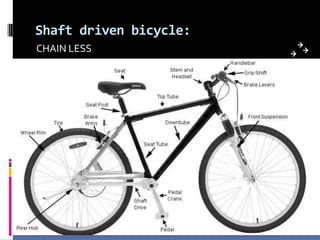
 A shaft-driven bicycle is a bicycle that uses a drive shaft instead of
  a chain to transmit power from the pedals to the wheel. Shaft drives
  were introduced over a century ago, but were mostly supplanted by
  chain-driven bicycles due to the gear ranges possible with sprockets
  and derailleur. Recently, due to advancements in internal gear
  technology, a small number of modern shaft-driven bicycles have
  been introduced.
 Shaft-driven bikes have a be where a conventional bike would have
  its chain ring. This meshes with another bevel gear mounted on the
  drive shaft. The Bevel gears are the most efficient way of turning
  drives 90 degrees as compared to worm gears or crossed helical gear.
 The shaft drive only needs periodic lubrication using a grease gun to
  keep the gears running quiet and smooth. This “chainless” drive
  system provides smooth, quite and efficient transfer of energy from
  the pedals to the rear wheel. It is attractive in look compare with
  chain driven bicycle. It replaces the traditional method.
Shaft driven bicycle:
CHAIN LESS
INTRODUCTION:

 The first shaft drives for cycles appear to have
  been invented independently in 1890 in the
  United States and England.
 If bevel-wheels could be accurately and
  cheaply cut by machinery, it is possible that
  gears of this description might supplant, to a
  great extent, the chain-drive gear; but the
  fact that the teeth of the bevel-wheels cannot
  be accurately milled is a serious obstacle to
  their practical success
SHAFT DRIVEN SYSTEM:

 The shaft is connected between the pair of
  spiral bevel gears.
 The main application of the spiral bevel gear
  is in a vehicle differential, where the direction
  of drive from the drive shaft must be turned
  90 degrees to drive the wheels.
 The helical design produces less vibration
  and noise than conventional straight-cut or
  spur-cut gear with straight teeth.
Components:

 Bicycle
 Shaft
 Bevel gears
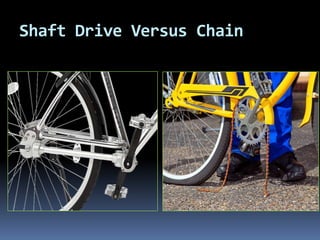
Shaft Drive Versus Chain

 High durability           Low durability
 Less noise                Noisy
 Safe no chain bite        Tear and soil clothing
 90%+ efficient             and cut hands
  (consistently with        75% - 95% efficient
  minimal maintenance)       (varies depending on
 Easy - no grease or        condition and upkeep)
  external components to    Dirty and greasy chain;
  disturb or damage          sharp sprocket teeth;
                             delicate components
                             susceptible to damage
                           
Shaft Drive Versus Chain
ADVANTAGES

 Smoother ride:
 Easier to transport
 Lower cost of ownership
 Cleaner
APPLICATION:

 Racing
 Off –road riding
 cycling
THANKING YOU

Shaft driven bicycle(chainless)

  • 1.
    PROJECT BY: R.Venkatesh V.Sugumar S.K.Veeresh M.Muralidharan GUIDED BY: Mr. C.D.Elangovan M.E
  • 2.
    ABSTRACT:  A shaft-drivenbicycle is a bicycle that uses a drive shaft instead of a chain to transmit power from the pedals to the wheel. Shaft drives were introduced over a century ago, but were mostly supplanted by chain-driven bicycles due to the gear ranges possible with sprockets and derailleur. Recently, due to advancements in internal gear technology, a small number of modern shaft-driven bicycles have been introduced.  Shaft-driven bikes have a be where a conventional bike would have its chain ring. This meshes with another bevel gear mounted on the drive shaft. The Bevel gears are the most efficient way of turning drives 90 degrees as compared to worm gears or crossed helical gear.  The shaft drive only needs periodic lubrication using a grease gun to keep the gears running quiet and smooth. This “chainless” drive system provides smooth, quite and efficient transfer of energy from the pedals to the rear wheel. It is attractive in look compare with chain driven bicycle. It replaces the traditional method.
  • 3.
  • 4.
    INTRODUCTION:  The firstshaft drives for cycles appear to have been invented independently in 1890 in the United States and England.  If bevel-wheels could be accurately and cheaply cut by machinery, it is possible that gears of this description might supplant, to a great extent, the chain-drive gear; but the fact that the teeth of the bevel-wheels cannot be accurately milled is a serious obstacle to their practical success
  • 5.
    SHAFT DRIVEN SYSTEM: The shaft is connected between the pair of spiral bevel gears.  The main application of the spiral bevel gear is in a vehicle differential, where the direction of drive from the drive shaft must be turned 90 degrees to drive the wheels.  The helical design produces less vibration and noise than conventional straight-cut or spur-cut gear with straight teeth.
  • 6.
  • 7.
    Shaft Drive VersusChain  High durability  Low durability  Less noise  Noisy  Safe no chain bite  Tear and soil clothing  90%+ efficient and cut hands (consistently with  75% - 95% efficient minimal maintenance) (varies depending on  Easy - no grease or condition and upkeep) external components to  Dirty and greasy chain; disturb or damage sharp sprocket teeth; delicate components susceptible to damage 
  • 8.
  • 9.
    ADVANTAGES  Smoother ride: Easier to transport  Lower cost of ownership  Cleaner
  • 10.
    APPLICATION:  Racing  Off–road riding  cycling
  • 11.