International Research Journal of Engineering and Technology (IRJET) e-ISSN: 2395-0056
Volume: 07 Issue: 07 | July 2020 www.irjet.net p-ISSN: 2395-0072
© 2020, IRJET | Impact Factor value: 7.529 | ISO 9001:2008 Certified Journal | Page 3708
Blade Propelled Bicycle
Shitansh Jain1, Mayur Bidwe2, Samrudhi Godse3, Gaurang Patil4 and Manoj Patil5
1-4Student, Dept. of Mechanical Engineering, KBTCOE, Nashik, Maharashtra, India;
5Professor, Dept. of Mechanical Engineering, KBTCOE, Nashik, Maharashtra, India;
---------------------------------------------------------------------***----------------------------------------------------------------------
Abstract - The world today heavily relies on fossil fuels for
power consumption. It is only a matter of time that fossil fuels
will be completely used up and no longer available. In such
scenario, riding a bicycle is the best suitable option to go from
one place to another. An alternative to this is the electric
bicycles which have greater speed and require less effort to
ride the bicycle. Also there are some research papers on
motion of bicycle with the help of compressed air. Contrary, to
already existing technology, the purpose of this research is to
get boosted power (thrust). The research mainly involves
designing the bicycle frame and giving it electrical power
support for motion of the structure with the help of batteries,
motors, propeller fans, etc. Design and modification of bicycle
carrier is also one of the salient features of the research. The
ultimate goal is to have a green environment by reducing
emission gases and reducing the reliance of fossil fuels.
Key Words: Alternative1, Batteries2, Bicycle3, Bicycle
Carrier4, Designing5,Motors6,Power7,PropellerFans8.
1. INTRODUCTION
The first verifiable used bicycle belongs to German Baron
Karl von Drais, a civil servant to the Grand Duke of Baden in
Germany. Drais invented his Laufmaschine (German name
for “running machine”) in 1817, that is referred to as
Draisine (English) or draisienne (French) byusingthepress.
Karl von Drais patented his design in 1818, which changed
into the first commercially successful two-wheeled,
steerable, human-propelled machine, commonlyknownasa
velocipede, and nicknamed hobby-horse or dandy horse. It
started with manufacturing in Germany and France.
The 21st century has seen an endured utility of era to
bicycles (which commenced within the 20th century): in
designing them, constructing them, and using them. Bicycle
frames and additives hold to get lighter and greater
aerodynamic shape without sacrificing the strength in large
part with the use of pc aided layout, finite structure analysis,
and computational fluid dynamics. Recent discoveries such
as bicycle stability had been facilitated via pc stimulations.
Once designed, new technology is carried out to
manufacturing along with hydroforming and automated
carbon fibre layout. Finally, digital gadgetry has increased
from just cyclocomputers to cycling power meters and
electronic gear-transferring systems.
In recent years, bicycle designs have trended toward
multiplied specialization, as the range of casual,recreational
and commuter cyclists has grown. For those groups, the
industry responded with the hybrid bicycle, occasionally
advertised as a town bike, cross bike, or commuter bike.
Hybrid bicycles combine factors of avenue racing and
mountain bikes, even though the term is applied to a wide
variety of bicycle types.
By 2007, e-motorcycles were notion to make up ten to
twenty percent of all two-wheeled vehicles at the street of
many primary Chinese localities. A standard unit requires 8
hours to rate the battery, which offers the variety of 25 to 30
miles, at a speed of 20km/h.
2. LITERATURE REVIEW
Several research papers are available related to the topic
Blade Propelled Bicycle. Following are some of the studies
which have helped in this research.
• Nguyen Ba Hung et al [1] have studied the running traits of
electric bicycle. Electric bicycle is attracting more human
beings as attention around the sector because it's far
certainly one of environmentally-friendly motors inaddition
to a zero-emissions vehicle.Inordertobroadenahighoverall
performance electric powered bicycle,a stimulation observe
of its opening characteristicsisconductedprimarilybasedon
consequences of keyparameterswhichincludesrider’smass,
wind speed and slope. Operation of this bicycle is simulated
based totally on dynamic equations with sure operating
conditions. Based on required electricity obtained from this
simulation, a suitable power is selected for motor of the
electric bicycle.
• Jaewon Sung et al [2] have studied the electricity required
by means of an electric powered bicycle. The objectiveofthis
examineistoanalyzedynamiccharacteristicsandtooptimize
required energy of an electric bicycle ready with a semi-
automatic transmission. In this simulation, we examine the
dynamic characteristics and operation traits of an electric
powered bicycle an optimized evaluation is conducted to
maximize the electricity era of electrical bicycle. We also
conduct an experiment on a real street and analyse the
dynamics and the required energy of the electric bicycle.
• Octacek Lim et al [3] have studied dynamic overall
performance and electric intake of electrical bicycles on the
consequences of numerous operating situations. This
establishes the stimulation models which include dynamic
models of the electric bicycle and battery fashions. The
consequences of operating conditions consisting of air
density and slope on the dynamics and electric consumption
of the electric bicycle are investigated.Thesimulationresults
International Research Journal of Engineering and Technology (IRJET) e-ISSN: 2395-0056
Volume: 07 Issue: 07 | July 2020 www.irjet.net p-ISSN: 2395-0072
© 2020, IRJET | Impact Factor value: 7.529 | ISO 9001:2008 Certified Journal | Page 3709
show that the reduction of air density and slope results in a
developmentofthedynamicoverallperformanceandelectric
intake. Apart from the simulation look at, an experimental
have a look at changed into additionally performed to
observe the dynamic and electric intake traits of the electric
bicycle.
• Ramis Zaripov andPavelsGavrilovs[4]studiedthedynamic
performance of the electricalbicycle.Experimentalstudiesof
the dynamics and electricity of an electric motorbike are
presented. The acceleration traits were measured through a
traction electric pressure and the dynamics of the
acceleration have been expected at exceptional battery
charges. It is hooked up that once a battery is used as an
energy source, the acceleration time to a speed of five m/s
decreases with the discharge of the battery. This is due to a
decrease within the output strength of the battery as it
discharges due to a decrease in voltage and a growth in
internal resistance(agrowthinthevoltagejumpbelowload);
Acceleration with pedaling leads to an enormous reduction
inside the power expended for acceleration to a given pace.
At the identical time, the course traversed by using the
electrical motorcycle during the acceleration time
additionally increases. This means that the reduced strength
consumption inside the acceleration mode with pedaling
decreases even more.
• Derek Covill et al [5] studied the Bicycle Frame behaviour
under various loading conditions using Finite Element
Analysis. The load cases analysed include static
representations of dynamic bump situations which occur
sporadically and also those which occur constantly or
regularly such as those generated at the drive and
handlebars during climbing or cruising. The resulting
stresses within the bicycle are analysed in the context of
frame performance relating to static and fatigue strengths
and are also compared to similar load cases presented in the
literature. Further research is required to understand the
influence of tube profiles on frame strength, and to analyse
the modes of failure for various bicycle designs and
materials used under typical and extreme usage in order
to understand the implications of design on safety.
• Adrian Shaw et al [6] have studied the material and
design optimization of bicycle frame. Fatigueisaprominent
failure mechanism for bike frames, and can lead to serious
accidents, costly recalls, and poor product image for bicycle
frame manufacturers. The team collaborated with a local
bike company, in the process of developing a new 6061-T6
aluminium bike, to investigate the fatigue behaviour of
the new frame and optimize the material/heat treatment
and frame design. The fatigue testing was done in-house
using a test rig specifically built for this project according
to the ASTM standard F2711-08 for horizontal loading.
3. DESIGN
3.1. Problem Statement
To design a pocket friendly bicycle powered by motor,
propeller fans, batteries, etc. in order to reduce human effort
and to give more efficiency by use of batteries as a power
source and also to evaluatebicycle frameforitsloadcarrying
capacity and durability.
3.2. Stages of design
Fig -1: Stages of design
International Research Journal of Engineering and Technology (IRJET) e-ISSN: 2395-0056
Volume: 07 Issue: 07 | July 2020 www.irjet.net p-ISSN: 2395-0072
© 2020, IRJET | Impact Factor value: 7.529 | ISO 9001:2008 Certified Journal | Page 3710
3.3. Calculations
Let us consider the average speed of Blade Propelled Bicycle
as 35 km/hr.
Also,consider a 100m distance which will be travelled bythe
Blade Propelled Bicycle at 35 km/hr = 9.72 m/s.
Total mass of the Blade Propelled Bicycle including average
human weight = 100 kg
Let the speed of Motor shaft be 20000 rpm.
According to Newton’s 3rd equation of motion,
v2 = u2 + 2as [7], we get
a1 = 0.47 m/s2 and a2 = 0.00405 m/s2
We know that,
Force F = m (a1 – a2)
F = 46.595 N
Also,
Power P = F x v
= 452.9034 W
This is the total power required topropeltheBladePropelled
Bicycle.
Therefore, 1 motor develops Power = (452.9034/4) =
113.225 W
Now, Torque developed by 1 motor
P = (2 x pi x N x T)/60 [8]
T = 0.054 N-m
Therefore we select RS-775 motor with Torque = 0.09 N-m
Thrust calculations
The amount of thrust forcerequiredtoovercomealltheother
forces:-
Fr = Mt * g * Cr + {(1/2) * Cd * ƍ * (Vb + Va)2 * Af} [9]
Where, Mt = total mass of Blade Propelled Bicycle
Cr = coefficient of resistance in surface
Cd = coefficient of drag
Vb = velocity of bike
Therefore,
Fr = (100 * 9.81 * 0.0022) + {(1/2) * 0.9 * 1.2 * 0.85 * (9.72 +
0.9)2}
= 53.92 N
(Fr1) = force by 1 motor
= 13.481 N
Blade Calculation:-
A = {(Fr1)3 / (4 * ƍ * P2)}
(pi / 4) * d2 = {(13.481)3 / (4 * 1.2 * (113.225)2}
Therefore,
d = 0.2251 m
Hence weselect 10 * 4.5proPropellerbladeshavingstandard
diameter of 25.4cm
Table -1: Calculation Results
Sr.no Parameter Calculated
Value
Selected
Parameter
1. Total Power
Required
452.9034 W -
2. Torque Produced 0.054 N-m RS-775 Motor
with Torque =
0.09 N-m
3. Total Thrust 53.92 N -
4. Diameter of blade 0.2251 m 10 * 4.5pro
Propeller
blades with
std. diameter
of 0.254 m
3.4. Working
3.4.1. Pedal Assist Mode
Pedal help, also referred to as pedelec, is a style that affords
power simplest while rider is pedaling. If a person is used to
riding a conventional bike, the pedal assist mode has a
greater intuitive sense compared to the throttle mode. The
pedal assist modes is also fine due to the fact one can be
aware of only pedaling and not preserve the throttle in a
certain position. The pedal mode will generally give more
variety while compared to the throttle mode. A lot of pedal
help motorcycles have different stages of assistance, for
example: low, medium, or excessive assist. Please be aware
that some e-motorcycles have 4 or 5 pedal help settings.
Low pedal mode - rider feels pretty suitable at the bike. It
help presents a touch electric assist even as the rider offer
more pedal power and get extra of a workout.
Medium pedal mode - rider have a nice tailwind everywhere
he/she goes. Mediumpedalmodecanbeapleasingbalanceof
your pedal strength and the motor power.
International Research Journal of Engineering and Technology (IRJET) e-ISSN: 2395-0056
Volume: 07 Issue: 07 | July 2020 www.irjet.net p-ISSN: 2395-0072
© 2020, IRJET | Impact Factor value: 7.529 | ISO 9001:2008 Certified Journal | Page 3711
High pedal mode - rider experiences like superman! High
pedal mode is while the rider wants to cross somewhere
speedy and with minimal effort. It may get beneficial if
he/she wants to get to work without sweating too much. On
the way home rider may want to use the low pedal assist to
exercise session the stress of the day.
3.4.2. Battery Mode
In this era full of trends and fads, the world demands speed
and efficiency with less human efforts, but not at the cost of
degrading the environment. And transportation is one such
field where there is more fascination about. People want
efficient and comfortable mode of transport. So our group
thought of developing a system which is fast, efficient and
eco-friendly. Here our group developed an electric bicycle
which works on battery power. First a frame structure was
designed and then a frame was chosen and then analyzed by
applying given loading condition. After choosing a suitable
frame structure, various mountings were mounted on the T.
In this type of mode, the bicycle motion is assisted by 6
batteries which power the 4DCMotor.Themotorsareplaced
on the carrier with the help of clamps. These motors are
equipped with Propeller Fan Blades, which rotates in
clockwise or anticlockwise direction as per requirement.
These batteries are connected in combination of series and
parallel with the help of wires. When the fan blades rotate, it
produces thrust which forces the bicycle to move. The speed
of this bike can be controlled with the help of 2 switches.
When the switches are put ON, the motors get the power
from the batteries and the blades start rotating. Thisrotation
helps the bicycle to move.
Figure -2: Battery assisted mode
3.5. Analysis of Bicycle Frame
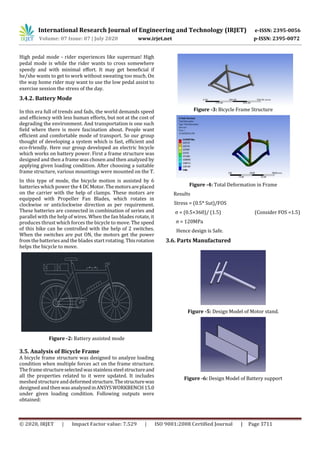
A bicycle frame structure was designed to analyze loading
condition when multiple forces act on the frame structure.
The framestructureselectedwasstainlesssteelstructureand
all the properties related to it were updated. It includes
meshed structureand deformedstructure.Thestructurewas
designed and thenwasanalyzedinANSYSWORKBENCH15.0
under given loading condition. Following outputs were
obtained:
Figure -3: Bicycle Frame Structure
Figure -4: Total Deformation in Frame
Results
Stress = (0.5* Sut)/FOS
σ = (0.5×360)/ (1.5) (Consider FOS =1.5)
σ = 120MPa
Hence design is Safe.
3.6. Parts Manufactured
Figure -5: Design Model of Motor stand.
Figure -6: Design Model of Battery support
International Research Journal of Engineering and Technology (IRJET) e-ISSN: 2395-0056
Volume: 07 Issue: 07 | July 2020 www.irjet.net p-ISSN: 2395-0072
© 2020, IRJET | Impact Factor value: 7.529 | ISO 9001:2008 Certified Journal | Page 3712
3.7. Circuit Connections
For the battery operated mode circuit connections is given.
Which includes six rechargeable batteries, four motors, two
switches, and the whole is connected by wiresasshowninfig
4.6.
Figure -7: Circuit Connection for the motors
4. CONCLUSION
Today, the level of fuels is depletingatanalarmingrate.With
this rate of consumption it is quite evident that the fuel will
not last in the long run. Also consumption of this fuel causes
pollution thereby increasing the average temperature ofthe
Earth's surface. So as to overcome with these challenges,
Blade Propelled Bicycle can be an alternative for the 2-
wheelers. This Blade Propelled Bicycle uses basic
components like batteries, motors, etc. to generate the
power and use that power for its motion. Here, the normal
bicycle is converted into a powerpropelledbicycle.Therider
can just sit back on his seat and enjoy the ride. It will
eventually save the efforts of the rider as compared to an
individual riding a normal bicycle. Also, complete justice is
being done to the ergonomics of the bicycle. It is cheap and
any one can afford it at a much lower cost than the one
consuming fuel. Thus the idea of making a power propelled
Blade Propelled Bicycle has been met.
REFERENCES
[1] Nguyen Ba Hung, Jeawon Sung, Octaeck Lim, Kyoungmin
Kim, A simulation and experimental study of operating
characteristics of an electric bicycle(ELSEVIER), 2017,
Volume 107, Pages 2512-2517.
[2] Jeawon Sung, Nguyen Ba Hung, Octaeck Lim, Sangjin
Yoon, A study of the dynamic characteristics and required
power of an electric bicycle equipped with semi-automatic
transmission (ELSEVIER),21-24 August 2017, Volume 142,
Pages 2057-2064.
[3] Nguyen Ba Hung, Octaeck Lim, A simulation and
experimental study of dynamic performance and electric
consumption of electric bicycle(ELSEVIER), 22-25 August
2019, Volume 158, Pages 2865-2871.
[4] Ramis Zaripov, Pavels Gavrilovs, Study of dynamic
characteristics of electric bicycles
(ELSEVIER), 2019, Volume 149, Pages 307-313.
[5] Derek Covill, Philippe Allard, Jean-Marc Droue, Nicholas
Emerson, An Assessment of Bicycle Frame Behaviour under
Various Load Conditions Using Numerical
Simulations(ELSEVIER), 2016, Volume 147, Pages 665-670.
[6] Adrian Shaw, Forrest Dwyer, Richard Tombarelli,
Material and Design Optimization for an Aluminium Bike
Frame (WPI), 26th April 2012.
[7]https://isaacphysics.org/concepts/cp_eq_of_motion, Last
visited on 24th June, 2020.
[8]https://www.ckit.co.za/secure/conveyor/troughed/dr
ive_units_complete/hansen/06-power-torque-speed.html,
Last visited on 24th June, 2020.
[9] Surendar Ganesan, Balasubramanian Esakki, Design and
Development of Unmanned Hovercraft (IJMEMS), 2019,
Volume 4, Number 5, Pages 1180-1195

IRJET - Blade Propelled Bicycle

  • 1.
    International Research Journalof Engineering and Technology (IRJET) e-ISSN: 2395-0056 Volume: 07 Issue: 07 | July 2020 www.irjet.net p-ISSN: 2395-0072 © 2020, IRJET | Impact Factor value: 7.529 | ISO 9001:2008 Certified Journal | Page 3708 Blade Propelled Bicycle Shitansh Jain1, Mayur Bidwe2, Samrudhi Godse3, Gaurang Patil4 and Manoj Patil5 1-4Student, Dept. of Mechanical Engineering, KBTCOE, Nashik, Maharashtra, India; 5Professor, Dept. of Mechanical Engineering, KBTCOE, Nashik, Maharashtra, India; ---------------------------------------------------------------------***---------------------------------------------------------------------- Abstract - The world today heavily relies on fossil fuels for power consumption. It is only a matter of time that fossil fuels will be completely used up and no longer available. In such scenario, riding a bicycle is the best suitable option to go from one place to another. An alternative to this is the electric bicycles which have greater speed and require less effort to ride the bicycle. Also there are some research papers on motion of bicycle with the help of compressed air. Contrary, to already existing technology, the purpose of this research is to get boosted power (thrust). The research mainly involves designing the bicycle frame and giving it electrical power support for motion of the structure with the help of batteries, motors, propeller fans, etc. Design and modification of bicycle carrier is also one of the salient features of the research. The ultimate goal is to have a green environment by reducing emission gases and reducing the reliance of fossil fuels. Key Words: Alternative1, Batteries2, Bicycle3, Bicycle Carrier4, Designing5,Motors6,Power7,PropellerFans8. 1. INTRODUCTION The first verifiable used bicycle belongs to German Baron Karl von Drais, a civil servant to the Grand Duke of Baden in Germany. Drais invented his Laufmaschine (German name for “running machine”) in 1817, that is referred to as Draisine (English) or draisienne (French) byusingthepress. Karl von Drais patented his design in 1818, which changed into the first commercially successful two-wheeled, steerable, human-propelled machine, commonlyknownasa velocipede, and nicknamed hobby-horse or dandy horse. It started with manufacturing in Germany and France. The 21st century has seen an endured utility of era to bicycles (which commenced within the 20th century): in designing them, constructing them, and using them. Bicycle frames and additives hold to get lighter and greater aerodynamic shape without sacrificing the strength in large part with the use of pc aided layout, finite structure analysis, and computational fluid dynamics. Recent discoveries such as bicycle stability had been facilitated via pc stimulations. Once designed, new technology is carried out to manufacturing along with hydroforming and automated carbon fibre layout. Finally, digital gadgetry has increased from just cyclocomputers to cycling power meters and electronic gear-transferring systems. In recent years, bicycle designs have trended toward multiplied specialization, as the range of casual,recreational and commuter cyclists has grown. For those groups, the industry responded with the hybrid bicycle, occasionally advertised as a town bike, cross bike, or commuter bike. Hybrid bicycles combine factors of avenue racing and mountain bikes, even though the term is applied to a wide variety of bicycle types. By 2007, e-motorcycles were notion to make up ten to twenty percent of all two-wheeled vehicles at the street of many primary Chinese localities. A standard unit requires 8 hours to rate the battery, which offers the variety of 25 to 30 miles, at a speed of 20km/h. 2. LITERATURE REVIEW Several research papers are available related to the topic Blade Propelled Bicycle. Following are some of the studies which have helped in this research. • Nguyen Ba Hung et al [1] have studied the running traits of electric bicycle. Electric bicycle is attracting more human beings as attention around the sector because it's far certainly one of environmentally-friendly motors inaddition to a zero-emissions vehicle.Inordertobroadenahighoverall performance electric powered bicycle,a stimulation observe of its opening characteristicsisconductedprimarilybasedon consequences of keyparameterswhichincludesrider’smass, wind speed and slope. Operation of this bicycle is simulated based totally on dynamic equations with sure operating conditions. Based on required electricity obtained from this simulation, a suitable power is selected for motor of the electric bicycle. • Jaewon Sung et al [2] have studied the electricity required by means of an electric powered bicycle. The objectiveofthis examineistoanalyzedynamiccharacteristicsandtooptimize required energy of an electric bicycle ready with a semi- automatic transmission. In this simulation, we examine the dynamic characteristics and operation traits of an electric powered bicycle an optimized evaluation is conducted to maximize the electricity era of electrical bicycle. We also conduct an experiment on a real street and analyse the dynamics and the required energy of the electric bicycle. • Octacek Lim et al [3] have studied dynamic overall performance and electric intake of electrical bicycles on the consequences of numerous operating situations. This establishes the stimulation models which include dynamic models of the electric bicycle and battery fashions. The consequences of operating conditions consisting of air density and slope on the dynamics and electric consumption of the electric bicycle are investigated.Thesimulationresults
  • 2.
    International Research Journalof Engineering and Technology (IRJET) e-ISSN: 2395-0056 Volume: 07 Issue: 07 | July 2020 www.irjet.net p-ISSN: 2395-0072 © 2020, IRJET | Impact Factor value: 7.529 | ISO 9001:2008 Certified Journal | Page 3709 show that the reduction of air density and slope results in a developmentofthedynamicoverallperformanceandelectric intake. Apart from the simulation look at, an experimental have a look at changed into additionally performed to observe the dynamic and electric intake traits of the electric bicycle. • Ramis Zaripov andPavelsGavrilovs[4]studiedthedynamic performance of the electricalbicycle.Experimentalstudiesof the dynamics and electricity of an electric motorbike are presented. The acceleration traits were measured through a traction electric pressure and the dynamics of the acceleration have been expected at exceptional battery charges. It is hooked up that once a battery is used as an energy source, the acceleration time to a speed of five m/s decreases with the discharge of the battery. This is due to a decrease within the output strength of the battery as it discharges due to a decrease in voltage and a growth in internal resistance(agrowthinthevoltagejumpbelowload); Acceleration with pedaling leads to an enormous reduction inside the power expended for acceleration to a given pace. At the identical time, the course traversed by using the electrical motorcycle during the acceleration time additionally increases. This means that the reduced strength consumption inside the acceleration mode with pedaling decreases even more. • Derek Covill et al [5] studied the Bicycle Frame behaviour under various loading conditions using Finite Element Analysis. The load cases analysed include static representations of dynamic bump situations which occur sporadically and also those which occur constantly or regularly such as those generated at the drive and handlebars during climbing or cruising. The resulting stresses within the bicycle are analysed in the context of frame performance relating to static and fatigue strengths and are also compared to similar load cases presented in the literature. Further research is required to understand the influence of tube profiles on frame strength, and to analyse the modes of failure for various bicycle designs and materials used under typical and extreme usage in order to understand the implications of design on safety. • Adrian Shaw et al [6] have studied the material and design optimization of bicycle frame. Fatigueisaprominent failure mechanism for bike frames, and can lead to serious accidents, costly recalls, and poor product image for bicycle frame manufacturers. The team collaborated with a local bike company, in the process of developing a new 6061-T6 aluminium bike, to investigate the fatigue behaviour of the new frame and optimize the material/heat treatment and frame design. The fatigue testing was done in-house using a test rig specifically built for this project according to the ASTM standard F2711-08 for horizontal loading. 3. DESIGN 3.1. Problem Statement To design a pocket friendly bicycle powered by motor, propeller fans, batteries, etc. in order to reduce human effort and to give more efficiency by use of batteries as a power source and also to evaluatebicycle frameforitsloadcarrying capacity and durability. 3.2. Stages of design Fig -1: Stages of design
  • 3.
    International Research Journalof Engineering and Technology (IRJET) e-ISSN: 2395-0056 Volume: 07 Issue: 07 | July 2020 www.irjet.net p-ISSN: 2395-0072 © 2020, IRJET | Impact Factor value: 7.529 | ISO 9001:2008 Certified Journal | Page 3710 3.3. Calculations Let us consider the average speed of Blade Propelled Bicycle as 35 km/hr. Also,consider a 100m distance which will be travelled bythe Blade Propelled Bicycle at 35 km/hr = 9.72 m/s. Total mass of the Blade Propelled Bicycle including average human weight = 100 kg Let the speed of Motor shaft be 20000 rpm. According to Newton’s 3rd equation of motion, v2 = u2 + 2as [7], we get a1 = 0.47 m/s2 and a2 = 0.00405 m/s2 We know that, Force F = m (a1 – a2) F = 46.595 N Also, Power P = F x v = 452.9034 W This is the total power required topropeltheBladePropelled Bicycle. Therefore, 1 motor develops Power = (452.9034/4) = 113.225 W Now, Torque developed by 1 motor P = (2 x pi x N x T)/60 [8] T = 0.054 N-m Therefore we select RS-775 motor with Torque = 0.09 N-m Thrust calculations The amount of thrust forcerequiredtoovercomealltheother forces:- Fr = Mt * g * Cr + {(1/2) * Cd * ƍ * (Vb + Va)2 * Af} [9] Where, Mt = total mass of Blade Propelled Bicycle Cr = coefficient of resistance in surface Cd = coefficient of drag Vb = velocity of bike Therefore, Fr = (100 * 9.81 * 0.0022) + {(1/2) * 0.9 * 1.2 * 0.85 * (9.72 + 0.9)2} = 53.92 N (Fr1) = force by 1 motor = 13.481 N Blade Calculation:- A = {(Fr1)3 / (4 * ƍ * P2)} (pi / 4) * d2 = {(13.481)3 / (4 * 1.2 * (113.225)2} Therefore, d = 0.2251 m Hence weselect 10 * 4.5proPropellerbladeshavingstandard diameter of 25.4cm Table -1: Calculation Results Sr.no Parameter Calculated Value Selected Parameter 1. Total Power Required 452.9034 W - 2. Torque Produced 0.054 N-m RS-775 Motor with Torque = 0.09 N-m 3. Total Thrust 53.92 N - 4. Diameter of blade 0.2251 m 10 * 4.5pro Propeller blades with std. diameter of 0.254 m 3.4. Working 3.4.1. Pedal Assist Mode Pedal help, also referred to as pedelec, is a style that affords power simplest while rider is pedaling. If a person is used to riding a conventional bike, the pedal assist mode has a greater intuitive sense compared to the throttle mode. The pedal assist modes is also fine due to the fact one can be aware of only pedaling and not preserve the throttle in a certain position. The pedal mode will generally give more variety while compared to the throttle mode. A lot of pedal help motorcycles have different stages of assistance, for example: low, medium, or excessive assist. Please be aware that some e-motorcycles have 4 or 5 pedal help settings. Low pedal mode - rider feels pretty suitable at the bike. It help presents a touch electric assist even as the rider offer more pedal power and get extra of a workout. Medium pedal mode - rider have a nice tailwind everywhere he/she goes. Mediumpedalmodecanbeapleasingbalanceof your pedal strength and the motor power.
  • 4.
    International Research Journalof Engineering and Technology (IRJET) e-ISSN: 2395-0056 Volume: 07 Issue: 07 | July 2020 www.irjet.net p-ISSN: 2395-0072 © 2020, IRJET | Impact Factor value: 7.529 | ISO 9001:2008 Certified Journal | Page 3711 High pedal mode - rider experiences like superman! High pedal mode is while the rider wants to cross somewhere speedy and with minimal effort. It may get beneficial if he/she wants to get to work without sweating too much. On the way home rider may want to use the low pedal assist to exercise session the stress of the day. 3.4.2. Battery Mode In this era full of trends and fads, the world demands speed and efficiency with less human efforts, but not at the cost of degrading the environment. And transportation is one such field where there is more fascination about. People want efficient and comfortable mode of transport. So our group thought of developing a system which is fast, efficient and eco-friendly. Here our group developed an electric bicycle which works on battery power. First a frame structure was designed and then a frame was chosen and then analyzed by applying given loading condition. After choosing a suitable frame structure, various mountings were mounted on the T. In this type of mode, the bicycle motion is assisted by 6 batteries which power the 4DCMotor.Themotorsareplaced on the carrier with the help of clamps. These motors are equipped with Propeller Fan Blades, which rotates in clockwise or anticlockwise direction as per requirement. These batteries are connected in combination of series and parallel with the help of wires. When the fan blades rotate, it produces thrust which forces the bicycle to move. The speed of this bike can be controlled with the help of 2 switches. When the switches are put ON, the motors get the power from the batteries and the blades start rotating. Thisrotation helps the bicycle to move. Figure -2: Battery assisted mode 3.5. Analysis of Bicycle Frame A bicycle frame structure was designed to analyze loading condition when multiple forces act on the frame structure. The framestructureselectedwasstainlesssteelstructureand all the properties related to it were updated. It includes meshed structureand deformedstructure.Thestructurewas designed and thenwasanalyzedinANSYSWORKBENCH15.0 under given loading condition. Following outputs were obtained: Figure -3: Bicycle Frame Structure Figure -4: Total Deformation in Frame Results Stress = (0.5* Sut)/FOS σ = (0.5×360)/ (1.5) (Consider FOS =1.5) σ = 120MPa Hence design is Safe. 3.6. Parts Manufactured Figure -5: Design Model of Motor stand. Figure -6: Design Model of Battery support
  • 5.
    International Research Journalof Engineering and Technology (IRJET) e-ISSN: 2395-0056 Volume: 07 Issue: 07 | July 2020 www.irjet.net p-ISSN: 2395-0072 © 2020, IRJET | Impact Factor value: 7.529 | ISO 9001:2008 Certified Journal | Page 3712 3.7. Circuit Connections For the battery operated mode circuit connections is given. Which includes six rechargeable batteries, four motors, two switches, and the whole is connected by wiresasshowninfig 4.6. Figure -7: Circuit Connection for the motors 4. CONCLUSION Today, the level of fuels is depletingatanalarmingrate.With this rate of consumption it is quite evident that the fuel will not last in the long run. Also consumption of this fuel causes pollution thereby increasing the average temperature ofthe Earth's surface. So as to overcome with these challenges, Blade Propelled Bicycle can be an alternative for the 2- wheelers. This Blade Propelled Bicycle uses basic components like batteries, motors, etc. to generate the power and use that power for its motion. Here, the normal bicycle is converted into a powerpropelledbicycle.Therider can just sit back on his seat and enjoy the ride. It will eventually save the efforts of the rider as compared to an individual riding a normal bicycle. Also, complete justice is being done to the ergonomics of the bicycle. It is cheap and any one can afford it at a much lower cost than the one consuming fuel. Thus the idea of making a power propelled Blade Propelled Bicycle has been met. REFERENCES [1] Nguyen Ba Hung, Jeawon Sung, Octaeck Lim, Kyoungmin Kim, A simulation and experimental study of operating characteristics of an electric bicycle(ELSEVIER), 2017, Volume 107, Pages 2512-2517. [2] Jeawon Sung, Nguyen Ba Hung, Octaeck Lim, Sangjin Yoon, A study of the dynamic characteristics and required power of an electric bicycle equipped with semi-automatic transmission (ELSEVIER),21-24 August 2017, Volume 142, Pages 2057-2064. [3] Nguyen Ba Hung, Octaeck Lim, A simulation and experimental study of dynamic performance and electric consumption of electric bicycle(ELSEVIER), 22-25 August 2019, Volume 158, Pages 2865-2871. [4] Ramis Zaripov, Pavels Gavrilovs, Study of dynamic characteristics of electric bicycles (ELSEVIER), 2019, Volume 149, Pages 307-313. [5] Derek Covill, Philippe Allard, Jean-Marc Droue, Nicholas Emerson, An Assessment of Bicycle Frame Behaviour under Various Load Conditions Using Numerical Simulations(ELSEVIER), 2016, Volume 147, Pages 665-670. [6] Adrian Shaw, Forrest Dwyer, Richard Tombarelli, Material and Design Optimization for an Aluminium Bike Frame (WPI), 26th April 2012. [7]https://isaacphysics.org/concepts/cp_eq_of_motion, Last visited on 24th June, 2020. [8]https://www.ckit.co.za/secure/conveyor/troughed/dr ive_units_complete/hansen/06-power-torque-speed.html, Last visited on 24th June, 2020. [9] Surendar Ganesan, Balasubramanian Esakki, Design and Development of Unmanned Hovercraft (IJMEMS), 2019, Volume 4, Number 5, Pages 1180-1195