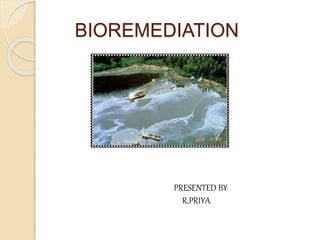
BIOREMEDIATION 
PRESENTED BY 
R.PRIYA
BIOREMEDIATION 
Bioremediation refers to the process of using microorganisms to 
remove the environmental pollutants or prevent pollution. 
The removal of organic wastes by microbes for environmental 
clean-up is the essence of bioremediation. 
The other names used for bioremediation are biotreatment, 
bioreclamation and biorestoration. 
Xenobiotics broadly refer to the unnatural, foreign and 
synthetic chemicals such as pesticide, herbicide & other organic 
compounds. 
TYPES OF BIOREMEDIATION : 
1. Biostimulation 
2. Bioaugmentation 
3. Intrinsic bioremediation
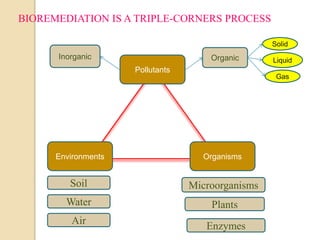
BIOREMEDIATION IS A TRIPLE-CORNERS PROCESS 
Inorganic Organic 
Organisms 
Pollutants 
Environments 
Microorganisms 
Plants 
Enzymes 
Soil 
Water 
Air 
Solid 
Liquid 
Gas
REDOX CLEAN-UP REACTIONS 
Anaerobic or aerobic metabolism involve oxidation and 
reduction reactions or Redox reactions for detoxification. 
Oxygen could be reduced to water and oxidize organic 
compounds. Anaerobic reaction can use nitrate. 
In return, biomass is gained for bacterial or fungal growth. 
In many cases, combined efforts are needed, indigenous 
microbes found naturally in polluted sites are useful.
USE OF BACTERIA IN BIOREMEDIATION 
Greatly affected by unstable climatic and environmental factors 
from moisture to temperature. 
For examples, pH in soil is slightly acidic; petroleum hydrocarbon 
degrading bacteria do not work well < 10º C. 
These microbes are usually thermophilic anaerobic. 
Fertilizers are needed. Seeding or bioaugmentation could be useful 
too. 
They contain monooxygenases and dehydrogenases to break down 
organic matters including most toxic substances.
PSEUDOMONAS 
Genetically engineered bacteria (Pseudomonas) with 
plasmid producing enzymes to degrade octane and many 
different organic compounds from crude oil. 
A selected list of genetically engineered microorganisms 
GEMs XENOBIOTICS 
Pseudomonas putida Mono-and dichloro 
aromatic compounds 
P.diminuta Parathion 
P.oleovorans Alkane 
P.cepacia 2,4,5-Trichlorophenol 
Acinetobacter species 4-Chlorobenzene 
Alcaligenes species 2,4-Dichlorophenoxy 
acetic acid
USE OF FUNGI IN BIOREMEDIATION 
Candida can degrade formaldehyde. 
Gibeberella can degrade cyanide. 
Slurry-phase bioremediation is useful too but only for small 
amounts of contaminated soil. 
Composting can be used to degrade household wastes. 
WHITE ROT FUNGI 
White rot fungi can degrade organic pollutants in soil and 
effluent and decolorize kraft black liquor, e.g. Phanerochaete 
chrysosporium can produce aromatic mixtures with its 
lignolytic system. 
Pentachlorophenol, dichlorodiphenyltrichloroethane (e.g. 
DDT), even TNT (trinitrotoluene) can be degraded by white 
rot fungi.
ENVIRONMENTAL CLEAN-UP PROCESS 
The basis of removal and transportation of wastes for 
treatment, basically there are two methods. 
1.Insitu bioremediation 
2.Ex situ bioremediation 
 INSITU BIOREMEDIATION: 
* It involves direct approach for the microbial 
degradation of xenobiotics at the sites of pollution (soil, ground 
water). 
* It has been successfully applied for clan-up oil 
spillages, beaches etc. 
* There are 2 types of insitu bioremediation , 
‡ Intrinsic bioremediation 
‡ Engineered bioremediation
EXSITU BIOREMEDIATION 
* The waste or toxic materials can be collected from the 
polluted sites and the bioremediation with the requisite 
microorganisms can be carried out at designed places. 
METABOLIC EFFECT OFMO’S ON XENOBIOTICS: 
¤ Detoxification ¤ Activation 
¤ Degradation ¤ Conjugation 
TYPES OF REACTIONS IN BIOREMEDIATION: 
» Aerobic bioremediation 
» Anaerobic bioremediation 
» Sequential bioremediation
BIOREMEDIATION OF HYDROCARBONS 
Petroleum and its products are hydrocarbons. Oil constitute a 
variety of hydrocarbons (xylanes, naphthalenes, octane's, camphor 
etc,). 
The pollutants can be degraded by a consortium of microorganisms, 
e.g Pseudomoas, Corynebacterium, Arthrobacter, Mycobacterium 
and Nocardia. 
Genetically engineered bacterial strains are used to enhance 
bioremediation. 
In 1979, Anand Mohan Chakrabarty - obtained a strain of 
Pseudomonas putida that contained the XYL and NAH plasmid as 
well as a hybrid plasmid derived by recombinating parts of CAM 
and OCT. 
In 1990, the USA Govt allowed him to use this superbug for 
cleaning up of an oil spill in water of State of Texas. It was 
produced on a large scale in laboratory, mixed with straw and dried.
MARINE POLLUTION 
Sewage from cities 
Industrial effluents 
Oil slick 
Pollution from warships 
Military activities
MARINE POLLUTION
Oil spill 
11 million gallon oil spill 
from the supertanker 
EXXON VALDEZ-ALASKA 
in March- 
1989.
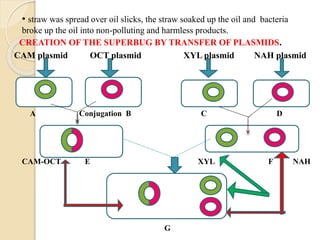
• straw was spread over oil slicks, the straw soaked up the oil and bacteria 
broke up the oil into non-polluting and harmless products. 
CREATION OF THE SUPERBUG BY TRANSFER OF PLASMIDS. 
CAM plasmid OCT plasmid XYL plasmid NAH plasmid 
A Conjugation B C D 
CAM-OCT E XYL F NAH 
G
PHYTOREMEDIATION 
• Phytoremediation is use of plants for accumulation, 
removal or conversion of pollutants. 
Phytoremediation 
Phytostabilization 
Phytovolatilization Phytostimulation 
Phytotransformation Phytoextraction
• Approximately 400 plant species have been classified as 
hyperaccumulators of heavy metals, such as grasses, 
sunflower, corn, hemp, flax, alfalfa, tobacco, willow, 
Indian mustard, poplar, water hyacinth, etc.
The root exudates of these plants play an important role in 
phytoremediation as it activate the surrounded microorganisms. 
Genetic engineering are used as in case of BT protein or insect 
pheromones producing plants to reduce the use of pesticides.
PHYTO-REMEDIATION 
Effective and low cost , environmental friendly. 
Soil clean up of heavy metals and organic compounds. 
Pollutants are absorbed in roots, thus plants removed 
could be disposed or burned. 
Sunflower plants were used to remove cesium and 
strontium from ponds at the Chernobyl nuclear power 
plant. 
Transgenic plants with exogenous metallothionein (a 
metal binding protein) used to remove metals .
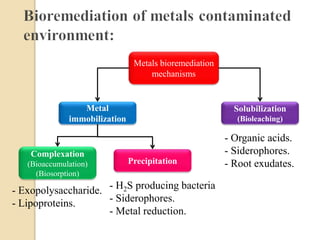
Metals bioremediation 
mechanisms 
Solubilization 
(Bioleaching) 
Complexation 
(Bioaccumulation) 
(Biosorption) 
Metal 
immobilization 
Precipitation 
- H2S producing bacteria 
- Siderophores. 
- Metal reduction. 
- Exopolysaccharide. 
- Lipoproteins. 
- Organic acids. 
- Siderophores. 
- Root exudates.
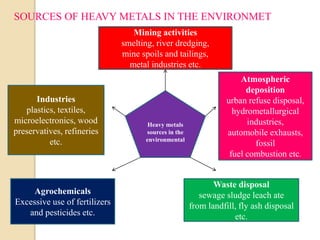
SOURCES OF HEAVY METALS IN THE ENVIRONMET 
Industries 
plastics, textiles, 
microelectronics, wood 
preservatives, refineries 
etc. 
Agrochemicals 
Excessive use of fertilizers 
and pesticides etc. 
Waste disposal 
sewage sludge leach ate 
from landfill, fly ash disposal 
etc. 
Mining activities 
smelting, river dredging, 
mine spoils and tailings, 
metal industries etc. 
Atmospheric 
deposition 
urban refuse disposal, 
hydrometallurgical 
industries, 
automobile exhausts, 
fossil 
fuel combustion etc. 
Heavy metals 
sources in the 
environmental
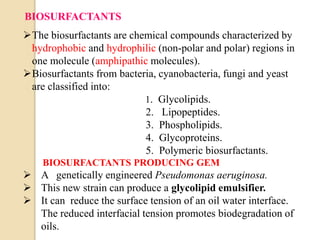
BIOSURFACTANTS 
The biosurfactants are chemical compounds characterized by 
hydrophobic and hydrophilic (non-polar and polar) regions in 
one molecule (amphipathic molecules). 
Biosurfactants from bacteria, cyanobacteria, fungi and yeast 
are classified into: 
1. Glycolipids. 
2. Lipopeptides. 
3. Phospholipids. 
4. Glycoproteins. 
5. Polymeric biosurfactants. 
BIOSURFACTANTS PRODUCING GEM 
 A genetically engineered Pseudomonas aeruginosa. 
 This new strain can produce a glycolipid emulsifier. 
 It can reduce the surface tension of an oil water interface. 
The reduced interfacial tension promotes biodegradation of 
oils.
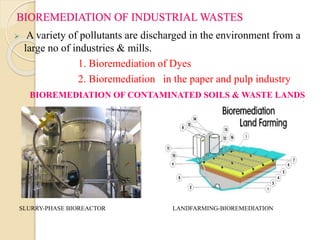
BIOREMEDIATION OF INDUSTRIAL WASTES 
 A variety of pollutants are discharged in the environment from a 
large no of industries & mills. 
1. Bioremediation of Dyes 
2. Bioremediation in the paper and pulp industry 
BIOREMEDIATION OF CONTAMINATED SOILS & WASTE LANDS 
SLURRY-PHASE BIOREACTOR LANDFARMING-BIOREMEDIATION
PREVENTION AND CONTROL OF POLLUTION 
These activities are supported by a set of legislative and regulatory 
promotional measures such as Policy Statement on Abatement of 
Pollution, 1992; and the National Environment Policy, 2006. 
The major actions on Abatement of Pollution and Environmental 
Cleanup are as follows: Clean Technology (CT), Control of Pollution 
(CP), Environment Education (EE), Environmental Impact Assessment 
(IA), Environmental Information (EI), Environmental Information 
System (ENVIS), Environment Research (RE), Forest Protection 
(FPR), Hazardous Substances Management (HSM) , Climate 
Change(CC) , Clean Development Mechanism (CDM).
There is an immediate necessity for initiating an “All India Coordinated 
project on Bioremediation of the Contaminated Sites” involving premier 
institutions in this field for conducting large scale demonstration projects. 
Further, various departmental agencies and related ministries in India may 
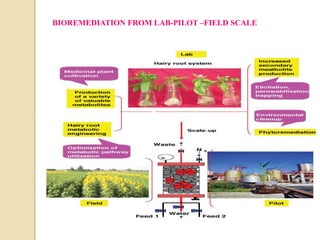
plan a joint action plan to launch bioremediation from Lab-Pilot –Field 
scale projects at specific sites 
Environmental 
cleanup 
Joint action of 
Govt.(various 
ministries and 
their 
departments) 
Novel lab level 
research 
Pilot Scale 
experiments 
Possible All India coordinated bioremediation demonstration projects at specifi c sites
BIOREMEDIATION FROM LAB-PILOT –FIELD SCALE
ADVANTAGES AND DISADVANTAGES 
ADVANTAGES OF BIOREMEDIATION 
Bioremediation is a natural process and is therefore perceived by the public. 
Bioremediation is useful for the complete destruction of a wide variety of 
contaminants. 
Instead of transferring contaminants from one environmental medium to 
another, for example, from land to water or air, the complete destruction of 
target pollutants is possible. 
Bioremediation can often be carried out on site, often without causing a 
major disruption of normal activities. 
Bioremediation can prove less expensive than other technologies that are 
used for cleanup of hazardous waste.
DISADVANTAGES OF BIOREMEDIATION 
Bioremediation is limited to those compounds that are biodegradable. Not all 
compounds are susceptible to rapid and complete degradation. 
There are some concerns that the products of biodegradation may be more 
persistent or toxic than the parent compound. 
Biological processes are often highly specific. microbial populations, suitable 
environmental growth conditions, and appropriate levels of nutrients and 
contaminants. 
It is difficult to extrapolate (deduce) from bench and pilot-scale studies to 
fullscale field operations. 
Bioremediation often takes longer than other treatment options.
REFERENCE 
Bioremediation, its Applications to Contaminated Sites in 
India, Ministry of Environment & Forests. 
Text book of Biotechnology- U.sathyanarayana. 
A text book of Biotechnology- R.C.Dubey 
PPT-Bioremediation methods and its application , MISR 
university. 
http://www.nal.usda.gov/bic/Biorem/biorem.htm. 
http://www.lbl.gov/NABIR/index.html
THANK YOU

Bioremediation

  • 1.
  • 2.
    BIOREMEDIATION Bioremediation refersto the process of using microorganisms to remove the environmental pollutants or prevent pollution. The removal of organic wastes by microbes for environmental clean-up is the essence of bioremediation. The other names used for bioremediation are biotreatment, bioreclamation and biorestoration. Xenobiotics broadly refer to the unnatural, foreign and synthetic chemicals such as pesticide, herbicide & other organic compounds. TYPES OF BIOREMEDIATION : 1. Biostimulation 2. Bioaugmentation 3. Intrinsic bioremediation
  • 3.
    BIOREMEDIATION IS ATRIPLE-CORNERS PROCESS Inorganic Organic Organisms Pollutants Environments Microorganisms Plants Enzymes Soil Water Air Solid Liquid Gas
  • 4.
    REDOX CLEAN-UP REACTIONS Anaerobic or aerobic metabolism involve oxidation and reduction reactions or Redox reactions for detoxification. Oxygen could be reduced to water and oxidize organic compounds. Anaerobic reaction can use nitrate. In return, biomass is gained for bacterial or fungal growth. In many cases, combined efforts are needed, indigenous microbes found naturally in polluted sites are useful.
  • 5.
    USE OF BACTERIAIN BIOREMEDIATION Greatly affected by unstable climatic and environmental factors from moisture to temperature. For examples, pH in soil is slightly acidic; petroleum hydrocarbon degrading bacteria do not work well < 10º C. These microbes are usually thermophilic anaerobic. Fertilizers are needed. Seeding or bioaugmentation could be useful too. They contain monooxygenases and dehydrogenases to break down organic matters including most toxic substances.
  • 6.
    PSEUDOMONAS Genetically engineeredbacteria (Pseudomonas) with plasmid producing enzymes to degrade octane and many different organic compounds from crude oil. A selected list of genetically engineered microorganisms GEMs XENOBIOTICS Pseudomonas putida Mono-and dichloro aromatic compounds P.diminuta Parathion P.oleovorans Alkane P.cepacia 2,4,5-Trichlorophenol Acinetobacter species 4-Chlorobenzene Alcaligenes species 2,4-Dichlorophenoxy acetic acid
  • 7.
    USE OF FUNGIIN BIOREMEDIATION Candida can degrade formaldehyde. Gibeberella can degrade cyanide. Slurry-phase bioremediation is useful too but only for small amounts of contaminated soil. Composting can be used to degrade household wastes. WHITE ROT FUNGI White rot fungi can degrade organic pollutants in soil and effluent and decolorize kraft black liquor, e.g. Phanerochaete chrysosporium can produce aromatic mixtures with its lignolytic system. Pentachlorophenol, dichlorodiphenyltrichloroethane (e.g. DDT), even TNT (trinitrotoluene) can be degraded by white rot fungi.
  • 8.
    ENVIRONMENTAL CLEAN-UP PROCESS The basis of removal and transportation of wastes for treatment, basically there are two methods. 1.Insitu bioremediation 2.Ex situ bioremediation  INSITU BIOREMEDIATION: * It involves direct approach for the microbial degradation of xenobiotics at the sites of pollution (soil, ground water). * It has been successfully applied for clan-up oil spillages, beaches etc. * There are 2 types of insitu bioremediation , ‡ Intrinsic bioremediation ‡ Engineered bioremediation
  • 9.
    EXSITU BIOREMEDIATION *The waste or toxic materials can be collected from the polluted sites and the bioremediation with the requisite microorganisms can be carried out at designed places. METABOLIC EFFECT OFMO’S ON XENOBIOTICS: ¤ Detoxification ¤ Activation ¤ Degradation ¤ Conjugation TYPES OF REACTIONS IN BIOREMEDIATION: » Aerobic bioremediation » Anaerobic bioremediation » Sequential bioremediation
  • 10.
    BIOREMEDIATION OF HYDROCARBONS Petroleum and its products are hydrocarbons. Oil constitute a variety of hydrocarbons (xylanes, naphthalenes, octane's, camphor etc,). The pollutants can be degraded by a consortium of microorganisms, e.g Pseudomoas, Corynebacterium, Arthrobacter, Mycobacterium and Nocardia. Genetically engineered bacterial strains are used to enhance bioremediation. In 1979, Anand Mohan Chakrabarty - obtained a strain of Pseudomonas putida that contained the XYL and NAH plasmid as well as a hybrid plasmid derived by recombinating parts of CAM and OCT. In 1990, the USA Govt allowed him to use this superbug for cleaning up of an oil spill in water of State of Texas. It was produced on a large scale in laboratory, mixed with straw and dried.
  • 11.
    MARINE POLLUTION Sewagefrom cities Industrial effluents Oil slick Pollution from warships Military activities
  • 12.
  • 13.
    Oil spill 11million gallon oil spill from the supertanker EXXON VALDEZ-ALASKA in March- 1989.
  • 14.
    • straw wasspread over oil slicks, the straw soaked up the oil and bacteria broke up the oil into non-polluting and harmless products. CREATION OF THE SUPERBUG BY TRANSFER OF PLASMIDS. CAM plasmid OCT plasmid XYL plasmid NAH plasmid A Conjugation B C D CAM-OCT E XYL F NAH G
  • 15.
    PHYTOREMEDIATION • Phytoremediationis use of plants for accumulation, removal or conversion of pollutants. Phytoremediation Phytostabilization Phytovolatilization Phytostimulation Phytotransformation Phytoextraction
  • 16.
    • Approximately 400plant species have been classified as hyperaccumulators of heavy metals, such as grasses, sunflower, corn, hemp, flax, alfalfa, tobacco, willow, Indian mustard, poplar, water hyacinth, etc.
  • 17.
    The root exudatesof these plants play an important role in phytoremediation as it activate the surrounded microorganisms. Genetic engineering are used as in case of BT protein or insect pheromones producing plants to reduce the use of pesticides.
  • 18.
    PHYTO-REMEDIATION Effective andlow cost , environmental friendly. Soil clean up of heavy metals and organic compounds. Pollutants are absorbed in roots, thus plants removed could be disposed or burned. Sunflower plants were used to remove cesium and strontium from ponds at the Chernobyl nuclear power plant. Transgenic plants with exogenous metallothionein (a metal binding protein) used to remove metals .
  • 19.
    Metals bioremediation mechanisms Solubilization (Bioleaching) Complexation (Bioaccumulation) (Biosorption) Metal immobilization Precipitation - H2S producing bacteria - Siderophores. - Metal reduction. - Exopolysaccharide. - Lipoproteins. - Organic acids. - Siderophores. - Root exudates.
  • 20.
    SOURCES OF HEAVYMETALS IN THE ENVIRONMET Industries plastics, textiles, microelectronics, wood preservatives, refineries etc. Agrochemicals Excessive use of fertilizers and pesticides etc. Waste disposal sewage sludge leach ate from landfill, fly ash disposal etc. Mining activities smelting, river dredging, mine spoils and tailings, metal industries etc. Atmospheric deposition urban refuse disposal, hydrometallurgical industries, automobile exhausts, fossil fuel combustion etc. Heavy metals sources in the environmental
  • 21.
    BIOSURFACTANTS The biosurfactantsare chemical compounds characterized by hydrophobic and hydrophilic (non-polar and polar) regions in one molecule (amphipathic molecules). Biosurfactants from bacteria, cyanobacteria, fungi and yeast are classified into: 1. Glycolipids. 2. Lipopeptides. 3. Phospholipids. 4. Glycoproteins. 5. Polymeric biosurfactants. BIOSURFACTANTS PRODUCING GEM  A genetically engineered Pseudomonas aeruginosa.  This new strain can produce a glycolipid emulsifier.  It can reduce the surface tension of an oil water interface. The reduced interfacial tension promotes biodegradation of oils.
  • 22.
    BIOREMEDIATION OF INDUSTRIALWASTES  A variety of pollutants are discharged in the environment from a large no of industries & mills. 1. Bioremediation of Dyes 2. Bioremediation in the paper and pulp industry BIOREMEDIATION OF CONTAMINATED SOILS & WASTE LANDS SLURRY-PHASE BIOREACTOR LANDFARMING-BIOREMEDIATION
  • 24.
    PREVENTION AND CONTROLOF POLLUTION These activities are supported by a set of legislative and regulatory promotional measures such as Policy Statement on Abatement of Pollution, 1992; and the National Environment Policy, 2006. The major actions on Abatement of Pollution and Environmental Cleanup are as follows: Clean Technology (CT), Control of Pollution (CP), Environment Education (EE), Environmental Impact Assessment (IA), Environmental Information (EI), Environmental Information System (ENVIS), Environment Research (RE), Forest Protection (FPR), Hazardous Substances Management (HSM) , Climate Change(CC) , Clean Development Mechanism (CDM).
  • 25.
    There is animmediate necessity for initiating an “All India Coordinated project on Bioremediation of the Contaminated Sites” involving premier institutions in this field for conducting large scale demonstration projects. Further, various departmental agencies and related ministries in India may plan a joint action plan to launch bioremediation from Lab-Pilot –Field scale projects at specific sites Environmental cleanup Joint action of Govt.(various ministries and their departments) Novel lab level research Pilot Scale experiments Possible All India coordinated bioremediation demonstration projects at specifi c sites
  • 26.
  • 27.
    ADVANTAGES AND DISADVANTAGES ADVANTAGES OF BIOREMEDIATION Bioremediation is a natural process and is therefore perceived by the public. Bioremediation is useful for the complete destruction of a wide variety of contaminants. Instead of transferring contaminants from one environmental medium to another, for example, from land to water or air, the complete destruction of target pollutants is possible. Bioremediation can often be carried out on site, often without causing a major disruption of normal activities. Bioremediation can prove less expensive than other technologies that are used for cleanup of hazardous waste.
  • 28.
    DISADVANTAGES OF BIOREMEDIATION Bioremediation is limited to those compounds that are biodegradable. Not all compounds are susceptible to rapid and complete degradation. There are some concerns that the products of biodegradation may be more persistent or toxic than the parent compound. Biological processes are often highly specific. microbial populations, suitable environmental growth conditions, and appropriate levels of nutrients and contaminants. It is difficult to extrapolate (deduce) from bench and pilot-scale studies to fullscale field operations. Bioremediation often takes longer than other treatment options.
  • 29.
    REFERENCE Bioremediation, itsApplications to Contaminated Sites in India, Ministry of Environment & Forests. Text book of Biotechnology- U.sathyanarayana. A text book of Biotechnology- R.C.Dubey PPT-Bioremediation methods and its application , MISR university. http://www.nal.usda.gov/bic/Biorem/biorem.htm. http://www.lbl.gov/NABIR/index.html
  • 30.