HYPONATREMIA
DRVANDANAG HARI MBBS DNB
RESIDENT
DEPT OF HEMATOLOGY
MADRAS MEDICAL COLLEGE
HYPONATREMIA
•Hyponatraemia, defined as a serum sodium
concentration <135 mmol/L.
•The most common disorder of body fluid and
electrolyte balance encountered in clinical practice.
•15–20 % of emergency admissions to hospital and
occurs in up to 20 % of critically ill patients.
DEFINITIONS
•Mild hyponatraemia 130-135 mmol/L as measured by
ion specific electrode.
•Moderate’ hyponatraemia 125-129 mmol/L as
measured by ion specific electrode.
•Profound’ hyponatraemia <125 mmol/L as measured by
ion specific electrode.
•Acute – Less than 48 hours
•Chronic – More than 48 hours
•Unknown consider as chronic
Moderately severe
• Nausea without vomiting
• Confusion
• Headache
Severe
• Vomiting
• Cardio-respiratory distress
• Abnormal and deep somnolence
• Seizures
• Coma (Glasgow Coma Scale less than 8)
Case History -1
• A 64 year-old man with a past medical history of hypertension,
depression, and IgG lambda multiple myeloma presents to the hospital
to initiate chemotherapy.
• C/o tiredness
• Physical examination
• Pallor +
• No edema
• PR-90/min
• BP 140/70mmhg
• Systems – NAD
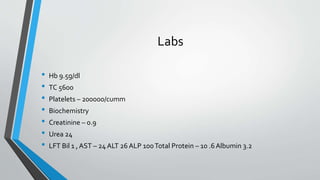
Labs
• Hb 9.5g/dl
• TC 5600
• Platelets – 200000/cumm
• Biochemistry
• Creatinine – 0.9
• Urea 24
• LFT Bil 1 , AST – 24 ALT 26 ALP 100Total Protein – 10 .6 Albumin 3.2
• Sodium 128 Chloride 106
• Potassium 4.2
• Glucose 108 mg / dl
• pT 10/0.8 aptt- 28
?????
• Moderate hyponatremia- Asymptomatic
Step 1 of evaluation
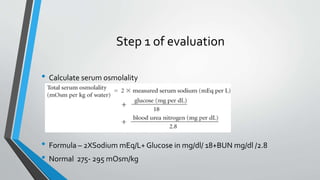
• Calculate serum osmolality
• Formula – 2XSodium mEq/L+ Glucose in mg/dl/ 18+BUN mg/dl /2.8
• Normal 275- 295 mOsm/kg
Further evaluation
• Serum osmolality :This test can help us get a better sense of our patient’s
tonicity in the setting of hyponatremia.
• The serum osmolality is 285 mOsm/kg. (normal range: 275 – 295 mOsm/kg)
So diagnosis………
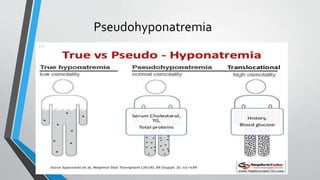
•Pseudohyponatremia---- Low
Sodium with increased or
normal Serum osmolality
• Blood Urea Nitrogen – Urea / 2 ( nitrogen contributes approx 46 % of
molecular weight of Urea CO (NH2)2
Pseudohyponatremia
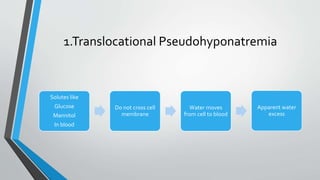
1.Translocational Pseudohyponatremia
Solutes like
Glucose
Mannitol
In blood
Do not cross cell
membrane
Water moves
from cell to blood
Apparent water
excess
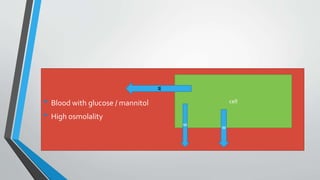
• Blood with glucose / mannitol
• High osmolality
cell
w w
w
2. Hyponatremia with normal osmolality
• Estimation with Flame spectrometry in serum with high lipids and proteins
• Present day – Ion sensitive electrode method- Accurate
Case 2
• A 38-year-old male in excellent health suffered a fall from a tree causing a
right leg fracture and blunt trauma to the head with concussion but no other
signs of head injury.The patient was discharged several days after surgery
for repair of his leg fracture. On 6 th day after his discharge he presented to
ER severely ill with nausea, vomiting, headache, and seizures.
• O/E patient drowsy GCS 10 / 15
• No edema
• Bp 120/70 PR 98 /min
• Afebrile
• Systems- CNS drowsy moves all 4 limbs
• Rest Normal
• Seizures ? Cause…. in post ictal confusion
A repeat CT brain- Normal
CBC/RFT – normal
Serum Sodium – 100meq/ L
Glucose 100
BUN- 24mg/dl
• Diagnosis – Hyponatremia induced seizure
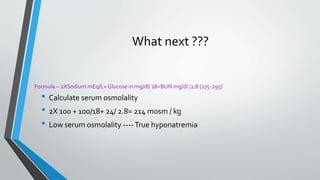
What next ???
• Calculate serum osmolality
• 2X 100 + 100/18+ 24/ 2.8= 214 mosm / kg
• Low serum osmolality ----True hyponatremia
Formula – 2XSodium mEq/L+ Glucose in mg/dl/ 18+BUN mg/dl /2.8 (275-295)
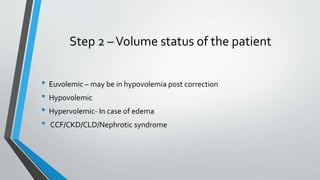
Step 2 –Volume status of the patient
• Euvolemic – may be in hypovolemia post correction
• Hypovolemic
• Hypervolemic- In case of edema
• CCF/CKD/CLD/Nephrotic syndrome
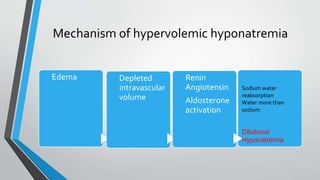
Mechanism of hypervolemic hyponatremia
Edema Depleted
intravascular
volume
Renin
Angiotensin
Aldosterone
activation
Sodium water
reabsorption
Water more than
sodium
Dilutional
Hyponatremia
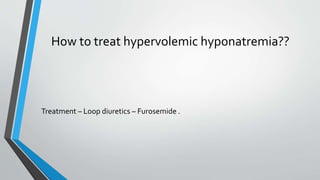
How to treat hypervolemic hyponatremia??
Treatment – Loop diuretics – Furosemide .
What if the patient is hypovolemic ???
Hypovolemic hyponatremia
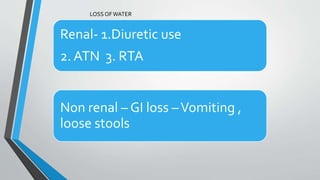
Renal- 1.Diuretic use
2. ATN 3. RTA
Non renal – GI loss –Vomiting ,
loose stools
LOSS OFWATER
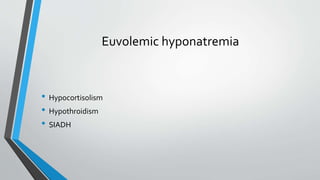
Euvolemic hyponatremia
• Hypocortisolism
• Hypothroidism
• SIADH
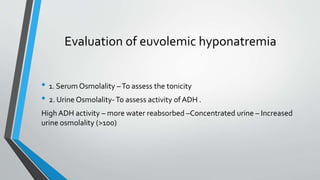
Evaluation of euvolemic hyponatremia
• 1. Serum Osmolality –To assess the tonicity
• 2. Urine Osmolality-To assess activity of ADH .
High ADH activity – more water reabsorbed –Concentrated urine – Increased
urine osmolality (>100)
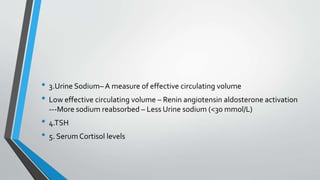
• 3.Urine Sodium– A measure of effective circulating volume
• Low effective circulating volume – Renin angiotensin aldosterone activation
---More sodium reabsorbed – Less Urine sodium (<30 mmol/L)
• 4.TSH
• 5. SerumCortisol levels
SIADH
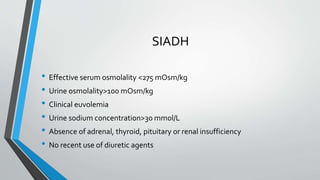
• Effective serum osmolality <275 mOsm/kg
• Urine osmolality>100 mOsm/kg
• Clinical euvolemia
• Urine sodium concentration>30 mmol/L
• Absence of adrenal, thyroid, pituitary or renal insufficiency
• No recent use of diuretic agents
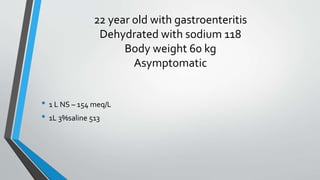
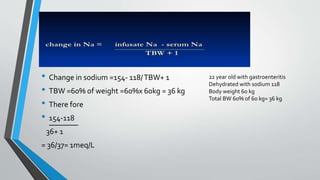
22 year old with gastroenteritis
Dehydrated with sodium 118
Body weight 60 kg
Asymptomatic
• 1 L NS – 154 meq/L
• 1L 3%saline 513
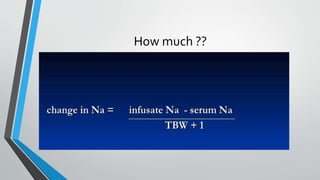
How much ??
• Change in sodium =154- 118/TBW+ 1
• TBW =60% of weight =60%x 60kg = 36 kg
• There fore
• 154-118
36+ 1
= 36/37= 1meq/L
22 year old with gastroenteritis
Dehydrated with sodium 118
Body weight 60 kg
Total BW 60% of 60 kg= 36 kg
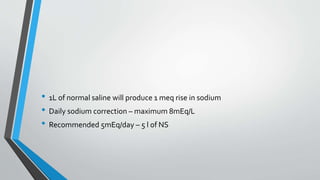
• 1L of normal saline will produce 1 meq rise in sodium
• Daily sodium correction – maximum 8mEq/L
• Recommended 5mEq/day – 5 l of NS
How to treat ???
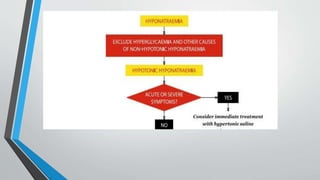
Treatment of hyponatremia with severe symptoms
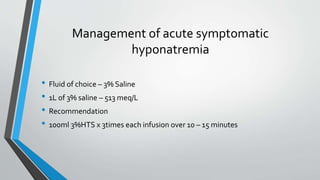
Management of acute symptomatic
hyponatremia
• Fluid of choice – 3% Saline
• 1L of 3% saline – 513 meq/L
• Recommendation
• 100ml 3%HTS x 3times each infusion over 10 – 15 minutes
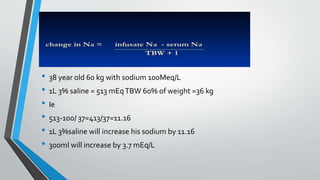
• 38 year old 60 kg with sodium 100Meq/L
• 1L 3% saline = 513 mEqTBW 60% of weight =36 kg
• Ie
• 513-100/ 37=413/37=11.16
• 1L 3%saline will increase his sodium by 11.16
• 300ml will increase by 3.7 mEq/L
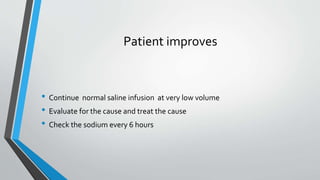
Patient improves
• Continue normal saline infusion at very low volume
• Evaluate for the cause and treat the cause
• Check the sodium every 6 hours
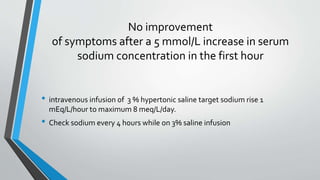
No improvement
of symptoms after a 5 mmol/L increase in serum
sodium concentration in the first hour
• intravenous infusion of 3 % hypertonic saline target sodium rise 1
mEq/L/hour to maximum 8 meq/L/day.
• Check sodium every 4 hours while on 3% saline infusion
Treatment of chronic hyponatremia
• If asymptomatic –brain shrinks in size to accommodate the edema
• 3% saline in chronic asymptomatic case or correction more than 8
mEq/L/day--- Further shrinking of brain – Further water from brain to CSF ---
Osmotic demyelination –
• Clinical symptoms-Dysarthria/ dysphagia/ paraparesis/ lethargy/confusion /
coma
Treatment of asymptomatic chronic
hyponatremia
• 1. Fluid restriction
• 2. Oral salts
• 3.Vaptans-V2 receptor antagonist—(v2- mediate anti diurectic response )
• ExampleTolvaptan 15mg once daily
• CI- CLD .AE : hepatotoxic
• May be used in hypervolemic also
• ThankYou
Reference
• Clinical practice guideline on diagnosis and treatment of hyponatraemia
Intensive Care Med (2014) 40:320–331 DOI 10.1007/s00134-014-3210-2
• Uptodate
• Harrison 20 th edition

Hyponatremia

  • 1.
    HYPONATREMIA DRVANDANAG HARI MBBSDNB RESIDENT DEPT OF HEMATOLOGY MADRAS MEDICAL COLLEGE
  • 2.
    HYPONATREMIA •Hyponatraemia, defined asa serum sodium concentration <135 mmol/L. •The most common disorder of body fluid and electrolyte balance encountered in clinical practice. •15–20 % of emergency admissions to hospital and occurs in up to 20 % of critically ill patients.
  • 3.
    DEFINITIONS •Mild hyponatraemia 130-135mmol/L as measured by ion specific electrode. •Moderate’ hyponatraemia 125-129 mmol/L as measured by ion specific electrode. •Profound’ hyponatraemia <125 mmol/L as measured by ion specific electrode.
  • 4.
    •Acute – Lessthan 48 hours •Chronic – More than 48 hours •Unknown consider as chronic
  • 5.
    Moderately severe • Nauseawithout vomiting • Confusion • Headache
  • 6.
    Severe • Vomiting • Cardio-respiratorydistress • Abnormal and deep somnolence • Seizures • Coma (Glasgow Coma Scale less than 8)
  • 7.
    Case History -1 •A 64 year-old man with a past medical history of hypertension, depression, and IgG lambda multiple myeloma presents to the hospital to initiate chemotherapy. • C/o tiredness
  • 8.
    • Physical examination •Pallor + • No edema • PR-90/min • BP 140/70mmhg • Systems – NAD
  • 9.
    Labs • Hb 9.5g/dl •TC 5600 • Platelets – 200000/cumm • Biochemistry • Creatinine – 0.9 • Urea 24 • LFT Bil 1 , AST – 24 ALT 26 ALP 100Total Protein – 10 .6 Albumin 3.2
  • 10.
    • Sodium 128Chloride 106 • Potassium 4.2 • Glucose 108 mg / dl • pT 10/0.8 aptt- 28
  • 11.
  • 12.
    Step 1 ofevaluation • Calculate serum osmolality • Formula – 2XSodium mEq/L+ Glucose in mg/dl/ 18+BUN mg/dl /2.8 • Normal 275- 295 mOsm/kg
  • 13.
    Further evaluation • Serumosmolality :This test can help us get a better sense of our patient’s tonicity in the setting of hyponatremia. • The serum osmolality is 285 mOsm/kg. (normal range: 275 – 295 mOsm/kg)
  • 14.
    So diagnosis……… •Pseudohyponatremia---- Low Sodiumwith increased or normal Serum osmolality
  • 15.
    • Blood UreaNitrogen – Urea / 2 ( nitrogen contributes approx 46 % of molecular weight of Urea CO (NH2)2
  • 16.
  • 17.
    1.Translocational Pseudohyponatremia Solutes like Glucose Mannitol Inblood Do not cross cell membrane Water moves from cell to blood Apparent water excess
  • 18.
    • Blood withglucose / mannitol • High osmolality cell w w w
  • 19.
    2. Hyponatremia withnormal osmolality • Estimation with Flame spectrometry in serum with high lipids and proteins • Present day – Ion sensitive electrode method- Accurate
  • 20.
    Case 2 • A38-year-old male in excellent health suffered a fall from a tree causing a right leg fracture and blunt trauma to the head with concussion but no other signs of head injury.The patient was discharged several days after surgery for repair of his leg fracture. On 6 th day after his discharge he presented to ER severely ill with nausea, vomiting, headache, and seizures.
  • 21.
    • O/E patientdrowsy GCS 10 / 15 • No edema • Bp 120/70 PR 98 /min • Afebrile • Systems- CNS drowsy moves all 4 limbs • Rest Normal
  • 22.
    • Seizures ?Cause…. in post ictal confusion
  • 23.
    A repeat CTbrain- Normal CBC/RFT – normal Serum Sodium – 100meq/ L Glucose 100 BUN- 24mg/dl
  • 24.
    • Diagnosis –Hyponatremia induced seizure
  • 25.
    What next ??? •Calculate serum osmolality • 2X 100 + 100/18+ 24/ 2.8= 214 mosm / kg • Low serum osmolality ----True hyponatremia Formula – 2XSodium mEq/L+ Glucose in mg/dl/ 18+BUN mg/dl /2.8 (275-295)
  • 26.
    Step 2 –Volumestatus of the patient • Euvolemic – may be in hypovolemia post correction • Hypovolemic • Hypervolemic- In case of edema • CCF/CKD/CLD/Nephrotic syndrome
  • 27.
    Mechanism of hypervolemichyponatremia Edema Depleted intravascular volume Renin Angiotensin Aldosterone activation Sodium water reabsorption Water more than sodium Dilutional Hyponatremia
  • 28.
    How to treathypervolemic hyponatremia?? Treatment – Loop diuretics – Furosemide .
  • 29.
    What if thepatient is hypovolemic ???
  • 30.
    Hypovolemic hyponatremia Renal- 1.Diureticuse 2. ATN 3. RTA Non renal – GI loss –Vomiting , loose stools LOSS OFWATER
  • 31.
  • 32.
    Evaluation of euvolemichyponatremia • 1. Serum Osmolality –To assess the tonicity • 2. Urine Osmolality-To assess activity of ADH . High ADH activity – more water reabsorbed –Concentrated urine – Increased urine osmolality (>100)
  • 33.
    • 3.Urine Sodium–A measure of effective circulating volume • Low effective circulating volume – Renin angiotensin aldosterone activation ---More sodium reabsorbed – Less Urine sodium (<30 mmol/L) • 4.TSH • 5. SerumCortisol levels
  • 34.
    SIADH • Effective serumosmolality <275 mOsm/kg • Urine osmolality>100 mOsm/kg • Clinical euvolemia • Urine sodium concentration>30 mmol/L • Absence of adrenal, thyroid, pituitary or renal insufficiency • No recent use of diuretic agents
  • 35.
    22 year oldwith gastroenteritis Dehydrated with sodium 118 Body weight 60 kg Asymptomatic • 1 L NS – 154 meq/L • 1L 3%saline 513
  • 36.
  • 37.
    • Change insodium =154- 118/TBW+ 1 • TBW =60% of weight =60%x 60kg = 36 kg • There fore • 154-118 36+ 1 = 36/37= 1meq/L 22 year old with gastroenteritis Dehydrated with sodium 118 Body weight 60 kg Total BW 60% of 60 kg= 36 kg
  • 38.
    • 1L ofnormal saline will produce 1 meq rise in sodium • Daily sodium correction – maximum 8mEq/L • Recommended 5mEq/day – 5 l of NS
  • 40.
    How to treat??? Treatment of hyponatremia with severe symptoms
  • 41.
    Management of acutesymptomatic hyponatremia • Fluid of choice – 3% Saline • 1L of 3% saline – 513 meq/L • Recommendation • 100ml 3%HTS x 3times each infusion over 10 – 15 minutes
  • 42.
    • 38 yearold 60 kg with sodium 100Meq/L • 1L 3% saline = 513 mEqTBW 60% of weight =36 kg • Ie • 513-100/ 37=413/37=11.16 • 1L 3%saline will increase his sodium by 11.16 • 300ml will increase by 3.7 mEq/L
  • 43.
    Patient improves • Continuenormal saline infusion at very low volume • Evaluate for the cause and treat the cause • Check the sodium every 6 hours
  • 44.
    No improvement of symptomsafter a 5 mmol/L increase in serum sodium concentration in the first hour • intravenous infusion of 3 % hypertonic saline target sodium rise 1 mEq/L/hour to maximum 8 meq/L/day. • Check sodium every 4 hours while on 3% saline infusion
  • 45.
    Treatment of chronichyponatremia • If asymptomatic –brain shrinks in size to accommodate the edema • 3% saline in chronic asymptomatic case or correction more than 8 mEq/L/day--- Further shrinking of brain – Further water from brain to CSF --- Osmotic demyelination – • Clinical symptoms-Dysarthria/ dysphagia/ paraparesis/ lethargy/confusion / coma
  • 46.
    Treatment of asymptomaticchronic hyponatremia • 1. Fluid restriction • 2. Oral salts • 3.Vaptans-V2 receptor antagonist—(v2- mediate anti diurectic response ) • ExampleTolvaptan 15mg once daily • CI- CLD .AE : hepatotoxic • May be used in hypervolemic also
  • 47.
  • 48.
    Reference • Clinical practiceguideline on diagnosis and treatment of hyponatraemia Intensive Care Med (2014) 40:320–331 DOI 10.1007/s00134-014-3210-2 • Uptodate • Harrison 20 th edition