HYPONATREMIA-
approach
&
management
Presented by,
Dr Zakeena S
II year DNB Resident
General Medicine
Govt. HQ hospital,
Cuddalore.
OVERVIEW
• Introduction
• Etiopathogenesis
• Types
• Clinical features
• Management
• Complications
INTRODUCTION
• Disorders of serum sodium concentration are
caused by abnormalities of water homeostasis.
• Water intake and circulating AVP- defense
mechanisms to maintain serum osmolality.
• Hyponatremia- plasma Na+ <135 mEq/L.
• Occurs due to
– Increase in circulating AVP +/_
– Increased renal sensitivity to AVP +
– Intake of free water (except low solute intake)
ETIOPATHOGENESIS
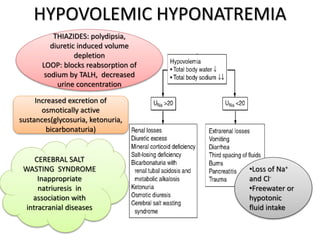
HYPOVOLEMIC HYPONATREMIA
THIAZIDES: polydipsia,
diuretic induced volume
depletion
LOOP: blocks reabsorption of
sodium by TALH, decreased
urine concentration
Increased excretion of
osmotically active
sustances(glycosuria, ketonuria,
bicarbonaturia)
CEREBRAL SALT
WASTING SYNDROME
Inappropriate
natriuresis in
association with
intracranial diseases
•Loss of Na+
and Cl-
•Freewater or
hypotonic
fluid intake
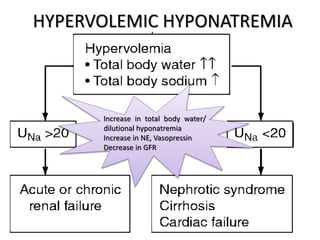
HYPERVOLEMIC HYPONATREMIA
Increase in total body water/
dilutional hyponatremia
Increase in NE, Vasopressin
Decrease in GFR
EUVOLEMIC HYPONATREMIA
Glucocorticoid exert
negative feedback on
AVP(1o adrenal deficiency)
reducing circulating AVP
Moderate to
severe
hypothyroidism
after correction
to euthyroid
state
Decreased CO
Increased
Vasopressin
Decrese in GFR
SIADH:
•Persistent free water intake at
serum osmolalities lower than the
threshold for thirst.
•Unregulated and erratic AVP
secretion with a normal or lower
or unrelated osmolility.
•Usually associated with
subclinically volume expanded
due to AVP induced water and
Na+ _ Cl- retention.
•Causes:
•Pulmonary(TB, pneumonia,
asthma)
•CNS(meningitis, Encephalitis,
abscess, malignancy,GBS, MS)
•Malignancy(SCC lung, GIT
Carcinoma, thymomas,
lymphomas)
•Drugs(SSRI,TCA, NSAIDS, CBZ,
etc.,)
•Hereditary, idiopathic
BEER PROTOMANIA
• Occurs in patients with very low intake of
dietary solutes.
• Causes:
– Beer protomania
– Nutrient restricted diets(extreme vegetarians)
• Hyponatremia is associated with very low
urine osmolality(<100-200 mOsm/kg) and
urine sodium <10-20 mEq/L.
• Recovery with resumption to normal diet and
saline rehydration.
PSEUDOHYPONATREMIA
• Low sodium with normal/high osmolality
• Causes:
– Translocational hyponatremia due to presence of
effective solutes in plasma eg., glucose, maltose,
glycine, mannitol
– Methodology used for sodium measurement eg.,
Flame spectrophotometry-presence of lipids and
proteins can give a false decrease in sodium
values. Avoided by using other methods such as
ion sensitive electrodes.
CLINICAL FEATURES
• ACUTE HYPONATREMIA:
Causes: Presentation:
• Acute hyponatremic
encephalopathy
• Acute cerebral edema
– Nausea, vomiting
– Headache
– Seizures
– Brainstem herniation
leading to coma
– Normocapneic or
hypercapneic respiratory
failure
– Noncardiogenic, neurogenic
pulmonary edema
• CHRONIC HYPONATREMIA:
– Asymptomatic with subtle gait and cognitive
disturbances
– Nausea,vomiting
– Confusion
– Seizures
– Recurrent falls
– Risk of bony fractures due to hyponatremia
associated reduction in bone density.
SODIUM LEVELS AND CLINICAL MANIFESTATIONS
120-125 mEq/L
• Asymptomatic
115-120/125 mEq/L
• GI symptoms
• Anorexia
• Nausea, vomiting
• Abdominal cramps
<110-115 mEq/L
•Mild neurological symptoms
•Agitation
•Confusion, decreased concentration
•Dizziness
•Ataxia
<100-105 mEq/L
•Serious neurological symptoms
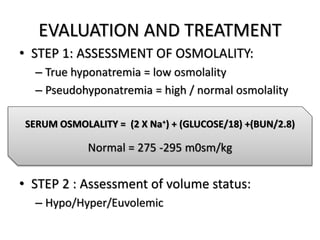
EVALUATION AND TREATMENT
• STEP 1: ASSESSMENT OF OSMOLALITY:
– True hyponatremia = low osmolality
– Pseudohyponatremia = high / normal osmolality
• STEP 2 : Assessment of volume status:
– Hypo/Hyper/Euvolemic
SERUM OSMOLALITY = (2 X Na+) + (GLUCOSE/18) +(BUN/2.8)
Normal = 275 -295 m0sm/kg
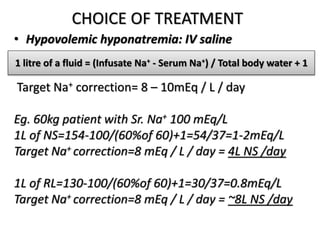
CHOICE OF TREATMENT
• Hypovolemic hyponatremia: IV saline
Target Na+ correction= 8 – 10mEq / L / day
Eg. 60kg patient with Sr. Na+ 100 mEq/L
1L of NS=154-100/(60%of 60)+1=54/37=1-2mEq/L
Target Na+ correction=8 mEq / L / day = 4L NS /day
1L of RL=130-100/(60%of 60)+1=30/37=0.8mEq/L
Target Na+ correction=8 mEq / L / day = ~8L NS /day
1 litre of a fluid = (Infusate Na+ - Serum Na+) / Total body water + 1
• Acute euvolemic hyponatremia: 3% NaCl
100ml of 3% NaCl = 51.3 mEq of Na+
Eg. 60kg euvolemic patient with Sr. Na+ 95 mEq/L
I method:
1L of 3% NaCl =513-95/(60%of 60)+1
=418/37 = 12mEq/L
100ml 3% NaCl over 10 min repeated thrice rise
Na+ by 3-4 mEq/L
II method: 24 hrs correction
1L of 3% NaCl = 11-12mEq/L
Target Na+ correction= 8 – 10mEq / L / day
# for increasing Sr. Na by 8 mEq=1/8
=0.7L or 700ml over 24hrs
=1 bottle 3%NaCl every 3.25hrs
• Chronic euvolemic hyponatremia (post 48hrs)
– If symptomatic similar management as acute one.
– If stable or mild neurological symptoms water restriction
based on
>1 = <500ml/day
~1 = 500-700 ml/day
>1 = <1L/day
o If corrected with 3%NaCl, central pontine myelinosis/osmotic
demyelination syndrome occurs due further shrinkage of brain.
Associated hypokalemia correction tends to overcorrect
sodium.
 increase in dietary solute intake: oral salt tablets,
palatable urea
Urine-to-plasma electrolyte ratio={Urine [Na+]+[K+]} / Plasma [Na+]
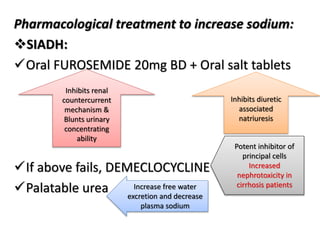
Pharmacological treatment to increase sodium:
SIADH:
Oral FUROSEMIDE 20mg BD + Oral salt tablets
If above fails, DEMECLOCYCLINE
Palatable urea
Inhibits renal
countercurrent
mechanism &
Blunts urinary
concentrating
ability
Inhibits diuretic
associated
natriuresis
Potent inhibitor of
principal cells
Increased
nephrotoxicity in
cirrhosis patients
Increase free water
excretion and decrease
plasma sodium
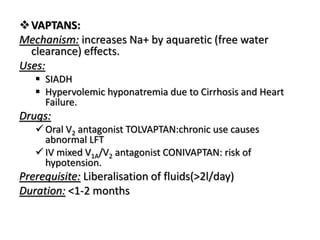
VAPTANS:
Mechanism: increases Na+ by aquaretic (free water
clearance) effects.
Uses:
 SIADH
 Hypervolemic hyponatremia due to Cirrhosis and Heart
Failure.
Drugs:
 Oral V2 antagonist TOLVAPTAN:chronic use causes
abnormal LFT
 IV mixed V1A/V2 antagonist CONIVAPTAN: risk of
hypotension.
Prerequisite: Liberalisation of fluids(>2l/day)
Duration: <1-2 months
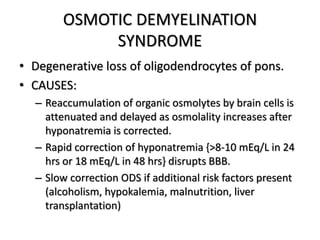
OSMOTIC DEMYELINATION
SYNDROME
• Degenerative loss of oligodendrocytes of pons.
• CAUSES:
– Reaccumulation of organic osmolytes by brain cells is
attenuated and delayed as osmolality increases after
hyponatremia is corrected.
– Rapid correction of hyponatremia {>8-10 mEq/L in 24
hrs or 18 mEq/L in 48 hrs} disrupts BBB.
– Slow correction ODS if additional risk factors present
(alcoholism, hypokalemia, malnutrition, liver
transplantation)
CLINICAL FEATURES:
• Central pontine
myelinosis one or more
days after
overcorrection
• Para/quadriparesis
• Dysphagia
• Dysarthria
• Diplopia
• Locked-in-
syndrome
• Loss of
consciousness
• Extra pontine
myelinosis
• Ataxia
• Mutism
• Dystonia
• Catatonia
• Parkinsonism.
KEY POINTS
• Acute = NS / 3% saline
• Chronic symptomatic = 3% saline
• Chronic asymptomatic = water deprivation
Thank you…

HYPONATREMIA.pptx

  • 1.
    HYPONATREMIA- approach & management Presented by, Dr ZakeenaS II year DNB Resident General Medicine Govt. HQ hospital, Cuddalore.
  • 2.
    OVERVIEW • Introduction • Etiopathogenesis •Types • Clinical features • Management • Complications
  • 3.
    INTRODUCTION • Disorders ofserum sodium concentration are caused by abnormalities of water homeostasis. • Water intake and circulating AVP- defense mechanisms to maintain serum osmolality. • Hyponatremia- plasma Na+ <135 mEq/L. • Occurs due to – Increase in circulating AVP +/_ – Increased renal sensitivity to AVP + – Intake of free water (except low solute intake)
  • 4.
  • 5.
    HYPOVOLEMIC HYPONATREMIA THIAZIDES: polydipsia, diureticinduced volume depletion LOOP: blocks reabsorption of sodium by TALH, decreased urine concentration Increased excretion of osmotically active sustances(glycosuria, ketonuria, bicarbonaturia) CEREBRAL SALT WASTING SYNDROME Inappropriate natriuresis in association with intracranial diseases •Loss of Na+ and Cl- •Freewater or hypotonic fluid intake
  • 6.
    HYPERVOLEMIC HYPONATREMIA Increase intotal body water/ dilutional hyponatremia Increase in NE, Vasopressin Decrease in GFR
  • 7.
    EUVOLEMIC HYPONATREMIA Glucocorticoid exert negativefeedback on AVP(1o adrenal deficiency) reducing circulating AVP Moderate to severe hypothyroidism after correction to euthyroid state Decreased CO Increased Vasopressin Decrese in GFR SIADH: •Persistent free water intake at serum osmolalities lower than the threshold for thirst. •Unregulated and erratic AVP secretion with a normal or lower or unrelated osmolility. •Usually associated with subclinically volume expanded due to AVP induced water and Na+ _ Cl- retention. •Causes: •Pulmonary(TB, pneumonia, asthma) •CNS(meningitis, Encephalitis, abscess, malignancy,GBS, MS) •Malignancy(SCC lung, GIT Carcinoma, thymomas, lymphomas) •Drugs(SSRI,TCA, NSAIDS, CBZ, etc.,) •Hereditary, idiopathic
  • 8.
    BEER PROTOMANIA • Occursin patients with very low intake of dietary solutes. • Causes: – Beer protomania – Nutrient restricted diets(extreme vegetarians) • Hyponatremia is associated with very low urine osmolality(<100-200 mOsm/kg) and urine sodium <10-20 mEq/L. • Recovery with resumption to normal diet and saline rehydration.
  • 9.
    PSEUDOHYPONATREMIA • Low sodiumwith normal/high osmolality • Causes: – Translocational hyponatremia due to presence of effective solutes in plasma eg., glucose, maltose, glycine, mannitol – Methodology used for sodium measurement eg., Flame spectrophotometry-presence of lipids and proteins can give a false decrease in sodium values. Avoided by using other methods such as ion sensitive electrodes.
  • 10.
    CLINICAL FEATURES • ACUTEHYPONATREMIA: Causes: Presentation: • Acute hyponatremic encephalopathy • Acute cerebral edema – Nausea, vomiting – Headache – Seizures – Brainstem herniation leading to coma – Normocapneic or hypercapneic respiratory failure – Noncardiogenic, neurogenic pulmonary edema
  • 11.
    • CHRONIC HYPONATREMIA: –Asymptomatic with subtle gait and cognitive disturbances – Nausea,vomiting – Confusion – Seizures – Recurrent falls – Risk of bony fractures due to hyponatremia associated reduction in bone density.
  • 12.
    SODIUM LEVELS ANDCLINICAL MANIFESTATIONS 120-125 mEq/L • Asymptomatic 115-120/125 mEq/L • GI symptoms • Anorexia • Nausea, vomiting • Abdominal cramps <110-115 mEq/L •Mild neurological symptoms •Agitation •Confusion, decreased concentration •Dizziness •Ataxia <100-105 mEq/L •Serious neurological symptoms
  • 13.
    EVALUATION AND TREATMENT •STEP 1: ASSESSMENT OF OSMOLALITY: – True hyponatremia = low osmolality – Pseudohyponatremia = high / normal osmolality • STEP 2 : Assessment of volume status: – Hypo/Hyper/Euvolemic SERUM OSMOLALITY = (2 X Na+) + (GLUCOSE/18) +(BUN/2.8) Normal = 275 -295 m0sm/kg
  • 14.
    CHOICE OF TREATMENT •Hypovolemic hyponatremia: IV saline Target Na+ correction= 8 – 10mEq / L / day Eg. 60kg patient with Sr. Na+ 100 mEq/L 1L of NS=154-100/(60%of 60)+1=54/37=1-2mEq/L Target Na+ correction=8 mEq / L / day = 4L NS /day 1L of RL=130-100/(60%of 60)+1=30/37=0.8mEq/L Target Na+ correction=8 mEq / L / day = ~8L NS /day 1 litre of a fluid = (Infusate Na+ - Serum Na+) / Total body water + 1
  • 15.
    • Acute euvolemichyponatremia: 3% NaCl 100ml of 3% NaCl = 51.3 mEq of Na+ Eg. 60kg euvolemic patient with Sr. Na+ 95 mEq/L I method: 1L of 3% NaCl =513-95/(60%of 60)+1 =418/37 = 12mEq/L 100ml 3% NaCl over 10 min repeated thrice rise Na+ by 3-4 mEq/L
  • 16.
    II method: 24hrs correction 1L of 3% NaCl = 11-12mEq/L Target Na+ correction= 8 – 10mEq / L / day # for increasing Sr. Na by 8 mEq=1/8 =0.7L or 700ml over 24hrs =1 bottle 3%NaCl every 3.25hrs
  • 17.
    • Chronic euvolemichyponatremia (post 48hrs) – If symptomatic similar management as acute one. – If stable or mild neurological symptoms water restriction based on >1 = <500ml/day ~1 = 500-700 ml/day >1 = <1L/day o If corrected with 3%NaCl, central pontine myelinosis/osmotic demyelination syndrome occurs due further shrinkage of brain. Associated hypokalemia correction tends to overcorrect sodium.  increase in dietary solute intake: oral salt tablets, palatable urea Urine-to-plasma electrolyte ratio={Urine [Na+]+[K+]} / Plasma [Na+]
  • 18.
    Pharmacological treatment toincrease sodium: SIADH: Oral FUROSEMIDE 20mg BD + Oral salt tablets If above fails, DEMECLOCYCLINE Palatable urea Inhibits renal countercurrent mechanism & Blunts urinary concentrating ability Inhibits diuretic associated natriuresis Potent inhibitor of principal cells Increased nephrotoxicity in cirrhosis patients Increase free water excretion and decrease plasma sodium
  • 19.
    VAPTANS: Mechanism: increases Na+by aquaretic (free water clearance) effects. Uses:  SIADH  Hypervolemic hyponatremia due to Cirrhosis and Heart Failure. Drugs:  Oral V2 antagonist TOLVAPTAN:chronic use causes abnormal LFT  IV mixed V1A/V2 antagonist CONIVAPTAN: risk of hypotension. Prerequisite: Liberalisation of fluids(>2l/day) Duration: <1-2 months
  • 20.
    OSMOTIC DEMYELINATION SYNDROME • Degenerativeloss of oligodendrocytes of pons. • CAUSES: – Reaccumulation of organic osmolytes by brain cells is attenuated and delayed as osmolality increases after hyponatremia is corrected. – Rapid correction of hyponatremia {>8-10 mEq/L in 24 hrs or 18 mEq/L in 48 hrs} disrupts BBB. – Slow correction ODS if additional risk factors present (alcoholism, hypokalemia, malnutrition, liver transplantation)
  • 21.
    CLINICAL FEATURES: • Centralpontine myelinosis one or more days after overcorrection • Para/quadriparesis • Dysphagia • Dysarthria • Diplopia • Locked-in- syndrome • Loss of consciousness • Extra pontine myelinosis • Ataxia • Mutism • Dystonia • Catatonia • Parkinsonism.
  • 22.
    KEY POINTS • Acute= NS / 3% saline • Chronic symptomatic = 3% saline • Chronic asymptomatic = water deprivation
  • 23.

Editor's Notes

  • #6 Water and sodium gets lost either renal or extra renal mechanisms. Cerebral salt wasting:SAH, trauma, craniotomy ,meningitis, encephalitis.