The Scientific Method
According to Hockenbury and Hockenbury
(2014) “The scientific method is a set of
assumptions, attitudes, and procedures that
guides all scientists, including
psychologists, in conducting research. (p.
117)”
Psychology
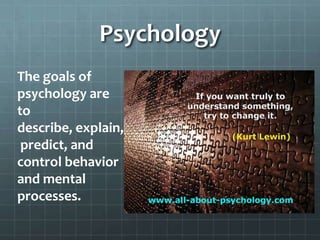
The goals of
psychology are
to
describe, explain,
predict, and
control behavior
and mental
processes.
Steps of the Scientific
Method
Formulate a Question that can be Tested
Do Background Research and Formulate a
Hypothesis
Design a Study to Collect Data
Analyze the Data
Report the Results
Step 1
Formulate a
question that can
be tested
Observations
Consider Variables
Operational
Definitions
Step 2
Background Research
What has been done
already and what
have they found?
Formulate a Hypothesis
Statement about
relationship between
variables
Step 3
Design a Study to
Collect Data
Research Methods
Descriptive Methods
Naturalistic Observation
Surveys
Case Studies
Correlational Studies
Experimental Method
Shows cause and Effect
Step 4
Analyze the Data
Statistics
Statistically significant
Results are not by
chance
Confirms hypothesis
Draw Conclusions
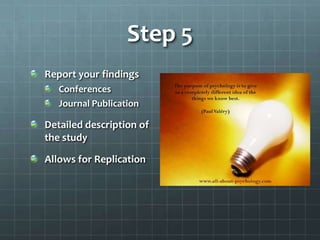
Step 5
Report your findings
Conferences
Journal Publication
Detailed description of
the study
Allows for Replication
References
Hockenbury, D. H. and Hockenbury, S. E. (2014).
Discovering Psychology, 6th Ed. New York, NY: Worth
Publishers.
All Images free for sharing. For more information
please see: http://creativecommons.org/licenses/by-
nc/2.0/

Scientific method Powerpoint

  • 1.
  • 2.
    The Scientific Method Accordingto Hockenbury and Hockenbury (2014) “The scientific method is a set of assumptions, attitudes, and procedures that guides all scientists, including psychologists, in conducting research. (p. 117)”
  • 3.
    Psychology The goals of psychologyare to describe, explain, predict, and control behavior and mental processes.
  • 4.
    Steps of theScientific Method Formulate a Question that can be Tested Do Background Research and Formulate a Hypothesis Design a Study to Collect Data Analyze the Data Report the Results
  • 5.
    Step 1 Formulate a questionthat can be tested Observations Consider Variables Operational Definitions
  • 6.
    Step 2 Background Research Whathas been done already and what have they found? Formulate a Hypothesis Statement about relationship between variables
  • 7.
    Step 3 Design aStudy to Collect Data Research Methods Descriptive Methods Naturalistic Observation Surveys Case Studies Correlational Studies Experimental Method Shows cause and Effect
  • 8.
    Step 4 Analyze theData Statistics Statistically significant Results are not by chance Confirms hypothesis Draw Conclusions
  • 9.
    Step 5 Report yourfindings Conferences Journal Publication Detailed description of the study Allows for Replication
  • 10.
    References Hockenbury, D. H.and Hockenbury, S. E. (2014). Discovering Psychology, 6th Ed. New York, NY: Worth Publishers. All Images free for sharing. For more information please see: http://creativecommons.org/licenses/by- nc/2.0/