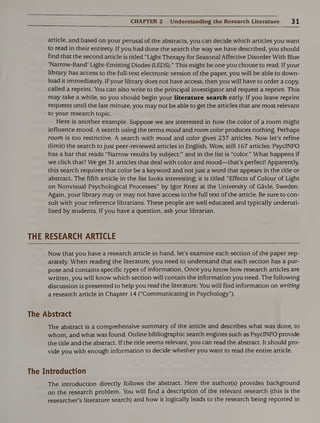
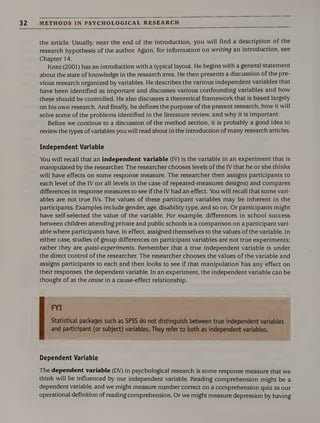
Methods In Psychological Research 3rd Edition Annabel Ness Evans
Methods In Psychological Research 3rd Edition Annabel Ness Evans
Methods In Psychological Research 3rd Edition Annabel Ness Evans
Methods In Psychological Research 3rd Edition Annabel Ness Evans
Methods In Psychological Research 3rd Edition Annabel Ness Evans
1.
Methods In PsychologicalResearch 3rd Edition
Annabel Ness Evans download
https://ebookbell.com/product/methods-in-psychological-
research-3rd-edition-annabel-ness-evans-11751462
Explore and download more ebooks at ebookbell.com
2.
Here are somerecommended products that we believe you will be
interested in. You can click the link to download.
Apa Handbook Of Research Methods In Psychology Vol 1 Foundations
Planning Measures And Psychometrics 1st Ed Onlineausg Harris M Cooper
https://ebookbell.com/product/apa-handbook-of-research-methods-in-
psychology-vol-1-foundations-planning-measures-and-psychometrics-1st-
ed-onlineausg-harris-m-cooper-37318778
Apa Handbook Of Research Methods In Psychology Research Designs
Quantitative Qualitative Neuropsychological And Biological 2nd Edition
Harris M Cooper
https://ebookbell.com/product/apa-handbook-of-research-methods-in-
psychology-research-designs-quantitative-qualitative-
neuropsychological-and-biological-2nd-edition-harris-m-cooper-51423366
Beyond Significance Testing Reforming Data Analysis Methods In
Behavioral Research 1st Edition Rex B Kline
https://ebookbell.com/product/beyond-significance-testing-reforming-
data-analysis-methods-in-behavioral-research-1st-edition-rex-b-
kline-1621416
Laboratory Animals In Research And Teaching Ethics Care And Methods
1st Ed Chana K Akins
https://ebookbell.com/product/laboratory-animals-in-research-and-
teaching-ethics-care-and-methods-1st-ed-chana-k-akins-1399798
3.
Key Topics InPsychological Methods Springer Behavioral Health
Sciences
https://ebookbell.com/product/key-topics-in-psychological-methods-
springer-behavioral-health-sciences-47138220
The Nature Of Work Advances In Psychological Theory Methods And
Practice John Kevin Ford
https://ebookbell.com/product/the-nature-of-work-advances-in-
psychological-theory-methods-and-practice-john-kevin-ford-150131508
Team Cohesion Advances In Psychological Theory Methods And Practice
First Edition Estrada
https://ebookbell.com/product/team-cohesion-advances-in-psychological-
theory-methods-and-practice-first-edition-estrada-11814736
Training And Supervision In Specialized Cognitive Behavior Therapy
Methods Settings And Populations Eric A Storch
https://ebookbell.com/product/training-and-supervision-in-specialized-
cognitive-behavior-therapy-methods-settings-and-populations-eric-a-
storch-52458954
Apa Handbook Of Comparative Psychology Vol 1 Basic Concepts Methods
Neural Substrate And Behavior Vol 2 Perception Learning And Cognition
Apa Handbooks In Psychology 1st Edition Josep Call
https://ebookbell.com/product/apa-handbook-of-comparative-psychology-
vol-1-basic-concepts-methods-neural-substrate-and-behavior-
vol-2-perception-learning-and-cognition-apa-handbooks-in-
psychology-1st-edition-josep-call-5856770
Brief Contents
Preface xiii
Acknowledgmentsxv
1. Introduction to Research in Psychology 1
2. Understanding the Research Literature 27
3. Research in Psychology: An Ethical Enterprise 51
4. Hypothesis Testing, Power, and Control: A Review of the Basics 76
5. Measuring Variables 97
6. Selecting Research Participants 119
7. Experimental Design: Independent Groups Designs 133
8. Experimental Design: Dependent Groups and Mixed Groups Designs 158
9. Experimental Design: Single-Participant Designs/The Operant Approach 175
10. Finding Relationships Among Variables: Nonexperimental Research 193
11. Data Collection Methods 219
12. Program Evaluation, Archival Research, and Meta-Analytic Designs 255
13. Your Research Project: Analyzing, Interpreting, and Presenting Your Research 270
14. Communicating in Psychology 324
Glossary 366
Index 377
About the Authors 387
12.
Detailed Contents
Preface xiii
Acknowledgmentsxv
Introduction to Research in Psychology 1
Objectives 2
Acquiring Knowledge About the World 2
Tradition or Tenacity: I Believe It Is True Because It Has Always Been True 3
Intuition: I Believe It Is True Because I Feel It Is True 3
Authority: I Believe It Is True Because an "Expert" Says It Is True 4
Reasoning: I Believe It Is True Because It Is Logically Derived 4
Empiricism: I Believe It Is True Because I Experienced It 5
Science 5
Psychology—Science and Art 6
Critical Thinking 6
The Critical Thinking Process 7
Objectives of Science 9
To Describe 9
To Explain 9
To Predict 9
To Control 10
The Tenets of Science 10
Determinism 10
Empiricism 10
Replicability 11
Falsifiability 11
Parsimony 11
The Scientific Method 12
Theories, Concepts, and Hypotheses 13
Why We Do Research 14
To Evaluate a Theory 14
To Satisfy Our Curiosity 14
To Demonstrate a New Technique 15
13.
To Demonstrate aBehavioral Phenomenon 15
To Investigate the Conditions Influencing Behavioral Phenomena
Approaches to Research 15
Descriptive Versus Explanatory Research 16
Quantitative Versus Qualitative Research 16
Basic Versus Applied Research 16
Cross-Sectional Versus Longitudinal Research 17
Field Versus Laboratory Research 17
Steps in Planning and Doing Research 18
Selecting a Research Topic 18
Generating Testable Hypotheses 19
Classifying Variables 20
Selecting an Appropriate Design 20
Planning the Method and Carrying It Out 20
Analyzing Results 21
Drawing Conclusions 21
Sharing Your Findings 21
Chapter Summary 21
ANSWERS TO CONCEPTUAL EXERCISES 22
FAQ 23
CHAPTER EXERCISES 24
CHAPTER PROJECTS 25
REFERENCES 26
Understanding the Research Literature 27
Objectives 28
Searching the Literature 28
The Research Article 31
The Abstract 31
The Introduction 31
The Method Section 34
The Results 35
The Discussion 39
Chapter Summary 48
ANSWERS TO CONCEPTUAL EXERCISES 49
FAQ 49
CHAPTER EXERCISES 49
CHAPTER PROJECTS 50
REFERENCES 50
Research in Psychology: An Ethical Enterprise 51__
Objectives 51
General Principles 52
Principle A: Beneficence and Nonmaleficence 53
Principle B: Fidelity and Responsibility 53
14.
Principle C: Integrity53
Principle D: Justice 54
Principle E: Respect for People's Rights and Dignity 54
Ethical Standards 55
2. Competence 55
3. Human Relations 56
4. Privacy and Confidentiality 61
8. Research and Publication 63
Special Populations 70
Internet Research 70
Bias and Intellectual Honesty 71
Chapter Summary 71
ANSWERS TO CONCEPTUAL EXERCISES 72
FAQ 73
CHAPTER EXERCISES 74
CHAPTER PROJECTS 75
REFERENCES 75
Hypothesis Testing, Power, and Control: A Review of the Basics
Objectives 76
Three Levels of Hypotheses 77
Testing the Null Hypothesis 78
Statistical Significance 79
Inferential Errors: Type I and Type II 80
Power and How to Increase It 82
Effect Size 84
Power and the Role of Replication in Research 86
External and Internal Validity 87
Confounding and Extraneous Variables 88
Controlling Extraneous Variables 89
Chapter Summary 91
ANSWERS TO CONCEPTUAL EXERCISES 92
FAQ 93
CHAPTER EXERCISES 95
CHAPTER PROJECTS 95
REFERENCES 96
Measuring Variables 97
Objectives 98
Ways of Asking Questions 99
Fixed Alternative Questions 99
Open-Ended Questions 100
Rating Scales 100
Likert Scales 101
15.
Semantic Differential 102
SocialDesirability and Response Set 102
Measuring Observed Behavior 103
Levels of Measurement 103
The Importance of Precision in Measurement 106
Reliability of Measurement 108
Validity of Measurement 108
Tests, Scales, and Inventories 110
Commercially Available Tests and Inventories 110
Standardized Tests of Intelligence 110
Tests of Personality 111
Chapter Summary 113
ANSWERS TO CONCEPTUAL EXERCISES 114
FAQ 115
CHAPTER EXERCISES 117
CHAPTER PROJECTS 117
REFERENCES 118
Selecting Research Participants 119
Objectives 119
Sampling Methods 120
Probability Sampling 120
Nonprobability Sampling 125
Sample and Effect Size 127
Power Revisited 129
Chapter Summary 129
ANSWERS TO CONCEPTUAL EXERCISES 130
FAQ 130
CHAPTER EXERCISES 131
CHAPTER PROJECTS 132
REFERENCE 132
Experimental Design: Independent Groups Designs 133
Objectives 133
Why We Do Experiments 134
Steps in Conducting an Experiment 135
Where We Do Experiments 137
How We Do Experiments: Independent Groups Designs 139
Completely Randomized Groups Designs: One IV 139
Randomized Factorial Groups Designs: More Than One IV 145
Chapter Summary 153
ANSWERS TO CONCEPTUAL EXERCISES 154
FAQ 154
CHAPTER EXERCISES 156
16.
CHAPTER PROJECTS 156
REFERENCES157
8 Experimental Design: Dependent Groups and Mixed Groups Designs 158
Objectives 158
Dependent Groups Designs 159
Within-Participants Designs 159
Matched Groups Designs 163
Mixed Designs 167
Chapter Summary 172
ANSWER TO CONCEPTUAL EXERCISE 172
FAQ 172
CHAPTER EXERCISES 173
CHAPTER PROJECTS 173
REFERENCES 174
9 Experimental Design: Single-Participant Designs/The Operant Approach 175
Objectives 175
Single-Participant Design and the Experimental Analysis of Behavior 176
Concepts in the Experimental Analysis of Behavior 177
Operant 177
Phase 177
Baseline 177
Treatment 177
Length of Phase 178
Changing Phase 178
Measuring the Response 178
ABA and ABAB Withdrawal Designs 178
Multiple Baseline Design 182
Alternating Treatment Design 184
Changing Criterion Design 187
Advantages and Disadvantages of Single-Participant Designs 189
Chapter Summary 190
ANSWERS TO CONCEPTUAL EXERCISES 190
FAQ 191
CHAPTER EXERCISES 191
CHAPTER PROJECTS 192
REFERENCES 192
Finding Relationships Among Variables: Nonexperimental Research
Objectives 193
Quasi-Experiments 194
Time-Series Designs 195
Nonequivalent Groups Designs 200
193
17.
Longitudinal Research 202
Cross-SectionalResearch 204
Case Studies 206
Correlational Research 208
Chapter Summary 214
ANSWERS TO CONCEPTUAL EXERCISES 214
FAQ 215
CHAPTER EXERCISES 217
CHAPTER PROJECTS 217
REFERENCES 217
Data Collection Methods 219
Objectives 219
Observational Research: Observing the Behavior of Individuals 220
Observation Behavior From the Outside: Naturalistic Observation 220
Observing Behavior From the Inside: Participant Observation 224
Observing Behavior in a Controlled Setting: Laboratory Observation 227
Advantages and Disadvantages of Observational Research 230
Survey Research: Asking People Questions About Their Behavior 231
Defining Your Research Question 233
How Will You Ask Your Questions? 233
Interviews 234
Questionnaires 241
General Guidelines for Writing Survey Questions 245
Observing Group Behavior: The Focus Group 248
Chapter Summary 250
ANSWERS TO CONCEPTUAL EXERCISES 251
FAQ 251
CHAPTER EXERCISES 252
CHAPTER PROJECTS 253
APPENDIX: WAYS TO INCREASE RESPONSE RATES TO MAIL-OUT SURVEYS 253
REFERENCES 254
Program Evaluation, Archival Research, and Meta-Analytic Designs 255
Objectives 255
Program Evaluation 256
Determining Need 257
Selecting Outcome Measures 257
Ethical Constraints on Program Evaluation Research 258
Archival Research 260
Collecting Information From an Archive 261
Collecting Archival Information Online 262
Meta-Analysis 265
Chapter Summary 266
18.
ANSWERS TO CONCEPTUALEXERCISES 267
FAQ 267
CHAPTER EXERCISES 269
CHAPTER PROJECTS 269
REFERENCES 269
Your Research Project:
Analyzing, Interpreting, and Presenting Your Research 270
Objectives 270
What Are Statistics and Why Are They Necessary? 271
Summarizing Your Data With Descriptive Statistics 273
Making Inferences From Your Data 279
Testing the Statistical Significance of Your Research Findings 280
Choosing the Appropriate Test of Significance 317
More on Data Analysis With Computers 319
Chapter Summary 320
ANSWERS TO CONCEPTUAL EXERCISES 321
FAQ 322
Communicating in Psychology 324
Objectives 325
Writing in Psychology 325
Plagiarism 326
References and In-Text Citations 327
APA Primer 327
Presenting Research in Writing 334
The Term Paper/Literature Review 334
The Research Report 335
General Typing Guidelines for Term and Research Papers 341
A Sample Experimental Report 342
Other Ways of Presenting Research 355
Oral Presentations 355
Poster Presentations 356
Chapter Summary 358
ANSWERS TO CONCEPTUAL EXERCISES 358
FAQ 359
CHAPTER EXERCISES 361
CHAPTER PROJECTS 363
APPENDIX: RESEARCH REPORT CHECKLIST 363
Glossary 366
Index 377
About the Authors 387
19.
Preface
our motivation inwriting this book is probably similar to that of most textbook authors.
We teach a methods course, and although there are some great books available, none was
perfectly suited to our course.
We take an applied approach in our course, and our students are required to complete
research projects. As such, Chapter 13 was written specifically for students who are
required to conduct or propose a research project as part of their course. Instructors who
do not require students to conduct or propose a research project could omit Chapter 13.
However, we strongly recommend that students conduct a research project and write it up
following American Psychological Association (APA) style. Our students find this exercise
to be extremely valuable, and we include a lot of the supporting material we provide our
students in Chapters 13 and 14.
In Chapter 13, we discuss, with worked-through examples, basic statistical procedures
that students doing research projects would be likely to use to analyze their data. We also
cover statistical procedures that students who are reading the literature will need to under¬
stand the more complex analyses used by social scientists (Chapter 2), but we have written
the book with the expectation that students have taken an introductory statistics course.
Basic statistical concepts for students who have not taken statistics and for those who
need a refresher can be found in Chapters 2, 4, and 13.
APA FORMATTING AND STYLE
We have followed the recommendations of the APA as closely as possible in our reporting
of statistics, tables, and figures within the confines of Sage’s design style. In addition, we dis¬
cuss the style and manuscript requirements of the association in some detail in Chapter 14.
Key terms in each chapter are set in boldface, and most are included in each chapter sum¬
mary and the glossary at the end of the book.
xiii
20.
XIV METHODS INPSYCHOLOGICAL RESEARCH
END-OF-CHAPTER MATERIAL
Answers to Conceptual Exercises
Throughout the text, you will find mini-exercises that ask students to critically think about the
material they have just read. We have provided our suggested answers to these questions at the
end of each chapter. There may be other good answers to some of the conceptual exercises.
Students should not assume, if their answer differs from ours, that it is necessarily wrong. They
should be told to consult their instructor.
We think the FAQ sections that accompany each chapter will be very popular with students. We
compiled the questions most often asked by our students and couched those questions as our
students did. We answered the questions as we do in class.
Chapter Exercises and Projects
We have included the chapter exercises and projects that our students have reported, over the
years, to be most useful to them.
ANCILLARIES
Student Study Site
This free student study site provides additional support to students who are using Methods in
Psychological Research. Each chapter in the text is accompanied by a self-quiz on the Web site,
which includes true/false questions and multiple-choice questions, as well as e-flashcards and
chapter summaries and outlines. The site also includes suggested Web resources that provide
students with additional information and support. In addition, the site offers Sage journal arti¬
cles with discussion questions to get students into original research. Visit the study site at
www.sagepub.com/evansmprstudy.
Instructor's Resources on CD-ROM
This set of instructor’s resources provides a number of helpful teaching aids for professors who are
new to teaching research methods or to using Methods in Psychological Research. The CD-ROM
includes PowerPoint slides, a computerized test bank, suggested class activities, sample syllabi, and
suggested Web resources.
Our students appreciate the student-friendly style of our book, and we hope you and your
students do also.
—Annabel Ness Evans and Bryan J. Rooney
21.
Acknowledgments
Marc Daniel Coldeway,son of Annabel Evans, recently completed his BA degree in psy¬
chology and art and design. He created the illustrations that accompany several chapters
and are found throughout Chapter 6. He worked very hard under demanding time con¬
straints to create these unique designs, and we are extremely pleased with them. Thank you,
Marc Daniel.
We are both professors in the Psychology Department at Concordia University College
of Alberta, a small institution dedicated to teaching excellence. We want to express our sin¬
cere thanks to the administrators at our school who recognized the value of our writing proj¬
ect and gave us the time we needed to complete it.
The people at Sage have been supportive throughout this project, and our occasional
changes in focus were taken in stride. Jim Brace-Thompson was our first contact at Sage, and
his enthusiasm for our project increased ours immeasurably. Cheri Dellelo and Deya Saoud
took us through the preparation and launching of the book with grace and charm.
Gillian Dickens did the copy edit of the manuscript, and Laureen Shea served as the pro¬
duction editor during the production process. We want to express our sincere appreciation
to all of you and to the many other employees at Sage who worked on our book.
Several people reviewed the manuscript, and those reviews were invaluable to us as we
tried to determine the best direction to take with the material. Many thanks to the following:
Verneda P. Hamm Baugh, Kean University
David E. Campbell, Humboldt State University
Martin Dempster, Queen’s University Belfast
Michelle Drapkin, Rutgers University
Carlos Escoto, Eastern Connecticut State University
Richard Freeman, London Southbank University, UK
Alex Haslam, University ofExeter, UK
Rolf Holtz, Ball State University
Leona M. Johnson, Hampton University
Min Ju, Vassar College
XV
22.
XVI METHODS INPSYCHOLOGICAL RESEARCH
Robert Lennartz, Indiana University Southeast
Keith A. MarkusJohnJay College of CriminalJustice
Carol A. Miles, Carleton University
Jennifer Myers, University of Michigan
Todd Nelson, California State University, Stanislaus
Robert Proctor, Purdue University
Fran Sessa, Pennsylvania State University-Abington
H. David Smith, Northwestern University
Theodore Steiner, San Francisco State University
Harriet R. Tenenbaum, Brooklyn College and the CUNY Graduate Center
Burt Thompson, Niagara University
Errol Yudko, University ofHawaii at Hilo
Over the course of writing this book, we found ourselves in a quandary on several occa¬
sions. We would like to thank the people who helped us out. They are Rod M. Cooper,
Professor Emeritus of the University of Calgary; Jack B. Kelly of Carleton University;
Professor Rob Cribbie of York University; and Professor Alan Law of Trent University.
Of course, we wrote this book for students and would like to acknowledge some special
students here.
The students who took our research methods course in 2007 were patient and good-
humored “guinea pigs” as we piloted the book. Their comments and suggestions were taken
to heart and implemented more often than not. In particular, we want to thank Lisa Okoye,
who provided extensive feedback and a valuable student perspective.
Keith Nye allowed us to use his research paper as an example in Chapter 14, an excel¬
lent paper, we might add. Thanks, KeithI
Annabel Ness Evans would like to acknowledge the assistance provided by Shane
Whippier, who, by agreeing to take on a lot more responsibility than a typical TA, gave her
the time she needed to complete this project in a timely manner.
Finally, we want to thank all of our previous research methods students over the years
who taught us at least as much as, and very possibly more than, we taught them.
—ANE and BR
Edmonton, 2007
2 METHODS INPSYCHOLOGICAL RESEARCH
OBJECTIVES
After studying this chapter, students should be able to
• Describe common sources of belief and identify the likely source of example
beliefs
• Describe the critical thinking process
• Describe the objectives of science and identify examples of each
• Describe the tenets of science and identify examples of each
• List the steps of the scientific method and apply them to a problem
• Describe the difference between theory and hypothesis
• List the various reasons why scientists do research
• Describe various approaches to research and classify research examples
• List the steps in planning and doing research
• Generate a research topic from available sources
Vancouveryoga teacher Shakti Mhi has been drinking her own urine every dayfor the past
two decades. Ms. Mhi claims that it not only is rich in nutrients but also offers [and]
numerous health benefits, including a boosted immune system. “I drink itfirst thing in the
morning. . . . IfIfeel my energy level is dropping, I’ll drink three cups a day ... I always
heal myself. I haven’t seen a doctor in 20 years. ”
—Globe and Mail, Saturday, September 25, 2004
re you wondering what the basis is for Ms. Mhi’s claims about drinking urine? So are we.
ACQUIRING KNOWLEDGE ABOUT THE WORLD
Some expectant mothers play classical music to their growing bellies because they believe
this will make their babies more musically talented. Some people believe that dreams pre¬
dict future events or that a broken mirror can cause 7 years of bad luck. Many people believe
all sorts of things that really have no factual foundation.
Why are many people hard-pressed to give up beliefs such as these even in the face of
solid evidence to the contrary? Where do these beliefs come from?
Surprisingly, and often unfortunately, we acquire many of our beliefs from flawed sources
or in flawed ways.
25.
CHAPTER 1 Introductionto Research in Psychology 3
Tradition or Tenacity: I Believe It Is
True Because It Has Always Been True
Goodfences make good neighbors. Our fathers believed this so-called truism. So did their
fathers. The willingness to accept an idea as valid or as truth because it has been accepted
as such for so long or because it has been heard so often is an example of a belief acquired
through tradition. Psychologists have demonstrated that simply repeating an idea
increases the likelihood that people will believe it (e.g., Schwartz, 1982). No proof is neces¬
sary—no need to check the accuracy of the idea. Indeed, little intellectual effort is required
to acquire knowledge through tradition. Advertisers are well aware of this.
Accepting something as true because it has been traditionally accepted as such is a
flawed way of acquiring knowledge. And many traditionally accepted truisms are in fact
contradictory. Compare the adage Out of sight, out of mind with Absence makes the heart
grow fonder. These truisms cannot both be correct. What about Birds of a feather flock
together and Opposites attract. You can probably think of more examples. This is not to say
that some traditional beliefs are not true; it is to say that we cannot know that something
is true simply because it has always been thought to be true. A willingness to do so indicates
intellectual laziness.
Consider the following dialogue:
“Grandpa is never going to figure out e-mail.”
“What makes you say that?”
“Everybody knows you can’t teach an old dog new tricks.”
The belief expressed in this example is supported by nothing more than tradition.
Intuition: I Believe It Is True Because I Feel It Is True
Intuitive knowledge or beliefs come to us without any direct involvement of our senses,
apparently. Years ago, there was quite a flurry of interest in something called subliminal sug¬
gestion. It was thought that we could be influenced by messages sent to our unconscious
mind, messages that could not be detected by our normal sensory processes. That there was
and still is no evidence that such a process can occur has not deterred some people from
continuing to believe it can. The idea that we can perceive things that are purported to exist
outside of our senses (i.e., extrasensory perception) continues to thrive today to such an
extent that some police forces have been known to consult with psychics.
Consider the following dialogue:
“Same-sex couples do not make good parents.”
“How do you know that?”
“I don’t care what anybody says; I just know it.”
The belief expressed in this example is founded on a feeling or an intuition, a belief that
is not supported by any evidence.
26.
4 METHODS INPSYCHOLOGICAL RESEARCH
Authority: I Believe It Is True Because an "Expert" Says It Is True
We professors hear our students make the following kinds of statements all the time. 1 read
that... I heard that... I saw somewhere that_” We often reply, “Just because you read
it, heard it, or saw it doesn’t make it true.” Accepting an idea as true because it was claimed
to be so by a source we respect is the method of acquiring knowledge by authority. This
method of acquiring knowledge is pervasive in our world. We learn from our parents, from
our teachers, from our religious leaders, and from the media.
Sometimes the authority figures from whom we acquire knowledge are good authorities,
and by accepting what they tell us, we avoid having to evaluate the evidence ourselves and
save ourselves an enormous amount of work. Unfortunately, often we do not discriminate
between good and bad authorities. You have heard the adage Consider the source. We often
don’t consider the source—sometimes we don’t even remember the source! Recall our
students who heard it somewhere, read it somewhere. . . .
Consider the following dialogue:
“Women are more emotional and less rational than men.”
“How do you know that?”
“My philosophy professor said so.”
The belief expressed in this example is a belief acquired through authority. The truth of the
belief depends on the credibility of the authority.
Uncritical acceptance of an idea acquired through tradition, intuition, or authority is a
flawed method of acquiring knowledge. An intuitive belief that eating pizza late at night will
make you dream about dying is probably not going to adversely affect your life. Likewise,
not eating pork because your pastor says it is a sin or never wearing white shoes after Labor
Day will have few negative consequences in the larger scheme of things. But feeding your
infant nothing but eggs for the first year of her life on the advice of your meditation guru
(as a relative of one of the authors of this book did) is a decision better made after a more
rigorous evaluation of information. Accepting such advice on the basis of this particular
authority is doubly flawed: flawed source and flawed process.
Reasoning: I Believe It Is True Because It Is Logically Derived
Rational thought is thinking with reason. Rules of logic are applied so that reasonable con¬
clusions are made. Logical reasoning is a more rigorous way of arriving at knowledge.
However, logical reasoning requires confirmation from other evidence. A conclusion reached
from logical deduction is only as good as the assumptions of the reasoning process. If the
assumptions are flawed, then the conclusion, although logical, is still flawed.
Consider the following:
All poodles are dogs, (major premise)
Toast is a poodle, (minor premise)
Therefore, Toast is a dog. (conclusion)
27.
CHAPTER 1 Introductionto Research in Psychology 5
The conclusion is logical and follows from the premises.
However, consider the following:
All poodles are afraid of hot air balloons.
Toast is a poodle.
Therefore, Toast is afraid of hot air balloons.
The conclusion is logically valid, but Toast, the dog of one of your authors, is afraid of just
about everything except hot air balloons. The premise that all poodles are afraid of hot air
balloons must be wrong, or the premise that Toast is a poodle must be wrong. Each premise
must be proved to be true in some way other than logical reasoning before the process of
logical reasoning will work.
Empiricism: I Believe It Is True Because I Experienced It
Empiricism is acquiring knowledge through-oitrsenses or with instruments that extend
our senses. Other people can verify such^ser'vation^'and measurements using their senses
or their instruments. Directly observing aiTeVerrtnartising a machine to measure something
are both examples of empirical evidence.
Of course, it would be foolish to always require direct sensory experience before we
believe something. For example, just because we have never skied at Park City, Utah, does
not mean that the ski resort does not exist. Empiricism must be combined with rational
thought to make meaning of our world, and this is what science does.
Science
Science is a way of acquiring knowledge through the continual interaction of empiricism
and reasoning. Observation of real events provides the basis for hypotheses that can be
tested in methodical and systematic ways. Hypotheses that are not supported by further
empirical evidence are abandoned, and new hypotheses are constructed. In this way, gen¬
eral principles are identified and predictions can be made. This is the basis of theory build*
ing. Hypotheses that have been tested and found to be supported by the available evidence
are then encompassed in the body of knowledge of the discipline.
FYI
Interestingly, as its first entry, the Merriam-Webster dictionary lists empiricism as "a
former school of medical practice founded on experience without the aid of science or
theory b: QUACKERY, CHARLATANRY." This is not what we are referring to in our use of
the word. Ours is the second entry: "the practice of relying on observation and exper¬
iment especially in the natural sciences." Curious how the word refers to both quack¬
ery and the natural sciences!
28.
6 METHODS INPSYCHOLOGICAL RESEARCH
.
Conceptual Exercise 1A
Consider each of the following beliefs. By what process do you think it is likely the
believer acquired the belief?
1. Too many cooks spoil the broth.
2. Boys will be boys.
3. Politicians are corrupt.
4. Capital punishment is immoral.
5. Pedophiles can rarely be rehabilitated.
PSYCHOLOGY—SCIENCE AND ART
Psychology is both a science and an art. The psychologist as scientist might conduct
research to determine how best to ask questions of people to encourage sincere dialogue.
The psychologist as artist might use that information to help troubled teens in therapy. The
science provides the theory; the art of psychology might involve applying that theory in
skillful ways to help others.
CRITICAL THINKING
Critical thinking is the ability and willingness to assess claims and make objective judg¬
ments on the basis of well-supported evidence. Critical thinking skills can be applied to any
topic or problem.
Critical thinkers do the following:
• Ask questions
• Objectively define problems
• Examine the available evidence
• Assess assumptions and biases
• Avoid emotional reasoning
• Separate facts from opinion
• Avoid oversimplifying
• Consider alternative explanations
• Tolerate uncertainty
• Maintain an air of skepticism but be open minded (i.e., not cynical)
Critical thinking is particularly relevant to psychology. Thought and thinking are
important areas of study in psychology. Cognitive psychologists in particular study problem
29.
CHAPTER 1 Introductionto Research in Psychology 7
solving, concept formation, creativity, and other mental processes we would call thinking.
Second, thinking is a topic that interests everybody. We all want to know more about think¬
ing processes. Researchers in psychology generate many competing findings on topics that
we find personally interesting or relevant. The fascination by the general public with pop¬
ular psychology has created a huge market for pseudo-scientists and quacks. As a result,
students of psychology must be particularly prudent when it comes to evaluating claims and
beliefs. And critical thinking skills help us do that.
Critical thinking skills help us recognize different types of evidence and the kinds of con¬
clusions we can draw from each. For example, limited personal experience and anecdotal evi¬
dence are not reliable sources of knowledge. A pervasive habit of many people is to form
beliefs on the basis of limited experience. We sometimes call this the n of one fallacy. An
acquaintance of ours, who should know better, believes in ghosts. Why? Because his father
claimed to have seen one. One anecdote was enough for our friend to hold a belief. Limited
conclusions can be drawn from such anecdotal evidence.
The popular press is designed to be popular and often dramatizes or overgeneralizes
research findings. Critical thinkers are aware that the popular press is a biased sample of infor¬
mation. A critical thinker will view a single report linking urine drinking and improved health
with skepticism. A critical thinker will not rely on a newspaper writer’s assessment of research
(or even the researcher’s assessment) but will assess the research for himself or herself.
FYI
Do not confuse skepticism with cynicism. Skepticism is a healthy reluctance to accept
new information without sufficient evidence, but cynicism is a scornful, negative attitude
toward new ideas. A skeptic wants to see the evidence. A cynic is not interested in the
evidence; he or she has already decided to not accept the new information.
The Critical Thinking Process
1. Ask questions: What makes people happy?
2. Define the problem: What does happy mean? How will you know that someone
is or is not happy?
3. Examine the available evidence: Accepting a conclusion without evidence is
not critical thinking.
4. Analyze assumptions and biases: Consider an advertiser who claims that
medical doctors prefer her pain reliever. The conclusion she wants you to draw is
that doctors prefer her pain reliever because it is a better product. But she neither
says that nor is it likely to be true. Perhaps doctors prefer it because it is cheaper
than other pain relievers. What if she says that no other pain reliever relieves pain
better than hers? What does this really mean? It may mean that her pain reliever is
as effective as every other pain reliever on the market. Again remember the adage
30.
8 METHODS INPSYCHOLOGICAL RESEARCH
Consider the source. The advertiser has an interest in persuading you that her
product is better, doesn’t she?
5. Avoid emotional reasoning: Feelings alone are not reliable guides to truth. Set
feelings aside as you consider the evidence. Because you feel that something is
true does not make it so.
6. Do not oversimplify: One dishonest used car salesperson does not mean that
all used car salespeople are dishonest—at least we do not think so!
7. Consider other interpretations: In general, a critical thinker accepts the
interpretation that accounts for the most evidence with the least number of
assumptions. Consider the claim that interpersonal attraction occurs when the
planets are aligned. This interpretation requires many assumptions about the nature
of the relationship between planetary alignment and human behavior. A better
interpretation of attraction might be that people like people who are similar to them.
8. Tolerate uncertainty: Psychologists know that there may be no good answer. A
critical thinker knows this and is willing to accept this uncomfortable situation.
Consider a claim that we have heard many times:
“Eating raw oysters increases libido.”
First, let’s consider the possible sources of this popular belief. Perhaps someone in author¬
ity claimed that oysters increase libido. Perhaps this belief has been accepted for so long
that it has become part of a general belief system (tradition). Perhaps we have had personal
experience with eating oysters and the consequences thereof (empiricism). Perhaps. But we
think it is highly unlikely that this belief has come about as a result of scientific inquiry.
So let’s analyze this claim as a critical thinker might.
1. Ask the question: Does eating raw oysters improve libido?
2. Define the problem: How many raw oysters must we eat? How do we measure
improved libido?
3. Examine available evidence: Is there any scientific empirical evidence about
oysters and libido?
4. Analyze assumptions and biases: Did the claim originate from oyster farmers?
5. Avoid emotional reasoning: Set aside our feelings about oysters.
6. Don’t oversimplify: Did we have one experience with increased libido after
eating some oysters?
7. Consider other interpretations: If we have found that there is evidence that
libido increases after eating oysters, could there be another explanation for this?
Perhaps we only have the opportunity to eat raw oysters at fancy restaurants with
candlelight and romantic settings.
All good scientists practice critical thinking and base their scientific beliefs primarily on
empirical evidence. Let’s now turn to the goals or objectives of science.
31.
CHAPTER 1 Introductionto Research in Psychology 9
OBJECTIVES OF SCIENCE
The goals of science are to describe, explain, predict, and control some event(s). A young
science first must describe its subject matter. This is the first step, and empiricism is the
primary method of doing this. A mature science may be busier with prediction and control.
Early astronomers, for example, spent their time describing what they observed in the skies.
Only later, when a body of empirical evidence had been gathered, could they begin to explain
how planets, stars, and other cosmic entities were formed, died, and interacted.
To Describe
Description of its subject matter is the first objective of a science. The subject matter of
psychology is human behavior and mental processes. Describing general laws of human
behavior is the work of many researchers in psychology today. Sometimes animal models
are used to study human behavior. For example, Frank Epling (deceased) and David Pierce
of the University of Alberta have spent several years studying anorexia nervosa in labora¬
tory rats. They have described the phenomenon quite clearly. Rats will develop anorexia if
they are given access to a running wheel and if they are given an adequate amount of food
for a specific period of time each day. The rats will, over time, spend excessive amounts of
time running and will eat less and less even when adequate food is available but only when
that food is offered for a limited time each day. Are rats the same as humans? Of course not,
but this kind of research may offer some insights into similar processes in humans.
To Explain
Once we have described general laws of our subject matter, we then proceed to try to explain
those trends. Epling and Pierce postulated that excessive exercise prompts the body to pro¬
duce a lot of beta endorphins, which suppress appetite and cause feelings of well-being,
sometimes called the runner’s high. This, then, was their explanation for why rats become
anorectic under their laboratory conditions. This may not help us explain the problem with
humans; humans suffering from anorexia and bulimia have lower levels of beta endorphins.
To Predict
Once a behavior has been well described and an explanation has been offered, the next
step is often to make predictions from the explanation. If the predictions are not con¬
firmed, then the explanation is considered faulty and must be revised. A prediction that
might be made from Epling and Pierce’s explanation for the development of anorexia in
rats would be that people with anorexia engage in excessive exercise. Epling and Pierce
found that excessive physical exercise in anorectic patients was reported quite often and
was thought by professionals to be a side effect of the disorder (Epling &. Pierce, 1992).
Another interesting prediction Epling and Pierce made was that people in some profes¬
sions would be more likely than others to become anorectic. For example, according to
their model, ballet dancers (who are required to be very active) should be more likely to
develop anorexia than models. Both groups must control their weight to be successful, but
32.
10 METHODS INPSYCHOLOGICAL RESEARCH
only ballet dancers must also be active. Epling and Pierce (1992) report that the available
data support this prediction.
To Control
Once a science has described, explained, and made predictions about its subject matter,
control of the phenomena can be attempted. Applied psychology has a mandate to take
the principles of behavior demonstrated by researchers and use them to help with problems
people have. For example, a useful control application based on Epling and Pierce’s work
might be to treat people with anorexia by reducing the amount of exercise they are getting,
rather than trying to change their eating habits.
We have seen that scientists are critical thinkers, their beliefs are founded on empirical
evidence, and their goals in doing their science are to describe, explain, predict, and control
the subject matter of the discipline. Science, therefore, is a way of thinking and a way of doing
things. Scientists view the world differently than many nonscientists. The process of scien¬
tific inquiry involves certain assumed principles or tenets about how the world works.
THE TENETS OF SCIENCE
The scientific approach to discovering truth assumes several fundamental principles
about how the world works and demands that certain criteria be met. Some people mis¬
understand some of these tenets of science. Perhaps the most misunderstood is the doc¬
trine of determinism.
Determinism
Determinism is a doctrine of belief that events have natural causes. For psychologists, the
events we are interested in are behaviors of humans. When we apply this doctrine to psy¬
chology, then, we assume that human behavior is determined or caused by natural phenom¬
ena, not supernatural events. In other words, we believe that behavior is neither random nor
under the control of nonnatural events. Many people confuse this doctrine with another,
predeterminism. They are not the same. To say that behavior is determined by natural events
is not to say that our behavior is somehow predetermined or predestined. Some religious
approaches do have a predeterministic bent, but psychology does not.
To say that human behavior is determined is to say that humans behave for reasons that
can be understood in terms of natural laws of the universe. We may not know what those
laws are in any particular case, but we assume that those laws are operating nonetheless.
Empiricism
Scientists, including psychologists, rely on real evidence, empirical data, to confirm or refute
claims. Intuition, faith, and even logic are not enough. There must be empirical support
before a scientist will accept a claim.
33.
CHAPTER 1 Introductionto Research in Psychology 11
Replicability
Scientists require that findings be replicable before they are accepted. A single finding may
be just a fluke and not reliable. This is of particular importance in psychology because our
subject matter, human behavior, is so variable. Behavior varies among people in the same
or similar situations. Indeed, the behavior of one person varies even in what appear to be
identical conditions.
Falsifiability
For scientists, hypotheses and theories must be falsifiable through empirical research.
They must be testable such that they could be shown to be false. Some theories are just not
refutable. Consider Freud’s theory about repression. The assumption is that psychological
problems of adults are rooted in childhood trauma. Is this hypothesis falsifiable? We don’t
think so. If the adult can recall and describe the childhood trauma, the Freudian will con¬
clude that his or her current problems developed because of the trauma. If the adult
cannot recall any trauma, the Freudian concludes that he or she has repressed the events
into his or her unconscious mind. This hypothesis cannot be proven wrong. This hypoth¬
esis, like much of Freud’s theory, is pseudoscience. Consider another example of pseudo¬
science. The psychic who is brought into a laboratory and asked to demonstrate his powers
in a controlled setting and who cannot do so claims that the air of skepticism of the
researchers is responsible for interfering with the psychicforces. The psychic wins either
way. His powers are proven when he demonstrates evidence of psychic ability. His powers,
however, are not disproved when he does not.
Parsimony
A scientist looks for the simplest explanation for a phenomenon. Parsimony means the qual¬
ity of being sparing or frugal. If two explanations account for similar amounts of data but one
explanation requires fewer assumptions, the scientist will favor that explanation. In general, the
scientist looks for the explanation that accounts for the most data with the fewest assumptions.
1. John is a volunteer at a local ER. The medical personnel tell John that on nights when
there is a full moon, there are many more shooting and knifing cases in the ER. The
workers believe that the moon is the cause. John keeps records and finds that indeed,
on full-moon nights, there are many more of these cases that come into the ER than
on nights with no full moon. He contacts other ERs and finds that they too report
many more of these cases on those nights. He concludes that the full moon has
powers that increase criminality in people. What tenet of science has John failed to
follow?
34.
12 METHODS INPSYCHOLOGICAL RESEARCH
2. A student conducted a survey on the Internet to measure attitudes about funding of
animal research. She found that people are opposed to the use of animals in research
on cosmetic products. Another student used an interview method and learned that
her sample had no such opposition to the use of animals in cosmetic testing. What
tenet of science is the problem here?
3. Mary, a social worker, has observed that evil people do evil things and good people
do good things. She has many examples of this in her practice, and her colleagues
report they have too. When a person does evil, Mary claims it is the evil within him
or her that caused this behavior. Likewise, good behavior is evidence of goodness.
What tenet of science has Mary ignored?
We have discussed the tenets of science, but what makes a science a science? You may
have heard the terms hard and soft science. These terms, which we disapprove of, classify
science by its subject matter. Chemistry is considered by some to be a hard science and psy¬
chology a soft science. Some people claim that chemistry is a more rigorous science than
psychology. Why do they claim this? We think it lies in the variability of the behavior of the
subject matter, not in the rigor of the method used. Molecules are less variable in behavior
than humans are, but chemistry outside of the laboratory can be just as variable as psychol¬
ogy. A discipline is a science if the scientific method is the primary method used in the
research process.
THE SCIENTIFIC METHOD
The method of science involves logical steps toward finding truth. The steps are as follows:
1. Assume a natural cause for the phenomenon (i.e., determinism)
2. Make an educated guess about the cause (i.e., generate a testable hypothesis)
3. Test your guess
4. Revise your hypothesis
5. Retest your guess
6. Make a conclusion
Consider a psychology student who lives in a small town in southern Alabama. She has
noticed that people of the town often visit a recluse who lives outside of town when they
have aches and pains. The townspeople believe that the recluse is a witch who has super¬
natural healing powers. Our psychology student decides to apply the scientific method to
assess the beliefs of the townspeople.*
‘This example is a variation on one given by the PhD supervisor of Dr. Annabel Evans. Thanks to Dr. Willie Runquist.
35.
CHAPTER 1 Introductionto Research in Psychology 13
Step 1. She assumes there is a natural explanation for her observation that the
townspeople do appear to feel better after they visit the witch.
Step 2. She has noticed that the witch always gives the townspeople a potion to drink
when they visit, and she assumes that the potion contains something
medicinal. She has discovered that the potion contains eye of newt,
desiccated bat wings, and ground poppy seeds. She decides that the eye of
newt might be the active medicinal ingredient.
Step 3. She finds a way to substitute an inert substance for the witch’s supply of eye
of newt. For the next week, she observes the effects of the potion on the
visitors. She finds that they report they feel better as often as they did before
she made the substitution.
Step 4. She revises her hypothesis and systematically replaces the bat wing
ingredient and the poppy seed ingredient.
Step 5. She observes that the townspeople no longer report they feel better after
visiting the witch when the poppy seeds have been replaced.
Step 6. She concludes that poppy seeds have a medicinal quality that promotes
feelings of well-being.
THEORIES, CONCEPTS, AND HYPOTHESES
The objectives of science can be seen in theories. We use theories to describe what is known
in an area, present an explanation of those findings, and make predictions for further
research. A theory is a formal statement of how concepts are related. Concepts are the gen¬
eral category of ideas that are represented by our variables. Theories may be very general
and account for many phenomena, such as Skinner’s behavioral theory, with applications
to all of human behavior, or more specific and limited in scope, such as Epling and Pierce’s
theory of activity-based anorexia.
If we were all-knowing, we would not need theories. We would know how the universe
worked, and research would be predictable and boring. Fortunately for those of us who
enjoy research, we do not have all the answers, so we construct theories of how we think
the world works. The main advantage of a theory is that it provides an explanation of how
concepts are related. So rather than having to remember a whole library of specific
research findings, we need only to remember and apply the theory. The theory will
describe how general concepts are related.
Theories are an integral part of the research process. In addition to explaining what we
already know, we use theories to make new predictions that can be empirically tested. By
using specific instances of the general concepts, we can derive new testable hypotheses. A
hypothesis is a prediction of how concepts are related that is often deduced from a theory.
We then conduct our research to test the hypothesis. If the hypothesis is supported by the
research, the theory is strengthened. On the other hand, if the hypothesis is not supported,
then the theory may have to be altered. Theories do not live forever. They start out wonder¬
fully explaining and organizing a whole collection of observations. Over their life, they gain
support from some research, they may make surprising new predictions, and they may fail
36.
14 METHODS INPSYCHOLOGICAL RESEARCH
to explain some research findings. When enough research is compiled that does not fit the
theory, a new theory will be proposed.
So what is the nature of empirical research? Where do scientists get their ideas, and how
do they go about meeting their goals to describe, explain, predict, and control phenomena?
Let’s look at five common reasons researchers might have for conducting research.
WHY WE DO RESEARCH
To Evaluate a Theory
In psychology, theories abound. Theories, if they are good theories, generate testable
hypotheses. Good theories allow us to test hypotheses derived from them. Bad theories
often do not. In fact, one criterion of good theory is whether testable hypotheses can be
postulated. A great deal of research in psychology is conducted to evaluate current the¬
ories about human behavior. In a classic paper, Darley and Latane (1968) offered a theory
about why the many people who could hear, from their apartments, a young woman
being attacked outside did nothing to help her. They postulated that the responsibility to
be good citizens was diffused among the many people, and as a result, no one person felt
compelled to help. One hypothesis that can be derived from this theory (called the
bystander effect) is that as more people are present, the less likely any one person is to
help someone in distress. And indeed, this hypothesis has been confirmed in numerous
experiments.
Let’s look at another example. Developmental psychologists call the emotional bond
between children and their primary caregivers attachment. But why does this happen?
Behaviorists proposed that attachment develops because the primary caregiver, usually the
mother, is associated with food, a strong positive reinforcer to hungry babies. Harlow and
Harlow (1966) tested this theory in a classic set of studies. Their results did not support the
behaviorists’ claim. Contact comfort, not feeding, was shown to be the source of attach¬
ment, at least in rhesus monkeys.
Theories provide a wealth of ideas for research topics.
To Satisfy Our Curiosity
Science often develops because scientists are very curious people. We have heard it said that
you could get rid of warts by visiting a graveyard around midnight. We will not provide all
the details of this activity, but chasing away evil spirits, and presumably your wart, by toss¬
ing a cat is involved (see The Adventures of Tom Sawyer). The idea that you can rid yourself
of warts through some superstitious behavior led one group of researchers to investigate
whether you could get rid of warts through hypnosis (Spanos, Williams, & Gwynn, 1990).
They conducted a controlled experiment in the laboratory and found that hypnosis was
effective. They published their results in a scientific journal. But they were more than a little
embarrassed when their study made the cover of The National Enquirer—not exactly
something you want to brag about at your university.
37.
CHAPTER 1 Introductionto Research in Psychology 15
To Demonstrate a New Technique
As we learn new ways to do things, it is important to determine if those new ways are better
than the old ways. Professors are always interested in better ways of teaching. Textbooks
these days come with all sorts of fancy supplementary materials. But do they improve learn¬
ing? At our school, we conducted an experiment to try to answer that question. Different
groups of students taking introductory psychology received instruction with various tech¬
nological accompaniments. Some received traditional lecture instruction. Some received
computer-assisted instruction. We measured several variables, including performance and
more psychological variables. Are you wondering what we found? Well, very simply, the
students with added technology did not learn more, but they had more fun!
To Demonstrate a Behavioral Phenomenon
After observing behavior that tends to recur under certain circumstances, we need to demon¬
strate it under precise conditions before the phenomenon can be confidently added to the body
of knowledge about a discipline. The idea that organisms do things because they receive
rewards was known for a long time before Skinner demonstrated this in his laboratory. Indeed,
Skinner’s career was spent demonstrating the behavioral phenomena of operant conditioning.
Perhaps you have noticed that when you are out walking your dog, people seem a lot friend¬
lier than when you are out walking alone. You could design a simple experiment to see if your
perception that people are friendlier is a demonstrable phenomenon. You could take the same
walk at the same time each day for several weeks, sometimes with your dog and sometimes
without. You might collect data on how many people engage you in conversation and how long
they talk to you, for example. If you find that when your dog is with you, more people initiate
conversation more often, then you have evidence of a behavioral phenomenon.
To Investigate the Conditions Influencing Behavioral Phenomena
Darley and Latane’s (1968) bystander effect has been the focus of numerous experiments.
Researchers have studied not only the influence of number of bystanders on helping behav¬
ior but also many other factors, such as apparent degree of need of the victim and ability
to help of the bystanders. Skinner and others have investigated how size, frequency, and
quality of reward (reinforcer) affect behavior, as well as many other conditions affecting
operant behavior.
We have discussed some of the reasons why researchers do what they do. Now let’s dis¬
cuss various ways they go about doing what they do.
APPROACHES TO RESEARCH
Over many years of schooling, students are trained to be convergent thinkers, to converge
on the one correct answer. But research requires divergent thinking. It is a creative endeavor
with many approaches. Here we summarize the diversity of research by organizing various
38.
16 METHODS INPSYCHOLOGICAL RESEARCH
approaches on a number of typical continua you have probably come across in your under¬
graduate career.
Descriptive Versus Explanatory Research
Descriptive research involves describing a population of measurements. Usually, infer¬
ences are made from a representative sample to a population except in the case of censes
where entire populations are measured. This is the type of research we see in the media
from polling agencies, and the primary interest is in describing how the population thinks.
Descriptive research has applications in business, where it is used to understand the con¬
sumer, and in social services, where you need to understand the needs of your community.
The focus of explanatory research is to answer “why” questions. For example, you may
find that there are more women than men in your psychology program. That finding alone
is a description, but you may want to know why there are more women than men. In
explanatory research, you are interested in explaining why there is a gender difference. You
are trying to account for the difference. The simplest explanation would be that there are
just more women in the university. You could test this by comparing the gender ratio in psy¬
chology to the gender ratio in other disciplines. In this case, you are investigating a relation¬
ship between gender and university discipline. Finding a difference may lead to an
explanation of why there are more women than men in your psychology program.
Often research may contain aspects that are both descriptive and explanatory. For
example, researchers studying drug use in schools may want to describe the prevalence of
drug use and also try to account for why some students take drugs and others do not.
Quantitative Versus Qualitative Research
In essence, quantitative research in psychology measures differences in amount of
behavior. What causes people to become more or less aggressive? What factors increase or
decrease interpersonal attraction? Does a particular treatment reduce symptoms of depres¬
sion? Do children diagnosed with autism engage in less play behavior than children not
diagnosed with autism? In other words, we are measuring the quantity of a behavior often
because we wonder what causes the behavior to increase or decrease in quantity.
Qualitative research in psychology, on the other hand, describes differences in kind
or quality of behavior. What does aggressive behavior look like compared to nonaggressive
behavior? What is the nature of interpersonal attraction? What do depressed people think
or say about themselves? What kinds of play behavior are typical of children diagnosed with
autism? It is the nature or quality of the behavior that interests the qualitative researcher.
Quantitative research always involves numbers that reflect amount of behavior.
Qualitative research often involves narrative descriptions of what behavior looks like. A tally
of how many self-harm behaviors Susie exhibits in a day would be quantitative data. A
description of the nature of those self-harm behaviors would be qualitative data.
Basic Versus Applied Research
The distinction between basic or pure research and applied research is best made by exam¬
ining the motives of the researchers. In basic research, the researcher may have no application
39.
CHAPTER 1 Introductionto Research in Psychology 17
in mind but is interested in answering a question simply to satisfy his or her curiosity. In
applied research, the researcher is looking at applying the knowledge to somehow benefit
humankind.
Basic or pure research may seem esoteric and may leave people scratching their heads,
wondering why this type of research should be funded. Particularly in times of fiscal
restraint, should governments be funding research that is only going to increase our
understanding of something but has no application in daily life? The answer, of course, is
yes! Applied research typically involves the application of basic principles discovered by
basic researchers. Without basic research, there is nothing to apply; both are important.
An example of applied research that is becoming more and more common is program
evaluation. As the name implies, program evaluation involves the application of various
research approaches to measure the effectiveness of a program. Not implied in the name
is the importance of objective evaluation in the development of a program and its integra¬
tion as an ongoing part of the program. This applied research is usually a requirement of
any program supported by the government or developed by industry and is discussed in
greater detail in Chapter 12.
Cross-Sectional Versus Longitudinal Research
Most research in psychology that looks at age differences is cross-sectional. A cross
section of different ages is studied at one point in time. The goal is usually to understand
developmental or maturational differences between the ages. A potential problem with
this research is that there may be other variables that are confounded with age. This prob¬
lem has been called the cohort effect because a cohort of same-aged individuals will share
variables related to their history. Differences between age groups, then, are confounded
with differences in history. Imagine that we asked 30-, 40-, and 50-year-olds about their
attitudes about monogamy. If we found that 50-year-olds have much more liberal atti¬
tudes, could we conclude that this is a maturational effect? Probably not. People who are
in their 50s today spent their formative years during the 1960s, a very sexually free time
in our history.
A solution is to study a single age cohort over a number of years. With longitudinal
research, everyone has a similar history, but the research is going to take years! This raises
problems of cost and the tracking of participants over time.
Field Versus Laboratory Research
The distinction between field and laboratory research highlights a difference of control.
In the laboratory, researchers may have total control over most variables, whereas in the
field, they may have difficulty controlling even a few. The control afforded by laboratory
research makes it more likely that you will detect a treatment effect or a relationship
between variables. But the artificiality of the laboratory may mean that your results do not
generalize to the real world. On the other hand, there is nothing artificial about research in
the field, but your lack of control of variables may mean that you do not obtain significant
results. The decision to conduct research in the laboratory or in the field is a trade-off, then,
among artificiality (high in the lab; low in the field), control over variables (high in the lab;
low in the field), and generalizability (low in the lab; high in the field).
40.
18 METHODS INPSYCHOLOGICAL RESEARCH
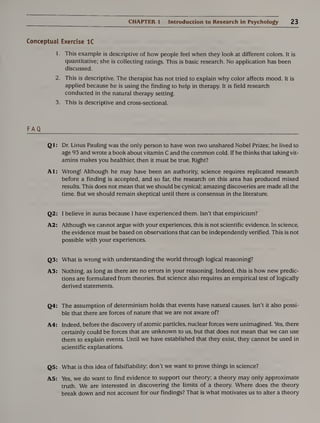
nConceptual Exercise 1C
1. A researcher has participants rate their mood on a scale after viewing different color
combinations. She wonders how color combinations make people feel. How would you
classify this research?
• Descriptive or explanatory?
• Quantitative or qualitative?
• Basic or applied?
2. A clinical psychologist, after reading the research on color and mood, decides to con¬
duct his therapy sessions in two rooms, one painted in warm colors that tend to be
calming and one painted in colors that have no effect on mood. He hopes that his
clients will be more forthcoming in the warm rooms. How would you classify this
research?
• Descriptive or explanatory?
• Basic or applied?
• Laboratory or field?
3. A developmental psychologist compares risky decision making of preteens and teens.
How would you classify this research?
• Descriptive or explanatory?
• Cross-sectional or longitudinal?
We have discussed why researchers do what they do and the general approaches taken
by researchers in the social sciences. Regardless of the approach that a researcher takes, the
process of planning and conducting research follows a logical series of steps.
STEPS IN PLANNING AND DOING RESEARCH
Most of you will be expected to conduct some sort of research project in your methods
course. Here we will discuss how to start thinking about doing research.
Selecting a Research Topic
From Life Experience
Very often, some life event inspires a researcher. Many years ago, one of your authors met
a man who could not remember anything he had just learned. She had to introduce her¬
self to him every time she met with him because he could not remember ever having met
her before. She found this to be such an interesting phenomenon that she decided, when
she began her graduate training, that she would focus on human memory.
41.
CHAPTER 1 Introductionto Research in Psychology 19
Have you noticed that people in elevators rarely make eye contact with you? Have you
ever found yourself trapped on the phone by a telemarketer, unable to just hang up? These
kinds of personal experiences are a great source of research ideas. As psychology students
know, Pavlov did not set out to discover the basic laws of classical conditioning. He was not
even interested in psychology. But he noticed something odd in the behavior of his dogs
when doing research on digestion. This personal experience led him to begin investigation
into an entirely new area.
From Existing Research
Students planning a research project must read the existing literature in the area. After all,
you don’t want to reinvent the wheel! Once you have an idea about the general area you
are interested in, you should read what has been found already. No doubt, as you read the
research, you will think of potentially interesting variables, populations, or methods that
have not been investigated. The existing research is a great source of ideas for research top¬
ics. Understanding empirical research articles can be challenging if you are not already
familiar with the topic, but the next chapter (Chapter 2) will provide help. There we will
provide you with an overview of the parts of a research article and describe, at a concep¬
tual level, the most common statistical analyses you will likely read about.
Common Sense
Psychology, more so than other sciences, yields research topics based on common sense
or folk wisdom. Earlier, we talked about commonsense folk wisdoms such as Absence
makes the heart growfonder and Out of sight, out of mind. Research topics can be gener¬
ated from common sense, and indeed, a lot of research has been done to test the veracity
of folk wisdom.
A New Technology
New technology can be a source of research topics. Magnetic resonance imaging (MRI), for
example, has allowed researchers to investigate what is going on in the brain during vari¬
ous activities. This kind of research was not possible before the development of the tech¬
nology. The Internet is an obvious example of new technology that has allowed researchers
to collect data that they could not easily have collected previously.
In psychology, interesting research topics are all around us. “Why do people do what they
do?” is a question we have all asked ourselves. No matter what has inspired your research
question, at some point you will need to think about hypotheses that you can test.
Generating Testable Hypotheses
To generate testable hypotheses, you must operationalize your concepts, that is, make them
measurable. We talked a bit about Harlow’s research earlier. One of his research questions
was, “Is contact comfort a source of attachment in monkeys?” How did he make the con¬
cepts contact comfort and attachment measurable? Read on!
He created what he called a surrogate “mother monkey” made of wire and a second
made of soft fabric. In essence, his operational definition of high-contact comfort was the soft,
42.
20 METHODS INPSYCHOLOGICAL RESEARCH
cuddly “mother,” and his operational definition of low-contact comfort was the cold wire
“mother.” Attachment was operationalized as the “mother” the infant clung to when stressed.
Students often ask us how they can tell if an operational definition is a good one or not.
This is an excellent question. Just because one researcher has an operational definition of
a concept does not guarantee that it is a good operational definition. We usually advise
students to read the literature in the area and see what most researchers tend to do, check
whether measures of reliability and validity have been taken, and go from there.
Once you have defined your research topic and generated testable hypotheses, you then
must determine which variables you are going to manipulate, which variables you will
control, and which variables you will measure.
Classifying Variables
Research in psychology involves various kinds of variables. There are variables you want to
manipulate (independent variables) to see if they affect other variables (dependent variables).
Then there are variables you want to control (control variables). Researchers must determine
how they will define these variables so that they can be measured and controlled. Harlow,
as we discussed earlier, in one experiment manipulated the contact comfort of the surrogate
mother monkey—this was an independent variable (high- and low-contact comfort). The
attachment behavior of the infant (i.e., which surrogate the infant clung to when stressed) was
the dependent variable. Size of surrogate mother, type of event that produced stress, and size
of cage were controlled variables in that they were constant. Researchers have to consider
the potentially important variables when they decide how to test their hypotheses.
You have your hypothesis and you have decided what variables you will measure and
control. Now you must select the research design.
Selecting an Appropriate Design
Selecting an appropriate design is a complex task. You will need to consider all sorts of
things as you make this decision. Practical factors such as time, money, and facilities; the
nature of your research question; and the kinds of variables you intend to measure must
be taken into account when you select a design. The research design often dictates the
analysis. You must think about how the data can be analyzed given your measures and
design. You do not want to find yourself in a position of having collected data that cannot
be analyzed the way you intended.
Once the research design has been selected, you need to figure out how to carry it out.
Planning the Method and Carrying It Out
The method should be carefully planned in advance. How will you select your participants?
Where and when will you gather your data? How many participants will you need? What are
the ethical considerations of your research? Who is responsible for reviewing the ethics of
your research? Although the method should be planned in advance, you will need to allow
for adjustments if something does not go as you expected. Perhaps you discover that your
first couple of participants misinterpreted an instruction. How will you deal with that?
The data have been collected. Now what?
43.
CHAPTER 1 Introductionto Research in Psychology 21
Analyzing Results
The design and the nature of the measures you took will determine the appropriate analy¬
sis. We cover the statistical analyses students are most likely to need for their research pro¬
jects in Chapter 13. Once the data have been analyzed, it is time to interpret the findings
and draw conclusions.
Drawing Conclusions
The last step of the research endeavor is to interpret the results and draw conclusions. This
is not easy. Researchers must be careful not to go too far from their results. There is a fine line
between justifiable conclusions and wild speculation. Your conclusions must include a discus¬
sion of how your results fit into the literature. How do your results support the conclusions
of other researchers, and how do they disagree? Do they support one theory but not another?
Sharing Your Findings
Of course, researchers do not keep their findings to themselves. Communicating with others
is an important part of the research process. Researchers share their work primarily by pub¬
lishing in journals and presenting their work at conferences. In this way, the research com¬
munity remains up to date about what is going on in the field. In Chapter 14, we discuss this
important part of the research endeavor.
In the above sections, we have tried to give you some idea about how psychologists go
about doing research and some tips to help you as a student plan a research project. Our
intention was to orient you to a way of thinking before you begin your methods course in
depth. Keep these ideas in mind as you study the rest of this book.
CHAPTER SUMMARY
Our knowledge of the world comes from many sources. Believing that something is true
because it has always been that way is a belief based on tradition. Believing that something
is true because an “expert” said so is a belief based on authority. Believing that something
is true because it feels true is a belief based on intuition. Tradition, authority, and intuition
are flawed sources of knowledge. Reasoning (i.e., beliefs based on logic) and empiricism
(i.e., beliefs based on measured observations) are better sources of knowledge.
Acquiring knowledge via interaction between empiricism and logic is the way of science.
Scientists are critical thinkers and apply critical thinking skills in their research. Critical
thinking is a process involving objectivity and unemotional examination of available
evidence. Alternative explanations are considered, uncertainty is tolerated, and skep¬
ticism is maintained.
The goals of science include description, explanation, prediction, and control.
Scientists assume that events in the world have natural causes (determinism). Scientists
are empiricists; they rely on real observations to assess claims. Scientific findings must be
replicated before they are incorporated into the body of knowledge. Hypotheses derived
44.
22 METHODS INPSYCHOLOGICAL RESEARCH
from scientific theory must be refutable through empirical research (falsifiability), and sci¬
entific explanations should require few assumptions (parsimony).
Science is defined by its method of hypothesis testing in the search for truth. Theories
yield hypotheses, which are tested, revised, and retested.
Researchers conduct their studies to evaluate theories, to satisfy their curiosity, to
demonstrate a new technique or behavioral phenomenon, or to investigate factors that
influence behavioral phenomena.
A researcher’s goal may be to describe a population (descriptive research) or to explain
relationships (explanatory research). Quantitative researchers in psychology are inter¬
ested in differences in amount of behavior, whereas qualitative researchers are interested
in differences in kind or quality of behavior. Basic or pure research is conducted to
increase the body of knowledge of the discipline; applied researchers use that knowledge
to improve things in the world. Researchers interested in age differences may study people
of different ages (cross-sectional research) or may study the same people at different
stages in their lives (longitudinal research). Laboratory research allows better control
over variables, but field research allows a more natural setting for the behavior.
Planning research involves several steps, including selecting a research topic from
theory, previous research, experience, or common sense; classifying variables; selecting the
design; carefully considering the ethics; carrying out the research; analyzing the results; and
drawing conclusions.
ANSWERS TO CONCEPTUAL EXERCISES
NOTE: There may be other good answers to some of the conceptual exercises. Do not assume, if
your answer differs from ours, that it is necessarily wrong. Consult with your instructor.
Conceptual Exercise 1A
1. Although some people may have experienced this, this belief, like all truisms, comes
from tradition.
2. As in the first example, this belief is primarily traditional.
3. This belief may have several sources, including tradition and authority.
4. This belief is best described as an intuitive belief based in religion, perhaps.
5. Some people may have acquired this belief from authority. For others, this belief
comes from personal experience and, for some, from science.
Conceptual Exercise IB
1. John has failed to follow the tenet of determinism. He should have assumed a natural
cause for the phenomenon. It is likely that on nights when the moon is full, there is
more crime committed because there is more light to conduct crime by! This
explanation is a deterministic one, a tenet of science.
2. This finding lacks replicability.
3. This example demonstrates lack of falsifiability. The hypothesis is not refutable.
45.
CHAPTER 1 Introductionto Research in Psychology 23
Conceptual Exercise 1C
1. This example is descriptive of how people feel when they look at different colors. It is
quantitative; she is collecting ratings. This is basic research. No application has been
discussed.
2. This is descriptive. The therapist has not tried to explain why color affects mood. It is
applied because he is using the finding to help in therapy. It is field research
conducted in the natural therapy setting.
3. This is descriptive and cross-sectional.
FAQ
Ql: Dr. Linus Pauling was the only person to have won two unshared Nobel Prizes; he lived to
age 93 and wrote a book about vitamin C and the common cold. If he thinks that taking vit¬
amins makes you healthier, then it must be true. Right?
Al: Wrong! Although he may have been an authority, science requires replicated research
before a finding is accepted, and so far, the research on this area has produced mixed
results. This does not mean that we should be cynical; amazing discoveries are made all the
time. But we should remain skeptical until there is consensus in the literature.
Q2: I believe in auras because I have experienced them. Isn’t that empiricism?
A2: Although we cannot argue with your experiences, this is not scientific evidence. In science,
the evidence must be based on observations that can be independently verified. This is not
possible with your experiences.
Q3: What is wrong with understanding the world through logical reasoning?
A3: Nothing, as long as there are no errors in your reasoning. Indeed, this is how new predic¬
tions are formulated from theories. But science also requires an empirical test of logically
derived statements.
Q4: The assumption of determinism holds that events have natural causes. Isn’t it also possi¬
ble that there are forces of nature that we are not aware of?
A4: Indeed, before the discovery of atomic particles, nuclear forces were unimagined. Yes, there
certainly could be forces that are unknown to us, but that does not mean that we can use
them to explain events. Until we have established that they exist, they cannot be used in
scientific explanations.
Q5: What is this idea of falsifiability; don’t we want to prove things in science?
A5: Yes, we do want to find evidence to support our theory; a theory may only approximate
truth. We are interested in discovering the limits of a theory. Where does the theory
break down and not account for our findings? That is what motivates us to alter a theory
46.
24 METHODS INPSYCHOLOGICAL RESEARCH
or construct a new theory. Often, research involves pitting two theories against one
another, each making a different prediction of outcome. Science moves ahead when we test
our theories, and that requires predictions that are falsifiable.
Q6: Is a research hypothesis just a guess of how things will turn out?
A6: A research hypothesis is not just a guess; it is an educated guess. The distinction is impor¬
tant because a hypothesis is a prediction based on a theory, which in turn is based on
empirical research. It is a guess based on the scientific literature.
Q7: Which is better, quantitative or qualitative research?
A7: We think the best answer to this is that it is not a contest. Our bias is toward quantitative
methods, but we see more and more qualitative research being published. Each approach
has its place.
Q8: rm still not clear on the cohort effect. Can you give another example?
A8: The cohort effect is a problem where age differences are confounded with history. For
example, suppose you wanted to look at age differences in people’s view of war. You may
find that older people have very different views than younger people. This may be an age
effect, but it may also reflect the fact that older people have survived World War II and that
may have shaped their views. The difference may be the shared experience of the cohort
and not an age effect.
Q9: Is it OK to select a research topic based on something you saw on TV?
A9: Absolutely! The most important factor in selecting a research topic is your interest.
Researchers are usually motivated by a genuine interest in the topic. Of course, you need
to read the scientific literature to get a better understanding of what has been done in the
area and what is known about the topic. There is more on selecting a research topic in a
later chapter.
CHAPTER EXERCISES
1. For each of the following, indicate the likely source of the belief:
a. Teenagers are hormonally challenged.
b. Because all little boys like to play rough, my boy will like to play rough.
c. Overexposure to sunlight causes skin cancer.
d. The sun sets in the west.
e. Men never ask for directions.
2. List and briefly describe the key elements of critical thinking.
3. For each of the following, identify the goal of the research (i.e., description, explanation, pre¬
diction, control):
a. What are violent criminals like?
b. Is there a connection between children’s diet and their school performance?
47.
CHAPTER 1 Introductionto Research in Psychology 2 5
c. Are violent criminals more likely than nonviolent criminals to have been abused as
children?
d. Can we develop programs to reduce the likelihood of criminal behavior in victims of child
abuse?
4. List and briefly describe each tenet of science. Also include why these tenets are important.
5. Briefly, what is the difference between theory and hypothesis? Can you provide an example
for each?
6. Are the following best described as descriptive or explanatory research questions? Why do
you think so?
a. What gambling strategies do men use?
b. Is parenting style linked to self-esteem in adolescent children?
7. Are the following best described as qualitative or quantitative research questions? Why do
you think so?
a. What are the major themes of the dreams of clinically depressed individuals?
b. Do clinically depressed people exhibit more negative self-talk than nondepressed people?
8. Are the following best described as basic or applied research questions? Why do you
think so?
a. What learning styles do first-year psychology students use?
b. Which learning style, typically used by first-year psychology students, is the most effec¬
tive in performance outcomes?
9. Are the following best described as longitudinal or cross-sectional research questions? Why
do you think so?
a. Do people become more tolerant as they age?
b. Are young people more tolerant than middle-aged people?
10. List one advantage of field research over laboratory research. List one advantage of labora¬
tory research over field research.
CHAPTER PROJECTS
1. Peruse the letters to the editor of your local newspaper. Identify a letter that describes a
belief that you suspect is based on each of the sources of beliefs discussed in this chapter.
Why do you think so?
2. Obtain a copy of a popular magazine. Find an article of your choice that is opinion based.
Identify the sources of belief used by the author. Do you think the writer was a critical
thinker? Explain your answer.
3. Select a major psychological theory. Generate three testable hypotheses.
4. Read a research paper in a scientific journal. Generate a testable hypothesis from the
research.
5. In our introductory psychology classes, we often do the following demonstration. We ask
for eight or so volunteers. Each student is given a coin. We turn our back to the students
and instruct them clench the fist holding the coin and place the fist next to their head. We
then ask them to try sending thoughts to us about which hand is holding the coin. We
hem and haw for a while. We then tell the students to drop the hand and hold out both
fists in front of them. We quickly turn around and identify which hand is the one holding
48.
26 METHODS INPSYCHOLOGICAL RESEARCH
the coin. We are always accurate. The students are required to generate a scientific
hypothesis for our ability to do this. Use the steps of the scientific method to plan a way
to test your hypothesis. Try to find more than one hypothesis that could explain our
“magical” ability and identify how you could test each.
REFERENCES
Darley, J., & Latane, B. (1968). Bystander intervention in emergencies: Diffusion of responsibility.
Journal ofPersonality and Social Psychology, 8, 377-383.
Epling, W. F., & Pierce, W. D. (1992). Solving the anorexia puzzle: A scientific approach. Toronto:
Hogrefe & Huber.
Epling, W. F., & Pierce, W. D. (1996). Activity anorexia: Theory, research and treatment. Mahwah, NJ:
Lawrence Erlbaum.
Harlow, H. F., & Harlow, M. H. (1966). Learning to love. American Scientist, 54, 244-272.
Schwartz, M. (1982). Repetition and rated truth value of statements. AmericanJournal of Psychology,
95, 393-407.
Spanos, N., Williams, V., &Gwynn, M. (1990). Effects of hypnotic, placebo, and salicylic acid treatments
on wart regression. Psychosomatic Medicine, 53(1), 109-114.
Visit the study site at www.sagepub.com/evansmprstudy for practice quizzes and other
study resources.
28 METHODS INPSYCHOLOGICAL RESEARCH
OBJECTIVES
After studying this chapter, students should be able to
• Search the literature using common online databases
• Describe what is meant by the term peer reviewed
• List and describe what is contained in each section of a typical research article
• Define independent, dependent, participant, mediating, and moderating variables
• Identify important variables in a research article
• Describe the typical descriptive statistics found in research articles
• Understand at a conceptual level common parametric tests of significance used
by researchers in the social sciences
• List common nonparametric alternatives to parametric tests of significance
• Understand how confidence intervals are used in estimating parameters
ou have selected your research topic. Now you need to discover what research has
already been done on the topic. It is time for you to peruse the research literature. You will
probably find some research on your topic, but it is unlikely that anyone has done exactly
the same study that you have in mind. We often tell our students to think through their topic
before going to the literature because it is easier to be creative about your project before you
have looked at the other approaches. Indeed, once you have read a few articles in the area,
it may be very difficult to think of an original idea!
Although it is unlikely that a study identical to yours has already been done, reading the
literature will give you an idea about the kinds of problems that other researchers have had,
and you can assess their solutions to those problems. The literature can provide a his¬
torical context for your study by describing what has been done and what remains to be
explored. You will also find valuable information on how to measure variables, how to
control variables, and, in experimental studies, how to manipulate variables. This sounds
wonderful, but how do you start to search through all the research to find studies relevant
to your topic? In the “good old days,” this required many hours (or days) of wading through
heavy indexes of research (just imagine a dozen or more telephone directories). Today, there
are a number of computer indexes that require no heavy lifting.
SEARCHING THE LITERATURE
There are a number of bibliographic databases for the psychology literature, including
Proquest, ERIC, and PsycINFO. We prefer PsycINFO, an index that is produced by the
51.
CHAPTER 2 Understandingthe Research Literature 2 9
American Psychological Association and is probably the most widely used bibliographic
search engine for English-language journals (http://www.apa.org/psycinfo/products/
psycinfo.html).
What is the psychology literature? When we use this term, we are usually referring to orig¬
inal research published in peer-reviewed journals. These journals can be easily recognized
by their common layout. They begin with an abstract (a short summary) and include an
introduction, a method section, a results section, and a discussion. But the literature
also includes review articles, books, chapters in books, edited volumes, and chapters in
edited volumes. These sources are not usually where original research is published. Rather,
they are usually a summary of a collection of research studies in a particular area. Although
these sources can be useful by helping you to put the research in context, it is better to read
the original research and draw your own conclusions.
Not included in the list above are newspapers, magazines (including Psychology Today),
or Web sites. There are two reasons that scientific research is not published in these media:
(1) the presence of advertising and (2) the lack of peer review. Let’s talk about advertising.
Newspapers and magazines contain a lot of advertising of products and services. Indeed,
these publications would not be viable without advertisers. Editors of newspapers and mag¬
azines must keep their advertisers happy; therefore, we, as consumers of the information
in these publications, cannot be confident that reporting will be unbiased. Now, we are not
saying that all newspaper and magazine reports are biased, but they could be. For example,
imagine you have conducted a study that shows that drinking Brand X beer can lead to
spontaneous uncontrollable hiccupping. You send your report to a magazine that has Brand
X beer as a major advertiser. It’s pretty unlikely that the magazine editor will accept your
paper for publication. Yes, your research might be terrific, but the potential damage to the
advertiser in terms of sales of the product might lead the editor to reject your study for pub¬
lication. This is why you will not see advertising in journals. Journal editors, by not permit¬
ting advertising, avoid the conflict of interest problem that advertising brings.
The second reason that original scientific research is not usually published in news¬
papers or magazines is that neither of these sources requires review of the research by
expert peers. Some sources that you can search are peer reviewed, and some are not. It is
important to understand the peer review process because it is a fundamental safeguard of
quality in research. As the name implies, peer review is a process whereby the editor of a
journal sends submitted manuscripts out to be reviewed by other researchers in the same
field of study. The manuscript is read and critiqued by peers who have expertise in the area.
The review is usually blind; this means that the name(s) of the author(s) of the manuscript
is removed from the manuscript before the copies are sent to the peer reviewers. Blind
review also means that the editor does not reveal the reviewers’ names to the author(s) of
the manuscript. Blind review helps to guard against any personal conflicts that may be pre¬
sent among researchers and to facilitate a fair review of the research. The editor receives
the reviews and decides whether the paper should be accepted as submitted, accepted with
minor changes, accepted with revisions, or not accepted at all. If the manuscript is accepted
but changes are required, the author(s) is given the opportunity to make the changes nec¬
essary to satisfy the editor and to address the concerns of the reviewers. If the study has
major flaws, it may have to be redone and resubmitted (of course, the researchers can sub¬
mit the manuscript to another journal and hope for a more positive review).
52.
30 METHODS INPSYCHOLOGICAL RESEARCH
Peer review helps to maintain a high standard of quality in research. Without peer review,
shoddy, or even fraudulent, research might be published that could send other researchers
off on a wild-goose chase that could last for years. Keep in mind that books and magazines
(e.g., Psychology Today) are usually not peer reviewed.
NOTE: In our courses, we do not permit the use of Psychology Today as a source. Students
often question this because a lot of psychological research is reported in Psychology Today
Along with the advertising and peer review issues, which we discussed above, there are two
other reasons for our decision to not permit this magazine as a source for student papers. One
reason is simple—we do not want our students to use secondary sources of any kind. Second,
the writers for Psychology Today are not scientists; they may have some academic back¬
ground in the area, but they are writing for the magazine as reporters. Psychology Today like
any other magazine, needs to sell magazines. Articles written by reporters will not be pub¬
lished unless the editor believes that the report will help sales.
FYI
There are two notable exceptions to the "no ads in journals" rule. Ironically, the two
most prestigious scientific journals worldwide are full of advertisements. Science and
Nature are peer reviewed, highly respected, and widely circulated.
When you are ready to use a bibliographic database, your first step is to select the appro¬
priate search terms. Often students will complain that they cannot find anything in the
literature on a particular topic even though a lot of research is there. Usually, the problem
is that they have not used the correct terms when doing the search. Using the correct terms
is crucial; fortunately, the databases have a thesaurus of keywords to help you.
Imagine you want to find articles on treating seasonal affective disorder (SAD) with light
therapy. You can go directly to the thesaurus in PsycINFO and look for “seasonal affective
disorder.” You will find that the term is used in the database; you will see a brief definition
of SAD and the information that the term was introduced in 1991. PsycINFO also provides
broader terms that would include SAD and narrower terms that are relevant. One of the nar¬
rower terms is phototherapy. That sounds useful. You can select “phototherapy” by clicking
on the box, and you can similarly select “seasonal affective disorder.” The default is to con¬
nect these two phrases with “or,” but if you want articles that contain both phrases, you
should choose the “and” option. When you click “add” and search (DE “Seasonal Affective
Disorder”) and (DE “Phototherapy”), you will find 276 publications with those keywords.
You might want to limit your search to only peer-reviewed articles in English by clicking
“refine search” and selecting peer reviewedjournals under publication type. Below that is
a box for selecting English language. If you do this and search again, you will get 235 hits.
That’s a more manageable number, but probably still more than you want to read. Let’s limit
the search to only originaljournal articles under document type. This time the search finds
only 25 articles. That seems like a reasonable number. Now you can click on each one and
read the abstract of the article. The abstract is a short but comprehensive summary of the
53.
CHAPTER 2 Understandingthe Research Literature 31
article, and based on your perusal of the abstracts, you can decide which articles you want
to read in their entirety. If you had done the search the way we have described, you should
find that the second article is titled “Light Therapy for Seasonal Affective Disorder With Blue
‘Narrow-Band’ Light-Emitting Diodes (LEDS)." This might be one you choose to read. If your
library has access to the full-text electronic version of the paper, you will be able to down¬
load it immediately. If your library does not have access, then you will have to order a copy,
called a reprint. You can also write to the principal investigator and request a reprint. This
may take a while, so you should begin your literature search early. If you leave reprint
requests until the last minute, you may not be able to get the articles that are most relevant
to your research topic.
Here is another example. Suppose we are interested in how the color of a room might
influence mood. A search using the terms mood and room color produces nothing. Perhaps
room is too restrictive. A search with mood and color gives 237 articles. Now let’s refine
(limit) the search to just peer-reviewed articles in English. Wow, still 167 articles. PsycINFO
has a bar that reads “Narrow results by subject:” and in the list is “color.” What happens if
we click that? We get 31 articles that deal with color and mood—that’s perfect! Apparently,
this search requires that color be a keyword and not just a word that appears in the title or
abstract. The fifth article in the list looks interesting; it is titled “Effects of Colour of Light
on Nonvisual Psychological Processes” by Igor Knez at the University of Gavle, Sweden.
Again, your library may or may not have access to the full text of the article. Be sure to con¬
sult with your reference librarians. These people are well educated and typically underuti¬
lized by students. If you have a question, ask your librarian.
THE RESEARCH ARTICLE
Now that you have a research article in hand, let’s examine each section of the paper sep¬
arately. When reading the literature, you need to understand that each section has a pur¬
pose and contains specific types of information. Once you know how research articles are
written, you will know which section will contain the information you need. The following
discussion is presented to help you read the literature. You will find information on writing
a research article in Chapter 14 (“Communicating in Psychology”).
The Abstract
The abstract is a comprehensive summary of the article and describes what was done, to
whom, and what was found. Online bibliographic search engines such as PsycINFO provide
the title and the abstract. If the title seems relevant, you can read the abstract. It should pro¬
vide you with enough information to decide whether you want to read the entire article.
The Introduction
The introduction directly follows the abstract. Here the author(s) provides background
on the research problem. You will find a description of the relevant research (this is the
researcher’s literature search) and how it logically leads to the research being reported in
54.
32 METHODS INPSYCHOLOGICAL RESEARCH
the article. Usually, near the end of the introduction, you will find a description of the
research hypothesis of the author. Again, for information on writing an introduction, see
Chapter 14.
Knez (2001) has an introduction with a typical layout. He begins with a general statement
about the state of knowledge in the research area. He then presents a discussion of the pre¬
vious research organized by variables. He describes the various independent variables that
have been identified as important and discusses various confounding variables and how
these should be controlled. He also discusses a theoretical framework that is based largely
on his own research. And finally, he defines the purpose of the present research, how it will
solve some of the problems identified in the literature review, and why it is important.
Before we continue to a discussion of the method section, it is probably a good idea to
review the types of variables you will read about in the introduction of many research articles.
Independent Variable
You will recall that an independent variable (IV) is the variable in an experiment that is
manipulated by the researcher. The researcher chooses levels of the IV that he or she thinks
will have effects on some response measure. The researcher then assigns participants to
each level of the IV (or all levels in the case of repeated-measures designs) and compares
differences in response measures to see if the IV had an effect. You will recall that some vari¬
ables are not true IVs. The values of these participant variables may be inherent in the
participants. Examples include gender, age, disability type, and so on. Or participants might
have self-selected the value of the variable. For example, differences in school success
between children attending private and public schools is a comparison on a participant vari¬
able where participants have, in effect, assigned themselves to the values of the variable. In
either case, studies of group differences on participant variables are not true experiments;
rather they are quasi-experiments. Remember that a true independent variable is under
the direct control of the researcher. The researcher chooses the values of the variable and
assigns participants to each and then looks to see if that manipulation has any effect on
their responses, the dependent variable. In an experiment, the independent variable can be
thought of as the cause in a cause-effect relationship.
IFYI
Statistical packages such as SPSS do not distinguish between true independent variables
and participant (or subject) variables. They refer to both as independent variables.
Dependent Variable
The dependent variable (DV) in psychological research is some response measure that we
think will be influenced by our independent variable. Reading comprehension might be a
dependent variable, and we might measure number correct on a comprehension quiz as our
operational definition of reading comprehension. Or we might measure depression by having
The sun hadrisen, a fresh sea breeze caused the leaves to rustle,
and the birds were singing on the branches. Montbarts walked on
hurriedly, looking neither to the right nor left, and apparently
plunged in deep thought.
On reaching the entrance of the village of Basse Terre, instead of
entering it, he skirted it, and going along a narrow path that crossed
a tobacco plantation, he went toward the interior of the island,
proceeding in the direction of Mount Misery, whose rise was already
perceptible beneath his feet.
After a very long walk, the filibuster at length stopped at the
entrance of a dry gorge, on one of the slopes of which stood a
wretched hut of tree trunks, poorly covered with palm leaves. A man
was standing in the doorway of this cabin: on perceiving Montbarts
he uttered a cry of joy and rushed toward him, running over the
rocks with the rapidity and lightness of a deer.
This man was Omopoua, the Carib; on coming up to the filibuster, he
fell on his knees.
"Rise," the adventurer said to him, "what have you to thank me for?"
"My master told me an hour ago that I no longer belonged to him,
but to you."
"Well, did I not promise it to you?"
"That is true, but the white men always promise, and never keep
their word."
"You see a proof of the contrary; come, get up, your master has sold
you to me, it is true, but I give you your liberty; you have now but
one master, God."
The Indian rose, laid his hand on his chest, tottered, his features
were contracted, and for a moment he seemed suffering from a
violent internal emotion, which in spite of all the power he had over
himself, he could not succeed in mastering.
57.
Montbarts, calm andgloomy, examined him attentively, while fixing a
scrutinizing glance upon him.
At length the Indian succeeded in speaking, though his voice issued
from his throat like a whistle.
"Omopoua was a renowned chief among his people," he said; "a
Spaniard had degraded him by making him a slave, through
treachery, and selling him like a beast of burden: you restore
Omopoua to the rank from which he ought never to have
descended. It is well, you lose a bad slave, but gain a devoted
friend; were it not for you I should be dead—my life belongs to you."
Montbarts offered the Carib his hand, which he kissed respectfully.
"Do you intend to remain at Saint Kitts, or would you like to return
to Haiti?"
"The family of Omopoua," the Indian replied, "and what remains of
his people, are wandering about the savannahs of Bohis, but where
you go, I will go."
"Very good, you shall follow me; now lead me to the man, you know
whom."
"At once."
"Are you certain he is a Spaniard?"
"I am."
"You do not know for what motives he has entered the island?"
"I do not."
"And at what place has he sought shelter?"
"With an Englishman."
"In the English colony there?"
"No; at Basse Terre."
"All the better. What is the Englishman's name?"
58.
"Captain William Drake."
"CaptainDrake!" Montbarts exclaimed with surprise, "It is
impossible."
"It is so."
"In that case, the Captain does not know him."
"No; the man entered his house and asked for hospitality, and the
Captain could not refuse it to him."
"That is true; go up to my hatto, take clothes, a fusil—in short, what
weapons you like, and come to me at Captain Drake's; if I am no
longer there, you will find me on the port; begone."
Montbarts then turned back, and proceeded toward Basse Terre,
while the Carib went towards the hatto as the bird flies, according to
Indian custom.
Basse Terre was the entrepôt, or to speak more correctly, the
headquarters of the French colony: at the period when our story is
laid it was only a miserable township, built without order, according
to the caprice or convenience of each owner, an agglomeration of
huts, rather than a town, but producing at a distance a most
picturesque effect through this very chaos of houses of all shapes
and sizes, thus grouped along the seashore, in front of magnificent
roads, filled with vessels swinging at their anchors, and constantly
furrowed by an infinite number of canoes.
A battery of six guns, built on an advanced point, defended the
entrance of the roads.
But in this town, apparently so mean, dirty, and wretched, it was
possible to watch the circulation of the life full of sap, vigour, and
violence belonging to the strange inhabitants, unique in the world,
who formed its heterogeneous population. The narrow gloomy
streets were crowded with people of every description and colour,
who came and went with a busy air.
59.
There were pothousesat the corner of all the streets and squares,
perambulating dealers shouted their goods in a ropy voice, and
public criers, followed by a crowd which was swelled at every step
by all the idlers, announced with a mighty noise of trumpets and
drums, the sale on that very day of the engagés, who had just
arrived in a Company's vessel.
Montbarts passed unnoticed through the crowd, and reached the
door of Captain Drake's house—a rather handsome looking and
cleanly kept house, which stood on the seashore at no great
distance from the governor's residence.
The filibuster pushed the door, which, according to the custom of the
country, was not locked, and entered the house.
CHAPTER XV.
THE SPY.
Montbarts, as we said, walked into the house.
There were two persons in the first room, which was contrived a
double debt to pay, as half sitting room, half kitchen.
These two persons were an engagé of Captain Drake and a stranger.
As for the Captain, he was absent at the moment.
The filibuster's eye flashed at the sight of the stranger, and an ill-
omened smile curled his pale lips.
As for the latter, he was seated at a table in the middle of the room,
and quietly breakfasting on a piece of cold bacon, washed down by
a bottle of Bordeaux,—a wine, let us remark, parenthetically, which,
though unknown in Paris till the reign of Louis XV., when the Duc de
60.
Richelieu brought itinto fashion on his return from the government
of Guyenne—had been for a long time appreciated in America.
The stranger was of rather tall stature, with a pale face, and ascetic
features, thin, bony, and angular; but his noble manners indicated a
high rank in society, which rank his simple and even more than
modest costume tried in vain to conceal.
On the filibuster's entrance, the stranger, without raising his head,
took a side-glance at him from under his long velvety eyelashes, and
again became absorbed or appeared to be so, in the contemplation
of the capital breakfast set before him.
Everything was in common among the filibusters, everyone took
from the other, whether he was at home or not, anything he wanted,
arms, gunpowder, clothes or food, and the person from whom it was
taken had no right to protest or make the slightest observation; this
was not merely admitted and tolerated, but was regarded as a right
which all took advantage of without the slightest scruple.
Montbarts, after looking round the room, took a chair, seated himself
unceremoniously opposite the stranger, and turning to the engagé,
said—
"Bring me some breakfast—I am hungry."
The other, without venturing the slightest remark, immediately
prepared to obey.
In a very short time he had served up an excellent breakfast for the
filibuster, and then took his place behind his chair to wait on him.
"My friend," the filibuster said, carelessly, "I thank you; but when I
take my meals I do not like to have anybody behind me. Leave the
room, but remain in front of the house door;" and he added, with a
singularly meaning glance, "let no one enter here without my orders:
no one—you understand me?" he said, laying a stress on the words;
"Not even your master, were he to come. Can I depend on you?"
"Yes, Montbarts," said the engagé, and left the room.
61.
At the nameof Montbarts, uttered by the servant, the stranger gave
an almost imperceptible start, and fixed an anxious glance on the
filibuster; but immediately recovering himself, he began eating again
in the most perfect tranquillity, or at least apparently so.
For his part, Montbarts went on eating without troubling himself, or
seeming to trouble himself, about the guest seated just opposite to
him.
This performance went on for some minutes; no other sound was
heard in the room, where such violent passions were smouldering,
but that produced by the knives and forks scratching on the platters.
At length Montbarts raised his head and looked at the stranger.
"You are very taciturn, sir," he said to him, with the simple air of a
man who is wearied at a lengthened silence, and wishes to get up a
conversation.
"I, sir?" the stranger replied, as he looked up in his turn with the
calmest air; "Not that I am aware of."
"Still, sir," the filibuster resumed, "I would remark, that during the
quarter of an hour I have had the honour of passing in your
company, you have not once addressed a syllable to me, not even in
greeting."
"Pray excuse me, sir," the stranger said, with a slight bow; "the fault
is entirely involuntary: besides, as I have not the advantage of
knowing you—?
"Are you quite sure of that, sir?" the adventurer interrupted,
ironically.
"At least, I think so; hence, having nothing to say to you, I suppose
that it would be useless to begin a conversation which would have
no object."
"Who knows, sir?" the filibuster remarked, jeeringly; "Conversations
the most frivolous at the outset, frequently become very interesting
at the expiration of a few minutes."
62.
"I doubt whetherthat would be the case with ours, sir. Permit me,
therefore, to break it off at once. Besides, I have finished my meal,"
the stranger said, rising; "and some serious business claims my
attention. Pray forgive me, therefore, for parting company so
hurriedly, and believe in the sincerity of my regret."
The adventurer did not leave his seat, but throwing himself back in it
with a graceful nonchalance, while playing with the knife he held in
his hand, he said in his gentle insinuating voice—
"Pardon me, my dear sir; only one word, pray."
"In that case make haste, sir," the stranger replied, as he stopped,
"for I am greatly pressed for time, I assure you."
"Oh! You will certainly grant me a few minutes," the adventurer
remarked, with the old sarcasm.
"As you desire it so eagerly, I will not refuse it you, sir. But I really
am in a hurry."
"I have no doubt on that point, sir; more especially hurried to leave
this house—is it not so?"
"What do you mean, sir?" the stranger asked, haughtily.
"I mean," the adventurer replied, as he rose and placed himself
between the stranger and the door, "that it is useless to feign any
longer, and that you are recognized."
"I recognized? I do not understand you. What does this language
mean?"
"It means," Montbarts said brutally, "that you are a spy and a traitor,
and that you will be hanged within ten minutes."
"I?" the stranger replied, with very cleverly assumed surprise; "Why,
you must be mad, sir, or suffering under a strange mistake. Let me
pass, I request."
"I am not mad or mistaken, Señor Don Antonio de la Ronda."
63.
The stranger started,a livid pallor covered his face, but he
immediately recovered himself.
"Why, this is madness!" he said.
"Sir," Montbarts remarked, still calm, but remaining in front of the
door, "when I affirm, you deny. It is evident that one of us lies, or is
mistaken. Now I declare that it is not I, hence it must be you; and to
remove your last doubts on this point, listen to this, but first be good
enough to resume your seat. We shall have, however much it may
annoy you, to converse for some time and I will remark, that it is a
very bad taste to talk standing face to face like two gamecocks
ready to fly at each other's combs, when it is possible to act
otherwise."
Mastered, in spite of himself, by the adventurer's flashing glance
obstinately fixed on him, and by his sharp, imperative accent, the
stranger returned to his seat, and fell into it rather than sat down.
"Now, sir," the filibuster continued, in the same calm voice, as he
reseated himself and placed his elbows on the table, "in order at
once to dissipate all the doubts you may have, and to prove to you
that I know more about you than you will doubtless like, let me tell
you your history in a couple of words."
"Sir!" the stranger interrupted.
"Oh, fear nothing," he added, with studied sarcasm, "I shall be brief:
I no more like than you do to waste my time in idle discourses; but
just notice, by the bye, that, as I prophesied, our conversation, at
first frivolous, has suddenly grown interesting. Is not this singular, I
ask you?"
"I am awaiting your explanation, sir," the stranger replied, coolly;
"for, up to the present, whatever you may say, I do not comprehend
a word of all that it pleases you to say to me."
"By Heavens! You are a man after my heart. I was not mistaken
about you. Brave, cold, and crafty, you are worthy to be a filibuster,
and to lead an adventurous life with us."
64.
"You do mea great honour, sir; but all this does not tell me—"
"Zounds! I am coming to it, sir—a little patience. How quick you are!
Take care: in your profession a man must be cool before all else, and
you are not so at this moment."
"You are very witty, sir," the stranger said, bowing ironically to his
opponent.
The latter was offended by this sudden attack, and smote the table
with his fist.
"Here is your history in two words, sir," he said. "You are an
Andalusian, born at Malaga, a younger son, and consequently
destined to take orders. One fine day, not feeling any liking for the
tonsure, you fled from the paternal roof and embarked on a Spanish
vessel bound for Hispaniola. Your name is Don Antonio de la Ronda.
You see, sir, that up to this point I am well informed, am I not?"
"Pray go on, sir," the stranger replied, with perfect coolness; "your
remarks are most interesting." Montbarts shrugged his shoulders,
and went on.
"On arriving at Hispaniola, you contrived, in a short time, thanks to
your good looks and polished manners, to secure powerful
protectors; and thus, though you only left Europe three years ago,
you have made such rapid progress, that you are at present one of
the most influential men in the colony. Unluckily—"
"Do you say unluckily?" the stranger interrupted with a jeering smile.
"Yes, sir," the adventurer replied imperturbably; "unluckily your
fortune turned your head so thoroughly—"
"So thoroughly?"
"That in defiance of your friends, you were arrested and threatened
with a trial for embezzling a sum of nearly two million piastres; a
noble amount, on which I compliment you. Any other man but you,
sir, I feel a pleasure in allowing the fact, would have been ruined, or
65.
nearly so, asthe case was very serious; and the Council of the
Indies does not joke on money matters."
"Permit me to interrupt you, my dear sir," the stranger said with the
most perfect ease; "you are telling this story in a very talented
manner, but if you go on so, it threatens to last indefinitely. If you
permit it, I will finish it in a few words."
"Ah! Ah! Then you allow its truth now?"
"Of course," the stranger said with admirable coolness.
"You acknowledge yourself to be Don Antonio de la Ronda?"
"Why should I deny it longer, when you are so well informed?"
"Better still; so that you confess to fraudulently entering the colony
for the object of—"
"I confess anything you like," the Spaniard said quickly.
"Well, that being well established, you deserve to be hung, and you
will be so in a few minutes."
"Well, no," he replied without losing any of his coolness; "that is
where we differ essentially in opinion, sir, your conclusion is not in
the least logical."
"What?" the adventurer exclaimed, surprised at this sudden change
of humour which he did not expect.
"I said that your conclusion was not logical."
"I heard you perfectly."
"And I am going to prove it," he continued; "grant me in your turn a
few moments' attention."
"Very good; we must be merciful to those who are about to die."
"You are very kind; but thank Heaven I am not there yet. There's
many a slip between the cup and the lip, as a very sensible proverb
says."
"Go on," the filibuster said with an ominous smile.
66.
But the Spaniardwas not affected.
"It is evident to me, sir, that you have some business or bargain to
propose to me."
"I?"
"Certainly, and for this reason; having recognized me as a spy, for I
must allow that I am really one (you see that I am frank in my
confession), nothing was easier for you than to have me strung up
to the nearest tree, without any form of trial."
"Yes, but I am going to do so."
"No, you will not do it now, and for this reason. You believe for
reasons I am ignorant of, for I will not insult you by supposing that
you had a feeling of pity for me, you who are so justly called by my
countrymen the Exterminator—you believe, I say, that I can serve
you, be useful to you in the success of one of your plans;
consequently instead of having me hanged, as you would have done
under any other circumstances, you came straight to find me here,
where I fancied myself well hidden, in order to converse with me,
like one friend with another. Well, I ask for nothing better, come,
speak, I am listening; what do you want of me?"
And after uttering these words with the most easy air he could
assume, Don Antonio threw himself back in his chair delicately
rolling a cigarette between his fingers.
The filibuster gazed for a moment at the Spaniard with a surprise
which he did not attempt to conceal, and then burst into a laugh.
"That will do," he said, "I prefer that; at least there will be no
misunderstanding between us. Yes, you have guessed correctly, I
have a proposal to make to you."
"That was not difficult to discover, sir; and pray what is the nature of
the proposal?"
"Well, it is very simple, I only require you to act exactly in the
opposite way to what you intended, to change sides, in short."
67.
"Very good, Iunderstand, that is to say, instead of betraying you for
the advantage of Spain, I am to betray Spain for your profit."
"Yes, you see it is easy."
"Very easy, in fact, but decidedly shabby; and supposing that I
consent to your request, what advantage shall I derive from it?"
"In the first place I need hardly say that you will not be hung."
"Pooh! To die by hanging, drowning, or a musket ball, is always
much the same thing. I should desire a more distinct benefit, with
your leave."
"Confound it, you are difficult to satisfy, then it is nothing to save
one's neck from a slip knot?"
"My dear sir, when, as in my case, a man has nothing to lose and
consequently everything to gain by any change in his position, death
is rather a comfort than a calamity."
"You are a philosopher, so it seems."
"No, confound it! such absurdity never troubled me, I am merely a
desperate man."
"That is often the same thing; but let us return to our matter."
"Yes, that will be better."
"Well! I offer you my whole share of the first ship I take; does that
suit you?"
"That is something better; but unluckily the ship to which you refer
is like the bear in the fable, not caught yet; I should prefer
something more substantial."
"Well, I see I must yield to you; serve me well and I will reward you
so generously that the King of Spain himself could not do more."
"Well, that is agreed, I'll run the risk; now be kind enough to tell me
the nature of the service you expect from me?"
68.
"I wish youto help me in taking by surprise Tortoise Island, where
you lived for a long time, and where, if I do not err, you still have
friends."
"I see no inconvenience in trying that, although I will begin by
making my reservations."
"What are they?"
"That I do not pledge myself to insure the success of your hazardous
undertaking."
"That remark is fair, but do not alarm yourself, if the Island is well
defended, it shall be well attacked."
"I am convinced; now for the next matter."
"I will let you know it when the time arrives, señor; for the present,
other business engages our attention."
"As you please, sir, you will be the best judge of the opportunity."
"Now, sir, as I had the honour of telling you at the outset, since I
know you to be a very sharp hand, and very capable of slipping
through my fingers like an eel, without the slightest scruple, and as I
wish to avoid that eventuality, and save you any notion of the sort,
you will do me the pleasure of going at once aboard my lugger."
"A prisoner!" the Spaniard said with a gesture of ill humour.
"Not as a prisoner, my dear Don Antonio, but regarded as a hostage,
and treated as such, that is to say, with all the attention compatible
with our common security."
"Still, the word of a gentleman—"
"Is valued between gentlemen, I allow, but with us Ladrones, as you
call us, it has no value in my opinion; you hidalgos of old Spain,
even make it a case of conscience to violate it without the slightest
scruple, when your interest invites you to do so."
Don Antonio hung his head; recognizing in his heart, though
unwilling to allow it, the exact truth, of the filibuster's words.
69.
The latter enjoyedfor a moment the Spaniard's discomfiture, and
then rapped the table twice or thrice with the handle of his knife.
The captain's engagé at once entered the room.
"What do you want of me, Montbarts?" he asked.
"Tell me, my good fellow," the adventurer asked, "have you not seen
a red Carib prowling round this house?"
"Pardon me, Montbarts, a Carib asked me only a moment ago,
whether you were here, and I answered in the affirmative, but I did
not like to transgress the orders I had received from you, and allow
him to enter as he desired."
"Very good. Did not the man mention his name?"
"On the contrary, that was the very first thing he did; it is
Omopoua."
"The very man I was expecting; tell him to come in, pray, for he is
sure to be hanging about the door; and come with him."
The engagé went out.
"What do you want with this man?" the Spaniard asked with a shade
of anxiety, which did not escape the adventurer's sharp eye.
"This Indian is simply intended to be your guard of honour," he said.
"Hum! It really seems as if you are anxious to keep me."
"Extremely so, señor."
At this moment, the engagé returned followed by the Carib, who had
made no change in his primitive costume; but had taken advantage
of Montbarts' permission to arm himself to the teeth.
"Omopoua and you, my friend, listen attentively to what I am going
to say to you; you see this man?" he said pointing to the Spaniard
who was still perfectly impassive.
"We see him," they answered.
70.
"You will takehim on board the lugger and hand him over to my
mate, Michael the Basque, recommending him to watch over his
guest most attentively! If, during the passage from here to the
vessel, this man attempts to take to flight, blow out his brains
without mercy. Have you understood me thoroughly?"
"Yes," said the engagé, "trust to us, we answer for him with our
heads."
"That is well, I accept your word; and now, sir," he added,
addressing Don Antonio, "be good enough to follow these two men."
"I yield to force, sir."
"Very good, that is how I regard the matter, but reassure yourself,
your captivity will be neither harsh nor long, and I shall keep the
promises I have made you, if you keep yours. Now, go and farewell
for the present."
The Spaniard, without replying, placed himself between his two
keepers voluntarily and left the room.
Montbarts remained alone.
CHAPTER XVI.
THE SLAVE SALE.
A moment after Montbarts rose, put on his cloak, which he had
thrown on a chair when he came in, and prepared to quit the house.
On the threshold he found himself face to face with Captain Drake.
"Ah," said the latter, "here you are."
"Yes! I have been breakfasting at your house."
71.
"You did well."
"Willyou accompany me to the sale?"
"I do not want any hired man."
"Nor I, but you know the enlistment will commence immediately
afterwards."
"That is true; let me say a word first to my engagé, and I will follow
you."
"He has gone out."
"Why! I ordered him not to leave the house."
"I have given him a commission."
"Oh! That is different."
"You do not ask me what the commission is I have given your
engagé," Montbarts remarked a moment later.
"Why should I? It does not concern me, I suppose."
"More than you imagine, brother."
"Nonsense, how so?"
"You offered hospitality to a stranger, did you not?"
"Yes, but what of that?"
"You shall see. This stranger, whom you do not know, for of course
you do not—"
"No more than Adam; what do I care who he is? hospitality is one of
those things which cannot be refused."
"That is true, but I recognized the man."
"Ah, ah, and who is he then?"
"Nothing less than a Spanish spy, brother."
"My God!" the captain said, stopping dead short.
"What is the matter with you now?"
72.
"Nothing, nothing, exceptthat I will go and blow out his brains,
unless you have done so already."
"Pray, do nothing of the sort; this man, I feel convinced, brother, will
prove very useful to us."
"Nonsense, how so?"
"Leave me to act; if we manage properly, we may draw profit even
from a Spanish spy; in the meanwhile, I have had him taken on
board the lugger by your engagé, and a man of my own, where he
will be watched so that he cannot part company."
"I trust to you for that, and thank you, brother, for having freed me
from the scoundrel."
While talking thus, the two men arrived at the spot where the sale of
the engagés to the colonists was to take place.
On the right of the square was a spacious shed, built of clumsily
planed planks, and open to the wind and rain; in the centre of the
shed was a table for the officials and secretaries of the company,
who had to manage the sale and draw up the contracts; an easy
chair had been set apart for the governor, by the side of a rather
lofty platform, on which each engagé, male or female, mounted in
turn, so that the purchasers might examine them at their ease.
These wretches, deceived by the company's agents in Europe, had
contracted engagements, whose consequences they did not at all
understand, and were convinced that, on their arrival in America,
with the exception of a certain tax they had to pay the company for
a certain period, they would be completely free to earn their
livelihood as they thought proper. The majority were carpenters,
masons and bricklayers, but there were also among them ruined
gentlemen and libertines who detest work and who imagined that in
America, the country of gold, fortune would visit them while they
slept.
A company's ship had arrived a few days previously and brought one
hundred and fifty engagés, among them were several young and
73.
pretty women, thoroughlyvitiated, however, and who, like the
Manon Lescault of the Abbé Prevost, had been picked up by the
police in the streets of Paris, and shipped off without further
formality.
These women were also sold to the colonists, not apparently as
slaves, but as wives.
These unions contracted in the gipsy fashion, were only intended to
last a settled time which must not exceed seven years, unless with
the mutual consent of the couple, though the clause was hardly ever
appealed to by them; at the end of that time they separated, and
each was set at liberty to form a fresh union.
The engagés had been landed two days before; these two days had
been granted them, that they might slightly recover from the fatigue
of a long sea voyage, walk about and breathe the reviving land
breeze, of which they had so long been deprived.
At the moment when the two adventurers arrived, the sale had been
going on for half an hour; the shed was crowded with colonists who
desired to purchase slaves, for we are compelled to use that odious
term, for the poor creatures were nothing else.
At the sight of Montbarts, however, whose name was justly
celebrated, a passage was opened, and he thus succeeded in
reaching the side of the governor, Chevalier de Fontenay, round
whom the most renowned adventurers were collected, among them
being Michael the Basque.
Monsieur de Fontenay received Montbarts with distinction; he even
rose from his chair and walked two or three steps to meet him,
which the filibusters considered in very good taste, and felt grateful
to him for it; this honour paid to the most celebrated among them
cast a reflection on them all.
After exchanging a few compliments with the governor, Montbarts
bent down to Michael's ear.
"Well, mate?" he said to him.
74.
"The Spaniard isaboard," Michael replied, "and carefully watched by
Bowline."
"In that case I can be at my ease?"
"Perfectly."
During this aside, the sale had been going on.
All the male engagés had been sold, with the exception of one who
was standing at this moment on the platform, by the side of a
company's agent, who acted as auctioneer, and praised the qualities
of the human merchandise he offered.
This engagé was a short, stout, powerfully built man, from twenty-
five to twenty-six years of age, with harsh, energetic, but intelligent
features, whose grey eyes sparkled with audacity and good humour.
"Pierre Nau, native of the sands of Olonne," said the company's
agent, "twenty-five years of age, powerful and in good health, a
sailor. Who'll say forty crowns for the Olonnais, forty crowns for
three years, gentlemen."
"Come, come," said the engagé, "if the person who buys me is a
man, he will have a good bargain."
"Going for forty crowns," the company's agent repeated, "forty
crowns, gentlemen."
Montbarts turned to the engagé.
"What, you scoundrel," he said to him, "you a sailor and sell yourself
instead of joining us? You have no pluck."
The Olonnais began laughing.
"You know nothing about it. I have sold myself, because I must do
so," he answered, "so that my mother may be able to live during my
absence."
"How so?"
"How does it concern you? You are not my master, and even if you
were, you would have no right to inquire into my private affairs."
75.
"You seem tome a bold fellow," Montbarts remarked.
"Indeed, I believe I am; besides, I wish to become an adventurer
like you fellows, and for that purpose I must serve my
apprenticeship to the trade."
"Going for forty crowns," cried the agent.
Montbarts examined with the most serious attention the engagé,
whose firm glance he could hardly manage to quell; then, doubtless
satisfied with his triumph, he turned to the agent.
"That will do," he said, "hold your row: I buy this man."
"The Olonnais is adjudged to Montbarts the exterminator, for forty
crowns," the agent said.
"Here they are," the adventurer answered as he threw a handful of
silver on the table; "now come," he ordered the Olonnais, "you are
now my engagé."
The latter leapt joyously off the platform and ran up to him.
"So you are Montbarts the exterminator?" he asked him curiously.
"I think you are questioning me," the adventurer said with a laugh,
"still, as your question appears to me very natural, I will answer it
this time; yes, I am Montbarts."
"In that case I thank you for buying me, Montbarts; with you I am
certain soon to become a man."
And at a sign from his new master, he respectfully placed himself
behind him.
The most curious part of the sale for the adventurers then began,
that is to say, the sale of the women.
The poor wretches, mostly young and pretty, mounted the platform
trembling, and in spite of their efforts to keep a good countenance,
they blushed with shame, and burning tears ran down their cheeks
on seeing themselves thus exposed before all these men, whose
flashing eyes were fixed upon them.
76.
Welcome to ourwebsite – the perfect destination for book lovers and
knowledge seekers. We believe that every book holds a new world,
offering opportunities for learning, discovery, and personal growth.
That’s why we are dedicated to bringing you a diverse collection of
books, ranging from classic literature and specialized publications to
self-development guides and children's books.
More than just a book-buying platform, we strive to be a bridge
connecting you with timeless cultural and intellectual values. With an
elegant, user-friendly interface and a smart search system, you can
quickly find the books that best suit your interests. Additionally,
our special promotions and home delivery services help you save time
and fully enjoy the joy of reading.
Join us on a journey of knowledge exploration, passion nurturing, and
personal growth every day!
ebookbell.com



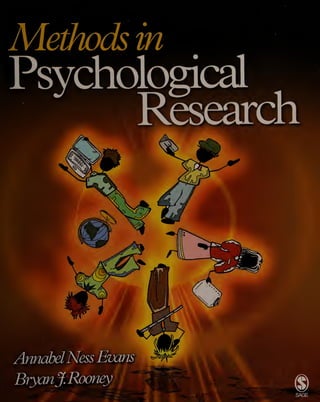


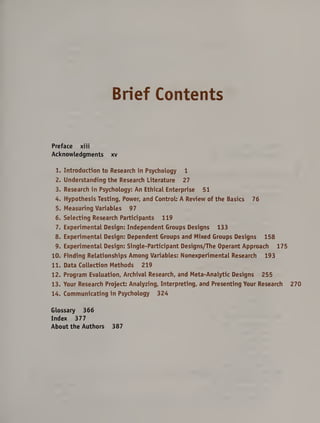
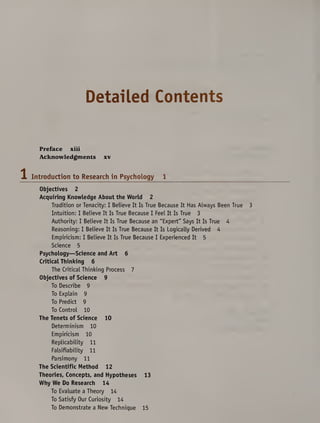
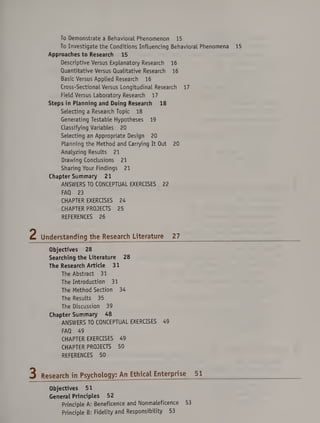
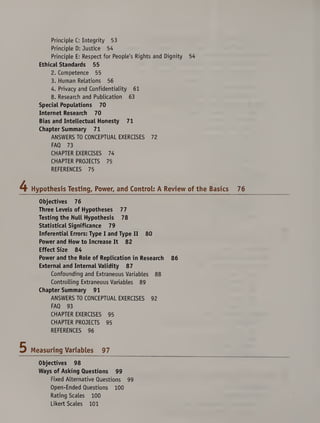
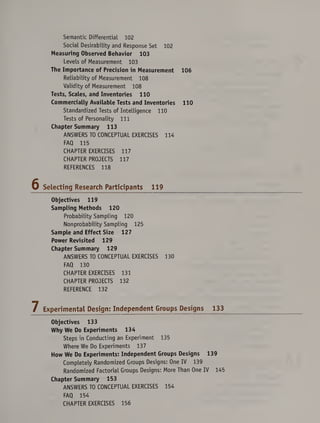

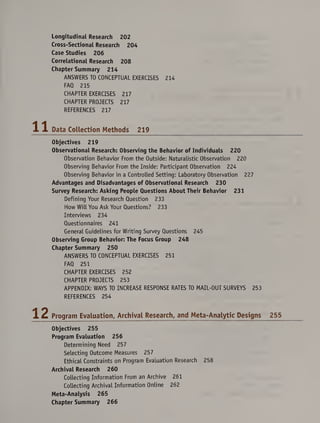
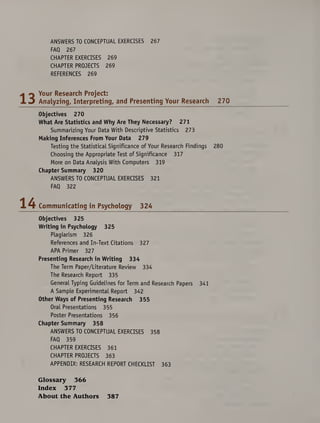

![2 METHODS IN PSYCHOLOGICAL RESEARCH
OBJECTIVES
After studying this chapter, students should be able to
• Describe common sources of belief and identify the likely source of example
beliefs
• Describe the critical thinking process
• Describe the objectives of science and identify examples of each
• Describe the tenets of science and identify examples of each
• List the steps of the scientific method and apply them to a problem
• Describe the difference between theory and hypothesis
• List the various reasons why scientists do research
• Describe various approaches to research and classify research examples
• List the steps in planning and doing research
• Generate a research topic from available sources
Vancouveryoga teacher Shakti Mhi has been drinking her own urine every dayfor the past
two decades. Ms. Mhi claims that it not only is rich in nutrients but also offers [and]
numerous health benefits, including a boosted immune system. “I drink itfirst thing in the
morning. . . . IfIfeel my energy level is dropping, I’ll drink three cups a day ... I always
heal myself. I haven’t seen a doctor in 20 years. ”
—Globe and Mail, Saturday, September 25, 2004
re you wondering what the basis is for Ms. Mhi’s claims about drinking urine? So are we.
ACQUIRING KNOWLEDGE ABOUT THE WORLD
Some expectant mothers play classical music to their growing bellies because they believe
this will make their babies more musically talented. Some people believe that dreams pre¬
dict future events or that a broken mirror can cause 7 years of bad luck. Many people believe
all sorts of things that really have no factual foundation.
Why are many people hard-pressed to give up beliefs such as these even in the face of
solid evidence to the contrary? Where do these beliefs come from?
Surprisingly, and often unfortunately, we acquire many of our beliefs from flawed sources
or in flawed ways.](https://image.slidesharecdn.com/5875731-250620102344-2d979692/85/Methods-In-Psychological-Research-3rd-Edition-Annabel-Ness-Evans-24-320.jpg)