I.
I. Social Sciences
SocialSciences
The study of society and the activities and
The study of society and the activities and
relationships of individuals and groups within
relationships of individuals and groups within
society.
society.
All subject matter is approached by a
All subject matter is approached by a
scientific approach
scientific approach
II.
II. Social Studies
Social Studies
Courses of instruction in an elementary or
Courses of instruction in an elementary or
secondary school, encompassing social
secondary school, encompassing social
sciences such as
sciences such as
Geography
Geography
History
History
Political sciences
Political sciences
3.
III.
III. Behavioral Sciences
BehavioralSciences
They must deal with humans directly
They must deal with humans directly
Animals are sometimes used for studying
Animals are sometimes used for studying
purposes
purposes
Three types of Behavioral Sciences
Three types of Behavioral Sciences
1.
1. Psychology – studies of behavior or the individual
Psychology – studies of behavior or the individual
(personality, learning, etc.).
(personality, learning, etc.).
2.
2. Sociology – studies the behavior of man in groups.
Sociology – studies the behavior of man in groups.
Focuses on:
Focuses on:
How and why groups develop.
How and why groups develop.
The mores and folkways that govern them
The mores and folkways that govern them
Mores – formal, written rules or laws
Mores – formal, written rules or laws
Folkways – informal, accepted ways of doing things
Folkways – informal, accepted ways of doing things
3.
3. Anthropology – Studies behavior within a culture
Anthropology – Studies behavior within a culture
(culture-knowledge, beliefs, values, customs, etc.)
(culture-knowledge, beliefs, values, customs, etc.)
that are learned.
that are learned.
4.
Types of ResearchMethods
Types of Research Methods
Experimental
Experimental
– A research method designed to answer questions about cause and
A research method designed to answer questions about cause and
effect
effect
– Its main advantage over other data gathering methods is that it
Its main advantage over other data gathering methods is that it
permits the researcher to control conditions, etc.
permits the researcher to control conditions, etc.
Sample Survey – Take a sample of a group that you are
Sample Survey – Take a sample of a group that you are
studying and survey them
studying and survey them
Case Study – Intensive study (in-depth) of a single person
Case Study – Intensive study (in-depth) of a single person
or group
or group
Natural Observation
Natural Observation
– You analyze a situation without getting involved (researcher stays
You analyze a situation without getting involved (researcher stays
out of the way
out of the way
– Also referred to as
Also referred to as Field Study
Field Study
– Most of the time the participants don’t know they are being watched
Most of the time the participants don’t know they are being watched
5.
Types of Research(cont’d)
Types of Research (cont’d)
Participant Observation – you join an existing
Participant Observation – you join an existing
group. (researcher actually gets involved)
group. (researcher actually gets involved)
– Joins the military
Joins the military
– Joins a cult
Joins a cult
All research must be
All research must be Both
Both valid and reliable
valid and reliable
– Valid – Does the research measure what it’s suppose to
Valid – Does the research measure what it’s suppose to
measure
measure
– Reliable – The research must yield reasonably
Reliable – The research must yield reasonably
consistent results
consistent results
6.
Types of ResearchMethods
Types of Research Methods
(Continued)
(Continued)
Lets suppose we as a class wanted to do an
Lets suppose we as a class wanted to do an
experiment, how might we set the
experiment, how might we set the
experiment up?
experiment up?
– Experimental group – Those subjects
Experimental group – Those subjects
experiencing the experimental condition
experiencing the experimental condition
– Control group – Same as above but this group
Control group – Same as above but this group
experiences the key factor the Psychologist (or
experiences the key factor the Psychologist (or
any other social scientist) is evaluating.
any other social scientist) is evaluating.
7.
Scientific Method (Approach)
ScientificMethod (Approach)
1.
1. State the problem
State the problem
2.
2. Hypothesize
Hypothesize
3.
3. Gather empirical data
Gather empirical data
4.
4. Interpret the data, test your hypotheses
Interpret the data, test your hypotheses
5.
5. Evaluate and conclude
Evaluate and conclude
8.
Requirements of theScientific
Requirements of the Scientific
Method
Method
1.
1. Procedures must be public
Procedures must be public
2.
2. Definitions must be clear and precise
Definitions must be clear and precise
3.
3. Collection of data must be objective
Collection of data must be objective
4.
4. Findings must be reproducible
Findings must be reproducible
Spirit of Science
Spirit of Science
In order to practice the spirit of science, one must be
In order to practice the spirit of science, one must be
prejudice free, devoted to critical thinking,
prejudice free, devoted to critical thinking,
curious, and seeking truth
curious, and seeking truth
9.
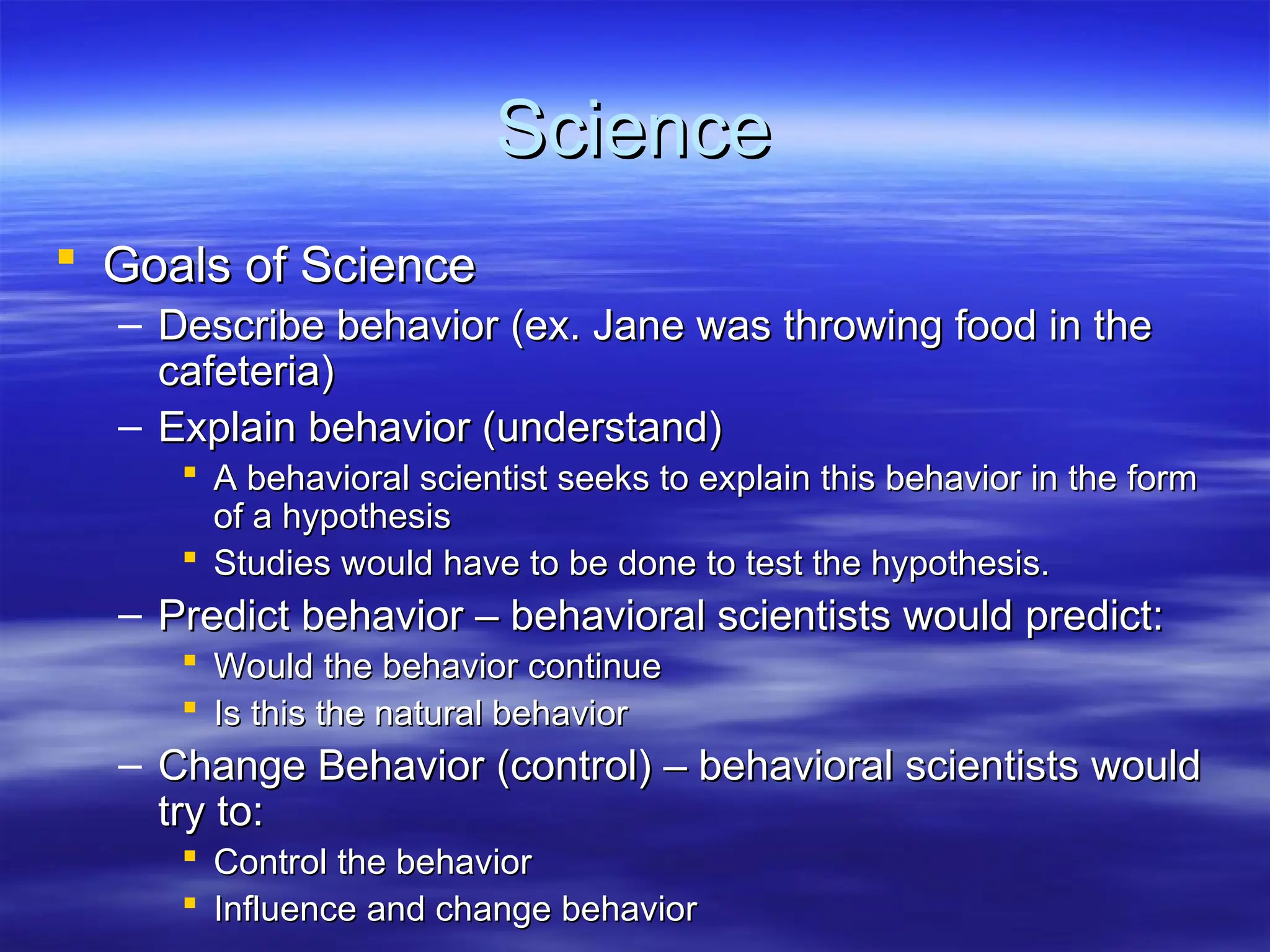
Science
Science
Goals ofScience
Goals of Science
– Describe behavior (ex. Jane was throwing food in the
Describe behavior (ex. Jane was throwing food in the
cafeteria)
cafeteria)
– Explain behavior (understand)
Explain behavior (understand)
A behavioral scientist seeks to explain this behavior in the form
A behavioral scientist seeks to explain this behavior in the form
of a hypothesis
of a hypothesis
Studies would have to be done to test the hypothesis.
Studies would have to be done to test the hypothesis.
– Predict behavior – behavioral scientists would predict:
Predict behavior – behavioral scientists would predict:
Would the behavior continue
Would the behavior continue
Is this the natural behavior
Is this the natural behavior
– Change Behavior (control) – behavioral scientists would
Change Behavior (control) – behavioral scientists would
try to:
try to:
Control the behavior
Control the behavior
Influence and change behavior
Influence and change behavior
10.
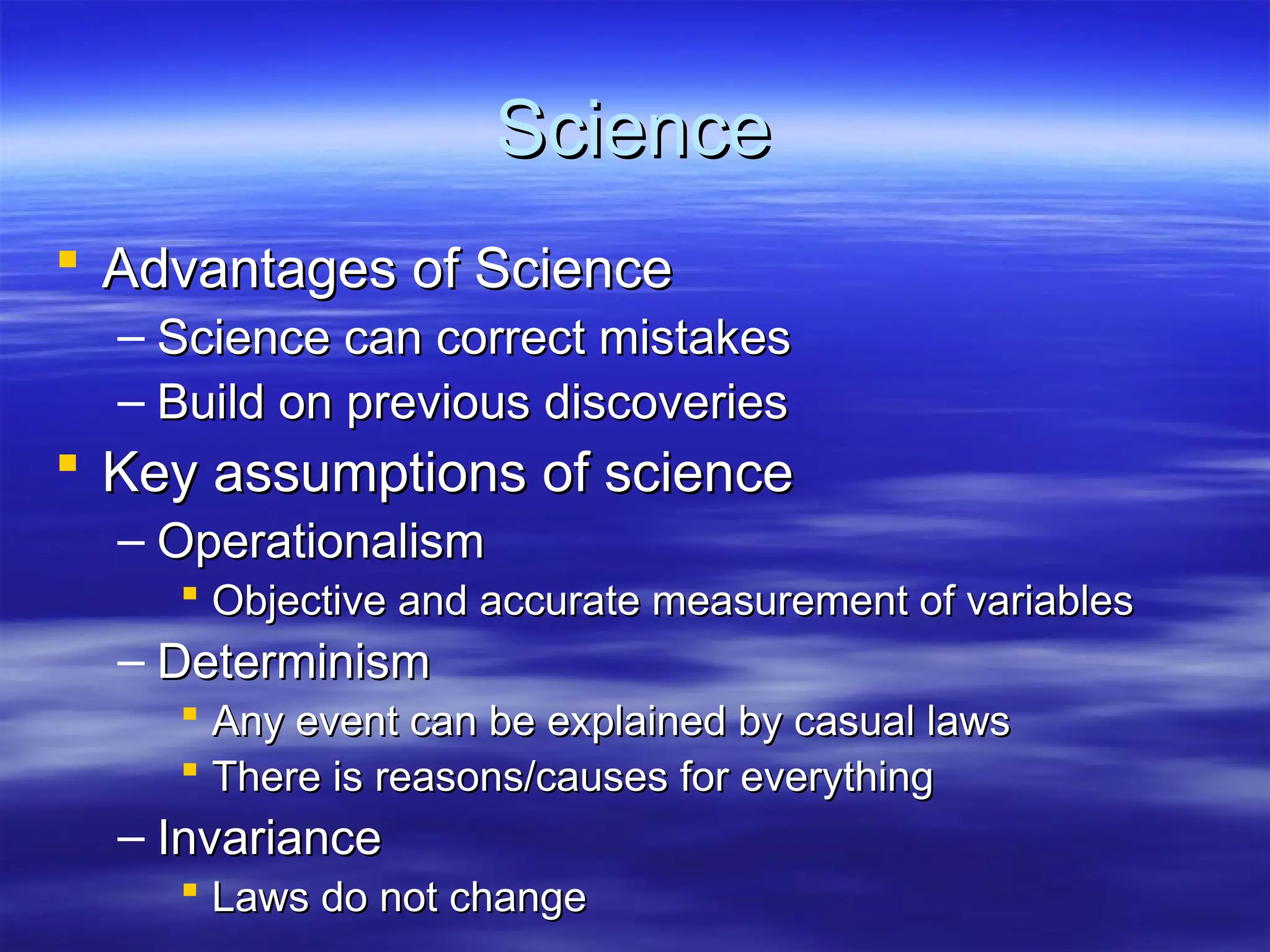
Science
Science
Advantages ofScience
Advantages of Science
– Science can correct mistakes
Science can correct mistakes
– Build on previous discoveries
Build on previous discoveries
Key assumptions of science
Key assumptions of science
– Operationalism
Operationalism
Objective and accurate measurement of variables
Objective and accurate measurement of variables
– Determinism
Determinism
Any event can be explained by casual laws
Any event can be explained by casual laws
There is reasons/causes for everything
There is reasons/causes for everything
– Invariance
Invariance
Laws do not change
Laws do not change
11.
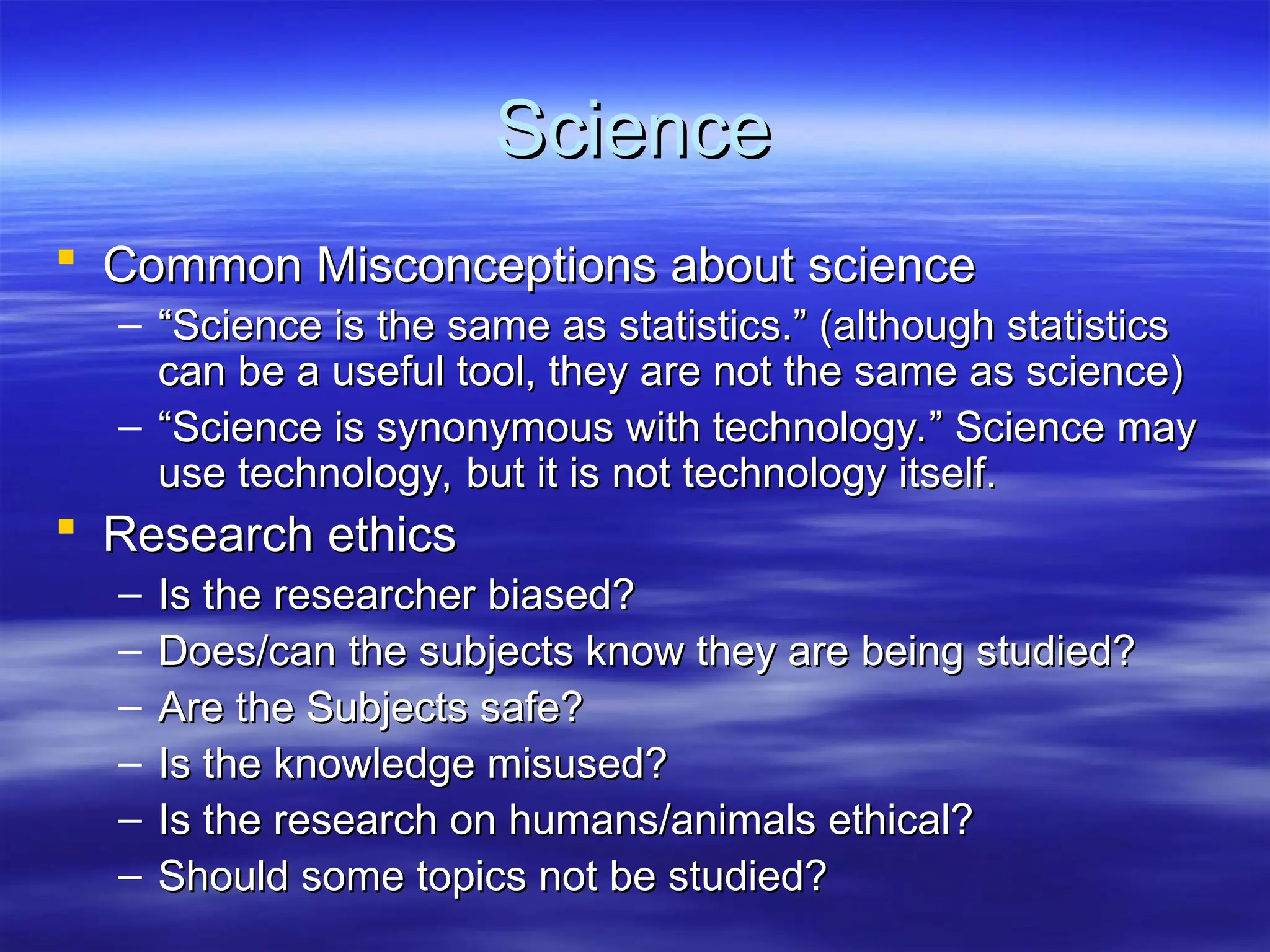
Science
Science
Common Misconceptionsabout science
Common Misconceptions about science
– “
“Science is the same as statistics.” (although statistics
Science is the same as statistics.” (although statistics
can be a useful tool, they are not the same as science)
can be a useful tool, they are not the same as science)
– “
“Science is synonymous with technology.” Science may
Science is synonymous with technology.” Science may
use technology, but it is not technology itself.
use technology, but it is not technology itself.
Research ethics
Research ethics
– Is the researcher biased?
Is the researcher biased?
– Does/can the subjects know they are being studied?
Does/can the subjects know they are being studied?
– Are the Subjects safe?
Are the Subjects safe?
– Is the knowledge misused?
Is the knowledge misused?
– Is the research on humans/animals ethical?
Is the research on humans/animals ethical?
– Should some topics not be studied?
Should some topics not be studied?
12.
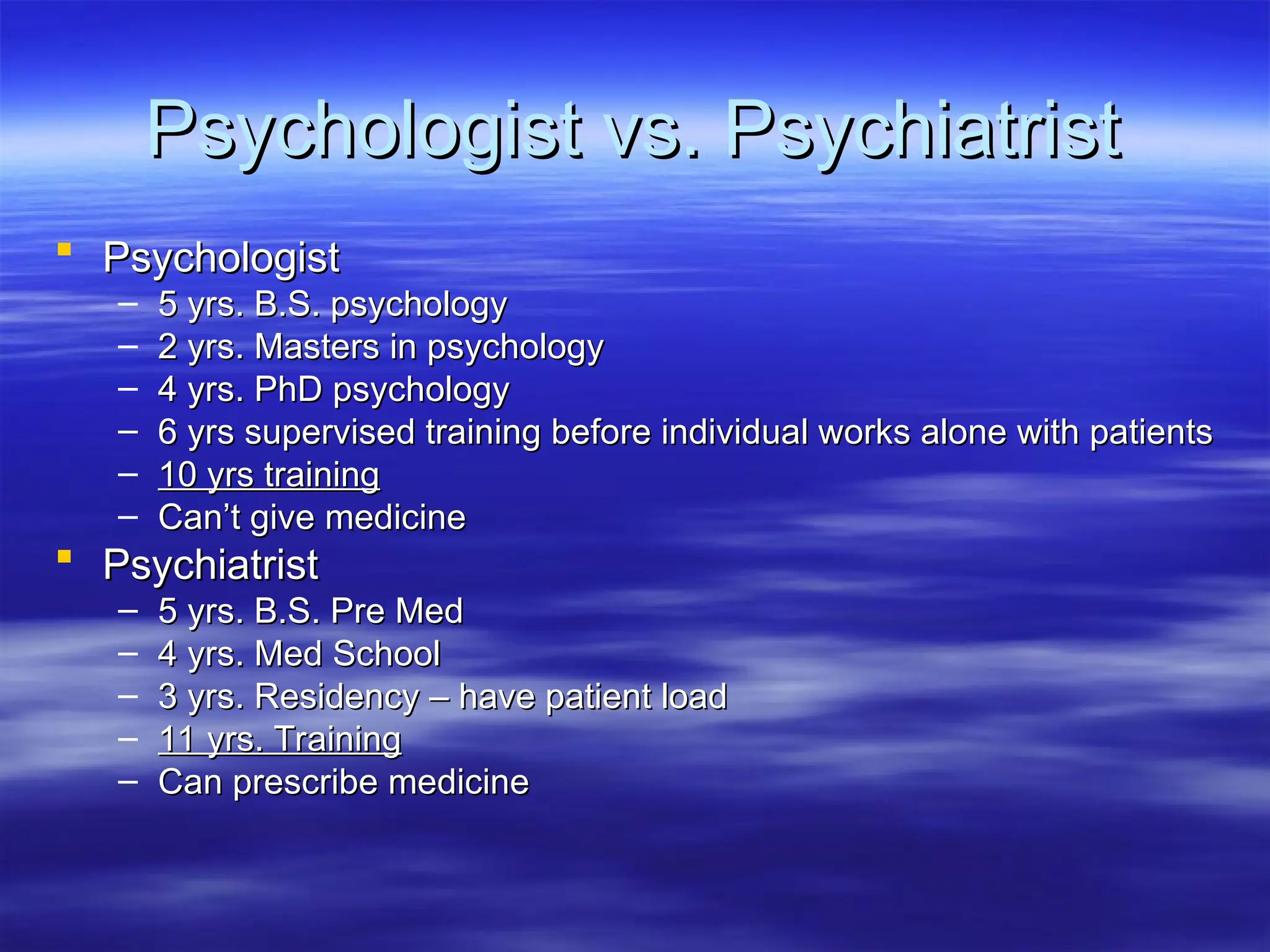
Psychologist vs. Psychiatrist
Psychologistvs. Psychiatrist
Psychologist
Psychologist
– 5 yrs. B.S. psychology
5 yrs. B.S. psychology
– 2 yrs. Masters in psychology
2 yrs. Masters in psychology
– 4 yrs. PhD psychology
4 yrs. PhD psychology
– 6 yrs supervised training before individual works alone with patients
6 yrs supervised training before individual works alone with patients
– 10 yrs training
10 yrs training
– Can’t give medicine
Can’t give medicine
Psychiatrist
Psychiatrist
– 5 yrs. B.S. Pre Med
5 yrs. B.S. Pre Med
– 4 yrs. Med School
4 yrs. Med School
– 3 yrs. Residency – have patient load
3 yrs. Residency – have patient load
– 11 yrs. Training
11 yrs. Training
– Can prescribe medicine
Can prescribe medicine
13.
In Class Assignment
InClass Assignment
You are now going to go through a make believe
You are now going to go through a make believe
research project (I want to see if you understand
research project (I want to see if you understand
the
the Research Method)
Research Method)
– Pick a behavior that you see here at school that would
Pick a behavior that you see here at school that would
be good to explain
be good to explain
– Put this idea into the Scientific Method for a fictitious
Put this idea into the Scientific Method for a fictitious
study
study
1.
1. What is the purpose of the study
What is the purpose of the study
2.
2. What is your hypothesis
What is your hypothesis
3.
3. What type of research would you use for this study
What type of research would you use for this study
4.
4. What data do you think you would come up with
What data do you think you would come up with
5.
5. What do you think your conclusion would be
What do you think your conclusion would be
For more detail contact us
#6 Example experiment – effect of music on studying ant test scores
Experimental group – those exposed to the independent variable (music while studying)
Control group – those exposed to all conditions except the independent variable (no music)