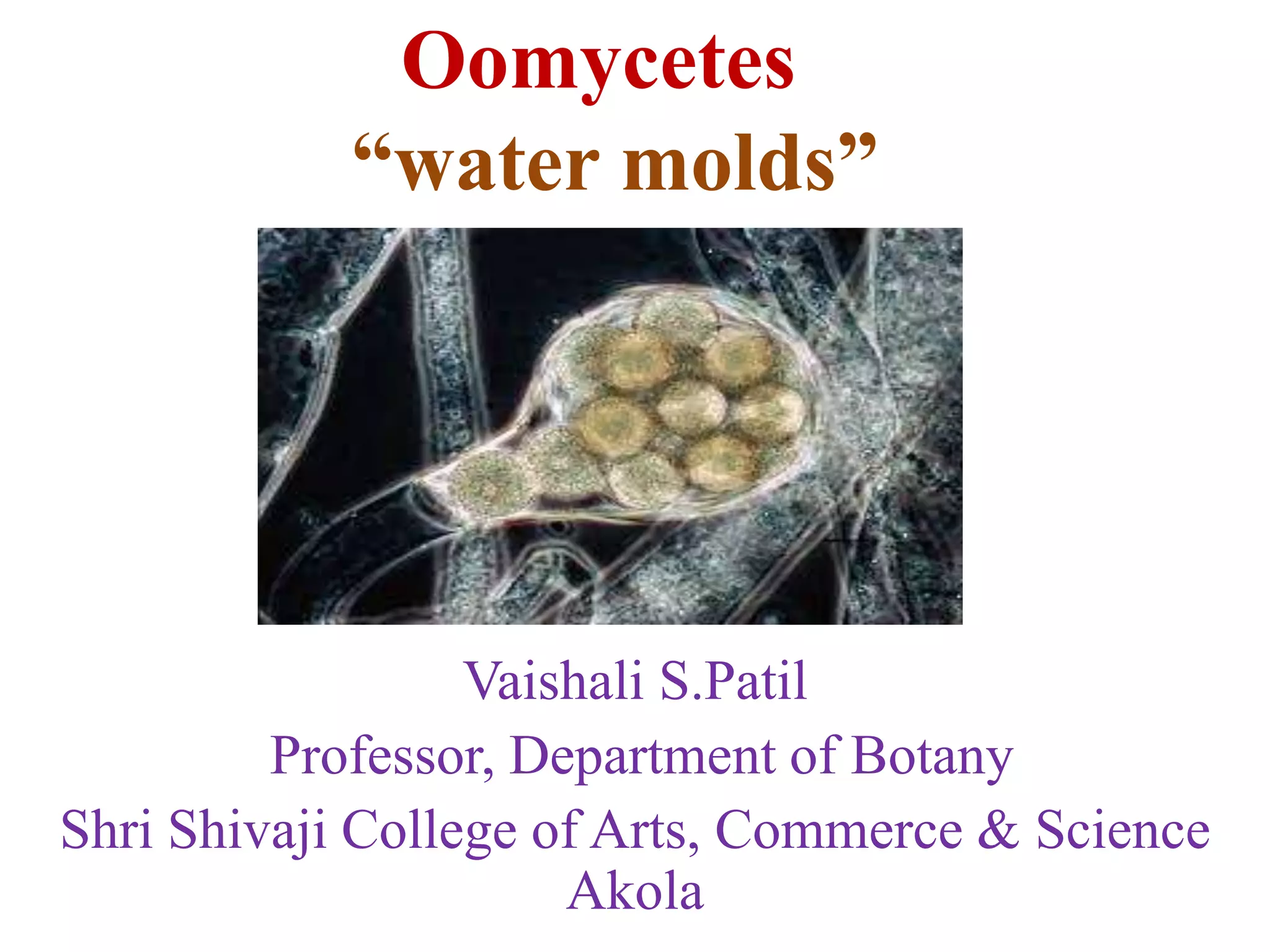
Oomycetes
“water molds”
Vaishali S.Patil
Professor, Department of Botany
Shri Shivaji College of Arts, Commerce & Science
Akola
It include some of the most devastating plant pathogens.
The diseases they cause include seedling blights, damping- off, root
rots, foliar blights and downy mildews.
Some notable diseases are the late blight of potato, downy mildew of
grape vine, sudden oak death, and root and stem rot of soybean.
Because of their filamentous growth habit, nutrition by absorption, and
reproduction via spores, oomycetes were long regarded by plant
pathologists as lower fungi.
Oomycetes are more closely related to algae and to green plants.
Septa (cell walls) in the hyphae are rare, resulting in a multinucleate
condition (termed coenocytic).
The nuclei of vegetative cells are typically diploid.
The cell wall is composed of β-1,3, and β-1,6 glucans, and not of
chitin (the polymer of N-acetyl glucose amine, found in the walls of true
fungi).
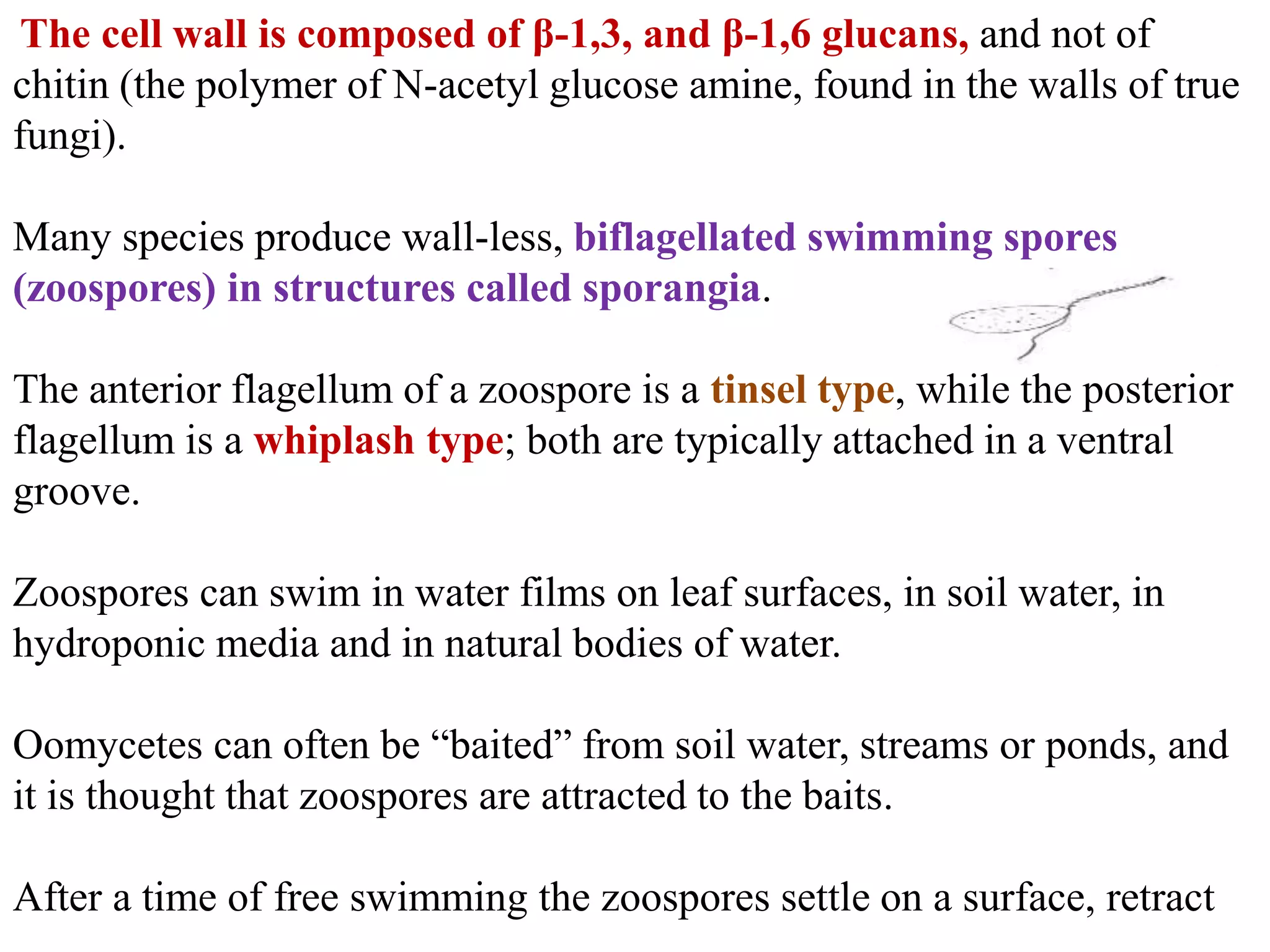
Many species produce wall-less, biflagellated swimming spores
(zoospores) in structures called sporangia.
The anterior flagellum of a zoospore is a tinsel type, while the posterior
flagellum is a whiplash type; both are typically attached in a ventral
groove.
Zoospores can swim in water films on leaf surfaces, in soil water, in
hydroponic media and in natural bodies of water.
Oomycetes can often be “baited” from soil water, streams or ponds, and
it is thought that zoospores are attracted to the baits.
After a time of free swimming the zoospores settle on a surface, retract
their flagella, and secrete a mucilaginous matrix which affixes them to
the surface.
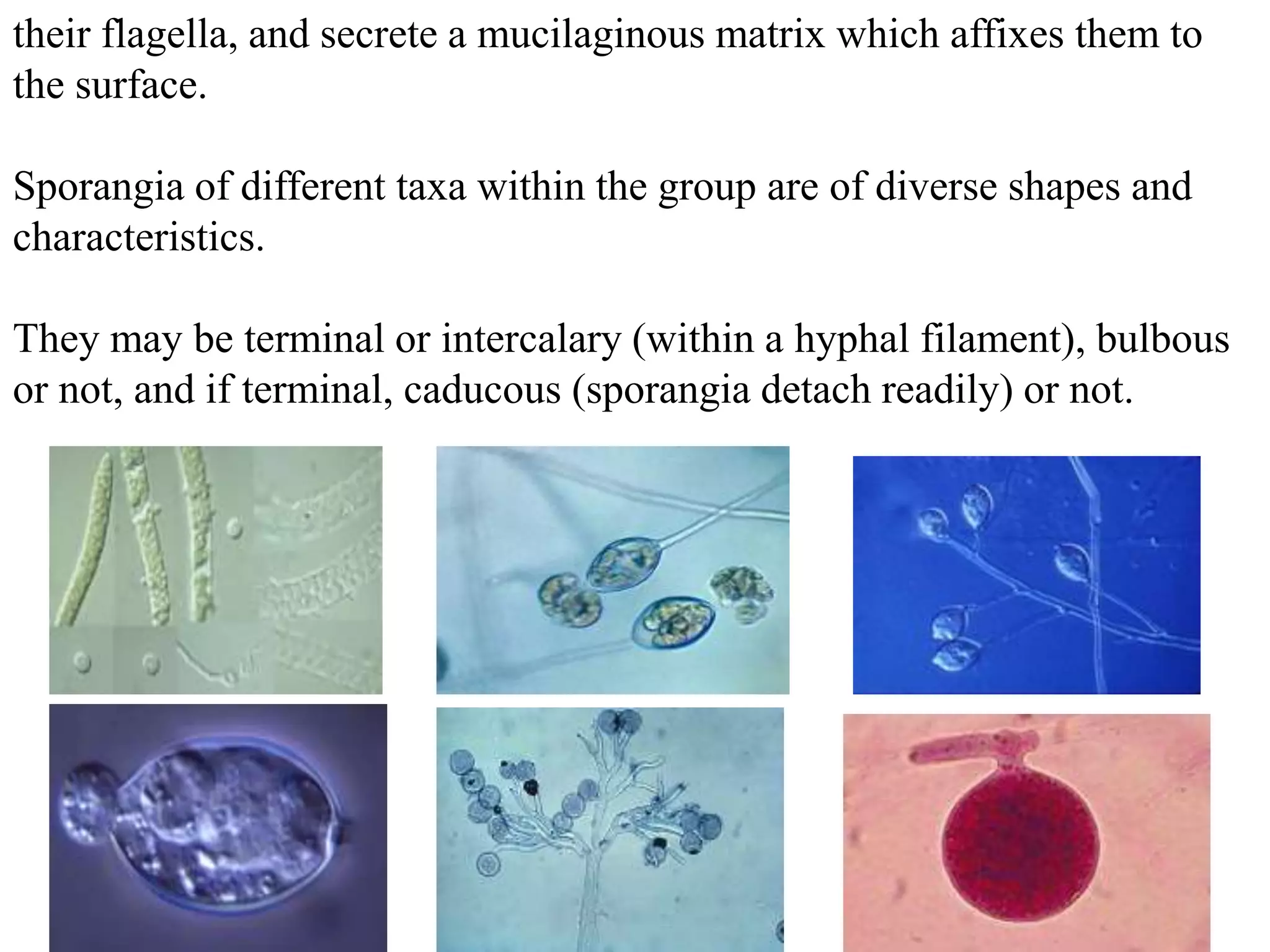
Sporangia of different taxa within the group are of diverse shapes and
characteristics.
They may be terminal or intercalary (within a hyphal filament), bulbous
or not, and if terminal, caducous (sporangia detach readily) or not.
Typically each individual produces both antheridia and oogonia.
In some species, two distinct mating types occur and both are required for sexual
reproduction (these are heterothallic as opposed to homothallic species). In
heterothallic oomycetes, the gametangia are produced only in the presence of both
mating types due to the fact that a hormone produced by one thallus stimulates the other
to produce gametangia.
In other species, sexual reproduction occurs within a single individual (these are
homothallic individuals). Unlike the heterothallic species, homothallic individuals do
not require distinct mating types, but can reproduce sexually by selfing.
All Pythium and some Phytophthora species are homothallic.
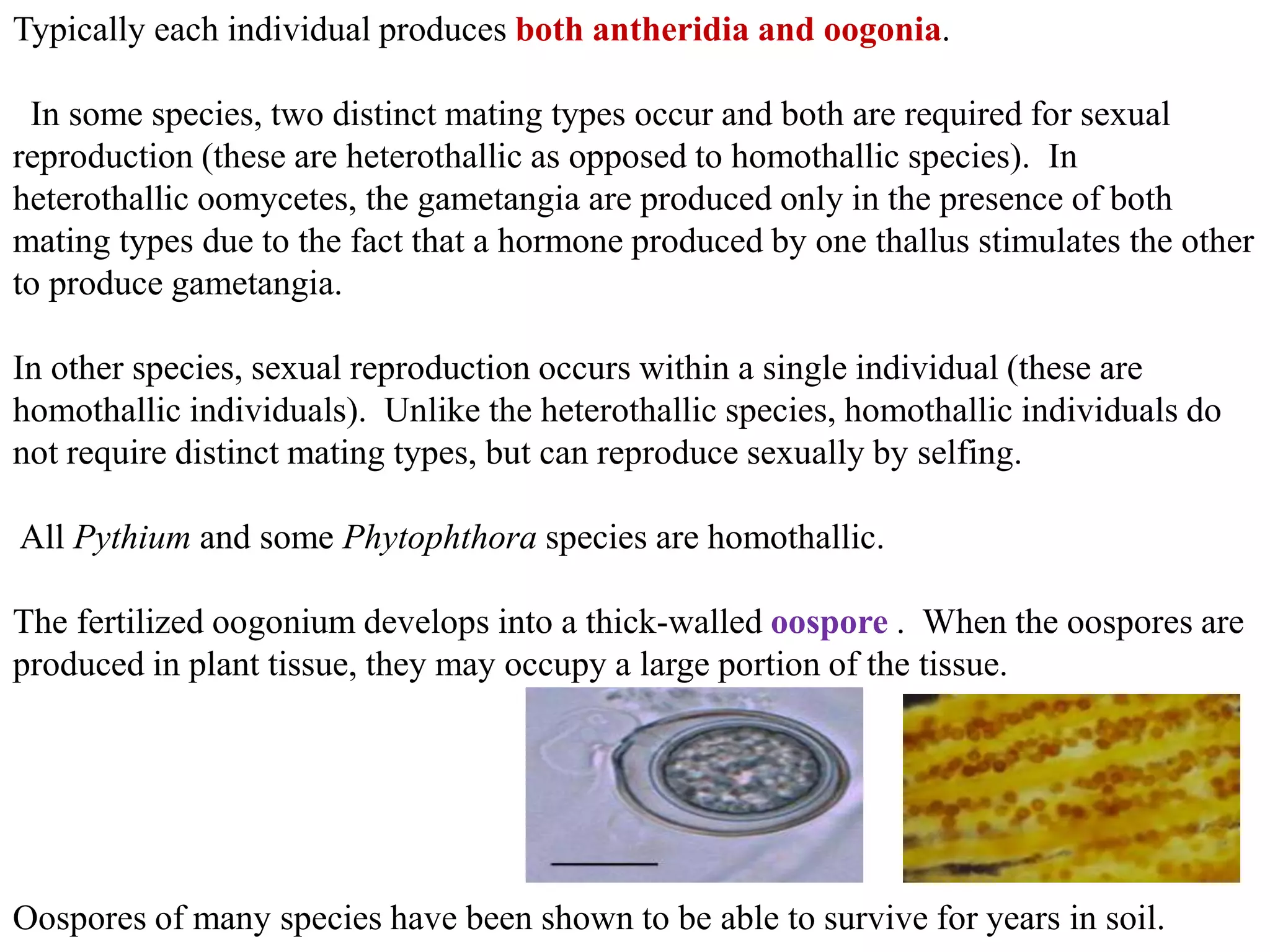
The fertilized oogonium develops into a thick-walled oospore . When the oospores are
produced in plant tissue, they may occupy a large portion of the tissue.
Oospores of many species have been shown to be able to survive for years in soil.
In some species, the ability to produce zoospores has been lost, and
sporangia are thought to have evolved into structures that germinate
directly to produce germ tubes. In this case, the sporangia are sometimes
termed “conidia”.
In yet other species, sporangia can germinate directly to produce germ
tubes or “indirectly” to produce zoospores.
Sexual reproduction occurs via the production of gametangia: oogonia
and antheridia. The vegetative nuclei are diploid.
In some genera the antheridium is attached to the side of the oogonium
(paragynous), but in other genera, the antheridium surrounds the base of
the oogonium (amphigynous).
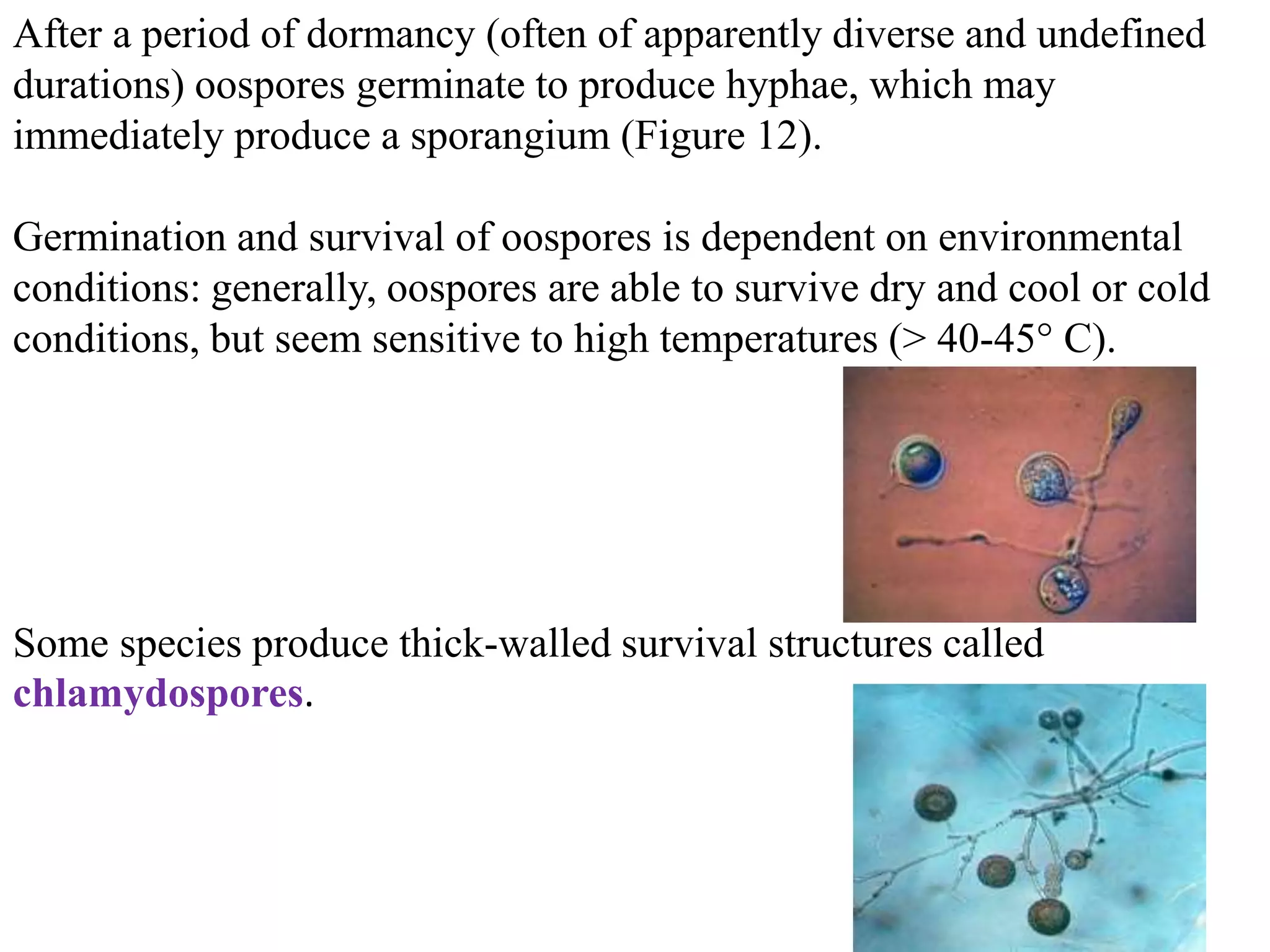
After a period of dormancy (often of apparently diverse and undefined
durations) oospores germinate to produce hyphae, which may
immediately produce a sporangium (Figure 12).
Germination and survival of oospores is dependent on environmental
conditions: generally, oospores are able to survive dry and cool or cold
conditions, but seem sensitive to high temperatures (> 40-45° C).
Some species produce thick-walled survival structures called
chlamydospores.
Fungi Classification by Ainsworth
Kingdom- Mycota (fungi)
Division- Eumycota (true fungi)
Class- Oomycetes
1.Order- Lagenidiales -Holocarpic, unicellular or filamentous water
molds, parasitic on algae and fungi or saprobic; oogonium (egg-
producing structure) typically containing a single egg; about 85 species.
2.Order- Saprolegniales- Mostly eucarpic, filamentous water molds or
soil fungi; saprobic or parasitic; hyphae without constrictions or cellulin
plugs; oogonia containing 1 to many free eggs; some species are
diplanetic, i.e., they produce 2 types of zoospores, primary (pear-shaped
with anterior flagella) and secondary (kidney-shaped with lateral
flagella); some (Aphanomyces) cause root rots; others (Saprolegnia)
infect fish and fish eggs; about 200 species. genera
include Leptolegnia, Achlya.
3.Order- Leptomitales- Aquatic saprobes found often in polluted
waters; eucarpic; hyphae constricted, with cellulin plugs, arising from a
well-defined basal cell; oogonium typically containing a single egg,
which may be free or embedded in periplasm (a peripheral layer of
protoplasm); 20 species. Ex.Apodachlyella, Ducellieria, Leptolegniella,
and Leptomitus.
4.Order- Peronosporales- Aquatic or terrestrial; parasitic on algae or
vascular plants, the latter mostly obligate parasites causing downy
mildews; zoosporangia, in advanced species, borne on well-differentiated
sporangiophores, deciduous and behaving as conidia (asexually produced
spores); about 250 species.
• Family Pythiaceae, Genus: Pithium, Phytophthora
• Family Peronosporaceae, Genus: Plasmopara
• Family Albuginaceae, Genus: Albugo.
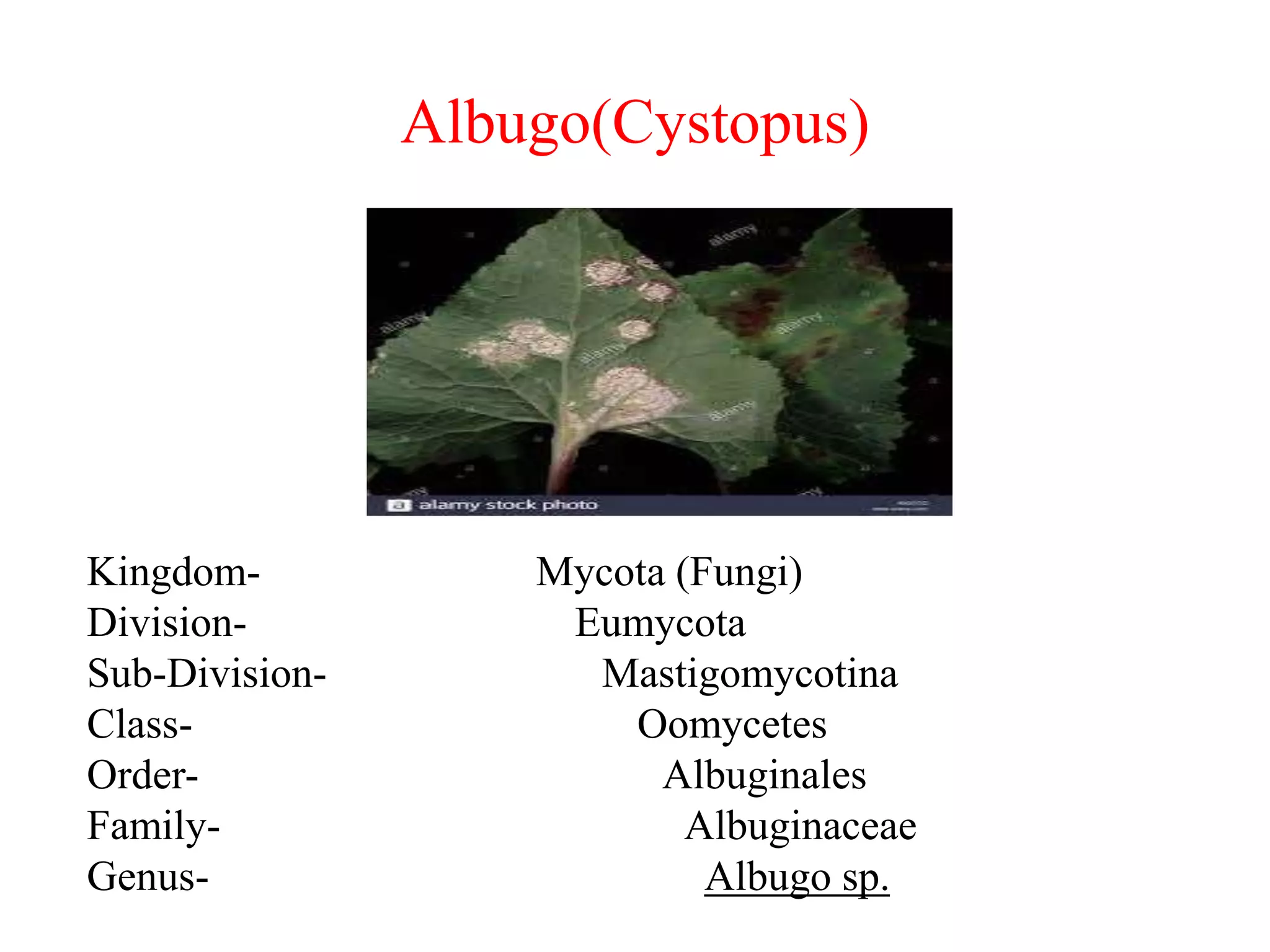
Albugo(Cystopus)
Kingdom- Mycota (Fungi)
Division- Eumycota
Sub-Division- Mastigomycotina
Class- Oomycetes
Order- Albuginales
Family- Albuginaceae
Genus- Albugo sp.
Phytophthora
Class: Oomycota
Order: Peronosporales
Family: Pythiaceae
Genus: Phytophthora
Species: P. Infestans
•It causes late blight and affects potato and tomato plants. The fungus
spreads through tissues of leaves, stems and tubers.
•Mycelium is intercellular and intracellular.
•Mycelium is profusely branched, aseptate, hyaline, coenocytic,
moderately thick. Haustoria develop on the intercellular hyphae. They
push their way out either through a stoma or by piercing through the
epidermal cell on the lower surface of the leaf. In the case of the tubers
they push their way through the lenticels or injured portions of the skin.
•These hyphae are called sporangiophores (conidiophores).
•The sporangium is formed by the inflation of the tip of the side branch
of the sporangiophore .
•The multinucleate inflation is then cut off by a transverse septum basal
plug as a sporangium.
•The hyphal branch bearing the young terminal sporangium continues to
grow. As the sporangium reaches maturity, the branch tip swells slightly
just below the sporangium and proliferates pushing the sporangium to
the side as the elongation proceeds .
•Sporangium is a hyaline,oval to elliptical thin wall spore sac with a
basal plug. It has a small stalk and an apical papilla. The mature lemon-
shaped, pappilate sporangium with a basal plug is readily detachable.
•Wind, rain splashes or contact with other leaves detach and spread or
scatter the ripe sporangia on to the leaves of other plants.
•The sporaniga germinate either indirectly by producing biflagellate
zoospores( at low temperature i.e. 12 to 15ᵒC) and thus functioning as
zoosporangia or directly by a germ tube and functioning as
conidia.(at high temperature i.e. 20 to 23°C).
•Each quiescent zoospore retracts its flagella and may encyst . The
encysted zoospore then germinates by putting out a special, short hypha
called the germ tube.
•Some species can produce chlamydospores.
•Sexual reproduction is oogamous. Some species were considered
homothallic while others proved to be heterothallic.
• Antheridia is thin-walled, funnel-shaped and contains non-vacuolated
cytoplasm with a single nuclei.
• Oogonia also arises as a short, lateral hypha without any inflation. It
contains dense, multinucleate cytoplasm. At mating time both curve
towards each other. The antheridium, now forms a collar-like structure
surrounding the base of the oogonium.
•Mating takes place. The oogonial wall bulges at one point into the
antheridium. This point is called the receptive spot. It then dissolves at
the receptive spot. Through the opening the antheridium pushes the
fertilization tube.
• Oospores are formed which is spherical or pear-shaped. Growth of the
germ tube takes place after resting period is over.
Perenospora
Class: Oomycota
Order: Peronosporales
Family: Peronosporaceae
Genus: Peronospora corda
•It is a plant pathogens which are obligate parasites of flowering plants
such as onion, grape, bajra, jowar, maize, pea, turnip, beet, tobacco
and many crucifers.
•The diseases caused by the Peronosporaceae are called downy mildews.
•Important genera placed in the family include Plasmopara,
Peronospora, Basidiospora, Bremia and Sclerospora .
•The mycelium is branched, tubular and coenocytic. The hyphae are
strictly intercellular and occur in the stem but more commonly in the
leaf.
• They absorb nutrition by sending vesicular (Fig. 6.36 A) or branched
finger-like haustoria into the host cells.
•The sporangiophores (or conidiophores) are distinct and of determinate
growth.
•They arise from an endophytic mycelium, emerge through the stomata
to come into the air.
•Each branch bears a few to many short, delicate branchlets.
•A single ovoid or pyriform sporangium is formed at the tip of an
ultimate branchlet called a sterigma.
•The sporangia are deciduous and thus get detached when mature. The
detached sporangia are disseminated by wind.
•It germinates either discharging a number of small biflagellate,
reniform zoospores or directly forming a short germ tube under
warmer or dry conditions.
•The germ tube formed enters the host through a stoma and forma
the mycelium.
•The sex organs are formed within the tissues of the host on the same
or adjacent hyphae.
•The antheridia are paragynous. The protoplast of the oogonium is
differentiated ooplasm.
•The oospore has a thick wall. The outer layer or epispore is
sculputured. The oospore, as a rule germinates by germ tubes.
Oomycetes
Oomycetes

Oomycetes

  • 1.
    Oomycetes “water molds” Vaishali S.Patil Professor,Department of Botany Shri Shivaji College of Arts, Commerce & Science Akola
  • 2.
    It include someof the most devastating plant pathogens. The diseases they cause include seedling blights, damping- off, root rots, foliar blights and downy mildews. Some notable diseases are the late blight of potato, downy mildew of grape vine, sudden oak death, and root and stem rot of soybean. Because of their filamentous growth habit, nutrition by absorption, and reproduction via spores, oomycetes were long regarded by plant pathologists as lower fungi. Oomycetes are more closely related to algae and to green plants. Septa (cell walls) in the hyphae are rare, resulting in a multinucleate condition (termed coenocytic). The nuclei of vegetative cells are typically diploid.
  • 3.
    The cell wallis composed of β-1,3, and β-1,6 glucans, and not of chitin (the polymer of N-acetyl glucose amine, found in the walls of true fungi). Many species produce wall-less, biflagellated swimming spores (zoospores) in structures called sporangia. The anterior flagellum of a zoospore is a tinsel type, while the posterior flagellum is a whiplash type; both are typically attached in a ventral groove. Zoospores can swim in water films on leaf surfaces, in soil water, in hydroponic media and in natural bodies of water. Oomycetes can often be “baited” from soil water, streams or ponds, and it is thought that zoospores are attracted to the baits. After a time of free swimming the zoospores settle on a surface, retract
  • 4.
    their flagella, andsecrete a mucilaginous matrix which affixes them to the surface. Sporangia of different taxa within the group are of diverse shapes and characteristics. They may be terminal or intercalary (within a hyphal filament), bulbous or not, and if terminal, caducous (sporangia detach readily) or not.
  • 5.
    Typically each individualproduces both antheridia and oogonia. In some species, two distinct mating types occur and both are required for sexual reproduction (these are heterothallic as opposed to homothallic species). In heterothallic oomycetes, the gametangia are produced only in the presence of both mating types due to the fact that a hormone produced by one thallus stimulates the other to produce gametangia. In other species, sexual reproduction occurs within a single individual (these are homothallic individuals). Unlike the heterothallic species, homothallic individuals do not require distinct mating types, but can reproduce sexually by selfing. All Pythium and some Phytophthora species are homothallic. The fertilized oogonium develops into a thick-walled oospore . When the oospores are produced in plant tissue, they may occupy a large portion of the tissue. Oospores of many species have been shown to be able to survive for years in soil.
  • 6.
    In some species,the ability to produce zoospores has been lost, and sporangia are thought to have evolved into structures that germinate directly to produce germ tubes. In this case, the sporangia are sometimes termed “conidia”. In yet other species, sporangia can germinate directly to produce germ tubes or “indirectly” to produce zoospores. Sexual reproduction occurs via the production of gametangia: oogonia and antheridia. The vegetative nuclei are diploid. In some genera the antheridium is attached to the side of the oogonium (paragynous), but in other genera, the antheridium surrounds the base of the oogonium (amphigynous).
  • 7.
    After a periodof dormancy (often of apparently diverse and undefined durations) oospores germinate to produce hyphae, which may immediately produce a sporangium (Figure 12). Germination and survival of oospores is dependent on environmental conditions: generally, oospores are able to survive dry and cool or cold conditions, but seem sensitive to high temperatures (> 40-45° C). Some species produce thick-walled survival structures called chlamydospores.
  • 8.
    Fungi Classification byAinsworth Kingdom- Mycota (fungi) Division- Eumycota (true fungi) Class- Oomycetes 1.Order- Lagenidiales -Holocarpic, unicellular or filamentous water molds, parasitic on algae and fungi or saprobic; oogonium (egg- producing structure) typically containing a single egg; about 85 species. 2.Order- Saprolegniales- Mostly eucarpic, filamentous water molds or soil fungi; saprobic or parasitic; hyphae without constrictions or cellulin plugs; oogonia containing 1 to many free eggs; some species are diplanetic, i.e., they produce 2 types of zoospores, primary (pear-shaped with anterior flagella) and secondary (kidney-shaped with lateral flagella); some (Aphanomyces) cause root rots; others (Saprolegnia) infect fish and fish eggs; about 200 species. genera include Leptolegnia, Achlya. 3.Order- Leptomitales- Aquatic saprobes found often in polluted waters; eucarpic; hyphae constricted, with cellulin plugs, arising from a well-defined basal cell; oogonium typically containing a single egg,
  • 9.
    which may befree or embedded in periplasm (a peripheral layer of protoplasm); 20 species. Ex.Apodachlyella, Ducellieria, Leptolegniella, and Leptomitus. 4.Order- Peronosporales- Aquatic or terrestrial; parasitic on algae or vascular plants, the latter mostly obligate parasites causing downy mildews; zoosporangia, in advanced species, borne on well-differentiated sporangiophores, deciduous and behaving as conidia (asexually produced spores); about 250 species. • Family Pythiaceae, Genus: Pithium, Phytophthora • Family Peronosporaceae, Genus: Plasmopara • Family Albuginaceae, Genus: Albugo.
  • 10.
    Albugo(Cystopus) Kingdom- Mycota (Fungi) Division-Eumycota Sub-Division- Mastigomycotina Class- Oomycetes Order- Albuginales Family- Albuginaceae Genus- Albugo sp.
  • 11.
    Phytophthora Class: Oomycota Order: Peronosporales Family:Pythiaceae Genus: Phytophthora Species: P. Infestans •It causes late blight and affects potato and tomato plants. The fungus spreads through tissues of leaves, stems and tubers. •Mycelium is intercellular and intracellular. •Mycelium is profusely branched, aseptate, hyaline, coenocytic, moderately thick. Haustoria develop on the intercellular hyphae. They push their way out either through a stoma or by piercing through the epidermal cell on the lower surface of the leaf. In the case of the tubers they push their way through the lenticels or injured portions of the skin. •These hyphae are called sporangiophores (conidiophores).
  • 12.
    •The sporangium isformed by the inflation of the tip of the side branch of the sporangiophore . •The multinucleate inflation is then cut off by a transverse septum basal plug as a sporangium. •The hyphal branch bearing the young terminal sporangium continues to grow. As the sporangium reaches maturity, the branch tip swells slightly just below the sporangium and proliferates pushing the sporangium to the side as the elongation proceeds . •Sporangium is a hyaline,oval to elliptical thin wall spore sac with a basal plug. It has a small stalk and an apical papilla. The mature lemon- shaped, pappilate sporangium with a basal plug is readily detachable. •Wind, rain splashes or contact with other leaves detach and spread or scatter the ripe sporangia on to the leaves of other plants.
  • 13.
    •The sporaniga germinateeither indirectly by producing biflagellate zoospores( at low temperature i.e. 12 to 15ᵒC) and thus functioning as zoosporangia or directly by a germ tube and functioning as conidia.(at high temperature i.e. 20 to 23°C). •Each quiescent zoospore retracts its flagella and may encyst . The encysted zoospore then germinates by putting out a special, short hypha called the germ tube. •Some species can produce chlamydospores. •Sexual reproduction is oogamous. Some species were considered homothallic while others proved to be heterothallic. • Antheridia is thin-walled, funnel-shaped and contains non-vacuolated cytoplasm with a single nuclei. • Oogonia also arises as a short, lateral hypha without any inflation. It
  • 14.
    contains dense, multinucleatecytoplasm. At mating time both curve towards each other. The antheridium, now forms a collar-like structure surrounding the base of the oogonium. •Mating takes place. The oogonial wall bulges at one point into the antheridium. This point is called the receptive spot. It then dissolves at the receptive spot. Through the opening the antheridium pushes the fertilization tube. • Oospores are formed which is spherical or pear-shaped. Growth of the germ tube takes place after resting period is over.
  • 16.
    Perenospora Class: Oomycota Order: Peronosporales Family:Peronosporaceae Genus: Peronospora corda •It is a plant pathogens which are obligate parasites of flowering plants such as onion, grape, bajra, jowar, maize, pea, turnip, beet, tobacco and many crucifers. •The diseases caused by the Peronosporaceae are called downy mildews. •Important genera placed in the family include Plasmopara, Peronospora, Basidiospora, Bremia and Sclerospora . •The mycelium is branched, tubular and coenocytic. The hyphae are strictly intercellular and occur in the stem but more commonly in the leaf.
  • 17.
    • They absorbnutrition by sending vesicular (Fig. 6.36 A) or branched finger-like haustoria into the host cells. •The sporangiophores (or conidiophores) are distinct and of determinate growth. •They arise from an endophytic mycelium, emerge through the stomata to come into the air. •Each branch bears a few to many short, delicate branchlets. •A single ovoid or pyriform sporangium is formed at the tip of an ultimate branchlet called a sterigma.
  • 18.
    •The sporangia aredeciduous and thus get detached when mature. The detached sporangia are disseminated by wind. •It germinates either discharging a number of small biflagellate, reniform zoospores or directly forming a short germ tube under warmer or dry conditions. •The germ tube formed enters the host through a stoma and forma the mycelium. •The sex organs are formed within the tissues of the host on the same or adjacent hyphae. •The antheridia are paragynous. The protoplast of the oogonium is differentiated ooplasm. •The oospore has a thick wall. The outer layer or epispore is sculputured. The oospore, as a rule germinates by germ tubes.