MANAGEMENTACCOUNTING
FinancialAnalysis and Interpretation :
TrendAnalysis
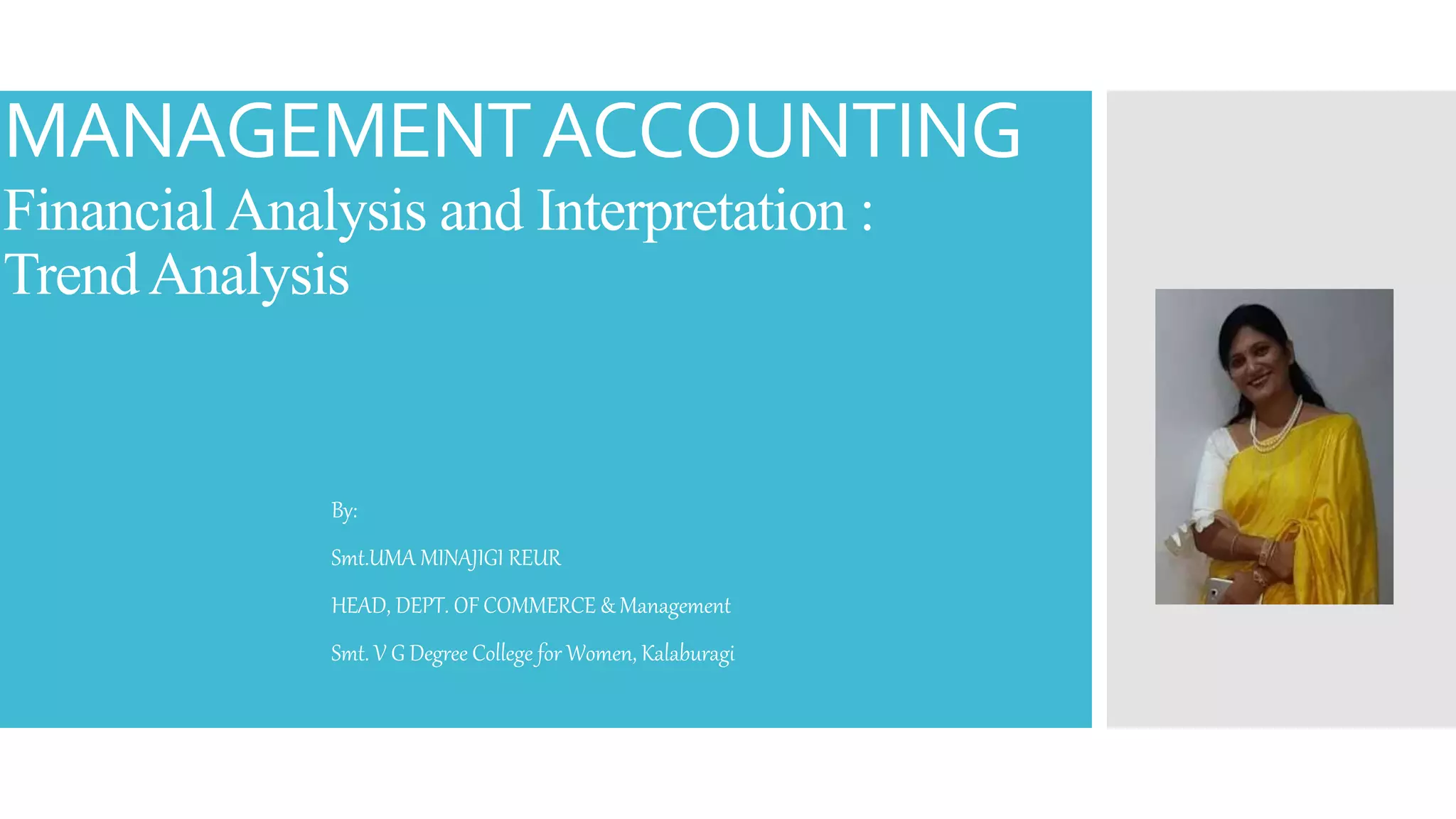
By:
Smt.UMA MINAJIGI REUR
HEAD, DEPT. OF COMMERCE & Management
Smt. V G Degree College for Women, Kalaburagi
MANAGEMENT
ACCOUNTING
B.COM SIXTH SEMESTER
&
BBA FOURTH SEMESTER
6.3: PRINCIPLES OF MANAGEMENT ACCOUNTING
B.COM SIXTH SEMESTER
6.3: PRINCIPLES OF MANAGEMENT ACCOUNTING
Unit I: Management Accounting (08 Hours):
Definition and objectives of Management Accounting - Relationship between Cost, Financial and Managerial Accounting.
Unit II : Financial Statements (15 Hours):
Nature, uses and limitations. Analysis and interpretations – meaning, procedure, objectives, and importance. Comparative
statement, Common Size Statements and Trend Analysis - practical problems.
Unit III: Ratio Analysis (15 Hours):
Definition and meaning of Ratio Analysis, importance and limitations, Profitability Ratio – Gross profit Ratio, operating
Ratio, Overall profitability ratio – Earning per share. Turnover Ratios- Inventory Turnover Ratio, Debtors Turnover Ratio,
Debt collection period , Creditors Turnover Ratio, Debt payment period, Liquidity Ratio- current ratio, liquid ratio.
Financial positions and Leverage Ratios- Debt Equity Ratio, Proprietary Ratio - Problems thereon.
Unit IV: Analysis through Leverages (12 Hours):
Meaning- types of Leverages- operating – financial and combined leverages- problems thereon.
Unit V: Fund Flow Statement (15 Hours):
Meaning , uses and limitations – preparation of fund-flow statement. Cash Flow Statement: Meaning and preparation of
Cash flow statement- problems thereon.
Unit II : Financial Statements :
• Nature, uses and limitations.
• Analysis and interpretations – meaning,
procedure, objectives, and importance.
• Comparative statement,
• Common Size Statements and
• Trend Analysis - practical problems.
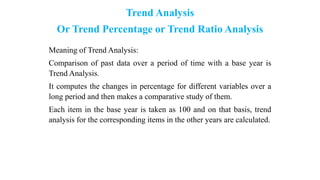
Trend Analysis
Or Trend Percentage or Trend Ratio Analysis
Meaning of Trend Analysis:
Comparison of past data over a period of time with a base year is
Trend Analysis.
It computes the changes in percentage for different variables over a
long period and then makes a comparative study of them.
Each item in the base year is taken as 100 and on that basis, trend
analysis for the corresponding items in the other years are calculated.
Trend Analysis
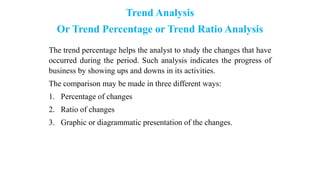
Or Trend Percentage or Trend Ratio Analysis
The trend percentage helps the analyst to study the changes that have
occurred during the period. Such analysis indicates the progress of
business by showing ups and downs in its activities.
The comparison may be made in three different ways:
1. Percentage of changes
2. Ratio of changes
3. Graphic or diagrammatic presentation of the changes.
Trend Analysis
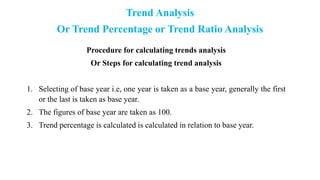
Or Trend Percentage or Trend Ratio Analysis
Procedure for calculating trends analysis
Or Steps for calculating trend analysis
1. Selecting of base year i.e, one year is taken as a base year, generally the first
or the last is taken as base year.
2. The figures of base year are taken as 100.
3. Trend percentage is calculated is calculated in relation to base year.
Trend Analysis
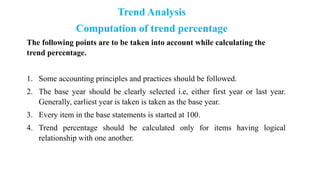
Computation of trend percentage
The following points are to be taken into account while calculating the
trend percentage.
1. Some accounting principles and practices should be followed.
2. The base year should be clearly selected i.e, either first year or last year.
Generally, earliest year is taken is taken as the base year.
3. Every item in the base statements is started at 100.
4. Trend percentage should be calculated only for items having logical
relationship with one another.
Trend Analysis
Computation of trend percentage
The following points are to be taken into account while calculating the
trend percentage.
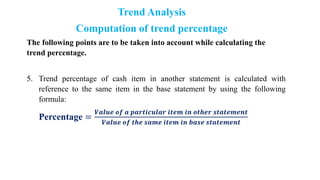
5. Trend percentage of cash item in another statement is calculated with
reference to the same item in the base statement by using the following
formula:
Percentage =
𝑽𝒂𝒍𝒖𝒆 𝒐𝒇 𝒂 𝒑𝒂𝒓𝒕𝒊𝒄𝒖𝒍𝒂𝒓 𝒊𝒕𝒆𝒎 𝒊𝒏 𝒐𝒕𝒉𝒆𝒓 𝒔𝒕𝒂𝒕𝒆𝒎𝒆𝒏𝒕
𝑽𝒂𝒍𝒖𝒆 𝒐𝒇 𝒕𝒉𝒆 𝒔𝒂𝒎𝒆 𝒊𝒕𝒆𝒎 𝒊𝒏 𝒃𝒂𝒔𝒆 𝒔𝒕𝒂𝒕𝒆𝒎𝒆𝒏𝒕
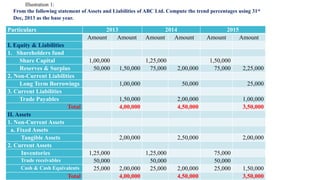
Illustration 1:
From the following statement of Assets and Liabilities of ABC Ltd. Compute the trend percentages using 31st
Dec, 2013 as the base year.
Particulars 2013 2014 2015
Amount Amount Amount Amount Amount Amount
I. Equity & Liabilities
1. Shareholders fund
Share Capital 1,00,000 1,25,000 1,50,000
Reserves & Surplus 50,000 1,50,000 75,000 2,00,000 75,000 2,25,000
2. Non-Current Liabilities
Long Term Borrowings 1,00,000 50,000 25,000
3. Current Liabilities
Trade Payables 1,50,000 2,00,000 1,00,000
Total 4,00,000 4,50,000 3,50,000
II. Assets
1. Non-Current Assets
a. Fixed Assets
Tangible Assets 2,00,000 2,50,000 2,00,000
2. Current Assets
Inventories 1,25,000 1,25,000 75,000
Trade receivables 50,000 50,000 50,000
Cash & Cash Equivalents 25,000 2,00,000 25,000 2,00,000 25,000 1,50,000
Total 4,00,000 4,50,000 3,50,000
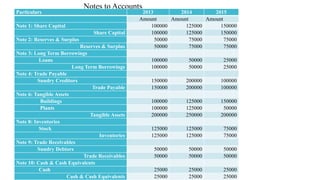
Notes to Accounts
Particulars 2013 2014 2015
Amount Amount Amount
Note 1: Share Capital 100000 125000 150000
Share Capital 100000 125000 150000
Note 2: Reserves & Surplus 50000 75000 75000
Reserves & Surplus 50000 75000 75000
Note 3: Long Term Borrowings
Loans 100000 50000 25000
Long Term Borrowings 100000 50000 25000
Note 4: Trade Payable
Sundry Creditors 150000 200000 100000
Trade Payable 150000 200000 100000
Note 6: Tangible Assets
Buildings 100000 125000 150000
Plants 100000 125000 50000
Tangible Assets 200000 250000 200000
Note 8: Inventories
Stock 125000 125000 75000
Inventories 125000 125000 75000
Note 9: Trade Receivables
Sundry Debtors 50000 50000 50000
Trade Receivables 50000 50000 50000
Note 10: Cash & Cash Equivalents
Cash 25000 25000 25000
Cash & Cash Equivalents 25000 25000 25000
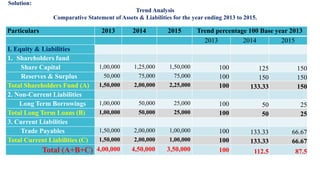
Particulars 2013 2014 2015 Trend percentage 100 Base year 2013
2013 2014 2015
I. Equity & Liabilities
1. Shareholders fund
Share Capital 1,00,000 1,25,000 1,50,000 100 125 150
Reserves & Surplus 50,000 75,000 75,000 100 150 150
Total Shareholders Fund (A) 1,50,000 2,00,000 2,25,000 100 133.33 150
2. Non-Current Liabilities
Long Term Borrowings 1,00,000 50,000 25,000 100 50 25
Total Long Term Loans (B) 1,00,000 50,000 25,000 100 50 25
3. Current Liabilities
Trade Payables 1,50,000 2,00,000 1,00,000 100 133.33 66.67
Total Current Liabilities (C) 1,50,000 2,00,000 1,00,000 100 133.33 66.67
Total (A+B+C) 4,00,000 4,50,000 3,50,000 100 112.5 87.5
Solution:
Trend Analysis
Comparative Statement of Assets & Liabilities for the year ending 2013 to 2015.
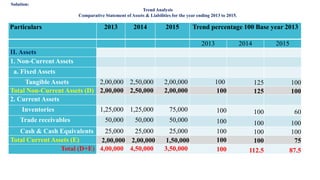
Particulars 2013 2014 2015 Trend percentage 100 Base year 2013
2013 2014 2015
II. Assets
1. Non-Current Assets
a. Fixed Assets
Tangible Assets 2,00,000 2,50,000 2,00,000 100 125 100
Total Non-Current Assets (D) 2,00,000 2,50,000 2,00,000 100 125 100
2. Current Assets
Inventories 1,25,000 1,25,000 75,000 100 100 60
Trade receivables 50,000 50,000 50,000 100 100 100
Cash & Cash Equivalents 25,000 25,000 25,000 100 100 100
Total Current Assets (E) 2,00,000 2,00,000 1,50,000 100 100 75
Total (D+E) 4,00,000 4,50,000 3,50,000 100 112.5 87.5
Solution:
Trend Analysis
Comparative Statement of Assets & Liabilities for the year ending 2013 to 2015.
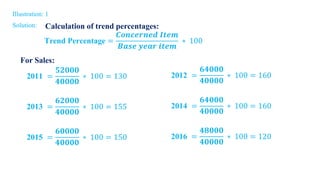
Illustration: 1
Solution:
For Sales:
Trend Percentage =
𝑪𝒐𝒏𝒄𝒆𝒓𝒏𝒆𝒅 𝑰𝒕𝒆𝒎
𝑩𝒂𝒔𝒆 𝒚𝒆𝒂𝒓 𝒊𝒕𝒆𝒎
∗ 100
Calculation of trend percentages:
2011 =
𝟓𝟐𝟎𝟎𝟎
𝟒𝟎𝟎𝟎𝟎
∗ 100 = 130
2013 =
𝟔𝟐𝟎𝟎𝟎
𝟒𝟎𝟎𝟎𝟎
∗ 100 = 155
2015 =
𝟔𝟎𝟎𝟎𝟎
𝟒𝟎𝟎𝟎𝟎
∗ 100 = 150
2012 =
𝟔𝟒𝟎𝟎𝟎
𝟒𝟎𝟎𝟎𝟎
∗ 100 = 160
2014 =
𝟔𝟒𝟎𝟎𝟎
𝟒𝟎𝟎𝟎𝟎
∗ 100 = 160
2016 =
𝟒𝟖𝟎𝟎𝟎
𝟒𝟎𝟎𝟎𝟎
∗ 100 = 120
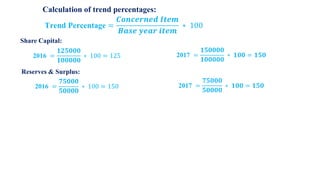
Share Capital:
Trend Percentage =
𝑪𝒐𝒏𝒄𝒆𝒓𝒏𝒆𝒅 𝑰𝒕𝒆𝒎
𝑩𝒂𝒔𝒆 𝒚𝒆𝒂𝒓 𝒊𝒕𝒆𝒎
∗ 100
Calculation of trend percentages:
2016 =
𝟏𝟐𝟓𝟎𝟎𝟎
𝟏𝟎𝟎𝟎𝟎𝟎
∗ 100 = 125
2016 =
𝟕𝟓𝟎𝟎𝟎
𝟓𝟎𝟎𝟎𝟎
∗ 100 = 150
2017 =
𝟏𝟓𝟎𝟎𝟎𝟎
𝟏𝟎𝟎𝟎𝟎𝟎
∗ 𝟏𝟎𝟎 = 𝟏𝟓𝟎
2017 =
𝟕𝟓𝟎𝟎𝟎
𝟓𝟎𝟎𝟎𝟎
∗ 𝟏𝟎𝟎 = 𝟏𝟓𝟎
Reserves & Surplus:
Thank You
Watch next PPT & Video

Trend Analysis - Statement of Assets & Liabilities

  • 1.
    MANAGEMENTACCOUNTING FinancialAnalysis and Interpretation: TrendAnalysis By: Smt.UMA MINAJIGI REUR HEAD, DEPT. OF COMMERCE & Management Smt. V G Degree College for Women, Kalaburagi
  • 2.
    MANAGEMENT ACCOUNTING B.COM SIXTH SEMESTER & BBAFOURTH SEMESTER 6.3: PRINCIPLES OF MANAGEMENT ACCOUNTING
  • 3.
    B.COM SIXTH SEMESTER 6.3:PRINCIPLES OF MANAGEMENT ACCOUNTING Unit I: Management Accounting (08 Hours): Definition and objectives of Management Accounting - Relationship between Cost, Financial and Managerial Accounting. Unit II : Financial Statements (15 Hours): Nature, uses and limitations. Analysis and interpretations – meaning, procedure, objectives, and importance. Comparative statement, Common Size Statements and Trend Analysis - practical problems. Unit III: Ratio Analysis (15 Hours): Definition and meaning of Ratio Analysis, importance and limitations, Profitability Ratio – Gross profit Ratio, operating Ratio, Overall profitability ratio – Earning per share. Turnover Ratios- Inventory Turnover Ratio, Debtors Turnover Ratio, Debt collection period , Creditors Turnover Ratio, Debt payment period, Liquidity Ratio- current ratio, liquid ratio. Financial positions and Leverage Ratios- Debt Equity Ratio, Proprietary Ratio - Problems thereon. Unit IV: Analysis through Leverages (12 Hours): Meaning- types of Leverages- operating – financial and combined leverages- problems thereon. Unit V: Fund Flow Statement (15 Hours): Meaning , uses and limitations – preparation of fund-flow statement. Cash Flow Statement: Meaning and preparation of Cash flow statement- problems thereon.
  • 4.
    Unit II :Financial Statements : • Nature, uses and limitations. • Analysis and interpretations – meaning, procedure, objectives, and importance. • Comparative statement, • Common Size Statements and • Trend Analysis - practical problems.
  • 5.
    Trend Analysis Or TrendPercentage or Trend Ratio Analysis Meaning of Trend Analysis: Comparison of past data over a period of time with a base year is Trend Analysis. It computes the changes in percentage for different variables over a long period and then makes a comparative study of them. Each item in the base year is taken as 100 and on that basis, trend analysis for the corresponding items in the other years are calculated.
  • 6.
    Trend Analysis Or TrendPercentage or Trend Ratio Analysis The trend percentage helps the analyst to study the changes that have occurred during the period. Such analysis indicates the progress of business by showing ups and downs in its activities. The comparison may be made in three different ways: 1. Percentage of changes 2. Ratio of changes 3. Graphic or diagrammatic presentation of the changes.
  • 7.
    Trend Analysis Or TrendPercentage or Trend Ratio Analysis Procedure for calculating trends analysis Or Steps for calculating trend analysis 1. Selecting of base year i.e, one year is taken as a base year, generally the first or the last is taken as base year. 2. The figures of base year are taken as 100. 3. Trend percentage is calculated is calculated in relation to base year.
  • 8.
    Trend Analysis Computation oftrend percentage The following points are to be taken into account while calculating the trend percentage. 1. Some accounting principles and practices should be followed. 2. The base year should be clearly selected i.e, either first year or last year. Generally, earliest year is taken is taken as the base year. 3. Every item in the base statements is started at 100. 4. Trend percentage should be calculated only for items having logical relationship with one another.
  • 9.
    Trend Analysis Computation oftrend percentage The following points are to be taken into account while calculating the trend percentage. 5. Trend percentage of cash item in another statement is calculated with reference to the same item in the base statement by using the following formula: Percentage = 𝑽𝒂𝒍𝒖𝒆 𝒐𝒇 𝒂 𝒑𝒂𝒓𝒕𝒊𝒄𝒖𝒍𝒂𝒓 𝒊𝒕𝒆𝒎 𝒊𝒏 𝒐𝒕𝒉𝒆𝒓 𝒔𝒕𝒂𝒕𝒆𝒎𝒆𝒏𝒕 𝑽𝒂𝒍𝒖𝒆 𝒐𝒇 𝒕𝒉𝒆 𝒔𝒂𝒎𝒆 𝒊𝒕𝒆𝒎 𝒊𝒏 𝒃𝒂𝒔𝒆 𝒔𝒕𝒂𝒕𝒆𝒎𝒆𝒏𝒕
  • 10.
    Illustration 1: From thefollowing statement of Assets and Liabilities of ABC Ltd. Compute the trend percentages using 31st Dec, 2013 as the base year. Particulars 2013 2014 2015 Amount Amount Amount Amount Amount Amount I. Equity & Liabilities 1. Shareholders fund Share Capital 1,00,000 1,25,000 1,50,000 Reserves & Surplus 50,000 1,50,000 75,000 2,00,000 75,000 2,25,000 2. Non-Current Liabilities Long Term Borrowings 1,00,000 50,000 25,000 3. Current Liabilities Trade Payables 1,50,000 2,00,000 1,00,000 Total 4,00,000 4,50,000 3,50,000 II. Assets 1. Non-Current Assets a. Fixed Assets Tangible Assets 2,00,000 2,50,000 2,00,000 2. Current Assets Inventories 1,25,000 1,25,000 75,000 Trade receivables 50,000 50,000 50,000 Cash & Cash Equivalents 25,000 2,00,000 25,000 2,00,000 25,000 1,50,000 Total 4,00,000 4,50,000 3,50,000
  • 11.
    Notes to Accounts Particulars2013 2014 2015 Amount Amount Amount Note 1: Share Capital 100000 125000 150000 Share Capital 100000 125000 150000 Note 2: Reserves & Surplus 50000 75000 75000 Reserves & Surplus 50000 75000 75000 Note 3: Long Term Borrowings Loans 100000 50000 25000 Long Term Borrowings 100000 50000 25000 Note 4: Trade Payable Sundry Creditors 150000 200000 100000 Trade Payable 150000 200000 100000 Note 6: Tangible Assets Buildings 100000 125000 150000 Plants 100000 125000 50000 Tangible Assets 200000 250000 200000 Note 8: Inventories Stock 125000 125000 75000 Inventories 125000 125000 75000 Note 9: Trade Receivables Sundry Debtors 50000 50000 50000 Trade Receivables 50000 50000 50000 Note 10: Cash & Cash Equivalents Cash 25000 25000 25000 Cash & Cash Equivalents 25000 25000 25000
  • 12.
    Particulars 2013 20142015 Trend percentage 100 Base year 2013 2013 2014 2015 I. Equity & Liabilities 1. Shareholders fund Share Capital 1,00,000 1,25,000 1,50,000 100 125 150 Reserves & Surplus 50,000 75,000 75,000 100 150 150 Total Shareholders Fund (A) 1,50,000 2,00,000 2,25,000 100 133.33 150 2. Non-Current Liabilities Long Term Borrowings 1,00,000 50,000 25,000 100 50 25 Total Long Term Loans (B) 1,00,000 50,000 25,000 100 50 25 3. Current Liabilities Trade Payables 1,50,000 2,00,000 1,00,000 100 133.33 66.67 Total Current Liabilities (C) 1,50,000 2,00,000 1,00,000 100 133.33 66.67 Total (A+B+C) 4,00,000 4,50,000 3,50,000 100 112.5 87.5 Solution: Trend Analysis Comparative Statement of Assets & Liabilities for the year ending 2013 to 2015.
  • 13.
    Particulars 2013 20142015 Trend percentage 100 Base year 2013 2013 2014 2015 II. Assets 1. Non-Current Assets a. Fixed Assets Tangible Assets 2,00,000 2,50,000 2,00,000 100 125 100 Total Non-Current Assets (D) 2,00,000 2,50,000 2,00,000 100 125 100 2. Current Assets Inventories 1,25,000 1,25,000 75,000 100 100 60 Trade receivables 50,000 50,000 50,000 100 100 100 Cash & Cash Equivalents 25,000 25,000 25,000 100 100 100 Total Current Assets (E) 2,00,000 2,00,000 1,50,000 100 100 75 Total (D+E) 4,00,000 4,50,000 3,50,000 100 112.5 87.5 Solution: Trend Analysis Comparative Statement of Assets & Liabilities for the year ending 2013 to 2015.
  • 14.
    Illustration: 1 Solution: For Sales: TrendPercentage = 𝑪𝒐𝒏𝒄𝒆𝒓𝒏𝒆𝒅 𝑰𝒕𝒆𝒎 𝑩𝒂𝒔𝒆 𝒚𝒆𝒂𝒓 𝒊𝒕𝒆𝒎 ∗ 100 Calculation of trend percentages: 2011 = 𝟓𝟐𝟎𝟎𝟎 𝟒𝟎𝟎𝟎𝟎 ∗ 100 = 130 2013 = 𝟔𝟐𝟎𝟎𝟎 𝟒𝟎𝟎𝟎𝟎 ∗ 100 = 155 2015 = 𝟔𝟎𝟎𝟎𝟎 𝟒𝟎𝟎𝟎𝟎 ∗ 100 = 150 2012 = 𝟔𝟒𝟎𝟎𝟎 𝟒𝟎𝟎𝟎𝟎 ∗ 100 = 160 2014 = 𝟔𝟒𝟎𝟎𝟎 𝟒𝟎𝟎𝟎𝟎 ∗ 100 = 160 2016 = 𝟒𝟖𝟎𝟎𝟎 𝟒𝟎𝟎𝟎𝟎 ∗ 100 = 120
  • 15.
    Share Capital: Trend Percentage= 𝑪𝒐𝒏𝒄𝒆𝒓𝒏𝒆𝒅 𝑰𝒕𝒆𝒎 𝑩𝒂𝒔𝒆 𝒚𝒆𝒂𝒓 𝒊𝒕𝒆𝒎 ∗ 100 Calculation of trend percentages: 2016 = 𝟏𝟐𝟓𝟎𝟎𝟎 𝟏𝟎𝟎𝟎𝟎𝟎 ∗ 100 = 125 2016 = 𝟕𝟓𝟎𝟎𝟎 𝟓𝟎𝟎𝟎𝟎 ∗ 100 = 150 2017 = 𝟏𝟓𝟎𝟎𝟎𝟎 𝟏𝟎𝟎𝟎𝟎𝟎 ∗ 𝟏𝟎𝟎 = 𝟏𝟓𝟎 2017 = 𝟕𝟓𝟎𝟎𝟎 𝟓𝟎𝟎𝟎𝟎 ∗ 𝟏𝟎𝟎 = 𝟏𝟓𝟎 Reserves & Surplus:
  • 16.