Definitions
• Infant Mortality: It is defined as the
proportion of children who die before they
reach the age of one year
• Life Expectancy: It is the number of years that
a child born in a particular country in a
certain year can expect to live
Demographic Transition
Model
Population increase=
Natural increase + rate of net migration
These changes are analyze in a
Demographic Transition Model
There are 4 stagesin the model
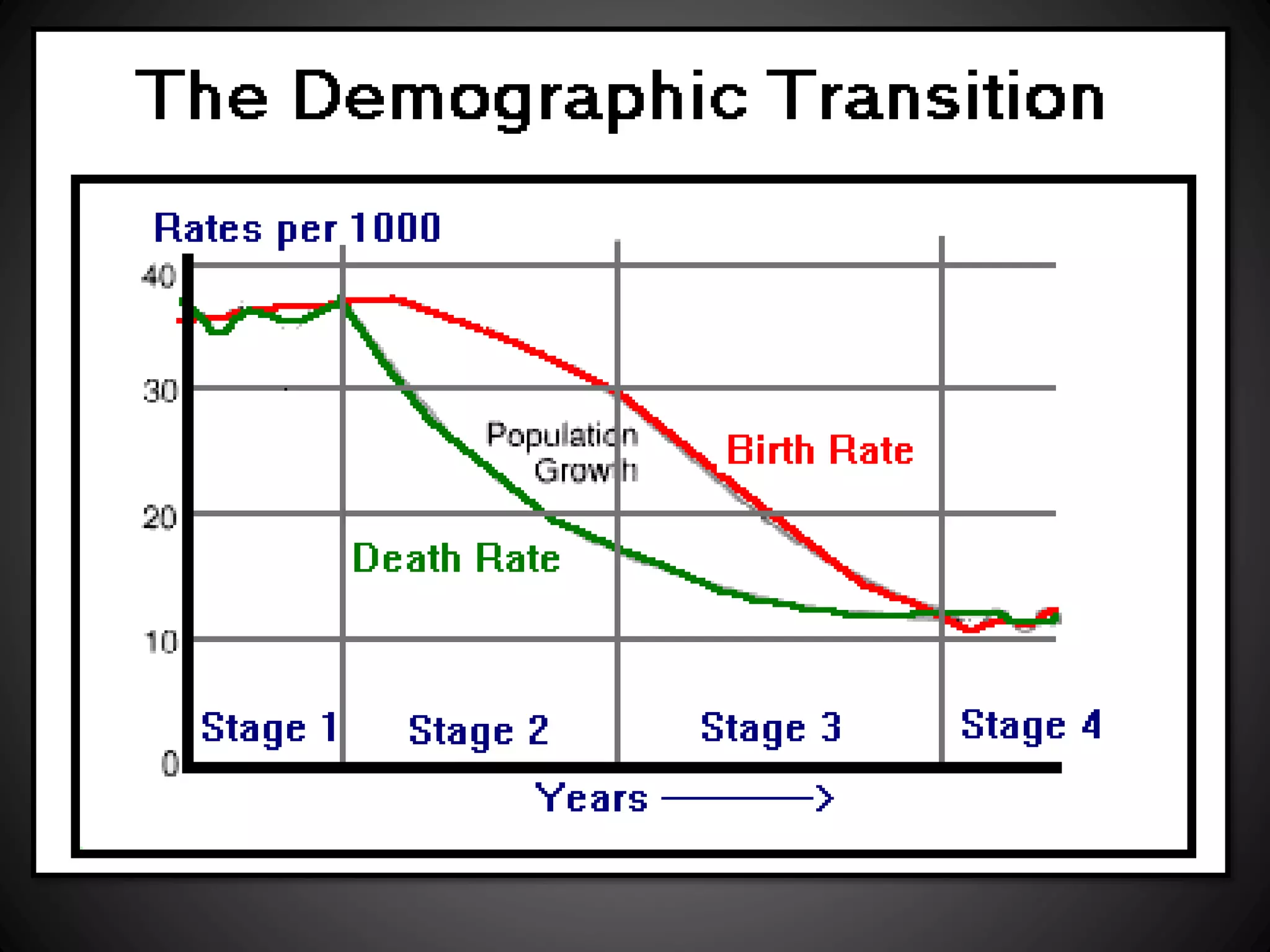
• The Demographic Transition Model attempts to
show how population changes as a country
develops.
• The model is divided into four stages.
• The Demographic Transition Model does not take into account migration.
The Four Stages
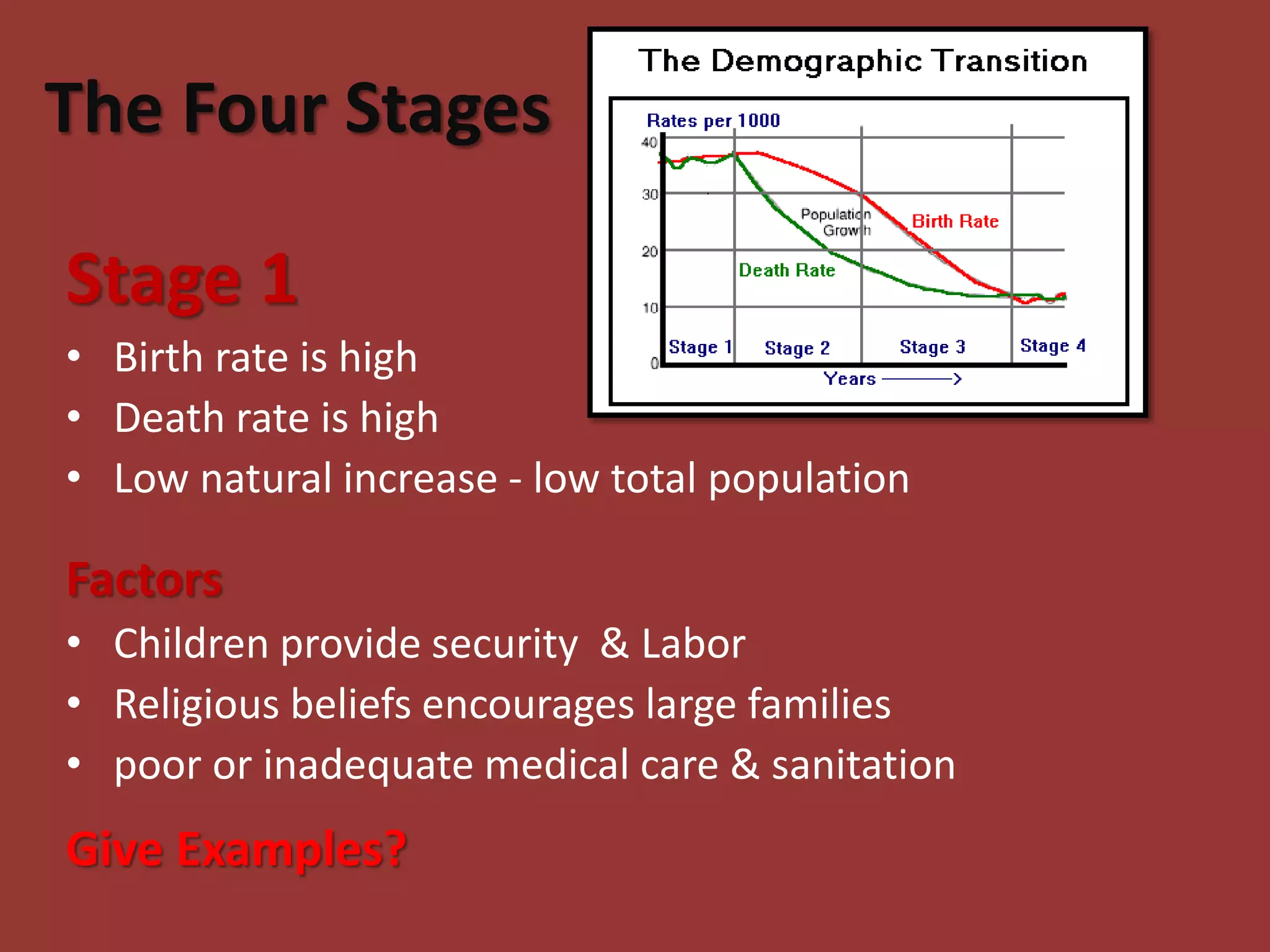
Stage 1
• Birth rate is high
• Death rate is high
• Low natural increase - low total population
Factors
• Children provide security & Labor
• Religious beliefs encourages large families
• poor or inadequate medical care & sanitation
Give Examples?
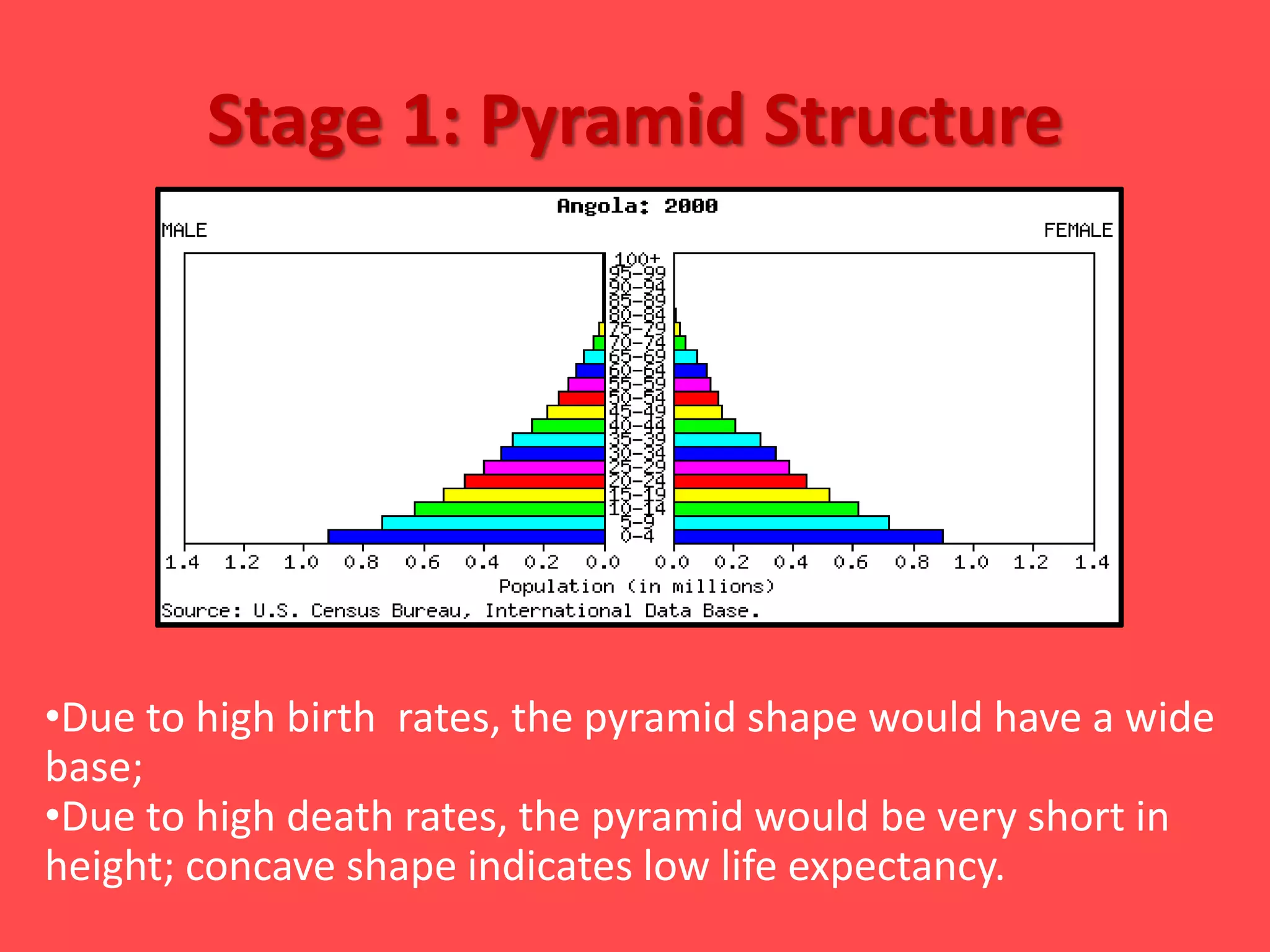
Stage 1: Pyramid Structure
•Due to high birth rates, the pyramid shape would have a wide
base;
•Due to high death rates, the pyramid would be very short in
height; concave shape indicates low life expectancy.
The Four Stages
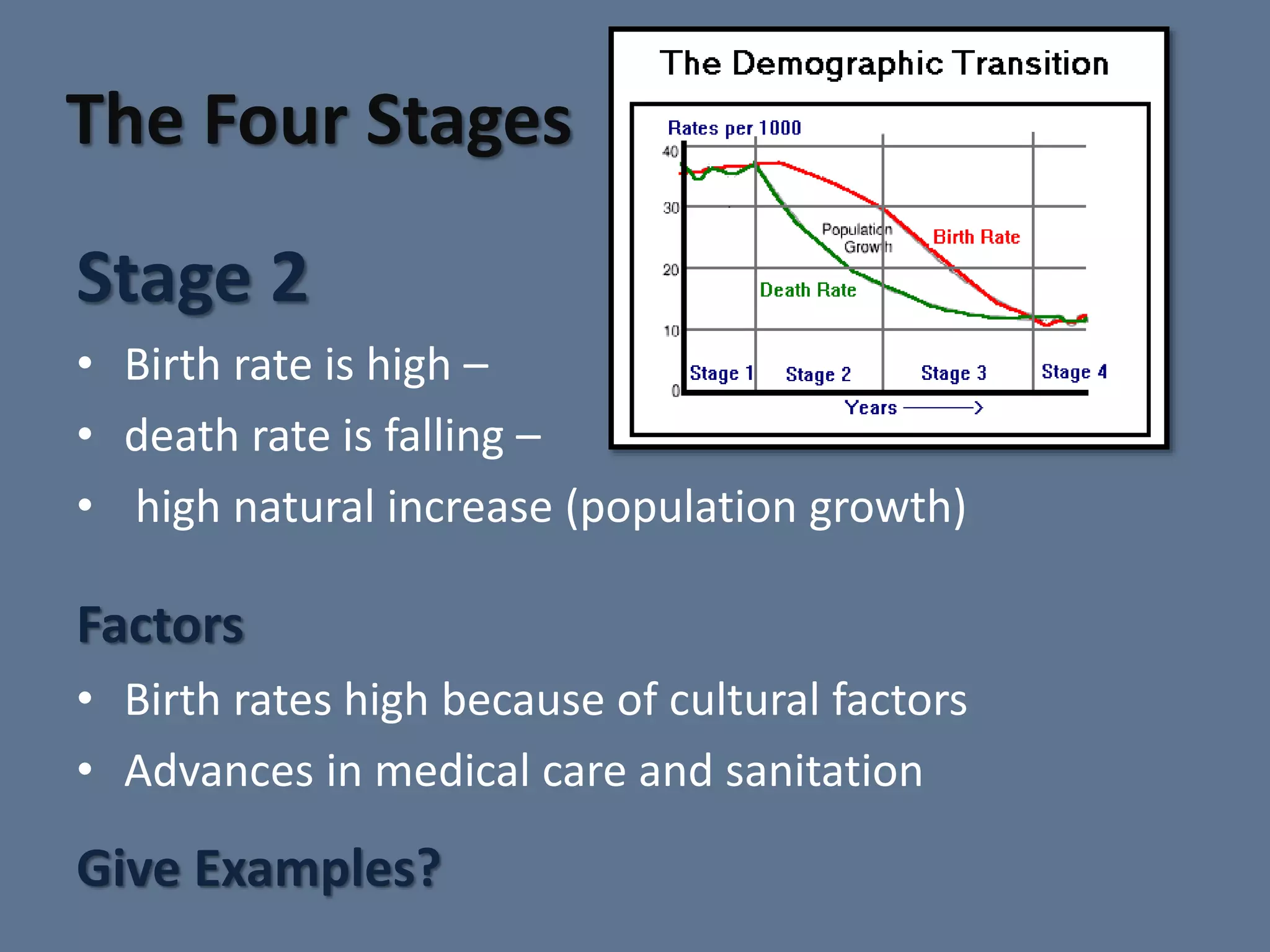
Stage 2
• Birth rate is high –
• death rate is falling –
• high natural increase (population growth)
Factors
• Birth rates high because of cultural factors
• Advances in medical care and sanitation
Give Examples?
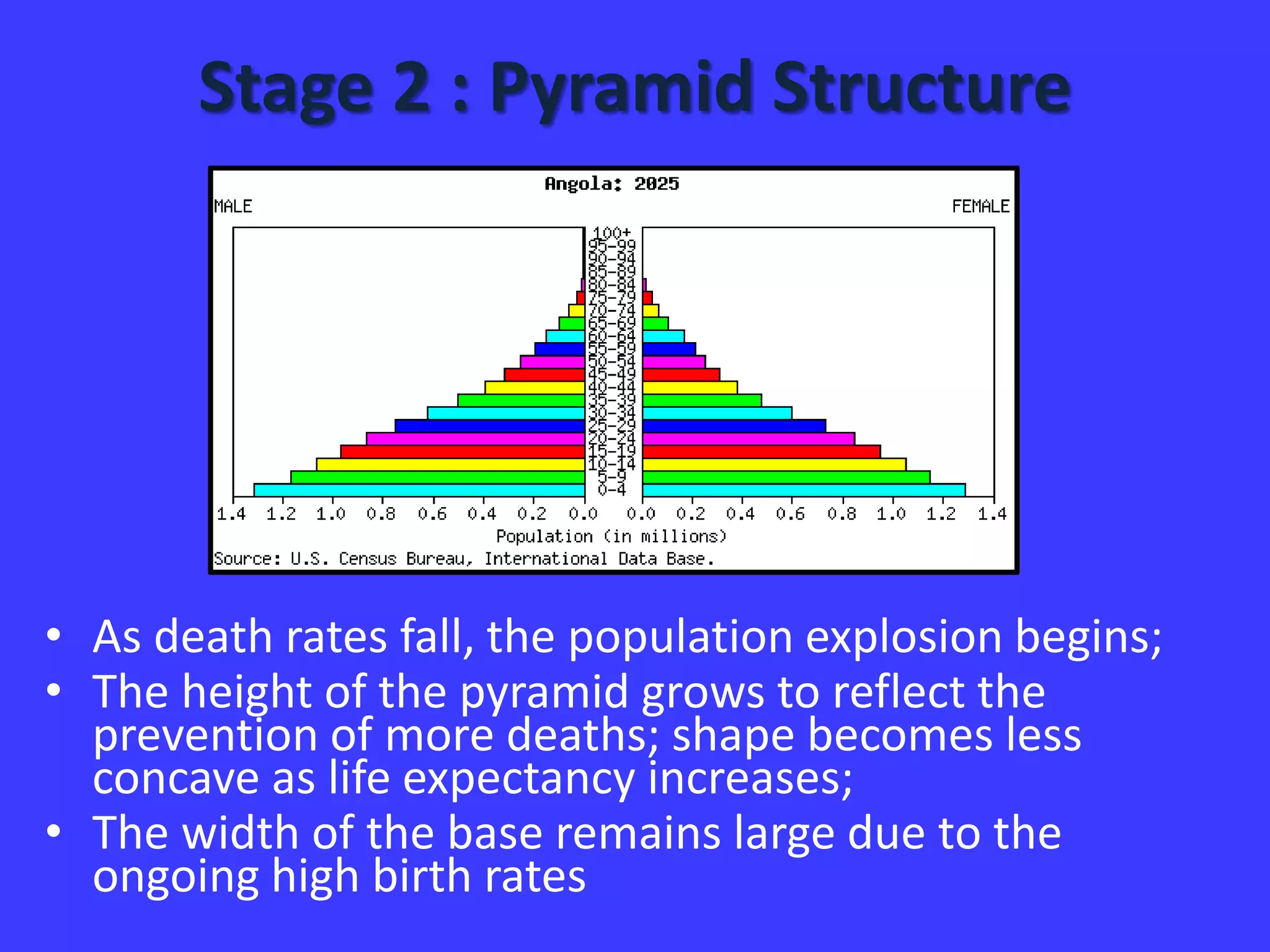
Stage 2 : Pyramid Structure
• As death rates fall, the population explosion begins;
• The height of the pyramid grows to reflect the
prevention of more deaths; shape becomes less
concave as life expectancy increases;
• The width of the base remains large due to the
ongoing high birth rates
The Four Stages
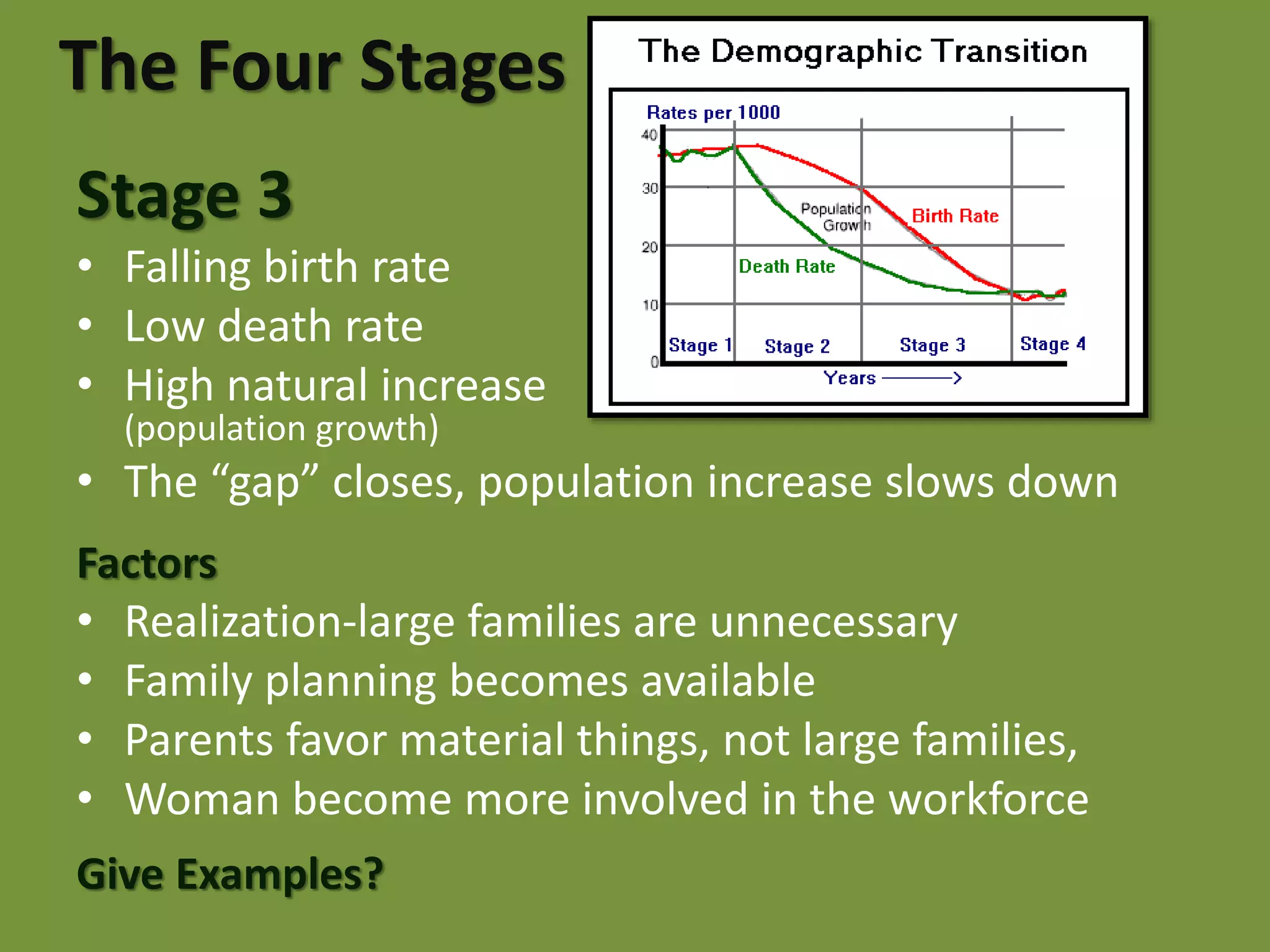
Stage 3
• Falling birth rate
• Low death rate
• High natural increase
(population growth)
• The “gap” closes, population increase slows down
Factors
• Realization-large families are unnecessary
• Family planning becomes available
• Parents favor material things, not large families,
• Woman become more involved in the workforce
Give Examples?
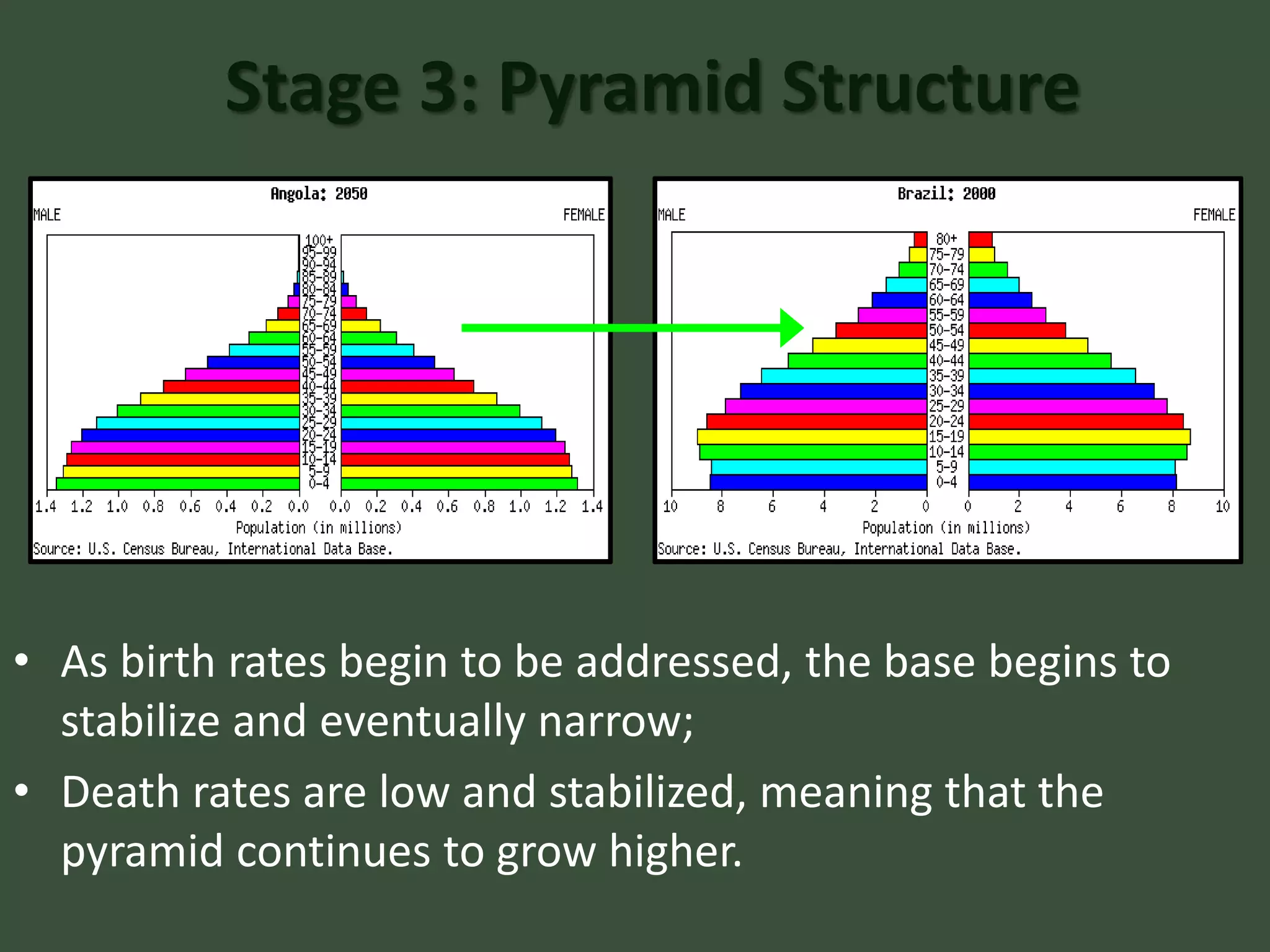
Stage 3: Pyramid Structure
• As birth rates begin to be addressed, the base begins to
stabilize and eventually narrow;
• Death rates are low and stabilized, meaning that the
pyramid continues to grow higher.
The Four Stages
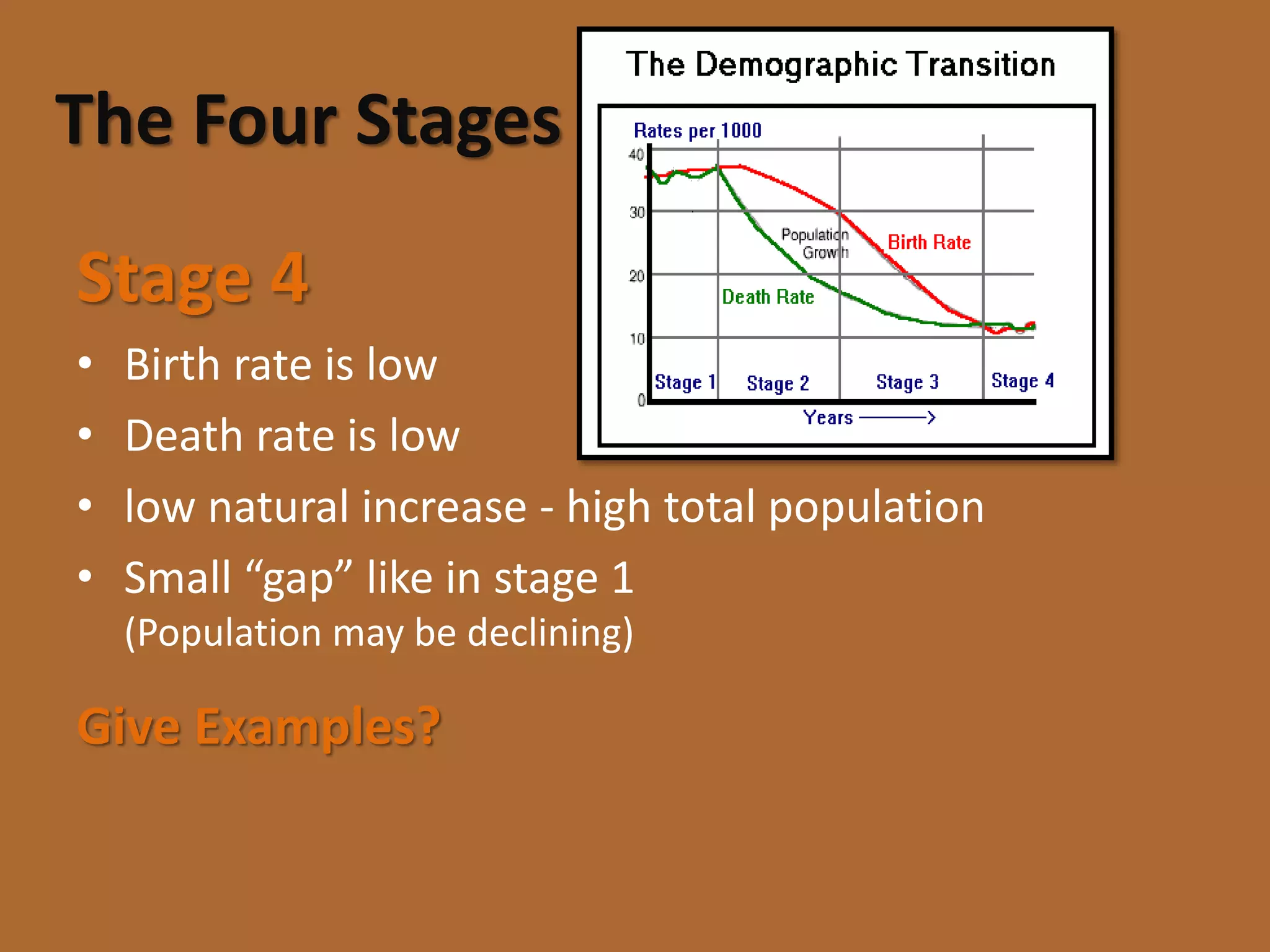
Stage 4
• Birth rate is low
• Death rate is low
• low natural increase - high total population
• Small “gap” like in stage 1
(Population may be declining)
Give Examples?
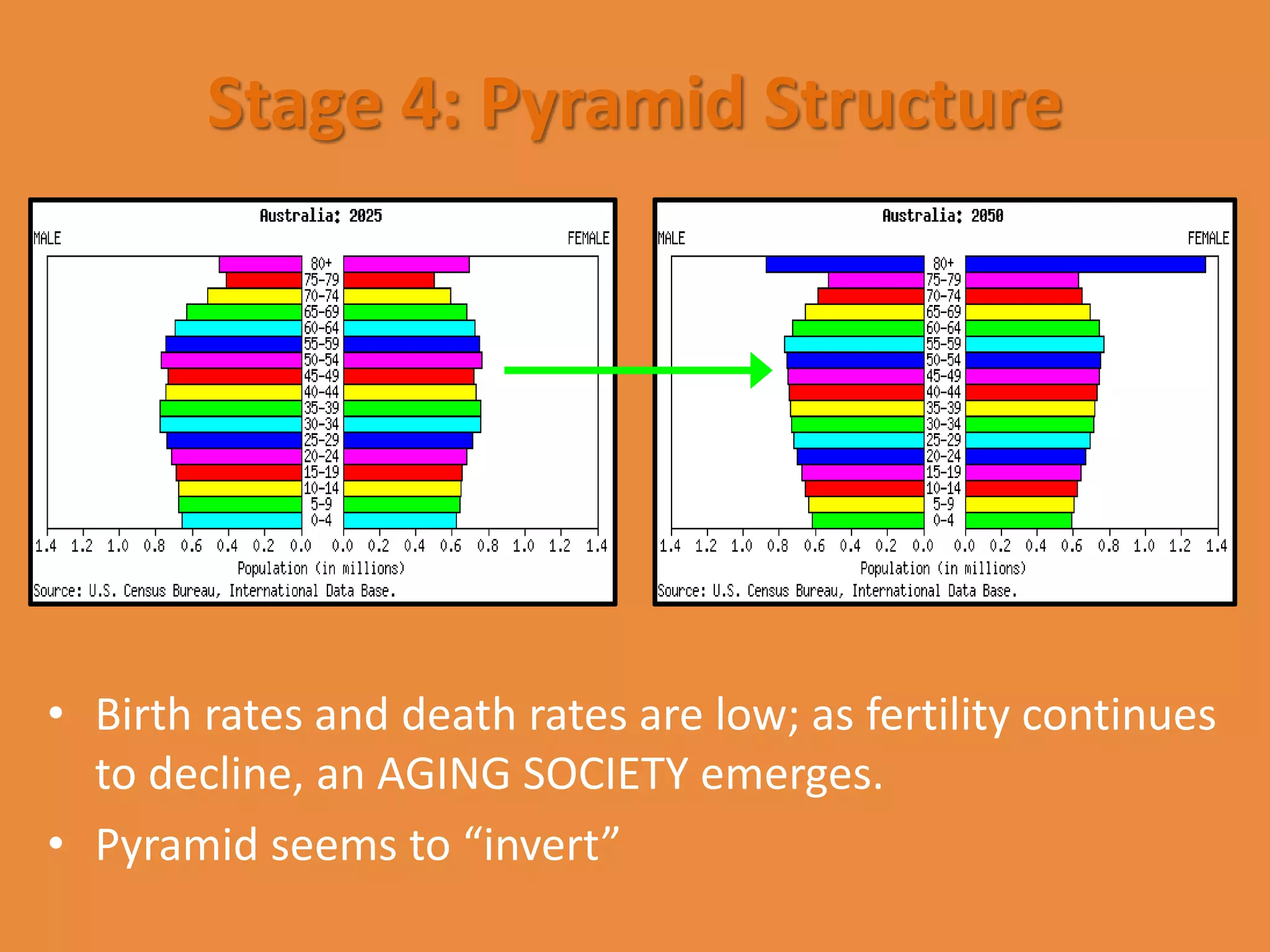
Stage 4: Pyramid Structure
• Birth rates and death rates are low; as fertility continues
to decline, an AGING SOCIETY emerges.
• Pyramid seems to “invert”
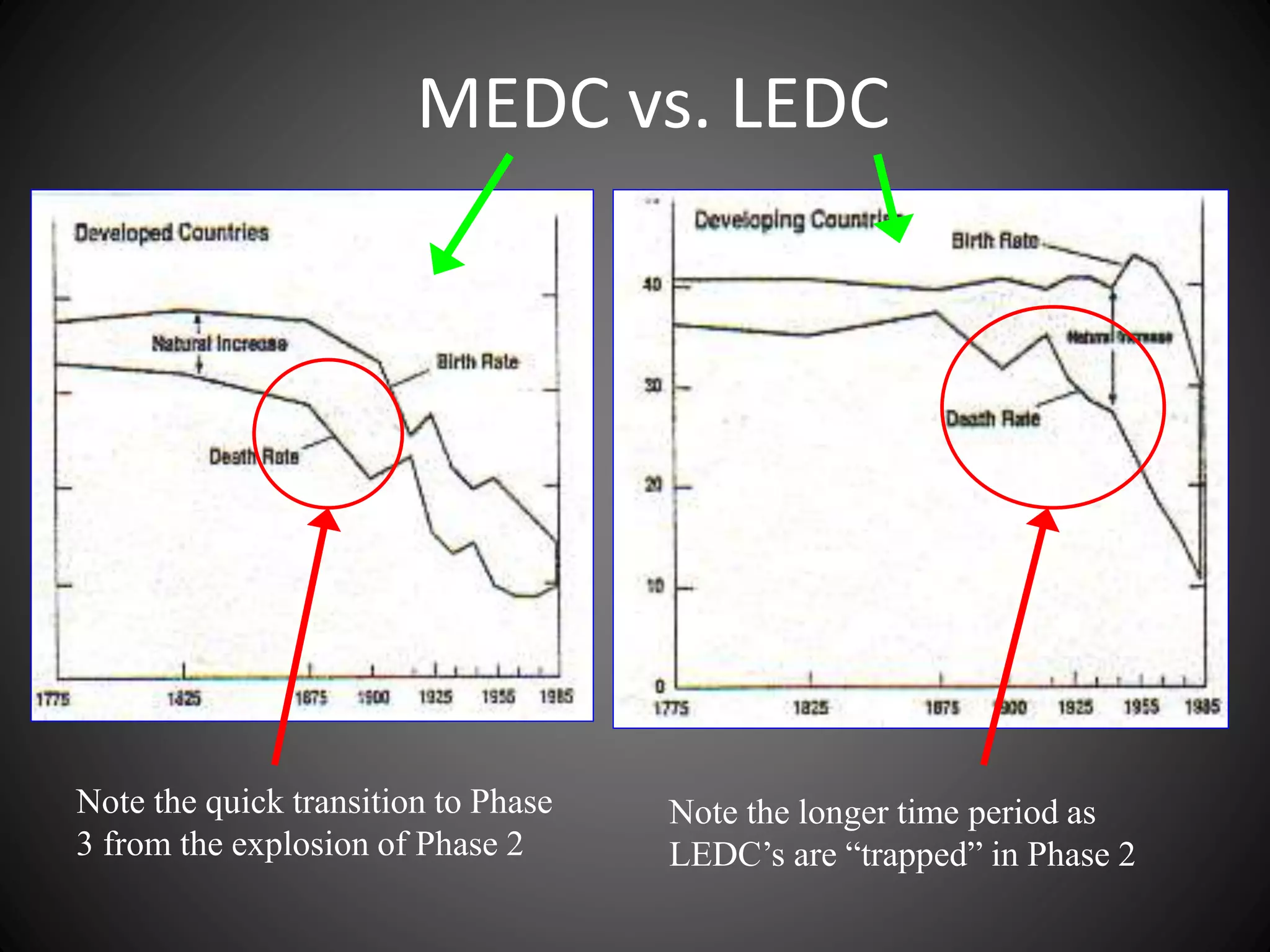
MEDC vs. LEDC
Note the quick transition to Phase
3 from the explosion of Phase 2
Note the longer time period as
LEDC’s are “trapped” in Phase 2
Criticism of DTM
• The model is an over-generalization of the industrialized
European experience
• Industrialization is difficult to achieve for LEDC’s in a
trading system that protects the industries of MEDC’s;
• Model assumes all countries proceed from stage 1-4;
• It ignores variables and exceptions (ie. War, political turmoil)
• The model assumes that reductions in fertility are a
function of increased wealth and industrialization–
• Other factors such as the status of women and other social
development are ignored.

5 Demographic Transition model

  • 1.
    Definitions • Infant Mortality:It is defined as the proportion of children who die before they reach the age of one year • Life Expectancy: It is the number of years that a child born in a particular country in a certain year can expect to live
  • 2.
    Demographic Transition Model Population increase= Naturalincrease + rate of net migration These changes are analyze in a Demographic Transition Model
  • 3.
    There are 4stagesin the model • The Demographic Transition Model attempts to show how population changes as a country develops. • The model is divided into four stages. • The Demographic Transition Model does not take into account migration.
  • 5.
    The Four Stages Stage1 • Birth rate is high • Death rate is high • Low natural increase - low total population Factors • Children provide security & Labor • Religious beliefs encourages large families • poor or inadequate medical care & sanitation Give Examples?
  • 6.
    Stage 1: PyramidStructure •Due to high birth rates, the pyramid shape would have a wide base; •Due to high death rates, the pyramid would be very short in height; concave shape indicates low life expectancy.
  • 7.
    The Four Stages Stage2 • Birth rate is high – • death rate is falling – • high natural increase (population growth) Factors • Birth rates high because of cultural factors • Advances in medical care and sanitation Give Examples?
  • 8.
    Stage 2 :Pyramid Structure • As death rates fall, the population explosion begins; • The height of the pyramid grows to reflect the prevention of more deaths; shape becomes less concave as life expectancy increases; • The width of the base remains large due to the ongoing high birth rates
  • 9.
    The Four Stages Stage3 • Falling birth rate • Low death rate • High natural increase (population growth) • The “gap” closes, population increase slows down Factors • Realization-large families are unnecessary • Family planning becomes available • Parents favor material things, not large families, • Woman become more involved in the workforce Give Examples?
  • 10.
    Stage 3: PyramidStructure • As birth rates begin to be addressed, the base begins to stabilize and eventually narrow; • Death rates are low and stabilized, meaning that the pyramid continues to grow higher.
  • 11.
    The Four Stages Stage4 • Birth rate is low • Death rate is low • low natural increase - high total population • Small “gap” like in stage 1 (Population may be declining) Give Examples?
  • 12.
    Stage 4: PyramidStructure • Birth rates and death rates are low; as fertility continues to decline, an AGING SOCIETY emerges. • Pyramid seems to “invert”
  • 13.
    MEDC vs. LEDC Notethe quick transition to Phase 3 from the explosion of Phase 2 Note the longer time period as LEDC’s are “trapped” in Phase 2
  • 14.
    Criticism of DTM •The model is an over-generalization of the industrialized European experience • Industrialization is difficult to achieve for LEDC’s in a trading system that protects the industries of MEDC’s; • Model assumes all countries proceed from stage 1-4; • It ignores variables and exceptions (ie. War, political turmoil) • The model assumes that reductions in fertility are a function of increased wealth and industrialization– • Other factors such as the status of women and other social development are ignored.