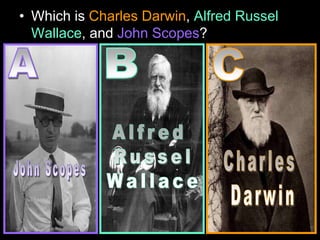
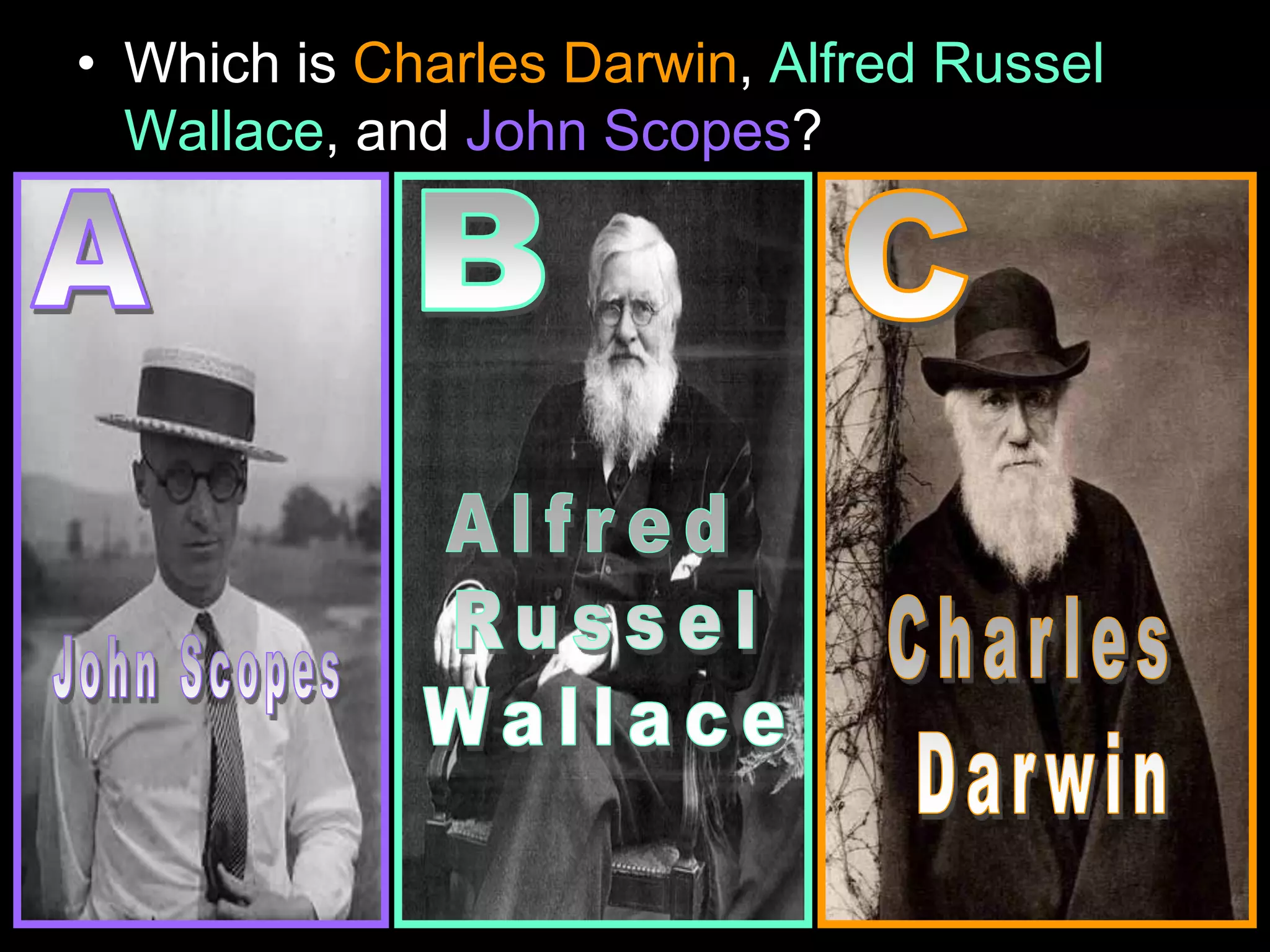


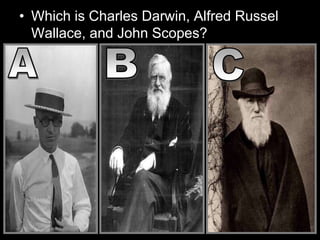
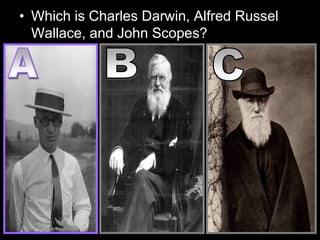
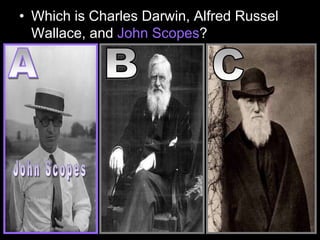
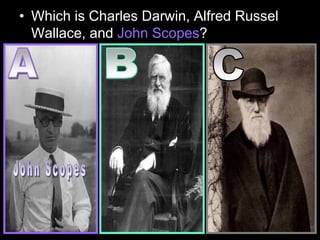
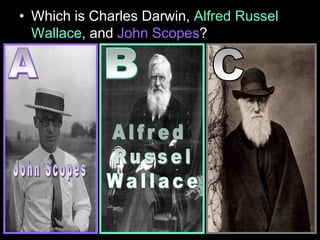
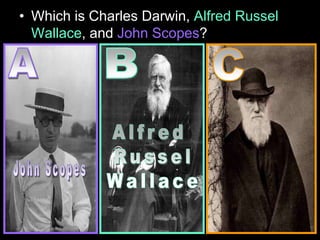
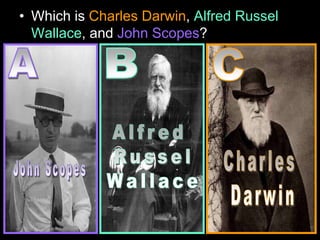
• Which is Charles Darwin, Alfred Russel
Wallace, and John Scopes?
• RED SLIDE: These are notes that are very
important and should be recorded in your
science journal.
Copyright © 2010 Ryan P. Murphy
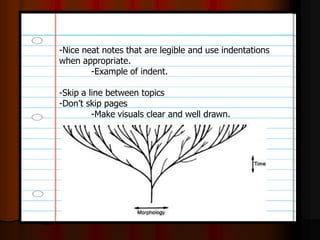
-Nice neat notes that are legible and use indentations
when appropriate.
-Example of indent.
-Skip a line between topics
-Don’t skip pages
-Make visuals clear and well drawn.
• RED SLIDE: These are notes that are very
important and should be recorded in your
science journal.
• BLACK SLIDE: Pay attention, follow
directions, complete projects as described
and answer required questions neatly.
Copyright © 2010 Ryan P. Murphy
http://sciencepowerpoint.com/Website Link:
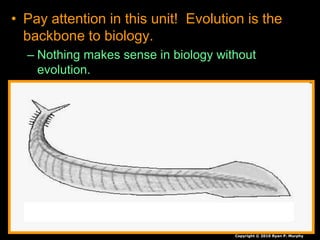
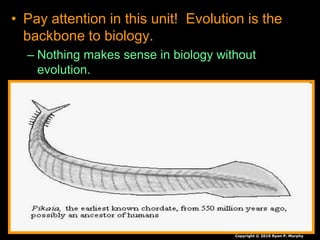
• Pay attention in this unit! Evolution is the
backbone to biology.
– Nothing makes sense in biology without
evolution.
Copyright © 2010 Ryan P. Murphy
• Pay attention in this unit! Evolution is the
backbone to biology.
– Nothing makes sense in biology without
evolution.
Copyright © 2010 Ryan P. Murphy
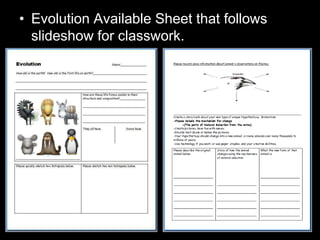
• Evolution Available Sheet that follows
slideshow for classwork.
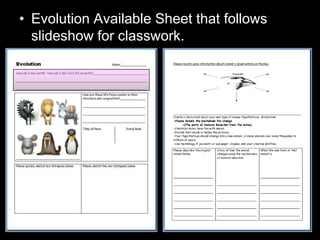
• Evolution Available Sheet that follows
slideshow for classwork.
• How old is the earth?
– How old is the first life on earth?
This unit belongs to Ryan P.
Murphy Copyright 2010 found at
www.sciencepowerpoint.com
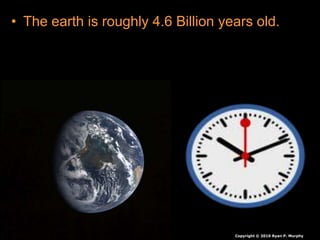
• The earth is roughly 4.6 Billion years old.
– Primitive life is believed to have formed 3.85
Billion years ago.
– The earth is old, and a lot has changed over time.
Copyright © 2010 Ryan P. Murphy
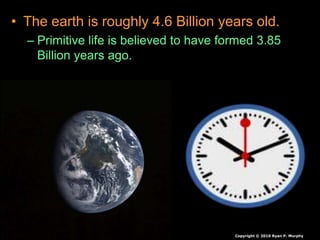
• The earth is roughly 4.6 Billion years old.
– Primitive life is believed to have formed 3.85
Billion years ago.
– The earth is old, and a lot has changed over time.
Copyright © 2010 Ryan P. Murphy
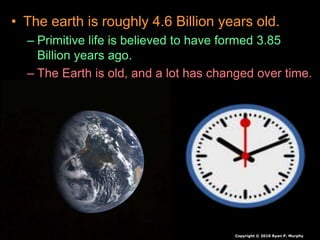
• The earth is roughly 4.6 Billion years old.
– Primitive life is believed to have formed 3.85
Billion years ago.
– The Earth is old, and a lot has changed over time.
Copyright © 2010 Ryan P. Murphy
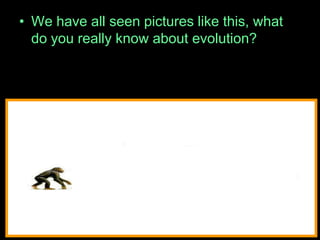
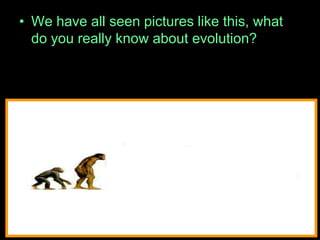
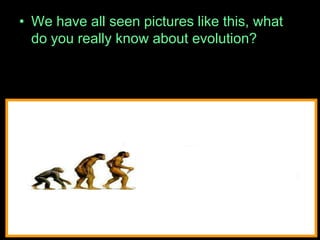
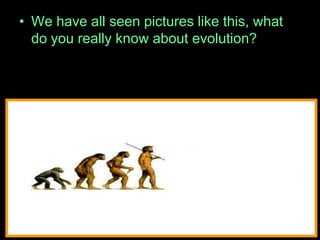
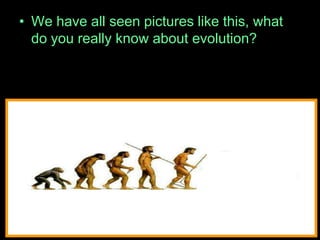
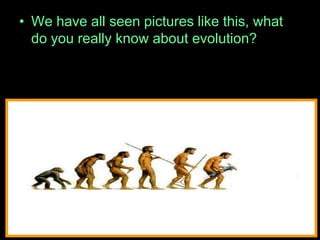
• We have all seen pictures like this, what
do you really know about evolution?
• We have all seen pictures like this, what
do you really know about evolution?
• We have all seen pictures like this, what
do you really know about evolution?
• We have all seen pictures like this, what
do you really know about evolution?
• We have all seen pictures like this, what
do you really know about evolution?
• We have all seen pictures like this, what
do you really know about evolution?
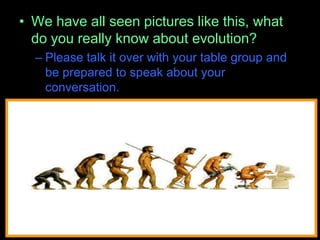
• We have all seen pictures like this, what
do you really know about evolution?
– Please talk it over with your table group and
be prepared to speak about your
conversation.
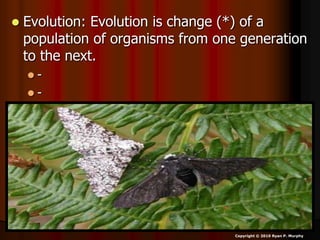
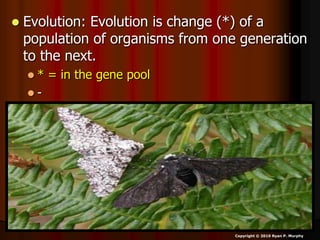
 Evolution: Evolution is change (*) of a
population of organisms from one generation
to the next.
 -
 -
Copyright © 2010 Ryan P. Murphy
 Evolution: Evolution is change (*) of a
population of organisms from one generation
to the next.
 * = in the gene pool
 -
Copyright © 2010 Ryan P. Murphy
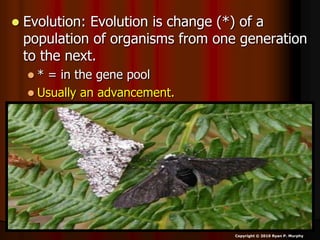
 Evolution: Evolution is change (*) of a
population of organisms from one generation
to the next.
 * = in the gene pool
 Usually an advancement.
Copyright © 2010 Ryan P. Murphy
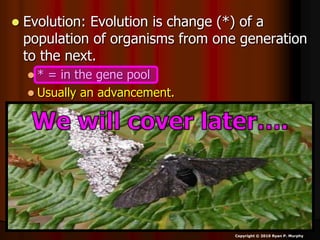
 Evolution: Evolution is change (*) of a
population of organisms from one generation
to the next.
 * = in the gene pool
 Usually an advancement.
Copyright © 2010 Ryan P. Murphy
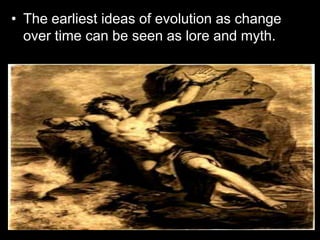
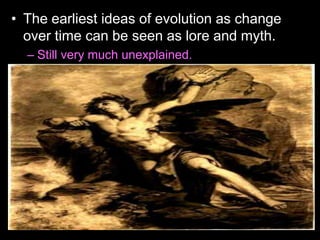
• The earliest ideas of evolution as change
over time can be seen as lore and myth.
– Still very much unexplained.
• The earliest ideas of evolution as change
over time can be seen as lore and myth.
– Still very much unexplained.
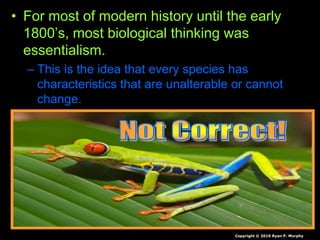
• For most of modern history until the early
1800’s, most biological thinking was
essentialism.
Copyright © 2010 Ryan P. Murphy
• For most of modern history until the early
1800’s, most biological thinking was
essentialism.
– This is the idea that every species has
characteristics that are unalterable or cannot
change.
Copyright © 2010 Ryan P. Murphy
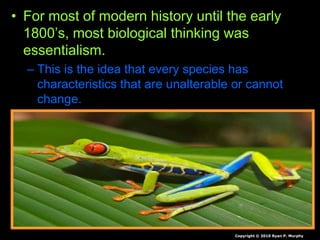
• For most of modern history until the early
1800’s, most biological thinking was
essentialism.
– This is the idea that every species has
characteristics that are unalterable or cannot
change.
Copyright © 2010 Ryan P. Murphy
• For most of modern history until the early
1800’s, most biological thinking was
essentialism.
– This is the idea that every species has
characteristics that are unalterable or cannot
change.
Copyright © 2010 Ryan P. Murphy
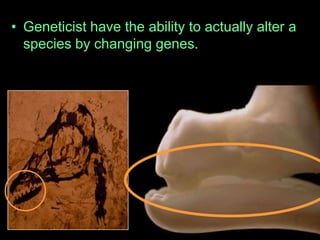
• Geneticist have the ability to actually alter a
species by changing genes.
• Geneticist have the ability to actually alter a
species by changing genes.
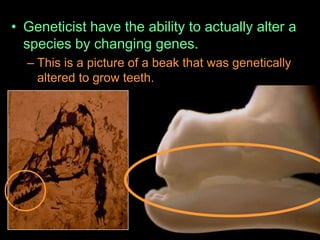
• Geneticist have the ability to actually alter a
species by changing genes.
– This is a picture of a beak that was genetically
altered to grow teeth.
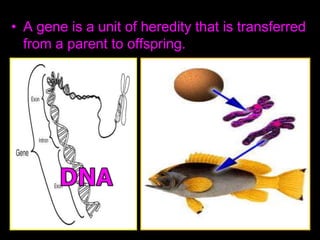
• A gene is a unit of heredity that is transferred
from a parent to offspring.
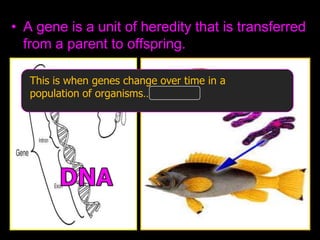
• A gene is a unit of heredity that is transferred
from a parent to offspring.
This is when genes change over time in a
population of organisms… Evolution
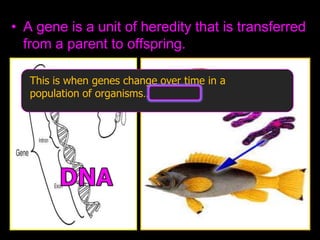
• A gene is a unit of heredity that is transferred
from a parent to offspring.
This is when genes change over time in a
population of organisms… Evolution
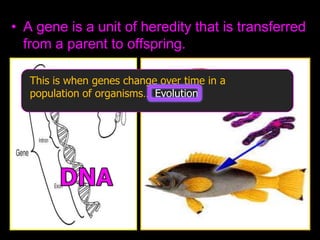
• A gene is a unit of heredity that is transferred
from a parent to offspring.
This is when genes change over time in a
population of organisms… Evolution
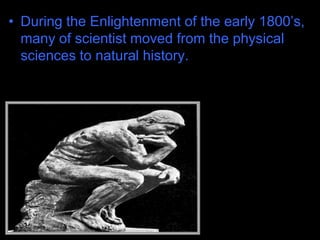
• During the Enlightenment of the early 1800’s,
many of scientist moved from the physical
sciences to natural history.
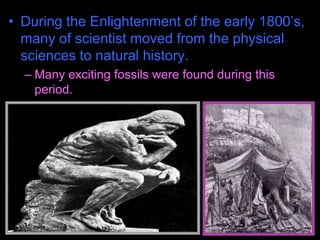
• During the Enlightenment of the early 1800’s,
many of scientist moved from the physical
sciences to natural history.
– Many exciting fossils were found during this
period.
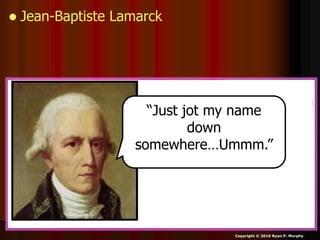
 Jean-Baptiste Lamarck
Copyright © 2010 Ryan P. Murphy
“Just jot my name
down
somewhere…Ummm.”
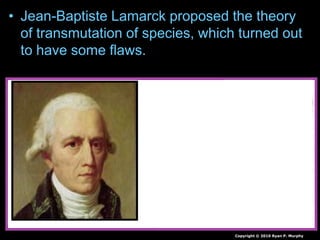
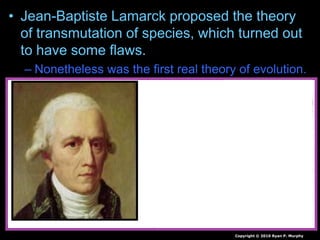
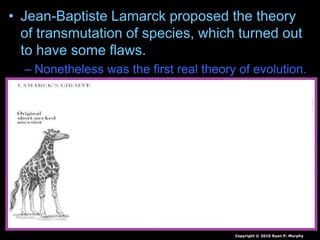
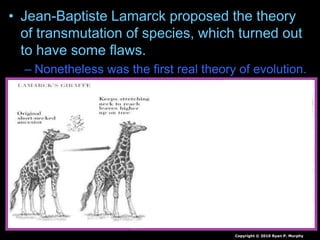
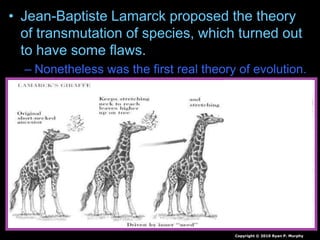
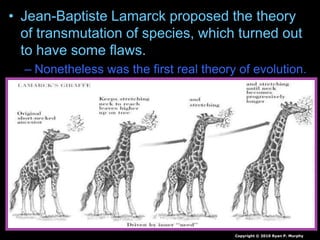
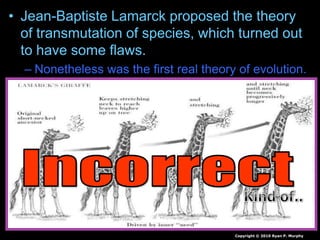
• Jean-Baptiste Lamarck proposed the theory
of transmutation of species, which turned out
to have some flaws.
– Nonetheless was the first real theory of evolution.
Copyright © 2010 Ryan P. Murphy
• Jean-Baptiste Lamarck proposed the theory
of transmutation of species, which turned out
to have some flaws.
– Nonetheless was the first real theory of evolution.
Copyright © 2010 Ryan P. Murphy
• Jean-Baptiste Lamarck proposed the theory
of transmutation of species, which turned out
to have some flaws.
– Nonetheless was the first real theory of evolution.
Copyright © 2010 Ryan P. Murphy
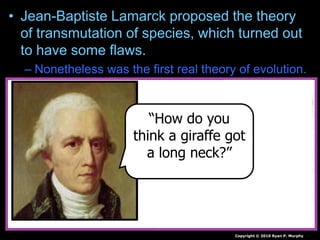
“How do you
think a giraffe got
a long neck?”
• Jean-Baptiste Lamarck proposed the theory
of transmutation of species, which turned out
to have some flaws.
– Nonetheless was the first real theory of evolution.
Copyright © 2010 Ryan P. Murphy
• Jean-Baptiste Lamarck proposed the theory
of transmutation of species, which turned out
to have some flaws.
– Nonetheless was the first real theory of evolution.
Copyright © 2010 Ryan P. Murphy
• Jean-Baptiste Lamarck proposed the theory
of transmutation of species, which turned out
to have some flaws.
– Nonetheless was the first real theory of evolution.
Copyright © 2010 Ryan P. Murphy
• Jean-Baptiste Lamarck proposed the theory
of transmutation of species, which turned out
to have some flaws.
– Nonetheless was the first real theory of evolution.
Copyright © 2010 Ryan P. Murphy
• Jean-Baptiste Lamarck proposed the theory
of transmutation of species, which turned out
to have some flaws.
– Nonetheless was the first real theory of evolution.
Copyright © 2010 Ryan P. Murphy
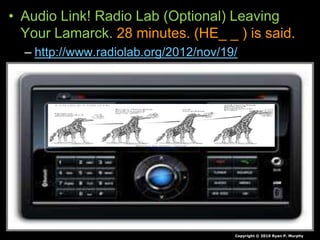
• Audio Link! Radio Lab (Optional) Leaving
Your Lamarck. 28 minutes. (HE_ _ ) is said.
– http://www.radiolab.org/2012/nov/19/
Copyright © 2010 Ryan P. Murphy
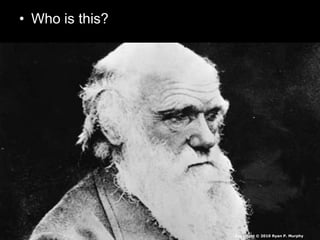
• Who is this?
Copyright © 2010 Ryan P. Murphy
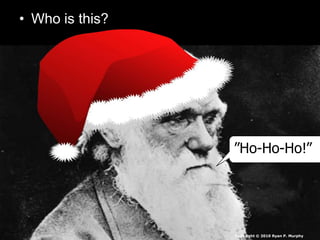
• Who is this?
”Ho-Ho-Ho!”
Copyright © 2010 Ryan P. Murphy
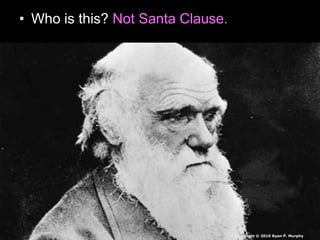
• Who is this? Not Santa Clause.
Copyright © 2010 Ryan P. Murphy
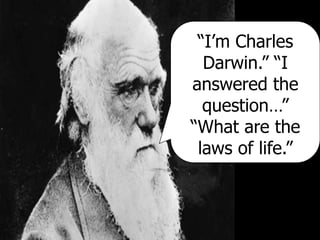
“I’m Charles
Darwin.” “I
answered the
question…”
“What are the
laws of life.”
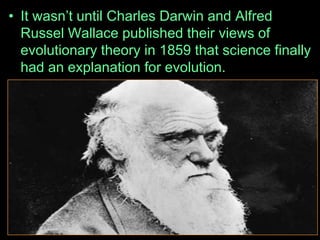
• It wasn’t until Charles Darwin and Alfred
Russel Wallace published their views of
evolutionary theory in 1859 that science finally
had an explanation for evolution.
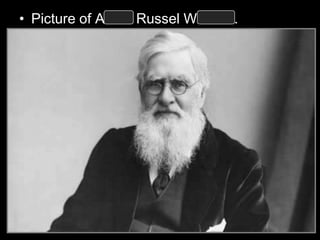
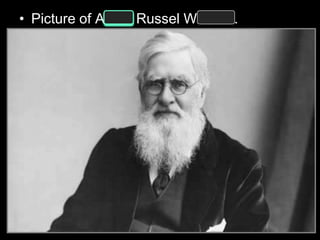
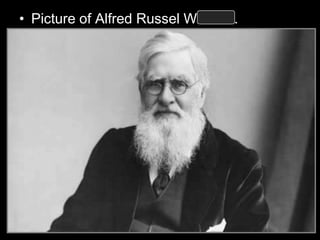
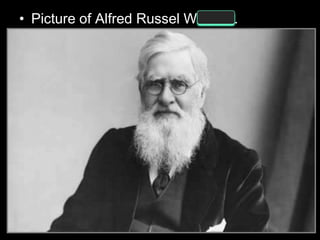
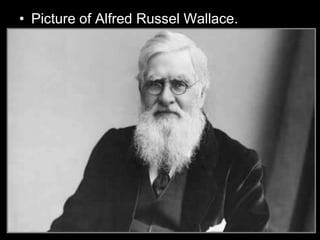
• Picture of Alfred Russel Wallace.
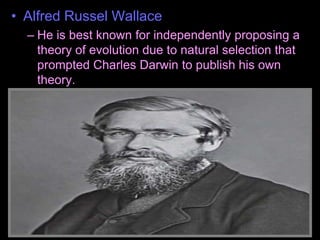
• Alfred Russel Wallace
– He is best known for independently proposing a
theory of evolution due to natural selection that
prompted Charles Darwin to publish his own
theory.
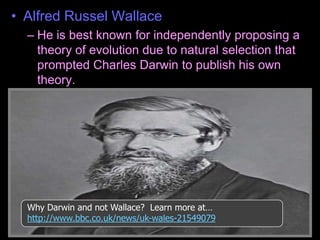
• Alfred Russel Wallace
– He is best known for independently proposing a
theory of evolution due to natural selection that
prompted Charles Darwin to publish his own
theory.
Why Darwin and not Wallace? Learn more at…
http://www.bbc.co.uk/news/uk-wales-21549079
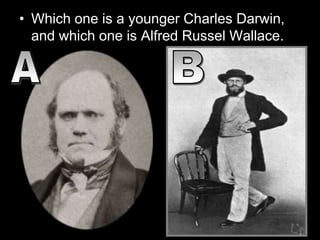
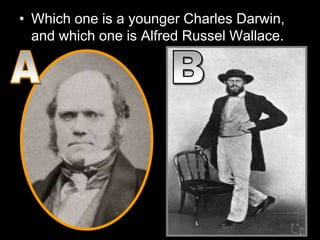
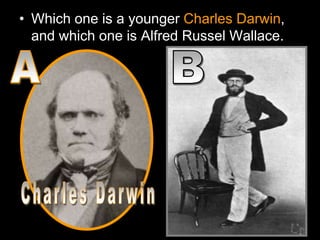
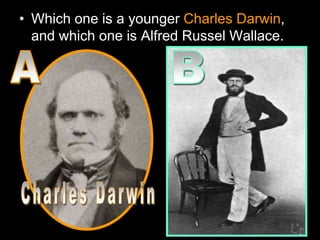
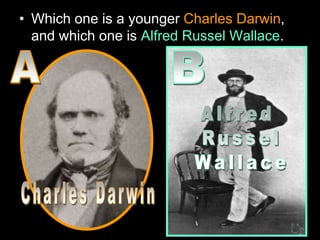
• Which one is a younger Charles Darwin,
and which one is Alfred Russel Wallace.
• Which one is a younger Charles Darwin,
and which one is Alfred Russel Wallace.
• Which one is a younger Charles Darwin,
and which one is Alfred Russel Wallace.
• Which one is a younger Charles Darwin,
and which one is Alfred Russel Wallace.
• Which one is a younger Charles Darwin,
and which one is Alfred Russel Wallace.
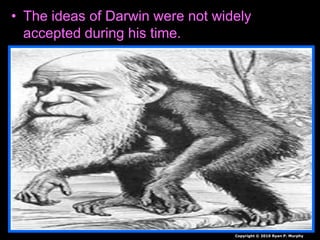
• The ideas of Darwin were not widely
accepted during his time.
Copyright © 2010 Ryan P. Murphy
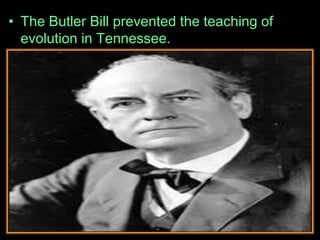
• The Butler Bill prevented the teaching of
evolution in Tennessee.
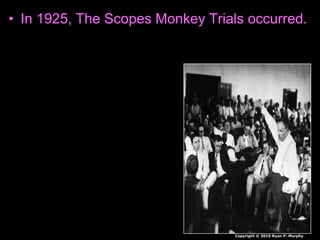
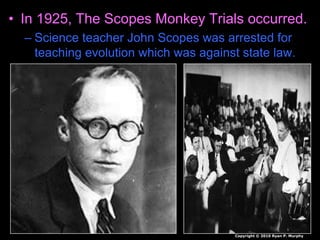
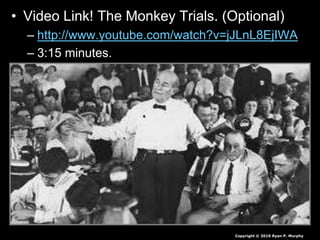
• In 1925, The Scopes Monkey Trials occurred.
– Science teacher John Scopes was arrested for
teaching evolution which was against state law.
Copyright © 2010 Ryan P. Murphy
• In 1925, The Scopes Monkey Trials occurred.
– Science teacher John Scopes was arrested for
teaching evolution which was against state law.
Copyright © 2010 Ryan P. Murphy
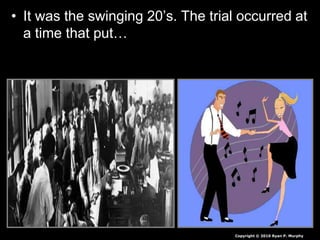
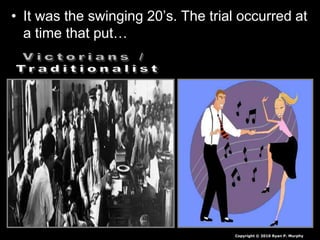
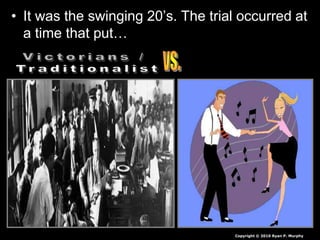
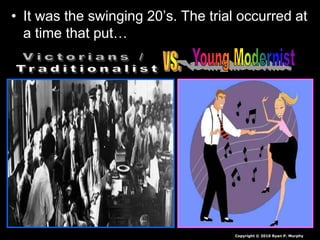
• It was the swinging 20’s. The trial occurred at
a time that put…
Copyright © 2010 Ryan P. Murphy
• It was the swinging 20’s. The trial occurred at
a time that put…
Copyright © 2010 Ryan P. Murphy
• It was the swinging 20’s. The trial occurred at
a time that put…
Copyright © 2010 Ryan P. Murphy
• It was the swinging 20’s. The trial occurred at
a time that put…
Copyright © 2010 Ryan P. Murphy
• Video Link! The Monkey Trials. (Optional)
– http://www.youtube.com/watch?v=jJLnL8EjIWA
– 3:15 minutes.
Copyright © 2010 Ryan P. Murphy
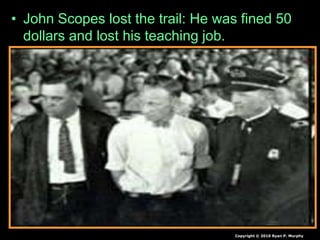
• John Scopes lost the trail: He was fined 50
dollars and lost his teaching job.
Copyright © 2010 Ryan P. Murphy
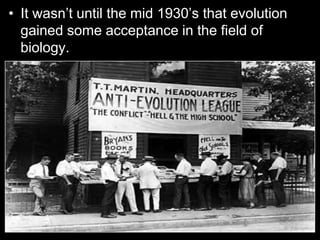
• It wasn’t until the mid 1930’s that evolution
gained some acceptance in the field of
biology.
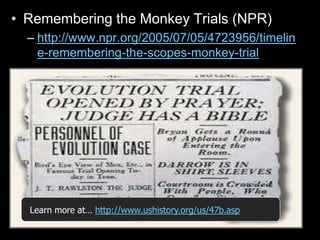
• Remembering the Monkey Trials (NPR)
– http://www.npr.org/2005/07/05/4723956/timelin
e-remembering-the-scopes-monkey-trial
Learn more at… http://www.ushistory.org/us/47b.asp
• The First Amendment does not permit the
state to require that teaching and learning
must be tailored to the principles or
prohibitions of any religious sect or dogma...
– The state has no legitimate interest in protecting
any or all religions from views distasteful to them.
Copyright © 2010 Ryan P. Murphy
• The First Amendment does not permit the
state to require that teaching and learning
must be tailored to the principles or
prohibitions of any religious sect or dogma...
– The state has no legitimate interest in protecting
any or all religions from views distasteful to them.
Copyright © 2010 Ryan P. Murphy
• The First Amendment does not permit the
state to require that teaching and learning
must be tailored to the principles or
prohibitions of any religious sect or dogma...
– The state has no legitimate interest in protecting
any or all religions from views distasteful to them.
Copyright © 2010 Ryan P. Murphy
• Summary –
– Creationism cannot be taught in a public school.
– Evolution is not a religion.
– Evolution to some is a theory, a fact by others.
– A theory is an educated guess based on large
amounts of data. It explains a great deal about
how things may have changed over time, but can
be revised and changed as new information is
found.
– It is the backbone of biology, and backed by
mountains of evidence.
Copyright © 2010 Ryan P. Murphy
• Summary –
– Creationism cannot be taught in a public school.
– Evolution is not a religion.
– Evolution to some is a theory, a fact by others.
– A theory is an educated guess based on large
amounts of data. It explains a great deal about
how things may have changed over time, but can
be revised and changed as new information is
found.
– It is the backbone of biology, and backed by
mountains of evidence.
Copyright © 2010 Ryan P. Murphy
• Summary –
– Creationism cannot be taught in a public school.
– Evolution is not a religion.
– Evolution to some is a theory, a fact by others.
– A theory is an educated guess based on large
amounts of data. It explains a great deal about
how things may have changed over time, but can
be revised and changed as new information is
found.
– It is the backbone of biology, and backed by
mountains of evidence.
Copyright © 2010 Ryan P. Murphy
• Summary –
– Creationism cannot be taught in a public school.
– Evolution is not a religion.
– Evolution to some is a theory, a fact by others.
– A theory is an educated guess based on large
amounts of data. It explains a great deal about
how things may have changed over time, but can
be revised and changed as new information is
found.
– It is the backbone of biology, and backed by
mountains of evidence.
Copyright © 2010 Ryan P. Murphy
• Summary –
– Creationism cannot be taught in a public school.
– Evolution is not a religion.
– Evolution to some is a theory, a fact by others.
– A theory is an educated guess based on large
amounts of data. It explains a great deal about
how things may have changed over time, but can
be revised and changed as new information is
found.
– It is the backbone of biology, and backed by
mountains of evidence.
Copyright © 2010 Ryan P. Murphy
• Summary –
– Creationism cannot be taught in a public school.
– Evolution is not a religion.
– Evolution to some is a theory, a fact by others.
– A theory is an educated guess based on large
amounts of data. It explains a great deal about
how things may have changed over time, but can
be revised and changed as new information is
found.
– It is the backbone of biology, and backed by
mountains of evidence.
Copyright © 2010 Ryan P. Murphy
• Which is Charles Darwin, Alfred Russel
Wallace, and John Scopes?
• Which is Charles Darwin, Alfred Russel
Wallace, and John Scopes?
• Which is Charles Darwin, Alfred Russel
Wallace, and John Scopes?
• Which is Charles Darwin, Alfred Russel
Wallace, and John Scopes?
• Which is Charles Darwin, Alfred Russel
Wallace, and John Scopes?
• Which is Charles Darwin, Alfred Russel
Wallace, and John Scopes?
• Which is Charles Darwin, Alfred Russel
Wallace, and John Scopes?
http://sciencepowerpoint.com/Website Link:
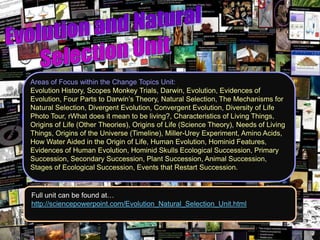
Areas of Focus within the Change Topics Unit:
Evolution History, Scopes Monkey Trials, Darwin, Evolution, Evidences of
Evolution, Four Parts to Darwin’s Theory, Natural Selection, The Mechanisms for
Natural Selection, Divergent Evolution, Convergent Evolution, Diversity of Life
Photo Tour, rWhat does it mean to be living?, Characteristics of Living Things,
Origins of Life (Other Theories), Origins of Life (Science Theory), Needs of Living
Things, Origins of the Universe (Timeline), Miller-Urey Experiment, Amino Acids,
How Water Aided in the Origin of Life, Human Evolution, Hominid Features,
Evidences of Human Evolution, Hominid Skulls Ecological Succession, Primary
Succession, Secondary Succession, Plant Succession, Animal Succession,
Stages of Ecological Succession, Events that Restart Succession.
Full unit can be found at…
http://sciencepowerpoint.com/Evolution_Natural_Selection_Unit.html
• Please visit the links below to learn more
about each of the units in this curriculum
– These units take me about four years to complete
with my students in grades 5-10.
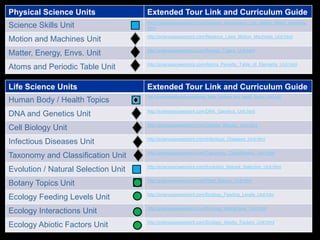
Earth Science Units Extended Tour Link and Curriculum Guide
Geology Topics Unit http://sciencepowerpoint.com/Geology_Unit.html
Astronomy Topics Unit http://sciencepowerpoint.com/Astronomy_Unit.html
Weather and Climate Unit http://sciencepowerpoint.com/Weather_Climate_Unit.html
Soil Science, Weathering, More http://sciencepowerpoint.com/Soil_and_Glaciers_Unit.html
Water Unit http://sciencepowerpoint.com/Water_Molecule_Unit.html
Rivers Unit http://sciencepowerpoint.com/River_and_Water_Quality_Unit.html
Physical Science Units Extended Tour Link and Curriculum Guide
Science Skills Unit http://sciencepowerpoint.com/Science_Introduction_Lab_Safety_Metric_Methods.
html
Motion and Machines Unit http://sciencepowerpoint.com/Newtons_Laws_Motion_Machines_Unit.html
Matter, Energy, Envs. Unit http://sciencepowerpoint.com/Energy_Topics_Unit.html
Atoms and Periodic Table Unit http://sciencepowerpoint.com/Atoms_Periodic_Table_of_Elements_Unit.html
Life Science Units Extended Tour Link and Curriculum Guide
Human Body / Health Topics
http://sciencepowerpoint.com/Human_Body_Systems_and_Health_Topics_Unit.html
DNA and Genetics Unit http://sciencepowerpoint.com/DNA_Genetics_Unit.html
Cell Biology Unit http://sciencepowerpoint.com/Cellular_Biology_Unit.html
Infectious Diseases Unit http://sciencepowerpoint.com/Infectious_Diseases_Unit.html
Taxonomy and Classification Unit http://sciencepowerpoint.com/Taxonomy_Classification_Unit.html
Evolution / Natural Selection Unit http://sciencepowerpoint.com/Evolution_Natural_Selection_Unit.html
Botany Topics Unit http://sciencepowerpoint.com/Plant_Botany_Unit.html
Ecology Feeding Levels Unit http://sciencepowerpoint.com/Ecology_Feeding_Levels_Unit.htm
Ecology Interactions Unit http://sciencepowerpoint.com/Ecology_Interactions_Unit.html
Ecology Abiotic Factors Unit http://sciencepowerpoint.com/Ecology_Abiotic_Factors_Unit.html
• The entire four year curriculum can be found at...
http://sciencepowerpoint.com/ Please feel free to
contact me with any questions you may have.
Thank you for your interest in this curriculum.
Sincerely,
Ryan Murphy M.Ed
www.sciencepowerpoint@gmail.com
http://sciencepowerpoint.com/Website Link:

Charles Darwin, Alfred Russel Wallace, John Scopes, Evolution Lesson PowerPoint

  • 1.
    • Which isCharles Darwin, Alfred Russel Wallace, and John Scopes?
  • 3.
    • RED SLIDE:These are notes that are very important and should be recorded in your science journal. Copyright © 2010 Ryan P. Murphy
  • 4.
    -Nice neat notesthat are legible and use indentations when appropriate. -Example of indent. -Skip a line between topics -Don’t skip pages -Make visuals clear and well drawn.
  • 5.
    • RED SLIDE:These are notes that are very important and should be recorded in your science journal. • BLACK SLIDE: Pay attention, follow directions, complete projects as described and answer required questions neatly. Copyright © 2010 Ryan P. Murphy
  • 6.
  • 8.
    • Pay attentionin this unit! Evolution is the backbone to biology. – Nothing makes sense in biology without evolution. Copyright © 2010 Ryan P. Murphy
  • 9.
    • Pay attentionin this unit! Evolution is the backbone to biology. – Nothing makes sense in biology without evolution. Copyright © 2010 Ryan P. Murphy
  • 10.
    • Evolution AvailableSheet that follows slideshow for classwork.
  • 11.
    • Evolution AvailableSheet that follows slideshow for classwork.
  • 12.
    • How oldis the earth? – How old is the first life on earth? This unit belongs to Ryan P. Murphy Copyright 2010 found at www.sciencepowerpoint.com
  • 13.
    • The earthis roughly 4.6 Billion years old. – Primitive life is believed to have formed 3.85 Billion years ago. – The earth is old, and a lot has changed over time. Copyright © 2010 Ryan P. Murphy
  • 14.
    • The earthis roughly 4.6 Billion years old. – Primitive life is believed to have formed 3.85 Billion years ago. – The earth is old, and a lot has changed over time. Copyright © 2010 Ryan P. Murphy
  • 15.
    • The earthis roughly 4.6 Billion years old. – Primitive life is believed to have formed 3.85 Billion years ago. – The Earth is old, and a lot has changed over time. Copyright © 2010 Ryan P. Murphy
  • 16.
    • We haveall seen pictures like this, what do you really know about evolution?
  • 17.
    • We haveall seen pictures like this, what do you really know about evolution?
  • 18.
    • We haveall seen pictures like this, what do you really know about evolution?
  • 19.
    • We haveall seen pictures like this, what do you really know about evolution?
  • 20.
    • We haveall seen pictures like this, what do you really know about evolution?
  • 21.
    • We haveall seen pictures like this, what do you really know about evolution?
  • 22.
    • We haveall seen pictures like this, what do you really know about evolution? – Please talk it over with your table group and be prepared to speak about your conversation.
  • 23.
     Evolution: Evolutionis change (*) of a population of organisms from one generation to the next.  -  - Copyright © 2010 Ryan P. Murphy
  • 24.
     Evolution: Evolutionis change (*) of a population of organisms from one generation to the next.  * = in the gene pool  - Copyright © 2010 Ryan P. Murphy
  • 25.
     Evolution: Evolutionis change (*) of a population of organisms from one generation to the next.  * = in the gene pool  Usually an advancement. Copyright © 2010 Ryan P. Murphy
  • 26.
     Evolution: Evolutionis change (*) of a population of organisms from one generation to the next.  * = in the gene pool  Usually an advancement. Copyright © 2010 Ryan P. Murphy
  • 27.
    • The earliestideas of evolution as change over time can be seen as lore and myth. – Still very much unexplained.
  • 28.
    • The earliestideas of evolution as change over time can be seen as lore and myth. – Still very much unexplained.
  • 29.
    • For mostof modern history until the early 1800’s, most biological thinking was essentialism. Copyright © 2010 Ryan P. Murphy
  • 30.
    • For mostof modern history until the early 1800’s, most biological thinking was essentialism. – This is the idea that every species has characteristics that are unalterable or cannot change. Copyright © 2010 Ryan P. Murphy
  • 31.
    • For mostof modern history until the early 1800’s, most biological thinking was essentialism. – This is the idea that every species has characteristics that are unalterable or cannot change. Copyright © 2010 Ryan P. Murphy
  • 32.
    • For mostof modern history until the early 1800’s, most biological thinking was essentialism. – This is the idea that every species has characteristics that are unalterable or cannot change. Copyright © 2010 Ryan P. Murphy
  • 33.
    • Geneticist havethe ability to actually alter a species by changing genes.
  • 34.
    • Geneticist havethe ability to actually alter a species by changing genes.
  • 35.
    • Geneticist havethe ability to actually alter a species by changing genes. – This is a picture of a beak that was genetically altered to grow teeth.
  • 36.
    • A geneis a unit of heredity that is transferred from a parent to offspring.
  • 37.
    • A geneis a unit of heredity that is transferred from a parent to offspring. This is when genes change over time in a population of organisms… Evolution
  • 38.
    • A geneis a unit of heredity that is transferred from a parent to offspring. This is when genes change over time in a population of organisms… Evolution
  • 39.
    • A geneis a unit of heredity that is transferred from a parent to offspring. This is when genes change over time in a population of organisms… Evolution
  • 40.
    • During theEnlightenment of the early 1800’s, many of scientist moved from the physical sciences to natural history.
  • 41.
    • During theEnlightenment of the early 1800’s, many of scientist moved from the physical sciences to natural history. – Many exciting fossils were found during this period.
  • 42.
     Jean-Baptiste Lamarck Copyright© 2010 Ryan P. Murphy “Just jot my name down somewhere…Ummm.”
  • 43.
    • Jean-Baptiste Lamarckproposed the theory of transmutation of species, which turned out to have some flaws. – Nonetheless was the first real theory of evolution. Copyright © 2010 Ryan P. Murphy
  • 44.
    • Jean-Baptiste Lamarckproposed the theory of transmutation of species, which turned out to have some flaws. – Nonetheless was the first real theory of evolution. Copyright © 2010 Ryan P. Murphy
  • 45.
    • Jean-Baptiste Lamarckproposed the theory of transmutation of species, which turned out to have some flaws. – Nonetheless was the first real theory of evolution. Copyright © 2010 Ryan P. Murphy “How do you think a giraffe got a long neck?”
  • 46.
    • Jean-Baptiste Lamarckproposed the theory of transmutation of species, which turned out to have some flaws. – Nonetheless was the first real theory of evolution. Copyright © 2010 Ryan P. Murphy
  • 47.
    • Jean-Baptiste Lamarckproposed the theory of transmutation of species, which turned out to have some flaws. – Nonetheless was the first real theory of evolution. Copyright © 2010 Ryan P. Murphy
  • 48.
    • Jean-Baptiste Lamarckproposed the theory of transmutation of species, which turned out to have some flaws. – Nonetheless was the first real theory of evolution. Copyright © 2010 Ryan P. Murphy
  • 49.
    • Jean-Baptiste Lamarckproposed the theory of transmutation of species, which turned out to have some flaws. – Nonetheless was the first real theory of evolution. Copyright © 2010 Ryan P. Murphy
  • 50.
    • Jean-Baptiste Lamarckproposed the theory of transmutation of species, which turned out to have some flaws. – Nonetheless was the first real theory of evolution. Copyright © 2010 Ryan P. Murphy
  • 51.
    • Audio Link!Radio Lab (Optional) Leaving Your Lamarck. 28 minutes. (HE_ _ ) is said. – http://www.radiolab.org/2012/nov/19/ Copyright © 2010 Ryan P. Murphy
  • 52.
    • Who isthis? Copyright © 2010 Ryan P. Murphy
  • 53.
    • Who isthis? ”Ho-Ho-Ho!” Copyright © 2010 Ryan P. Murphy
  • 54.
    • Who isthis? Not Santa Clause. Copyright © 2010 Ryan P. Murphy
  • 55.
    “I’m Charles Darwin.” “I answeredthe question…” “What are the laws of life.”
  • 56.
    • It wasn’tuntil Charles Darwin and Alfred Russel Wallace published their views of evolutionary theory in 1859 that science finally had an explanation for evolution.
  • 57.
    • Picture ofAlfred Russel Wallace.
  • 58.
    • Picture ofAlfred Russel Wallace.
  • 59.
    • Picture ofAlfred Russel Wallace.
  • 60.
    • Picture ofAlfred Russel Wallace.
  • 61.
    • Picture ofAlfred Russel Wallace.
  • 62.
    • Alfred RusselWallace – He is best known for independently proposing a theory of evolution due to natural selection that prompted Charles Darwin to publish his own theory.
  • 63.
    • Alfred RusselWallace – He is best known for independently proposing a theory of evolution due to natural selection that prompted Charles Darwin to publish his own theory. Why Darwin and not Wallace? Learn more at… http://www.bbc.co.uk/news/uk-wales-21549079
  • 64.
    • Which oneis a younger Charles Darwin, and which one is Alfred Russel Wallace.
  • 65.
    • Which oneis a younger Charles Darwin, and which one is Alfred Russel Wallace.
  • 66.
    • Which oneis a younger Charles Darwin, and which one is Alfred Russel Wallace.
  • 67.
    • Which oneis a younger Charles Darwin, and which one is Alfred Russel Wallace.
  • 68.
    • Which oneis a younger Charles Darwin, and which one is Alfred Russel Wallace.
  • 69.
    • The ideasof Darwin were not widely accepted during his time. Copyright © 2010 Ryan P. Murphy
  • 70.
    • The ButlerBill prevented the teaching of evolution in Tennessee.
  • 71.
    • In 1925,The Scopes Monkey Trials occurred. – Science teacher John Scopes was arrested for teaching evolution which was against state law. Copyright © 2010 Ryan P. Murphy
  • 72.
    • In 1925,The Scopes Monkey Trials occurred. – Science teacher John Scopes was arrested for teaching evolution which was against state law. Copyright © 2010 Ryan P. Murphy
  • 73.
    • It wasthe swinging 20’s. The trial occurred at a time that put… Copyright © 2010 Ryan P. Murphy
  • 74.
    • It wasthe swinging 20’s. The trial occurred at a time that put… Copyright © 2010 Ryan P. Murphy
  • 75.
    • It wasthe swinging 20’s. The trial occurred at a time that put… Copyright © 2010 Ryan P. Murphy
  • 76.
    • It wasthe swinging 20’s. The trial occurred at a time that put… Copyright © 2010 Ryan P. Murphy
  • 77.
    • Video Link!The Monkey Trials. (Optional) – http://www.youtube.com/watch?v=jJLnL8EjIWA – 3:15 minutes. Copyright © 2010 Ryan P. Murphy
  • 78.
    • John Scopeslost the trail: He was fined 50 dollars and lost his teaching job. Copyright © 2010 Ryan P. Murphy
  • 79.
    • It wasn’tuntil the mid 1930’s that evolution gained some acceptance in the field of biology.
  • 80.
    • Remembering theMonkey Trials (NPR) – http://www.npr.org/2005/07/05/4723956/timelin e-remembering-the-scopes-monkey-trial Learn more at… http://www.ushistory.org/us/47b.asp
  • 81.
    • The FirstAmendment does not permit the state to require that teaching and learning must be tailored to the principles or prohibitions of any religious sect or dogma... – The state has no legitimate interest in protecting any or all religions from views distasteful to them. Copyright © 2010 Ryan P. Murphy
  • 82.
    • The FirstAmendment does not permit the state to require that teaching and learning must be tailored to the principles or prohibitions of any religious sect or dogma... – The state has no legitimate interest in protecting any or all religions from views distasteful to them. Copyright © 2010 Ryan P. Murphy
  • 83.
    • The FirstAmendment does not permit the state to require that teaching and learning must be tailored to the principles or prohibitions of any religious sect or dogma... – The state has no legitimate interest in protecting any or all religions from views distasteful to them. Copyright © 2010 Ryan P. Murphy
  • 84.
    • Summary – –Creationism cannot be taught in a public school. – Evolution is not a religion. – Evolution to some is a theory, a fact by others. – A theory is an educated guess based on large amounts of data. It explains a great deal about how things may have changed over time, but can be revised and changed as new information is found. – It is the backbone of biology, and backed by mountains of evidence. Copyright © 2010 Ryan P. Murphy
  • 85.
    • Summary – –Creationism cannot be taught in a public school. – Evolution is not a religion. – Evolution to some is a theory, a fact by others. – A theory is an educated guess based on large amounts of data. It explains a great deal about how things may have changed over time, but can be revised and changed as new information is found. – It is the backbone of biology, and backed by mountains of evidence. Copyright © 2010 Ryan P. Murphy
  • 86.
    • Summary – –Creationism cannot be taught in a public school. – Evolution is not a religion. – Evolution to some is a theory, a fact by others. – A theory is an educated guess based on large amounts of data. It explains a great deal about how things may have changed over time, but can be revised and changed as new information is found. – It is the backbone of biology, and backed by mountains of evidence. Copyright © 2010 Ryan P. Murphy
  • 87.
    • Summary – –Creationism cannot be taught in a public school. – Evolution is not a religion. – Evolution to some is a theory, a fact by others. – A theory is an educated guess based on large amounts of data. It explains a great deal about how things may have changed over time, but can be revised and changed as new information is found. – It is the backbone of biology, and backed by mountains of evidence. Copyright © 2010 Ryan P. Murphy
  • 88.
    • Summary – –Creationism cannot be taught in a public school. – Evolution is not a religion. – Evolution to some is a theory, a fact by others. – A theory is an educated guess based on large amounts of data. It explains a great deal about how things may have changed over time, but can be revised and changed as new information is found. – It is the backbone of biology, and backed by mountains of evidence. Copyright © 2010 Ryan P. Murphy
  • 89.
    • Summary – –Creationism cannot be taught in a public school. – Evolution is not a religion. – Evolution to some is a theory, a fact by others. – A theory is an educated guess based on large amounts of data. It explains a great deal about how things may have changed over time, but can be revised and changed as new information is found. – It is the backbone of biology, and backed by mountains of evidence. Copyright © 2010 Ryan P. Murphy
  • 90.
    • Which isCharles Darwin, Alfred Russel Wallace, and John Scopes?
  • 91.
    • Which isCharles Darwin, Alfred Russel Wallace, and John Scopes?
  • 92.
    • Which isCharles Darwin, Alfred Russel Wallace, and John Scopes?
  • 93.
    • Which isCharles Darwin, Alfred Russel Wallace, and John Scopes?
  • 94.
    • Which isCharles Darwin, Alfred Russel Wallace, and John Scopes?
  • 95.
    • Which isCharles Darwin, Alfred Russel Wallace, and John Scopes?
  • 96.
    • Which isCharles Darwin, Alfred Russel Wallace, and John Scopes?
  • 97.
  • 99.
    Areas of Focuswithin the Change Topics Unit: Evolution History, Scopes Monkey Trials, Darwin, Evolution, Evidences of Evolution, Four Parts to Darwin’s Theory, Natural Selection, The Mechanisms for Natural Selection, Divergent Evolution, Convergent Evolution, Diversity of Life Photo Tour, rWhat does it mean to be living?, Characteristics of Living Things, Origins of Life (Other Theories), Origins of Life (Science Theory), Needs of Living Things, Origins of the Universe (Timeline), Miller-Urey Experiment, Amino Acids, How Water Aided in the Origin of Life, Human Evolution, Hominid Features, Evidences of Human Evolution, Hominid Skulls Ecological Succession, Primary Succession, Secondary Succession, Plant Succession, Animal Succession, Stages of Ecological Succession, Events that Restart Succession. Full unit can be found at… http://sciencepowerpoint.com/Evolution_Natural_Selection_Unit.html
  • 105.
    • Please visitthe links below to learn more about each of the units in this curriculum – These units take me about four years to complete with my students in grades 5-10. Earth Science Units Extended Tour Link and Curriculum Guide Geology Topics Unit http://sciencepowerpoint.com/Geology_Unit.html Astronomy Topics Unit http://sciencepowerpoint.com/Astronomy_Unit.html Weather and Climate Unit http://sciencepowerpoint.com/Weather_Climate_Unit.html Soil Science, Weathering, More http://sciencepowerpoint.com/Soil_and_Glaciers_Unit.html Water Unit http://sciencepowerpoint.com/Water_Molecule_Unit.html Rivers Unit http://sciencepowerpoint.com/River_and_Water_Quality_Unit.html
  • 106.
    Physical Science UnitsExtended Tour Link and Curriculum Guide Science Skills Unit http://sciencepowerpoint.com/Science_Introduction_Lab_Safety_Metric_Methods. html Motion and Machines Unit http://sciencepowerpoint.com/Newtons_Laws_Motion_Machines_Unit.html Matter, Energy, Envs. Unit http://sciencepowerpoint.com/Energy_Topics_Unit.html Atoms and Periodic Table Unit http://sciencepowerpoint.com/Atoms_Periodic_Table_of_Elements_Unit.html Life Science Units Extended Tour Link and Curriculum Guide Human Body / Health Topics http://sciencepowerpoint.com/Human_Body_Systems_and_Health_Topics_Unit.html DNA and Genetics Unit http://sciencepowerpoint.com/DNA_Genetics_Unit.html Cell Biology Unit http://sciencepowerpoint.com/Cellular_Biology_Unit.html Infectious Diseases Unit http://sciencepowerpoint.com/Infectious_Diseases_Unit.html Taxonomy and Classification Unit http://sciencepowerpoint.com/Taxonomy_Classification_Unit.html Evolution / Natural Selection Unit http://sciencepowerpoint.com/Evolution_Natural_Selection_Unit.html Botany Topics Unit http://sciencepowerpoint.com/Plant_Botany_Unit.html Ecology Feeding Levels Unit http://sciencepowerpoint.com/Ecology_Feeding_Levels_Unit.htm Ecology Interactions Unit http://sciencepowerpoint.com/Ecology_Interactions_Unit.html Ecology Abiotic Factors Unit http://sciencepowerpoint.com/Ecology_Abiotic_Factors_Unit.html
  • 107.
    • The entirefour year curriculum can be found at... http://sciencepowerpoint.com/ Please feel free to contact me with any questions you may have. Thank you for your interest in this curriculum. Sincerely, Ryan Murphy M.Ed www.sciencepowerpoint@gmail.com
  • 108.