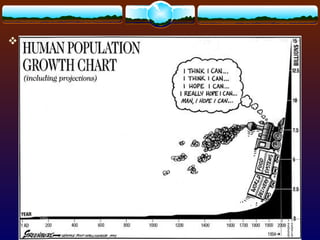
Population Theories and Models
 Stay tuned for tons of IB excitement!
Natural Increase= Crude Birth Rate – Crude Death Rate
How
you
doin’?

Malthus’ Theory of Population
Growth
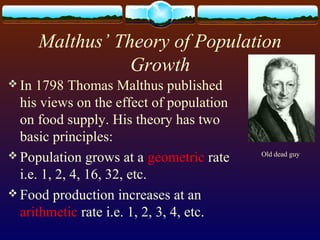
 In 1798 Thomas Malthus published
his views on the effect of population
on food supply. His theory has two
basic principles:
 Population grows at a geometric rate
i.e. 1, 2, 4, 16, 32, etc.
 Food production increases at an
arithmetic rate i.e. 1, 2, 3, 4, etc.
Old dead guy
Malthus (cont.)
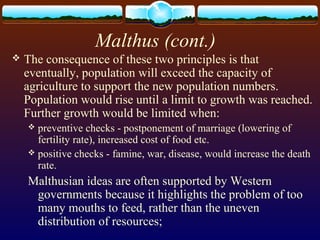
 The consequence of these two principles is that
eventually, population will exceed the capacity of
agriculture to support the new population numbers.
Population would rise until a limit to growth was reached.
Further growth would be limited when:
 preventive checks - postponement of marriage (lowering of
fertility rate), increased cost of food etc.
 positive checks - famine, war, disease, would increase the death
rate.
Malthusian ideas are often supported by Western
governments because it highlights the problem of too
many mouths to feed, rather than the uneven
distribution of resources;
Malthus (cont.)
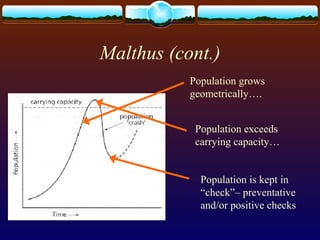
Population grows
geometrically….
Population exceeds
carrying capacity…
Population is kept in
“check”– preventative
and/or positive checks
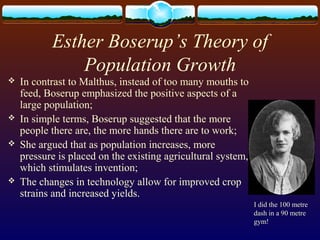
Esther Boserup’s Theory of
Population Growth
 In contrast to Malthus, instead of too many mouths to
feed, Boserup emphasized the positive aspects of a
large population;
 In simple terms, Boserup suggested that the more
people there are, the more hands there are to work;
 She argued that as population increases, more
pressure is placed on the existing agricultural system,
which stimulates invention;
 The changes in technology allow for improved crop
strains and increased yields.
I did the 100 metre
dash in a 90 metre
gym!
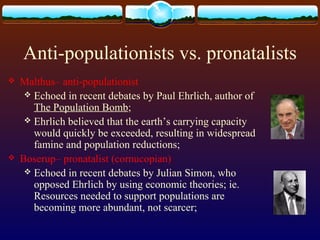
Anti-populationists vs. pronatalists
 Malthus– anti-populationist
 Echoed in recent debates by Paul Ehrlich, author of
The Population Bomb;
 Ehrlich believed that the earth’s carrying capacity
would quickly be exceeded, resulting in widespread
famine and population reductions;
 Boserup– pronatalist (cornucopian)
 Echoed in recent debates by Julian Simon, who
opposed Ehrlich by using economic theories; ie.
Resources needed to support populations are
becoming more abundant, not scarcer;
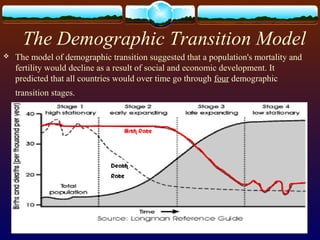
The Demographic Transition Model
 The model of demographic transition suggested that a population's mortality and
fertility would decline as a result of social and economic development. It
predicted that all countries would over time go through four demographic
transition stages.
STAGE 1– High Stationary or Pre-
Industrial
 HIGH BIRTH RATES
 Little or no family planning
 Parents have many children because few survive
 Many children are needed to work the land
 Children are a sign of virility
 Some religious beliefs and cultural traditions encourage large families
 HIGH DEATH RATES
 Disease and plague (e.g. bubonic, cholera, kwashiorkor)
 Famine , uncertain food supplies, and poor diet
 Poor hygiene, no piped clean water or sewage disposal
 POPULATION GROWTH-- SLOW
STAGE 1 (continued)
Birth Rate High
Death Rate High
Natural Increase Low
Fertility Rate High
Infant Mortality RateHigh
Example Region Various isolated communities in the
least
developed regions of Africa; war-torn
regions (eg Afghanistan, Sudan, Angola);
political hotspots (eg North Korea)
Other Characteristics: Characterizes pre-industrial societies. Most of the
population is rural and involved in subsistence agriculture.
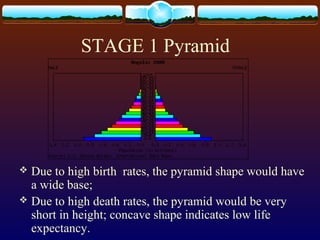
STAGE 1 Pyramid
 Due to high birth rates, the pyramid shape would have
a wide base;
 Due to high death rates, the pyramid would be very
short in height; concave shape indicates low life
expectancy.
STAGE 2– Early Expanding or Early
Industrial
(Rapid population growth)
 Ehrlich described this stage as the “population explosion”
 HIGH BIRTH RATES
 As STAGE 1
 FALLING DEATH RATES
 Improved medical care e.g. vaccinations , hospitals, doctors, new drugs, and
scientific inventions
 Improved sanitation and water supply
 Improvements in food production in terms of quality and quantity
 Improved transport to move food and doctors
 A decrease in child mortality
 POPULATION GROWTH-- RAPID
EARLY STAGE 2 (continued)
Birth Rate High
Death Rate Decreasing
Natural Increase Increasing
Fertility Rate High
Infant Mortality Rate High
Example Region Sub-Saharan Africa
Other Characteristics: Characterizes post-industrial societies. Most of the
population is rural, but urbanization is increasing rapidly. Dependency load
begins to increase rapidly as the young cohort (%<15 yrs old) begins to dominate
the proportion of the population.
LATE STAGE 2 (continued)
Birth Rate High
Death Rate Lowered
Natural Increase Increasing rapidly
Fertility Rate High
Infant Mortality Rate Declining
Example Region Many African countries, Middle East
Other Characteristics: The beginning of the population “explosion”. Often,
social and economic problems begin on a large scale. Urbanization continues to
grow rapidly. Dependency load is huge due to a massive, young cohort (<15yrs
old).
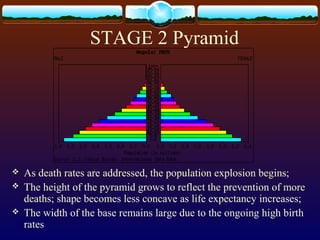
STAGE 2 Pyramid
 As death rates are addressed, the population explosion begins;
 The height of the pyramid grows to reflect the prevention of more
deaths; shape becomes less concave as life expectancy increases;
 The width of the base remains large due to the ongoing high birth
rates
STAGE 3– Late Expanding or Late
Industrial
 FALLING BIRTH RATES
 Family Planning utilized; contraceptives, abortions, sterilization, and other
government incentives adopted
 A lower infant mortality rates means less pressure to have children
 Increased mechanization and industrialization means less need for labour
 Increased desire for material possessions and less desire for large families
 Emancipation of women
 DEATH RATES LOW
 As Stage 2
 POPULATION GROWTH– STILL GROWING BUT SLOWING
EARLY STAGE 3 (continued)
Birth Rate Decreasing
Death Rate Low
Natural Increase High, but decreasing
Fertility Rate Decreasing
Infant Mortality Rate Decreasing
Example Region South and East Asia
Other Characteristics: Birth control is introduced and begins wide social
acceptance. Social and economic issues begin to be addressed. Dependency load
is still large due to a large young cohort group (<15yrs old).
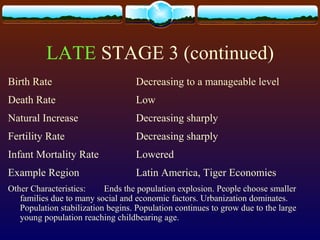
LATE STAGE 3 (continued)
Birth Rate Decreasing to a manageable level
Death Rate Low
Natural Increase Decreasing sharply
Fertility Rate Decreasing sharply
Infant Mortality Rate Lowered
Example Region Latin America, Tiger Economies
Other Characteristics: Ends the population explosion. People choose smaller
families due to many social and economic factors. Urbanization dominates.
Population stabilization begins. Population continues to grow due to the large
young population reaching childbearing age.
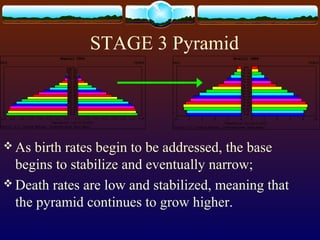
STAGE 3 Pyramid
 As birth rates begin to be addressed, the base
begins to stabilize and eventually narrow;
 Death rates are low and stabilized, meaning that
the pyramid continues to grow higher.
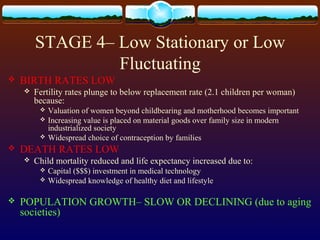
STAGE 4– Low Stationary or Low
Fluctuating
 BIRTH RATES LOW
 Fertility rates plunge to below replacement rate (2.1 children per woman)
because:
 Valuation of women beyond childbearing and motherhood becomes important
 Increasing value is placed on material goods over family size in modern
industrialized society
 Widespread choice of contraception by families
 DEATH RATES LOW
 Child mortality reduced and life expectancy increased due to:
 Capital ($$$) investment in medical technology
 Widespread knowledge of healthy diet and lifestyle
 POPULATION GROWTH– SLOW OR DECLINING (due to aging
societies)
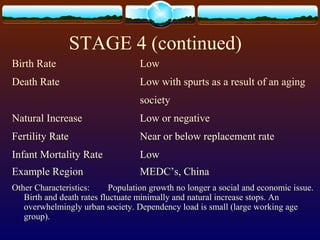
STAGE 4 (continued)
Birth Rate Low
Death Rate Low with spurts as a result of an aging
society
Natural Increase Low or negative
Fertility Rate Near or below replacement rate
Infant Mortality Rate Low
Example Region MEDC’s, China
Other Characteristics: Population growth no longer a social and economic issue.
Birth and death rates fluctuate minimally and natural increase stops. An
overwhelmingly urban society. Dependency load is small (large working age
group).
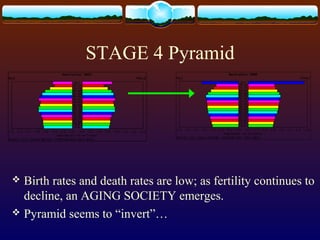
STAGE 4 Pyramid
 Birth rates and death rates are low; as fertility continues to
decline, an AGING SOCIETY emerges.
 Pyramid seems to “invert”…
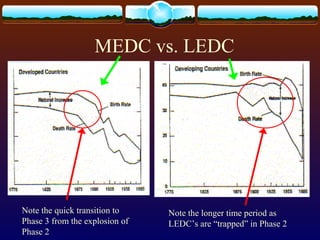
MEDC vs. LEDC
Note the quick transition to
Phase 3 from the explosion of
Phase 2
Note the longer time period as
LEDC’s are “trapped” in Phase 2
Criticism of the DTM…
 The model is an over-generalization of the industrialized
European experience;
 Model is too rigid in assuming all countries proceed from
stage 1-4; it ignores variables and exceptions (eg. War,
political turmoil);
 Industrialization is difficult to achieve for LEDC’s in a
trading system that protects the industries of MEDC’s;
 The model assumes that reductions in fertility are a
function of increased wealth and industrialization– other
factors such as the status of women and other social
development are ignored.

Ib population overview

  • 1.
    Population Theories andModels  Stay tuned for tons of IB excitement! Natural Increase= Crude Birth Rate – Crude Death Rate How you doin’?
  • 2.
  • 3.
    Malthus’ Theory ofPopulation Growth  In 1798 Thomas Malthus published his views on the effect of population on food supply. His theory has two basic principles:  Population grows at a geometric rate i.e. 1, 2, 4, 16, 32, etc.  Food production increases at an arithmetic rate i.e. 1, 2, 3, 4, etc. Old dead guy
  • 4.
    Malthus (cont.)  Theconsequence of these two principles is that eventually, population will exceed the capacity of agriculture to support the new population numbers. Population would rise until a limit to growth was reached. Further growth would be limited when:  preventive checks - postponement of marriage (lowering of fertility rate), increased cost of food etc.  positive checks - famine, war, disease, would increase the death rate. Malthusian ideas are often supported by Western governments because it highlights the problem of too many mouths to feed, rather than the uneven distribution of resources;
  • 5.
    Malthus (cont.) Population grows geometrically…. Populationexceeds carrying capacity… Population is kept in “check”– preventative and/or positive checks
  • 6.
    Esther Boserup’s Theoryof Population Growth  In contrast to Malthus, instead of too many mouths to feed, Boserup emphasized the positive aspects of a large population;  In simple terms, Boserup suggested that the more people there are, the more hands there are to work;  She argued that as population increases, more pressure is placed on the existing agricultural system, which stimulates invention;  The changes in technology allow for improved crop strains and increased yields. I did the 100 metre dash in a 90 metre gym!
  • 7.
    Anti-populationists vs. pronatalists Malthus– anti-populationist  Echoed in recent debates by Paul Ehrlich, author of The Population Bomb;  Ehrlich believed that the earth’s carrying capacity would quickly be exceeded, resulting in widespread famine and population reductions;  Boserup– pronatalist (cornucopian)  Echoed in recent debates by Julian Simon, who opposed Ehrlich by using economic theories; ie. Resources needed to support populations are becoming more abundant, not scarcer;
  • 9.
    The Demographic TransitionModel  The model of demographic transition suggested that a population's mortality and fertility would decline as a result of social and economic development. It predicted that all countries would over time go through four demographic transition stages.
  • 10.
    STAGE 1– HighStationary or Pre- Industrial  HIGH BIRTH RATES  Little or no family planning  Parents have many children because few survive  Many children are needed to work the land  Children are a sign of virility  Some religious beliefs and cultural traditions encourage large families  HIGH DEATH RATES  Disease and plague (e.g. bubonic, cholera, kwashiorkor)  Famine , uncertain food supplies, and poor diet  Poor hygiene, no piped clean water or sewage disposal  POPULATION GROWTH-- SLOW
  • 11.
    STAGE 1 (continued) BirthRate High Death Rate High Natural Increase Low Fertility Rate High Infant Mortality RateHigh Example Region Various isolated communities in the least developed regions of Africa; war-torn regions (eg Afghanistan, Sudan, Angola); political hotspots (eg North Korea) Other Characteristics: Characterizes pre-industrial societies. Most of the population is rural and involved in subsistence agriculture.
  • 12.
    STAGE 1 Pyramid Due to high birth rates, the pyramid shape would have a wide base;  Due to high death rates, the pyramid would be very short in height; concave shape indicates low life expectancy.
  • 13.
    STAGE 2– EarlyExpanding or Early Industrial (Rapid population growth)  Ehrlich described this stage as the “population explosion”  HIGH BIRTH RATES  As STAGE 1  FALLING DEATH RATES  Improved medical care e.g. vaccinations , hospitals, doctors, new drugs, and scientific inventions  Improved sanitation and water supply  Improvements in food production in terms of quality and quantity  Improved transport to move food and doctors  A decrease in child mortality  POPULATION GROWTH-- RAPID
  • 14.
    EARLY STAGE 2(continued) Birth Rate High Death Rate Decreasing Natural Increase Increasing Fertility Rate High Infant Mortality Rate High Example Region Sub-Saharan Africa Other Characteristics: Characterizes post-industrial societies. Most of the population is rural, but urbanization is increasing rapidly. Dependency load begins to increase rapidly as the young cohort (%<15 yrs old) begins to dominate the proportion of the population.
  • 15.
    LATE STAGE 2(continued) Birth Rate High Death Rate Lowered Natural Increase Increasing rapidly Fertility Rate High Infant Mortality Rate Declining Example Region Many African countries, Middle East Other Characteristics: The beginning of the population “explosion”. Often, social and economic problems begin on a large scale. Urbanization continues to grow rapidly. Dependency load is huge due to a massive, young cohort (<15yrs old).
  • 16.
    STAGE 2 Pyramid As death rates are addressed, the population explosion begins;  The height of the pyramid grows to reflect the prevention of more deaths; shape becomes less concave as life expectancy increases;  The width of the base remains large due to the ongoing high birth rates
  • 17.
    STAGE 3– LateExpanding or Late Industrial  FALLING BIRTH RATES  Family Planning utilized; contraceptives, abortions, sterilization, and other government incentives adopted  A lower infant mortality rates means less pressure to have children  Increased mechanization and industrialization means less need for labour  Increased desire for material possessions and less desire for large families  Emancipation of women  DEATH RATES LOW  As Stage 2  POPULATION GROWTH– STILL GROWING BUT SLOWING
  • 18.
    EARLY STAGE 3(continued) Birth Rate Decreasing Death Rate Low Natural Increase High, but decreasing Fertility Rate Decreasing Infant Mortality Rate Decreasing Example Region South and East Asia Other Characteristics: Birth control is introduced and begins wide social acceptance. Social and economic issues begin to be addressed. Dependency load is still large due to a large young cohort group (<15yrs old).
  • 19.
    LATE STAGE 3(continued) Birth Rate Decreasing to a manageable level Death Rate Low Natural Increase Decreasing sharply Fertility Rate Decreasing sharply Infant Mortality Rate Lowered Example Region Latin America, Tiger Economies Other Characteristics: Ends the population explosion. People choose smaller families due to many social and economic factors. Urbanization dominates. Population stabilization begins. Population continues to grow due to the large young population reaching childbearing age.
  • 20.
    STAGE 3 Pyramid As birth rates begin to be addressed, the base begins to stabilize and eventually narrow;  Death rates are low and stabilized, meaning that the pyramid continues to grow higher.
  • 21.
    STAGE 4– LowStationary or Low Fluctuating  BIRTH RATES LOW  Fertility rates plunge to below replacement rate (2.1 children per woman) because:  Valuation of women beyond childbearing and motherhood becomes important  Increasing value is placed on material goods over family size in modern industrialized society  Widespread choice of contraception by families  DEATH RATES LOW  Child mortality reduced and life expectancy increased due to:  Capital ($$$) investment in medical technology  Widespread knowledge of healthy diet and lifestyle  POPULATION GROWTH– SLOW OR DECLINING (due to aging societies)
  • 22.
    STAGE 4 (continued) BirthRate Low Death Rate Low with spurts as a result of an aging society Natural Increase Low or negative Fertility Rate Near or below replacement rate Infant Mortality Rate Low Example Region MEDC’s, China Other Characteristics: Population growth no longer a social and economic issue. Birth and death rates fluctuate minimally and natural increase stops. An overwhelmingly urban society. Dependency load is small (large working age group).
  • 23.
    STAGE 4 Pyramid Birth rates and death rates are low; as fertility continues to decline, an AGING SOCIETY emerges.  Pyramid seems to “invert”…
  • 24.
    MEDC vs. LEDC Notethe quick transition to Phase 3 from the explosion of Phase 2 Note the longer time period as LEDC’s are “trapped” in Phase 2
  • 25.
    Criticism of theDTM…  The model is an over-generalization of the industrialized European experience;  Model is too rigid in assuming all countries proceed from stage 1-4; it ignores variables and exceptions (eg. War, political turmoil);  Industrialization is difficult to achieve for LEDC’s in a trading system that protects the industries of MEDC’s;  The model assumes that reductions in fertility are a function of increased wealth and industrialization– other factors such as the status of women and other social development are ignored.