Moocs 2017 – Possibilities for On
Campus and Lifelong Learning
Terry Anderson, PhD
May 2017
MOOC
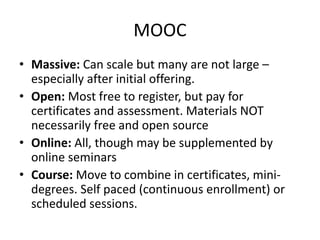
• Massive: Can scale but many are not large –
especially after initial offering.
• Open: Most free to register, but pay for
certificates and assessment. Materials NOT
necessarily free and open source
• Online: All, though may be supplemented by
online seminars
• Course: Move to combine in certificates, mini-
degrees. Self paced (continuous enrollment) or
scheduled sessions.
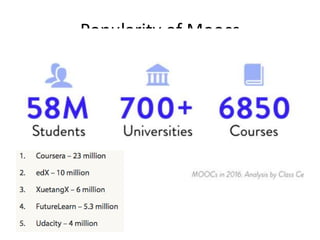
Popularity of Moocs
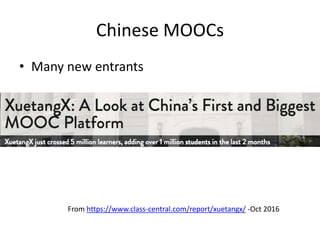
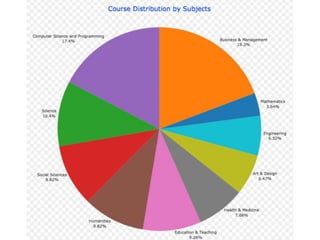
Chinese MOOCs
• Many new entrants
From https://www.class-central.com/report/xuetangx/ -Oct 2016
Social Drivers
• High cost of education
• Scaling difficulty
• Government and peer pressure
• Need to Increase access
• Sharing resources
• Lifelong learning
Drivers for Universities
• “don’t want to get left behind”
• Expectations for doing more from public and
government
• New learners
• Opportunity to explore new approaches –
especially blended learning and new credentials
• Opportunities for change agents to push
universities to use technologies, be more
student-focused, create a new identity for
Universities
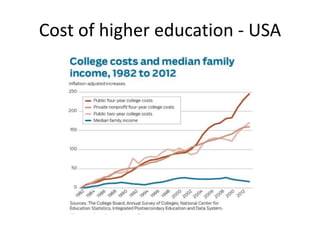
Cost of higher education - USA
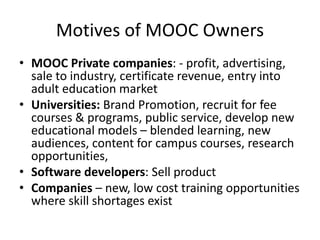
Motives of MOOC Owners
• MOOC Private companies: - profit, advertising,
sale to industry, certificate revenue, entry into
adult education market
• Universities: Brand Promotion, recruit for fee
courses & programs, public service, develop new
educational models – blended learning, new
audiences, content for campus courses, research
opportunities,
• Software developers: Sell product
• Companies – new, low cost training opportunities
where skill shortages exist
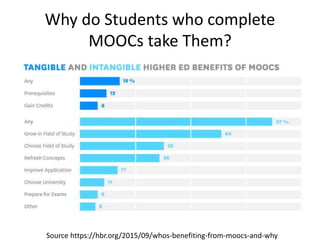
Why do Students who complete
MOOCs take Them?
Source https://hbr.org/2015/09/whos-benefiting-from-moocs-and-why
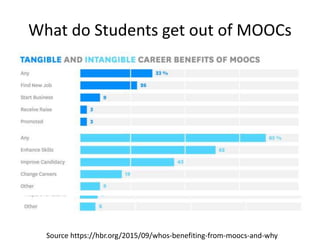
What do Students get out of MOOCs
Source https://hbr.org/2015/09/whos-benefiting-from-moocs-and-why
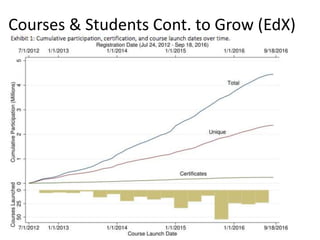
Courses & Students Cont. to Grow (EdX)
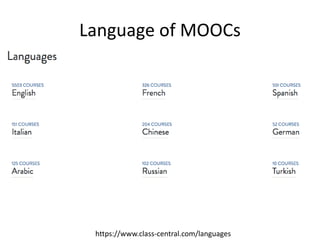
Language of MOOCs
https://www.class-central.com/languages
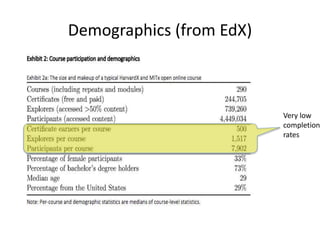
Demographics (from EdX)
Very low
completion
rates
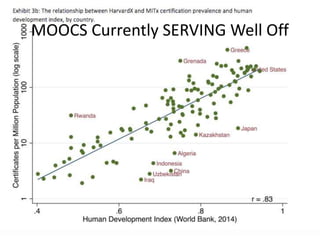
MOOCS Currently SERVING Well Off
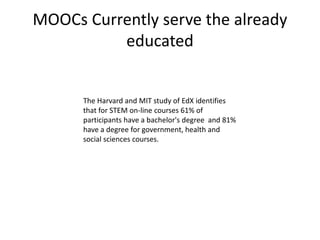
MOOCs Currently serve the already
educated
The Harvard and MIT study of EdX identifies
that for STEM on-line courses 61% of
participants have a bachelor's degree and 81%
have a degree for government, health and
social sciences courses.
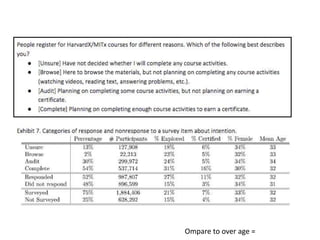
Ompare to over age =
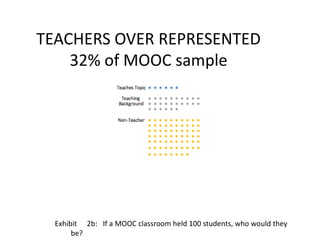
Exhibit 2b: If a MOOC classroom held 100 students, who would they
be?
TEACHERS OVER REPRESENTED
32% of MOOC sample
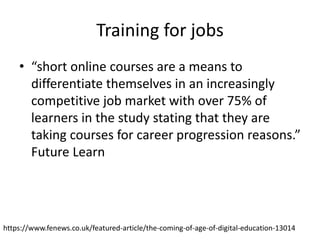
Training for jobs
• “short online courses are a means to
differentiate themselves in an increasingly
competitive job market with over 75% of
learners in the study stating that they are
taking courses for career progression reasons.”
Future Learn
https://www.fenews.co.uk/featured-article/the-coming-of-age-of-digital-education-13014
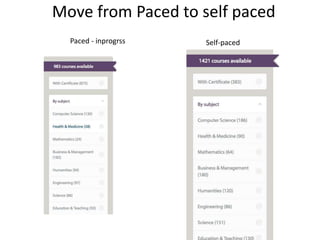
Move from Paced to self paced
Paced - inprogrss Self-paced
Use of Moocs within Credit
Universities
• Students study Moocs together in a class
• Institution evaluates and credits like normal
course
• Teachers use MOOC for extra resources
• Students do MOOC for exam preparation
• Works best with self-paced MOOCs to align
with institutional timelines
Moocs for Credit
• Achieving recognition is the most challenging issue for
students, companies and institutions
• Udacity’s nano degree – “recognized by a number of
well-known companies, such as Mercedes-Benz,
Microsoft, Google, IBM and Amazon.”
• CoursEra certificates
• Some Universities offering Prior Learning Assessment
or challenge exams to provide University credit – but
resistance from many faculty and administrators
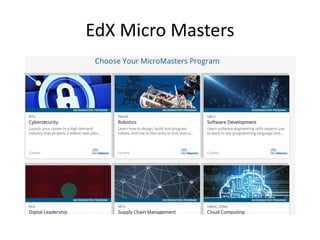
• EdEx Micro Masters Degree
– Credit for MOOC, reduces time in campus
EdX Micro Masters
MicroMasters Example (EdX)
• MircoMasters from MIT
• 30 students/year on Campus
• 40,000 register for MOOC for free
• 12% pay fee for testing = 480 MOOC students
• MicroMasters – better assessment machine,
peer and teacher
• Students who pay have MUCH higher
completion rates
Course Transfer
• California Community Colleges, the nation’s
largest system with 113 institutions, just
launched a course exchange so students at
one campus can take classes online at another
if those courses aren’t available on their home
turf.
https://www.edsurge.com/news/2017-01-24-
california-launches-the-nation-s-largest-
community-college-course-exchange
Remote invigilation/proctoring
How do you know who wrote the
exam?
• Face to face invigilation is inconvenient, time
consuming and costly - around $200/student
at Athabasca
• Remote invigilation by
humans is convenient,
and mildly expensive
• Invigilation by webcam/realtime analytics low
cost, convenient see http://smowltech.com/
What about Low Completion Rates
• “Findings indicated that the strongest predictor of
performance was participation, followed by
motivation.” de Barba, Kennedy, Ainley (20i6)
• Students taking for credit have higher motivation
and achievement
• Many register to see and understand MOOCs or
content and have no intention of completing
•
Quality in Moocs
• (1) problem-centric learning with clear
expositions,
• (2) instructor accessibility and passion,
• (3) active learning,
• (4) peer interaction, and
• (5) using helpful course resources.
Khe Foon Hew (2016) Promoting engagement in online courses: What strategies can we
learn from three highly rated MOOCS. British Journal of Educational Technology 47 (2)
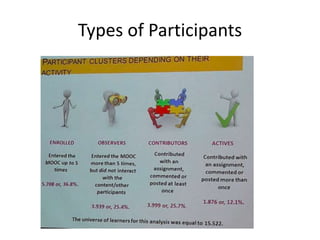
Types of Participants
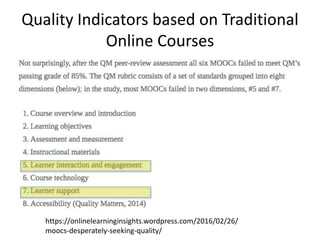
Quality Indicators based on Traditional
Online Courses
https://onlinelearninginsights.wordpress.com/2016/02/26/
moocs-desperately-seeking-quality/
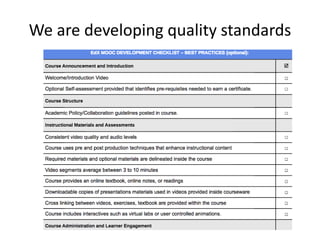
We are developing quality standards
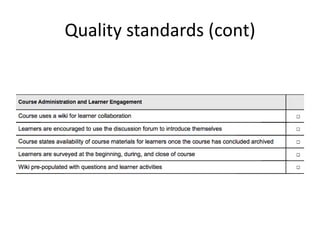
Quality standards (cont)
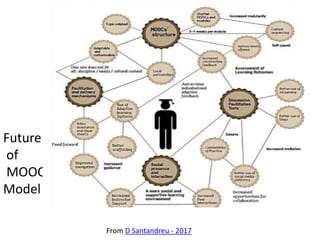
Future
of
MOOCs
Model
From D Santandreu - 2017
terrya@athabascau.ca
Blog: virtualcanuck.ca
Your comments and questions
most welcomed!
Terry Anderson, Ph.D.
Editor Emeritus
Professor, Athabasca University
Athabasca University
10005 93 St
Edmonton, AB Canada
T5H 1W6 Ph 780 425 5950
These slides are available!

Moocs 2017 On campus and Off

  • 1.
    Moocs 2017 –Possibilities for On Campus and Lifelong Learning Terry Anderson, PhD May 2017
  • 2.
    MOOC • Massive: Canscale but many are not large – especially after initial offering. • Open: Most free to register, but pay for certificates and assessment. Materials NOT necessarily free and open source • Online: All, though may be supplemented by online seminars • Course: Move to combine in certificates, mini- degrees. Self paced (continuous enrollment) or scheduled sessions.
  • 3.
  • 5.
    Chinese MOOCs • Manynew entrants From https://www.class-central.com/report/xuetangx/ -Oct 2016
  • 7.
    Social Drivers • Highcost of education • Scaling difficulty • Government and peer pressure • Need to Increase access • Sharing resources • Lifelong learning
  • 8.
    Drivers for Universities •“don’t want to get left behind” • Expectations for doing more from public and government • New learners • Opportunity to explore new approaches – especially blended learning and new credentials • Opportunities for change agents to push universities to use technologies, be more student-focused, create a new identity for Universities
  • 9.
    Cost of highereducation - USA
  • 10.
    Motives of MOOCOwners • MOOC Private companies: - profit, advertising, sale to industry, certificate revenue, entry into adult education market • Universities: Brand Promotion, recruit for fee courses & programs, public service, develop new educational models – blended learning, new audiences, content for campus courses, research opportunities, • Software developers: Sell product • Companies – new, low cost training opportunities where skill shortages exist
  • 11.
    Why do Studentswho complete MOOCs take Them? Source https://hbr.org/2015/09/whos-benefiting-from-moocs-and-why
  • 12.
    What do Studentsget out of MOOCs Source https://hbr.org/2015/09/whos-benefiting-from-moocs-and-why
  • 13.
    Courses & StudentsCont. to Grow (EdX)
  • 14.
  • 15.
    Demographics (from EdX) Verylow completion rates
  • 16.
  • 17.
    MOOCs Currently servethe already educated The Harvard and MIT study of EdX identifies that for STEM on-line courses 61% of participants have a bachelor's degree and 81% have a degree for government, health and social sciences courses.
  • 18.
  • 19.
    Exhibit 2b: Ifa MOOC classroom held 100 students, who would they be? TEACHERS OVER REPRESENTED 32% of MOOC sample
  • 20.
    Training for jobs •“short online courses are a means to differentiate themselves in an increasingly competitive job market with over 75% of learners in the study stating that they are taking courses for career progression reasons.” Future Learn https://www.fenews.co.uk/featured-article/the-coming-of-age-of-digital-education-13014
  • 21.
    Move from Pacedto self paced Paced - inprogrss Self-paced
  • 22.
    Use of Moocswithin Credit Universities • Students study Moocs together in a class • Institution evaluates and credits like normal course • Teachers use MOOC for extra resources • Students do MOOC for exam preparation • Works best with self-paced MOOCs to align with institutional timelines
  • 23.
    Moocs for Credit •Achieving recognition is the most challenging issue for students, companies and institutions • Udacity’s nano degree – “recognized by a number of well-known companies, such as Mercedes-Benz, Microsoft, Google, IBM and Amazon.” • CoursEra certificates • Some Universities offering Prior Learning Assessment or challenge exams to provide University credit – but resistance from many faculty and administrators • EdEx Micro Masters Degree – Credit for MOOC, reduces time in campus
  • 24.
  • 25.
    MicroMasters Example (EdX) •MircoMasters from MIT • 30 students/year on Campus • 40,000 register for MOOC for free • 12% pay fee for testing = 480 MOOC students • MicroMasters – better assessment machine, peer and teacher • Students who pay have MUCH higher completion rates
  • 26.
    Course Transfer • CaliforniaCommunity Colleges, the nation’s largest system with 113 institutions, just launched a course exchange so students at one campus can take classes online at another if those courses aren’t available on their home turf. https://www.edsurge.com/news/2017-01-24- california-launches-the-nation-s-largest- community-college-course-exchange
  • 27.
    Remote invigilation/proctoring How doyou know who wrote the exam? • Face to face invigilation is inconvenient, time consuming and costly - around $200/student at Athabasca • Remote invigilation by humans is convenient, and mildly expensive • Invigilation by webcam/realtime analytics low cost, convenient see http://smowltech.com/
  • 28.
    What about LowCompletion Rates • “Findings indicated that the strongest predictor of performance was participation, followed by motivation.” de Barba, Kennedy, Ainley (20i6) • Students taking for credit have higher motivation and achievement • Many register to see and understand MOOCs or content and have no intention of completing •
  • 29.
    Quality in Moocs •(1) problem-centric learning with clear expositions, • (2) instructor accessibility and passion, • (3) active learning, • (4) peer interaction, and • (5) using helpful course resources. Khe Foon Hew (2016) Promoting engagement in online courses: What strategies can we learn from three highly rated MOOCS. British Journal of Educational Technology 47 (2)
  • 30.
  • 31.
    Quality Indicators basedon Traditional Online Courses https://onlinelearninginsights.wordpress.com/2016/02/26/ moocs-desperately-seeking-quality/
  • 32.
    We are developingquality standards
  • 33.
  • 34.
  • 35.
    terrya@athabascau.ca Blog: virtualcanuck.ca Your commentsand questions most welcomed! Terry Anderson, Ph.D. Editor Emeritus Professor, Athabasca University Athabasca University 10005 93 St Edmonton, AB Canada T5H 1W6 Ph 780 425 5950 These slides are available!