MMVC15 4th annual 3-day
conference August 7-9
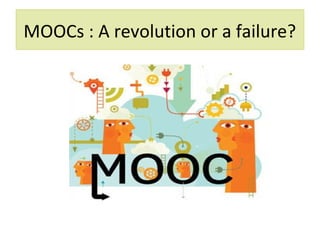
MOOCs : A revolution or a failure?
Some numbers
• 400+
• 2400+
• 16-18 million
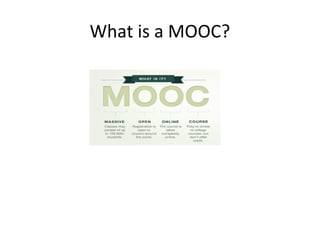
What is a MOOC?
Two key features (Wikipedia, 2012):
1. Open access - anyone can participate in an
online course for free
2. Scalability - courses are designed to support
an indefinite number of participants
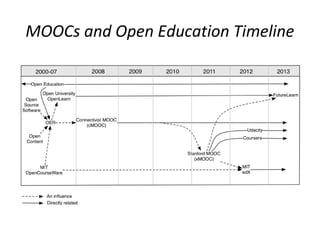
MOOCs and Open Education Timeline
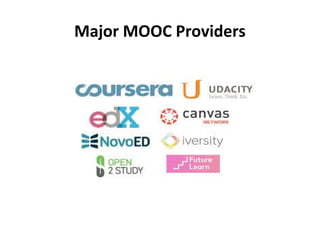
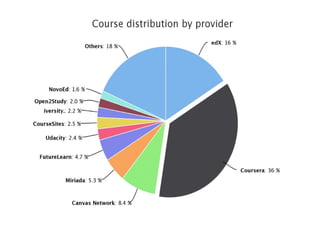
Major MOOC Providers
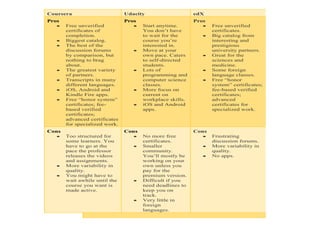
Coursera Udacity edX
Pros
• Free unverified
certificates of
completion.
• Biggest catalog.
• The best of the
discussion forums
by comparison, but
nothing to brag
about.
• The greatest variety
of partners.
• Transcripts in many
different languages.
• iOS, Android and
Kindle Fire apps.
• Free “honor system”
certificates; fee-
based verified
certificates;
advanced certificates
for specialized work.
Pros
• Start anytime.
You don’t have
to wait for the
course you’re
interested in.
• Move at your
own pace. Caters
to self-directed
students.
• Lots of
programming and
computer science
classes.
• More focus on
current on
workplace skills.
• iOS and Android
apps.
Pros
• Free unverified
certificates.
• Big catalog from
interesting and
prestigious
university partners.
• Great for the
sciences and
medicine.
• Some foreign
language classes.
• Free “honor
system” certificates;
fee-based verified
certificates;
advanced
certificates for
specialized work.
Cons
• Too structured for
some learners. You
have to go at the
pace the professor
releases the videos
and assignments.
• More variability in
quality.
• You might have to
wait awhile until the
course you want is
made active.
Cons
• No more free
certificates.
• Smaller
community.
You’ll mostly be
working on your
own unless you
pay for the
premium version.
• Difficult if you
need deadlines to
keep you on
track.
• Very little in
foreign
languages.
Cons
• Frustrating
discussion forums.
• More variability in
quality.
• No apps.
Why are they so popular?
• Only need a reliable internet connection
• The majority of them are free
• Thousands of courses available
• Huge variety of subjects
• No real requirements for anyone to attend
Why are they so popular?
• credit toward a higher education award
• Future economic benefit
• Development of personal and professional
identity
• Enjoyment and fun
• experience or explore online education
Some scepticism
• delusion to believe the masses can be
educated in this way
• high dropout rates (Stein, 2013).
• supposed to be reaching poor and
uneducated people but not in reality (Mazoue,
2013)
• Risk only the IT literate individuals use them,
feeling of exclusion for the others (Yuan et al.,
2013)
Some scepticism
• concerns about the pedagogy and quality of
current MOOC courses (Yuan et al., 2013)
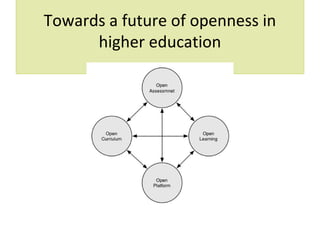
Towards a future of openness in
higher education
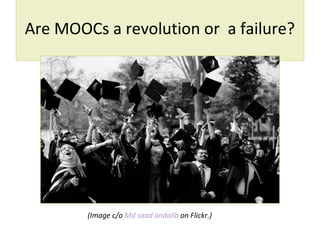
Are MOOCs a revolution or a failure?
(Image c/o Md saad andalib on Flickr.)
How to choose the right MOOC
• The course length and estimated weekly
workload
• Who the instructors are – there is often a
short biography of the course instructors
• The course syllabus
• The course format – will it be delivered by
video, audio, written text etc?
• Course Schedule
How to choose the right MOOC
• Scheduled MOOC versus Self-Paced MOOC
• Determine the amount of time you have to
devote to a course.
• Tangible portfolio
• Don’t assume there’s consistency between
classes.
Some statistics
• Today, there are nearly 600 publications that
reference MOOCs (Rutter, 2015)
• Teachers are already a big audience . A study
of 11 MOOCs offered by MIT last spring found
that nearly 28 percent of enrollees were
former or active teachers. (Pope, 2014)
Remember!

Moocs : A revolution or a failure?

  • 1.
    MMVC15 4th annual3-day conference August 7-9
  • 2.
    MOOCs : Arevolution or a failure?
  • 4.
    Some numbers • 400+ •2400+ • 16-18 million
  • 5.
    What is aMOOC?
  • 6.
    Two key features(Wikipedia, 2012): 1. Open access - anyone can participate in an online course for free 2. Scalability - courses are designed to support an indefinite number of participants
  • 7.
    MOOCs and OpenEducation Timeline
  • 8.
  • 16.
    Coursera Udacity edX Pros •Free unverified certificates of completion. • Biggest catalog. • The best of the discussion forums by comparison, but nothing to brag about. • The greatest variety of partners. • Transcripts in many different languages. • iOS, Android and Kindle Fire apps. • Free “honor system” certificates; fee- based verified certificates; advanced certificates for specialized work. Pros • Start anytime. You don’t have to wait for the course you’re interested in. • Move at your own pace. Caters to self-directed students. • Lots of programming and computer science classes. • More focus on current on workplace skills. • iOS and Android apps. Pros • Free unverified certificates. • Big catalog from interesting and prestigious university partners. • Great for the sciences and medicine. • Some foreign language classes. • Free “honor system” certificates; fee-based verified certificates; advanced certificates for specialized work. Cons • Too structured for some learners. You have to go at the pace the professor releases the videos and assignments. • More variability in quality. • You might have to wait awhile until the course you want is made active. Cons • No more free certificates. • Smaller community. You’ll mostly be working on your own unless you pay for the premium version. • Difficult if you need deadlines to keep you on track. • Very little in foreign languages. Cons • Frustrating discussion forums. • More variability in quality. • No apps.
  • 17.
    Why are theyso popular? • Only need a reliable internet connection • The majority of them are free • Thousands of courses available • Huge variety of subjects • No real requirements for anyone to attend
  • 18.
    Why are theyso popular? • credit toward a higher education award • Future economic benefit • Development of personal and professional identity • Enjoyment and fun • experience or explore online education
  • 19.
    Some scepticism • delusionto believe the masses can be educated in this way • high dropout rates (Stein, 2013). • supposed to be reaching poor and uneducated people but not in reality (Mazoue, 2013) • Risk only the IT literate individuals use them, feeling of exclusion for the others (Yuan et al., 2013)
  • 20.
    Some scepticism • concernsabout the pedagogy and quality of current MOOC courses (Yuan et al., 2013)
  • 21.
    Towards a futureof openness in higher education
  • 22.
    Are MOOCs arevolution or a failure? (Image c/o Md saad andalib on Flickr.)
  • 23.
    How to choosethe right MOOC • The course length and estimated weekly workload • Who the instructors are – there is often a short biography of the course instructors • The course syllabus • The course format – will it be delivered by video, audio, written text etc? • Course Schedule
  • 24.
    How to choosethe right MOOC • Scheduled MOOC versus Self-Paced MOOC • Determine the amount of time you have to devote to a course. • Tangible portfolio • Don’t assume there’s consistency between classes.
  • 25.
    Some statistics • Today,there are nearly 600 publications that reference MOOCs (Rutter, 2015) • Teachers are already a big audience . A study of 11 MOOCs offered by MIT last spring found that nearly 28 percent of enrollees were former or active teachers. (Pope, 2014)
  • 26.