MOOC FOR PROFESSIONAL LEARNING Jaspal Singh
MOOC – WHAT, WHERE AND WHY ?
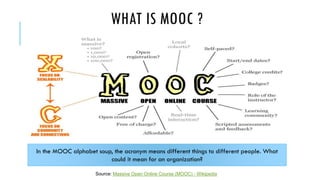
WHAT IS MOOC ? 
In the MOOC alphabet soup, the acronym means different things to different people. What 
could it mean for an organization? 
Source: Massive Open Online Course (MOOC) - Wikipedia
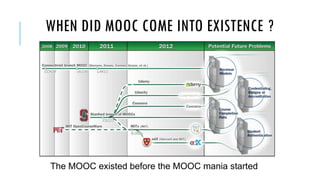
WHEN DID MOOC COME INTO EXISTENCE ? 
The MOOC existed before the MOOC mania started.
THE STATE OF THE MOOC 
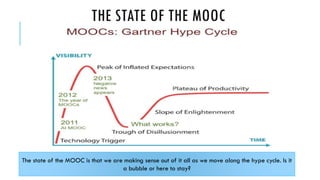
The state of the MOOC is that we are making sense out of it all as we move along the hype cycle. Is it 
a bubble or here to stay?
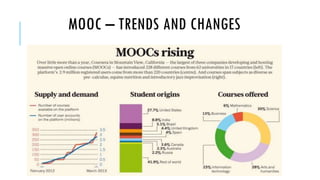
MOOC – TRENDS AND CHANGES
MOOC : EMERGING NEW ‘NORMAL’ FOR MOOCS 
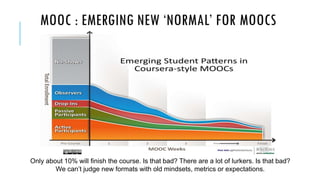
Only about 10% will finish the course. Is that bad? There are a lot of lurkers. Is that bad? 
We can’t judge new formats with old mindsets, metrics or expectations.
MOOC – TRENDS AND CHANGES 
“We are moving away from the model 
in which learning is organized around 
stable, usually hierarchical institutions 
(schools, colleges, universities) that, for 
better and worse, have served as the 
main gateways to education and social 
mobility. Replacing that model is a new 
system in which learning is best 
conceived of as a flow, where learning 
resources are not scarce but widely 
available, opportunities for learning 
are abundant, and learners increasingly 
have the ability to autonomously dip 
into and out of continuous learning 
flows.” 
- Marina Gorbis (IFTF)
INDIA INC. LOGS IN TO MOOC
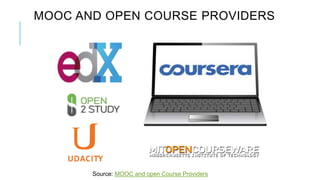
MOOC AND OPEN COURSE PROVIDERS 
Source: MOOC and open Course Providers
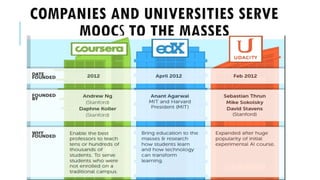
COMPANIES AND UNIVERSITIES SERVE 
MOOCS TO THE MASSES
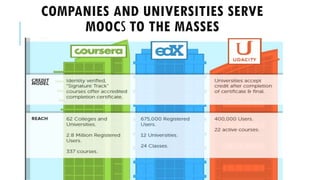
COMPANIES AND UNIVERSITIES SERVE 
MOOCS TO THE MASSES
MOOC AND PROFESSIONAL LEARNING
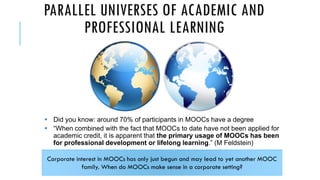
PARALLEL UNIVERSES OF ACADEMIC AND 
PROFESSIONAL LEARNING 
 Did you know: around 70% of participants in MOOCs have a degree 
 “When combined with the fact that MOOCs to date have not been applied for 
academic credit, it is apparent that the primary usage of MOOCs has been 
for professional development or lifelong learning.” (M Feldstein) 
Corporate interest in MOOCs has only just begun and may lead to yet another MOOC 
family. When do MOOCs make sense in a corporate setting?
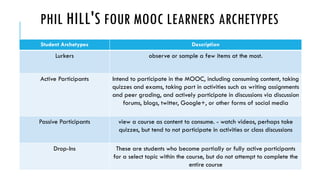
PHIL HILL'S FOUR MOOC LEARNERS ARCHETYPES 
Student Archetypes Description 
Lurkers observe or sample a few items at the most. 
Active Participants Intend to participate in the MOOC, including consuming content, taking 
quizzes and exams, taking part in activities such as writing assignments 
and peer grading, and actively participate in discussions via discussion 
forums, blogs, twitter, Google+, or other forms of social media 
Passive Participants view a course as content to consume. - watch videos, perhaps take 
quizzes, but tend to not participate in activities or class discussions 
Drop-Ins These are students who become partially or fully active participants 
for a select topic within the course, but do not attempt to complete the 
entire course
WHAT TO EXPECT FROM MOOC AS LEARNING TOOL ? 
Videos 
• You can adjust speed of videos. 
• Sometimes the video lectures are verbal presentation of content available elsewhere, decide which 
suits you : reading or watching. 
Discussion forums 
• Brush up on your netiquette. 
• Be aware that anyone can be in a MOOC, so conduct yourself professionally. 
• Posting anonymously is of limited value. 
• Be careful of ‘auto-subscription’ to forums lest you get 100s of emails overnight. 
• Choose one or two forums and interact with those. 
• Posting in a discussion forum is different than writing academically, read others to get a feel for tone. 
Quizzes 
• These are knowledge checks, so be realistic about your expectations. 
• If you want a certificate find out what the requirements are. 
Peer assessment 
• The experience of others on the MOOC will vary so be open to the various types of feedback you might 
get.
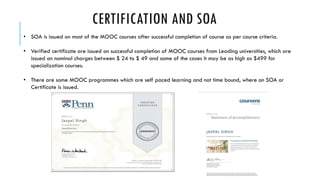
CERTIFICATION AND SOA 
• SOA is issued on most of the MOOC courses after successful completion of course as per course criteria. 
• Verified certificate are issued on successful completion of MOOC courses from Leading universities, which are 
issued on nominal charges between $ 24 to $ 49 and some of the cases it may be as high as $499 for 
specialization courses. 
• There are some MOOC programmes which are self paced learning and not time bound, where on SOA or 
Certificate is issued.
MOOC ADOPTION – COMMON CHALLENGES 
• There is never enough time 
• Classes are hard to follow with discipline 
• Technology can be intimidating 
• You need a reasonably good internet speed at home. eg:- Downloading virtual machine images to 
do some assignments 
• You need a reasonably good desktop or laptops. eg:- A minimum of i5 processor and 8 GB RAM is 
recommended. 
• You need to learn new programming or scripting languages. eg:- Assignments in python. 
• The course caters to many groups of people.
MOOC ADOPTION : COMMON MISTAKES 
• Attending more than one course at the same time 
• Waiting for last minute to complete the assignments and quizzes 
• Not utilizing the community forums effectively 
• Not asking questions thinking it is very basic
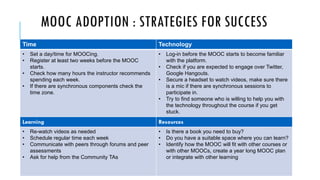
MOOC ADOPTION : STRATEGIES FOR SUCCESS 
Time Technology 
• Set a day/time for MOOCing. 
• Register at least two weeks before the MOOC 
starts. 
• Check how many hours the instructor recommends 
spending each week. 
• If there are synchronous components check the 
time zone. 
• Log-in before the MOOC starts to become familiar 
with the platform. 
• Check if you are expected to engage over Twitter, 
Google Hangouts. 
• Secure a headset to watch videos, make sure there 
is a mic if there are synchronous sessions to 
participate in. 
• Try to find someone who is willing to help you with 
the technology throughout the course if you get 
stuck. 
Learning Resources 
• Re-watch videos as needed 
• Schedule regular time each week 
• Communicate with peers through forums and peer 
assessments 
• Ask for help from the Community TAs 
• Is there a book you need to buy? 
• Do you have a suitable space where you can learn? 
• Identify how the MOOC will fit with other courses or 
with other MOOCs, create a year long MOOC plan 
or integrate with other learning
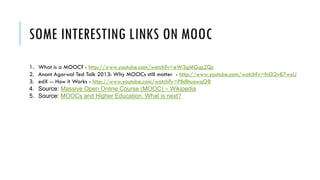
SOME INTERESTING LINKS ON MOOC 
1. What is a MOOC? - http://www.youtube.com/watch?v=eW3gMGqcZQc 
2. Anant Agarwal Ted Talk 2013: Why MOOCs still matter - http://www.youtube.com/watch?v=fn0i2v87woU 
3. edX -- How it Works - http://www.youtube.com/watch?v=PIh8huowqO8 
4. Source: Massive Open Online Course (MOOC) – Wikipedia 
5. Source: MOOCs and Higher Education: What is next?
SOURCES 
http://mfeldstein.com/moocs-beyond-professional-development-courseras-big-announcement-in-context/ 
http://mfeldstein.com 
http://www.nytimes.com/2012/11/04/education/edlife/massive-open-online-courses-are-multiplying-at-a-rapid-pace.html?pagewanted=all&_r=0 
http://www.forbes.com/sites/georgeanders/2013/07/10/coursera-hits-4-million-students-and-triples-its-funding/ 
http://storify.com/derekbruff/prof-leaves-mooc-mid-stream 
http://onlinelearninginsights.wordpress.com/2013/02/05/the-mooc-honeymoon-is-over-three-takeaways-from-the-coursera-calamity 
http://www.educause.edu/eli/events/eli-online-spring-focus-session/2013/2013/everything-you-think-you-know-about-moocs-could-be-wrong 
http://www.insidehighered.com/news/2013/07/09/higher-ed-leaders-urge-slow-down-mooc-train 
http://allmoocs.wordpress.com/2013/04/16/gartners-hype-cycle-as-springboard-mooc-and-public-policy 
http://www.elearnspace.org/blog/2013/07/08/neoliberalism-and-moocs-amplifying-nonsense 
http://donaldclarkplanb.blogspot.be/2013/04/moocs-whos-using-moocs-10-different.html 
http://www.educatorstechnology.com/2012/12/a-must-have-educational-technology.html 
http://www.educause.edu/sites/default/files/library/presentations/ELI134/OL01/FeldsteinHill_Everything%2BYou%2BThink%2BYou.pdf 
http://donaldclarkplanb.blogspot.be/2013/04/moocs-taxonomy-of-8-types-of-mooc.html 
http://www.youtube.com/watch?v=DGaUfWkJdi4&feature=player_embedded 
https://twitter.com/search?q=%23qmooc 
http://homocompetens.blogspot.be/2013/03/this-one-has-mooc-in-title.html

Mooc for professional learning - A Presentation

  • 1.
    MOOC FOR PROFESSIONALLEARNING Jaspal Singh
  • 2.
    MOOC – WHAT,WHERE AND WHY ?
  • 3.
    WHAT IS MOOC? In the MOOC alphabet soup, the acronym means different things to different people. What could it mean for an organization? Source: Massive Open Online Course (MOOC) - Wikipedia
  • 4.
    WHEN DID MOOCCOME INTO EXISTENCE ? The MOOC existed before the MOOC mania started.
  • 5.
    THE STATE OFTHE MOOC The state of the MOOC is that we are making sense out of it all as we move along the hype cycle. Is it a bubble or here to stay?
  • 6.
    MOOC – TRENDSAND CHANGES
  • 7.
    MOOC : EMERGINGNEW ‘NORMAL’ FOR MOOCS Only about 10% will finish the course. Is that bad? There are a lot of lurkers. Is that bad? We can’t judge new formats with old mindsets, metrics or expectations.
  • 8.
    MOOC – TRENDSAND CHANGES “We are moving away from the model in which learning is organized around stable, usually hierarchical institutions (schools, colleges, universities) that, for better and worse, have served as the main gateways to education and social mobility. Replacing that model is a new system in which learning is best conceived of as a flow, where learning resources are not scarce but widely available, opportunities for learning are abundant, and learners increasingly have the ability to autonomously dip into and out of continuous learning flows.” - Marina Gorbis (IFTF)
  • 9.
    INDIA INC. LOGSIN TO MOOC
  • 10.
    MOOC AND OPENCOURSE PROVIDERS Source: MOOC and open Course Providers
  • 11.
    COMPANIES AND UNIVERSITIESSERVE MOOCS TO THE MASSES
  • 12.
    COMPANIES AND UNIVERSITIESSERVE MOOCS TO THE MASSES
  • 13.
  • 14.
    PARALLEL UNIVERSES OFACADEMIC AND PROFESSIONAL LEARNING  Did you know: around 70% of participants in MOOCs have a degree  “When combined with the fact that MOOCs to date have not been applied for academic credit, it is apparent that the primary usage of MOOCs has been for professional development or lifelong learning.” (M Feldstein) Corporate interest in MOOCs has only just begun and may lead to yet another MOOC family. When do MOOCs make sense in a corporate setting?
  • 15.
    PHIL HILL'S FOURMOOC LEARNERS ARCHETYPES Student Archetypes Description Lurkers observe or sample a few items at the most. Active Participants Intend to participate in the MOOC, including consuming content, taking quizzes and exams, taking part in activities such as writing assignments and peer grading, and actively participate in discussions via discussion forums, blogs, twitter, Google+, or other forms of social media Passive Participants view a course as content to consume. - watch videos, perhaps take quizzes, but tend to not participate in activities or class discussions Drop-Ins These are students who become partially or fully active participants for a select topic within the course, but do not attempt to complete the entire course
  • 16.
    WHAT TO EXPECTFROM MOOC AS LEARNING TOOL ? Videos • You can adjust speed of videos. • Sometimes the video lectures are verbal presentation of content available elsewhere, decide which suits you : reading or watching. Discussion forums • Brush up on your netiquette. • Be aware that anyone can be in a MOOC, so conduct yourself professionally. • Posting anonymously is of limited value. • Be careful of ‘auto-subscription’ to forums lest you get 100s of emails overnight. • Choose one or two forums and interact with those. • Posting in a discussion forum is different than writing academically, read others to get a feel for tone. Quizzes • These are knowledge checks, so be realistic about your expectations. • If you want a certificate find out what the requirements are. Peer assessment • The experience of others on the MOOC will vary so be open to the various types of feedback you might get.
  • 17.
    CERTIFICATION AND SOA • SOA is issued on most of the MOOC courses after successful completion of course as per course criteria. • Verified certificate are issued on successful completion of MOOC courses from Leading universities, which are issued on nominal charges between $ 24 to $ 49 and some of the cases it may be as high as $499 for specialization courses. • There are some MOOC programmes which are self paced learning and not time bound, where on SOA or Certificate is issued.
  • 18.
    MOOC ADOPTION –COMMON CHALLENGES • There is never enough time • Classes are hard to follow with discipline • Technology can be intimidating • You need a reasonably good internet speed at home. eg:- Downloading virtual machine images to do some assignments • You need a reasonably good desktop or laptops. eg:- A minimum of i5 processor and 8 GB RAM is recommended. • You need to learn new programming or scripting languages. eg:- Assignments in python. • The course caters to many groups of people.
  • 19.
    MOOC ADOPTION :COMMON MISTAKES • Attending more than one course at the same time • Waiting for last minute to complete the assignments and quizzes • Not utilizing the community forums effectively • Not asking questions thinking it is very basic
  • 20.
    MOOC ADOPTION :STRATEGIES FOR SUCCESS Time Technology • Set a day/time for MOOCing. • Register at least two weeks before the MOOC starts. • Check how many hours the instructor recommends spending each week. • If there are synchronous components check the time zone. • Log-in before the MOOC starts to become familiar with the platform. • Check if you are expected to engage over Twitter, Google Hangouts. • Secure a headset to watch videos, make sure there is a mic if there are synchronous sessions to participate in. • Try to find someone who is willing to help you with the technology throughout the course if you get stuck. Learning Resources • Re-watch videos as needed • Schedule regular time each week • Communicate with peers through forums and peer assessments • Ask for help from the Community TAs • Is there a book you need to buy? • Do you have a suitable space where you can learn? • Identify how the MOOC will fit with other courses or with other MOOCs, create a year long MOOC plan or integrate with other learning
  • 21.
    SOME INTERESTING LINKSON MOOC 1. What is a MOOC? - http://www.youtube.com/watch?v=eW3gMGqcZQc 2. Anant Agarwal Ted Talk 2013: Why MOOCs still matter - http://www.youtube.com/watch?v=fn0i2v87woU 3. edX -- How it Works - http://www.youtube.com/watch?v=PIh8huowqO8 4. Source: Massive Open Online Course (MOOC) – Wikipedia 5. Source: MOOCs and Higher Education: What is next?
  • 22.
    SOURCES http://mfeldstein.com/moocs-beyond-professional-development-courseras-big-announcement-in-context/ http://mfeldstein.com http://www.nytimes.com/2012/11/04/education/edlife/massive-open-online-courses-are-multiplying-at-a-rapid-pace.html?pagewanted=all&_r=0 http://www.forbes.com/sites/georgeanders/2013/07/10/coursera-hits-4-million-students-and-triples-its-funding/ http://storify.com/derekbruff/prof-leaves-mooc-mid-stream http://onlinelearninginsights.wordpress.com/2013/02/05/the-mooc-honeymoon-is-over-three-takeaways-from-the-coursera-calamity http://www.educause.edu/eli/events/eli-online-spring-focus-session/2013/2013/everything-you-think-you-know-about-moocs-could-be-wrong http://www.insidehighered.com/news/2013/07/09/higher-ed-leaders-urge-slow-down-mooc-train http://allmoocs.wordpress.com/2013/04/16/gartners-hype-cycle-as-springboard-mooc-and-public-policy http://www.elearnspace.org/blog/2013/07/08/neoliberalism-and-moocs-amplifying-nonsense http://donaldclarkplanb.blogspot.be/2013/04/moocs-whos-using-moocs-10-different.html http://www.educatorstechnology.com/2012/12/a-must-have-educational-technology.html http://www.educause.edu/sites/default/files/library/presentations/ELI134/OL01/FeldsteinHill_Everything%2BYou%2BThink%2BYou.pdf http://donaldclarkplanb.blogspot.be/2013/04/moocs-taxonomy-of-8-types-of-mooc.html http://www.youtube.com/watch?v=DGaUfWkJdi4&feature=player_embedded https://twitter.com/search?q=%23qmooc http://homocompetens.blogspot.be/2013/03/this-one-has-mooc-in-title.html