Daisy S. Capon
PhD Student (Crop Science)
1st
Semester 2014
ANGIOSPERM:
Seed Formation and Development
Topical Outline
 Development of male and female
gametophyte;
 Plant embryo development; and
 Chemical composition of seed and
factors affecting on it.
Development of Male Gametophyte
(Microsporogenesis and Microgametogenesis)
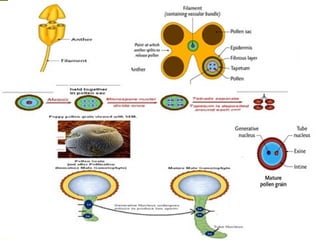
 Anthesis-is the period of flower development when the
stigma is ready to receive pollen. It is the
time when pollen begins to blow.
 Microsporangium- structure made of four sacs where
pollen is usually produced.
 Within the sporangia, certain cells become the
microspore mother cells and undergo a two-step
reduction division (meiosis), or microsporogenesis, to
yield four microspores, each of which is haploid (1n).
Each of the 4 microspores is normally functional and
undergoes two divisions, known as microgametogenesis,
or mature pollen grain.
 Sporangia- are enclosure or structure in which spores
are formed.
C. SEED FORMATION: Female
 Megasporogenesis- the formation and maturing of megaspores
 Ovule Primordia- is a meristematic tissue of the ovary wall
where seeds of angiosperms originate
 Diploid- possessing two matched sets of chromosomes in the
cell nucleus, one set from each parent.
 There is a characteristic diploid number of chromosomes for
each species.
 Haploid- having a single set of unpaired chromosomes
 The megaspore mother cell is diploid (2N), having the same number
of chromosomes as the parent plant. It undergoes a two-step cell
division (Meiosis I & Meiosis II). This process gives rise to 4
megaspores haploid cells (1N). Normally, only one megaspore is
functional, the other 3 degenerate.
Development of Female Gametophyte
(Megasporogenesis and Megagametogenesis)
Megagametogenesis- is the development of the female
gametophyte, or embryo sac , from the functional megaspore.
 
 It is a process of successive nuclear division within an
enlarging cell which becomes the embryo sac. Three
successive free nuclear division (mitosis) occur, culminating in
8 haploid (1N) nuclei. Soon these nuclei arrange themselves
within the enlarging embryo sac and formation of cell walls
occur, resulting in 3 antipodal cells at one end, 2 polar nuclei
at the center with the egg apparatus at the other end.
Development of Female Gametophyte
(Megasporogenesis and Megagametogenesis)
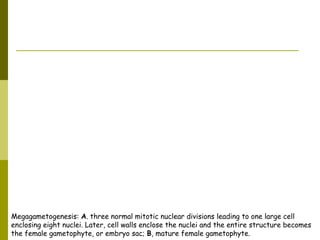
Megagametogenesis: A. three normal mitotic nuclear divisions leading to one large cell
enclosing eight nuclei. Later, cell walls enclose the nuclei and the entire structure becomes
the female gametophyte, or embryo sac; B, mature female gametophyte.
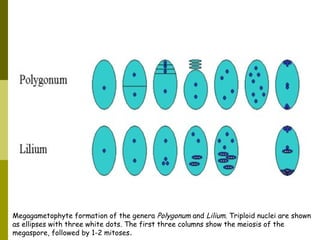
Megagametophyte formation of the genera Polygonum and Lilium. Triploid nuclei are shown
as ellipses with three white dots. The first three columns show the meiosis of the
megaspore, followed by 1-2 mitoses.
Ovule with megagametophyte: egg cell (yellow), synergids (orange),
central cell with two polar nuclei (bright green), and antipodals (dark
green)
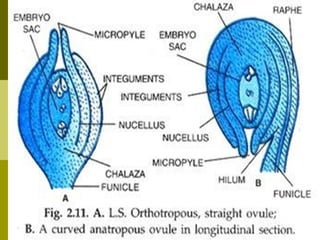
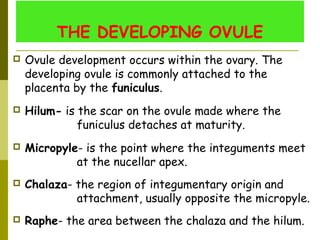
THE DEVELOPING OVULE
 Ovule development occurs within the ovary. The
developing ovule is commonly attached to the
placenta by the funiculus.
 
 Hilum- is the scar on the ovule made where the
funiculus detaches at maturity.
 
 Micropyle- is the point where the integuments meet
at the nucellar apex.
 
 Chalaza- the region of integumentary origin and
attachment, usually opposite the micropyle.
 
 Raphe- the area between the chalaza and the hilum.
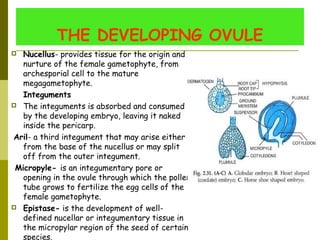
THE DEVELOPING OVULE
 Nucellus- provides tissue for the origin and
nurture of the female gametophyte, from
archesporial cell to the mature
megagametophyte.
  Integuments
 The integuments is absorbed and consumed
by the developing embryo, leaving it naked
inside the pericarp.
 Aril- a third integument that may arise either
from the base of the nucellus or may split
off from the outer integument.
 Micropyle- is an integumentary pore or
opening in the ovule through which the pollen
tube grows to fertilize the egg cells of the
female gametophyte.
 Epistase- is the development of well-
defined nucellar or integumentary tissue in
the micropylar region of the seed of certain
species.
Stages of Plant Embryo Development
(Monocot)
Stages of Plant Embryo Development
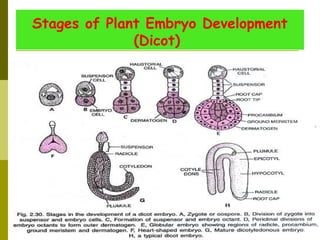
(Dicot)
Stages of Plant Embryo Development
Plant Embryo Development
(Plant Embryogenesis)
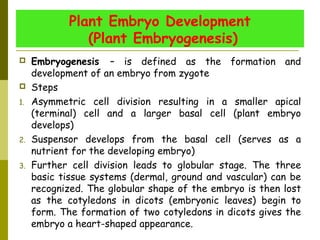
 Embryogenesis – is defined as the formation and
development of an embryo from zygote
 Steps
1. Asymmetric cell division resulting in a smaller apical
(terminal) cell and a larger basal cell (plant embryo
develops)
2. Suspensor develops from the basal cell (serves as a
nutrient for the developing embryo)
3. Further cell division leads to globular stage. The three
basic tissue systems (dermal, ground and vascular) can be
recognized. The globular shape of the embryo is then lost
as the cotyledons in dicots (embryonic leaves) begin to
form. The formation of two cotyledons in dicots gives the
embryo a heart-shaped appearance.
Plant Embryo Development
(Plant Embryogenesis)
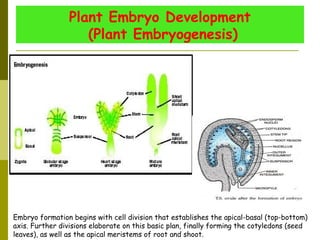
Embryo formation begins with cell division that establishes the apical-basal (top-bottom)
axis. Further divisions elaborate on this basic plan, finally forming the cotyledons (seed
leaves), as well as the apical meristems of root and shoot.
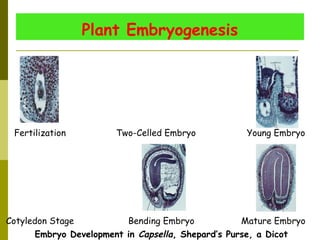
Plant Embryogenesis
Fertilization Two-Celled Embryo Young Embryo
Cotyledon Stage Bending Embryo Mature Embryo
Embryo Development in Capsella, Shepard’s Purse, a Dicot
The Origin of a Seed and Fruit from
Immature Stage
Flower Parts Mature Structure
 Egg + sperm = zygote Embryo
 2 Polar nuclei + Sperm Endosperm
 Integument Testa (Seedcoat)
 Nucellus Perisperm
 Micropyle Micropyle
 Funiculus Hilum
 Ovary Wall Pericarp (fruit)
 Ovule Seed
 Ovary Fruit
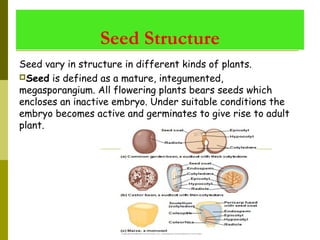
Seed Structure
Seed vary in structure in different kinds of plants.
Seed is defined as a mature, integumented,
megasporangium. All flowering plants bears seeds which
encloses an inactive embryo. Under suitable conditions the
embryo becomes active and germinates to give rise to adult
plant.
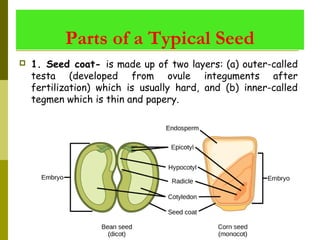
Parts of a Typical Seed
 1. Seed coat- is made up of two layers: (a) outer-called
testa (developed from ovule integuments after
fertilization) which is usually hard, and (b) inner-called
tegmen which is thin and papery.
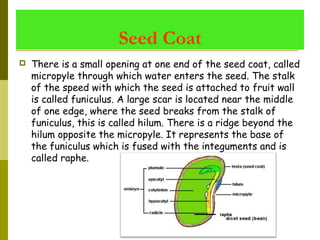
Seed Coat
 There is a small opening at one end of the seed coat, called
micropyle through which water enters the seed. The stalk
of the speed with which the seed is attached to fruit wall
is called funiculus. A large scar is located near the middle
of one edge, where the seed breaks from the stalk of
funiculus, this is called hilum. There is a ridge beyond the
hilum opposite the micropyle. It represents the base of
the funiculus which is fused with the integuments and is
called raphe.
rapheraphe
Seed Coat
 Functions of Seed Coat in Embryo Development
a. Pathway for transport and conversion of amino acid and
carbohydrates from the pericarp into the ovule for
development of the embryo.
b. Temporary storage of compounds for later use by seed
coat cells.
c. Involvement in gas exchange.
d. Possible supply of growth compounds to the growing
embryo and maternal organs.
e. Protection of the embryo and endosperm from desiccation
and mechanical injury
Seed Coat
 Functions of Seed Coat in Mature Seed
a. Protective covering of the seed (biotic and mechanical
injury)
b. Regulation of water uptake and gas exchange with the
surrounding ambient environment.
c. Regulation of germination and influencing the intensity of
dormancy expression (hard seed coat)
d. Control of seed dispersal (wings, hairs mucilages etc.)
Embryo (2n)
It is a young plant enclosed in a seed coat and has two
parts 
(i) Cotyledons
Their number is either one or two and they are the leaves of
embryo. Sometimes they store food materials and become
fleshy. When they do not store food they remain thin and
papery. The cotyledons are hinged to an axis (tigellum) at a
point called cotyledonary node.
Embryo (2n)
 It is a young plant enclosed in a seed coat and has two
parts 
(ii) Tigellum:
The main axis of the embryo is known as tigellum, one end of
which is pointed and protrudes out of cotyledons. This lies
next to micropyle and is called radicle (rudimentary root).
The other end of the tigellum is the plumule (first apical
bud of shoot). The portion of the axis above the point of
attachment of cotyledons is called epicotyl and that below
the cotyledonary node is called hypocotyl.
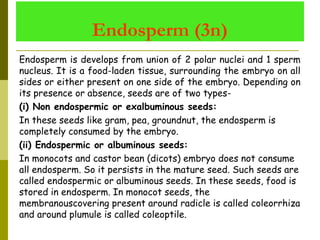
Endosperm (3n)
Endosperm is develops from union of 2 polar nuclei and 1 sperm
nucleus. It is a food-laden tissue, surrounding the embryo on all
sides or either present on one side of the embryo. Depending on
its presence or absence, seeds are of two types-
(i) Non endospermic or exalbuminous seeds:
In these seeds like gram, pea, groundnut, the endosperm is
completely consumed by the embryo.
(ii) Endospermic or albuminous seeds:
In monocots and castor bean (dicots) embryo does not consume
all endosperm. So it persists in the mature seed. Such seeds are
called endospermic or albuminous seeds. In these seeds, food is
stored in endosperm. In monocot seeds, the
membranouscovering present around radicle is called coleorrhiza
and around plumule is called coleoptile.
Seed Structure of Different Kinds of
Plants
1. Bean Seed:
It is kidney-shaped
brownish non endospermic
dicotyledonous seed. The surface
is smooth. Concave surface is
darker. It has a whitish scar or
hilum, a small pore or micropyle and
a faint ridge or raphe. A bulge of
underlying radicle is observed on
the opposite side of raphe. The
seed is covered by a thick, tough,
brownish seed coat or testa. A thin
papery transparent tegmen lies
below the testa.
Seed Structure of Different Kinds of
Plants
1. Bean Seed:
Seed coats enclose the embryo. There is no other
structure. Embryo axis or tigellum is curved. It is covered by
two massive cotyledons borne over it in the region called
cotyledonary node. One end of embryo axis called plumule lies
embedded in between the two cotyledons. It bears two small
folded leaves.
The other end of embryo axis is radicle. It protrudes out of
the cotyledons. Part of the embryo axis lying between radicle
and cotyle donary node is called hypocotyl while the part
between the cotyledonary node and plumule is known as
epicotyl. Food is stored in the cotyledons.
Seed Structure of Different Kinds of
Plants
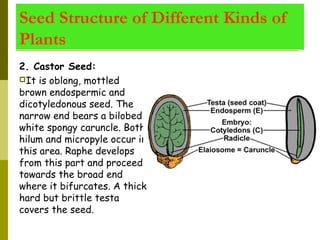
2. Castor Seed:
It is oblong, mottled
brown endospermic and
dicotyledonous seed. The
narrow end bears a bilobed
white spongy caruncle. Both
hilum and micropyle occur in
this area. Raphe develops
from this part and proceeds
towards the broad end
where it bifurcates. A thick
hard but brittle testa
covers the seed.
Seed Structure of Different Kinds of
Plants
2. Castor Seed:
A thin perisperm lies below it and around the kernel. A
white oily endosperm lies below the perisperm. It stores food
reserve as oil drops and proteins. Endosperm is source of
castor oil. Embryo lies in the center of seed. It consists of a
short embryo axis bearing two thin papery semitransparent
oval cotyledons, a small indistinct plumule and a knob-shaped
radicle. Palmate venation occurs over the cotyledons.
Seed Structure of Different Kinds of
Plants
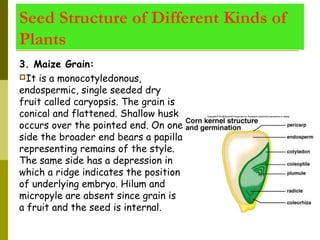
3. Maize Grain:
It is a monocotyledonous,
endospermic, single seeded dry
fruit called caryopsis. The grain is
conical and flattened. Shallow husk
occurs over the pointed end. On one
side the broader end bears a papilla
representing remains of the style.
The same side has a depression in
which a ridge indicates the position
of underlying embryo. Hilum and
micropyle are absent since grain is
a fruit and the seed is internal.
Seed Structure of Different Kinds of
Plants
3. Maize Grain:
Color is variable. Surface is nearly smooth. The covering of
the grain is made of fused pericarp and testa. 2/3 of the
grain interior has food storage tissue of endosperm. It is
rich in starch. A protein rich aleurone layer lies on the
outside of endosperm. Embryo lies on one side towards the
upper pointed part. A single large cotyledon lies lateral and
parallel to the embryo axis. It is called scutellum. Scutellum
is attached to the middle part of embryo axis. Its outer
layer in contact with endosperm is called epithelial layer.
Seed Structure of Different Kinds of
Plants
3. Maize Grain:
The layer secretes GA for formation of amylase during
germination. Embryo axis ends in plumule towards broader
side and radicle towards pointed side. Radicle has a root cap.
Plumule bears a few small leaves. Sheaths derived from
scutellum cover the two ends of embryo axis,
undifferentiated coleorhiza over the radicle root cap region
and hollow folial coleoptile over the plumule. Area of embryo
axis is between plumule and cotyledonary node is epicotyl
while the area between cotyledonary node and radicle is
called hypocotyl.
4. Onion Seed:
It is a small blackish endospermic monocotyledonous seed
with wrinkled surface. Seed coat is quite tough. It is
coloured. Endosperm or food storage tissue is also tough. It
is semitransparent. Embryo is curved. It is embedded in the
endosperm.
Embryo axis is small as compared to single cotyledon called
scutellum. Epicotyl is inconspicuous. Plumule is not
distinguishable. Instead shoot apical meristem is present. A
notch occurs in the area of origin of single cotyledon.
Hypocotyl is larger. It bears radicle or root tip.
Seed Structure of Different Kinds of
Plants
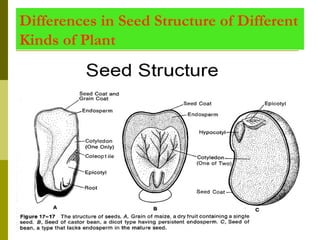
Differences in Seed Structure of Different
Kinds of Plant
Epicotyl
Hypocotyl
Cotyledons
Radicle
Seed coat
Seed coat
Endosperm
(a) Common garden bean, a eudicot with thick cotyledons
Cotyledons
Epicotyl
Hypocotyl
Radicle
(b) Castor bean, a eudicot with thin cotyledons
(c) Maize, a monocot
Scutellum
(cotyledon)
Pericarp fused
with seed coat
Endosperm
Epicotyl
Hypocotyl
Coleoptile
Radicle
Coleorhiza
II. THE CHEMISTRY OF SEEDS 
 Important consideration why knowledge on chemical
composition of seed is essential. 
1. Seeds are basic source of food for both man and animals.
 Poaceae/Grasses Family
ex: wheat. rice, corn – contribute more to human
nutrition (provide carbohydrates to diet) source of
proteins and other essential nutrients
 Fabaceae/Legume Family
ex: soybean, peanut, mungbean other beans –
important source of proteins and oils
 Other Species
ex: sunflower, palm, canola , cotton seeds – important
source of edible oils
II. THE CHEMISTRY OF SEEDS 
 Important consideration why knowledge on chemical
composition of seed is essential. 
2. They are important source of pharmaceuticals(medicine and
drugs) either active ingredients or components of the
formulations
ex: alkaloid
amino acid, amines, protein
glycosides
phenolics, volatile oils and polysaccharides
* Oils extracted from seeds improve the delivery of the active
ingredients (massage oil, ointments and creams) These oils
(coconut, castor bean, peanut, almond) help the respective
penetration through the skin.
II. THE CHEMISTRY OF SEEDS 
 Important consideration why knowledge on chemical
composition of seed is essential. 
3. They contain various antimetabolites which adversely
affect human and animal nutrition.
ex: alkaloids, lectins, proteinase inhibitors, phytin,
raffinose oligosaccharides
* These biologically active compounds present in seeds may
be harmful/toxic to humans and animals depending of the
dose (Jatropha curcas)
II. THE CHEMISTRY OF SEEDS 
 Important consideration why knowledge on chemical
composition of seed is essential. 
4. They contain reserve food supplies and growth substances
that influence seed germination, and seedling vigor, seed
storage and longevity, as well as industrial and agricultural
uses of seeds.
 Major Classes of Chemical Compounds
Stored in Seeds
 1. Carbohydrates (sugar)
 2. Lipids (fats and oils)
 3. Proteins (amino acids)
 
Carbohydrate Storage in Seeds
 Carbohydrates- are the major storage in
seeds of most cultivated plants.
 Cereals and grasses are specifically rich in
carbohydrates and low in fats and proteins.
THE CHEMISTRY OF SEEDS
Forms of carbohydrates in seeds
 a) Starch
 b) Hemicellulose
 c) Raffinose series oligosaccharides
 
Starch
 Starch is stored in seeds in two related forms
 1. Amylose- composed of about 300-400 glucose
residues in straight chain.
 2. Amylopectin- with much larger molecules than
amylase up to a thousand times larger, with
multiple branches, rather than straight chain.
THE CHEMISTRY OF SEEDS
 Structure of Glucose and how it branches to form starch

 O
 | |
 C —H
 |
 H—C —OH
 |
 H—C —OH
 |
 H—C —OH
 |
 H—C —OH
 |
 H
 Glucose molecule
glucose
glucose
Glucose-glucose-glucose - gluc
glucose- glucose
Amylopectin
Glucose—glucose—glucose--glu
Amylose
MAIN CHEMICAL STORED IN SEEDS
 Hemicellulose
Forms of Hemicellulose reserve food materials
1) Xylans
2) Mannans
3) Galactans
 Raffinose series oligosaccharides- are composed of
sucrose plus a variable number of galactose units.
MAIN CHEMICAL STORED IN SEEDS
LIPID STORAGE IN SEEDS 
 Lipids- are plant or animal substances that are
insoluble in water but soluble in ether, chloroform,
benzene, or other fat solvents.
 Lipids are a diverse group of organic compounds
such as fats, oils, waxes, sterols, glycolipids,
phospholipids, fat-soluble vitamins (e.g., vitamins A,
D, E and K), etc.
 Biological functions of Lipids:
 1) energy storage
 2) structural components of cell membranes,
 3) participating in signaling pathways.
MAIN CHEMICAL STORED IN SEEDS
LIPID STORAGE IN SEEDS 
 Fatty acids are classified as:
 Saturated fatty acids do not have carbon-to-
carbon double bonds (bad fats).
 Unsaturated fatty acids have one or more carbon-
to-carbon double bonds (good fats).
MAIN CHEMICAL STORED IN SEEDS
LIPID STORAGE IN SEEDS 
Classification of Lipids
1. Simple- include esters of fatty acids and glycerols or various
other alcohols. Ex. Fats & fatty oils.
2. Compound- are esters of fatty acids containing additional
chemical groups. Ex. Phospholipids
3. Derived- derived from simple lipid and compound lipids by
hydrolysis and are soluble in fat solvents. Ex. Cholesterol
 
* Majority of seed lipid are simple lipids which include fats,
fatty oils, and waxes.
* All seed waxes are solids.
* High lipid content is usually associated with high protein
content. Ex. Soybeans, Peanut, Cotton seeds.
MAIN CHEMICAL STORED IN SEEDS
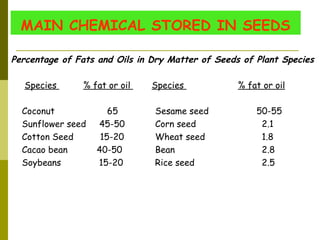
Percentage of Fats and Oils in Dry Matter of Seeds of Plant Species
Species % fat or oil Species % fat or oil
 
Coconut 65 Sesame seed 50-55
Sunflower seed 45-50 Corn seed 2.1
Cotton Seed 15-20 Wheat seed 1.8
Cacao bean 40-50 Bean 2.8
Soybeans 15-20 Rice seed 2.5
MAIN CHEMICAL STORED IN SEEDS
 Fatty acid- is a constituents of natural fats, and in
the free state they resemble fats in physical properties.
 Only found in germinating and deteriorating seeds as a
result of fat hy6drolysis.
 Glycerol and Other Alcohol
 They combine with fatty acids to form different kinds
of lipids.
 Fat Hydrolysis- the breakdown of fats during seed
germination or seed deterioration occurs by action of
lipase enzymes yielding glycerol and free fatty acids.
MAIN CHEMICAL STORED IN SEEDS
Protein Storage in Seeds
Protein- are nitrogen-containing molecules of large size and
exceedingly complex structure which yield amino acids upon
hydrolysis.
 Majority of seed proteins are metabolically inactive and
serves are food reserves for the growing embryo during
germination.
Proteins Found in most Cereals
1. Glubulin- soluble in water at neutral or slightly acid
reaction and coagulated by heat. Ex. Leucolins
for cereals, Legumelin for pulse seeds, Recin
for rice.
MAIN CHEMICAL STORED IN SEEDS
 Four categories are used to describe protein structure:
 Primary structure is the sequence of amino acids from
the amino group to the carboxyl end.
 Secondary structure represents the interactions
between amino acids from some regions in the
same polypeptide chain by hydrogen-oxygen bonds,
which results in helical- shaped (α-helices) or
sheet shaped (β-sheet) configurations.
 Tertiary structure describes the shape of the fully
folded polypeptide chain.
 Quaternary structure refers to the arrangement of
two or more polypeptide chains into a multi-subunit or
oligomeric protein.
MAIN CHEMICAL STORED IN SEEDS
 Seed proteins have been classified in four groups
according to their solubility:
1) Albumins, soluble in water at neutral or slightly acid pH.
This fraction is primarily enzymes.
2) Globulins, soluble in saline solution, but insoluble in water
(dicots).
3) Glutelins, soluble in acid or alkali solutions(cereals)
4) Prolamins, soluble in 70-90% ethanol (cereal grains)
MAIN CHEMICAL STORED IN SEEDS
 Storage Proteins in Cereal Seeds
 Zein (corn) is relatively rich in alanine and
leucine, with low levels of lysine and almost no
tryptophan;
 Gluten- major storage in wheat and abundant in rye
and barley seeds, has elastic properties that make it
valuable for baking products such as bread.
 Gliadin
 Glutenin -
 Storage Proteins in Dicotyledonous Seeds
 Predominantly globulins
 Very little prolamin and glutelin
OTHER CHEMICAL COMPOUNDS
FOUND IN SEEDS
 Alkaloids- physiologically active substance and, in many
cases, poisonous. Alkaloids may also serve as protective
mechanisms of seeds against pests and pathogens
because of their bitter flavor.
Ex. Caffeine
 Tannins- is a group of complex astringent polyphenolic
compounds occurring widely in plants.
 Glycosides- are compounds formed from the reaction
of a sugar (glucose) with one or more nonsugar
compounds, which are called aglycones (benzylaldehyde).
OTHER CHEMICAL COMPOUNDS
FOUND IN SEEDS
 Phytin- is the insoluble mixed potassium (K+), magnesium
(Mg++), and calcium (Ca++) salt of myo-inositol
hexaphosphoric acid (phytic acid).
 Vitamins- are a heterogeneous group of chemical
compounds synthesized by plants. They function principally
as enzyme cofactors.
 Hormones-are organic compounds that, in small
concentrations, have important regulatory effects on plant
and animal metabolism.
FACTORS AFFECTING THE CHEMICAL
COMPOSITION OF SEEDS
1. Genetic Factors
 Position of seed in the mother plant
wheat - 1st
and 2nd
seeds higher N content than 3rd
and 4th
seeds
Abutilon theophrastii (Malvaceae) – 1st
2 fruits high
N content than the last 2 fruits
Oilseed rape – the proportioned of 7 fatty acids
varies depending on the position of the pod in
the inflorescence
FACTORS AFFECTING THE CHEMICAL
COMPOSITION OF SEEDS
2. Environmental Factors
 Season effects
Soybean seeds – higher protein content at late
season
Sunflower seeds – oil quality tends to improve
gradually over the season (late summer)
* Differences in oil composition are differences in
temperature or photoperiod throughout the growing
season
FACTORS AFFECTING THE CHEMICAL
COMPOSITION OF SEEDS
2. Environmental Factors
 Temperature
Higher temperature during seed growth – produced
small seeds
Smaller seeds – lower accumulation of storage
reserves (carbohydrates)
Cooler temperature – higher linolenic: oleic acid ratio
(better quality oil), wild sunflower, flax, cacao
Higher temperatures – high protein content in wheat
and soybean seeds is the result of lower
carbohydrate accumulation during development
FACTORS AFFECTING THE CHEMICAL
COMPOSITION OF SEEDS
2. Environmental Factors
 Nutrients or Soil Fertility
addition of N fertilizer to soil – higher protein
content in wheat, rice, wheat, cotton seeds
addition of phosphate – higher phosphorus content of
pea, soybean, wheat, common bean seeds
increase presence of trace elements in the soil – it can
be also observed in soybean (manganese, boron,
zinc), wheat (copper), lupin (cobalt), lettuce
(selenium and cadmium)
low sulphur availability – methionine and cysteine is
lower content
increase N availability – higher seed protein content
and less oil content
FACTORS AFFECTING THE CHEMICAL
COMPOSITION OF SEEDS
 Environmental Factors
 Water Stress
plant subjected to water stress during seed filling is
33% higher protein content and 18% oil
concentration
Thank you for
listening…

Angiosperm (seed formation and development)

  • 1.
    Daisy S. Capon PhDStudent (Crop Science) 1st Semester 2014 ANGIOSPERM: Seed Formation and Development
  • 2.
    Topical Outline  Developmentof male and female gametophyte;  Plant embryo development; and  Chemical composition of seed and factors affecting on it.
  • 3.
    Development of MaleGametophyte (Microsporogenesis and Microgametogenesis)  Anthesis-is the period of flower development when the stigma is ready to receive pollen. It is the time when pollen begins to blow.  Microsporangium- structure made of four sacs where pollen is usually produced.  Within the sporangia, certain cells become the microspore mother cells and undergo a two-step reduction division (meiosis), or microsporogenesis, to yield four microspores, each of which is haploid (1n). Each of the 4 microspores is normally functional and undergoes two divisions, known as microgametogenesis, or mature pollen grain.  Sporangia- are enclosure or structure in which spores are formed.
  • 5.
    C. SEED FORMATION:Female  Megasporogenesis- the formation and maturing of megaspores  Ovule Primordia- is a meristematic tissue of the ovary wall where seeds of angiosperms originate  Diploid- possessing two matched sets of chromosomes in the cell nucleus, one set from each parent.  There is a characteristic diploid number of chromosomes for each species.  Haploid- having a single set of unpaired chromosomes  The megaspore mother cell is diploid (2N), having the same number of chromosomes as the parent plant. It undergoes a two-step cell division (Meiosis I & Meiosis II). This process gives rise to 4 megaspores haploid cells (1N). Normally, only one megaspore is functional, the other 3 degenerate. Development of Female Gametophyte (Megasporogenesis and Megagametogenesis)
  • 6.
    Megagametogenesis- is thedevelopment of the female gametophyte, or embryo sac , from the functional megaspore.    It is a process of successive nuclear division within an enlarging cell which becomes the embryo sac. Three successive free nuclear division (mitosis) occur, culminating in 8 haploid (1N) nuclei. Soon these nuclei arrange themselves within the enlarging embryo sac and formation of cell walls occur, resulting in 3 antipodal cells at one end, 2 polar nuclei at the center with the egg apparatus at the other end. Development of Female Gametophyte (Megasporogenesis and Megagametogenesis)
  • 7.
    Megagametogenesis: A. threenormal mitotic nuclear divisions leading to one large cell enclosing eight nuclei. Later, cell walls enclose the nuclei and the entire structure becomes the female gametophyte, or embryo sac; B, mature female gametophyte.
  • 8.
    Megagametophyte formation ofthe genera Polygonum and Lilium. Triploid nuclei are shown as ellipses with three white dots. The first three columns show the meiosis of the megaspore, followed by 1-2 mitoses.
  • 9.
    Ovule with megagametophyte:egg cell (yellow), synergids (orange), central cell with two polar nuclei (bright green), and antipodals (dark green)
  • 11.
    THE DEVELOPING OVULE Ovule development occurs within the ovary. The developing ovule is commonly attached to the placenta by the funiculus.    Hilum- is the scar on the ovule made where the funiculus detaches at maturity.    Micropyle- is the point where the integuments meet at the nucellar apex.    Chalaza- the region of integumentary origin and attachment, usually opposite the micropyle.    Raphe- the area between the chalaza and the hilum.
  • 12.
    THE DEVELOPING OVULE Nucellus- provides tissue for the origin and nurture of the female gametophyte, from archesporial cell to the mature megagametophyte.   Integuments  The integuments is absorbed and consumed by the developing embryo, leaving it naked inside the pericarp.  Aril- a third integument that may arise either from the base of the nucellus or may split off from the outer integument.  Micropyle- is an integumentary pore or opening in the ovule through which the pollen tube grows to fertilize the egg cells of the female gametophyte.  Epistase- is the development of well- defined nucellar or integumentary tissue in the micropylar region of the seed of certain species.
  • 13.
    Stages of PlantEmbryo Development (Monocot)
  • 14.
    Stages of PlantEmbryo Development (Dicot)
  • 15.
    Stages of PlantEmbryo Development
  • 16.
    Plant Embryo Development (PlantEmbryogenesis)  Embryogenesis – is defined as the formation and development of an embryo from zygote  Steps 1. Asymmetric cell division resulting in a smaller apical (terminal) cell and a larger basal cell (plant embryo develops) 2. Suspensor develops from the basal cell (serves as a nutrient for the developing embryo) 3. Further cell division leads to globular stage. The three basic tissue systems (dermal, ground and vascular) can be recognized. The globular shape of the embryo is then lost as the cotyledons in dicots (embryonic leaves) begin to form. The formation of two cotyledons in dicots gives the embryo a heart-shaped appearance.
  • 17.
    Plant Embryo Development (PlantEmbryogenesis) Embryo formation begins with cell division that establishes the apical-basal (top-bottom) axis. Further divisions elaborate on this basic plan, finally forming the cotyledons (seed leaves), as well as the apical meristems of root and shoot.
  • 18.
    Plant Embryogenesis Fertilization Two-CelledEmbryo Young Embryo Cotyledon Stage Bending Embryo Mature Embryo Embryo Development in Capsella, Shepard’s Purse, a Dicot
  • 19.
    The Origin ofa Seed and Fruit from Immature Stage Flower Parts Mature Structure  Egg + sperm = zygote Embryo  2 Polar nuclei + Sperm Endosperm  Integument Testa (Seedcoat)  Nucellus Perisperm  Micropyle Micropyle  Funiculus Hilum  Ovary Wall Pericarp (fruit)  Ovule Seed  Ovary Fruit
  • 20.
    Seed Structure Seed varyin structure in different kinds of plants. Seed is defined as a mature, integumented, megasporangium. All flowering plants bears seeds which encloses an inactive embryo. Under suitable conditions the embryo becomes active and germinates to give rise to adult plant.
  • 21.
    Parts of aTypical Seed  1. Seed coat- is made up of two layers: (a) outer-called testa (developed from ovule integuments after fertilization) which is usually hard, and (b) inner-called tegmen which is thin and papery.
  • 22.
    Seed Coat  Thereis a small opening at one end of the seed coat, called micropyle through which water enters the seed. The stalk of the speed with which the seed is attached to fruit wall is called funiculus. A large scar is located near the middle of one edge, where the seed breaks from the stalk of funiculus, this is called hilum. There is a ridge beyond the hilum opposite the micropyle. It represents the base of the funiculus which is fused with the integuments and is called raphe. rapheraphe
  • 23.
    Seed Coat  Functionsof Seed Coat in Embryo Development a. Pathway for transport and conversion of amino acid and carbohydrates from the pericarp into the ovule for development of the embryo. b. Temporary storage of compounds for later use by seed coat cells. c. Involvement in gas exchange. d. Possible supply of growth compounds to the growing embryo and maternal organs. e. Protection of the embryo and endosperm from desiccation and mechanical injury
  • 24.
    Seed Coat  Functionsof Seed Coat in Mature Seed a. Protective covering of the seed (biotic and mechanical injury) b. Regulation of water uptake and gas exchange with the surrounding ambient environment. c. Regulation of germination and influencing the intensity of dormancy expression (hard seed coat) d. Control of seed dispersal (wings, hairs mucilages etc.)
  • 25.
    Embryo (2n) It isa young plant enclosed in a seed coat and has two parts  (i) Cotyledons Their number is either one or two and they are the leaves of embryo. Sometimes they store food materials and become fleshy. When they do not store food they remain thin and papery. The cotyledons are hinged to an axis (tigellum) at a point called cotyledonary node.
  • 26.
    Embryo (2n)  Itis a young plant enclosed in a seed coat and has two parts  (ii) Tigellum: The main axis of the embryo is known as tigellum, one end of which is pointed and protrudes out of cotyledons. This lies next to micropyle and is called radicle (rudimentary root). The other end of the tigellum is the plumule (first apical bud of shoot). The portion of the axis above the point of attachment of cotyledons is called epicotyl and that below the cotyledonary node is called hypocotyl.
  • 27.
    Endosperm (3n) Endosperm isdevelops from union of 2 polar nuclei and 1 sperm nucleus. It is a food-laden tissue, surrounding the embryo on all sides or either present on one side of the embryo. Depending on its presence or absence, seeds are of two types- (i) Non endospermic or exalbuminous seeds: In these seeds like gram, pea, groundnut, the endosperm is completely consumed by the embryo. (ii) Endospermic or albuminous seeds: In monocots and castor bean (dicots) embryo does not consume all endosperm. So it persists in the mature seed. Such seeds are called endospermic or albuminous seeds. In these seeds, food is stored in endosperm. In monocot seeds, the membranouscovering present around radicle is called coleorrhiza and around plumule is called coleoptile.
  • 28.
    Seed Structure ofDifferent Kinds of Plants 1. Bean Seed: It is kidney-shaped brownish non endospermic dicotyledonous seed. The surface is smooth. Concave surface is darker. It has a whitish scar or hilum, a small pore or micropyle and a faint ridge or raphe. A bulge of underlying radicle is observed on the opposite side of raphe. The seed is covered by a thick, tough, brownish seed coat or testa. A thin papery transparent tegmen lies below the testa.
  • 29.
    Seed Structure ofDifferent Kinds of Plants 1. Bean Seed: Seed coats enclose the embryo. There is no other structure. Embryo axis or tigellum is curved. It is covered by two massive cotyledons borne over it in the region called cotyledonary node. One end of embryo axis called plumule lies embedded in between the two cotyledons. It bears two small folded leaves. The other end of embryo axis is radicle. It protrudes out of the cotyledons. Part of the embryo axis lying between radicle and cotyle donary node is called hypocotyl while the part between the cotyledonary node and plumule is known as epicotyl. Food is stored in the cotyledons.
  • 30.
    Seed Structure ofDifferent Kinds of Plants 2. Castor Seed: It is oblong, mottled brown endospermic and dicotyledonous seed. The narrow end bears a bilobed white spongy caruncle. Both hilum and micropyle occur in this area. Raphe develops from this part and proceeds towards the broad end where it bifurcates. A thick hard but brittle testa covers the seed.
  • 31.
    Seed Structure ofDifferent Kinds of Plants 2. Castor Seed: A thin perisperm lies below it and around the kernel. A white oily endosperm lies below the perisperm. It stores food reserve as oil drops and proteins. Endosperm is source of castor oil. Embryo lies in the center of seed. It consists of a short embryo axis bearing two thin papery semitransparent oval cotyledons, a small indistinct plumule and a knob-shaped radicle. Palmate venation occurs over the cotyledons.
  • 32.
    Seed Structure ofDifferent Kinds of Plants 3. Maize Grain: It is a monocotyledonous, endospermic, single seeded dry fruit called caryopsis. The grain is conical and flattened. Shallow husk occurs over the pointed end. On one side the broader end bears a papilla representing remains of the style. The same side has a depression in which a ridge indicates the position of underlying embryo. Hilum and micropyle are absent since grain is a fruit and the seed is internal.
  • 33.
    Seed Structure ofDifferent Kinds of Plants 3. Maize Grain: Color is variable. Surface is nearly smooth. The covering of the grain is made of fused pericarp and testa. 2/3 of the grain interior has food storage tissue of endosperm. It is rich in starch. A protein rich aleurone layer lies on the outside of endosperm. Embryo lies on one side towards the upper pointed part. A single large cotyledon lies lateral and parallel to the embryo axis. It is called scutellum. Scutellum is attached to the middle part of embryo axis. Its outer layer in contact with endosperm is called epithelial layer.
  • 34.
    Seed Structure ofDifferent Kinds of Plants 3. Maize Grain: The layer secretes GA for formation of amylase during germination. Embryo axis ends in plumule towards broader side and radicle towards pointed side. Radicle has a root cap. Plumule bears a few small leaves. Sheaths derived from scutellum cover the two ends of embryo axis, undifferentiated coleorhiza over the radicle root cap region and hollow folial coleoptile over the plumule. Area of embryo axis is between plumule and cotyledonary node is epicotyl while the area between cotyledonary node and radicle is called hypocotyl.
  • 35.
    4. Onion Seed: Itis a small blackish endospermic monocotyledonous seed with wrinkled surface. Seed coat is quite tough. It is coloured. Endosperm or food storage tissue is also tough. It is semitransparent. Embryo is curved. It is embedded in the endosperm. Embryo axis is small as compared to single cotyledon called scutellum. Epicotyl is inconspicuous. Plumule is not distinguishable. Instead shoot apical meristem is present. A notch occurs in the area of origin of single cotyledon. Hypocotyl is larger. It bears radicle or root tip. Seed Structure of Different Kinds of Plants
  • 36.
    Differences in SeedStructure of Different Kinds of Plant
  • 37.
    Epicotyl Hypocotyl Cotyledons Radicle Seed coat Seed coat Endosperm (a)Common garden bean, a eudicot with thick cotyledons Cotyledons Epicotyl Hypocotyl Radicle (b) Castor bean, a eudicot with thin cotyledons (c) Maize, a monocot Scutellum (cotyledon) Pericarp fused with seed coat Endosperm Epicotyl Hypocotyl Coleoptile Radicle Coleorhiza
  • 38.
    II. THE CHEMISTRYOF SEEDS   Important consideration why knowledge on chemical composition of seed is essential.  1. Seeds are basic source of food for both man and animals.  Poaceae/Grasses Family ex: wheat. rice, corn – contribute more to human nutrition (provide carbohydrates to diet) source of proteins and other essential nutrients  Fabaceae/Legume Family ex: soybean, peanut, mungbean other beans – important source of proteins and oils  Other Species ex: sunflower, palm, canola , cotton seeds – important source of edible oils
  • 39.
    II. THE CHEMISTRYOF SEEDS   Important consideration why knowledge on chemical composition of seed is essential.  2. They are important source of pharmaceuticals(medicine and drugs) either active ingredients or components of the formulations ex: alkaloid amino acid, amines, protein glycosides phenolics, volatile oils and polysaccharides * Oils extracted from seeds improve the delivery of the active ingredients (massage oil, ointments and creams) These oils (coconut, castor bean, peanut, almond) help the respective penetration through the skin.
  • 40.
    II. THE CHEMISTRYOF SEEDS   Important consideration why knowledge on chemical composition of seed is essential.  3. They contain various antimetabolites which adversely affect human and animal nutrition. ex: alkaloids, lectins, proteinase inhibitors, phytin, raffinose oligosaccharides * These biologically active compounds present in seeds may be harmful/toxic to humans and animals depending of the dose (Jatropha curcas)
  • 41.
    II. THE CHEMISTRYOF SEEDS   Important consideration why knowledge on chemical composition of seed is essential.  4. They contain reserve food supplies and growth substances that influence seed germination, and seedling vigor, seed storage and longevity, as well as industrial and agricultural uses of seeds.
  • 42.
     Major Classesof Chemical Compounds Stored in Seeds  1. Carbohydrates (sugar)  2. Lipids (fats and oils)  3. Proteins (amino acids)   Carbohydrate Storage in Seeds  Carbohydrates- are the major storage in seeds of most cultivated plants.  Cereals and grasses are specifically rich in carbohydrates and low in fats and proteins. THE CHEMISTRY OF SEEDS
  • 43.
    THE CHEMISTRY OFSEEDS Forms of carbohydrates in seeds  a) Starch  b) Hemicellulose  c) Raffinose series oligosaccharides   Starch  Starch is stored in seeds in two related forms  1. Amylose- composed of about 300-400 glucose residues in straight chain.  2. Amylopectin- with much larger molecules than amylase up to a thousand times larger, with multiple branches, rather than straight chain.
  • 44.
    THE CHEMISTRY OFSEEDS  Structure of Glucose and how it branches to form starch   O  | |  C —H  |  H—C —OH  |  H—C —OH  |  H—C —OH  |  H—C —OH  |  H  Glucose molecule glucose glucose Glucose-glucose-glucose - gluc glucose- glucose Amylopectin Glucose—glucose—glucose--glu Amylose
  • 45.
    MAIN CHEMICAL STOREDIN SEEDS  Hemicellulose Forms of Hemicellulose reserve food materials 1) Xylans 2) Mannans 3) Galactans  Raffinose series oligosaccharides- are composed of sucrose plus a variable number of galactose units.
  • 46.
    MAIN CHEMICAL STOREDIN SEEDS LIPID STORAGE IN SEEDS   Lipids- are plant or animal substances that are insoluble in water but soluble in ether, chloroform, benzene, or other fat solvents.  Lipids are a diverse group of organic compounds such as fats, oils, waxes, sterols, glycolipids, phospholipids, fat-soluble vitamins (e.g., vitamins A, D, E and K), etc.  Biological functions of Lipids:  1) energy storage  2) structural components of cell membranes,  3) participating in signaling pathways.
  • 47.
    MAIN CHEMICAL STOREDIN SEEDS LIPID STORAGE IN SEEDS   Fatty acids are classified as:  Saturated fatty acids do not have carbon-to- carbon double bonds (bad fats).  Unsaturated fatty acids have one or more carbon- to-carbon double bonds (good fats).
  • 48.
    MAIN CHEMICAL STOREDIN SEEDS LIPID STORAGE IN SEEDS  Classification of Lipids 1. Simple- include esters of fatty acids and glycerols or various other alcohols. Ex. Fats & fatty oils. 2. Compound- are esters of fatty acids containing additional chemical groups. Ex. Phospholipids 3. Derived- derived from simple lipid and compound lipids by hydrolysis and are soluble in fat solvents. Ex. Cholesterol   * Majority of seed lipid are simple lipids which include fats, fatty oils, and waxes. * All seed waxes are solids. * High lipid content is usually associated with high protein content. Ex. Soybeans, Peanut, Cotton seeds.
  • 49.
    MAIN CHEMICAL STOREDIN SEEDS Percentage of Fats and Oils in Dry Matter of Seeds of Plant Species Species % fat or oil Species % fat or oil   Coconut 65 Sesame seed 50-55 Sunflower seed 45-50 Corn seed 2.1 Cotton Seed 15-20 Wheat seed 1.8 Cacao bean 40-50 Bean 2.8 Soybeans 15-20 Rice seed 2.5
  • 50.
    MAIN CHEMICAL STOREDIN SEEDS  Fatty acid- is a constituents of natural fats, and in the free state they resemble fats in physical properties.  Only found in germinating and deteriorating seeds as a result of fat hy6drolysis.  Glycerol and Other Alcohol  They combine with fatty acids to form different kinds of lipids.  Fat Hydrolysis- the breakdown of fats during seed germination or seed deterioration occurs by action of lipase enzymes yielding glycerol and free fatty acids.
  • 51.
    MAIN CHEMICAL STOREDIN SEEDS Protein Storage in Seeds Protein- are nitrogen-containing molecules of large size and exceedingly complex structure which yield amino acids upon hydrolysis.  Majority of seed proteins are metabolically inactive and serves are food reserves for the growing embryo during germination. Proteins Found in most Cereals 1. Glubulin- soluble in water at neutral or slightly acid reaction and coagulated by heat. Ex. Leucolins for cereals, Legumelin for pulse seeds, Recin for rice.
  • 52.
    MAIN CHEMICAL STOREDIN SEEDS  Four categories are used to describe protein structure:  Primary structure is the sequence of amino acids from the amino group to the carboxyl end.  Secondary structure represents the interactions between amino acids from some regions in the same polypeptide chain by hydrogen-oxygen bonds, which results in helical- shaped (α-helices) or sheet shaped (β-sheet) configurations.  Tertiary structure describes the shape of the fully folded polypeptide chain.  Quaternary structure refers to the arrangement of two or more polypeptide chains into a multi-subunit or oligomeric protein.
  • 53.
    MAIN CHEMICAL STOREDIN SEEDS  Seed proteins have been classified in four groups according to their solubility: 1) Albumins, soluble in water at neutral or slightly acid pH. This fraction is primarily enzymes. 2) Globulins, soluble in saline solution, but insoluble in water (dicots). 3) Glutelins, soluble in acid or alkali solutions(cereals) 4) Prolamins, soluble in 70-90% ethanol (cereal grains)
  • 54.
    MAIN CHEMICAL STOREDIN SEEDS  Storage Proteins in Cereal Seeds  Zein (corn) is relatively rich in alanine and leucine, with low levels of lysine and almost no tryptophan;  Gluten- major storage in wheat and abundant in rye and barley seeds, has elastic properties that make it valuable for baking products such as bread.  Gliadin  Glutenin -  Storage Proteins in Dicotyledonous Seeds  Predominantly globulins  Very little prolamin and glutelin
  • 55.
    OTHER CHEMICAL COMPOUNDS FOUNDIN SEEDS  Alkaloids- physiologically active substance and, in many cases, poisonous. Alkaloids may also serve as protective mechanisms of seeds against pests and pathogens because of their bitter flavor. Ex. Caffeine  Tannins- is a group of complex astringent polyphenolic compounds occurring widely in plants.  Glycosides- are compounds formed from the reaction of a sugar (glucose) with one or more nonsugar compounds, which are called aglycones (benzylaldehyde).
  • 56.
    OTHER CHEMICAL COMPOUNDS FOUNDIN SEEDS  Phytin- is the insoluble mixed potassium (K+), magnesium (Mg++), and calcium (Ca++) salt of myo-inositol hexaphosphoric acid (phytic acid).  Vitamins- are a heterogeneous group of chemical compounds synthesized by plants. They function principally as enzyme cofactors.  Hormones-are organic compounds that, in small concentrations, have important regulatory effects on plant and animal metabolism.
  • 57.
    FACTORS AFFECTING THECHEMICAL COMPOSITION OF SEEDS 1. Genetic Factors  Position of seed in the mother plant wheat - 1st and 2nd seeds higher N content than 3rd and 4th seeds Abutilon theophrastii (Malvaceae) – 1st 2 fruits high N content than the last 2 fruits Oilseed rape – the proportioned of 7 fatty acids varies depending on the position of the pod in the inflorescence
  • 58.
    FACTORS AFFECTING THECHEMICAL COMPOSITION OF SEEDS 2. Environmental Factors  Season effects Soybean seeds – higher protein content at late season Sunflower seeds – oil quality tends to improve gradually over the season (late summer) * Differences in oil composition are differences in temperature or photoperiod throughout the growing season
  • 59.
    FACTORS AFFECTING THECHEMICAL COMPOSITION OF SEEDS 2. Environmental Factors  Temperature Higher temperature during seed growth – produced small seeds Smaller seeds – lower accumulation of storage reserves (carbohydrates) Cooler temperature – higher linolenic: oleic acid ratio (better quality oil), wild sunflower, flax, cacao Higher temperatures – high protein content in wheat and soybean seeds is the result of lower carbohydrate accumulation during development
  • 60.
    FACTORS AFFECTING THECHEMICAL COMPOSITION OF SEEDS 2. Environmental Factors  Nutrients or Soil Fertility addition of N fertilizer to soil – higher protein content in wheat, rice, wheat, cotton seeds addition of phosphate – higher phosphorus content of pea, soybean, wheat, common bean seeds increase presence of trace elements in the soil – it can be also observed in soybean (manganese, boron, zinc), wheat (copper), lupin (cobalt), lettuce (selenium and cadmium) low sulphur availability – methionine and cysteine is lower content increase N availability – higher seed protein content and less oil content
  • 61.
    FACTORS AFFECTING THECHEMICAL COMPOSITION OF SEEDS  Environmental Factors  Water Stress plant subjected to water stress during seed filling is 33% higher protein content and 18% oil concentration
  • 62.