APOMIXIS
In botany, apomixis was defined by Hans Winkler as replacement of the
normal sexual reproduction by asexual reproduction, without fertilization.
Its etymology is Greek for "away from" + "mixing". This definition notably
does not mention meiosis.
In flowering plants, the term "apomixis" is commonly used in a restricted
sense to mean agamospermy, i.e. clonal reproduction through seeds.
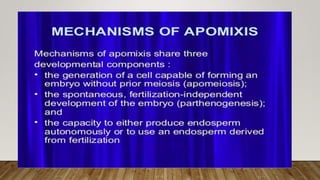
Thus, Apiomixis can be defined as the development of embryo with or
without embryosac formation but without fertilization.
Apomixis (asexual seed formation) is the result of a plant gaining the ability to bypass the
most fundamental aspects of sexual reproduction: meiosis and fertilization.
Without the need for male fertilization, the resulting seed germinates a plant that develops
as a maternal clone.
The ability to generate maternal clones and therefore rapidly fix desirable genotypes in
crop species could accelerate agricultural breeding strategies.
The potential of apomixis as a next-generation breeding technology has contributed to
increasing interest in the mechanisms controlling apomixis.
Research is currently focused on two fronts. One aims to identify and characterize genes
causing apomixis in apomictic species that have been developed as model species. The
other aims to engineer or switch the sexual seed formation pathway in non-apomictic
species, to one that mimics apomixis.
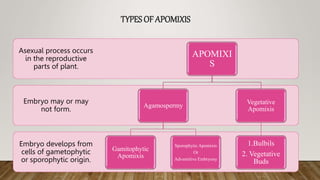
TYPES OF APOMIXIS
Embryo develops from
cells of gametophytic
or sporophytic origin.
Embryo may or may
not form.
Asexual process occurs
in the reproductive
parts of plant.
APOMIXI
S
Agamospermy
Gamitophytic
Apomixis
Sporophytic Apomixis
Or
Adventitive Embryony
Vegetative
Apomixis
1.Bulbils
2. Vegetative
Buds
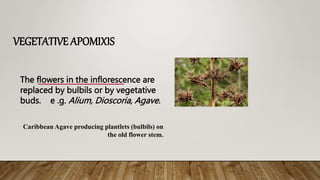
VEGETATIVE APOMIXIS
The flowers in the inflorescence are
replaced by bulbils or by vegetative
buds. e .g. Alium, Dioscoria, Agave.
Caribbean Agave producing plantlets (bulbils) on
the old flower stem.
AGAMOSPERMY
Agamospermy is formation of seeds or embryo without fertilization.
Agamospermy, asexual reproduction through seeds, occurs in flowering plants through many
different mechanisms and occurs mainly in two forms:
In gametophytic apomixis, the embryo arises from an unfertilized egg cell (i.e. by
parthenogenesis) or any other cells (i.e. by apogamy) in a gametophyte that was produced
from a cell that did not complete meiosis.
In Gametophytic Apomixis, embryo formation is accompanied with embryosac formation.
It may be recurrent ( embryosac is formed without meiosis) or non- recurrent ( embryosac is
formed after meiosis).
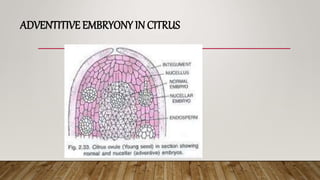
In adventitious embryony (sporophytic apomixis), an embryo is formed directly (not from a
gametophyte) from nucellus or integument tissue (i.e. sporophytic tissue).
 This may results in polyembryony. e. g. Citrus and mango.
ADVENTITIVE EMBRYONY IN CITRUS
GAMITOPHYTICAPOMIXIS
GAMETOPHYTIC APOMIXIS IN FLOWERING PLANTS DEVELOPS IN SEVERAL
DIFFERENT WAYS.
A MEGAGAMETOPHYTE DEVELOPS WITH AN EGG CELL WITHIN IT THAT
DEVELOPS INTO AN EMBRYO THROUGH PARTHENOGENESIS.
THE CENTRAL CELL OF THE MEGAGAMETOPHYTE MAY REQUIRE
FERTILIZATION TO FORM THE ENDOSPERM, PSEUDOGAMOUS
GAMETOPHYTIC APOMIXIS, OR IN AUTONOMOUS GAMETOPHYTIC
APOMIXIS FERTILIZATION IS NOT REQUIRED.
GAMITOPHYTIC APOMIXES PASSES THROUGH TWO STAGES, THESE ARE:
Embryosac Formation
1. Diplospory
2. Apospory
Embryo Formation
1. Parthenogenesis
2. Apogamety
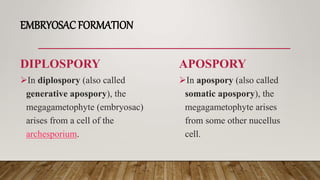
EMBRYOSAC FORMATION
DIPLOSPORY
In diplospory (also called
generative apospory), the
megagametophyte (embryosac)
arises from a cell of the
archesporium.
APOSPORY
In apospory (also called
somatic apospory), the
megagametophyte arises
from some other nucellus
cell.
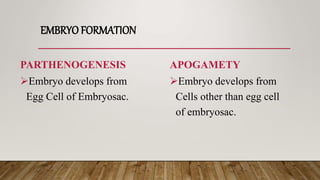
EMBRYO FORMATION
PARTHENOGENESIS
Embryo develops from
Egg Cell of Embryosac.
APOGAMETY
Embryo develops from
Cells other than egg cell
of embryosac.
CLASSIFICATION OF APOMIXIS BY MAHESHWARI
 Maheshwari used the following simple classification of types of apomixis in flowering plants:
 Nonrecurrent apomixis: In this type "the megaspore mother cell undergoes the usual meiotic divisions and a haploid
embryo sac [megagametophyte] is formed. The new embryo may then arise either from the egg (haploid parthenogenesis)
or from some other cell of the gametophyte (haploid apogamy)." The haploid plants have half as many chromosomes as
the mother plant, and "the process is not repeated from one generation to another" (which is why it is called
nonrecurrent). See also parthenogenesis and apogamy below.
 Recurrent apomixis, is now more often called gametophytic apomixis: In this type, the megagametophyte has the same
number of chromosomes as the mother plant because meiosis was not completed. It generally arises either from an
archesporial cell or from some other part of the nucellus.
 Adventive embryony, also called sporophytic apomixis, sporophytic budding, or nucellar embryony: Here there may be
a megagametophyte in the ovule, but the embryos do not arise from the cells of the gametophyte; they arise from cells of
nucellus or the integument. Adventive embryony is important in several species of Citrus, in Garcinia, Euphorbia dulcis,
Mangifera indica etc.
 Vegetative apomixis: In this type "the flowers are replaced by bulbils or other vegetative propagules which frequently
germinate while still on the plant". Vegetative apomixis is important in Allium, Fragaria, Agave, and some grasses,
among others.
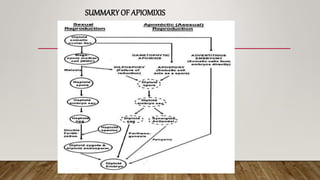
SUMMARY OF APIOMIXIS

Apomixis.ppt

  • 1.
    APOMIXIS In botany, apomixiswas defined by Hans Winkler as replacement of the normal sexual reproduction by asexual reproduction, without fertilization. Its etymology is Greek for "away from" + "mixing". This definition notably does not mention meiosis. In flowering plants, the term "apomixis" is commonly used in a restricted sense to mean agamospermy, i.e. clonal reproduction through seeds. Thus, Apiomixis can be defined as the development of embryo with or without embryosac formation but without fertilization.
  • 2.
    Apomixis (asexual seedformation) is the result of a plant gaining the ability to bypass the most fundamental aspects of sexual reproduction: meiosis and fertilization. Without the need for male fertilization, the resulting seed germinates a plant that develops as a maternal clone. The ability to generate maternal clones and therefore rapidly fix desirable genotypes in crop species could accelerate agricultural breeding strategies. The potential of apomixis as a next-generation breeding technology has contributed to increasing interest in the mechanisms controlling apomixis. Research is currently focused on two fronts. One aims to identify and characterize genes causing apomixis in apomictic species that have been developed as model species. The other aims to engineer or switch the sexual seed formation pathway in non-apomictic species, to one that mimics apomixis.
  • 3.
    TYPES OF APOMIXIS Embryodevelops from cells of gametophytic or sporophytic origin. Embryo may or may not form. Asexual process occurs in the reproductive parts of plant. APOMIXI S Agamospermy Gamitophytic Apomixis Sporophytic Apomixis Or Adventitive Embryony Vegetative Apomixis 1.Bulbils 2. Vegetative Buds
  • 4.
    VEGETATIVE APOMIXIS The flowersin the inflorescence are replaced by bulbils or by vegetative buds. e .g. Alium, Dioscoria, Agave. Caribbean Agave producing plantlets (bulbils) on the old flower stem.
  • 5.
    AGAMOSPERMY Agamospermy is formationof seeds or embryo without fertilization. Agamospermy, asexual reproduction through seeds, occurs in flowering plants through many different mechanisms and occurs mainly in two forms: In gametophytic apomixis, the embryo arises from an unfertilized egg cell (i.e. by parthenogenesis) or any other cells (i.e. by apogamy) in a gametophyte that was produced from a cell that did not complete meiosis. In Gametophytic Apomixis, embryo formation is accompanied with embryosac formation. It may be recurrent ( embryosac is formed without meiosis) or non- recurrent ( embryosac is formed after meiosis). In adventitious embryony (sporophytic apomixis), an embryo is formed directly (not from a gametophyte) from nucellus or integument tissue (i.e. sporophytic tissue).  This may results in polyembryony. e. g. Citrus and mango.
  • 6.
  • 7.
    GAMITOPHYTICAPOMIXIS GAMETOPHYTIC APOMIXIS INFLOWERING PLANTS DEVELOPS IN SEVERAL DIFFERENT WAYS. A MEGAGAMETOPHYTE DEVELOPS WITH AN EGG CELL WITHIN IT THAT DEVELOPS INTO AN EMBRYO THROUGH PARTHENOGENESIS. THE CENTRAL CELL OF THE MEGAGAMETOPHYTE MAY REQUIRE FERTILIZATION TO FORM THE ENDOSPERM, PSEUDOGAMOUS GAMETOPHYTIC APOMIXIS, OR IN AUTONOMOUS GAMETOPHYTIC APOMIXIS FERTILIZATION IS NOT REQUIRED. GAMITOPHYTIC APOMIXES PASSES THROUGH TWO STAGES, THESE ARE: Embryosac Formation 1. Diplospory 2. Apospory Embryo Formation 1. Parthenogenesis 2. Apogamety
  • 8.
    EMBRYOSAC FORMATION DIPLOSPORY In diplospory(also called generative apospory), the megagametophyte (embryosac) arises from a cell of the archesporium. APOSPORY In apospory (also called somatic apospory), the megagametophyte arises from some other nucellus cell.
  • 9.
    EMBRYO FORMATION PARTHENOGENESIS Embryo developsfrom Egg Cell of Embryosac. APOGAMETY Embryo develops from Cells other than egg cell of embryosac.
  • 10.
    CLASSIFICATION OF APOMIXISBY MAHESHWARI  Maheshwari used the following simple classification of types of apomixis in flowering plants:  Nonrecurrent apomixis: In this type "the megaspore mother cell undergoes the usual meiotic divisions and a haploid embryo sac [megagametophyte] is formed. The new embryo may then arise either from the egg (haploid parthenogenesis) or from some other cell of the gametophyte (haploid apogamy)." The haploid plants have half as many chromosomes as the mother plant, and "the process is not repeated from one generation to another" (which is why it is called nonrecurrent). See also parthenogenesis and apogamy below.  Recurrent apomixis, is now more often called gametophytic apomixis: In this type, the megagametophyte has the same number of chromosomes as the mother plant because meiosis was not completed. It generally arises either from an archesporial cell or from some other part of the nucellus.  Adventive embryony, also called sporophytic apomixis, sporophytic budding, or nucellar embryony: Here there may be a megagametophyte in the ovule, but the embryos do not arise from the cells of the gametophyte; they arise from cells of nucellus or the integument. Adventive embryony is important in several species of Citrus, in Garcinia, Euphorbia dulcis, Mangifera indica etc.  Vegetative apomixis: In this type "the flowers are replaced by bulbils or other vegetative propagules which frequently germinate while still on the plant". Vegetative apomixis is important in Allium, Fragaria, Agave, and some grasses, among others.
  • 12.