Email Etiquette Becoming fluent in today’s preferred form of business communication
According to ‘Hitch’ Our verbal communication is  60% human non-verbal cues (body language, facial expression) 30% tone of voice 10% what is actually said!
Electronic Mail It’s the writer’s responsibility to send a clear message Permanent form of communication. Easily shared. Email can make or break a career. Email sent from your company’s computer is the property of your company.
Costs Poorly written emails cost on average $45,000 annually Extended time to interpret the meaning Printing costs Does NOT include the cost of missed deadlines, offended clients and duplicated effort * 1,000 employees receiving 3-4 bad emails/day From  http://www. millennialliving .com Ouch!
Our Goal(s) as Communicators People receive the message we mean to send We look good Our company looks good People feel good about us and choose to spend money/resources with us
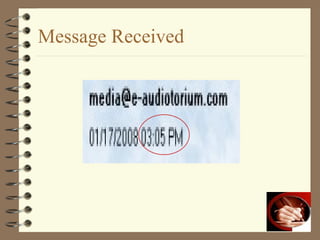
People receive the message... This email is to inform you that the  recording (s) you requested for the telephone conference titled:  Mercon CSA Webinar Call hosted by Andy 01/06/08 at  21:10 a.m .  have been  recorded for you and  were shipped  on or before 01/17/08 at  7:00 p.m .
Message Received
Message Received They shipped my stuff?  They know what I ordered. They finished high school?  Do they want my business again?  They care about me? My immediate thought upon receiving this email?
Compare Dear Susan: Thank you for shopping at Wine Country Gift Baskets.  Below is the status of each item in your order.  You will receive additional emails updating you of the status of you order until all items are shipped.
Message Received Wine Country Gift Baskets knows how to treat me. Wine Country Gift Baskets values my business. My immediate thought upon receiving this email?
Solve a problem Provide information Request information Build a relationship Build Trust - that you’re thinking of their best interests Build Confidence - in your abilities Build Comfort - they feel comfortable with you What are your objectives?
Use a Positive Approach Tell the reader what you  can  do, not what you  can’t . Assume ‘yes’ in every statement: “ If you have any questions, please don’t hesitate to call.” If a negative word (difficulty, problem, impossible) is used,  offer a solution. But   is the ultimate shrouded negative - it negates everything that comes before it in a sentence.
What are her objectives and needs? Will she know my jargon? Will he prefer a casual or professional tone? Is he likely to share my communication with others? Who is your Reader?
Courtesy and Consideration What does your reader already know? Is your reader familiar with your industry’s abbreviations and acronyms? What information might be redundant (and potentially insulting) to include? What does he need to know? Are there unasked questions she may need answered?
What does he NOT need to know? What are your reader’s goals? Tailor your message to reflect that you know what he needs or wants. Is the reader interested in details, or just the bottom line? Tailor your message to meet the reader’s expectations and comfort level. Courtesy and Consideration
It’s not so common anymore Courtesy is only used by those who understand it’s value. The word ‘please’ softens the tone of any command but does not change the message. ‘ Thank you’ is valuable only when attached to a real action. Respect is part of courtesy. Condescension is the antithesis of courtesy.
Messages must be Complete Let’s get together after lunch. Call me sometime! Get this to me A.S.A.P. The most effective messages do not ask the reader to interpret the writer’s meaning. Asking the reader to make assumptions can lead to costly, embarrassing errors.
Make it Clear Clarity is achieved when a reader interprets a message the way the writer intended. Written communication must express the writer’s intent as clearly as possible.
Be Specific General terms are subject to the interpretation of the reader. The IRS reminds us that our tax returns are due in mid-April. Specific language calls attention to and adds emphasis to a statement, and is more memorable. The IRS reminds us that our tax returns are due April 15th.
Efficient Action! Efficiency is saying all that  needs  to be said, and nothing more. It is the opposite of creative writing. Is being curt efficient? Use active verbs, present tense  I hit Joe VS. Joe was hit by me I am  VS.  I will be
Know the definitions of the words you are using to avoid redundancy. ‘ Revert’ means ‘go back’ - so ‘revert back’ is redundant. ‘ Maximum means the ‘most possible’ - ‘maximum possible’ is unnecessary. Efficient Action! Use   ‘ Problems’ OR ‘concerns’ ‘ Help’ OR ‘assistance’ ‘ Study’ OR ‘review’ ‘ Power’ OR ‘energy’ But Not Both
Sentence Structure In every sentence, the focus is the subject . Pay careful attention to the pronouns you use to refer to a subject - they need to agree. A cook who follows a recipe will succeed, but if you ignore the recipe, you’ll fail. All the boys wanted his own bicycle.
Subject and verb agreement The purpose of the verb is to tell what the subject is doing.  Using the wrong form of the verb can throw the meaning of the sentence into question. Subject and verbs must be either all plural, or all singular. A person….they Morals and manners will rise or decline with our attention to grammar.   Jason Chamberlain
What kind of message are you sending? Are you responding to the reader’s needs?  If so, are you meeting all his needs, some of his needs, or none of his needs? Positive Messages You can meet all the reader’s objectives while meeting your own. Neutral Messages You can meet some of his objectives, but need to compromise on others in order to meet your needs. Negative Messages You are unable to meet his needs and your own objectives.
Back to the Objectives - Your Reader’s and Your Own.  Is your objective to get the reader to take an action they might not take otherwise?  Then you are writing a  Persuasive message. Model for Persuasive Messages: Attract the attention and the interest of the reader quickly. Explain your request fully, making sure to justify it. Make it as easy as possible for the reader to grant your request. Request the action with confidence.
Your Subject Line Honest reflection of the content Avoid “Guess what this is about?” vagueness Keep it to a max. of seven (7) words Make it intriguing enough to get the email opened Strive for clarity ‘Meeting time changed’ doesn’t tell the recipient which of their 12 meetings  have been changed!
Email Etiquette Acronyms Very casual Presumptive Inappropriate in a business setting (LMAO) ALL CAPS Exclamation points Emoticons
Email Etiquette Return emails the same day you would return a phone call. Include a salutation or greeting for each ‘new subject’ email, however,  Several ‘back and forth’ messages regarding  the same topic do not need a greeting line with every message.
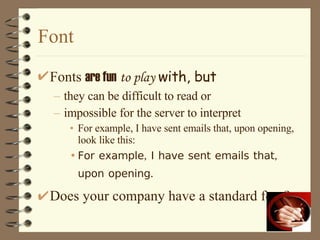
Font Fonts  are fun   to play   with, but   they can be difficult to read or impossible for the server to interpret For example, I have sent emails that, upon opening, look like this: For example, I have sent emails that, upon opening. Does your company have a standard font?
It’s our responsibility From  http://www. millennialliving .com
Bad Email!  Bad, bad email! “ Bad spelling, grammar and capitalization are often a clue to the fraudulent nature of a message.”  www.michaelhorowitz.com/bademails.html
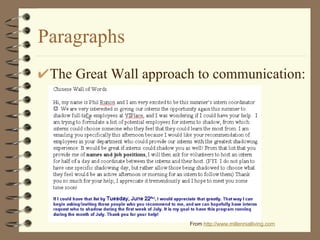
Paragraphs The Great Wall approach to communication: From  http://www. millennialliving .com
Paragraphs - in standard writing A paragraph contains 3-7 sentences that are about the same topic. The most important sentences are the first and the last. Middle sentences support the first sentence.
Paragraphs in Emails In emails, often you have only one or two sentences to offer on a topic before going to a different one. Separate subjects by a space, even if you don’t have a true paragraph. Limit the length of paragraphs in emails in order to increase the likelihood that your note will be read.
Humor & Sarcasm Humor and sarcasm help build rapport between people, however... They must be used carefully in emails. The written word is two-dimensional, without benefit of body language or the speaker’s voice inflections. The reader’s frame of mind at the time they read an item influences the tone of the written word.
Flaming Emails Flaming Emails Flaming is a virtual term for venting emotion online, or sending inflammatory emails.  Creates conflict Unproductive and injurious
Flaming Emails How to avoid sending a flaming email: Would I say this to the person’s face? Am I putting the receiver in an awkward position? How would I feel if I received this email? What if someone other than the intended recipient were to read this?
Email Etiquette When is email the wrong form of communication? Disciplinary action Conflicts or high-emotion topics Complaints When should I ‘Reply to All?’
Email Etiquette When is forwarding an email the wrong action? Consider the topic Requests Jokes - refer to your company’s policy
Email Do’s Determine your goal for the message. Think about your reader’s goals. Be mindful of your tone. Avoid acronyms (LOL). Mind punctuation and capitalization rules! Choose words carefully. Keep it short - one page maximum, usually. Consider how you will be viewed as the sender of your message. Write as though this message will be shared with others.
Email Don’ts Include emoticons Send unnecessary attachments ‘ Respond to All’ unless absolutely necessary Send a flaming message Incriminate yourself
What about Instant Messaging? People are creating a whole new language Great for the PDA’s Not acceptable for business contacts Not acceptable in emails  Language is the roadmap of a culture. It tells you where its people came from and where they are going .  Rita Mae Brown
Whether an email or a document, your message will benefit the most by the last step in the writing process...
Proof Reading and Editing! When finished writing, the efficient communicator  edits  for: Content Tone Sentence Structure Then proof reads for spelling and grammatical errors, etc. Proofing is best done after the writer has edited his piece.
You can be an Effective Email Communicator! Think of your goals Think of your reader Consider the type of message Always edit  for content, tone & sentence structure

Email Etiquette Workshop

  • 1.
    Email Etiquette Becomingfluent in today’s preferred form of business communication
  • 2.
    According to ‘Hitch’Our verbal communication is 60% human non-verbal cues (body language, facial expression) 30% tone of voice 10% what is actually said!
  • 3.
    Electronic Mail It’sthe writer’s responsibility to send a clear message Permanent form of communication. Easily shared. Email can make or break a career. Email sent from your company’s computer is the property of your company.
  • 4.
    Costs Poorly writtenemails cost on average $45,000 annually Extended time to interpret the meaning Printing costs Does NOT include the cost of missed deadlines, offended clients and duplicated effort * 1,000 employees receiving 3-4 bad emails/day From http://www. millennialliving .com Ouch!
  • 5.
    Our Goal(s) asCommunicators People receive the message we mean to send We look good Our company looks good People feel good about us and choose to spend money/resources with us
  • 6.
    People receive themessage... This email is to inform you that the recording (s) you requested for the telephone conference titled: Mercon CSA Webinar Call hosted by Andy 01/06/08 at 21:10 a.m . have been recorded for you and were shipped on or before 01/17/08 at 7:00 p.m .
  • 7.
  • 8.
    Message Received Theyshipped my stuff? They know what I ordered. They finished high school? Do they want my business again? They care about me? My immediate thought upon receiving this email?
  • 9.
    Compare Dear Susan:Thank you for shopping at Wine Country Gift Baskets. Below is the status of each item in your order. You will receive additional emails updating you of the status of you order until all items are shipped.
  • 10.
    Message Received WineCountry Gift Baskets knows how to treat me. Wine Country Gift Baskets values my business. My immediate thought upon receiving this email?
  • 11.
    Solve a problemProvide information Request information Build a relationship Build Trust - that you’re thinking of their best interests Build Confidence - in your abilities Build Comfort - they feel comfortable with you What are your objectives?
  • 12.
    Use a PositiveApproach Tell the reader what you can do, not what you can’t . Assume ‘yes’ in every statement: “ If you have any questions, please don’t hesitate to call.” If a negative word (difficulty, problem, impossible) is used, offer a solution. But is the ultimate shrouded negative - it negates everything that comes before it in a sentence.
  • 13.
    What are herobjectives and needs? Will she know my jargon? Will he prefer a casual or professional tone? Is he likely to share my communication with others? Who is your Reader?
  • 14.
    Courtesy and ConsiderationWhat does your reader already know? Is your reader familiar with your industry’s abbreviations and acronyms? What information might be redundant (and potentially insulting) to include? What does he need to know? Are there unasked questions she may need answered?
  • 15.
    What does heNOT need to know? What are your reader’s goals? Tailor your message to reflect that you know what he needs or wants. Is the reader interested in details, or just the bottom line? Tailor your message to meet the reader’s expectations and comfort level. Courtesy and Consideration
  • 16.
    It’s not socommon anymore Courtesy is only used by those who understand it’s value. The word ‘please’ softens the tone of any command but does not change the message. ‘ Thank you’ is valuable only when attached to a real action. Respect is part of courtesy. Condescension is the antithesis of courtesy.
  • 17.
    Messages must beComplete Let’s get together after lunch. Call me sometime! Get this to me A.S.A.P. The most effective messages do not ask the reader to interpret the writer’s meaning. Asking the reader to make assumptions can lead to costly, embarrassing errors.
  • 18.
    Make it ClearClarity is achieved when a reader interprets a message the way the writer intended. Written communication must express the writer’s intent as clearly as possible.
  • 19.
    Be Specific Generalterms are subject to the interpretation of the reader. The IRS reminds us that our tax returns are due in mid-April. Specific language calls attention to and adds emphasis to a statement, and is more memorable. The IRS reminds us that our tax returns are due April 15th.
  • 20.
    Efficient Action! Efficiencyis saying all that needs to be said, and nothing more. It is the opposite of creative writing. Is being curt efficient? Use active verbs, present tense I hit Joe VS. Joe was hit by me I am VS. I will be
  • 21.
    Know the definitionsof the words you are using to avoid redundancy. ‘ Revert’ means ‘go back’ - so ‘revert back’ is redundant. ‘ Maximum means the ‘most possible’ - ‘maximum possible’ is unnecessary. Efficient Action! Use ‘ Problems’ OR ‘concerns’ ‘ Help’ OR ‘assistance’ ‘ Study’ OR ‘review’ ‘ Power’ OR ‘energy’ But Not Both
  • 22.
    Sentence Structure Inevery sentence, the focus is the subject . Pay careful attention to the pronouns you use to refer to a subject - they need to agree. A cook who follows a recipe will succeed, but if you ignore the recipe, you’ll fail. All the boys wanted his own bicycle.
  • 23.
    Subject and verbagreement The purpose of the verb is to tell what the subject is doing. Using the wrong form of the verb can throw the meaning of the sentence into question. Subject and verbs must be either all plural, or all singular. A person….they Morals and manners will rise or decline with our attention to grammar. Jason Chamberlain
  • 24.
    What kind ofmessage are you sending? Are you responding to the reader’s needs? If so, are you meeting all his needs, some of his needs, or none of his needs? Positive Messages You can meet all the reader’s objectives while meeting your own. Neutral Messages You can meet some of his objectives, but need to compromise on others in order to meet your needs. Negative Messages You are unable to meet his needs and your own objectives.
  • 25.
    Back to theObjectives - Your Reader’s and Your Own. Is your objective to get the reader to take an action they might not take otherwise? Then you are writing a Persuasive message. Model for Persuasive Messages: Attract the attention and the interest of the reader quickly. Explain your request fully, making sure to justify it. Make it as easy as possible for the reader to grant your request. Request the action with confidence.
  • 26.
    Your Subject LineHonest reflection of the content Avoid “Guess what this is about?” vagueness Keep it to a max. of seven (7) words Make it intriguing enough to get the email opened Strive for clarity ‘Meeting time changed’ doesn’t tell the recipient which of their 12 meetings have been changed!
  • 27.
    Email Etiquette AcronymsVery casual Presumptive Inappropriate in a business setting (LMAO) ALL CAPS Exclamation points Emoticons
  • 28.
    Email Etiquette Returnemails the same day you would return a phone call. Include a salutation or greeting for each ‘new subject’ email, however, Several ‘back and forth’ messages regarding the same topic do not need a greeting line with every message.
  • 29.
    Font Fonts are fun to play with, but they can be difficult to read or impossible for the server to interpret For example, I have sent emails that, upon opening, look like this: For example, I have sent emails that, upon opening. Does your company have a standard font?
  • 30.
    It’s our responsibilityFrom http://www. millennialliving .com
  • 31.
    Bad Email! Bad, bad email! “ Bad spelling, grammar and capitalization are often a clue to the fraudulent nature of a message.” www.michaelhorowitz.com/bademails.html
  • 32.
    Paragraphs The GreatWall approach to communication: From http://www. millennialliving .com
  • 33.
    Paragraphs - instandard writing A paragraph contains 3-7 sentences that are about the same topic. The most important sentences are the first and the last. Middle sentences support the first sentence.
  • 34.
    Paragraphs in EmailsIn emails, often you have only one or two sentences to offer on a topic before going to a different one. Separate subjects by a space, even if you don’t have a true paragraph. Limit the length of paragraphs in emails in order to increase the likelihood that your note will be read.
  • 35.
    Humor & SarcasmHumor and sarcasm help build rapport between people, however... They must be used carefully in emails. The written word is two-dimensional, without benefit of body language or the speaker’s voice inflections. The reader’s frame of mind at the time they read an item influences the tone of the written word.
  • 36.
    Flaming Emails FlamingEmails Flaming is a virtual term for venting emotion online, or sending inflammatory emails. Creates conflict Unproductive and injurious
  • 37.
    Flaming Emails Howto avoid sending a flaming email: Would I say this to the person’s face? Am I putting the receiver in an awkward position? How would I feel if I received this email? What if someone other than the intended recipient were to read this?
  • 38.
    Email Etiquette Whenis email the wrong form of communication? Disciplinary action Conflicts or high-emotion topics Complaints When should I ‘Reply to All?’
  • 39.
    Email Etiquette Whenis forwarding an email the wrong action? Consider the topic Requests Jokes - refer to your company’s policy
  • 40.
    Email Do’s Determineyour goal for the message. Think about your reader’s goals. Be mindful of your tone. Avoid acronyms (LOL). Mind punctuation and capitalization rules! Choose words carefully. Keep it short - one page maximum, usually. Consider how you will be viewed as the sender of your message. Write as though this message will be shared with others.
  • 41.
    Email Don’ts Includeemoticons Send unnecessary attachments ‘ Respond to All’ unless absolutely necessary Send a flaming message Incriminate yourself
  • 42.
    What about InstantMessaging? People are creating a whole new language Great for the PDA’s Not acceptable for business contacts Not acceptable in emails Language is the roadmap of a culture. It tells you where its people came from and where they are going . Rita Mae Brown
  • 43.
    Whether an emailor a document, your message will benefit the most by the last step in the writing process...
  • 44.
    Proof Reading andEditing! When finished writing, the efficient communicator edits for: Content Tone Sentence Structure Then proof reads for spelling and grammatical errors, etc. Proofing is best done after the writer has edited his piece.
  • 45.
    You can bean Effective Email Communicator! Think of your goals Think of your reader Consider the type of message Always edit for content, tone & sentence structure

Editor's Notes

  • #2 Welcome, intro self and packets. Ask name, company and biggest email gaff they are aware of.