GAUSSIAN MODEL
Sumeet Khirade
Kabani.K.S
M E Environmental Engineering (semester 1)
Sinhgad College of Engineering, Vadgaon, Pune
19/1/2015
INTRODUCTION
• The Gaussian plume model is a (relatively)
simple mathematical model that is typically
applied to point source emitters, such as coal-
burning electricity-producing plants to
determine the pollution.
• Occasionally, this model will be applied to
non-point source emitters, such as exhaust
from automobiles in an urban area.
29/1/2015
What is mathematical modeling?
When the process of problem reduction or
solution involves transforming some idealized
form of the real world situation into mathematical
terms,it goes under generic name of mathematical
modeling.
39/1/2015
Air Quality Modeling (AQM)
• Predict pollutant concentrations at various
locations around the source.
• Identify source contribution to air quality
problems.
• Access source impacts and design control
strategies.
• Predict future pollutant concentrations from
sources after implementation of new
regulatory programs.
49/1/2015
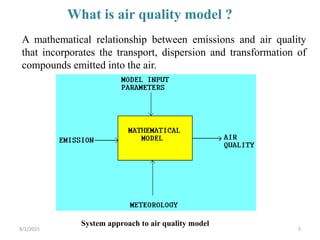
System approach to air quality model
What is air quality model ?
A mathematical relationship between emissions and air quality
that incorporates the transport, dispersion and transformation of
compounds emitted into the air.
59/1/2015
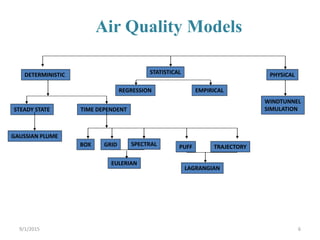
Air Quality Models
DETERMINISTIC STATISTICAL PHYSICAL
STEADY STATE TIME DEPENDENT
REGRESSION EMPIRICAL
WINDTUNNEL
SIMULATION
GAUSSIAN PLUME
BOX GRID PUFF TRAJECTORYSPECTRAL
LAGRANGIAN
EULERIAN
69/1/2015
The deterministic mathematical models calculate the
pollutant concentrations from emission inventory and
meteorological variables according to the solution of
various equations that represent the relevant physical
processes.
Deterministic modeling is the traditional approach for
the prediction of air pollutant concentrations in urban
areas.
What is deterministic approach?
79/1/2015
8
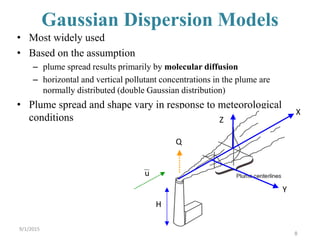
Gaussian Dispersion Models
• Most widely used
• Based on the assumption
– plume spread results primarily by molecular diffusion
– horizontal and vertical pollutant concentrations in the plume are
normally distributed (double Gaussian distribution)
• Plume spread and shape vary in response to meteorological
conditions
H
X
Y
Z
u
Q
9/1/2015
99/1/2015
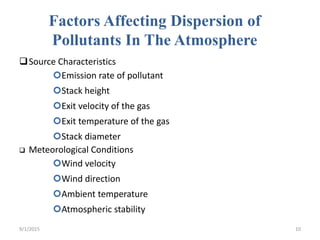
Factors Affecting Dispersion of
Pollutants In The Atmosphere
Source Characteristics
Emission rate of pollutant
Stack height
Exit velocity of the gas
Exit temperature of the gas
Stack diameter
 Meteorological Conditions
Wind velocity
Wind direction
Ambient temperature
Atmospheric stability
9/1/2015 10
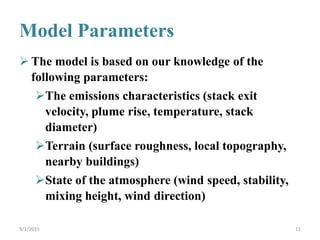
Model Parameters
 The model is based on our knowledge of the
following parameters:
The emissions characteristics (stack exit
velocity, plume rise, temperature, stack
diameter)
Terrain (surface roughness, local topography,
nearby buildings)
State of the atmosphere (wind speed, stability,
mixing height, wind direction)
9/1/2015 11
12
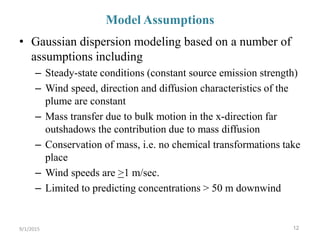
Model Assumptions
• Gaussian dispersion modeling based on a number of
assumptions including
– Steady-state conditions (constant source emission strength)
– Wind speed, direction and diffusion characteristics of the
plume are constant
– Mass transfer due to bulk motion in the x-direction far
outshadows the contribution due to mass diffusion
– Conservation of mass, i.e. no chemical transformations take
place
– Wind speeds are >1 m/sec.
– Limited to predicting concentrations > 50 m downwind
9/1/2015
The Diffusion Equation and the
Gaussian Plume Model
13
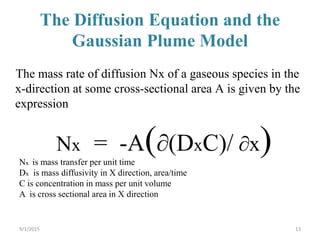
The mass rate of diffusion Nx of a gaseous species in the
x-direction at some cross-sectional area A is given by the
expression
Nx = -A(∂(DxC)/ ∂x)Nx is mass transfer per unit time
Dx is mass diffusivity in X direction, area/time
C is concentration in mass per unit volume
A is cross sectional area in X direction
9/1/2015
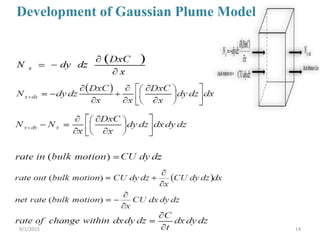
Development of Gaussian Plume Model
149/1/2015
15
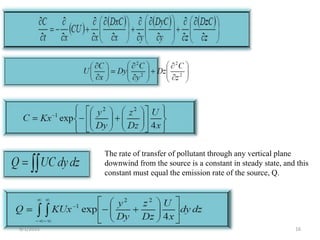
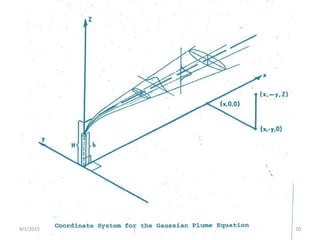
Where; x = along- wind coordinate measured in wind direction from the source
y = cross-wind coordinate direction
z = vertical coordinate measured from the ground
C(x,y,z) = mean concentration of diffusing substance at a point (x,y,z) [kg/m3]
Dy,Dz = mass diffusivity in the direction of the y- and z- axes [m2/s]
U = mean wind velocity along the x-axis [m/s]
Time rate of change and advection of the cloud by the mean wind
Turbulent diffusion of material relative to the center of the pollutant
cloud.( the cloud will expand over time due to these terms.)
9/1/2015
16
The rate of transfer of pollutant through any vertical plane
downwind from the source is a constant in steady state, and this
constant must equal the emission rate of the source, Q.
9/1/2015
17
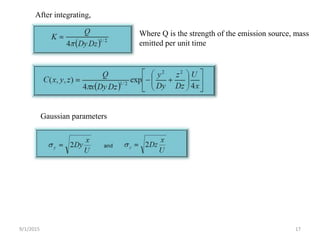
Where Q is the strength of the emission source, mass
emitted per unit time
After integrating,
Gaussian parameters
9/1/2015
18
Where;
c( x, y, z ) = mean concentration of diffusing substance at a point ( x, y, z ) [kg/m3]
x = downwind distance [m],
y = crosswind distance [m],
z = vertical distance above ground [m],
Q = contaminant emission rate [mass/s],
σx = lateral dispersion coefficient function [m],
σy = vertical dispersion coefficient function [m],
U = mean wind velocity in downwind direction [m/s],
H = effective stack height [m].
9/1/2015
199/1/2015
209/1/2015
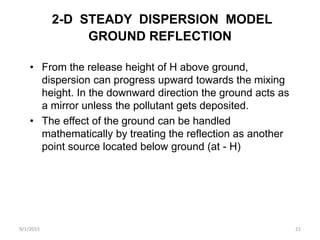
2-D STEADY DISPERSION MODEL
GROUND REFLECTION
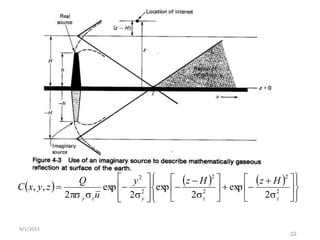
• From the release height of H above ground,
dispersion can progress upward towards the mixing
height. In the downward direction the ground acts as
a mirror unless the pollutant gets deposited.
• The effect of the ground can be handled
mathematically by treating the reflection as another
point source located below ground (at - H)
9/1/2015 21
22
     




































 2
2
2
2
2
2
2
exp
2
exp
2
exp
2
,,
zzyzy
HzHzy
u
Q
zyxC
9/1/2015
23
Gaussian Dispersion Equation
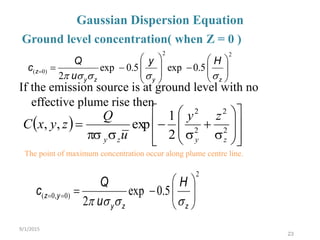
If the emission source is at ground level with no
effective plume rise then
 





















 2
2
2
2
2
1
exp,,
zyzy
zy
u
Q
zyxC
Ground level concentration( when Z = 0 )
The point of maximum concentration occur along plume centre line.
9/1/2015
2
)0,0( 5.0exp
2 






zzy
yz
H
u
Q
c

22
)0( 5.0exp5.0exp
2 















zyzy
z
Hy
u
Q
c

249/1/2015
259/1/2015
269/1/2015
279/1/2015
289/1/2015
299/1/2015
309/1/2015
31
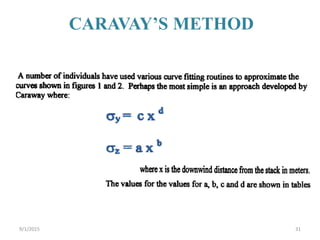
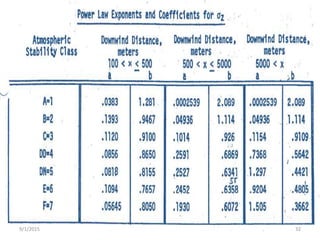
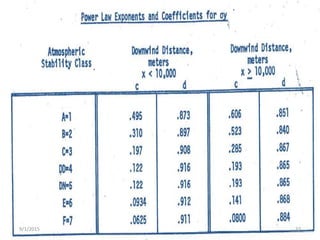
CARAVAY’S METHOD
9/1/2015
329/1/2015
339/1/2015
34
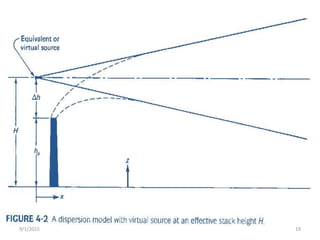
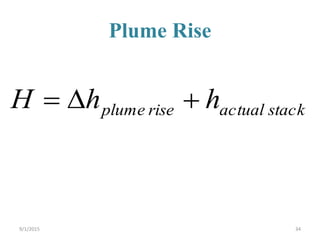
Plume Rise
stackactualriseplume hhH 
9/1/2015
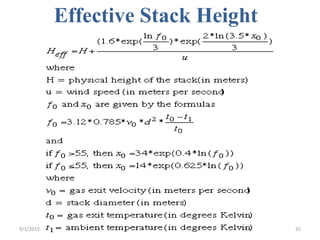
Effective Stack Height
359/1/2015
369/1/2015
379/1/2015
389/1/2015
Advantages of Gaussian model
Produce results that match closely with experimental data
Simple in their mathematics
Quicker than numerical models
Do not require super computers
Disadvantages of Gaussian model
 Not suitable if the pollutant is reactive in nature
 Unable to predict concentrations beyond radius of approximately
20 Km
 For greater distances, wind variations, mixing depths and
temporal variations become predominant
399/1/2015
Conclusion
• Air pollution in cities is a serious public health
problem. Therefore, there is need for reliable
air quality management system for abatement
of urban air pollution problem
• Gaussian plume model is a very effective
method in determining pollutant
concentrations in atmosphere.
• Gaussian model is the most widely used AQM
to predict pollutant concentrations.
409/1/2015
REFERENCES
• Weber, E., “Air pollution assessment modeling methodology”, NATO,
challenges of modern society, vol.2, Plenum press, 1982
• Chastain, J.P. 1999. Air Quality and Odor Control from Swine Production
Facilities. chapter 9 in Confined Animal Manure Managers Certification
Program Manual, Clemson University, Clemson SC, pp 9-1 to 9-11,
http//hubcap.clemson.edu/scafrs/Peedee/certifi/CAMM.html.
• www.mfe.govt
• http://www.csiir.ornl.gov
• Rao, M.N. and Rao, H. V. N., 1993. Air Pollution, Tata Mc-Graw Hill, New
Delhi.
• Murty, B. P., 2004. Environmental Meteorology, I.K. International Pvt.
Ltd., New Delhi.
419/1/2015
THANK YOU
429/1/2015

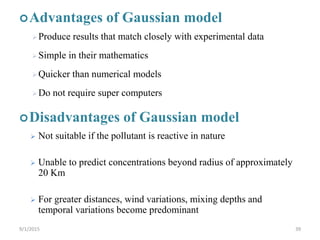
Gaussian model (kabani & sumeet)

  • 1.
    GAUSSIAN MODEL Sumeet Khirade Kabani.K.S ME Environmental Engineering (semester 1) Sinhgad College of Engineering, Vadgaon, Pune 19/1/2015
  • 2.
    INTRODUCTION • The Gaussianplume model is a (relatively) simple mathematical model that is typically applied to point source emitters, such as coal- burning electricity-producing plants to determine the pollution. • Occasionally, this model will be applied to non-point source emitters, such as exhaust from automobiles in an urban area. 29/1/2015
  • 3.
    What is mathematicalmodeling? When the process of problem reduction or solution involves transforming some idealized form of the real world situation into mathematical terms,it goes under generic name of mathematical modeling. 39/1/2015
  • 4.
    Air Quality Modeling(AQM) • Predict pollutant concentrations at various locations around the source. • Identify source contribution to air quality problems. • Access source impacts and design control strategies. • Predict future pollutant concentrations from sources after implementation of new regulatory programs. 49/1/2015
  • 5.
    System approach toair quality model What is air quality model ? A mathematical relationship between emissions and air quality that incorporates the transport, dispersion and transformation of compounds emitted into the air. 59/1/2015
  • 6.
    Air Quality Models DETERMINISTICSTATISTICAL PHYSICAL STEADY STATE TIME DEPENDENT REGRESSION EMPIRICAL WINDTUNNEL SIMULATION GAUSSIAN PLUME BOX GRID PUFF TRAJECTORYSPECTRAL LAGRANGIAN EULERIAN 69/1/2015
  • 7.
    The deterministic mathematicalmodels calculate the pollutant concentrations from emission inventory and meteorological variables according to the solution of various equations that represent the relevant physical processes. Deterministic modeling is the traditional approach for the prediction of air pollutant concentrations in urban areas. What is deterministic approach? 79/1/2015
  • 8.
    8 Gaussian Dispersion Models •Most widely used • Based on the assumption – plume spread results primarily by molecular diffusion – horizontal and vertical pollutant concentrations in the plume are normally distributed (double Gaussian distribution) • Plume spread and shape vary in response to meteorological conditions H X Y Z u Q 9/1/2015
  • 9.
  • 10.
    Factors Affecting Dispersionof Pollutants In The Atmosphere Source Characteristics Emission rate of pollutant Stack height Exit velocity of the gas Exit temperature of the gas Stack diameter  Meteorological Conditions Wind velocity Wind direction Ambient temperature Atmospheric stability 9/1/2015 10
  • 11.
    Model Parameters  Themodel is based on our knowledge of the following parameters: The emissions characteristics (stack exit velocity, plume rise, temperature, stack diameter) Terrain (surface roughness, local topography, nearby buildings) State of the atmosphere (wind speed, stability, mixing height, wind direction) 9/1/2015 11
  • 12.
    12 Model Assumptions • Gaussiandispersion modeling based on a number of assumptions including – Steady-state conditions (constant source emission strength) – Wind speed, direction and diffusion characteristics of the plume are constant – Mass transfer due to bulk motion in the x-direction far outshadows the contribution due to mass diffusion – Conservation of mass, i.e. no chemical transformations take place – Wind speeds are >1 m/sec. – Limited to predicting concentrations > 50 m downwind 9/1/2015
  • 13.
    The Diffusion Equationand the Gaussian Plume Model 13 The mass rate of diffusion Nx of a gaseous species in the x-direction at some cross-sectional area A is given by the expression Nx = -A(∂(DxC)/ ∂x)Nx is mass transfer per unit time Dx is mass diffusivity in X direction, area/time C is concentration in mass per unit volume A is cross sectional area in X direction 9/1/2015
  • 14.
    Development of GaussianPlume Model 149/1/2015
  • 15.
    15 Where; x =along- wind coordinate measured in wind direction from the source y = cross-wind coordinate direction z = vertical coordinate measured from the ground C(x,y,z) = mean concentration of diffusing substance at a point (x,y,z) [kg/m3] Dy,Dz = mass diffusivity in the direction of the y- and z- axes [m2/s] U = mean wind velocity along the x-axis [m/s] Time rate of change and advection of the cloud by the mean wind Turbulent diffusion of material relative to the center of the pollutant cloud.( the cloud will expand over time due to these terms.) 9/1/2015
  • 16.
    16 The rate oftransfer of pollutant through any vertical plane downwind from the source is a constant in steady state, and this constant must equal the emission rate of the source, Q. 9/1/2015
  • 17.
    17 Where Q isthe strength of the emission source, mass emitted per unit time After integrating, Gaussian parameters 9/1/2015
  • 18.
    18 Where; c( x, y,z ) = mean concentration of diffusing substance at a point ( x, y, z ) [kg/m3] x = downwind distance [m], y = crosswind distance [m], z = vertical distance above ground [m], Q = contaminant emission rate [mass/s], σx = lateral dispersion coefficient function [m], σy = vertical dispersion coefficient function [m], U = mean wind velocity in downwind direction [m/s], H = effective stack height [m]. 9/1/2015
  • 19.
  • 20.
  • 21.
    2-D STEADY DISPERSIONMODEL GROUND REFLECTION • From the release height of H above ground, dispersion can progress upward towards the mixing height. In the downward direction the ground acts as a mirror unless the pollutant gets deposited. • The effect of the ground can be handled mathematically by treating the reflection as another point source located below ground (at - H) 9/1/2015 21
  • 22.
    22                                           2 2 2 2 2 2 2 exp 2 exp 2 exp 2 ,, zzyzy HzHzy u Q zyxC 9/1/2015
  • 23.
    23 Gaussian Dispersion Equation Ifthe emission source is at ground level with no effective plume rise then                         2 2 2 2 2 1 exp,, zyzy zy u Q zyxC Ground level concentration( when Z = 0 ) The point of maximum concentration occur along plume centre line. 9/1/2015 2 )0,0( 5.0exp 2        zzy yz H u Q c  22 )0( 5.0exp5.0exp 2                 zyzy z Hy u Q c 
  • 24.
  • 25.
  • 26.
  • 27.
  • 28.
  • 29.
  • 30.
  • 31.
  • 32.
  • 33.
  • 34.
  • 35.
  • 36.
  • 37.
  • 38.
  • 39.
    Advantages of Gaussianmodel Produce results that match closely with experimental data Simple in their mathematics Quicker than numerical models Do not require super computers Disadvantages of Gaussian model  Not suitable if the pollutant is reactive in nature  Unable to predict concentrations beyond radius of approximately 20 Km  For greater distances, wind variations, mixing depths and temporal variations become predominant 399/1/2015
  • 40.
    Conclusion • Air pollutionin cities is a serious public health problem. Therefore, there is need for reliable air quality management system for abatement of urban air pollution problem • Gaussian plume model is a very effective method in determining pollutant concentrations in atmosphere. • Gaussian model is the most widely used AQM to predict pollutant concentrations. 409/1/2015
  • 41.
    REFERENCES • Weber, E.,“Air pollution assessment modeling methodology”, NATO, challenges of modern society, vol.2, Plenum press, 1982 • Chastain, J.P. 1999. Air Quality and Odor Control from Swine Production Facilities. chapter 9 in Confined Animal Manure Managers Certification Program Manual, Clemson University, Clemson SC, pp 9-1 to 9-11, http//hubcap.clemson.edu/scafrs/Peedee/certifi/CAMM.html. • www.mfe.govt • http://www.csiir.ornl.gov • Rao, M.N. and Rao, H. V. N., 1993. Air Pollution, Tata Mc-Graw Hill, New Delhi. • Murty, B. P., 2004. Environmental Meteorology, I.K. International Pvt. Ltd., New Delhi. 419/1/2015
  • 42.