![OBJECTIVE OF ATMOSPHERIC CHEMISTRY MODELS: QUANTIFY THE CONCENTRATIONS AND FLUXES OF ATMOSPHERIC SPECIES IN TIME AND SPACE Fires Land biosphere Human activity Lightning Ocean physics chemistry biology Volcanoes MEASURES OF ATMOSPHERIC CONCENTRATIONS: Number density n i (x, t ) [molecules cm -3 ] Mixing ratio (mole fraction) C i (x, t ) [mol/mol]](https://image.slidesharecdn.com/atmospheric-chemistry-models-1226866561560809-9/85/Atmospheric-Chemistry-Models-2-320.jpg)





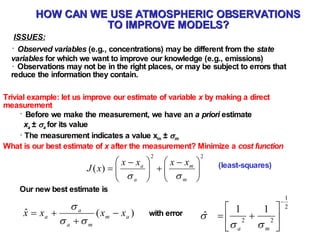
![INVERSE MODELING: GENERALIZATION OF CONCEPT Chemical data assimilation follows the same principle with x = y (optimize gridded field of y from observations of y). Method is then called Kalman filter . In advanced data assimilation, one wishes to optimize y( t o ) from multiple observations at t [ t o , t o + t ] in a non-linear model; this requires local linearization at t with a tangent linear (or adjoint ) model. Consider a state vector x, observation vector y which is linear function of x: K is a Jacobian matrix from our atmospheric chemistry model (termed the forward model ). If model is not linear, linearize it about a ref. point is the observational error vector Let S a , S be the error covariance matrices on the a priori x a and on the observations y: then the best estimate of x after the observations is with error covariance matrix](https://image.slidesharecdn.com/atmospheric-chemistry-models-1226866561560809-9/85/Atmospheric-Chemistry-Models-15-320.jpg)
![METHYL IODIDE: TRACER OF MARINE CONVECTION IN GLOBAL ATMOSPHERIC MODELS Loss by photolysis (~4 days), relatively uniform ocean source, large aircraft data base [D.R. Blake, UCI] Observations Model (GEOS-CHEM) Define Marine Convection Index (MCI) as ratio of upper tropospheric (8-12 km) to lower tropospheric (0-2.5 km) CH 3 I concentrations MCI over Pacific ranges from 0.11 (Easter Island dry season) to 0.40 (observations over tropical Pacific) GEOS-CHEM reproduces observed MCI with little global bias (+11%) but poor correlation (r 2 = 0.15, n=11) Bell et al. [2002] MCI: 0.40 (obs) 0.22 (mod) MCI: 0.16 (obs) 0.14 (mod)](https://image.slidesharecdn.com/atmospheric-chemistry-models-1226866561560809-9/85/Atmospheric-Chemistry-Models-17-320.jpg)
![LONG-RANGE TRANSPORT OF POLLUTION: SURFACE OZONE ENHANCEMENTS CAUSED BY ANTHROPOGENIC EMISSIONS FROM DIFFERENT CONTINENTS GEOS-CHEM model, July 1997 North America Europe Asia Li et al. [2001] Li et al. [2002]](https://image.slidesharecdn.com/atmospheric-chemistry-models-1226866561560809-9/85/Atmospheric-Chemistry-Models-18-320.jpg)
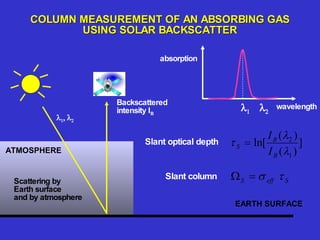

![IN SCATTERING ATMOSPHERE, AMF CALCULATION REQUIRES MODEL INFORMATION ON THE SHAPE OF THE VERTICAL PROFILE: d (z) I o I B EARTH SURFACE RADIATIVE TRANSFER MODEL Scattering weight ATMOSPHERIC CHEMISTRY MODEL Shape factor z number density n(z) Palmer et al. [2001]](https://image.slidesharecdn.com/atmospheric-chemistry-models-1226866561560809-9/85/Atmospheric-Chemistry-Models-21-320.jpg)
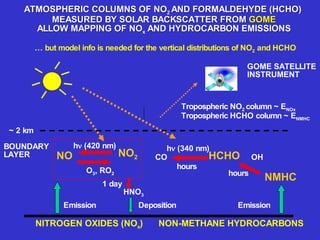
![CAN WE USE GOME TO ESTIMATE NO x EMISSIONS? TEST IN U.S. WHERE GOOD A PRIORI EXISTS Comparison of GOME retrieval (July 1996) to GEOS-CHEM model fields using EPA emission inventory for NO x GOME GEOS-CHEM (EPA emissions) BIAS = +3% R = 0.79 Martin et al. [2002]](https://image.slidesharecdn.com/atmospheric-chemistry-models-1226866561560809-9/85/Atmospheric-Chemistry-Models-23-320.jpg)
![GOME RETRIEVAL OF TROPOSPHERIC NO 2 vs. GEOS-CHEM SIMULATION (July 1996) GEIA emissions scaled to 1996 Martin et al. [2002]](https://image.slidesharecdn.com/atmospheric-chemistry-models-1226866561560809-9/85/Atmospheric-Chemistry-Models-24-320.jpg)
![FORMALDEHYDE COLUMNS FROM GOME: July 1996 means BIOGENIC ISOPRENE IS THE MAIN SOURCE OF HCHO IN U.S. IN SUMMER Palmer et al. [2001]](https://image.slidesharecdn.com/atmospheric-chemistry-models-1226866561560809-9/85/Atmospheric-Chemistry-Models-25-320.jpg)
![MAPPING OF ISOPRENE EMISSIONS FOR JULY 1996 BY SCALING OF GOME FORMALDEHYDE COLUMNS [Palmer et al., 2002] GEIA (IGAC inventory) BEIS2 GOME COMPARE TO…](https://image.slidesharecdn.com/atmospheric-chemistry-models-1226866561560809-9/85/Atmospheric-Chemistry-Models-26-320.jpg)
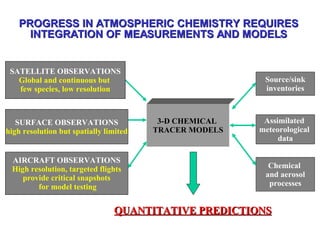
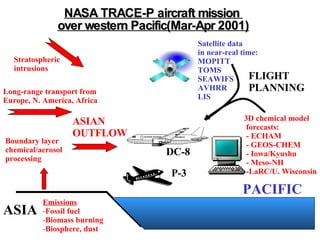

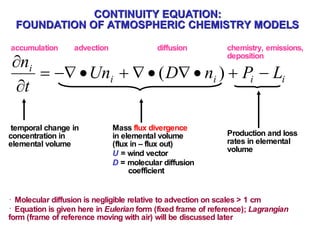
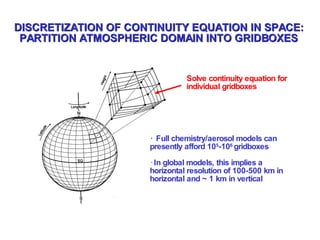
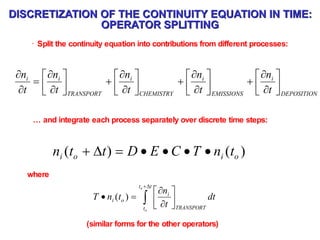
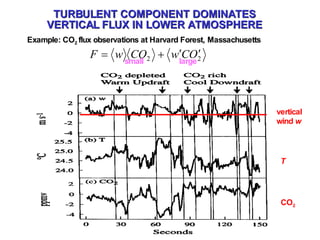
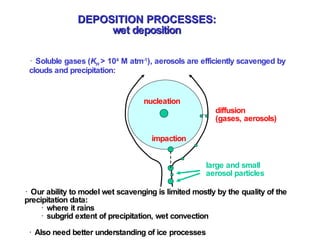
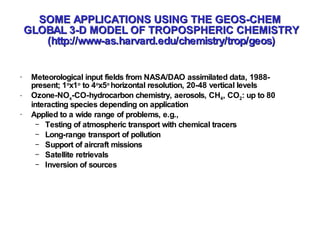
This document discusses atmospheric chemistry models and their use in quantifying atmospheric concentrations and fluxes. Global 3D models divide the atmosphere into grid boxes and use the continuity equation to track species concentrations over time, accounting for transport, chemistry, emissions and deposition. Transport is parameterized using turbulence and convection schemes. Chemistry is solved using operator splitting and implicit methods. Models are evaluated and improved using atmospheric observations from satellites, aircraft and surface sites through data assimilation techniques like inverse modeling. Examples are given of various applications of the GEOS-CHEM global model.


![PLEISTOCENE GLACIATION[2].pptx](https://cdn.slidesharecdn.com/ss_thumbnails/pleistoceneglaciation2-230427185954-e5deb48d-thumbnail.jpg?width=640&height=640&fit=bounds)


