Digital Journalism

        Steve Buttry
    University of Colorado
      October 19, 2012
          #cudigital
Read more about it
•   stevebuttry.wordpress.com
•   slideshare.net/stevebuttry
•   @stevebuttry
•   stephenbuttry@gmail.com
Plan for the day
1.   How a digital newsroom works
2.   Digital news strategy
3.   Working digital-first
4.   Digital tools for today’s journalists
5.   Social media tools & techniques
6.   Launching your career in digital
     journalism
The Digital Newsroom
What’s important?
•   What’s happening now?
•   Engagement & collaboration
•   Unique content (enterprise, analysis)
•   Measuring performance
•   Strong values
•   Experimentation w/ tools & techniques
•   Workflow: process & standards
What’s happening now?
•   Livestreaming
•   Liveblogging
•   Live chats
•   Alerts
•   Feed tweets into site
Engagement & collaboration
• Join, stimulate, lead & curate the
  community conversation
• Crowdsourcing stories
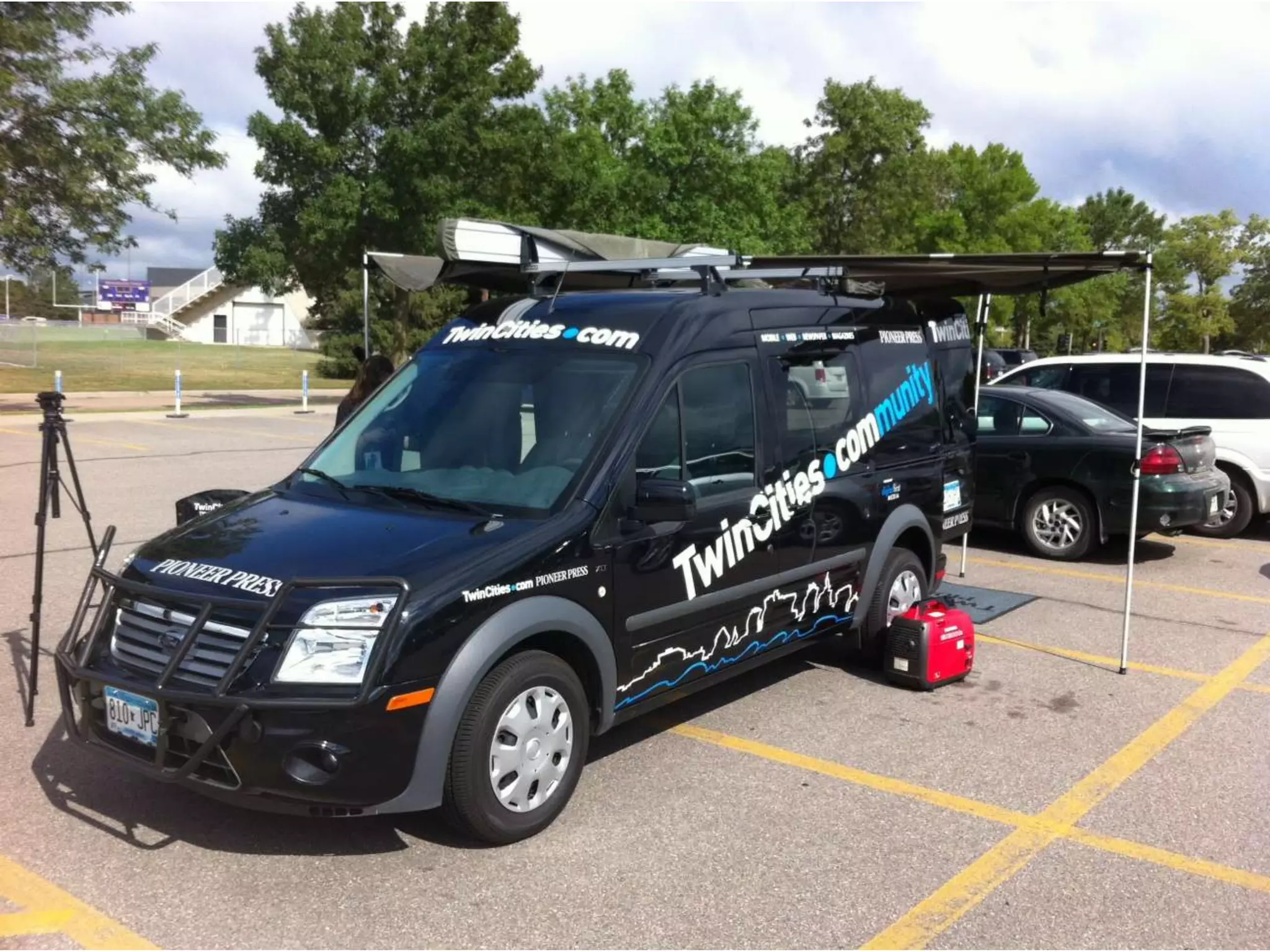
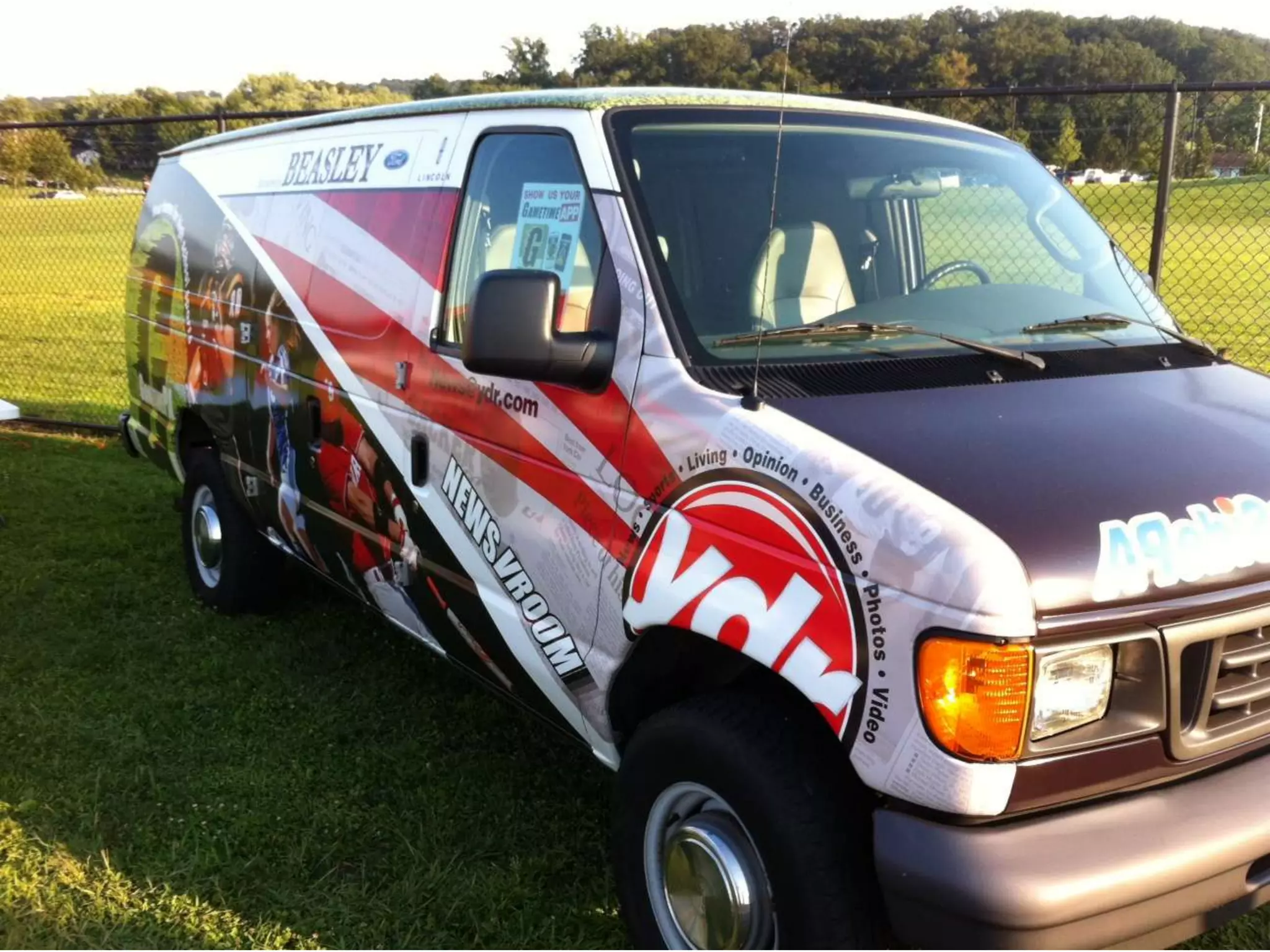
• Community newsrooms
• Mobile newsrooms
Engagement & collaboration
• Join, stimulate, lead & curate the
  community conversation
• Crowdsourcing stories
• Community newsrooms
• Mobile newsrooms
• Network w/ community blogs
Unique content
• Commodity content has little value
  (curation can add value)
• Databases (answerbases) have greater
  shelf life
• Lead conversation around enterprise
• Do what you do best & link to the rest
  (Jeff Jarvis)
Measuring performance
• Metrics have always mattered
• Understand what metrics say & what
  they don’t
• Seek multiple metrics
• Learn from metrics, but they don’t
  override values
• Recognize flukes & don’t overreact
Some values don’t change


“Seek truth & report it.”
                – SPJ Code of Ethics
Digital-first values
•   Accuracy         • Watchdog role
•   Truth            • First Amendment
•   Attribution      • Timeliness &
•   Transparency       reflection
•   Identification   • Civility & respect
•   Fairness         • Diversity
•   Community        • Skepticism
Can we raise standards?
• Does he-said-she-said story really seek &
  report truth?
• Is the “view from nowhere” honest?
• Dan Gillmor suggests replacing
  “objectivity” w/ transparency, fairness,
  accuracy, thoroughness
Digital news strategy
Clay Shirky:

 “Nothing will work,
but everything might.”
John Paton:

 “You don’t tinker or tweak a
broken model. You start again
           anew.”
Digital First principles
• Digital First & print last
• Put the digital people in charge
• Engage the community
• Core competencies: Local content & local
  sales
• If it’s not core: reduce it, stop it, sell it or
  outsource it
Foundation to build on:
•   Strong brands
•   Local content
•   Local sales force
•   Journalistic integrity
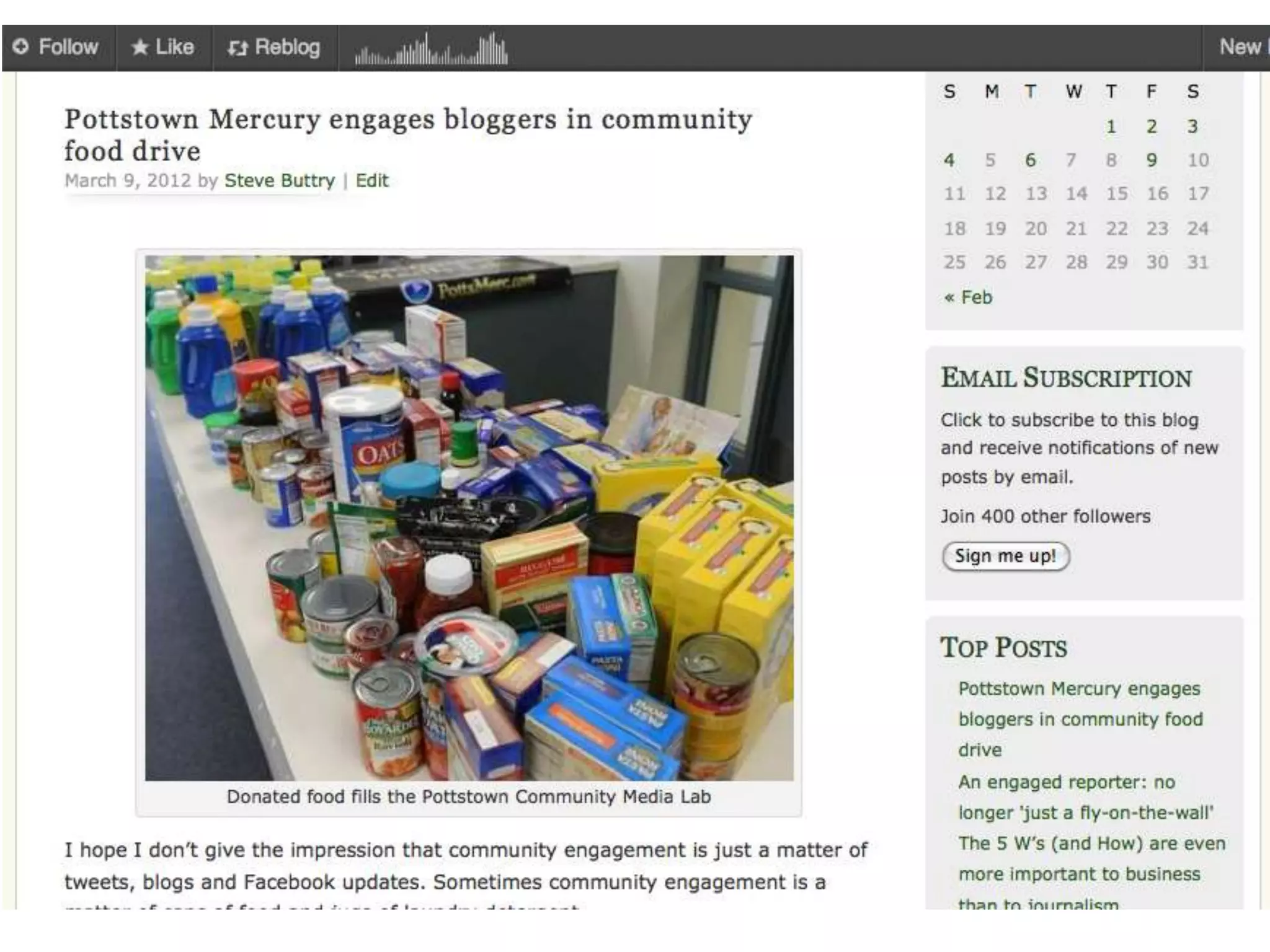
Engagement = value
     • Computers & archives for
       community use
     • Open news meetings
     • Blog network
     • Classes
     • Digital audience 5x print
     • From loss to profit
What engagement is
Community engagement = News orgs make
top priority to listen, to join, lead & enable
conversation to elevate journalism.
What engagement isn’t
• Promotion (though it has promotional
  value)
• Distribution of content (though you
  should)
• Purely a digital pursuit (it uses digital
  tools along w/ traditional ones)
What engagement is
Community engagement = News orgs
make top priority to listen, to join,
lead & enable conversation to elevate
journalism.
Avenues of Engagement
•   Social media    •   Content submissions
•   Blogs           •   Interactive content
•   Crowdsourcing   •   Voting, contests
•   Breaking news   •   Comments
•   Stories         •   Schools, groups
•   Events          •   Feedback
•   Curation        •   Print
•   Aggregation     •   Face to face
Jim Brady:

“There's no silver bullet.
 There's just shrapnel.”
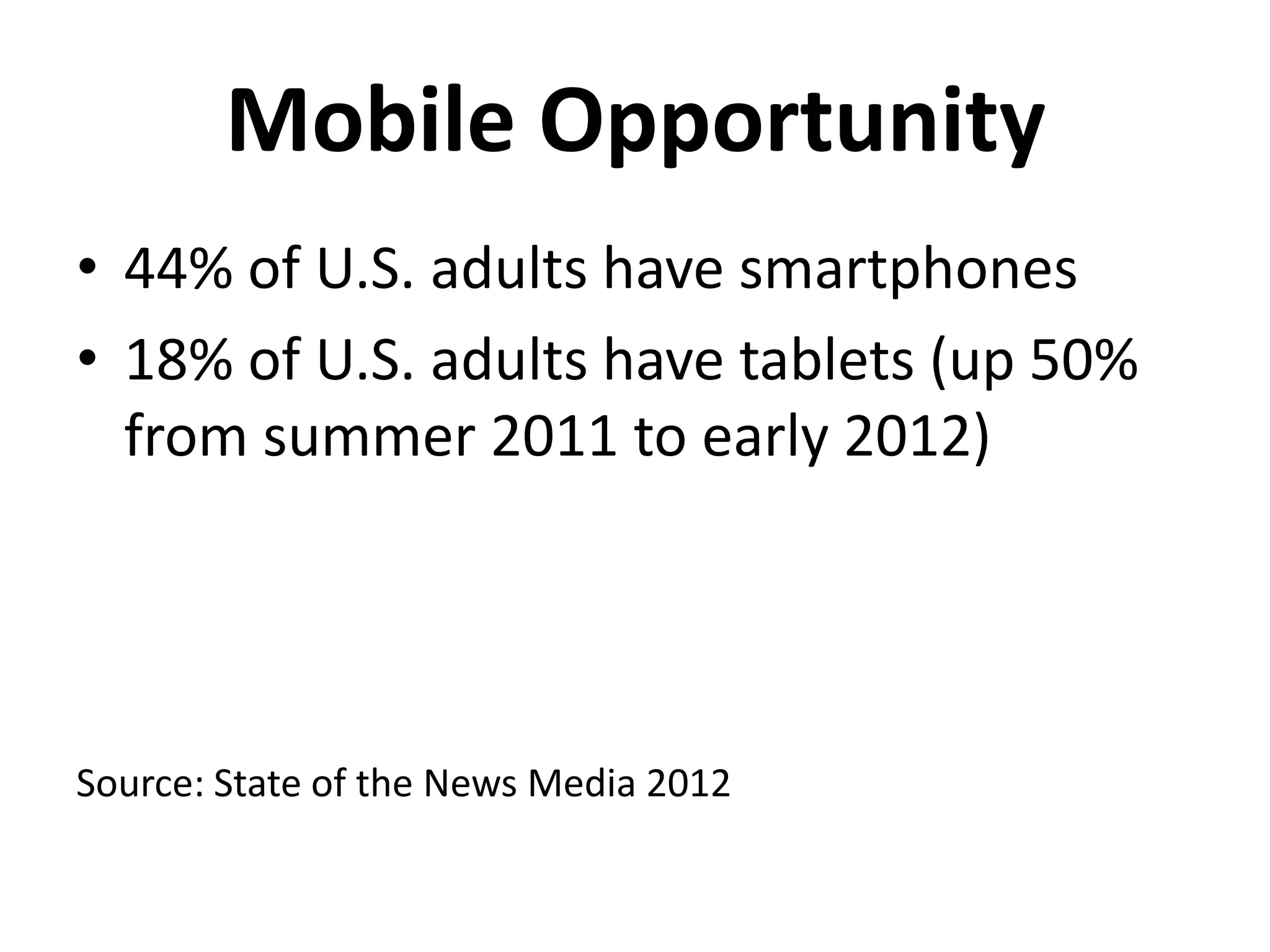
Mobile Opportunity
• 44% of U.S. adults have smartphones
• 18% of U.S. adults have tablets (up 50%
  from summer 2011 to early 2012)


Source: State of the News Media 2012
Mobile-first strategy
•   Text alerts
•   Email
•   Applications (phones & tablets)
•   Social media (tweets, check-ins, tips)
•   Location-based news, info & commerce
•   Easy-to-use mobile websites
•   Device-flexible (not device-agnostic)
•   Games (phones, iPads great for games)
Personal content
•   Births             • Divorce
•   Youth milestones   • Jobs, pets, holidays, fo
•   School               od, interests, health
•   Graduation         • Illness
•   College life       • Empty nesters
•   Military service   • Retirement
•   Weddings           • Reunions
•   Parenthood         • Obituaries
Life stories
• Commissioned obits (journalist tells life
  story, paid by family)
• Obituary, website, booklet, video
• Not just obits:
  weddings, retirements, anniversaries, mil
  estones
Newspaper Next
N2 lessons for Digital First

• Jobs to be done = opportunities
• “Good enough” opens doors to new
  avenues of excellence
• Potential markets exceed what you can
  imagine (or what research can project)
• “Beware the sucking sound of the core”
Working Digital-First
Thinking digital-first
• Story is, as Jeff Jarvis says, a process, not a
  product
• It’s great to be first w/ story or the idea, but
  otherwise link
• Community = collaborators
• Lots of RTs or a prominent link are better than
  front-page story
• How can you use new tools to do better
  stories?
Working digital-first
• Create content for digital platforms (web,
  email, SMS, social, mobile)
• Produce print & broadcast products from
  content on digital platforms
• Live coverage of events
• Breaking news coverage
• Engage community
Court reporter
• Live-tweet from courtroom (narrative,
  not a transcript)
• Feed tweets into liveblog
• Big development: Text news alert to
  editor
• Write summary or analysis story for web
  & print
Why to liveblog
•   Immediacy
•   News value
•   Storytelling
•   Traffic
•   Community engagement, loyalty
•   Interactivity
•   Saving time
Liveblog formats
• Update (time-stamp, reverse-chron) in
  blog or story template
• Use CoverItLive
• Use ScribbleLive
• Live-tweet (on Twitter or feeding blog)
• Video stream (w/liveblog)
• Raw, edited or moderated
Tips, techniques
•   Short, frequent takes
•   Space isn’t an issue; engagement is
•   Liveblog becomes notebook
•   Consider links, polls, photos, audio, video
•   Promote live & replays
•   Tweet links to liveblog & replay
•   OK to step away for question, video, etc.
Liveblog & print story
• Liveblog is notebook: cut, paste & edit
• Note when you know you’ve written
  good lead or passage for story
• Does summary (w/ web plug) work for
  print?
• Plug “complete coverage” in liveblog
Liveblogging issues
• Accuracy (stress verification, ask
  questions, seek links & documentation,
  correct quickly and candidly)
• Rough copy
• Sports credentials
• Multi-tasking
• Learning curve
Court reporter, no trial
• Traditional rounds: lawyers, judges,
  clerks, filings
• Add #DigitalFirst rounds: monitor tweets,
  search Twitter, Facebook groups & pages
• Tweet/alert/blog big filings
• Video clips in interviews
• Scan or download docs if not online
Beat reporter
•   Beatblog
•   Liveblog meetings, events
•   Tweet/alert/liveblog breaking news
•   Live chat on continuing stories
•   Data visualization
•   Curate community conversation
Beat reporter questions
• How to crowdsource story?
• What terms, hashtags should you search
  (routinely & for each story)?
• Regular/special hashtags to use?
• People to follow? New FB pages/groups?
• Other social media to search (YouTube,
  Flickr, Foursquare, Google+ …)?
Visual journalist
•   Shoot first w/ smartphone & post
•   Shoot w/ camera for slideshow & print
•   Shoot video
•   Record ambient sound, interviews
•   If disaster, shoot some after shots for
    before/after
Digital Journalism
Tools & Techniques
              Steve Buttry
University of Texas-Arlington Shorthorn
            August 14, 2012
             #utashorthorn
Text
•   Stories       •   Quizzes
•   Lists         •   Chats
•   Headlines     •   Tweets
•   Captions      •   FB updates
•   Liveblog      •   Text on video
•   Comments      •   Text in graphics
•   Polls         •   Links
Audio
•   Podcast
•   Audio clips
•   Audio w/ slides
•   Soundtrack on video
•   Google voice
Visuals
•   Photos                •   Maps
•   Slideshows            •   Instagram
•   Videos                •   Flickr
•   Animations            •   YouTube
•   Graphics              •   Facebook
•   Data visualizations   •   Pinterest
•   Screenshots           •   Twitter
Data
•   Think of answerbases, not databases
•   Data personalizes story for readers
•   Data gives lasting value to reporting
•   Caspio is plug & play database tool
•   DataViz & Visual.ly
•   Google Fusion maps
•   Google Docs & Forms
Factors in blogging success
•   Idea       •   Links
•   Format     •   Voice
•   Headline   •   Writing
•   Visuals    •   Conversation
Possible formats
•   Brief              •   Promotion
•   Video (w/ intro)   •   Chart/graph/map
•   Photo gallery      •   Q&A
•   List               •   Narrative
•   Review             •   Poll
•   News story         •   Curation
The blogging conversation
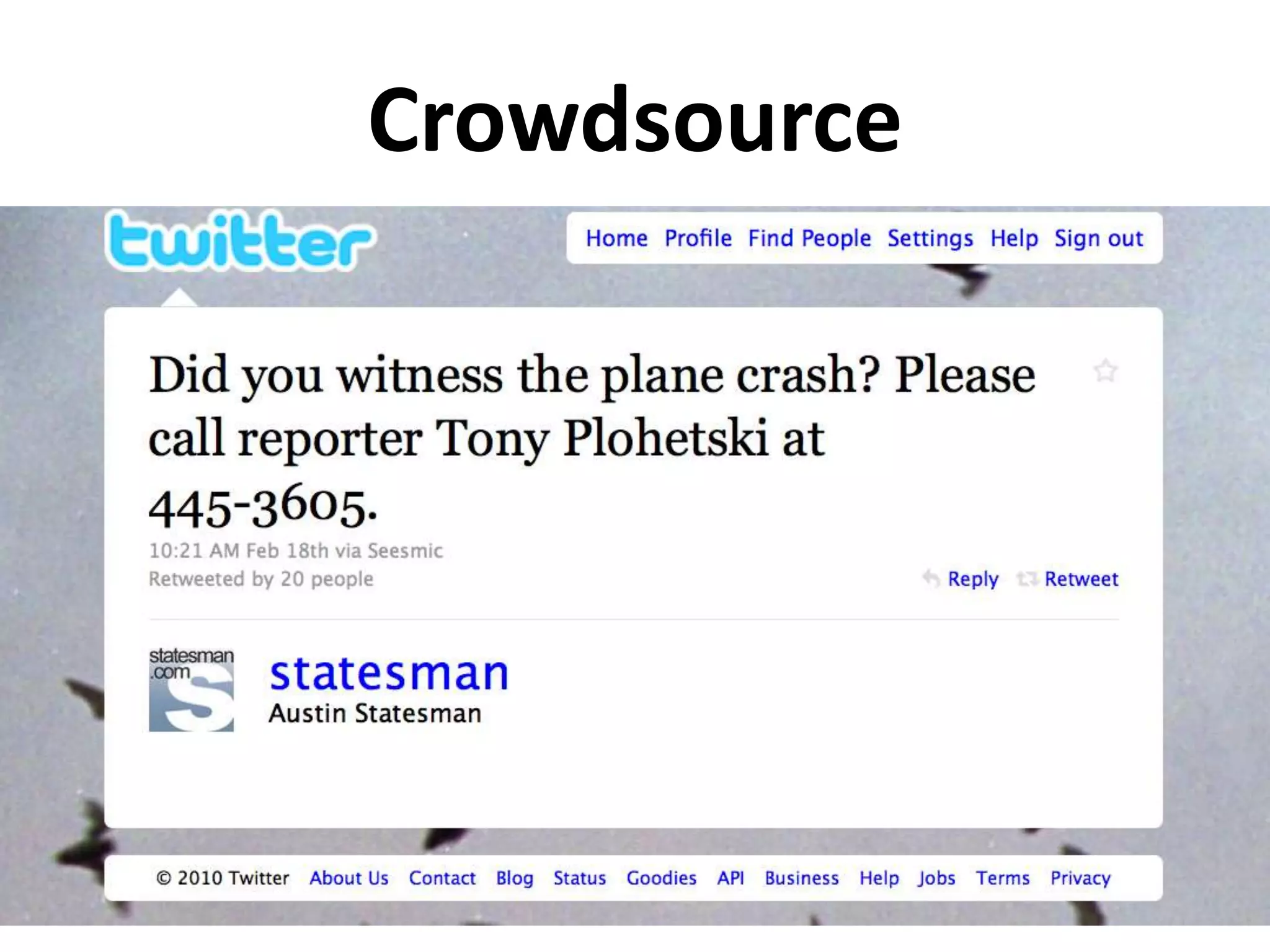
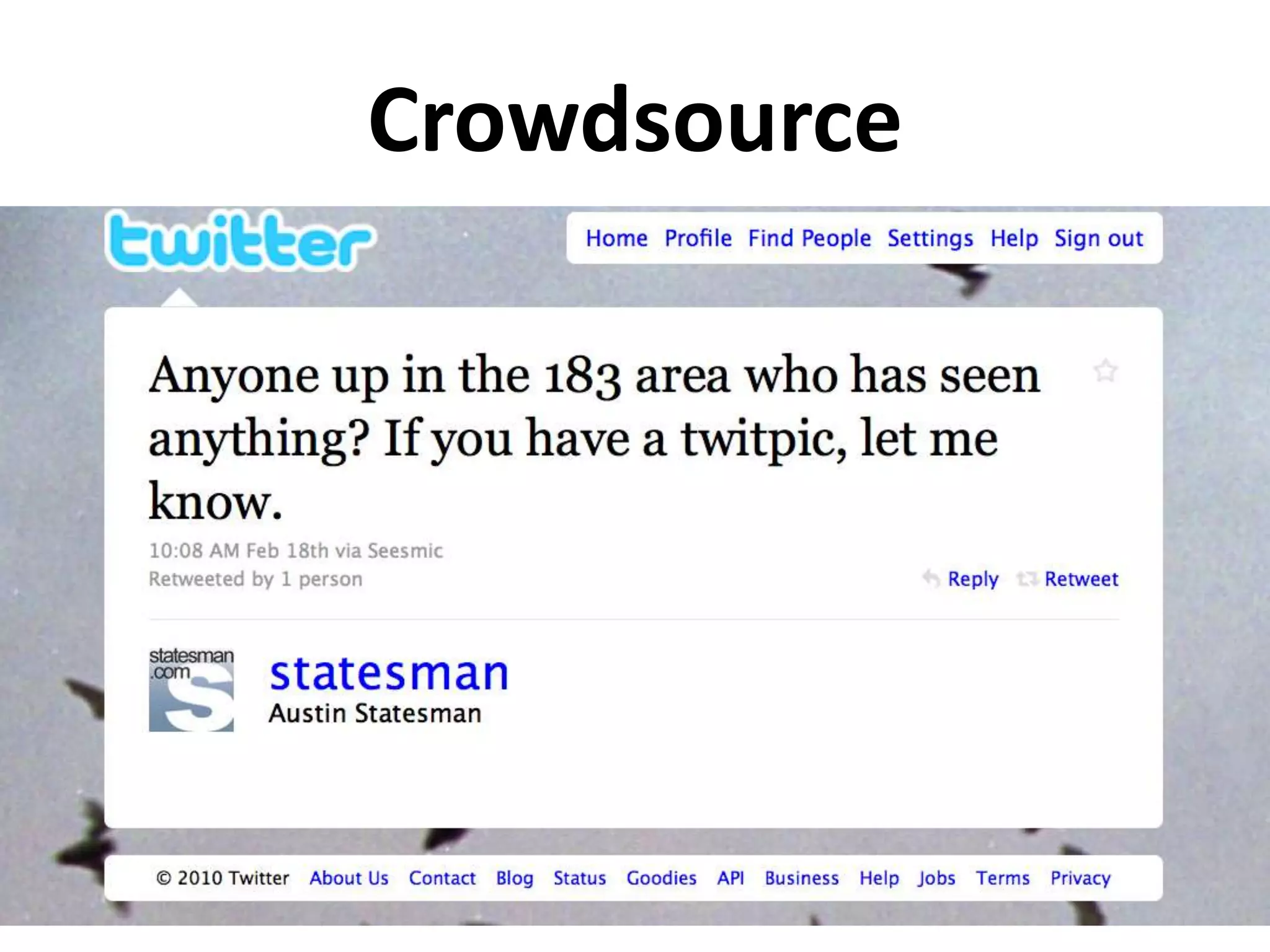
• Crowdsource (specific questions: “Do you
  know anyone who …?” “Did you see …?”
  “Has this ever happened to you?”)
• Consider ending post w/ question
• Stimulate/continue conversation in social
  media
• Engage with comments
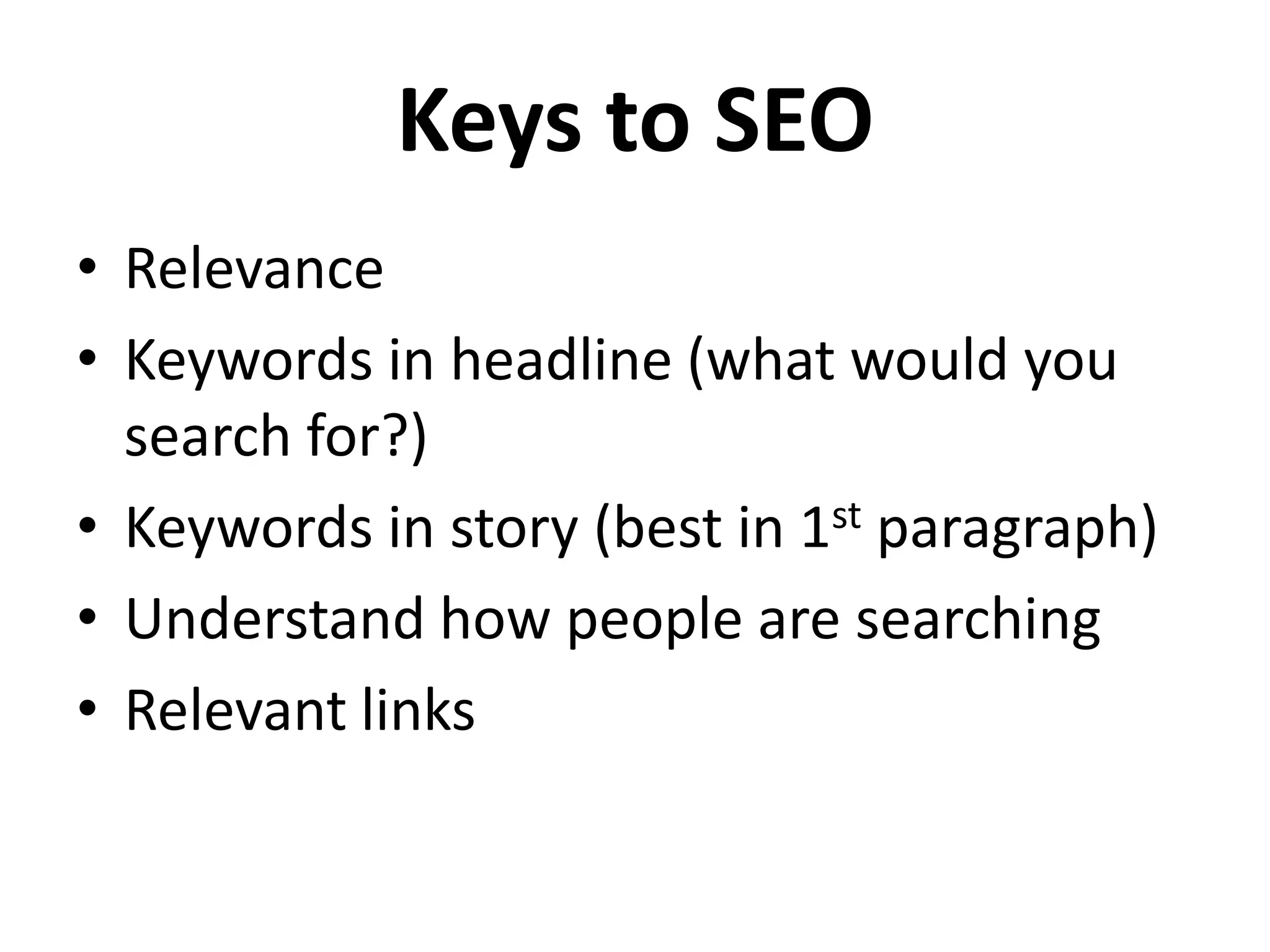
Keys to SEO
• Relevance
• Keywords in headline (what would you
  search for?)
• Keywords in story (best in 1st paragraph)
• Understand how people are searching
• Relevant links
Reporting with
 social media
Great for promotion, but also …
• Great for reporting
• Find story ideas
• Crowdsource
• Join the conversation (reply, retweet, ask
  questions)
• FB algorithm change hurts news brands
• Many more users     • Great for breaking
• Much info private     news
• Tougher to search   • Great real-time
• Not as immediate      search
  (less frequent      • Engagement not as
  updates)              intrusive
• Engage, don’t       • Hashtags help w/
  intrude               search, conversation
Personal vs. professional use
• Separate accounts OK but not necessary
• Always behave professionally, even on
  private accounts
• Be personable on pro accounts
• Presume future bosses will see all posts
• Don’t bore pro audience
Options for journalists:
• Use personal FB account, all or most
  public
• Journalist page
• Personal account, enable subscriptions
  (decide which updates are public)
• Connect w/ sources (balance,
  disclosure?)
• Check pages of agencies, people on beat
• Crowdsourcing (ask on their pages as
  well as yours)
• Look for people in the news
• Ask for permission to use photos
Why use Twitter?
•   It can save you time
•   It extends your reach
•   It’s an engaging, conversational tool
•   It’s great for connecting with people who
    experience stories you write about
Bookmark this page

https://twitter.com/#!/search-advanced
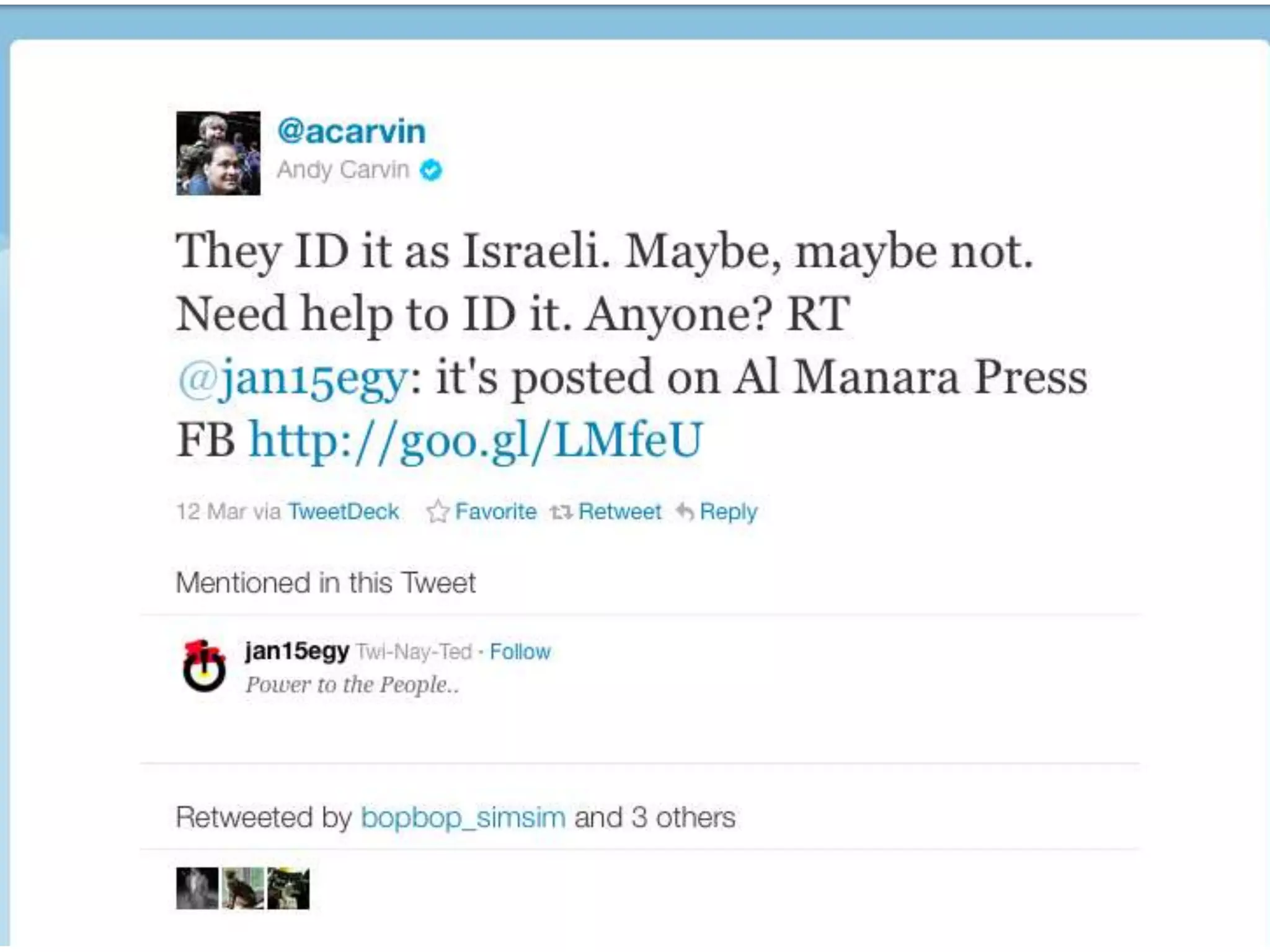
Vetting tweeps, verifying info
 •   Check full Twitter stream, profile
 •   Connect on phone, in person
 •   Check location (not 100% reliable)
 •   Others verifying? Clusters, not echos
 •   Photos?
 •   Other sources, other tweeps
 •   Ask, “How do you know that?”
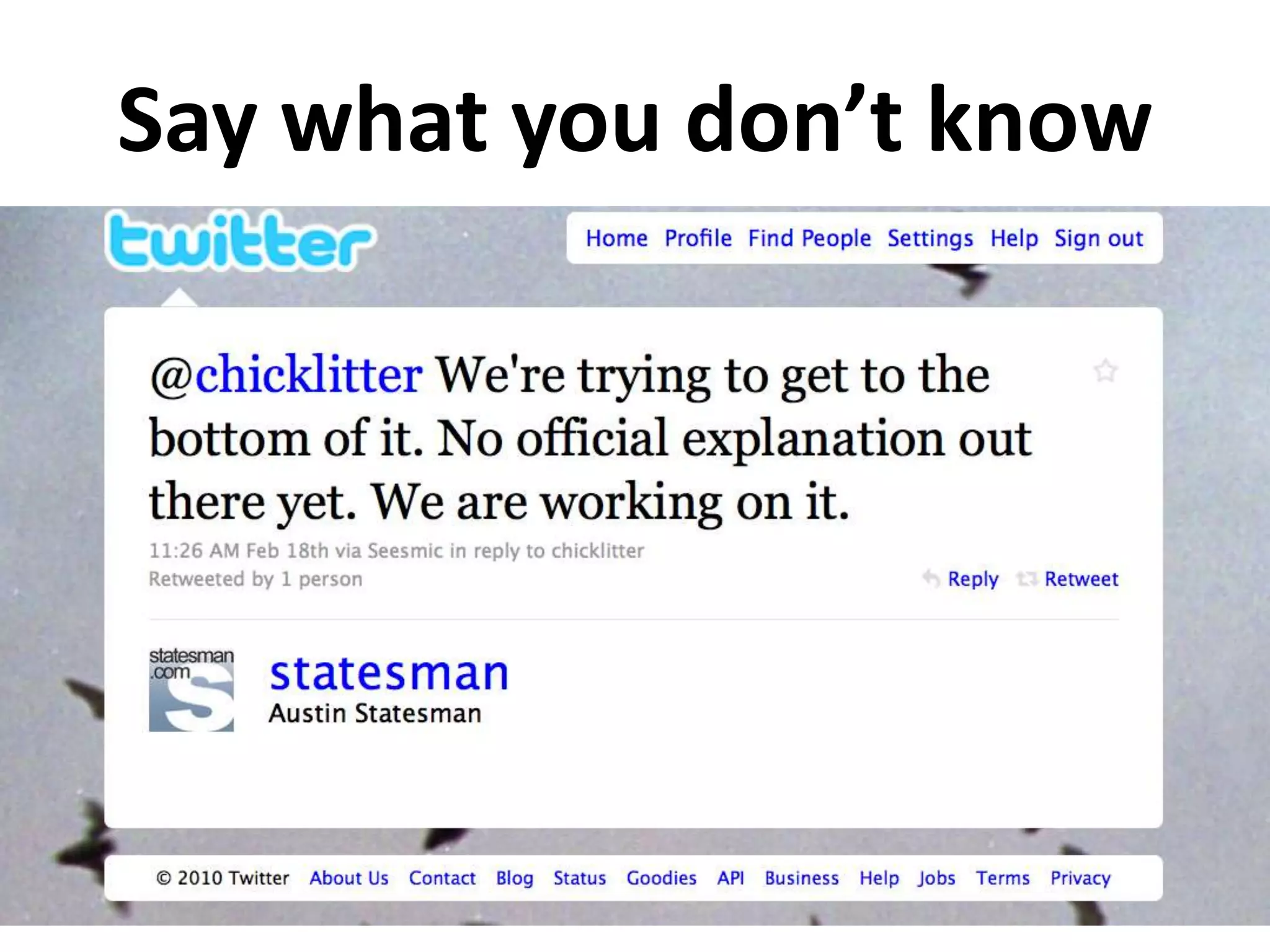
Say what you don’t know
More on verification
             Craig Silverman tips:
http://www.cjr.org/behind_the_news/eight_sim
          ple_rules_for_doing_a.php
              Mandy Jenkins tips:
  http://zombiejournalism.com/2011/09/b-s-
           detection-for-journalists/
Routine Twitter use
•   Follow people interested in your
    topic(replies, retweets, check
    followers)
•   Join topical conversation
•   Master Twitter search (advanced)
•   Find & promote topical #hashtags
•   Use Twitter routinely on your beat
Crowdsource
Crowdsource
•   Growing swiftly
•   Users share (pin, re-pin) visual content
•   80% of users are women
•   Heavy use for food, fashion, travel
•   Embeddable
•   How might you use?
• Effective curation of Sikh temple
  shooting
• Obama answered questions
• Search at searchreddit.com
• Do agencies on beat post photos?
• Search for keywords, photos
• Invite people to contribute photos on
  news stories
• Connect w/ people posting photos
• Seek permission (check conditions)
• Give credit
• Do agencies, people on beat use?
• Watch for public videos getting attention
  (will often see links, mentions on Twitter)
• Embed in stories, blogs
• “Mayor” is great source about an org or
  venue (employee or customer)
• See who has checked in for event or
  breaking news story
• Tips might provide questions for stories
• Break story w/ Foursquare “shout”
• Connect with sources
• Find new sources through
  connections, groups
• Discussions help find experts
• Check updates, slides, travel
• Search by location & keyword
•   Important for search
•   Interview by video Hangouts
•   Find sources
•   Follow sources in Circles
•   Follow beat topics in Sparks
Niche tools
Social fame is fleeting
Launching your career
 in digital journalism
Your job search is a story
•   Research online. Thoroughly
•   Work your connections
•   Nail the face-to-face interview
•   Be resourceful
•   Try multiple approaches
•   Never say no for someone else
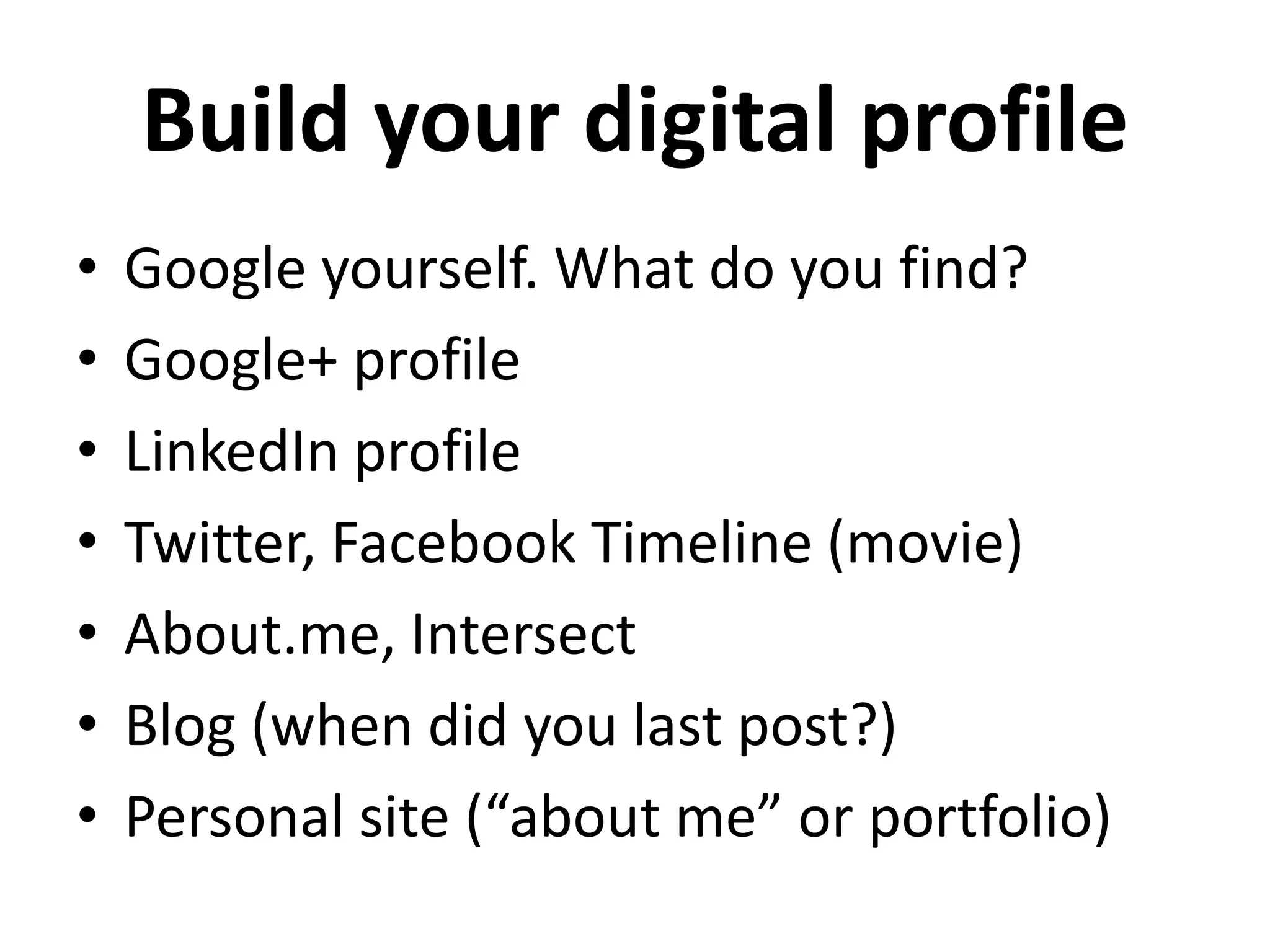
Build your digital profile
•   Google yourself. What do you find?
•   Google+ profile
•   LinkedIn profile
•   Twitter, Facebook Timeline (movie)
•   About.me, Intersect
•   Blog (when did you last post?)
•   Personal site (“about me” or portfolio)
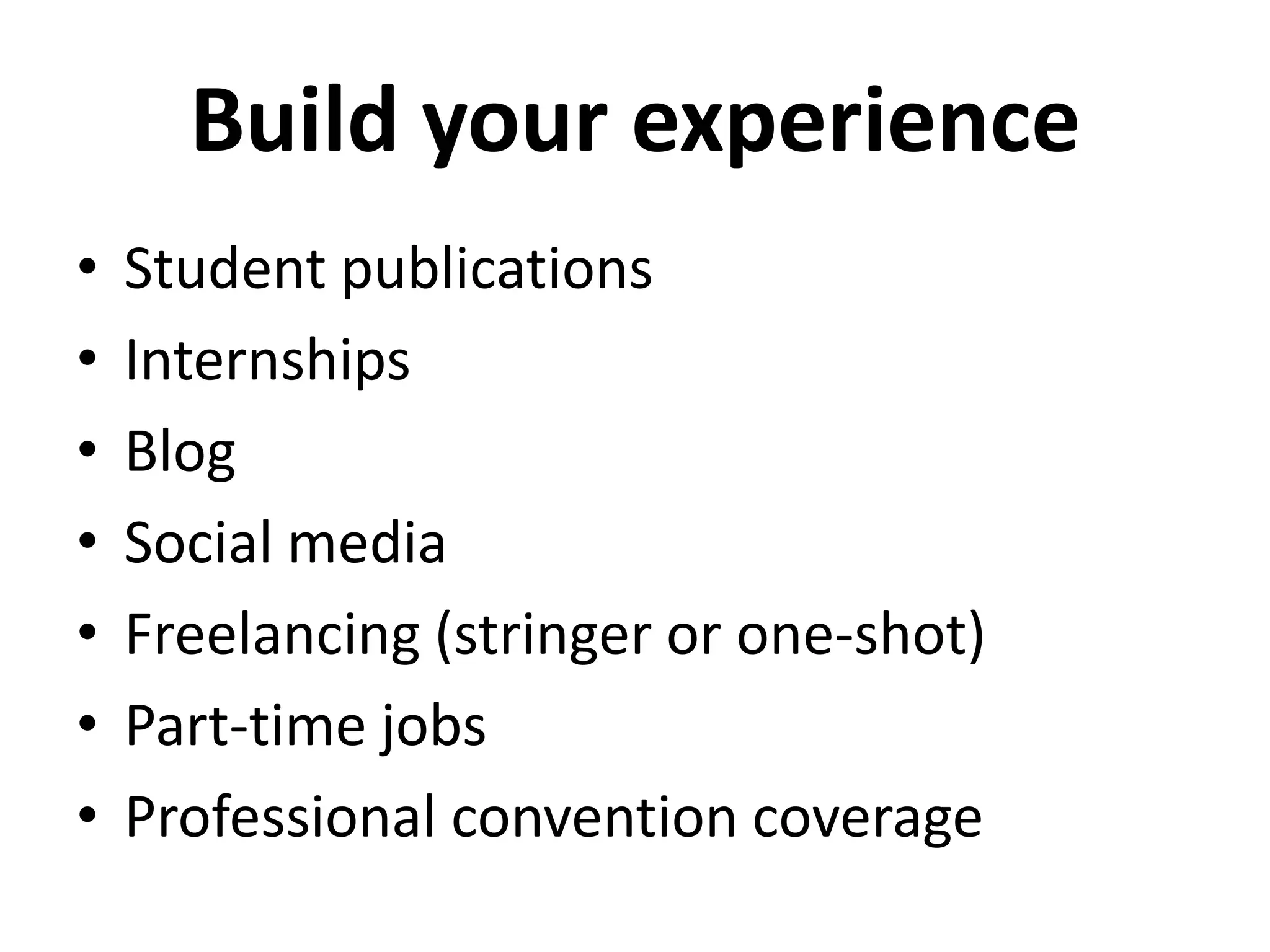
Build your experience
•   Student publications
•   Internships
•   Blog
•   Social media
•   Freelancing (stringer or one-shot)
•   Part-time jobs
•   Professional convention coverage
Network
•   Connect digitally w/ people you admire
•   Especially on Twitter
•   #wjchat, #spjchat, #dfmchat, etc.
•   Follow up (Twitter, email, handwritten)
•   Comment on blogs
•   IRL
Expand your search

“Every company is a media company now.”
                             -- Jay Rosen
Show, don’t tell
• Hyperlink résumé (but make sure it reads
  well w/o links)
• Don’t send hard copy by U.S. mail unless
  asked
• Video as part of résumé
  (you, Xtranormal, Search Stories, FB
  Timeline)
• Pitch through social media
• Use new tools
Do your reporting
• What does the job require?
• Who does similar work? What are their
  strengths? What are yours?
• What strengths should you highlight?
• What are you doing to address
  weaknesses?
• Research people you interview with
Little things are big things
• Customize your résumé
• Spell the prospective boss’s name right
• Take initiative (can you schedule your
  own interview?)
• Include Twitter username on résumé
Interviews count, too
•   Prepare thoroughly
•   Listen effectively
•   Answer honestly
•   Ask tough questions
•   Don’t fake: “I don’t know” beats BS
•   Follow up
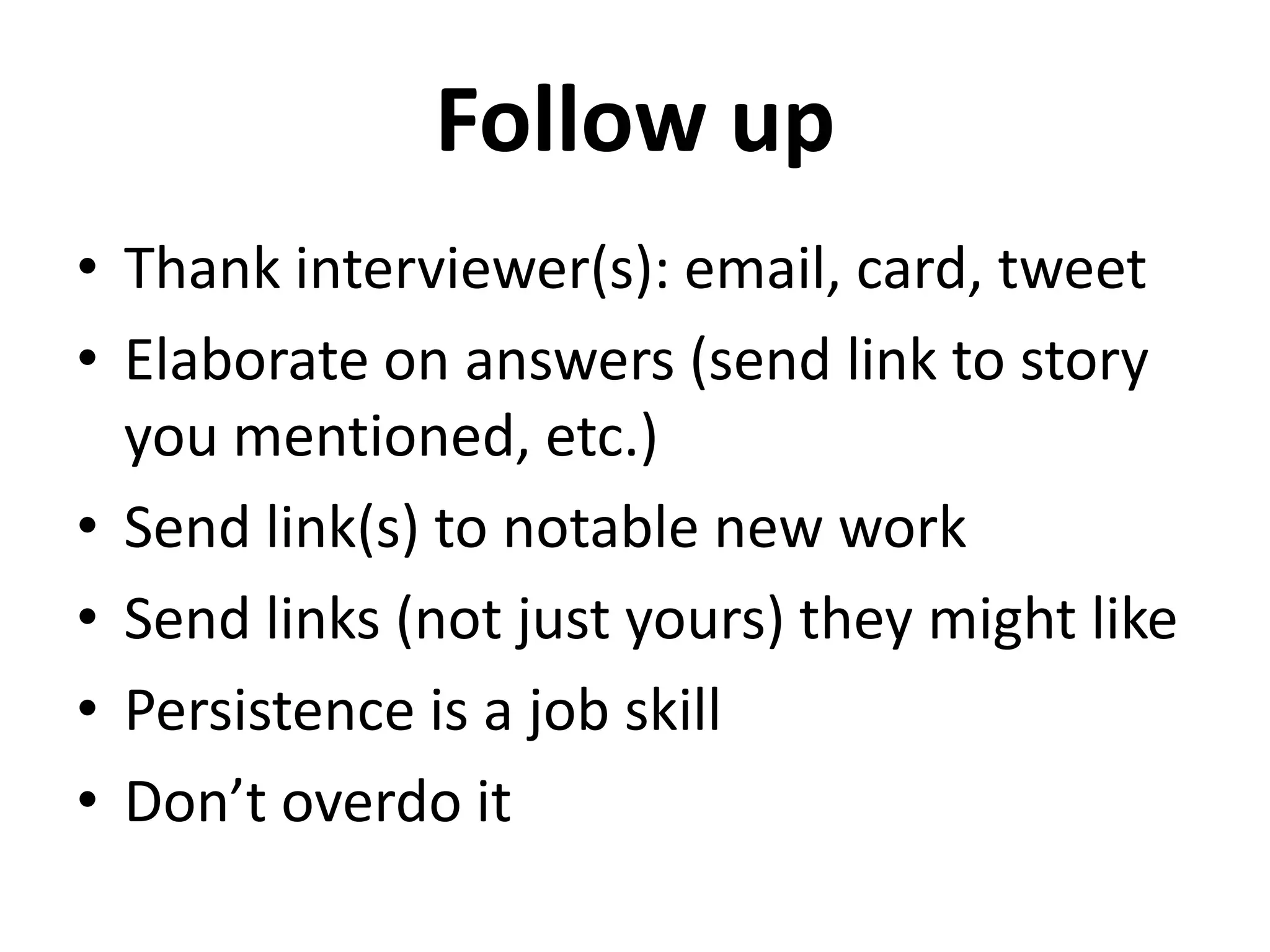
Follow up
• Thank interviewer(s): email, card, tweet
• Elaborate on answers (send link to story
  you mentioned, etc.)
• Send link(s) to notable new work
• Send links (not just yours) they might like
• Persistence is a job skill
• Don’t overdo it
Read more
• @stevebuttry
• #cudigital
• stevebuttry.wordpress.com (“career
  advice” category)
• Check links in today’s blog post
• slideshare.net/stevebuttry
• stephenbuttry@gmail.com
In job-hunting …

Don’t let obstacles
 become excuses

Digital Journalism

  • 1.
    Digital Journalism Steve Buttry University of Colorado October 19, 2012 #cudigital
  • 2.
    Read more aboutit • stevebuttry.wordpress.com • slideshare.net/stevebuttry • @stevebuttry • stephenbuttry@gmail.com
  • 3.
    Plan for theday 1. How a digital newsroom works 2. Digital news strategy 3. Working digital-first 4. Digital tools for today’s journalists 5. Social media tools & techniques 6. Launching your career in digital journalism
  • 4.
  • 5.
    What’s important? • What’s happening now? • Engagement & collaboration • Unique content (enterprise, analysis) • Measuring performance • Strong values • Experimentation w/ tools & techniques • Workflow: process & standards
  • 6.
    What’s happening now? • Livestreaming • Liveblogging • Live chats • Alerts • Feed tweets into site
  • 8.
    Engagement & collaboration •Join, stimulate, lead & curate the community conversation • Crowdsourcing stories • Community newsrooms • Mobile newsrooms
  • 11.
    Engagement & collaboration •Join, stimulate, lead & curate the community conversation • Crowdsourcing stories • Community newsrooms • Mobile newsrooms • Network w/ community blogs
  • 12.
    Unique content • Commoditycontent has little value (curation can add value) • Databases (answerbases) have greater shelf life • Lead conversation around enterprise • Do what you do best & link to the rest (Jeff Jarvis)
  • 14.
    Measuring performance • Metricshave always mattered • Understand what metrics say & what they don’t • Seek multiple metrics • Learn from metrics, but they don’t override values • Recognize flukes & don’t overreact
  • 16.
    Some values don’tchange “Seek truth & report it.” – SPJ Code of Ethics
  • 17.
    Digital-first values • Accuracy • Watchdog role • Truth • First Amendment • Attribution • Timeliness & • Transparency reflection • Identification • Civility & respect • Fairness • Diversity • Community • Skepticism
  • 18.
    Can we raisestandards? • Does he-said-she-said story really seek & report truth? • Is the “view from nowhere” honest? • Dan Gillmor suggests replacing “objectivity” w/ transparency, fairness, accuracy, thoroughness
  • 19.
  • 20.
    Clay Shirky: “Nothingwill work, but everything might.”
  • 22.
    John Paton: “Youdon’t tinker or tweak a broken model. You start again anew.”
  • 23.
    Digital First principles •Digital First & print last • Put the digital people in charge • Engage the community • Core competencies: Local content & local sales • If it’s not core: reduce it, stop it, sell it or outsource it
  • 24.
    Foundation to buildon: • Strong brands • Local content • Local sales force • Journalistic integrity
  • 25.
    Engagement = value • Computers & archives for community use • Open news meetings • Blog network • Classes • Digital audience 5x print • From loss to profit
  • 26.
    What engagement is Communityengagement = News orgs make top priority to listen, to join, lead & enable conversation to elevate journalism.
  • 27.
    What engagement isn’t •Promotion (though it has promotional value) • Distribution of content (though you should) • Purely a digital pursuit (it uses digital tools along w/ traditional ones)
  • 28.
    What engagement is Communityengagement = News orgs make top priority to listen, to join, lead & enable conversation to elevate journalism.
  • 29.
    Avenues of Engagement • Social media • Content submissions • Blogs • Interactive content • Crowdsourcing • Voting, contests • Breaking news • Comments • Stories • Schools, groups • Events • Feedback • Curation • Print • Aggregation • Face to face
  • 33.
    Jim Brady: “There's nosilver bullet. There's just shrapnel.”
  • 36.
    Mobile Opportunity • 44%of U.S. adults have smartphones • 18% of U.S. adults have tablets (up 50% from summer 2011 to early 2012) Source: State of the News Media 2012
  • 37.
    Mobile-first strategy • Text alerts • Email • Applications (phones & tablets) • Social media (tweets, check-ins, tips) • Location-based news, info & commerce • Easy-to-use mobile websites • Device-flexible (not device-agnostic) • Games (phones, iPads great for games)
  • 38.
    Personal content • Births • Divorce • Youth milestones • Jobs, pets, holidays, fo • School od, interests, health • Graduation • Illness • College life • Empty nesters • Military service • Retirement • Weddings • Reunions • Parenthood • Obituaries
  • 40.
    Life stories • Commissionedobits (journalist tells life story, paid by family) • Obituary, website, booklet, video • Not just obits: weddings, retirements, anniversaries, mil estones
  • 41.
  • 43.
    N2 lessons forDigital First • Jobs to be done = opportunities • “Good enough” opens doors to new avenues of excellence • Potential markets exceed what you can imagine (or what research can project) • “Beware the sucking sound of the core”
  • 44.
  • 45.
    Thinking digital-first • Storyis, as Jeff Jarvis says, a process, not a product • It’s great to be first w/ story or the idea, but otherwise link • Community = collaborators • Lots of RTs or a prominent link are better than front-page story • How can you use new tools to do better stories?
  • 46.
    Working digital-first • Createcontent for digital platforms (web, email, SMS, social, mobile) • Produce print & broadcast products from content on digital platforms • Live coverage of events • Breaking news coverage • Engage community
  • 47.
    Court reporter • Live-tweetfrom courtroom (narrative, not a transcript) • Feed tweets into liveblog • Big development: Text news alert to editor • Write summary or analysis story for web & print
  • 50.
    Why to liveblog • Immediacy • News value • Storytelling • Traffic • Community engagement, loyalty • Interactivity • Saving time
  • 51.
    Liveblog formats • Update(time-stamp, reverse-chron) in blog or story template • Use CoverItLive • Use ScribbleLive • Live-tweet (on Twitter or feeding blog) • Video stream (w/liveblog) • Raw, edited or moderated
  • 52.
    Tips, techniques • Short, frequent takes • Space isn’t an issue; engagement is • Liveblog becomes notebook • Consider links, polls, photos, audio, video • Promote live & replays • Tweet links to liveblog & replay • OK to step away for question, video, etc.
  • 53.
    Liveblog & printstory • Liveblog is notebook: cut, paste & edit • Note when you know you’ve written good lead or passage for story • Does summary (w/ web plug) work for print? • Plug “complete coverage” in liveblog
  • 54.
    Liveblogging issues • Accuracy(stress verification, ask questions, seek links & documentation, correct quickly and candidly) • Rough copy • Sports credentials • Multi-tasking • Learning curve
  • 55.
    Court reporter, notrial • Traditional rounds: lawyers, judges, clerks, filings • Add #DigitalFirst rounds: monitor tweets, search Twitter, Facebook groups & pages • Tweet/alert/blog big filings • Video clips in interviews • Scan or download docs if not online
  • 56.
    Beat reporter • Beatblog • Liveblog meetings, events • Tweet/alert/liveblog breaking news • Live chat on continuing stories • Data visualization • Curate community conversation
  • 57.
    Beat reporter questions •How to crowdsource story? • What terms, hashtags should you search (routinely & for each story)? • Regular/special hashtags to use? • People to follow? New FB pages/groups? • Other social media to search (YouTube, Flickr, Foursquare, Google+ …)?
  • 58.
    Visual journalist • Shoot first w/ smartphone & post • Shoot w/ camera for slideshow & print • Shoot video • Record ambient sound, interviews • If disaster, shoot some after shots for before/after
  • 59.
    Digital Journalism Tools &Techniques Steve Buttry University of Texas-Arlington Shorthorn August 14, 2012 #utashorthorn
  • 60.
    Text • Stories • Quizzes • Lists • Chats • Headlines • Tweets • Captions • FB updates • Liveblog • Text on video • Comments • Text in graphics • Polls • Links
  • 61.
    Audio • Podcast • Audio clips • Audio w/ slides • Soundtrack on video • Google voice
  • 62.
    Visuals • Photos • Maps • Slideshows • Instagram • Videos • Flickr • Animations • YouTube • Graphics • Facebook • Data visualizations • Pinterest • Screenshots • Twitter
  • 63.
    Data • Think of answerbases, not databases • Data personalizes story for readers • Data gives lasting value to reporting • Caspio is plug & play database tool • DataViz & Visual.ly • Google Fusion maps • Google Docs & Forms
  • 64.
    Factors in bloggingsuccess • Idea • Links • Format • Voice • Headline • Writing • Visuals • Conversation
  • 65.
    Possible formats • Brief • Promotion • Video (w/ intro) • Chart/graph/map • Photo gallery • Q&A • List • Narrative • Review • Poll • News story • Curation
  • 66.
    The blogging conversation •Crowdsource (specific questions: “Do you know anyone who …?” “Did you see …?” “Has this ever happened to you?”) • Consider ending post w/ question • Stimulate/continue conversation in social media • Engage with comments
  • 67.
    Keys to SEO •Relevance • Keywords in headline (what would you search for?) • Keywords in story (best in 1st paragraph) • Understand how people are searching • Relevant links
  • 68.
  • 70.
    Great for promotion,but also … • Great for reporting • Find story ideas • Crowdsource • Join the conversation (reply, retweet, ask questions) • FB algorithm change hurts news brands
  • 71.
    • Many moreusers • Great for breaking • Much info private news • Tougher to search • Great real-time • Not as immediate search (less frequent • Engagement not as updates) intrusive • Engage, don’t • Hashtags help w/ intrude search, conversation
  • 72.
    Personal vs. professionaluse • Separate accounts OK but not necessary • Always behave professionally, even on private accounts • Be personable on pro accounts • Presume future bosses will see all posts • Don’t bore pro audience
  • 73.
    Options for journalists: •Use personal FB account, all or most public • Journalist page • Personal account, enable subscriptions (decide which updates are public)
  • 74.
    • Connect w/sources (balance, disclosure?) • Check pages of agencies, people on beat • Crowdsourcing (ask on their pages as well as yours) • Look for people in the news • Ask for permission to use photos
  • 75.
    Why use Twitter? • It can save you time • It extends your reach • It’s an engaging, conversational tool • It’s great for connecting with people who experience stories you write about
  • 85.
  • 86.
    Vetting tweeps, verifyinginfo • Check full Twitter stream, profile • Connect on phone, in person • Check location (not 100% reliable) • Others verifying? Clusters, not echos • Photos? • Other sources, other tweeps • Ask, “How do you know that?”
  • 87.
    Say what youdon’t know
  • 89.
    More on verification Craig Silverman tips: http://www.cjr.org/behind_the_news/eight_sim ple_rules_for_doing_a.php Mandy Jenkins tips: http://zombiejournalism.com/2011/09/b-s- detection-for-journalists/
  • 90.
    Routine Twitter use • Follow people interested in your topic(replies, retweets, check followers) • Join topical conversation • Master Twitter search (advanced) • Find & promote topical #hashtags • Use Twitter routinely on your beat
  • 91.
  • 92.
  • 93.
    • Growing swiftly • Users share (pin, re-pin) visual content • 80% of users are women • Heavy use for food, fashion, travel • Embeddable • How might you use?
  • 94.
    • Effective curationof Sikh temple shooting • Obama answered questions • Search at searchreddit.com
  • 96.
    • Do agencieson beat post photos? • Search for keywords, photos • Invite people to contribute photos on news stories • Connect w/ people posting photos • Seek permission (check conditions) • Give credit
  • 97.
    • Do agencies,people on beat use? • Watch for public videos getting attention (will often see links, mentions on Twitter) • Embed in stories, blogs
  • 98.
    • “Mayor” isgreat source about an org or venue (employee or customer) • See who has checked in for event or breaking news story • Tips might provide questions for stories • Break story w/ Foursquare “shout”
  • 99.
    • Connect withsources • Find new sources through connections, groups • Discussions help find experts • Check updates, slides, travel • Search by location & keyword
  • 100.
    • Important for search • Interview by video Hangouts • Find sources • Follow sources in Circles • Follow beat topics in Sparks
  • 101.
  • 102.
  • 103.
    Launching your career in digital journalism
  • 105.
    Your job searchis a story • Research online. Thoroughly • Work your connections • Nail the face-to-face interview • Be resourceful • Try multiple approaches • Never say no for someone else
  • 106.
    Build your digitalprofile • Google yourself. What do you find? • Google+ profile • LinkedIn profile • Twitter, Facebook Timeline (movie) • About.me, Intersect • Blog (when did you last post?) • Personal site (“about me” or portfolio)
  • 107.
    Build your experience • Student publications • Internships • Blog • Social media • Freelancing (stringer or one-shot) • Part-time jobs • Professional convention coverage
  • 108.
    Network • Connect digitally w/ people you admire • Especially on Twitter • #wjchat, #spjchat, #dfmchat, etc. • Follow up (Twitter, email, handwritten) • Comment on blogs • IRL
  • 109.
    Expand your search “Everycompany is a media company now.” -- Jay Rosen
  • 110.
    Show, don’t tell •Hyperlink résumé (but make sure it reads well w/o links) • Don’t send hard copy by U.S. mail unless asked • Video as part of résumé (you, Xtranormal, Search Stories, FB Timeline) • Pitch through social media • Use new tools
  • 111.
    Do your reporting •What does the job require? • Who does similar work? What are their strengths? What are yours? • What strengths should you highlight? • What are you doing to address weaknesses? • Research people you interview with
  • 112.
    Little things arebig things • Customize your résumé • Spell the prospective boss’s name right • Take initiative (can you schedule your own interview?) • Include Twitter username on résumé
  • 113.
    Interviews count, too • Prepare thoroughly • Listen effectively • Answer honestly • Ask tough questions • Don’t fake: “I don’t know” beats BS • Follow up
  • 114.
    Follow up • Thankinterviewer(s): email, card, tweet • Elaborate on answers (send link to story you mentioned, etc.) • Send link(s) to notable new work • Send links (not just yours) they might like • Persistence is a job skill • Don’t overdo it
  • 115.
    Read more • @stevebuttry •#cudigital • stevebuttry.wordpress.com (“career advice” category) • Check links in today’s blog post • slideshare.net/stevebuttry • stephenbuttry@gmail.com
  • 117.
    In job-hunting … Don’tlet obstacles become excuses

Editor's Notes

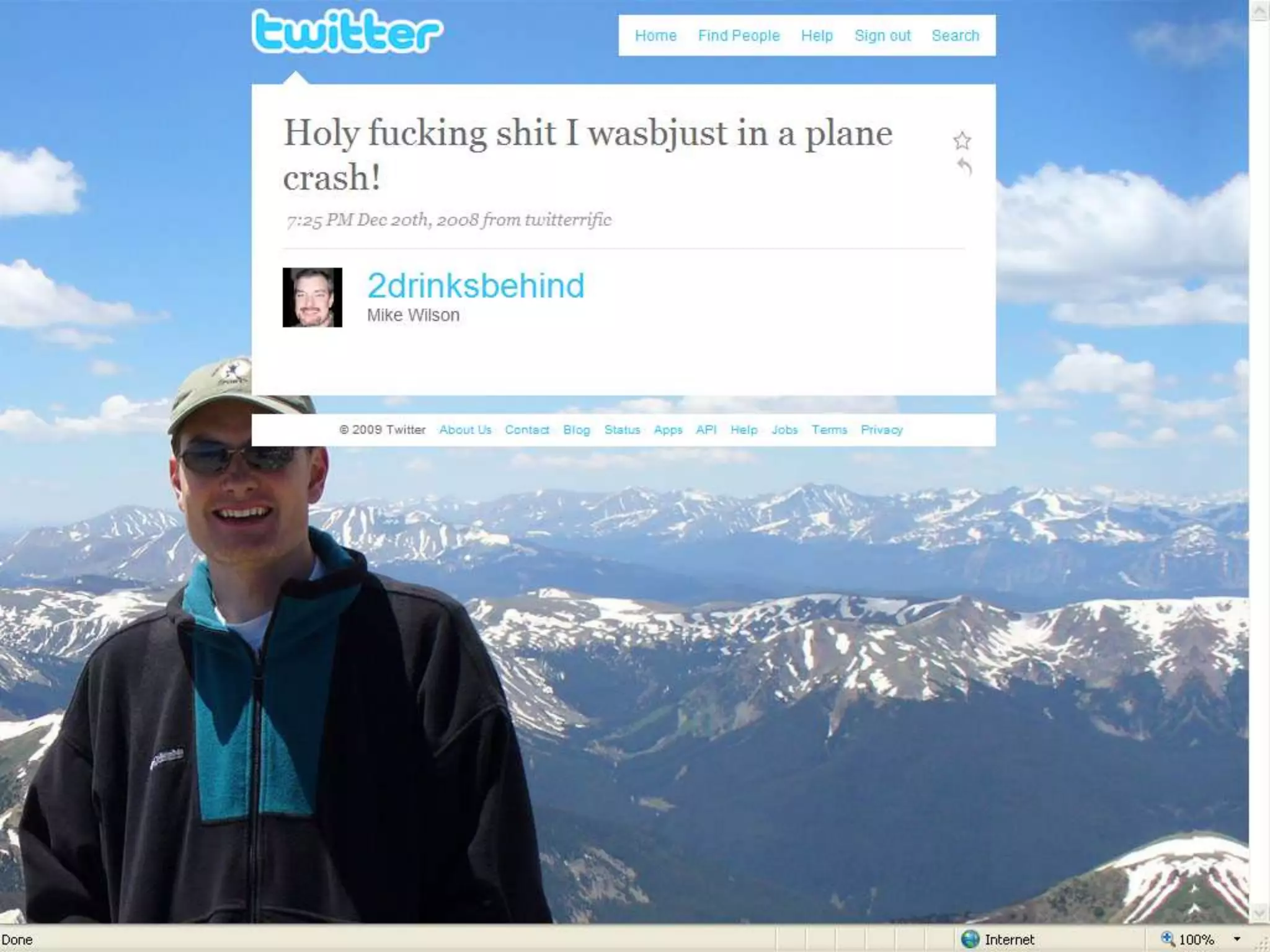
  • #80 We’ll also discuss the Denver plane crash that Mike Wilson survived and how the media missed an opportunity by not using Twitter.
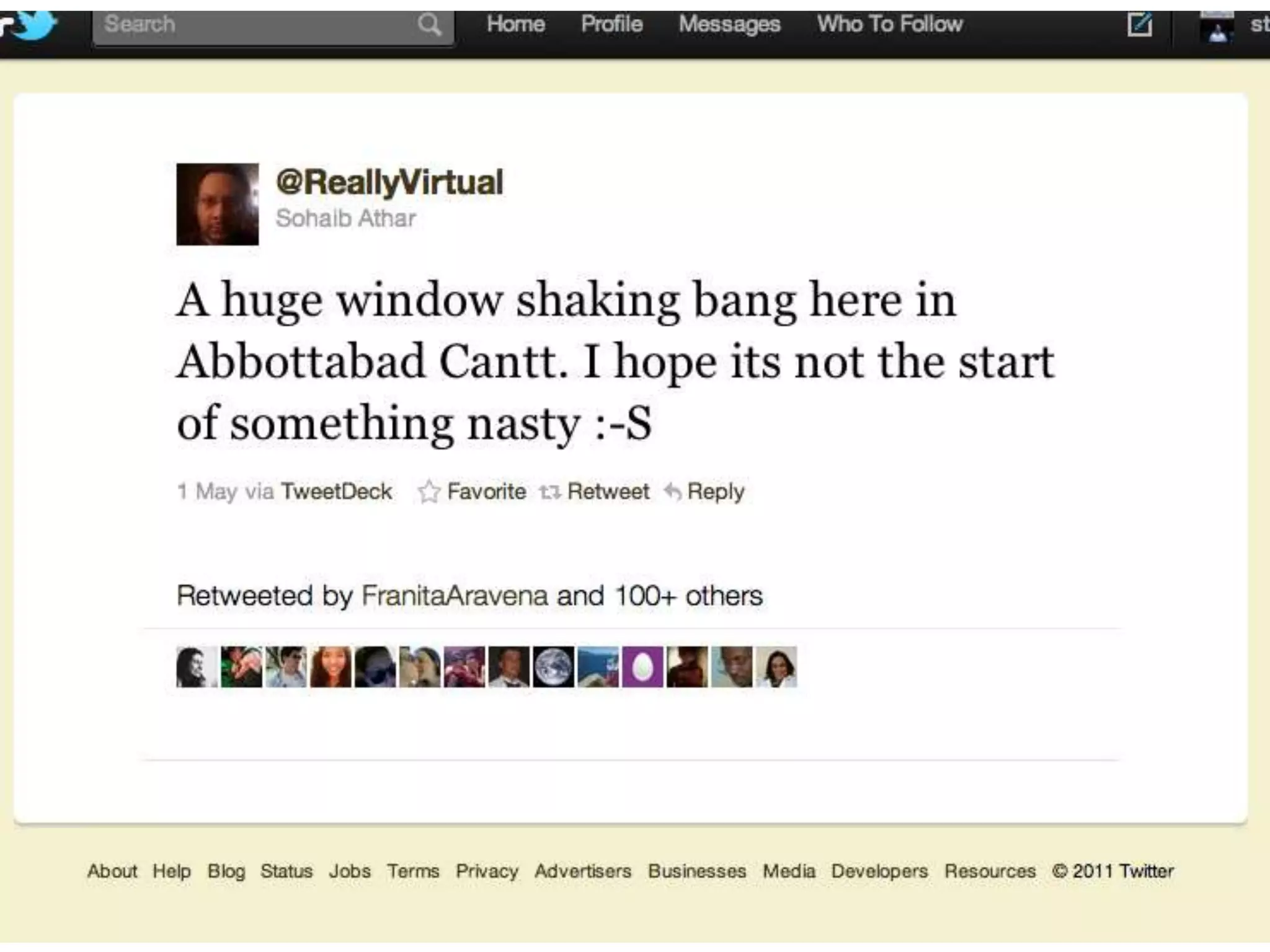
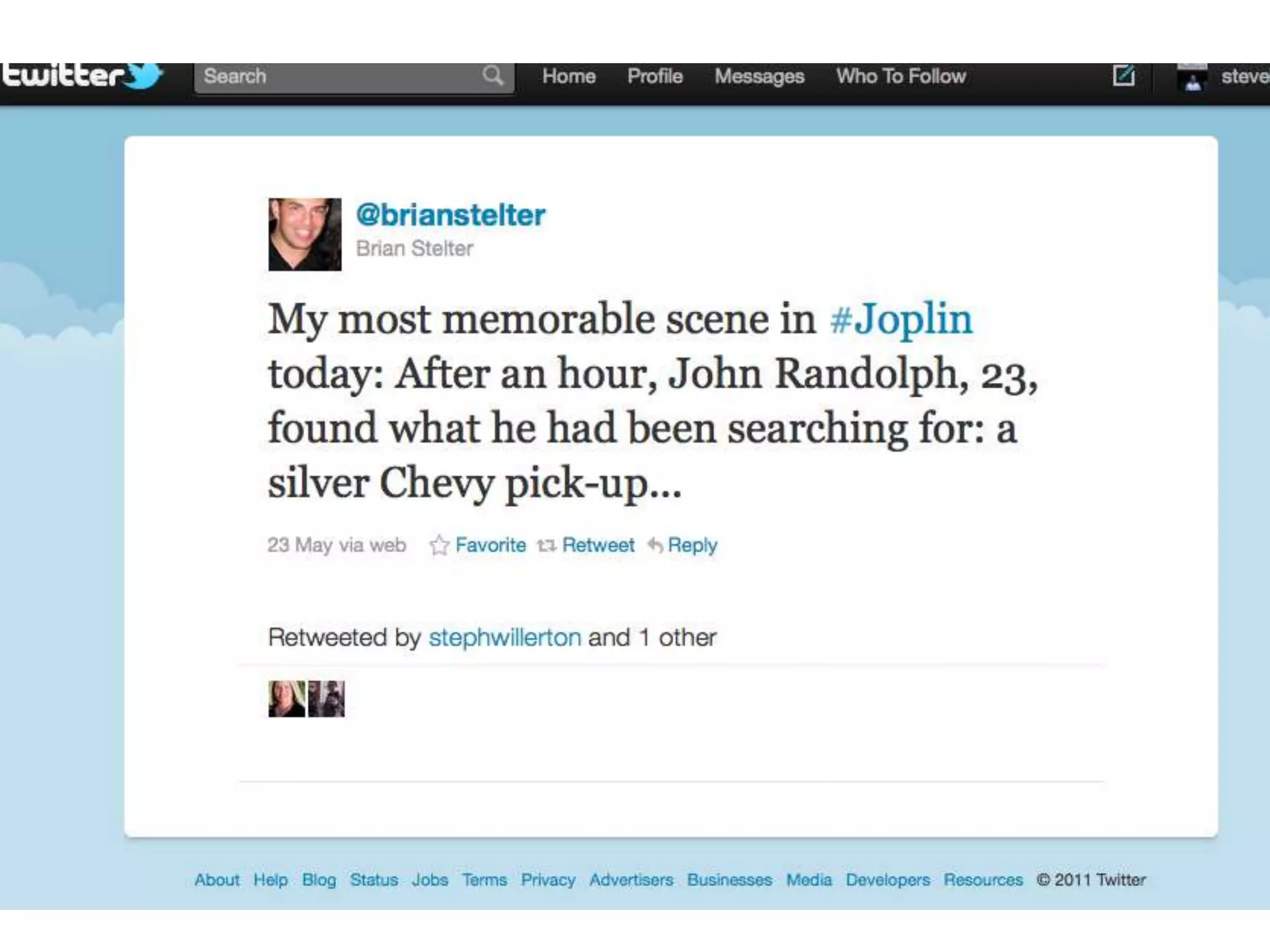
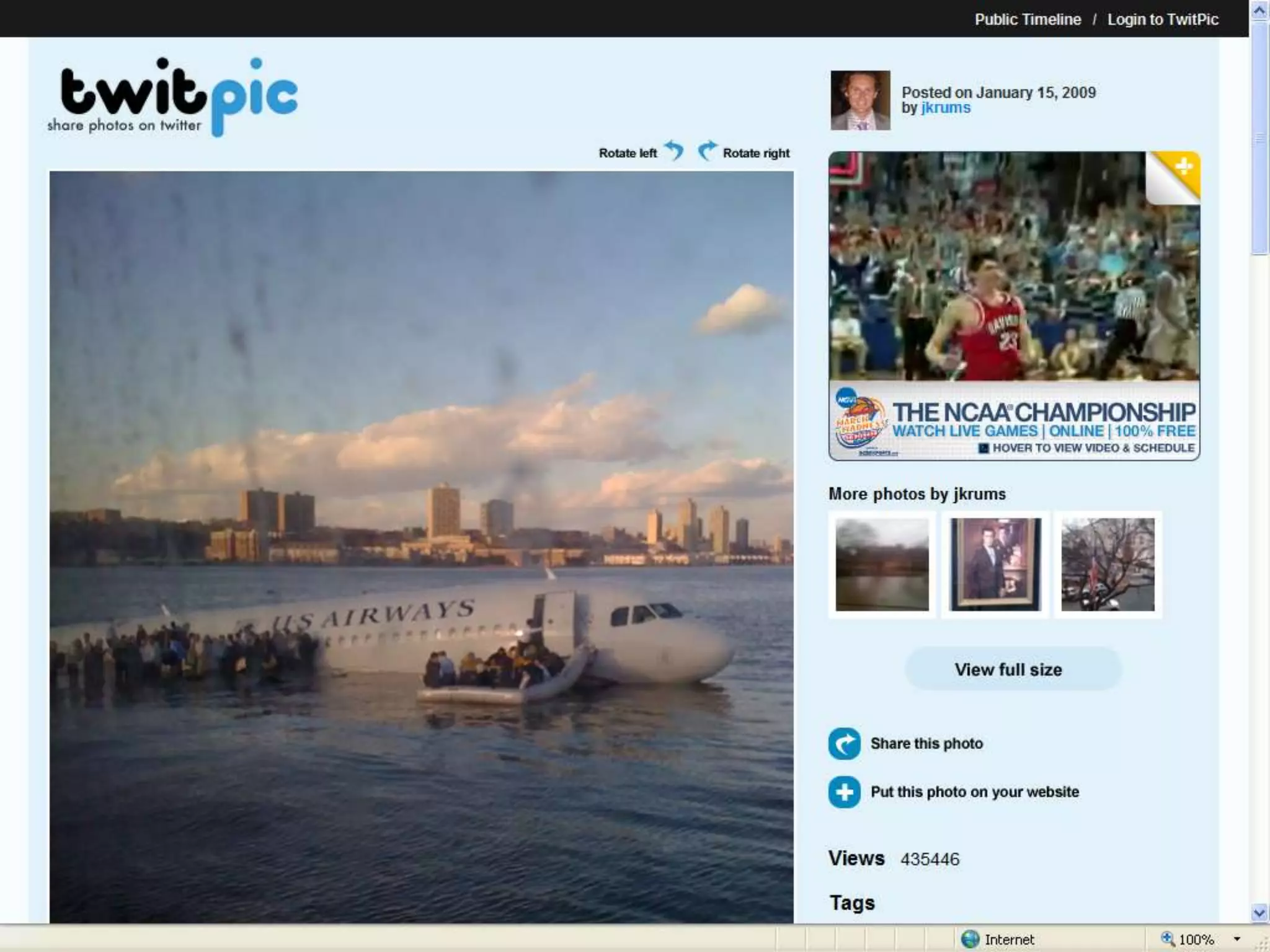
  • #85 We’ll start with some examples of why Twitter is a valuable breaking-news tool. Most will, of course, remember that Twitpic had the first shot of the Hudson landing.