Journalism in the Digital AgePeter Moorepeter@netmediaplanet.comwww.digital-notebook.com@petermoore (T)
Newspapers -> Magazines -> Blogs -> Websites
“Journalism is the discipline of gathering, writing and reporting news.”
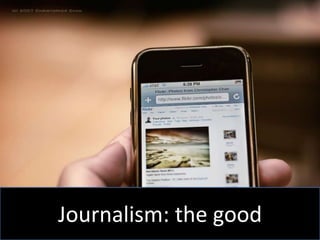
Journalism: the good
Charlie Beckett, POLIS DirectorJournalism has never been more plentiful and of such high quality. There is more good quality information, analysis and debate than ever before.  It’s never been easier or cheaper to make good journalism - sales of quality publications like the Economist and Wall Street Journal are up - the BBC now has global reach for its public service international journalism online. Even the liberal niche British broadsheet The Guardian has found 10 million online readers outside the UK. Across the world there are booming sales of newspapers and TV channels are being launched daily.New technologies are delivering opportunities for journalism. There is more processing and broadcasting power in my iPhone than I had in a whole newsroom 10 years ago. And the public want to help make news media even more plentiful and productive - and they will do it for free.
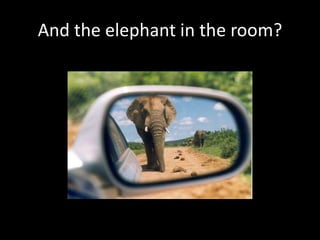
And the elephant in the room?
The Internet
The business model
Clay Shirky: Professor of New Media at New York University:“When a 14 year old kid can blow up your business in his spare time, not because he hates you but because he loves you, then you got a problem.” The unthinkable scenario unfolded something like this: The ability to share content wouldn’t shrink, it would grow. Walled gardens would prove unpopular. Digital advertising would reduce inefficiencies, and therefore profits. Dislike of micropayments would prevent widespread use. People would resist being educated to act against their own desires. Old habits of advertisers and readers would not transfer online. Even ferocious litigation would be inadequate to constrain massive, sustained law-breaking.
The curious thing about the various plans hatched in the ’90s is that they were, at base, all the same plan: Round and round this goes, with the people committed to saving newspapers demanding to know “If the old model is broken, what will work in its place?” To which the answer is: Nothing. Nothing will work. There is no general model for newspapers to replace the one the internet just broke. - Clay Shirky, (Newspapers and Thinking the Unthinkable)
Newspapers
The end of newspapers?“It’s a broken model. The Victorian chain of distribution that requires printing plants, lorries, wholesalers, newsagents, getting ten year-old boys out of bed to deliver the papers... That whole chain is so expensive with so many people taking their chunks out of it. The advertising doesn’t seem to be there and the audience rate is declining. You can cling onto that model but in the end I think you’ll just fall off the edge of a cliff.”	Alan Rusbridger – Editor of the Guardian
Books?
The cost of print20 years before the Gutenberg Press was invented Cambridge University had just 122 volumes in its library.Before the press was invented the price of a book was equivalent to the price of a vineyard.For the 500 years afterwards the price of a book was equivalent to the price of a bottle of wine.The price of a book is now equivalent to a glass of wine.	- Dr. Francis Pinter, Academic Publisher
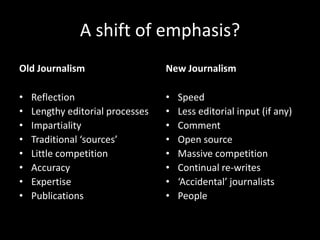
A shift of emphasis?Old JournalismReflectionLengthy editorial processesImpartialityTraditional ‘sources’Little competitionAccuracyExpertisePublicationsNew JournalismSpeedLess editorial input (if any)CommentOpen sourceMassive competitionContinual re-writes‘Accidental’ journalistsPeople
The New Media
Where do I start?
Always start with a blog
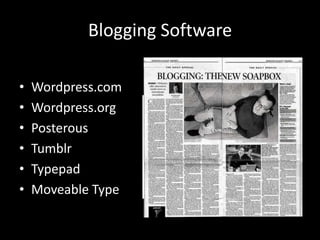
Blogging SoftwareWordpress.comWordpress.orgPosterousTumblrTypepadMoveable Type
What makes a good blog?A niche topic – the tighter the betterFrequent updatesCommunicative author(s)An understanding of online writing techniquesA mixture of written, audio and visual contentNarrative blogging (when narrative blogging is done well it can be effective, but when done badly it is terrible)
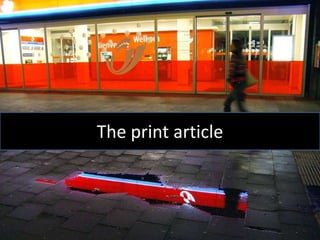
The print article
The blog post
The link economyBlog posts don’t just have length, they have depth.Back links – meritocratic (usually) and fundamental to the function of the Internet and search algorithms.The Creative Commons (6 licenses)“Do what you do best and link to the rest” (Jeff Jarvis, an American journalist, blogger and editor)
How do I build up my blog?Start slowly – it takes timeThink of your goals – have a clear objective and be consistentRead other blogs/sites  with a similar editorial agendas. Study carefully what are they doing well – learn from them.Join in with the conversation. Start thinking about your online community and set your own limits. Join Twitter, comment on other blogs - interact!Try to understand ‘how’ the Internet works – What are SEO, SMM and PPC? What do you need to know? Ask for advice. Most people will be happy to help.
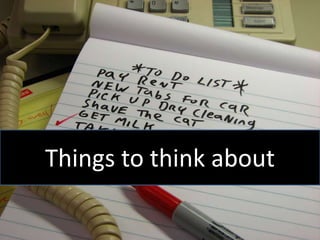
Things to think about
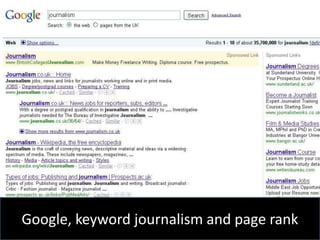
Google, keyword journalism and page rank
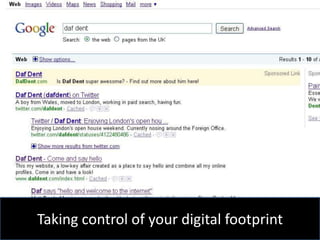
Taking control of your digital footprint
Joining in with the conversation
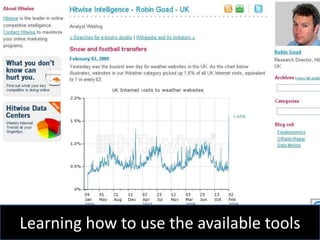
Learning how to use the available tools
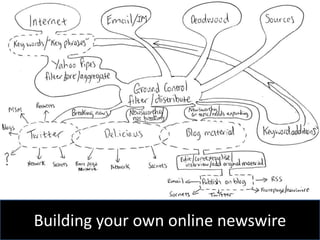
Building your own online newswire
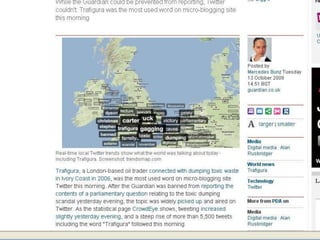
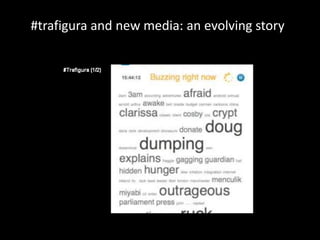
#trafigura and new media: an evolving story
What do the journalists say?I know someone has to worry about how this industry is going to make money, but the way I see it, that’s up to the publishers. Let them stagger about, blinking at the internet like blind moles looking for a business model. If the businesses were half as adaptable and open to change as most of the journalists who write for them, we’d probably stop yammering about which direction we’re going in, and just do it.My job is to adapt, without knee-jerk reactions, and that’s what I’ll aim to do. I’m certainly not going to breathlessly attempt to tick off all the different things we’re supposed to be doing, just for the sake of it. Stop telling me what it is I’ll be doing in ten years, what the new buzzword is – you don’t know. Nobody knows. Just let reporters and journalists get on with their jobs, with the tools that are available and suitable to them, and you’ll find we do ok.   Rebecca Thomson, The Future of Journalism: Just Get On With It (Bitchbuzz)
Sources Used:ImagesPage 1: Entering Hyperspace by Eole on FlickrPage 2: MacBook Pro keyboard by Sonic Julez on FlickrPage 3: And What shall I Write by tomswift46 on FlickrPage 4: iPhone by Christopher Chan on FlickrPage 6: Addo Elephant Park, South Africa by exfordy on FlickrPage 7: Addiction 2, Computer by aftab on FlickrPage 8: Broken Glass 2 by Nesster on FlickrPage 11: Newspaper by jamesjyu on FlickrPage 13: Vineyards and road by Tambako the Jaguar on FlickrPage 16: The New Media Studio by Richard Cawood on FlickrPage 18: Puzzled by MykiRoventine on FlickrPage 19: Wheel of Fortune? By Rickydavid on FlickrPage 20: Vancouver Sun Article on Blogging by Dbarefoot on FlickrPage 22: Post in a puddle by Squonk on FlickrPage 23: Swimming Pool, La PerlaVillas by pretty.face on FlickrPage 27: To Do List by Great Beyond on FlickrPage 30: Web 2.0 Parodies of Corporate Logos by FaceySpacey on FlickrPage 31: Online Newswire by Noodlepie on FlickrVideos:Web 2.0 ... The Machine is Us/ingUs by mwesch#Trafigura (1/2) by twitscoop

Journalism In The Digital Age

  • 1.
    Journalism in theDigital AgePeter Moorepeter@netmediaplanet.comwww.digital-notebook.com@petermoore (T)
  • 2.
    Newspapers -> Magazines-> Blogs -> Websites
  • 3.
    “Journalism is thediscipline of gathering, writing and reporting news.”
  • 4.
  • 5.
    Charlie Beckett, POLISDirectorJournalism has never been more plentiful and of such high quality. There is more good quality information, analysis and debate than ever before.  It’s never been easier or cheaper to make good journalism - sales of quality publications like the Economist and Wall Street Journal are up - the BBC now has global reach for its public service international journalism online. Even the liberal niche British broadsheet The Guardian has found 10 million online readers outside the UK. Across the world there are booming sales of newspapers and TV channels are being launched daily.New technologies are delivering opportunities for journalism. There is more processing and broadcasting power in my iPhone than I had in a whole newsroom 10 years ago. And the public want to help make news media even more plentiful and productive - and they will do it for free.
  • 6.
    And the elephantin the room?
  • 7.
  • 8.
  • 9.
    Clay Shirky: Professorof New Media at New York University:“When a 14 year old kid can blow up your business in his spare time, not because he hates you but because he loves you, then you got a problem.” The unthinkable scenario unfolded something like this: The ability to share content wouldn’t shrink, it would grow. Walled gardens would prove unpopular. Digital advertising would reduce inefficiencies, and therefore profits. Dislike of micropayments would prevent widespread use. People would resist being educated to act against their own desires. Old habits of advertisers and readers would not transfer online. Even ferocious litigation would be inadequate to constrain massive, sustained law-breaking.
  • 10.
    The curious thingabout the various plans hatched in the ’90s is that they were, at base, all the same plan: Round and round this goes, with the people committed to saving newspapers demanding to know “If the old model is broken, what will work in its place?” To which the answer is: Nothing. Nothing will work. There is no general model for newspapers to replace the one the internet just broke. - Clay Shirky, (Newspapers and Thinking the Unthinkable)
  • 11.
  • 12.
    The end ofnewspapers?“It’s a broken model. The Victorian chain of distribution that requires printing plants, lorries, wholesalers, newsagents, getting ten year-old boys out of bed to deliver the papers... That whole chain is so expensive with so many people taking their chunks out of it. The advertising doesn’t seem to be there and the audience rate is declining. You can cling onto that model but in the end I think you’ll just fall off the edge of a cliff.” Alan Rusbridger – Editor of the Guardian
  • 13.
  • 14.
    The cost ofprint20 years before the Gutenberg Press was invented Cambridge University had just 122 volumes in its library.Before the press was invented the price of a book was equivalent to the price of a vineyard.For the 500 years afterwards the price of a book was equivalent to the price of a bottle of wine.The price of a book is now equivalent to a glass of wine. - Dr. Francis Pinter, Academic Publisher
  • 15.
    A shift ofemphasis?Old JournalismReflectionLengthy editorial processesImpartialityTraditional ‘sources’Little competitionAccuracyExpertisePublicationsNew JournalismSpeedLess editorial input (if any)CommentOpen sourceMassive competitionContinual re-writes‘Accidental’ journalistsPeople
  • 16.
  • 18.
  • 19.
  • 20.
  • 21.
    What makes agood blog?A niche topic – the tighter the betterFrequent updatesCommunicative author(s)An understanding of online writing techniquesA mixture of written, audio and visual contentNarrative blogging (when narrative blogging is done well it can be effective, but when done badly it is terrible)
  • 22.
  • 23.
  • 24.
    The link economyBlogposts don’t just have length, they have depth.Back links – meritocratic (usually) and fundamental to the function of the Internet and search algorithms.The Creative Commons (6 licenses)“Do what you do best and link to the rest” (Jeff Jarvis, an American journalist, blogger and editor)
  • 26.
    How do Ibuild up my blog?Start slowly – it takes timeThink of your goals – have a clear objective and be consistentRead other blogs/sites with a similar editorial agendas. Study carefully what are they doing well – learn from them.Join in with the conversation. Start thinking about your online community and set your own limits. Join Twitter, comment on other blogs - interact!Try to understand ‘how’ the Internet works – What are SEO, SMM and PPC? What do you need to know? Ask for advice. Most people will be happy to help.
  • 27.
  • 28.
  • 29.
    Taking control ofyour digital footprint
  • 30.
    Joining in withthe conversation
  • 31.
    Learning how touse the available tools
  • 32.
    Building your ownonline newswire
  • 33.
    #trafigura and newmedia: an evolving story
  • 34.
    What do thejournalists say?I know someone has to worry about how this industry is going to make money, but the way I see it, that’s up to the publishers. Let them stagger about, blinking at the internet like blind moles looking for a business model. If the businesses were half as adaptable and open to change as most of the journalists who write for them, we’d probably stop yammering about which direction we’re going in, and just do it.My job is to adapt, without knee-jerk reactions, and that’s what I’ll aim to do. I’m certainly not going to breathlessly attempt to tick off all the different things we’re supposed to be doing, just for the sake of it. Stop telling me what it is I’ll be doing in ten years, what the new buzzword is – you don’t know. Nobody knows. Just let reporters and journalists get on with their jobs, with the tools that are available and suitable to them, and you’ll find we do ok. Rebecca Thomson, The Future of Journalism: Just Get On With It (Bitchbuzz)
  • 35.
    Sources Used:ImagesPage 1:Entering Hyperspace by Eole on FlickrPage 2: MacBook Pro keyboard by Sonic Julez on FlickrPage 3: And What shall I Write by tomswift46 on FlickrPage 4: iPhone by Christopher Chan on FlickrPage 6: Addo Elephant Park, South Africa by exfordy on FlickrPage 7: Addiction 2, Computer by aftab on FlickrPage 8: Broken Glass 2 by Nesster on FlickrPage 11: Newspaper by jamesjyu on FlickrPage 13: Vineyards and road by Tambako the Jaguar on FlickrPage 16: The New Media Studio by Richard Cawood on FlickrPage 18: Puzzled by MykiRoventine on FlickrPage 19: Wheel of Fortune? By Rickydavid on FlickrPage 20: Vancouver Sun Article on Blogging by Dbarefoot on FlickrPage 22: Post in a puddle by Squonk on FlickrPage 23: Swimming Pool, La PerlaVillas by pretty.face on FlickrPage 27: To Do List by Great Beyond on FlickrPage 30: Web 2.0 Parodies of Corporate Logos by FaceySpacey on FlickrPage 31: Online Newswire by Noodlepie on FlickrVideos:Web 2.0 ... The Machine is Us/ingUs by mwesch#Trafigura (1/2) by twitscoop