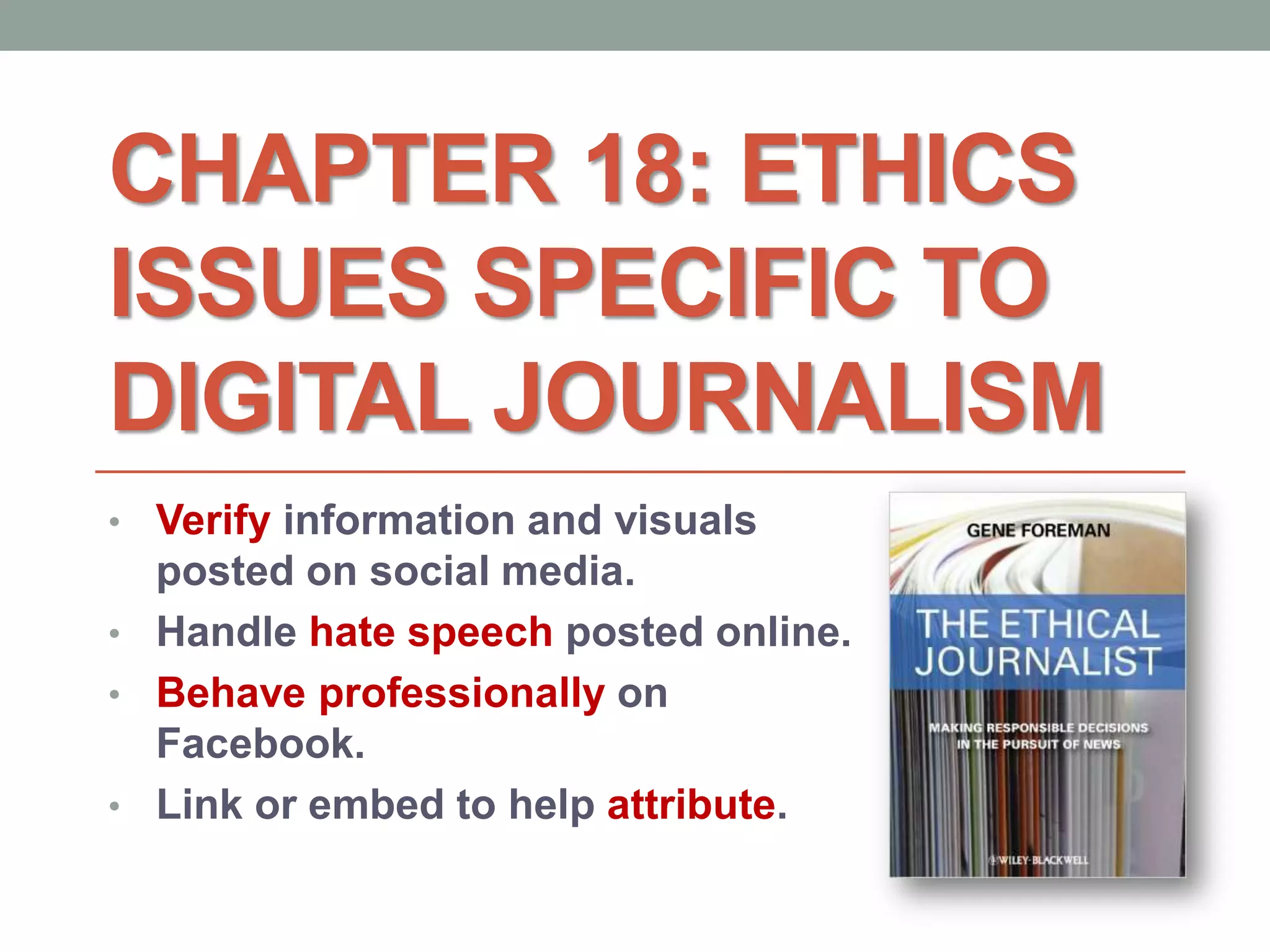
CHAPTER 18: ETHICS
ISSUES SPECIFIC TO
DIGITAL JOURNALISM
• Verify information and visuals
posted on social media.
• Handle hate speech posted online.
• Behave professionally on
Facebook.
• Link or embed to help attribute.
VERIFY
INFORMATION AND
VISUALS FROM
SOCIAL MEDIA
Verify statements, photos and videos.
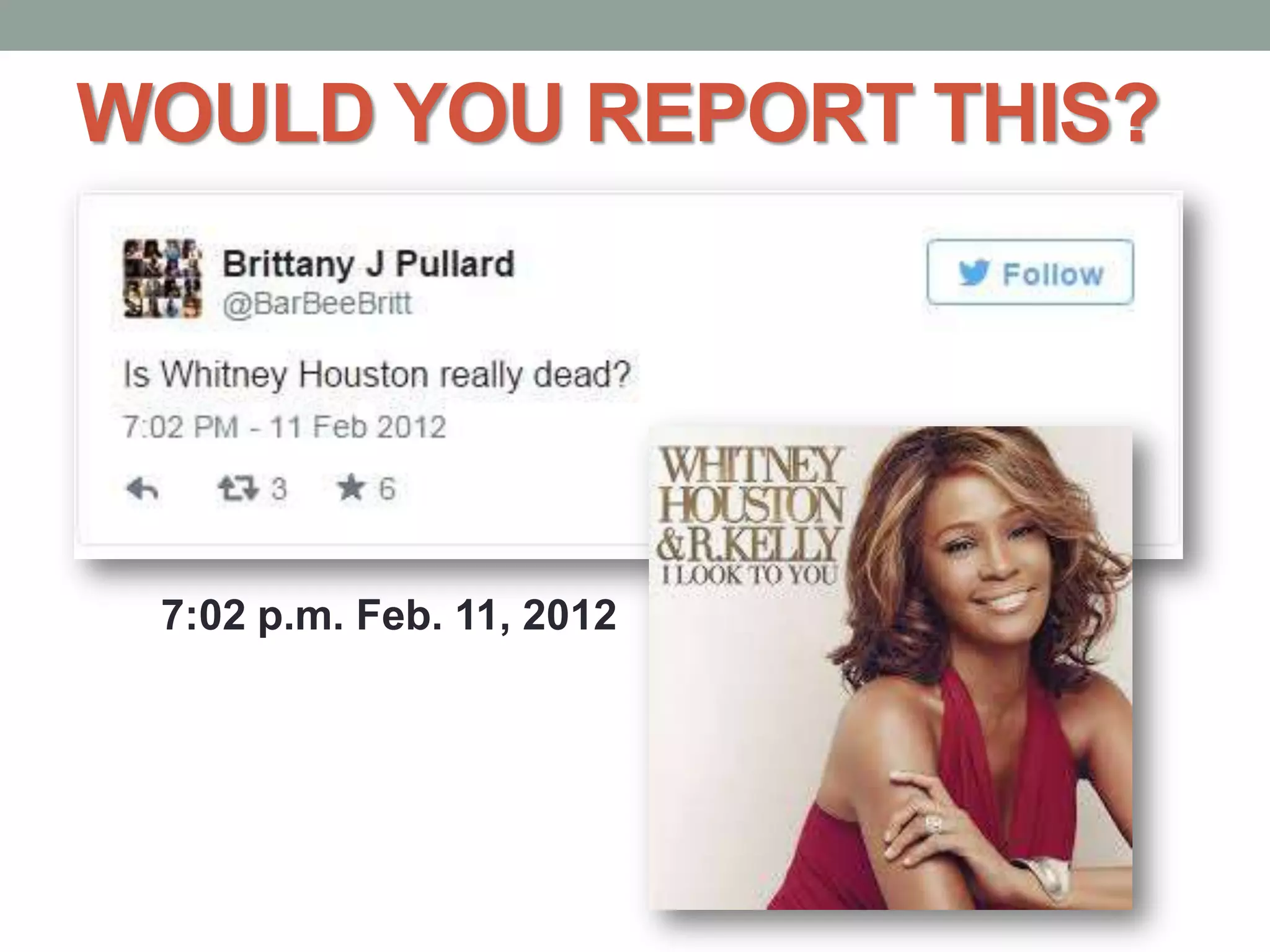
WOULD YOU REPORT THIS?
7:02 p.m. Feb. 11, 2012
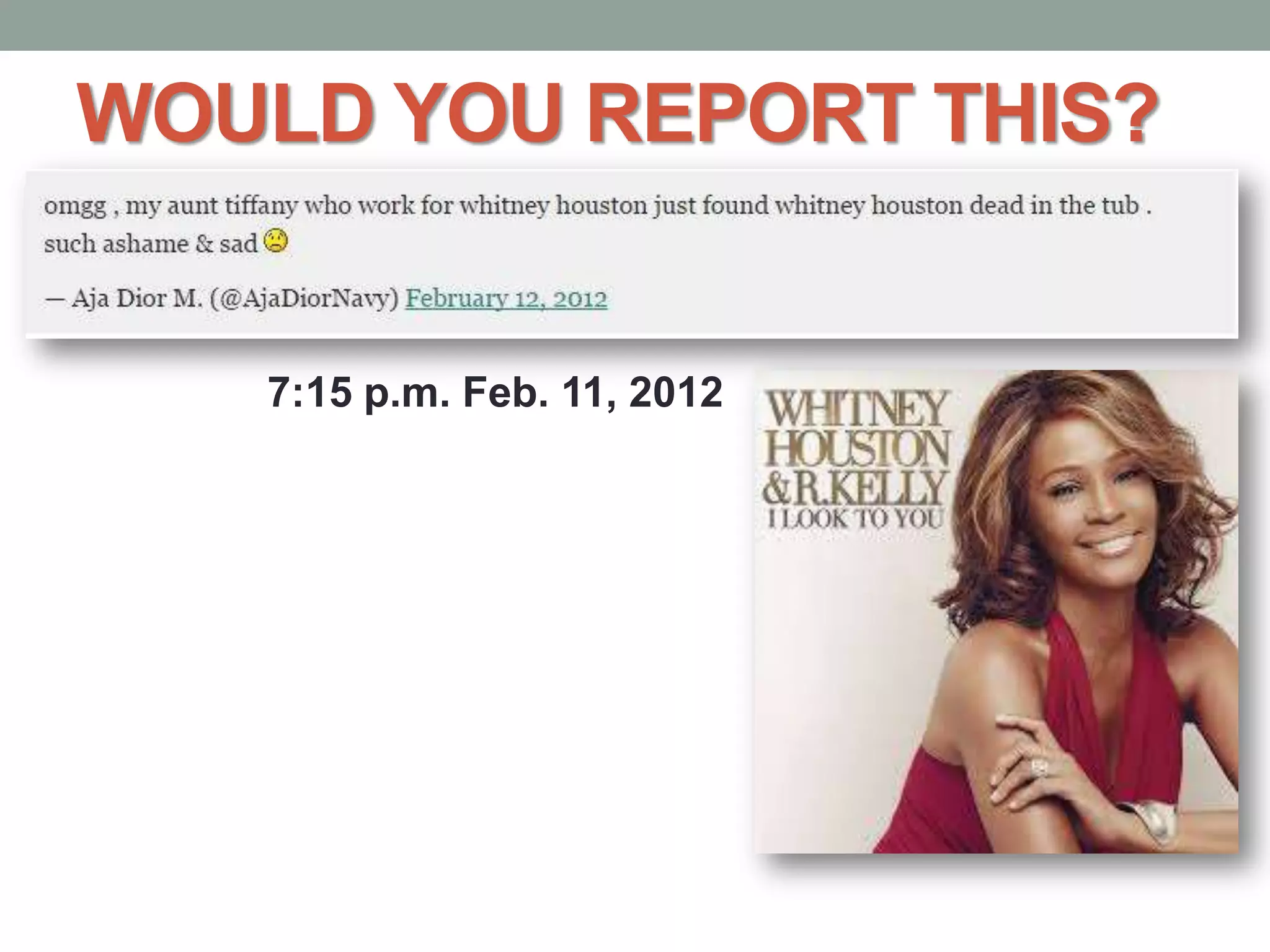
WOULD YOU REPORT THIS?
7:15 p.m. Feb. 11, 2012
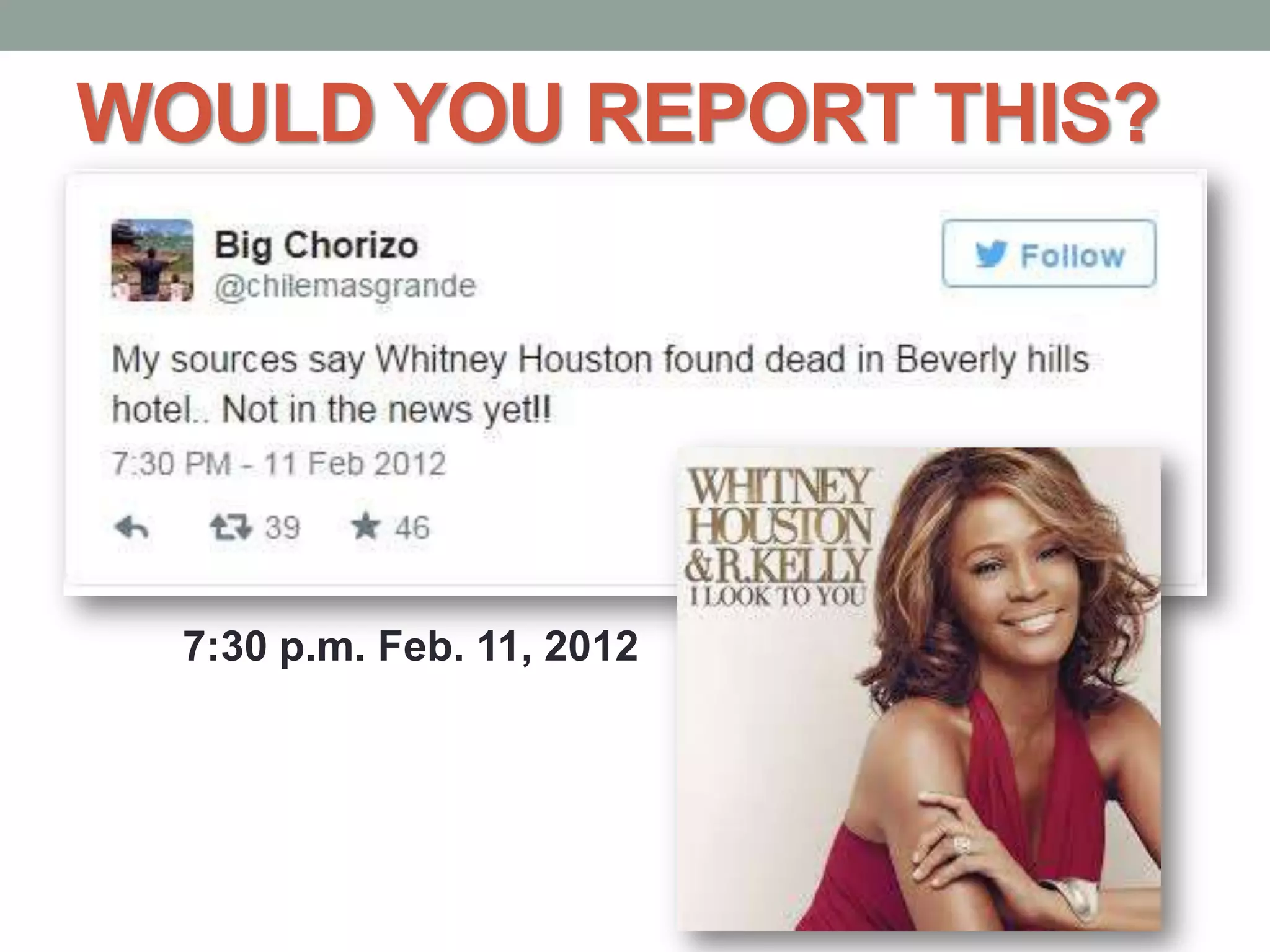
WOULD YOU REPORT THIS?
7:30 p.m. Feb. 11, 2012
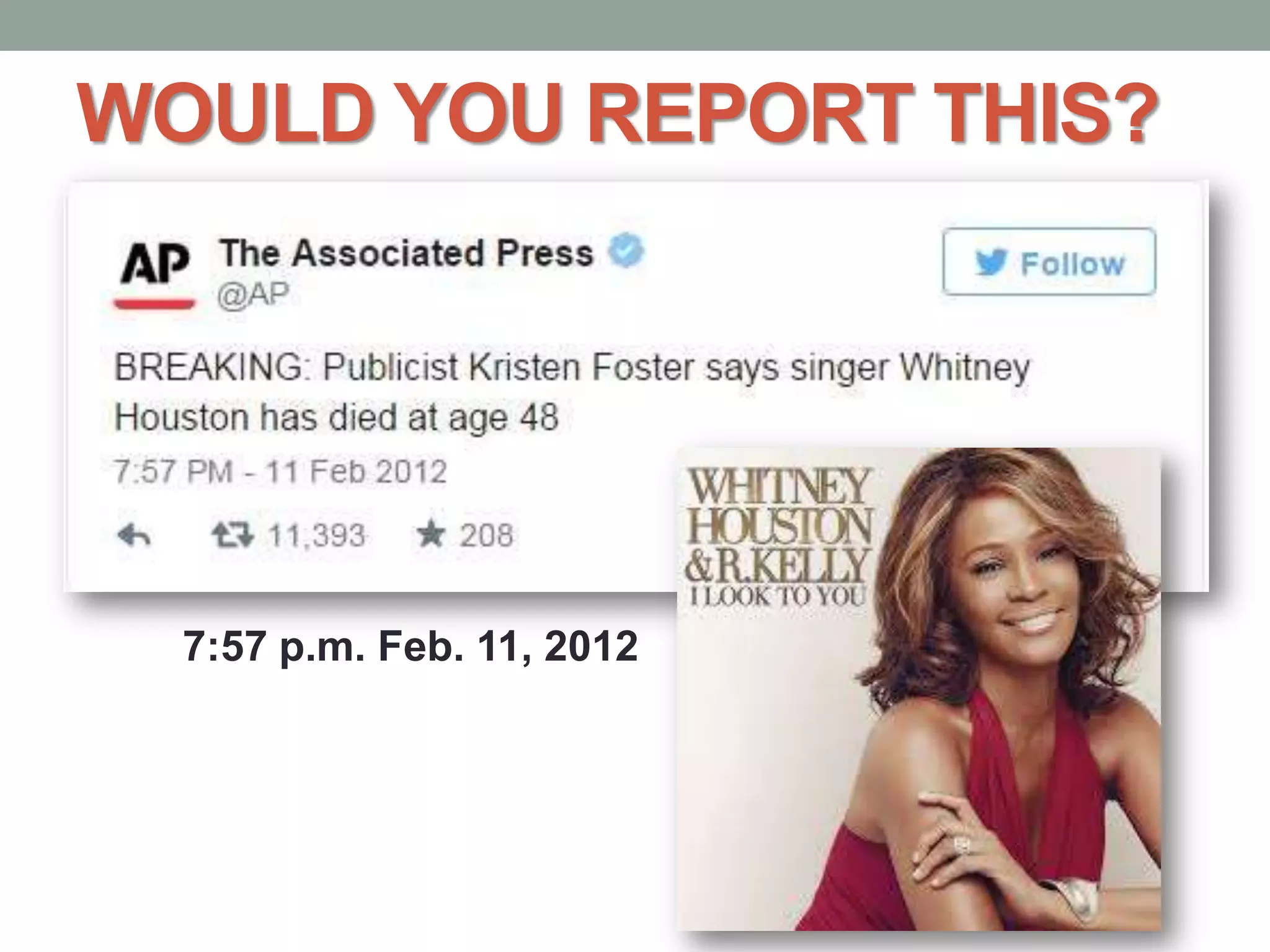
WOULD YOU REPORT THIS?
7:57 p.m. Feb. 11, 2012
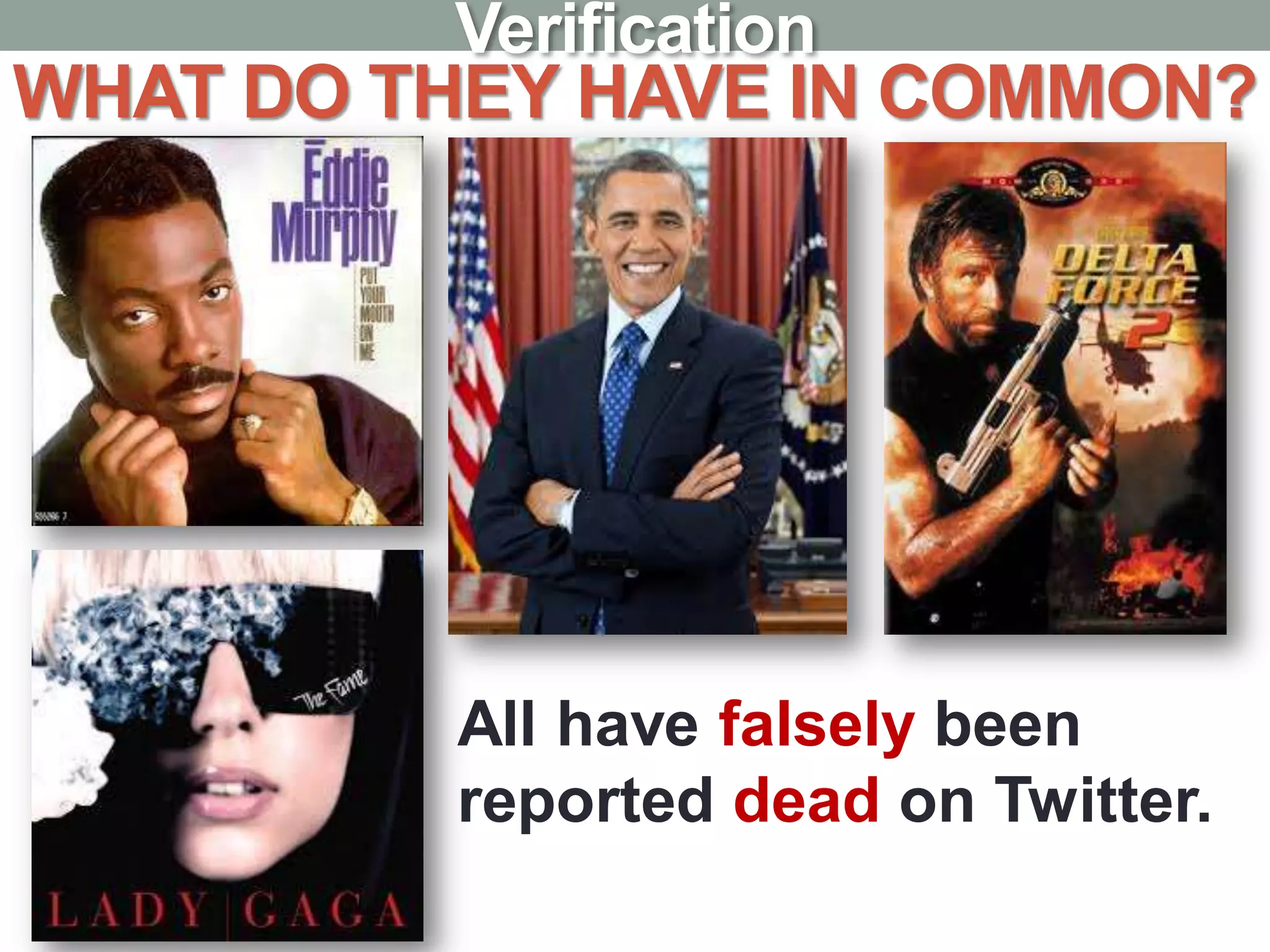
WHAT DO THEY HAVE IN COMMON?
All have falsely been
reported dead on Twitter.
Verification
SOCIAL MEDIA AND NEWS
“Now, conversations that might have occurred
between a few individuals can be amplified
exponentially to hundreds or thousands of people
within minutes.”
– Barb Palser, American Journalism Review
ByMattHamm
Verification
SOCIAL MEDIA AND NEWS
“The ways in which people first hear information may
have changed, but their reliance on reporters to
separate fact from fiction and provide depth and
context to the news has not.”
– Barb Palser, American Journalism Review
BySimonBerry
Verification
ASK:
HOW
DO YOU
KNOW THAT?
Verification
ASK:
HOW
DO THEY
KNOW THAT?
Verification
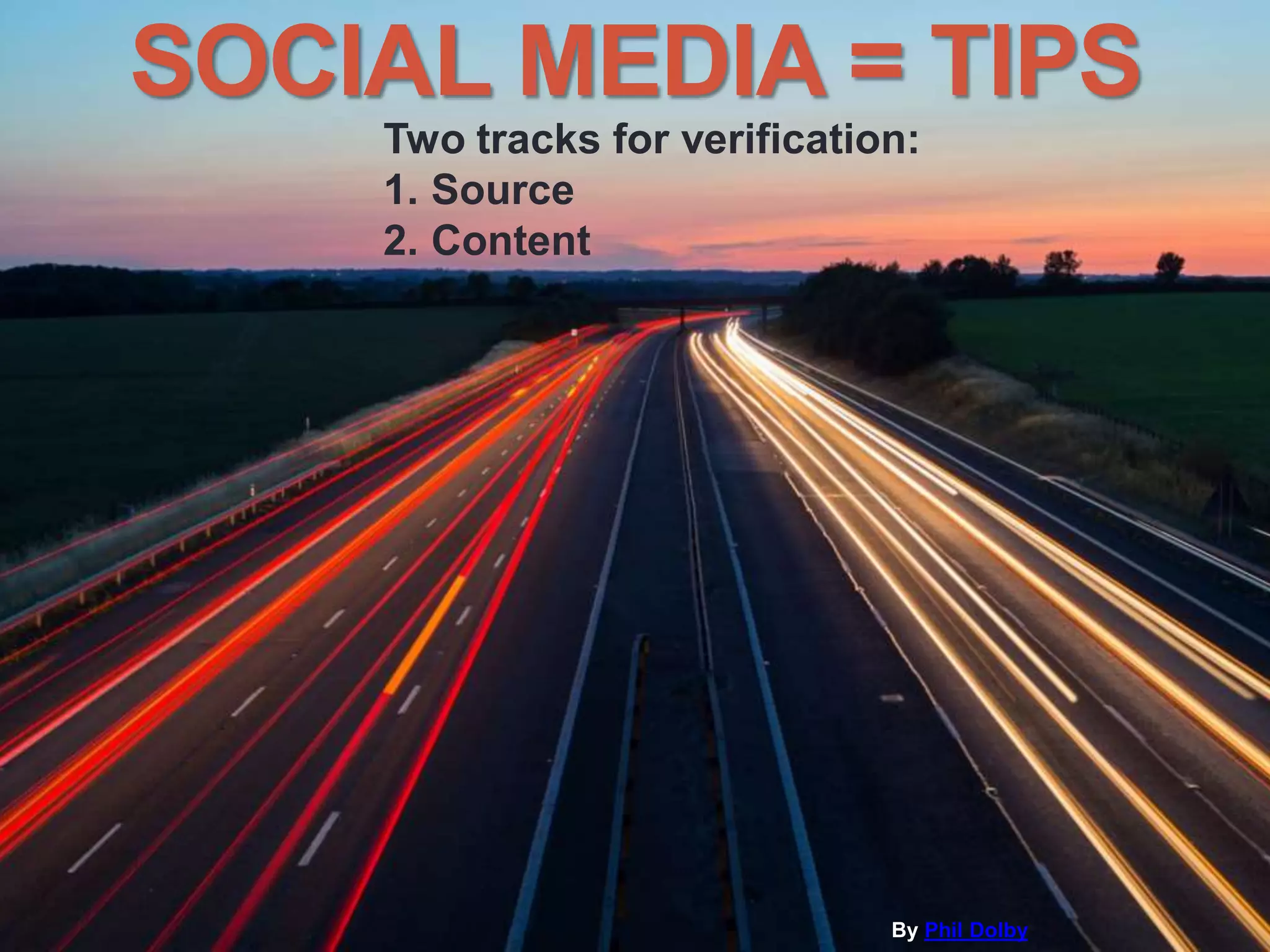
SOCIAL MEDIA = TIPS
By Phil Dolby
Two tracks for verification:
1. Source
2. Content
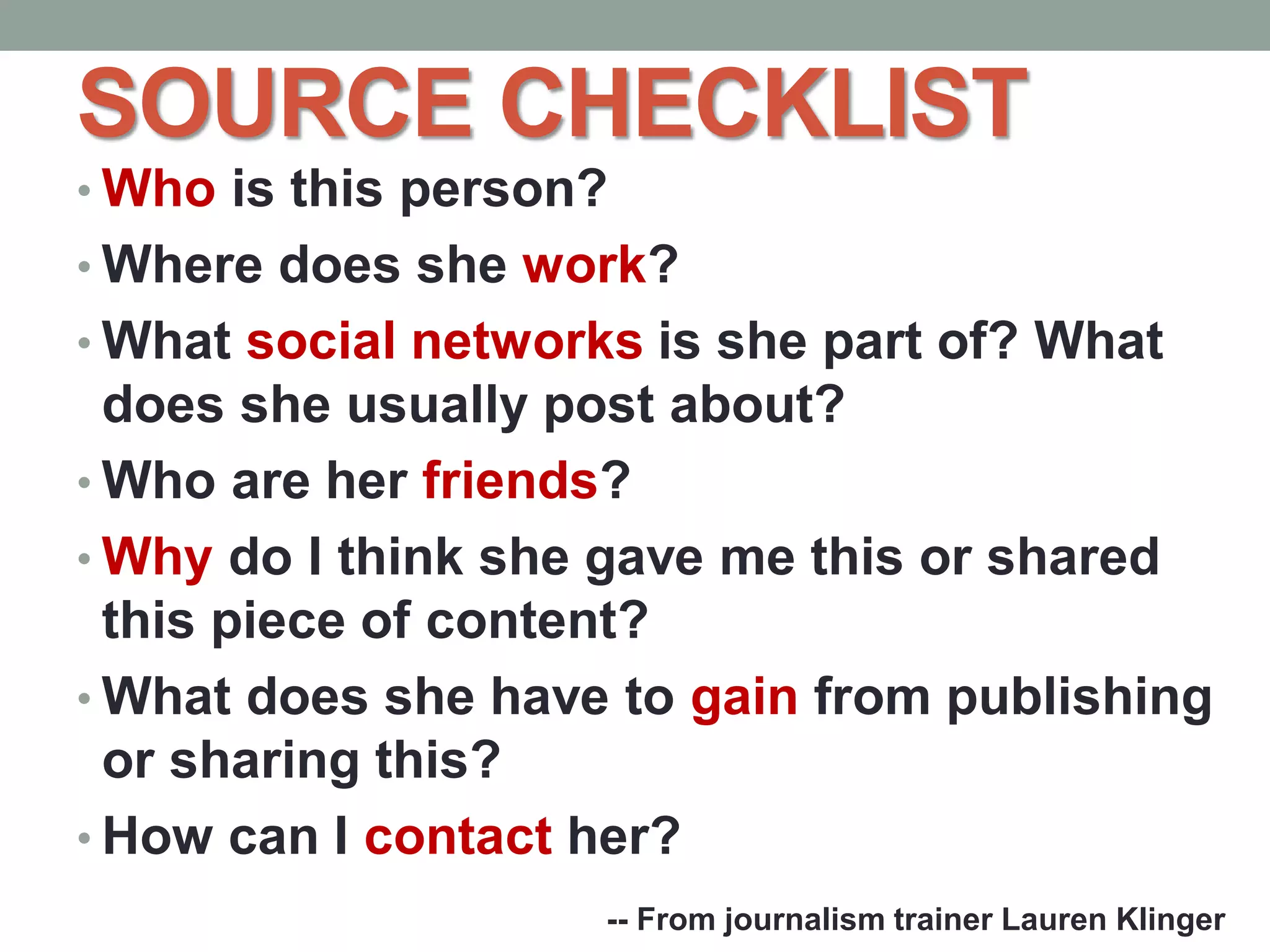
SOURCE CHECKLIST
• Who is this person?
• Where does she work?
• What social networks is she part of? What
does she usually post about?
• Who are her friends?
• Why do I think she gave me this or shared
this piece of content?
• What does she have to gain from publishing
or sharing this?
• How can I contact her?
-- From journalism trainer Lauren Klinger
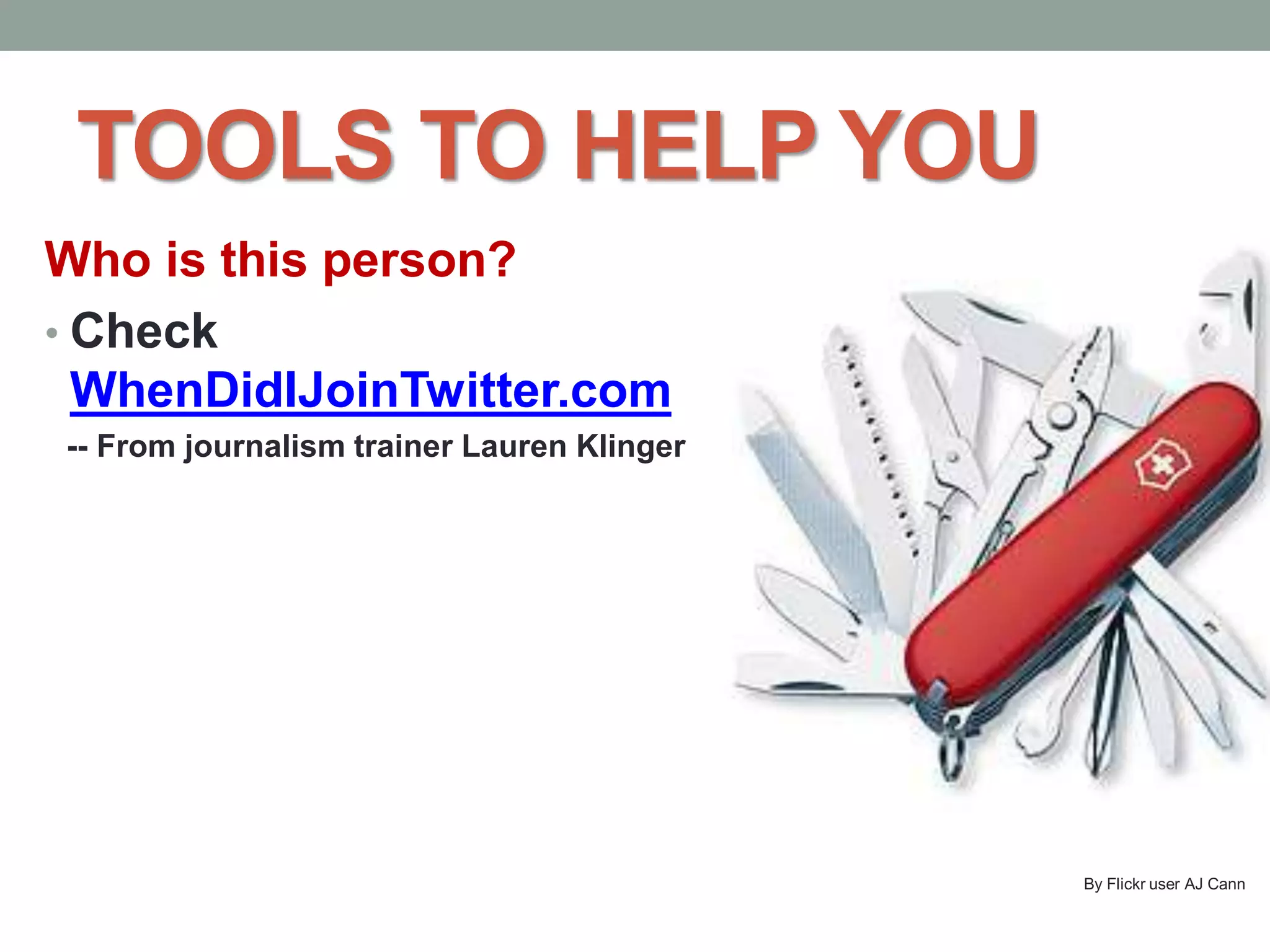
TOOLS TO HELP YOU
Who is this person?
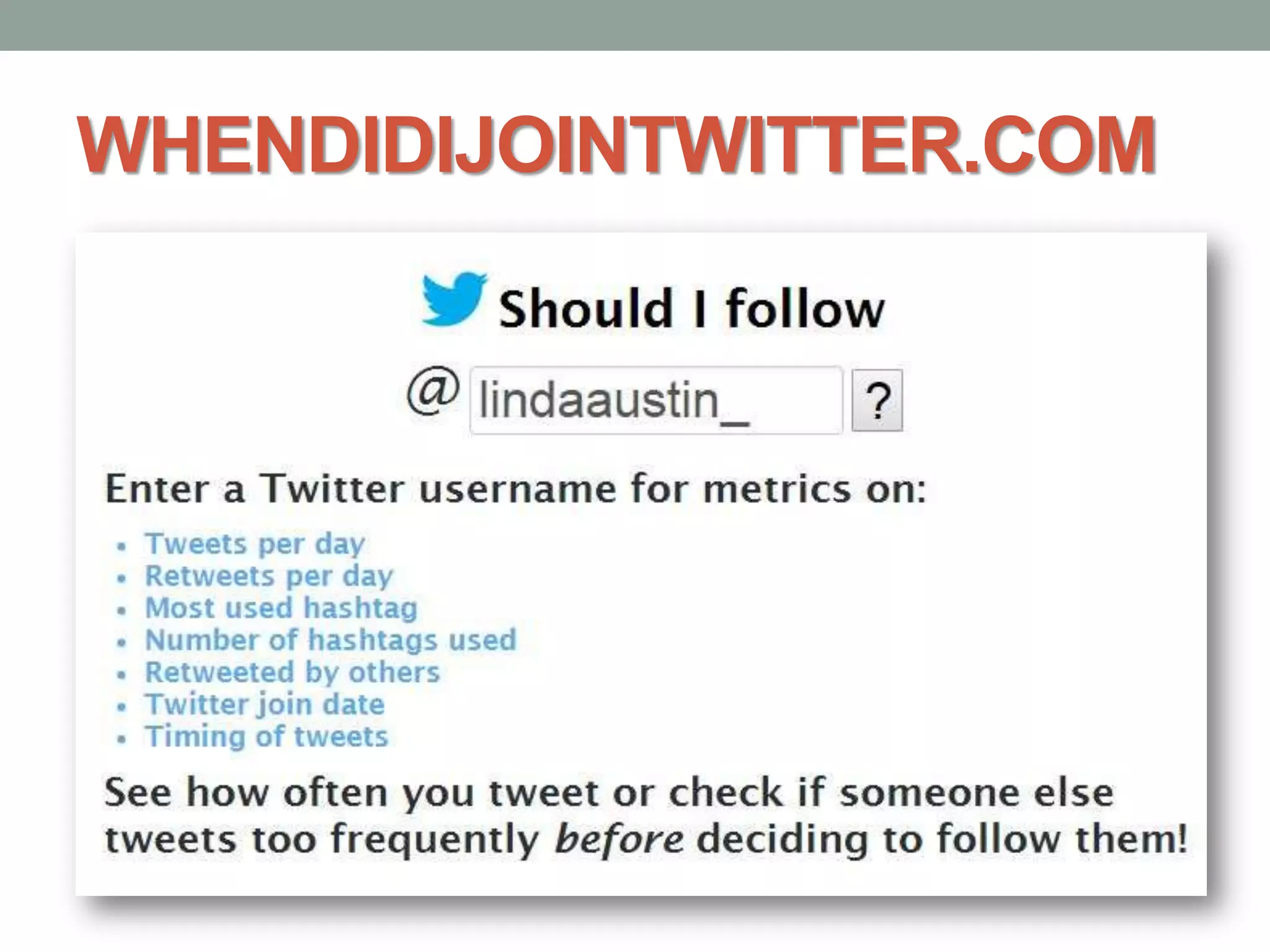
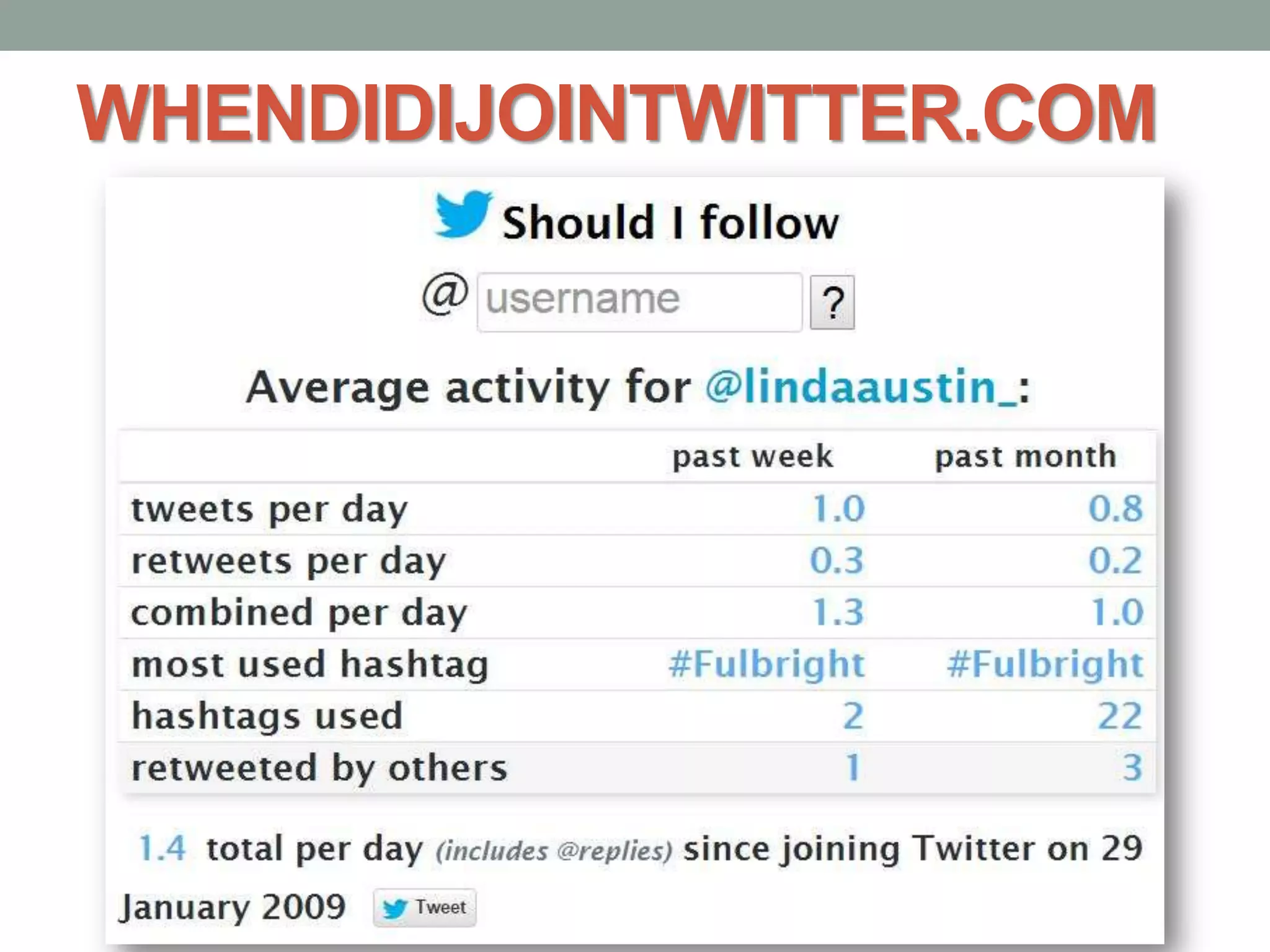
• Check
WhenDidIJoinTwitter.com
-- From journalism trainer Lauren Klinger
By Flickr user AJ Cann
WHENDIDIJOINTWITTER.COM
TOOLS TO HELP YOU
Who is this person?
• Check
WhenDidIJoinTwitter.com
• Check for a Facebook
profile
• Check Spokeo.com
-- From journalism trainer Lauren Klinger
By Flickr user AJ Cann
SPOKEO.COM
TOOLS TO HELP YOU
Who is this person?
• Check
WhenDidIJoinTwitter.com
• Check for a Facebook
profile
• Check Spokeo.com
• Check
http://www.myanmarteldir
.com.mm/white_pages/
-- From journalism trainer Lauren Klinger
By Flickr user AJ Cann
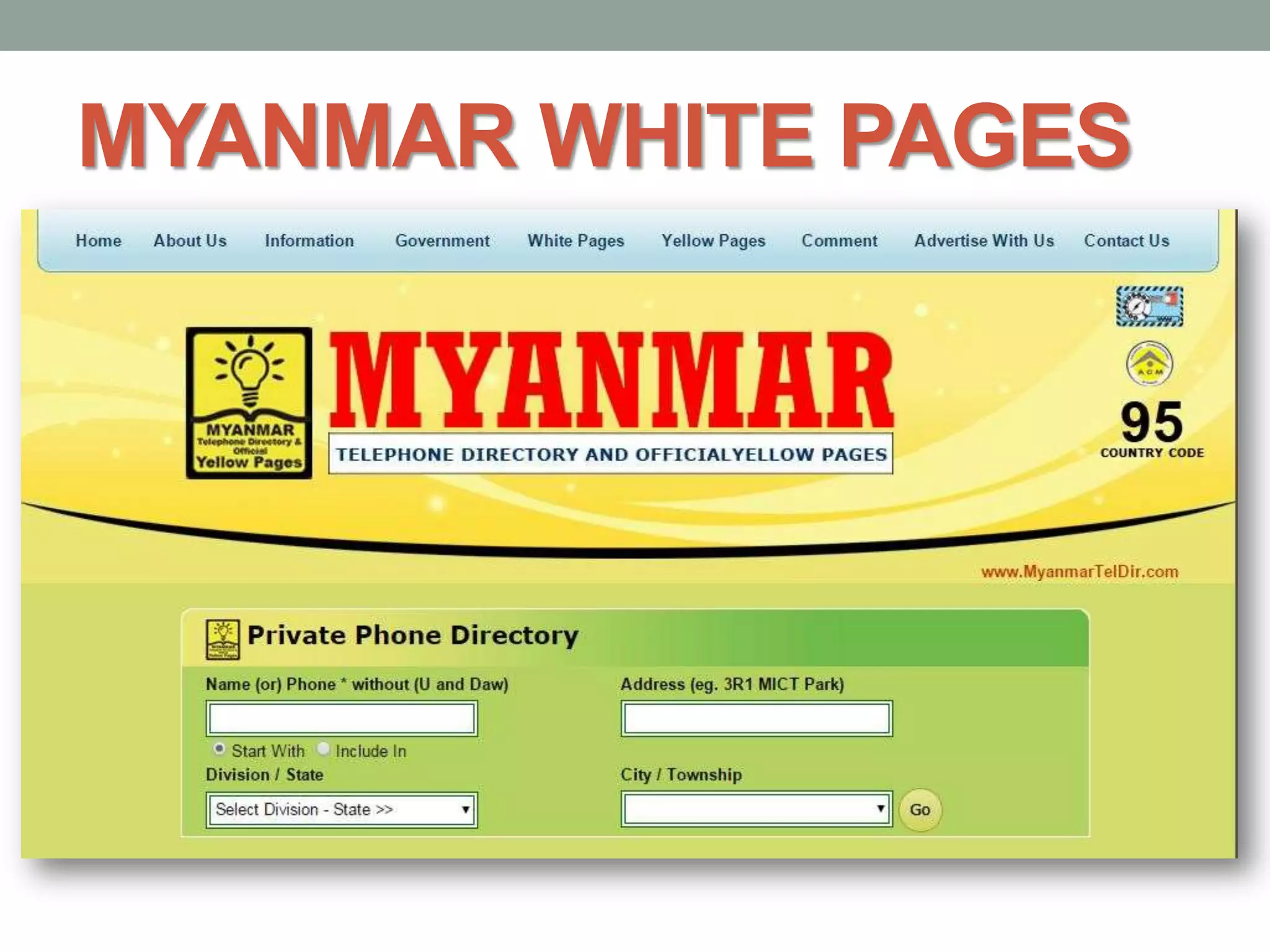
MYANMAR WHITE PAGES
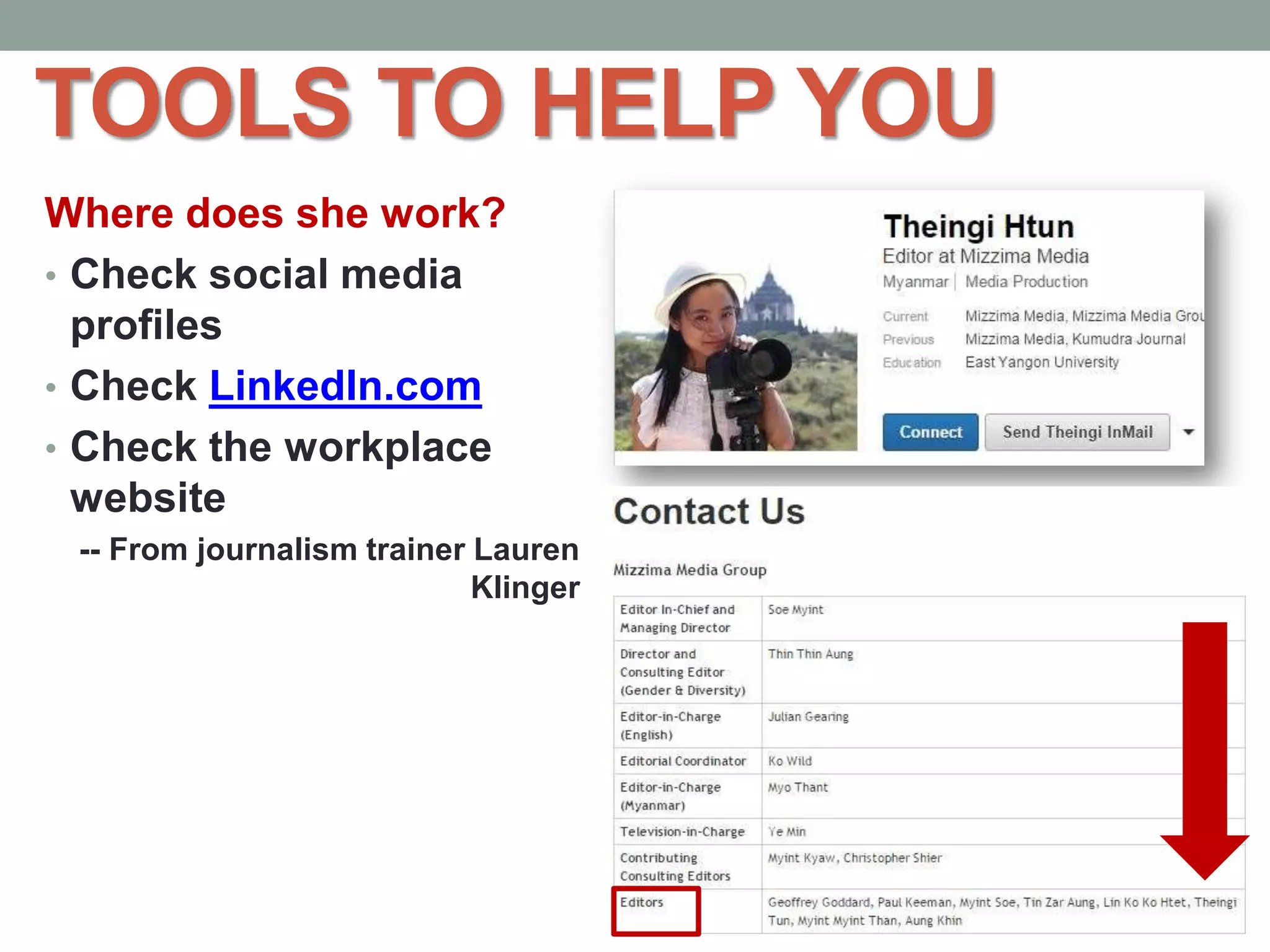
TOOLS TO HELP YOU
Where does she work?
• Check social media
profiles
• Check LinkedIn.com
• Check the workplace
website
-- From journalism trainer Lauren
Klinger
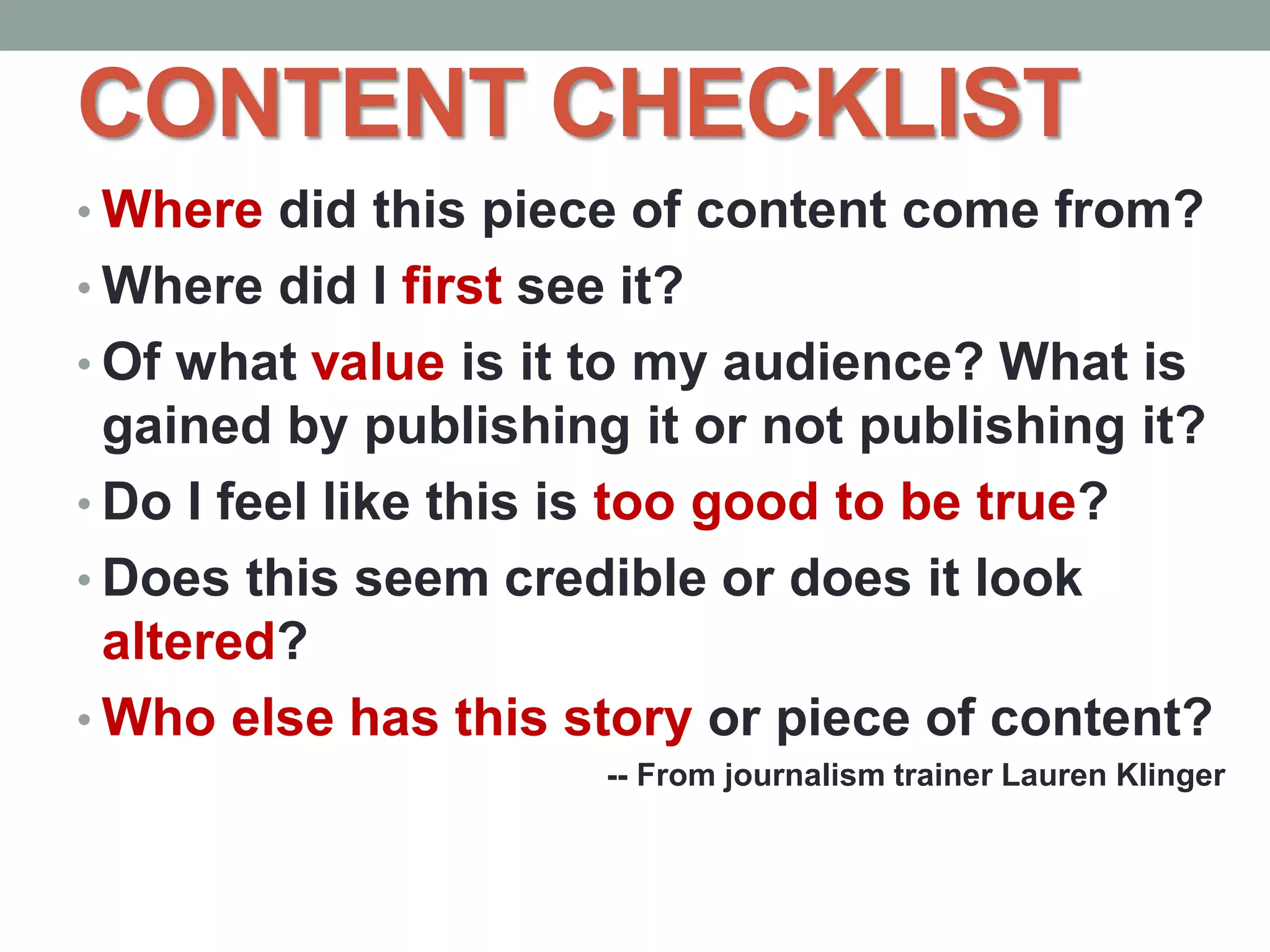
CONTENT CHECKLIST
• Where did this piece of content come from?
• Where did I first see it?
• Of what value is it to my audience? What is
gained by publishing it or not publishing it?
• Do I feel like this is too good to be true?
• Does this seem credible or does it look
altered?
• Who else has this story or piece of content?
-- From journalism trainer Lauren Klinger
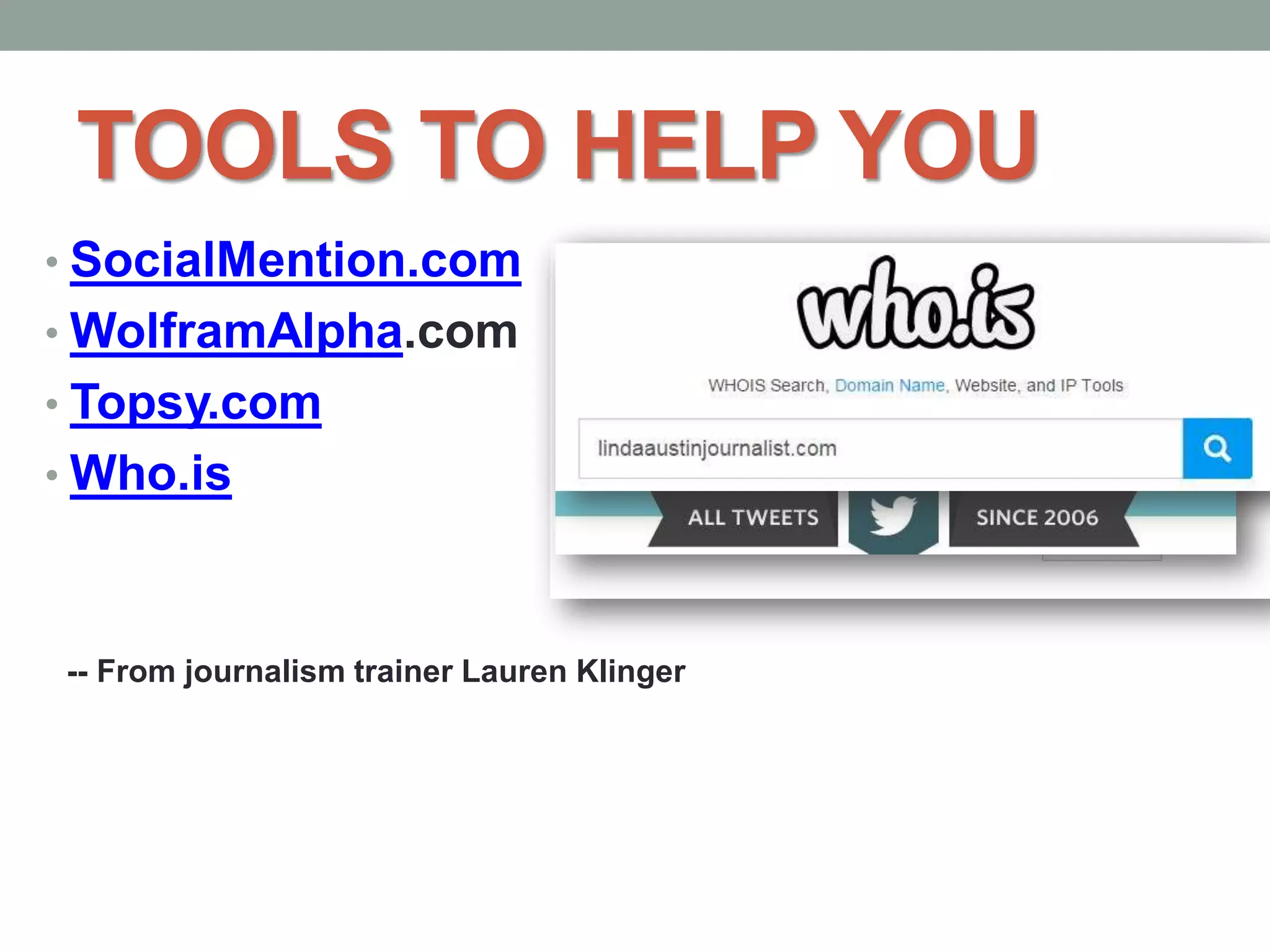
TOOLS TO HELP YOU
• SocialMention.com
• WolframAlpha.com
• Topsy.com
• Who.is
-- From journalism trainer Lauren Klinger
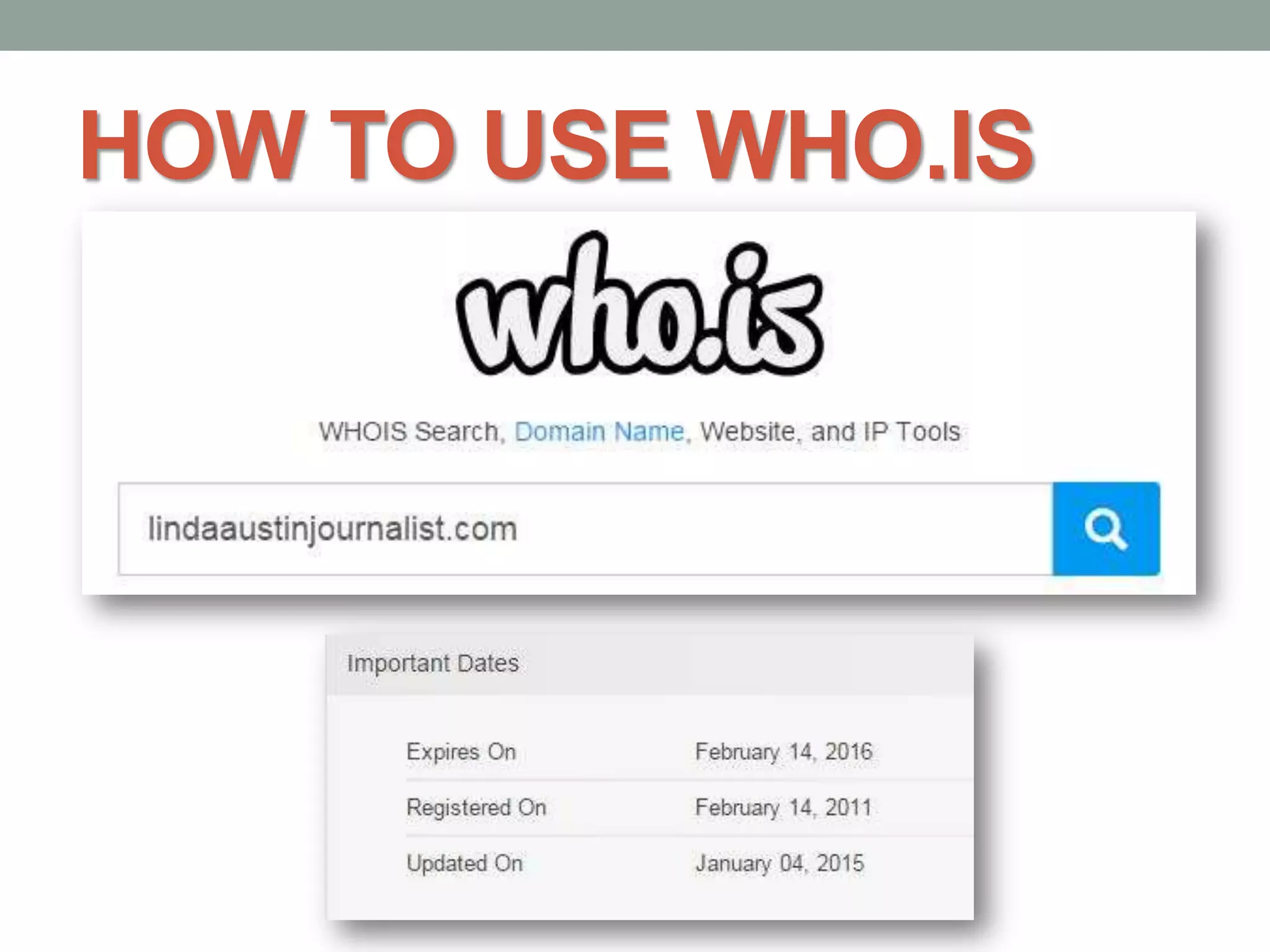
HOW TO USE WHO.IS
TOOLS TO HELP YOU
• SocialMention.com
• WolframAlpha.com
• Topsy.com
• Who.is
• Snopes.com
• EXIF-viewer.com
-- From journalism trainer Lauren Klinger
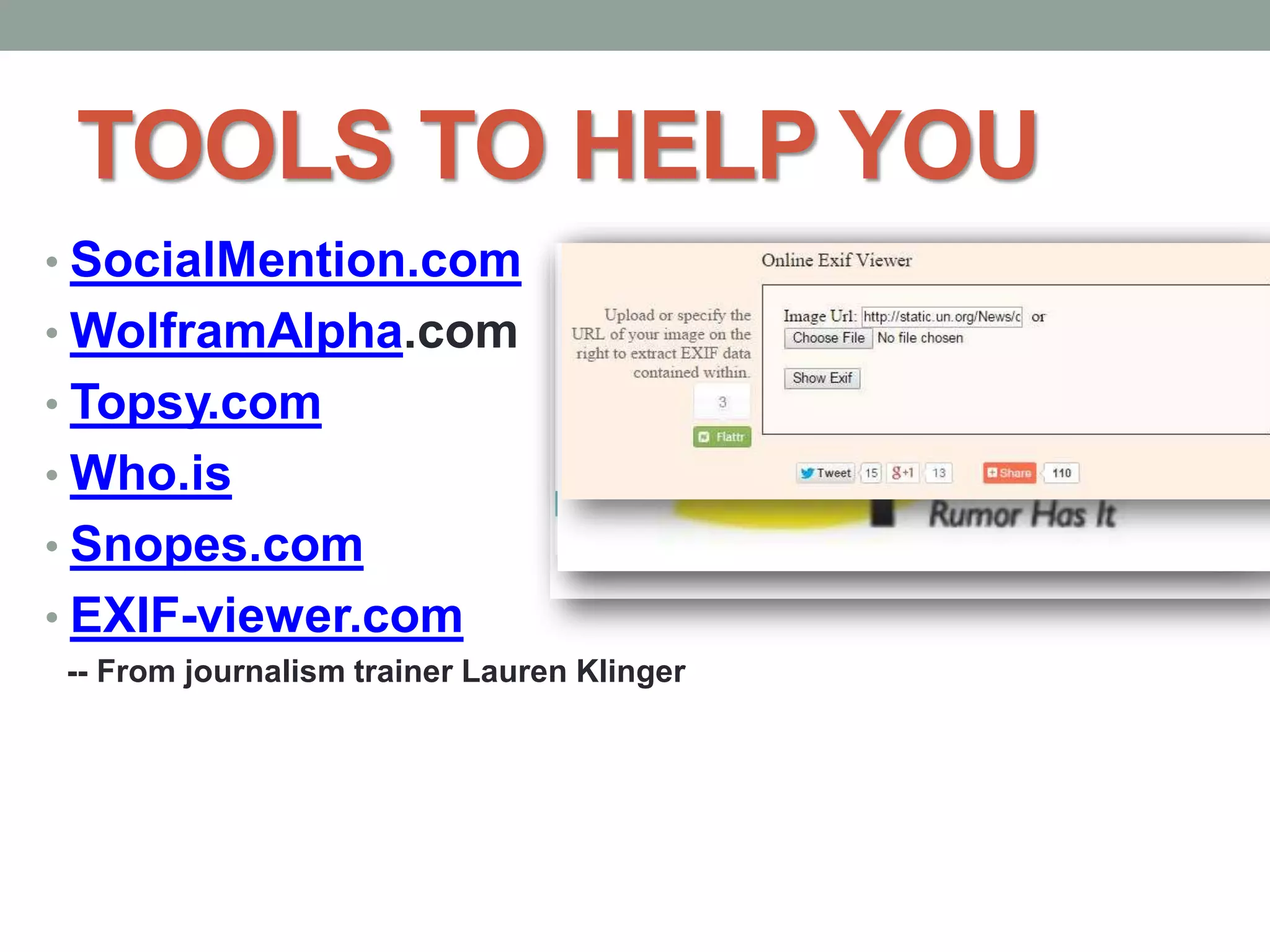
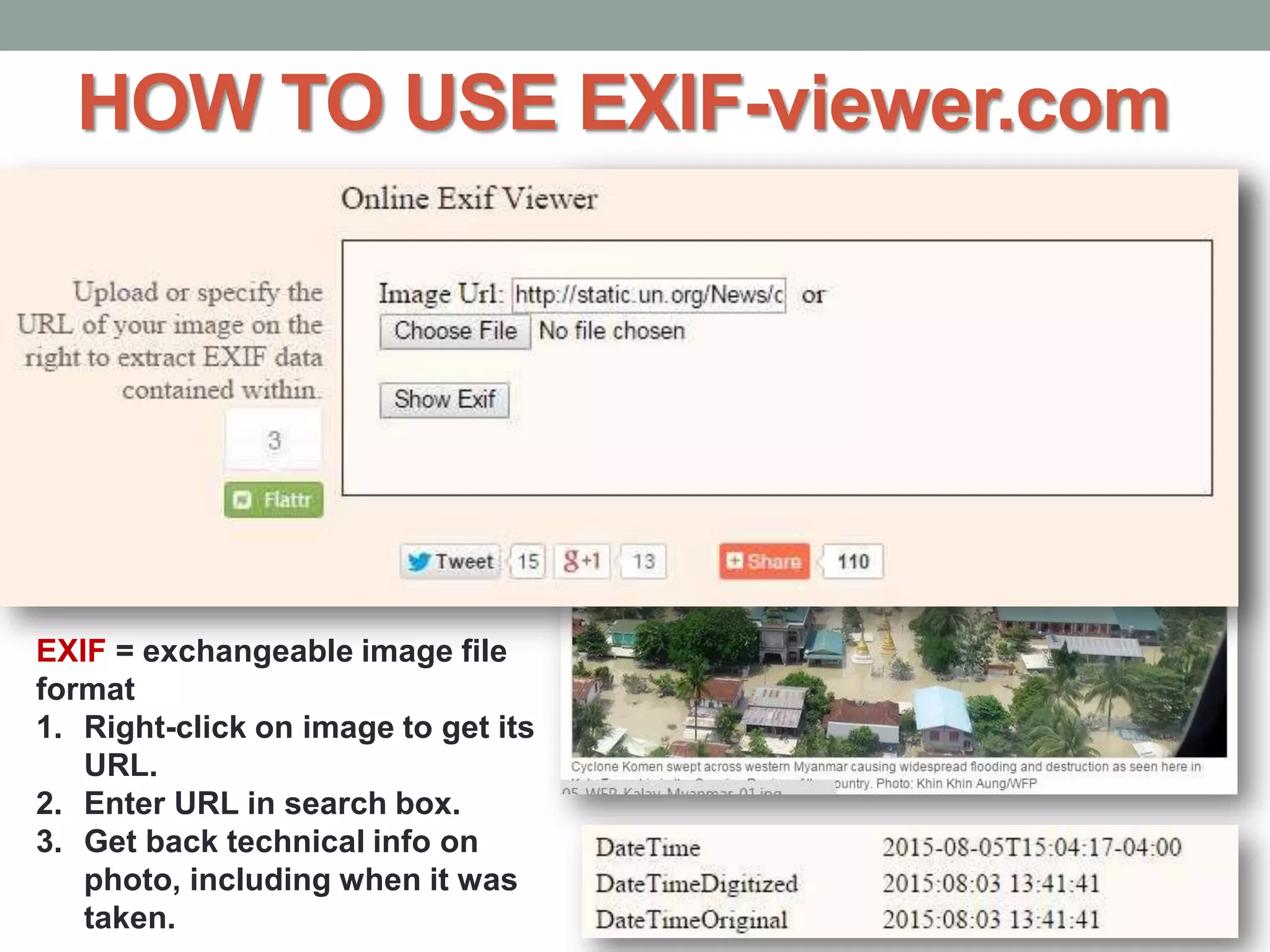
HOW TO USE EXIF-viewer.com
EXIF = exchangeable image file
format
1. Right-click on image to get its
URL.
2. Enter URL in search box.
3. Get back technical info on
photo, including when it was
taken.
ASK:
HOW
DO YOU
KNOW THAT?
Verification
ASK:
HOW
DO THEY
KNOW THAT?
Verification
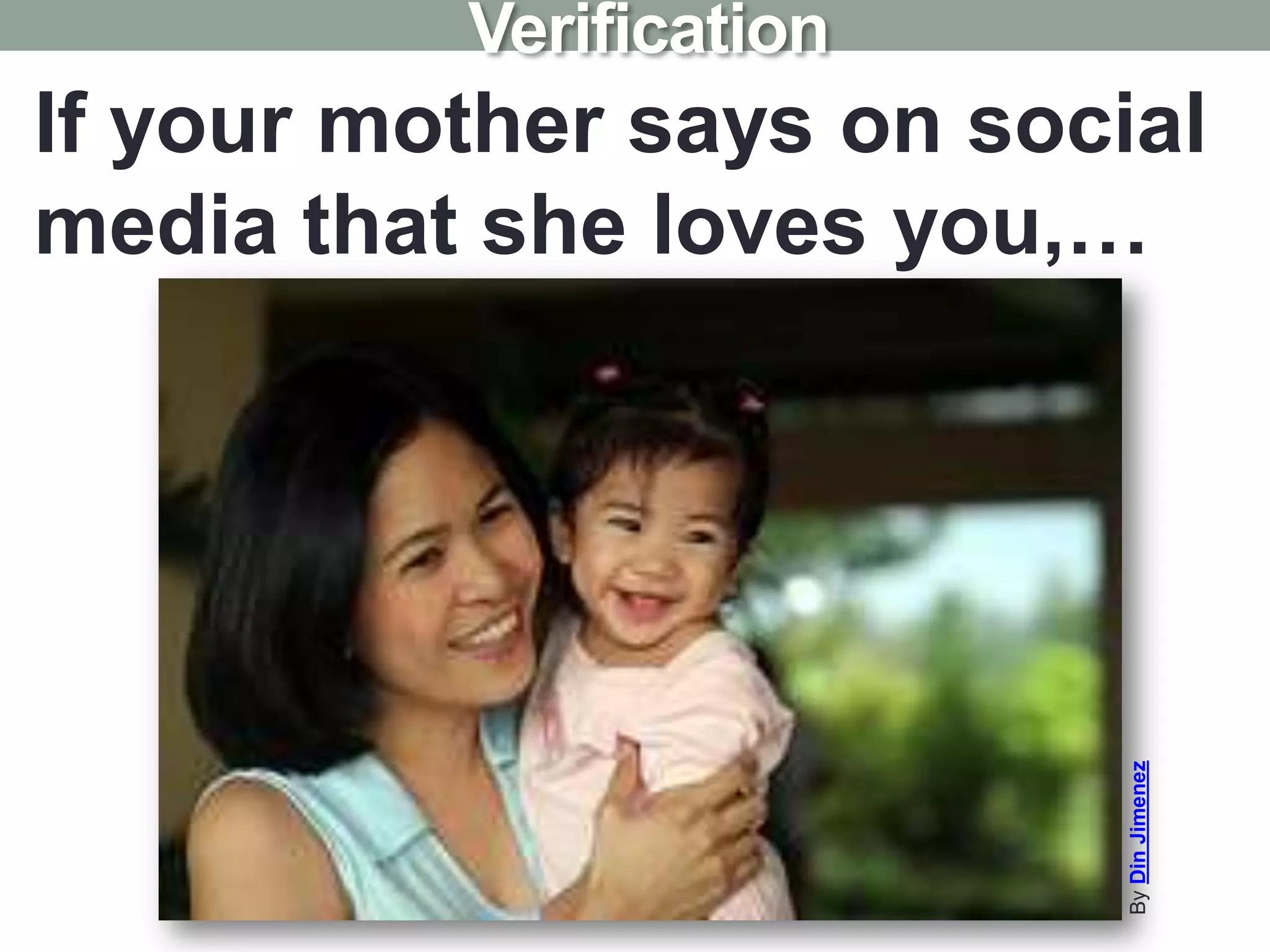
If your mother says on social
media that she loves you,…
ByDinJimenez
Verification
CHECK
IT
OUT!
Verification
By Din Jim
CHECK
Verification
By Din Jim
•Her Twitter timeline, bio, links
•Her Facebook posts
•Her followers and friends
•Google her -- From journalism trainer Steve Buttry
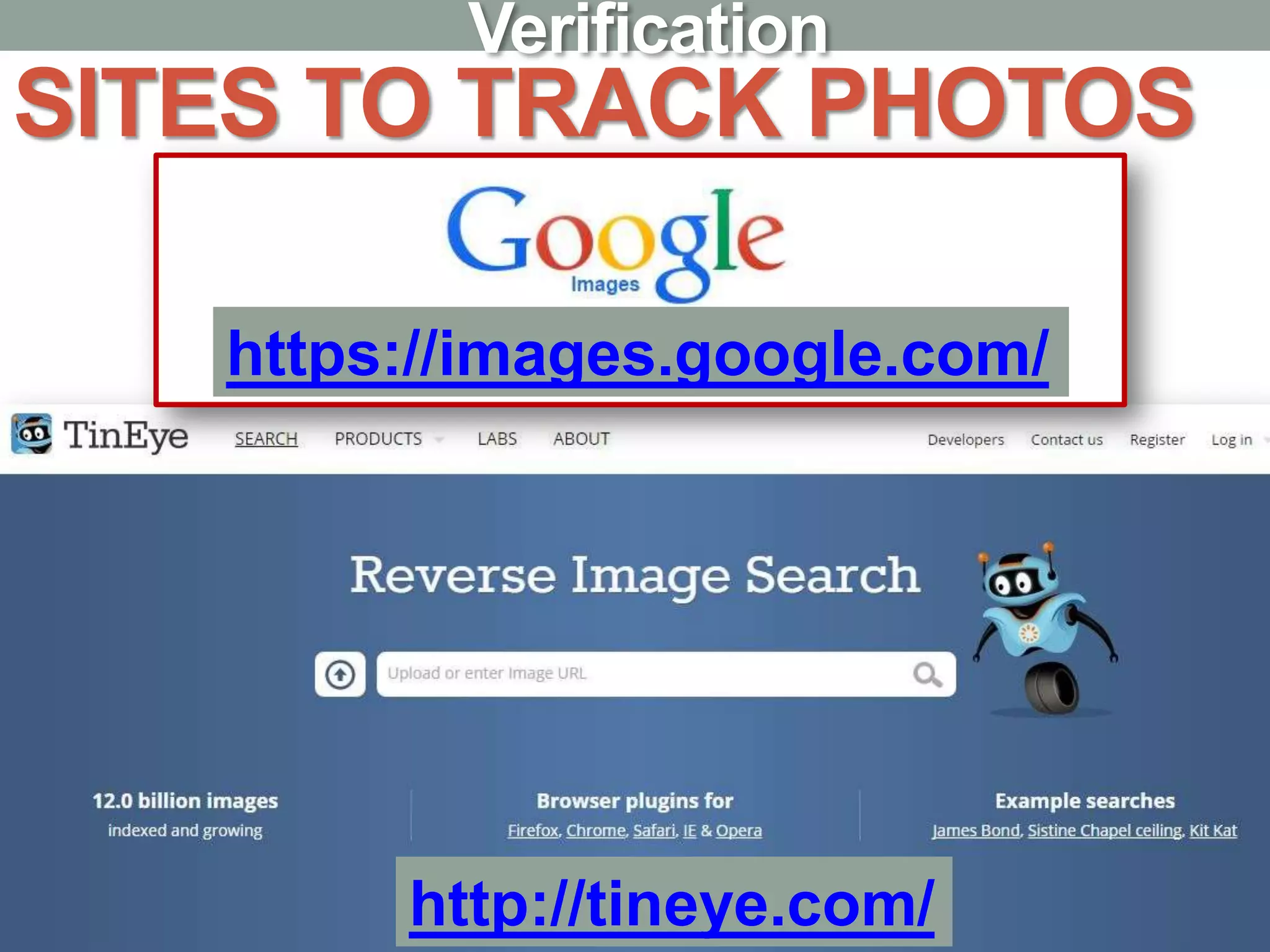
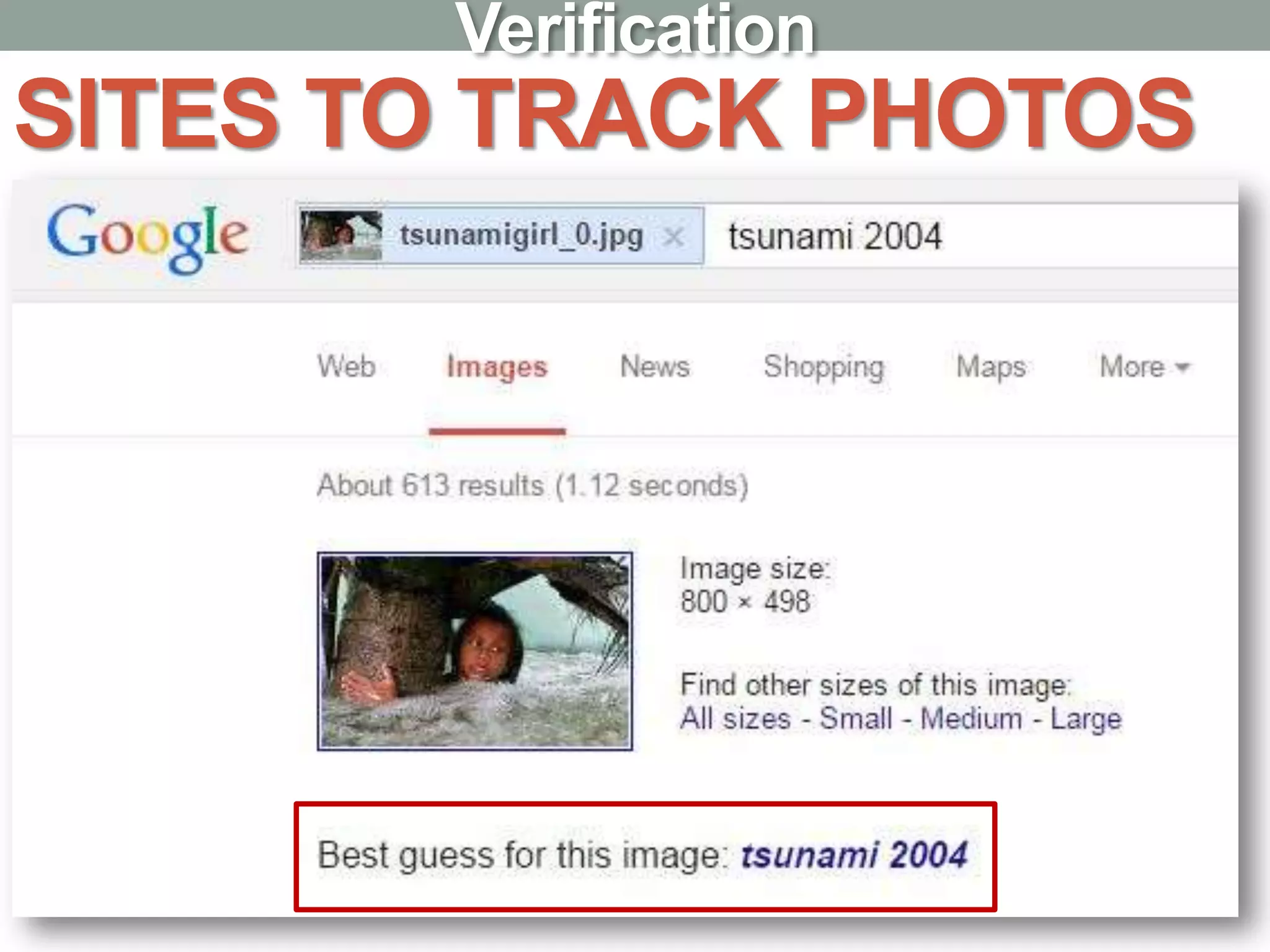
SITES TO TRACK PHOTOS
https://images.google.com/
http://tineye.com/
Verification
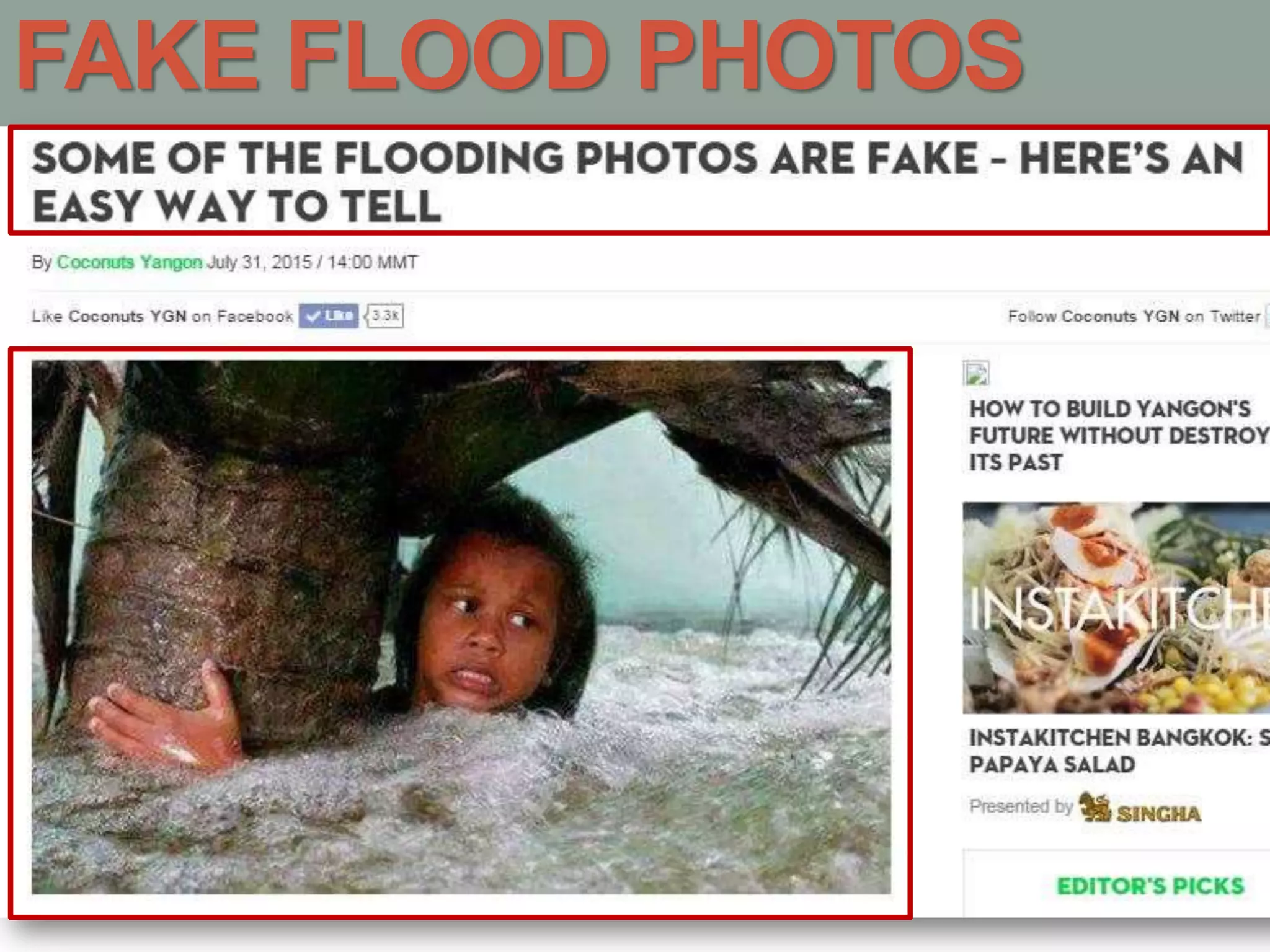
FAKE FLOOD PHOTOS
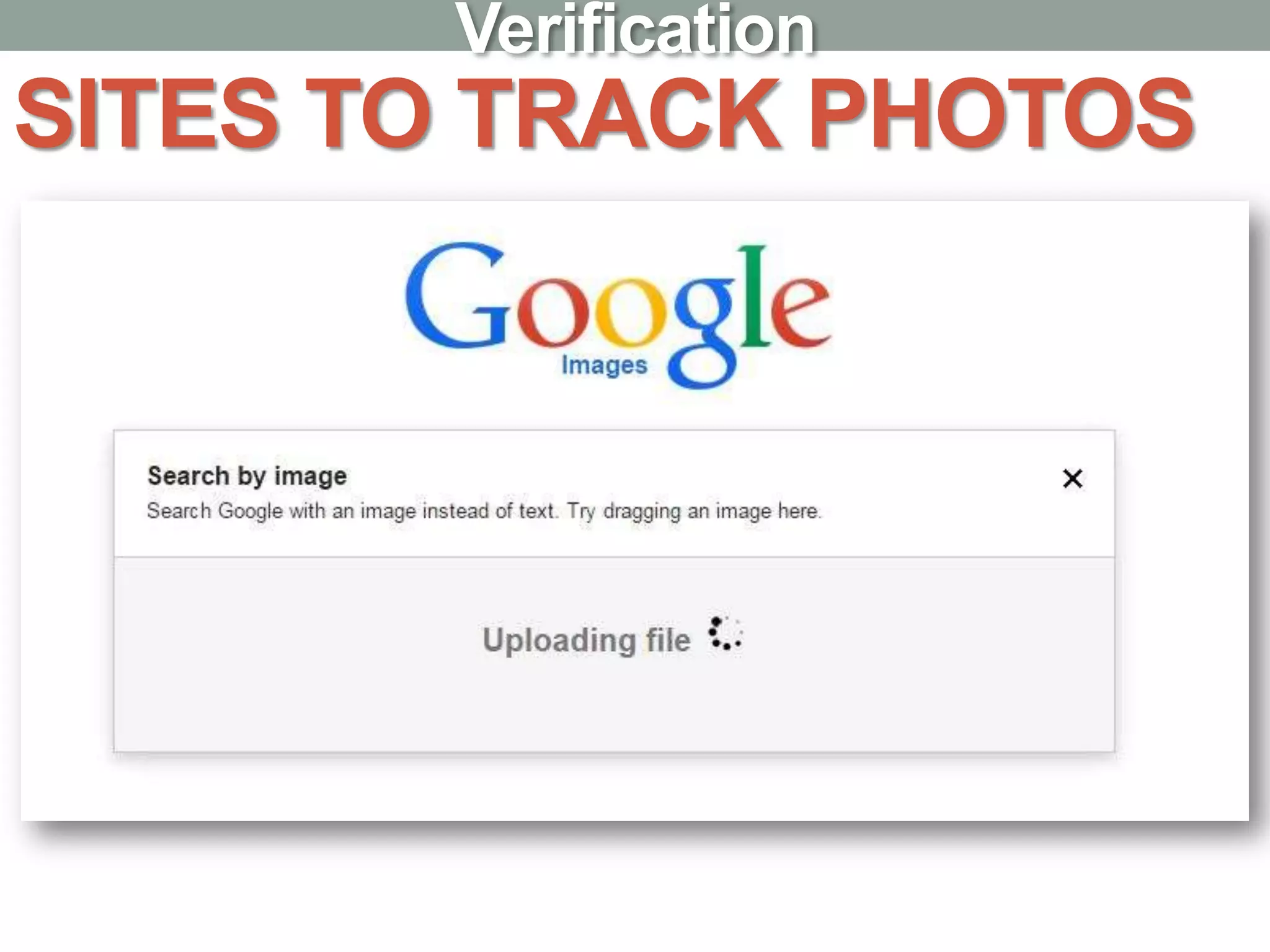
SITES TO TRACK PHOTOS
Verification
SITES TO TRACK PHOTOS
Verification
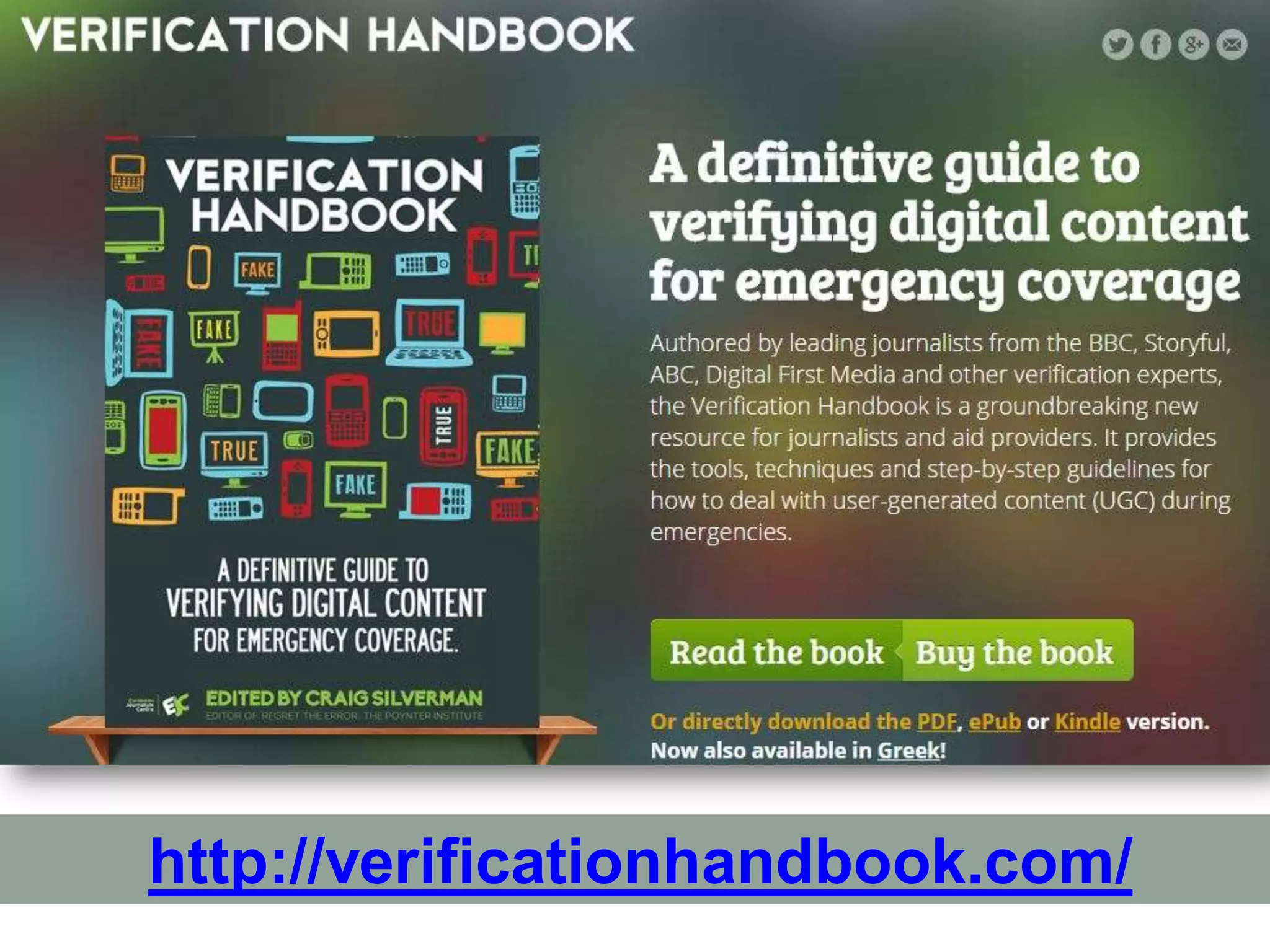
http://verificationhandbook.com/
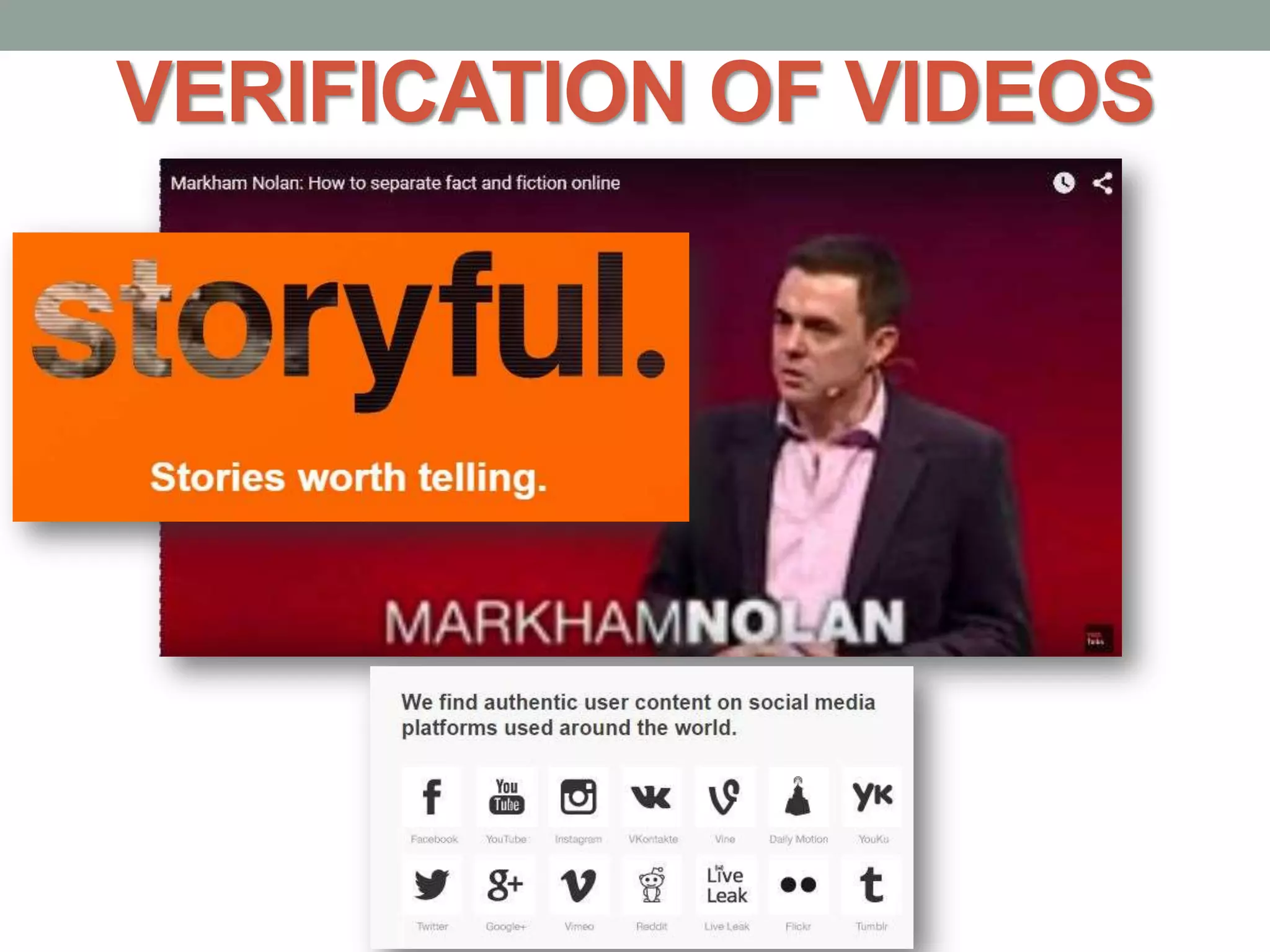
VERIFICATION OF VIDEOS
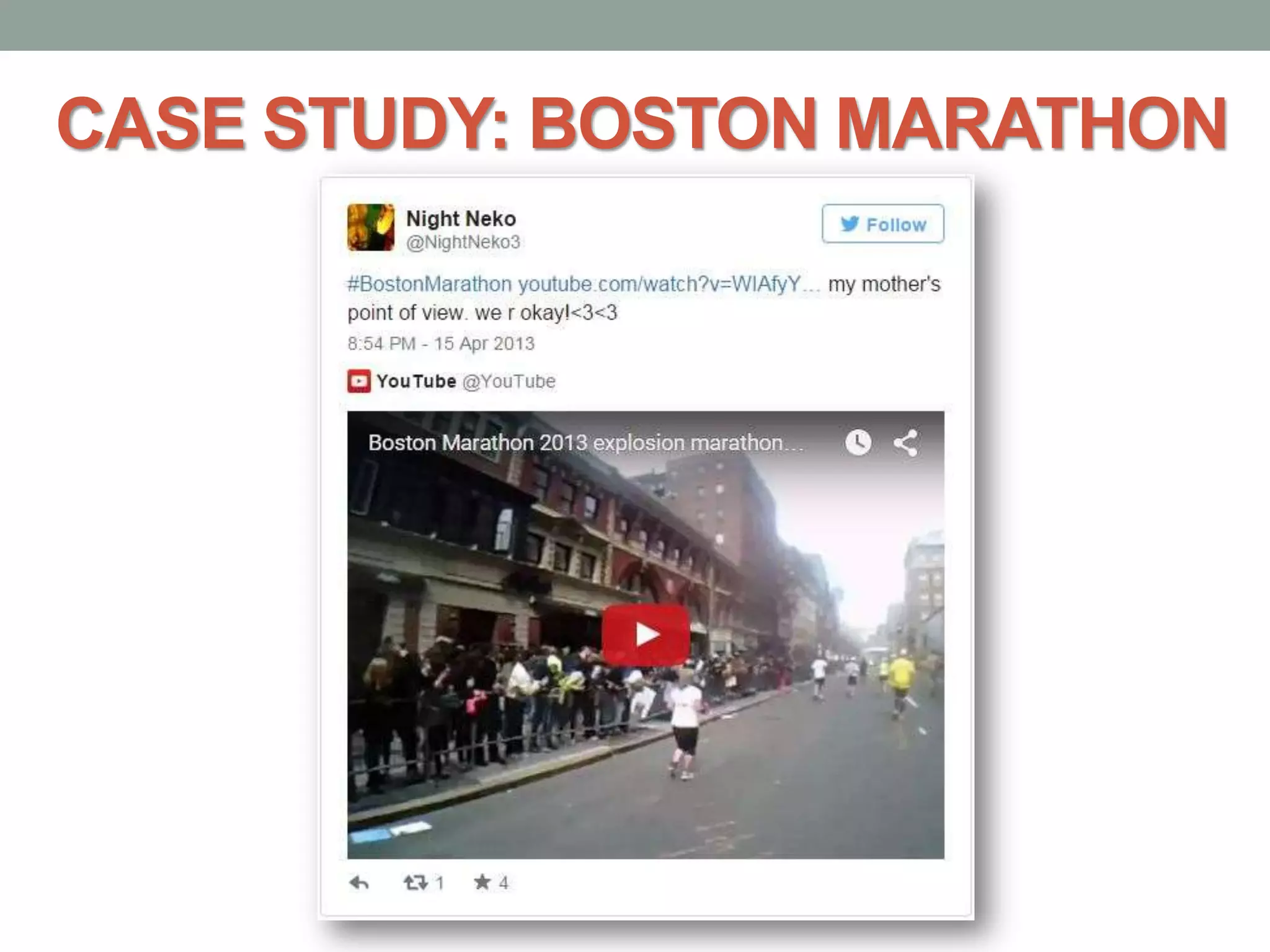
CASE STUDY: BOSTON MARATHON
HANDLE HATE
SPEECH ONLINE
• How to handle hate speech in comments on your
or your news organization’s Facebook page.
• When to report on hate speech happening on
social media.
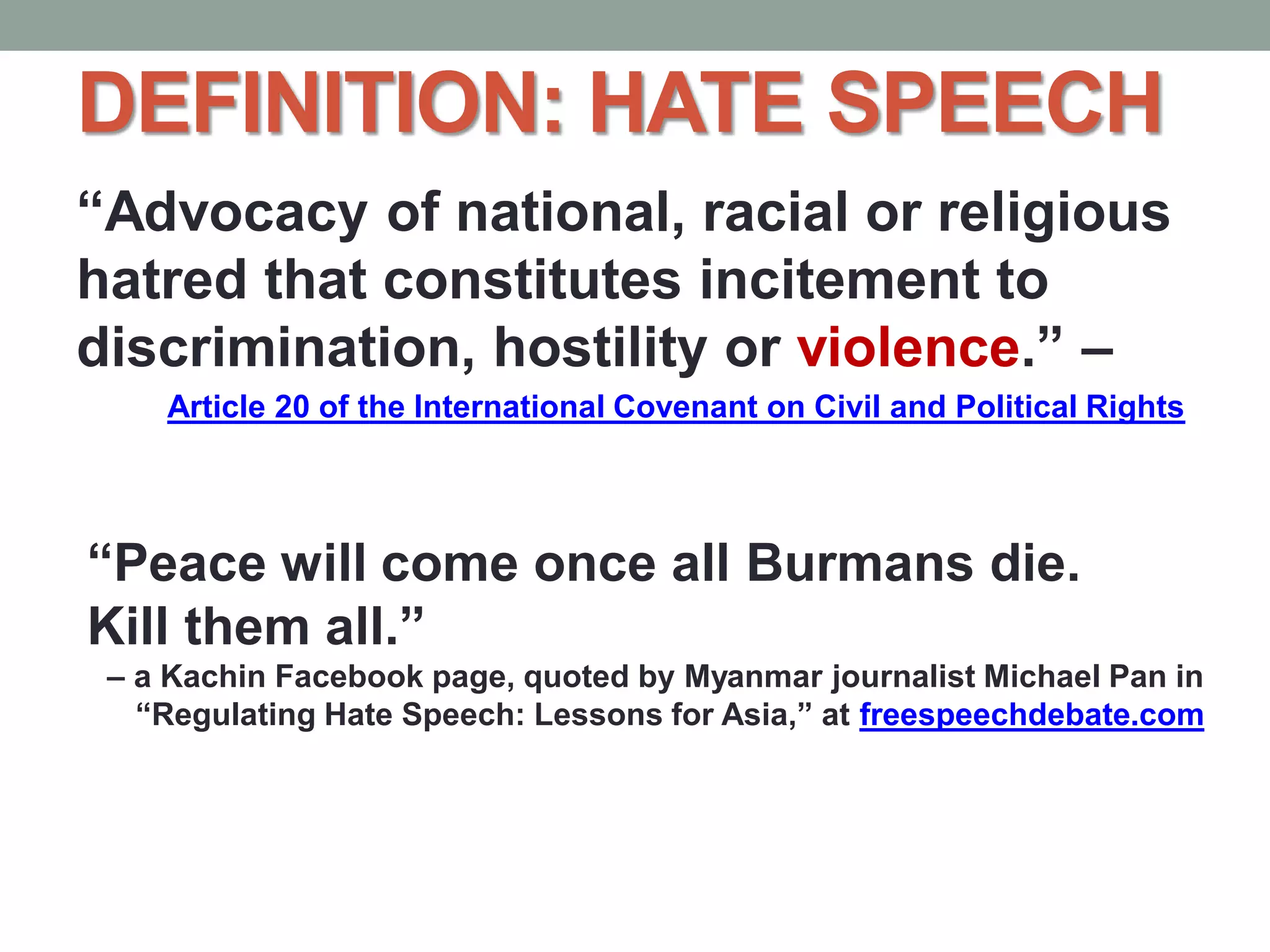
DEFINITION: HATE SPEECH
“Advocacy of national, racial or religious
hatred that constitutes incitement to
discrimination, hostility or violence.” –
Article 20 of the International Covenant on Civil and Political Rights
“Peace will come once all Burmans die.
Kill them all.”
– a Kachin Facebook page, quoted by Myanmar journalist Michael Pan in
“Regulating Hate Speech: Lessons for Asia,” at freespeechdebate.com
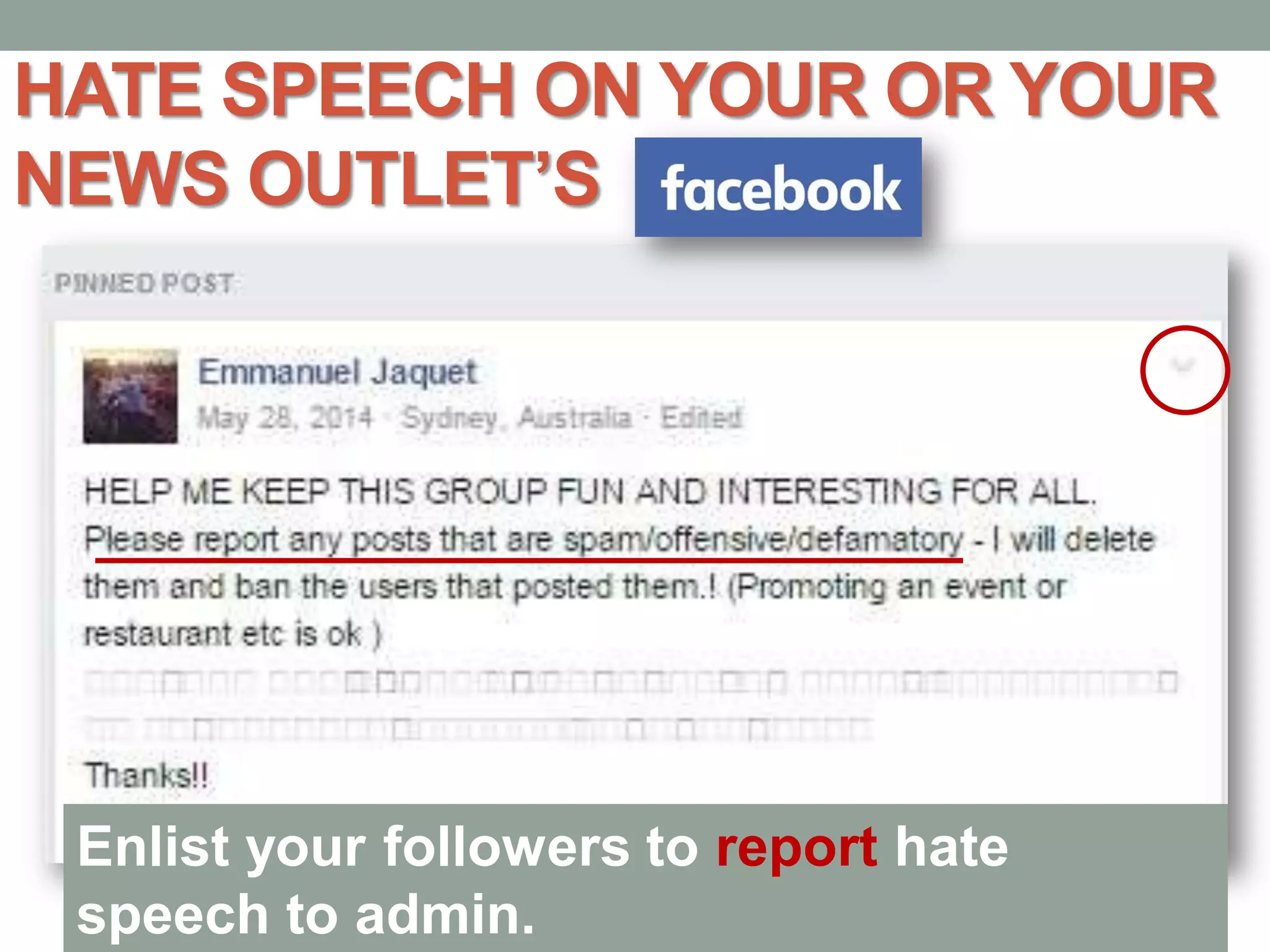
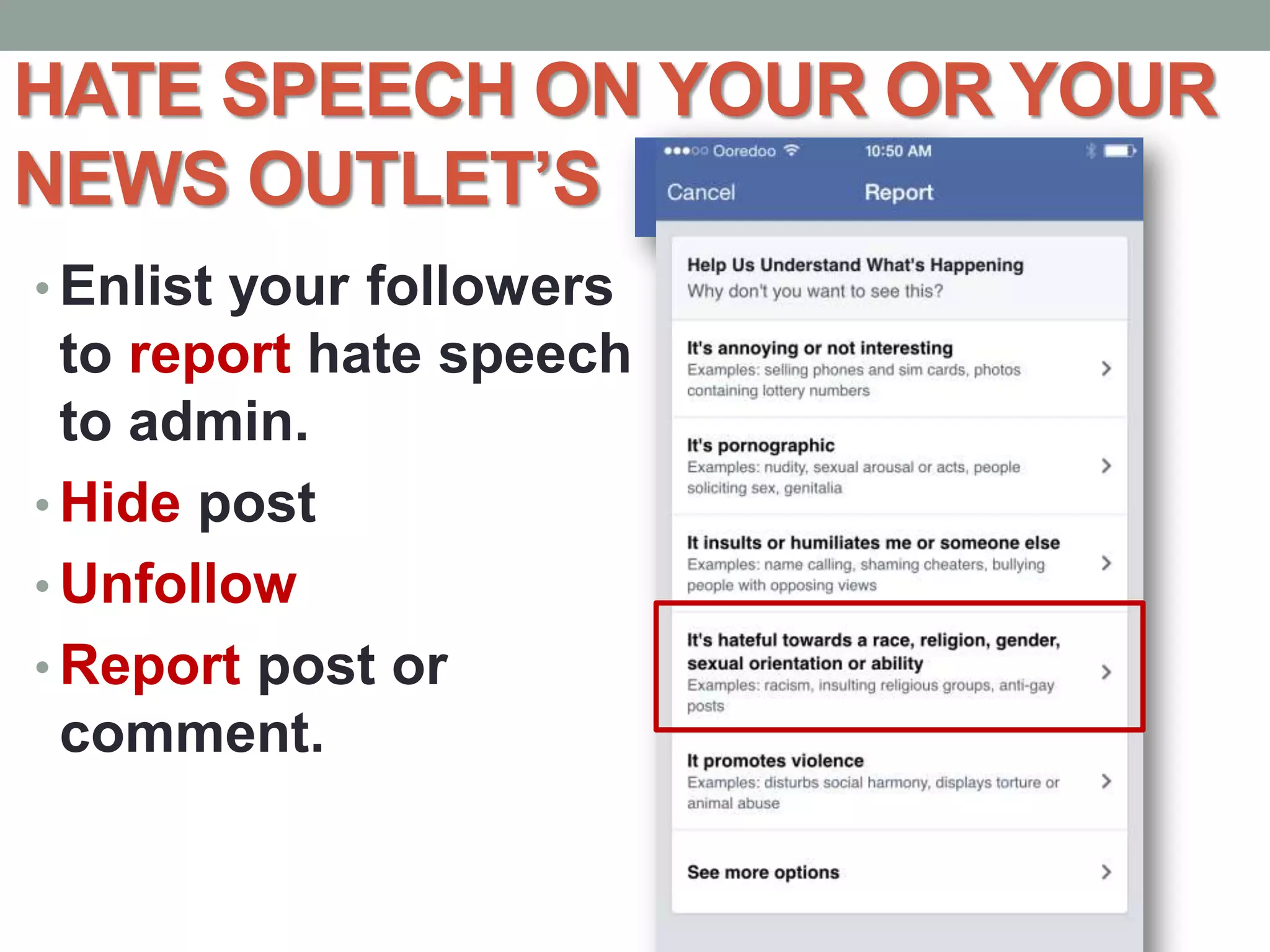
HATE SPEECH ON YOUR OR YOUR
NEWS OUTLET’S
Enlist your followers to report hate
speech to admin.
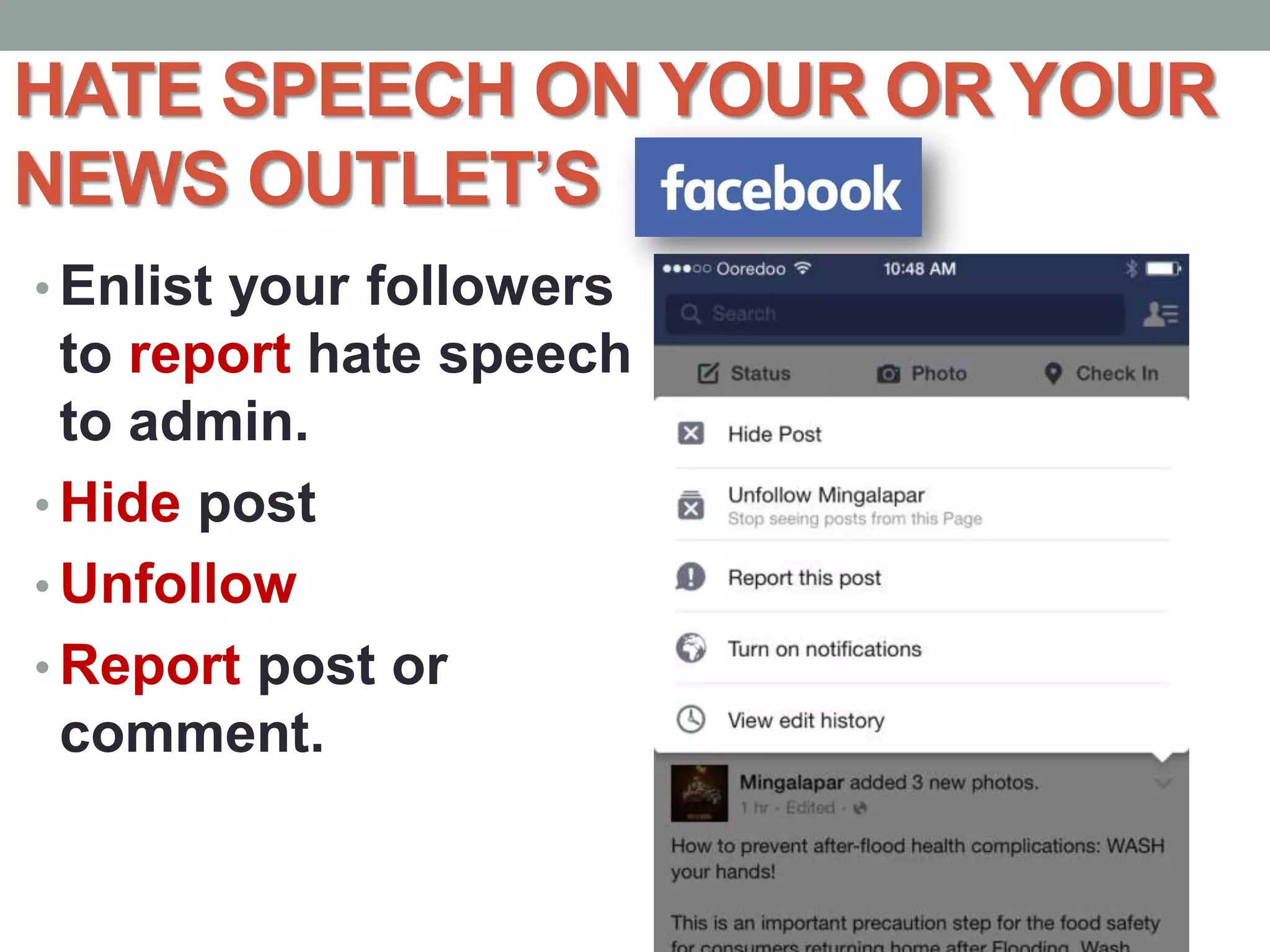
HATE SPEECH ON YOUR OR YOUR
NEWS OUTLET’S
• Enlist your followers
to report hate speech
to admin.
• Hide post
• Unfollow
• Report post or
comment.
HATE SPEECH ON YOUR OR YOUR
NEWS OUTLET’S
• Enlist your followers
to report hate speech
to admin.
• Hide post
• Unfollow
• Report post or
comment.
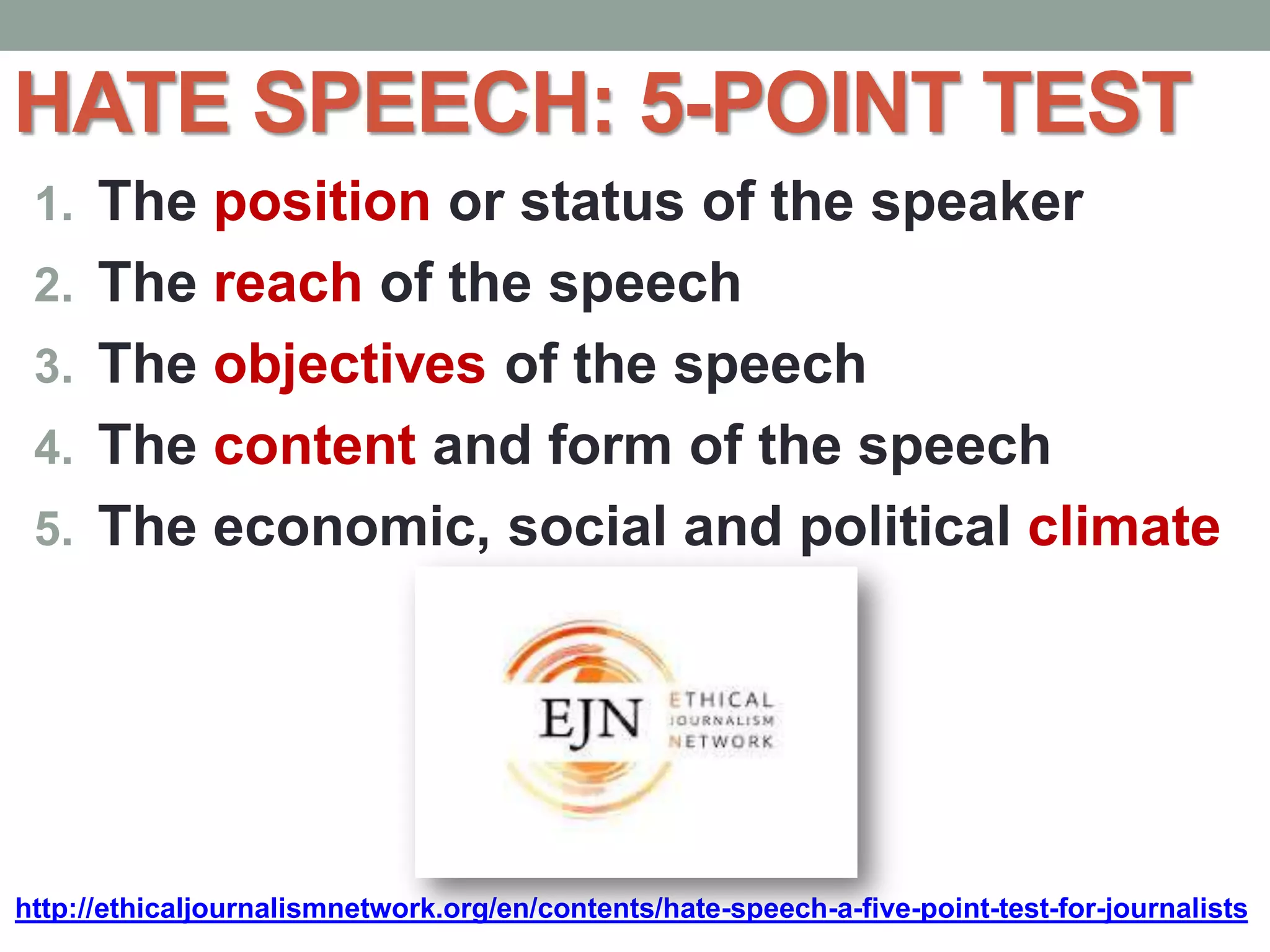
HATE SPEECH: 5-POINT TEST
1. The position or status of the speaker
2. The reach of the speech
3. The objectives of the speech
4. The content and form of the speech
5. The economic, social and political climate
http://ethicaljournalismnetwork.org/en/contents/hate-speech-a-five-point-test-for-journalists
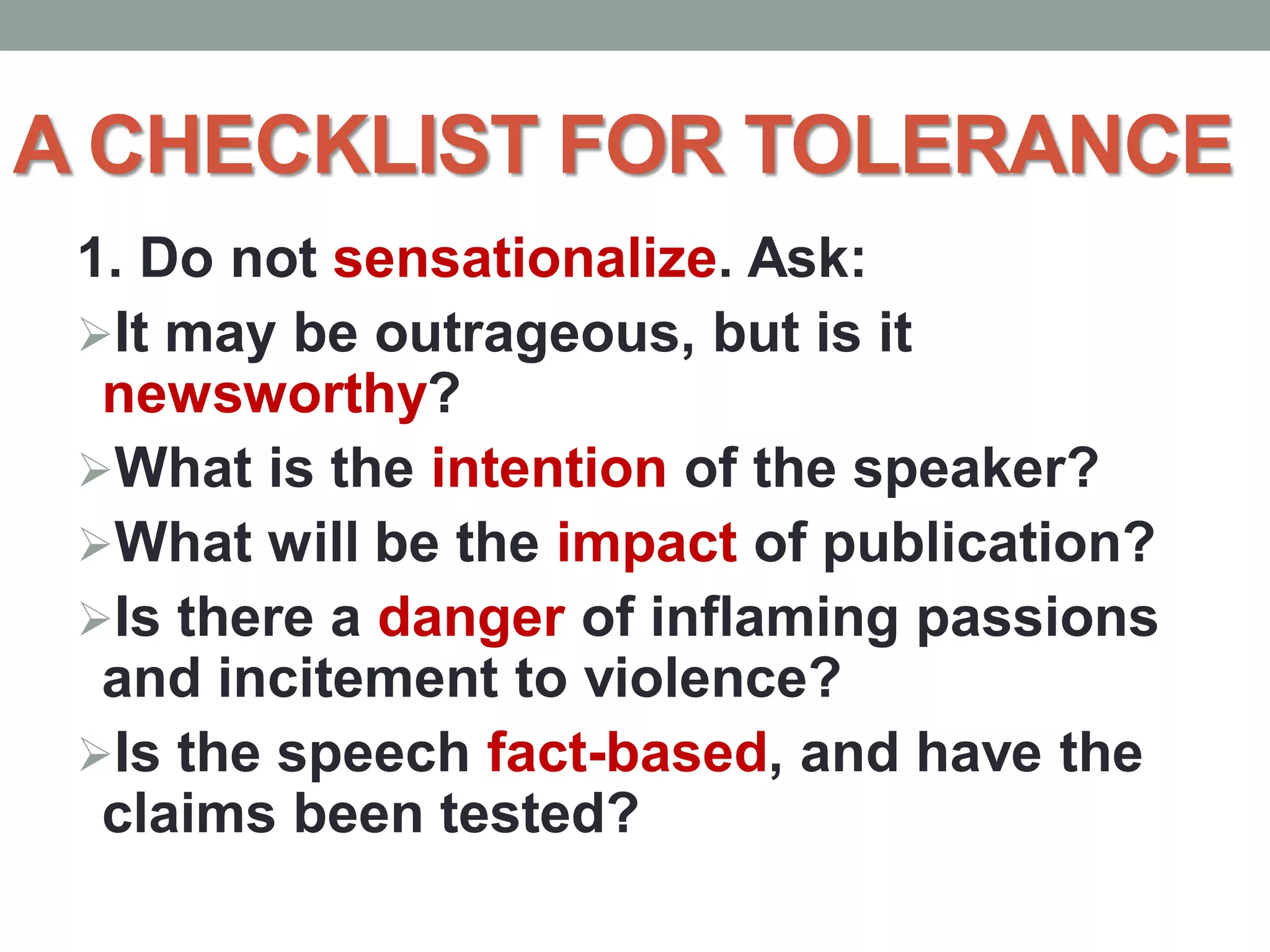
A CHECKLIST FOR TOLERANCE
1. Do not sensationalize. Ask:
It may be outrageous, but is it
newsworthy?
What is the intention of the speaker?
What will be the impact of publication?
Is there a danger of inflaming passions
and incitement to violence?
Is the speech fact-based, and have the
claims been tested?
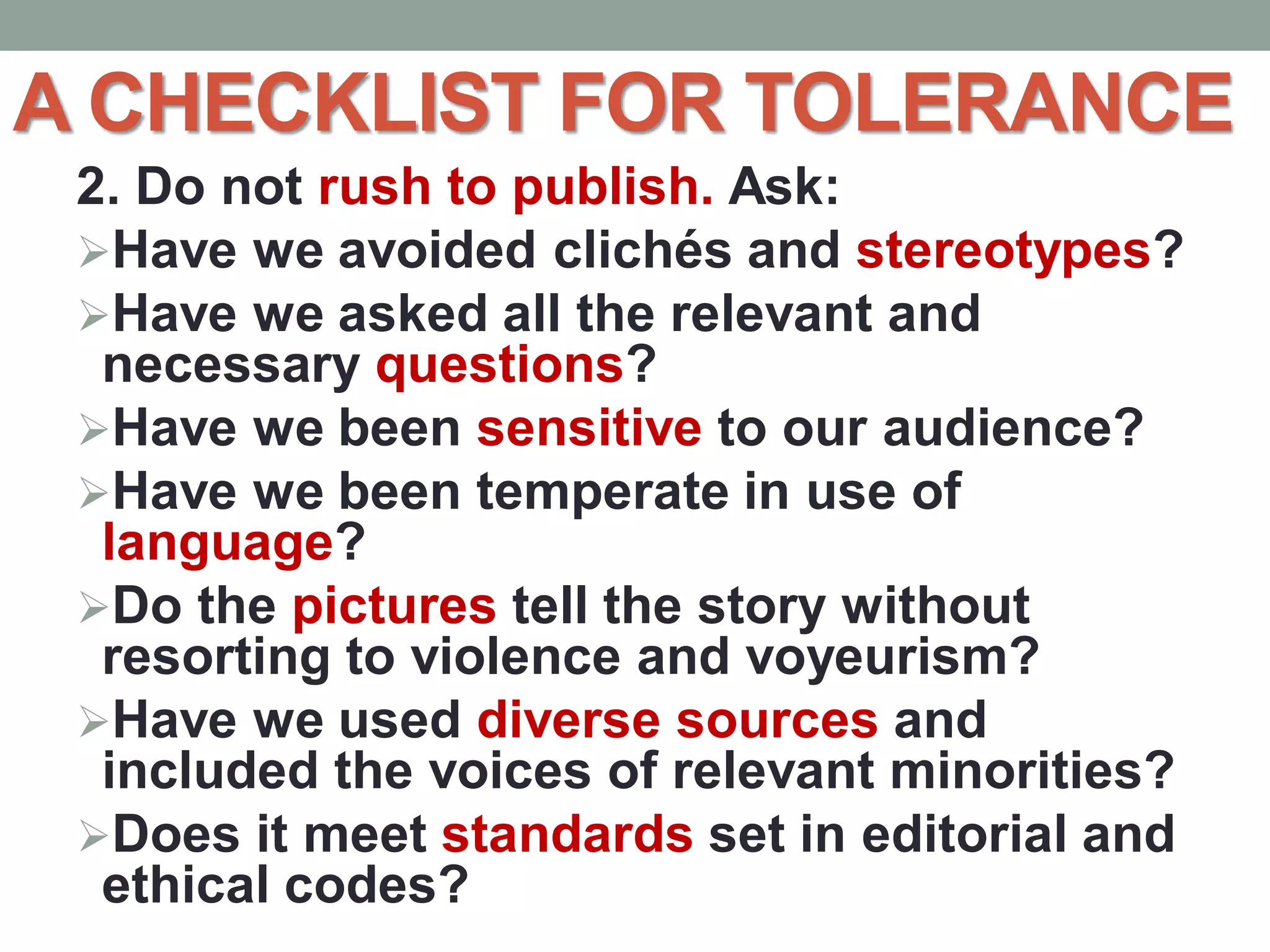
A CHECKLIST FOR TOLERANCE
2. Do not rush to publish. Ask:
Have we avoided clichés and stereotypes?
Have we asked all the relevant and
necessary questions?
Have we been sensitive to our audience?
Have we been temperate in use of
language?
Do the pictures tell the story without
resorting to violence and voyeurism?
Have we used diverse sources and
included the voices of relevant minorities?
Does it meet standards set in editorial and
ethical codes?
A CHECKLIST FOR TOLERANCE
3. Pause and reflect before publishing.
Ask:
Have we done good work?
Are there any nagging doubts?
Should I ask a colleague?
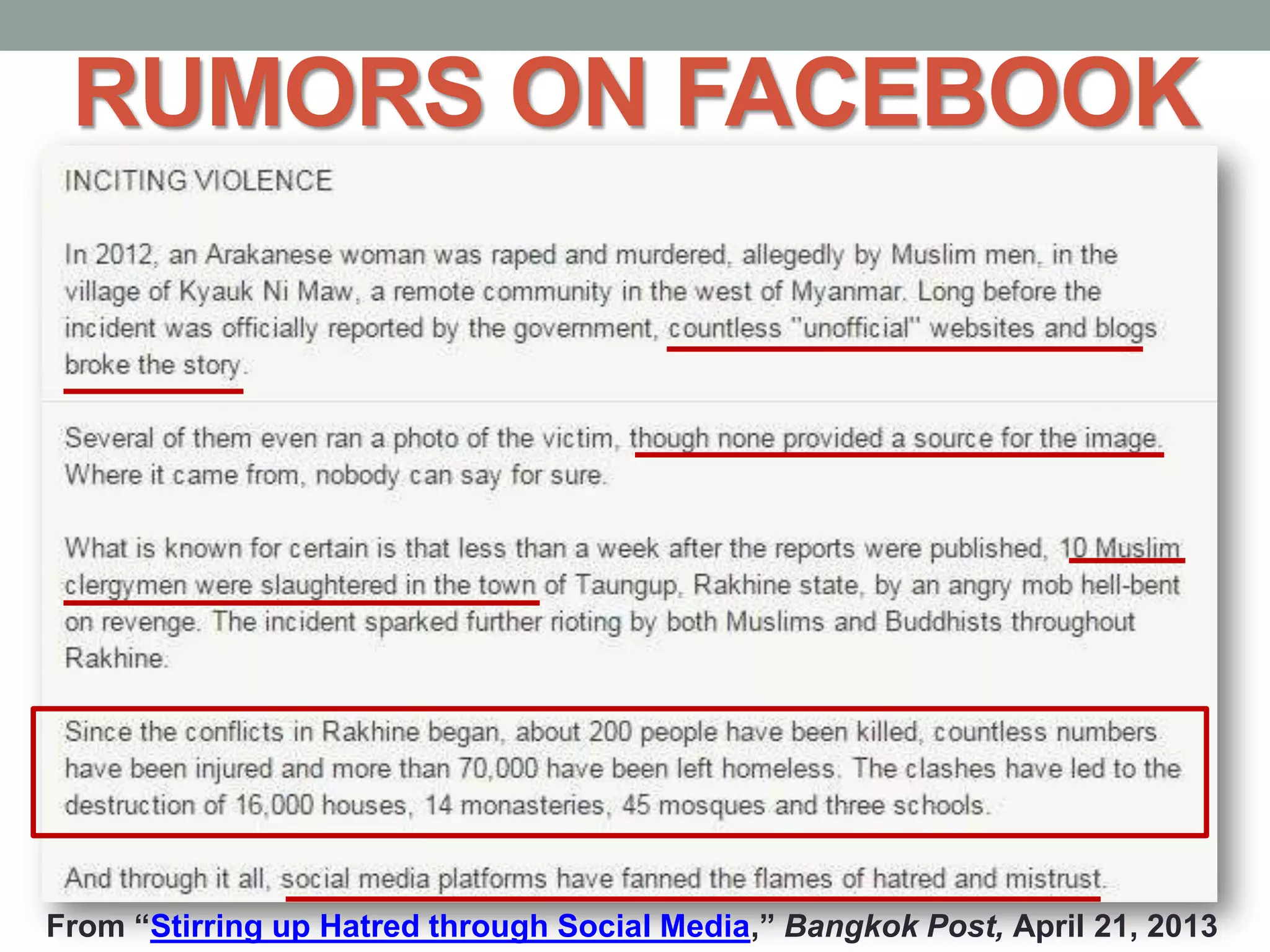
RUMORS ON FACEBOOK
From “Stirring up Hatred through Social Media,” Bangkok Post, April 21, 2013
QUESTIONS TO DISCUSS
• How do you verify the story?
• If verified, whose voices do you include
in the story to ensure balance?
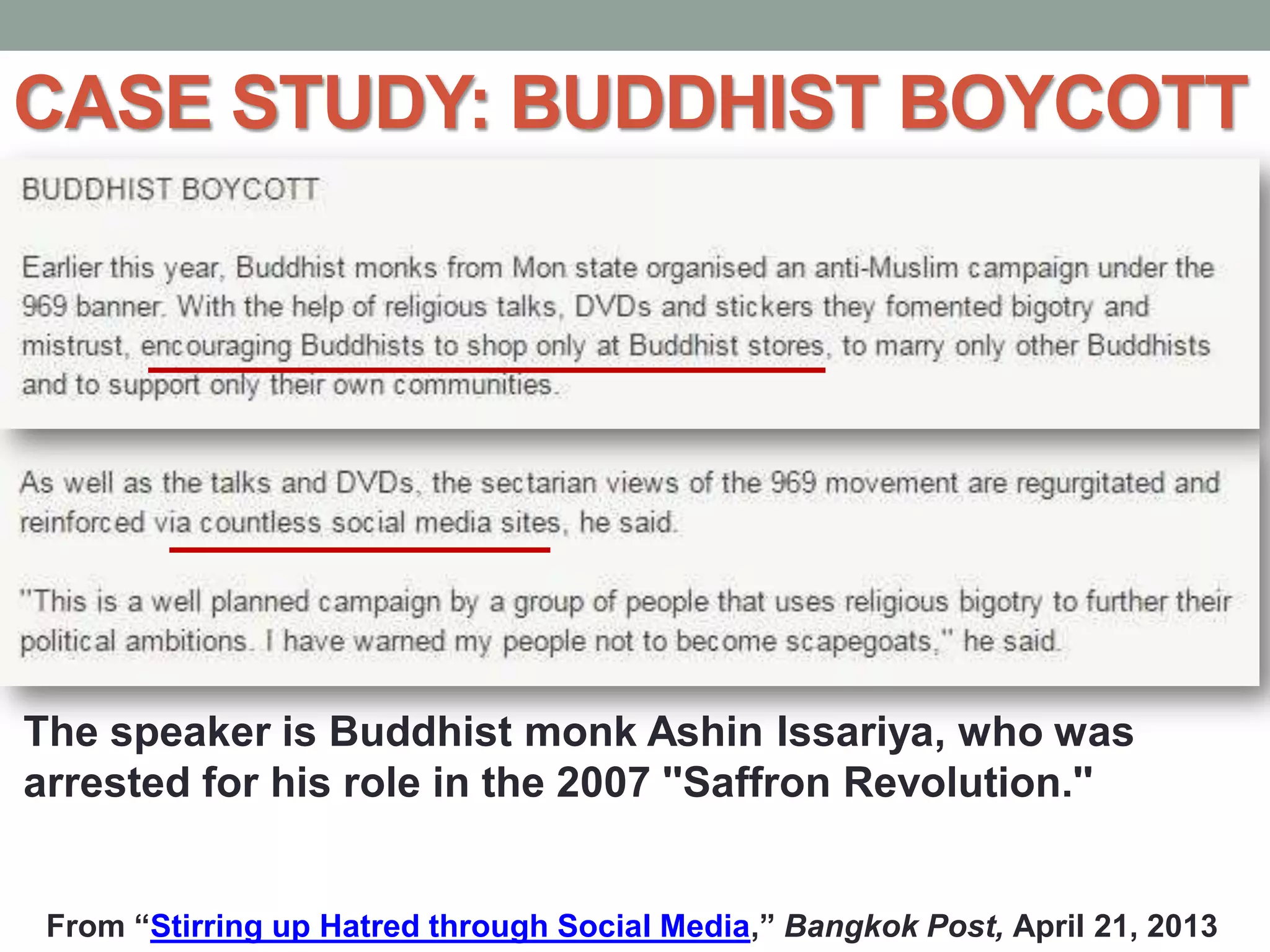
CASE STUDY: BUDDHIST BOYCOTT
From “Stirring up Hatred through Social Media,” Bangkok Post, April 21, 2013
The speaker is Buddhist monk Ashin Issariya, who was
arrested for his role in the 2007 ''Saffron Revolution.''
QUESTIONS TO DISCUSS
• If verified, should you report
on the boycott?
• If you do report on it, whose
voices do you include in the
story to ensure balance?
• What’s the line between
reporting news and simply
furthering a group’s message
and agenda?
• How can journalists avoid
being used to spread a hateful
message to a wider audience?
• What if the
boycott call
were made by
a more
prominent
person such
as Buddhist
monk U Wira
Thu?
HOW TO REPORT ON HATE SPEECH
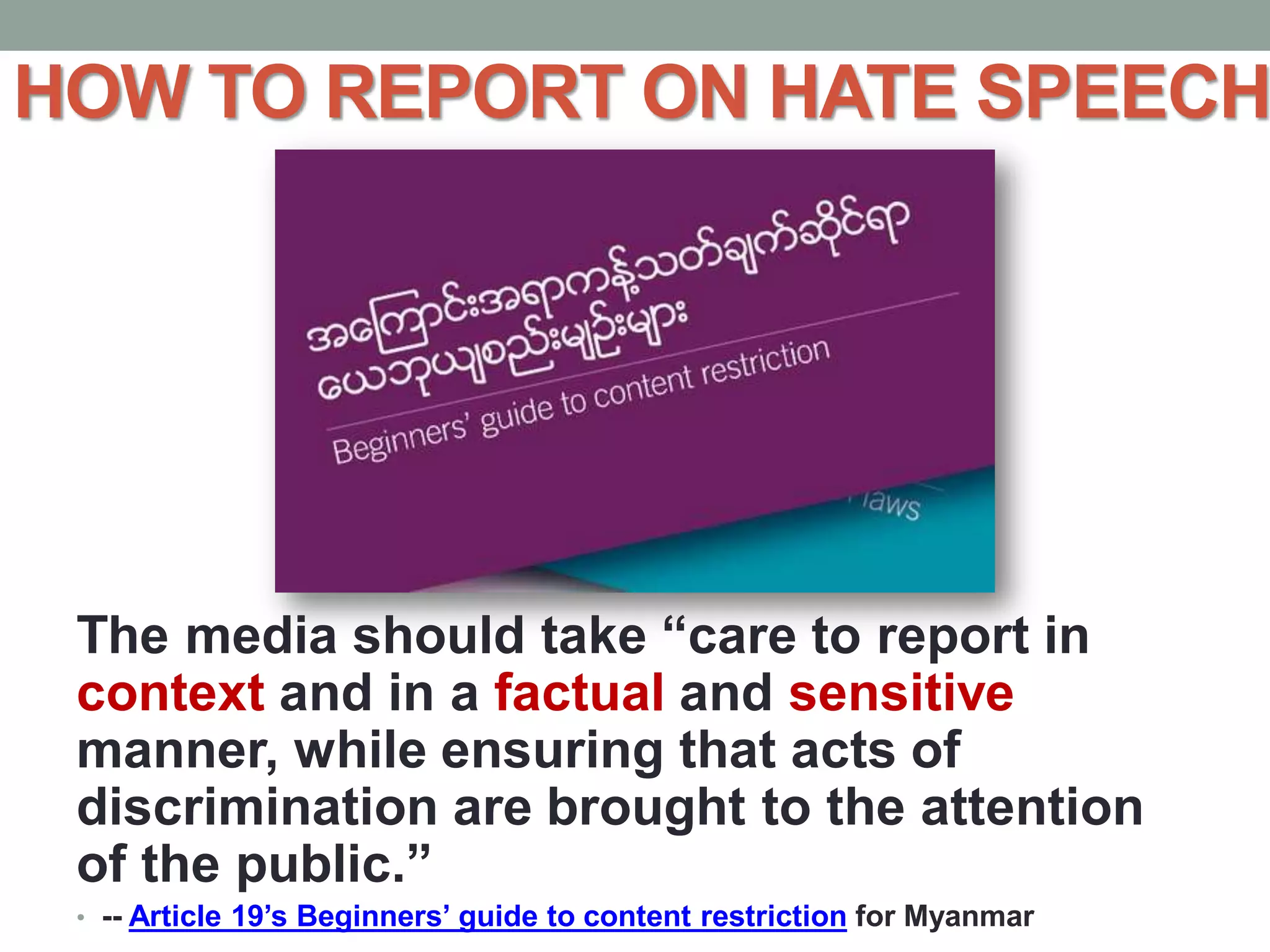
The media should take “care to report in
context and in a factual and sensitive
manner, while ensuring that acts of
discrimination are brought to the attention
of the public.”
• -- Article 19’s Beginners’ guide to content restriction for Myanmar
HOW TO REPORT ON HATE SPEECH
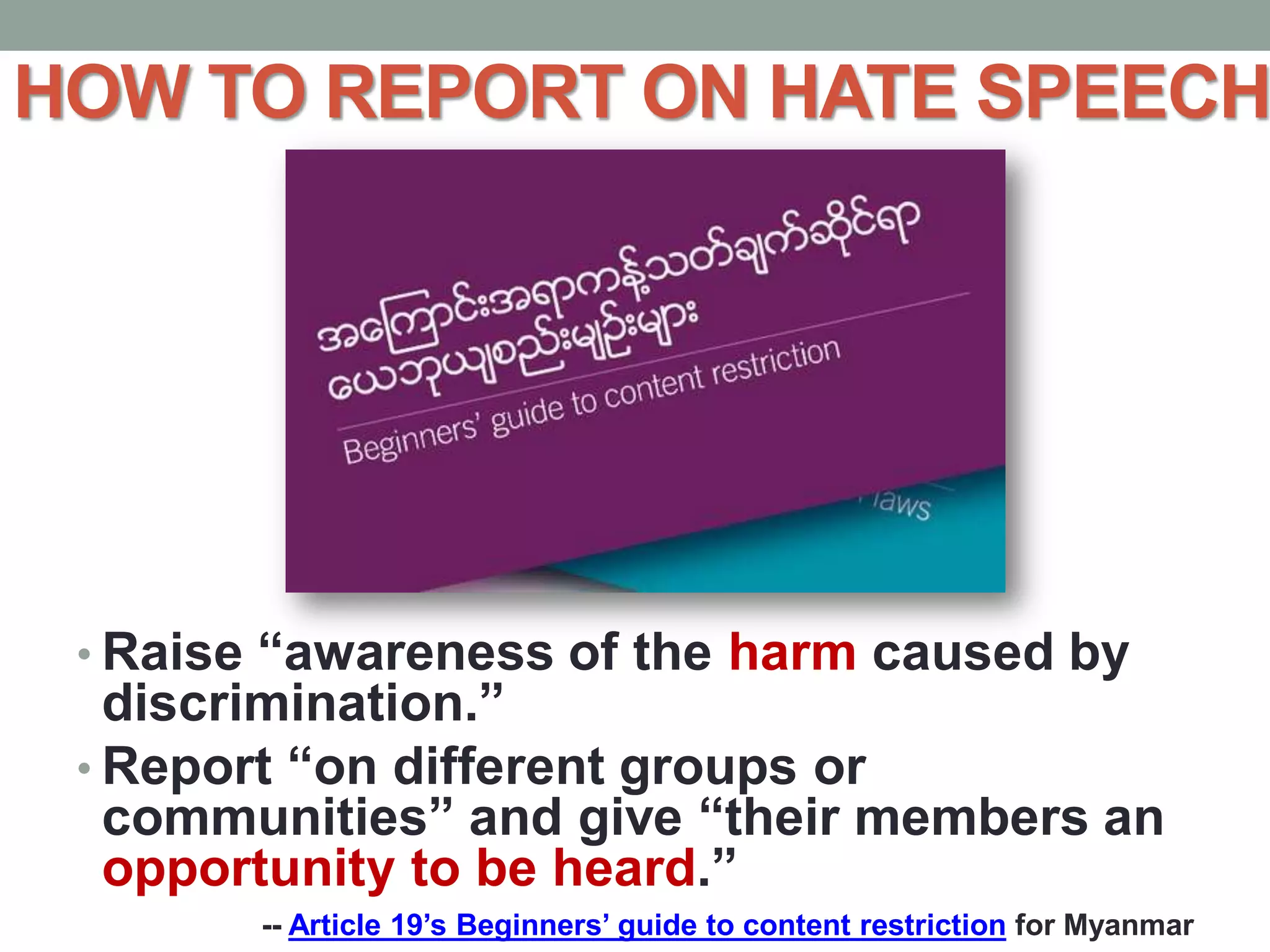
• Raise “awareness of the harm caused by
discrimination.”
• Report “on different groups or
communities” and give “their members an
opportunity to be heard.”
-- Article 19’s Beginners’ guide to content restriction for Myanmar
KEEP ASKING: “WHY?”
“Hate speech is driven
by real grievances, and
for it to be addressed in
a meaningful way, such
grievances must also be
addressed.”
– “From incitement to self-censorship: the media in the Kenyan elections
of 2007 and 2013” on freespeechdebate.com
KEEP ASKING: “WHY?”
• “Taking too short a view of hate speech and
only focusing on the symptom will ignore
the root causes which are in issues such as
land [ownership], youth unemployment and
impunity,” argued Wendy Crandall of the
Umati Project [which monitors hate speech
in Kenya].
• “If these larger issues are addressed,
constructively discussed and adequately
tackled, then I think over time, hate speech
may decrease.”
– “From incitement to self-censorship: the media in the Kenyan elections of
2007 and 2013” on freespeechdebate.com
BEHAVE
PROFESSIONALLY
ON FACEBOOK
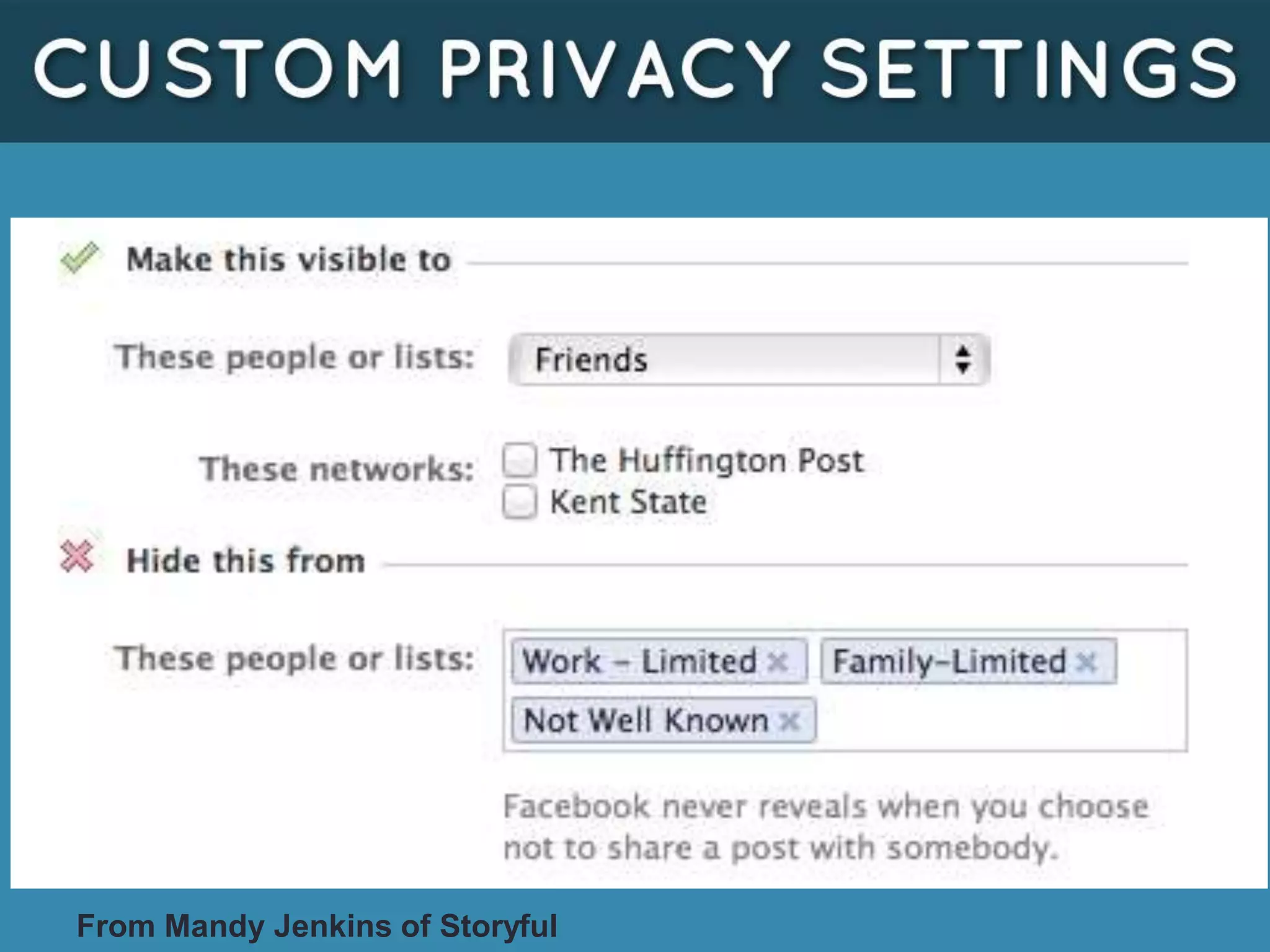
• Have a separate Facebook Page or enable the
Follow feature on your Profile for public updates.
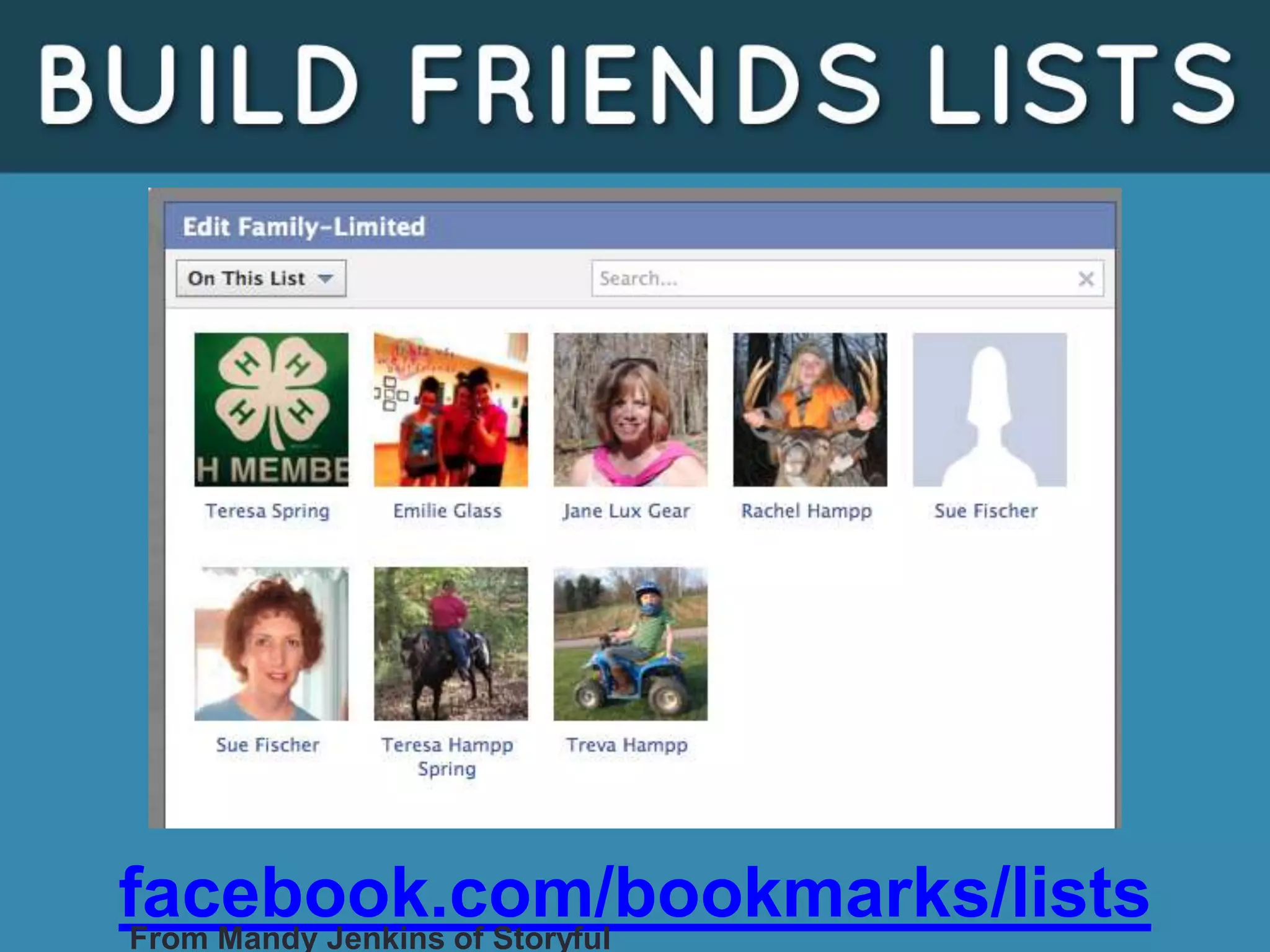
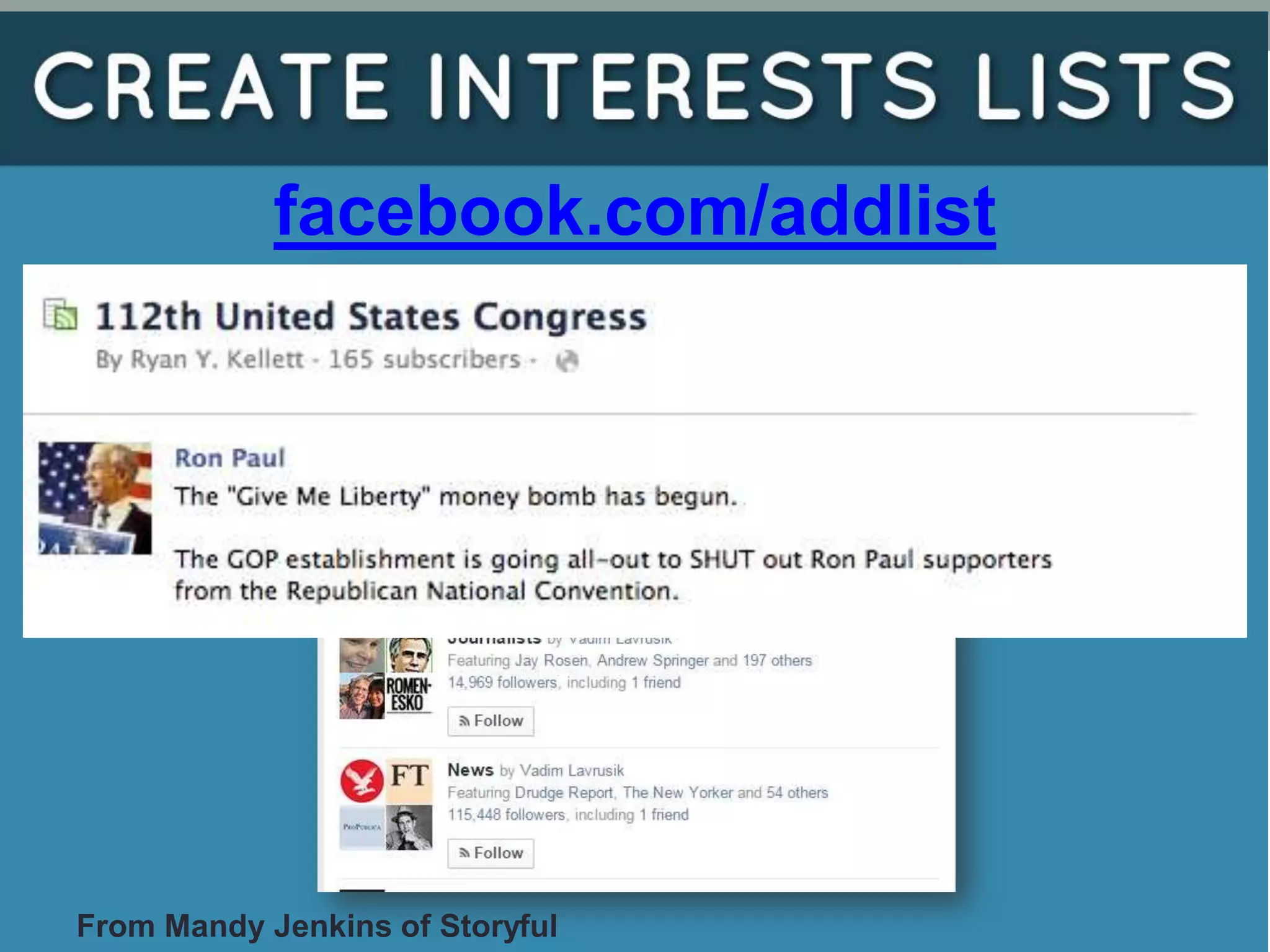
• Set up Facebook lists to monitor people and
organizations you cover and your competition.
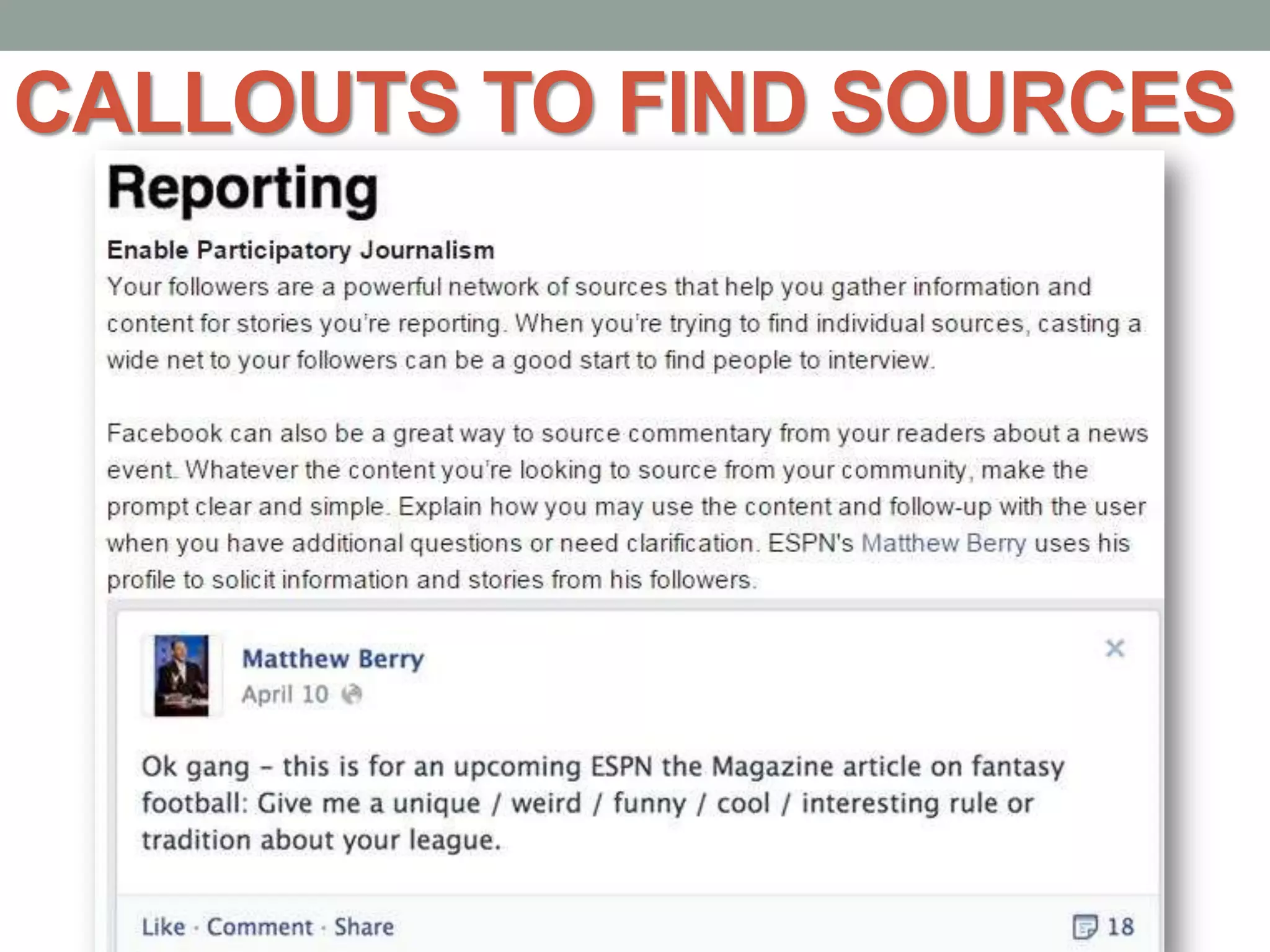
• Use callouts to find sources.
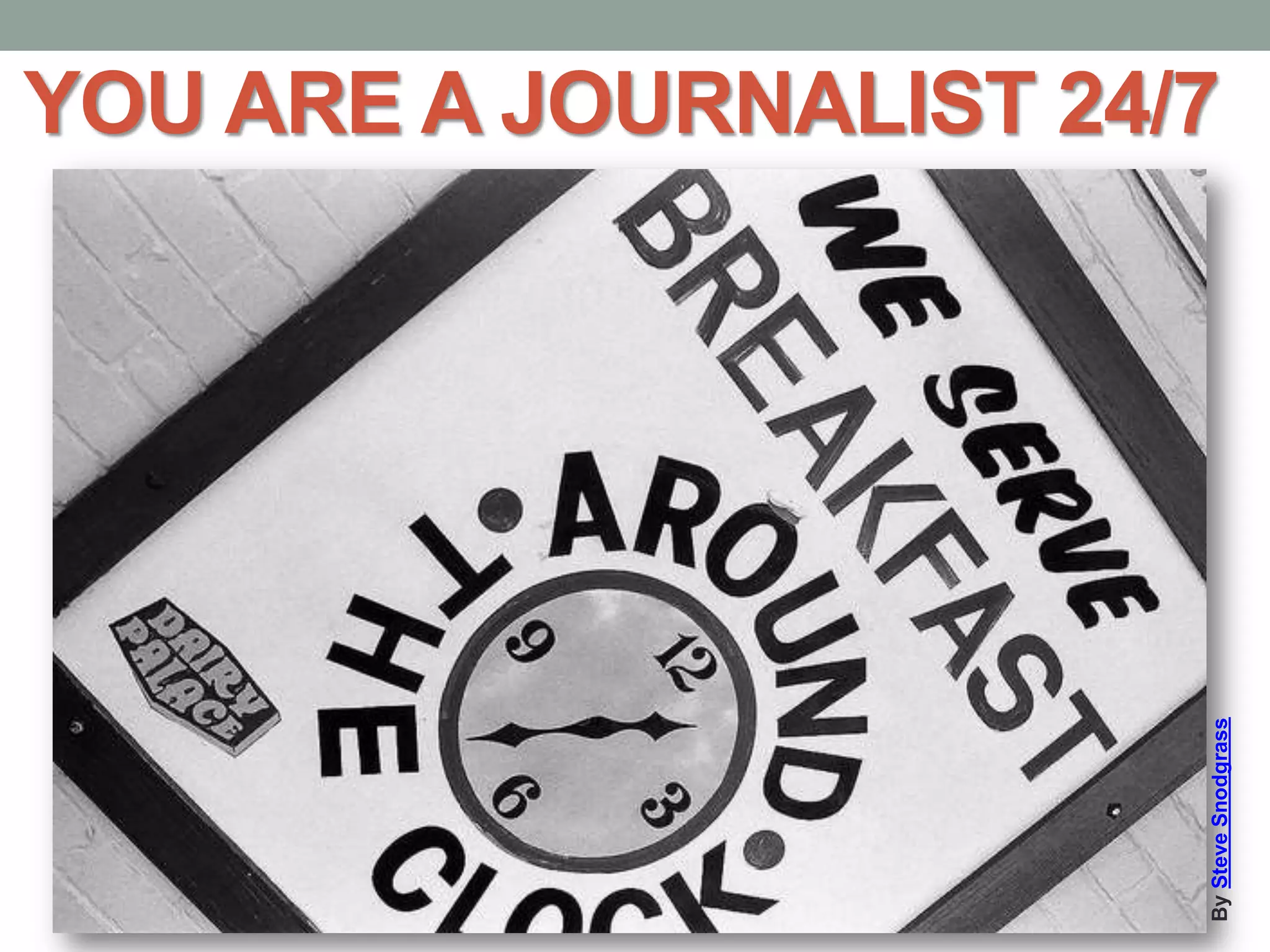
YOU ARE A JOURNALIST 24/7
BySteveSnodgrass
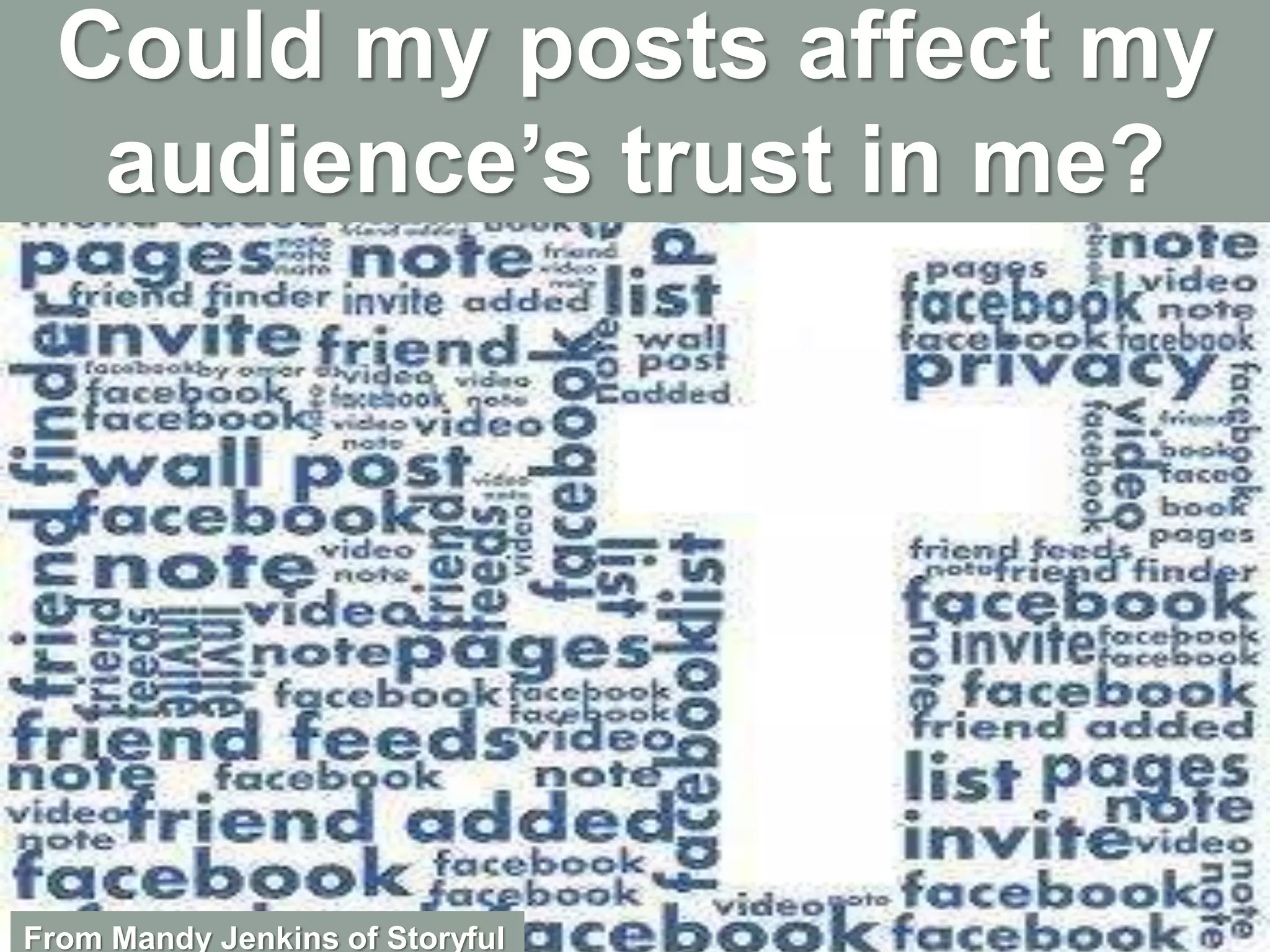
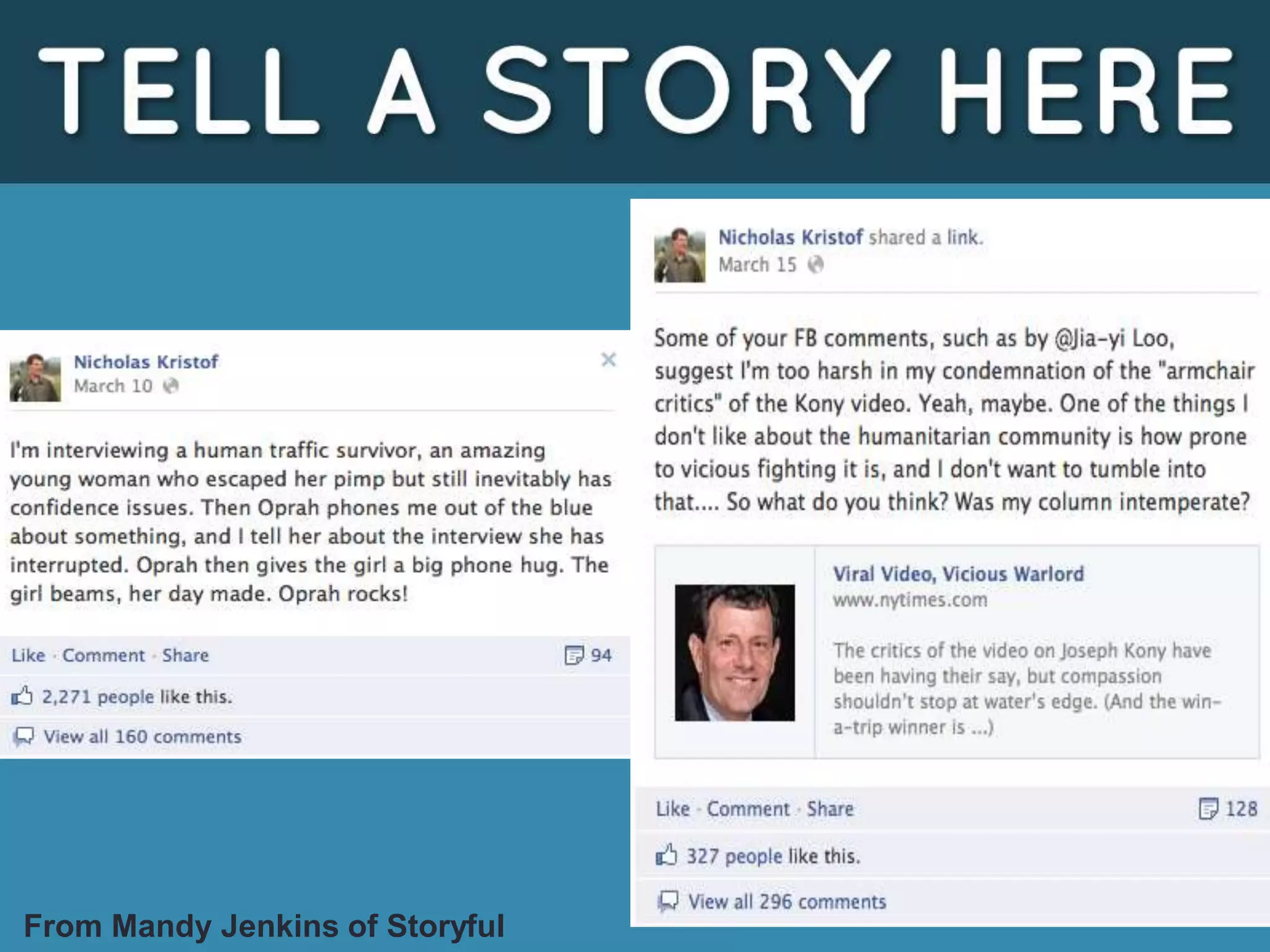
From Mandy Jenkins of Storyful
Could my posts affect my
audience’s trust in me?
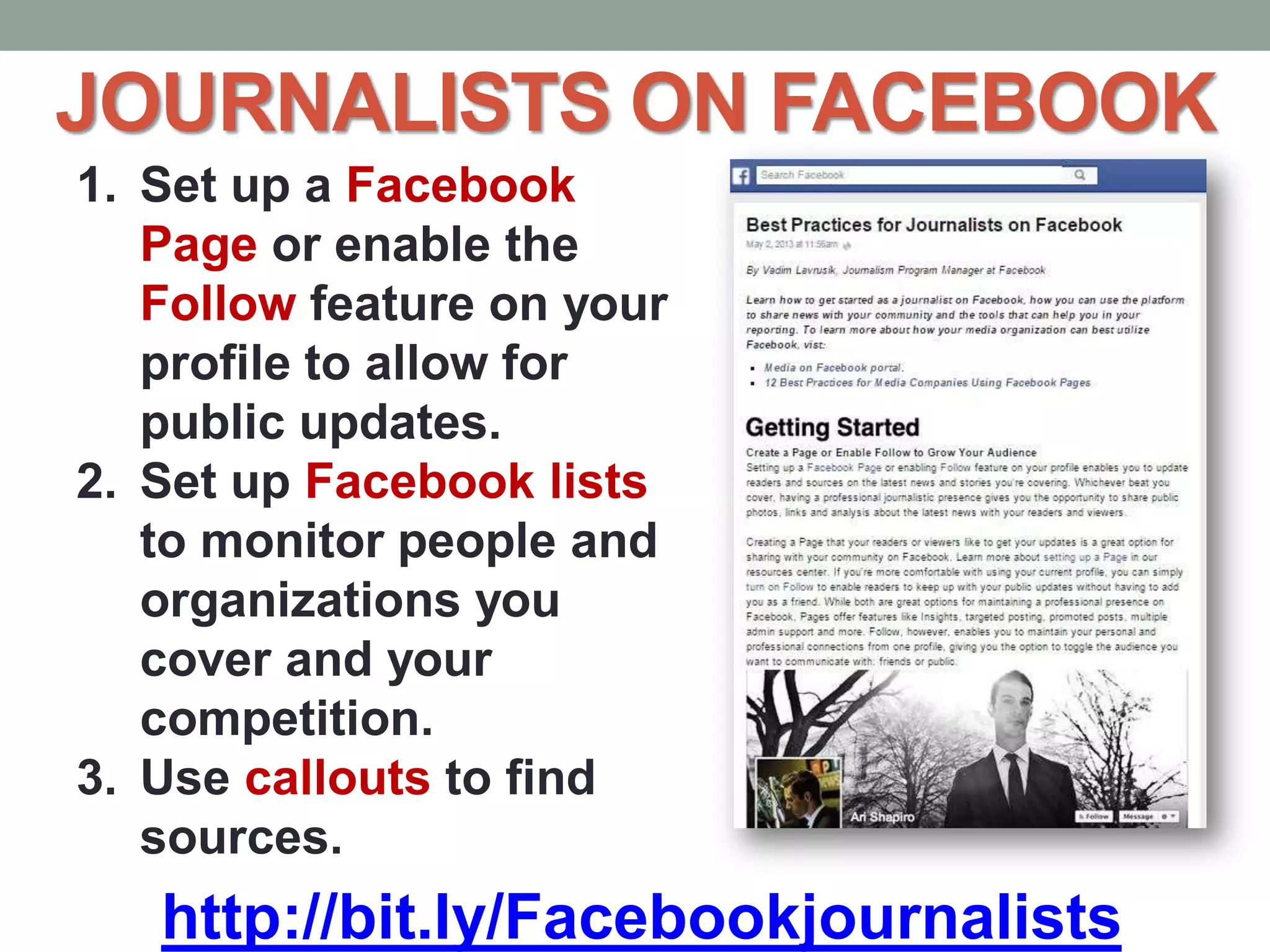
JOURNALISTS ON FACEBOOK
http://bit.ly/Facebookjournalists
1. Set up a Facebook
Page or enable the
Follow feature on your
profile to allow for
public updates.
2. Set up Facebook lists
to monitor people and
organizations you
cover and your
competition.
3. Use callouts to find
sources.
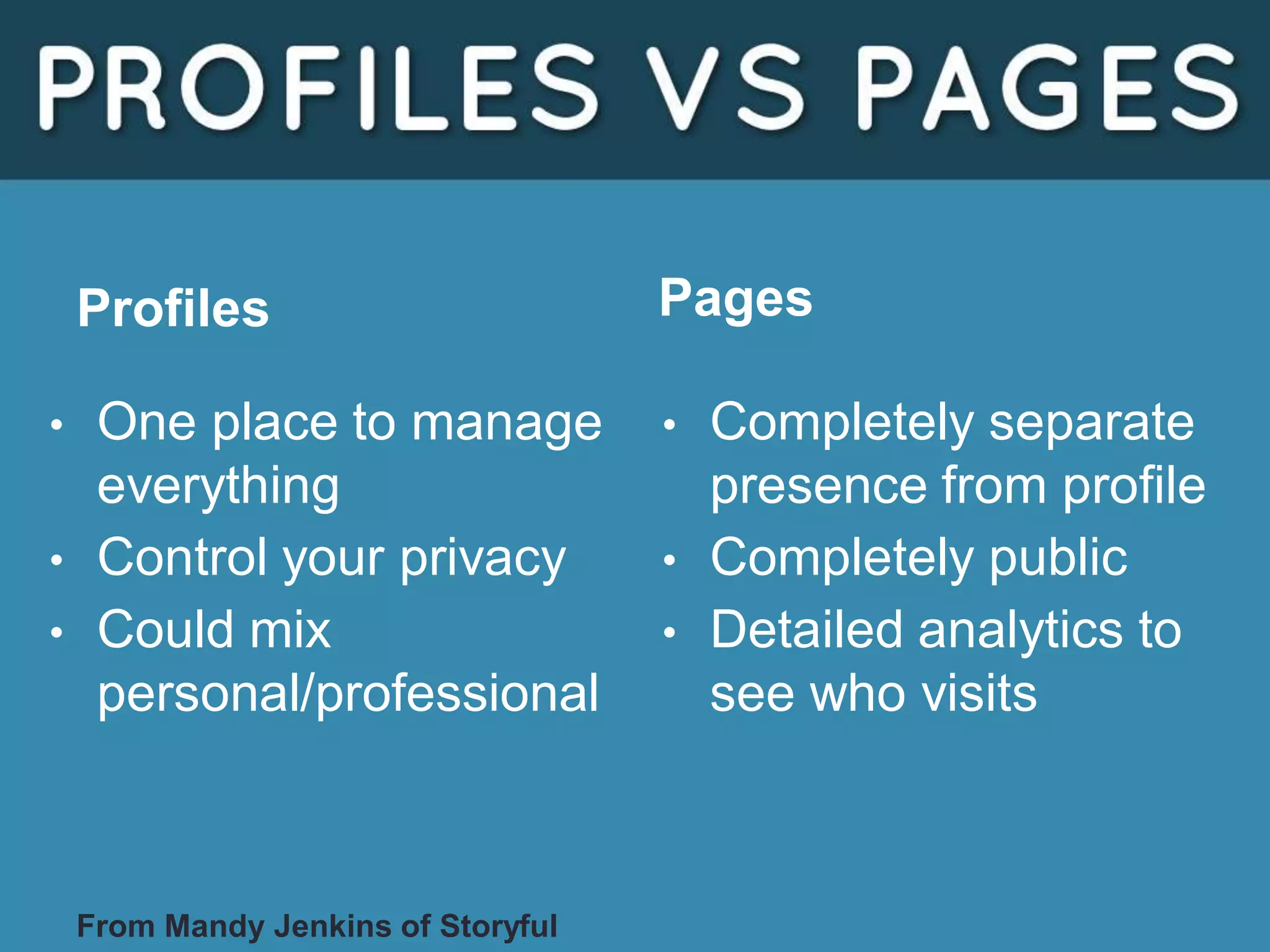
• One place to manage
everything
• Control your privacy
• Could mix
personal/professional
• Completely separate
presence from profile
• Completely public
• Detailed analytics to
see who visits
Profiles Pages
From Mandy Jenkins of Storyful
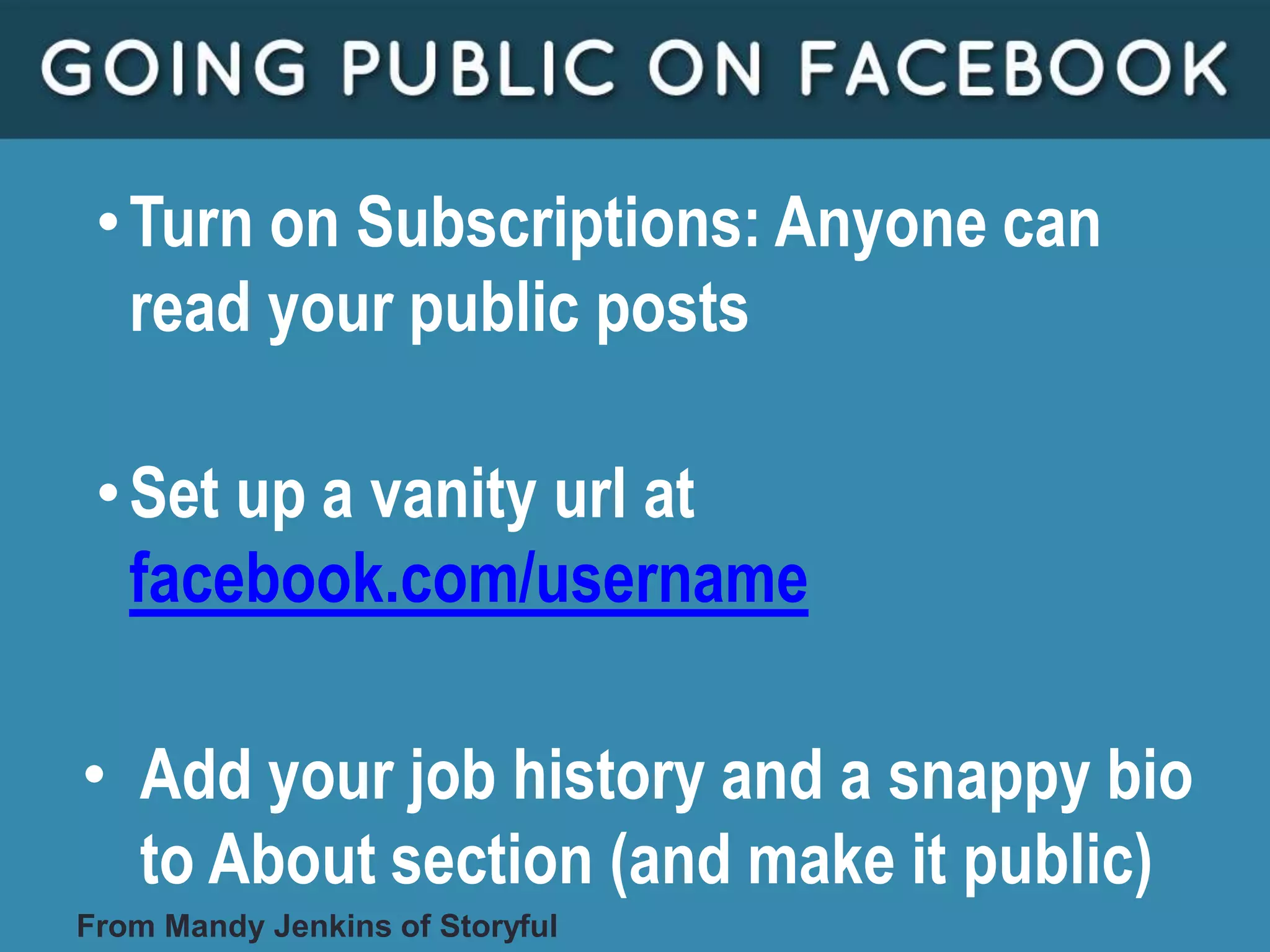
•Turn on Subscriptions: Anyone can
read your public posts
•Set up a vanity url at
facebook.com/username
• Add your job history and a snappy bio
to About section (and make it public)
From Mandy Jenkins of Storyful
facebook.com/bookmarks/listsFrom Mandy Jenkins of Storyful
From Mandy Jenkins of Storyful
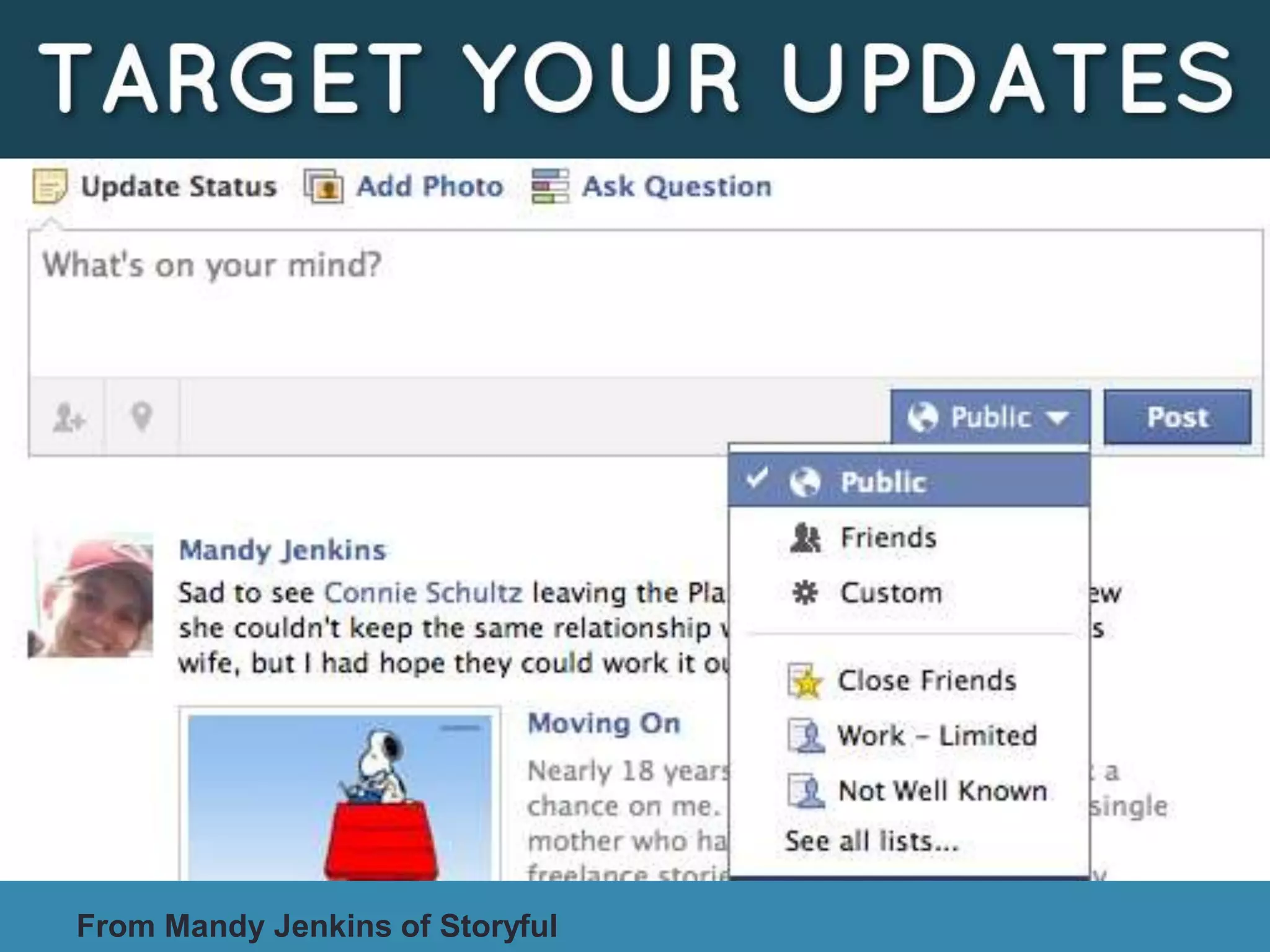
facebook.com/addlist
From Mandy Jenkins of Storyful
CALLOUTS TO FIND SOURCES
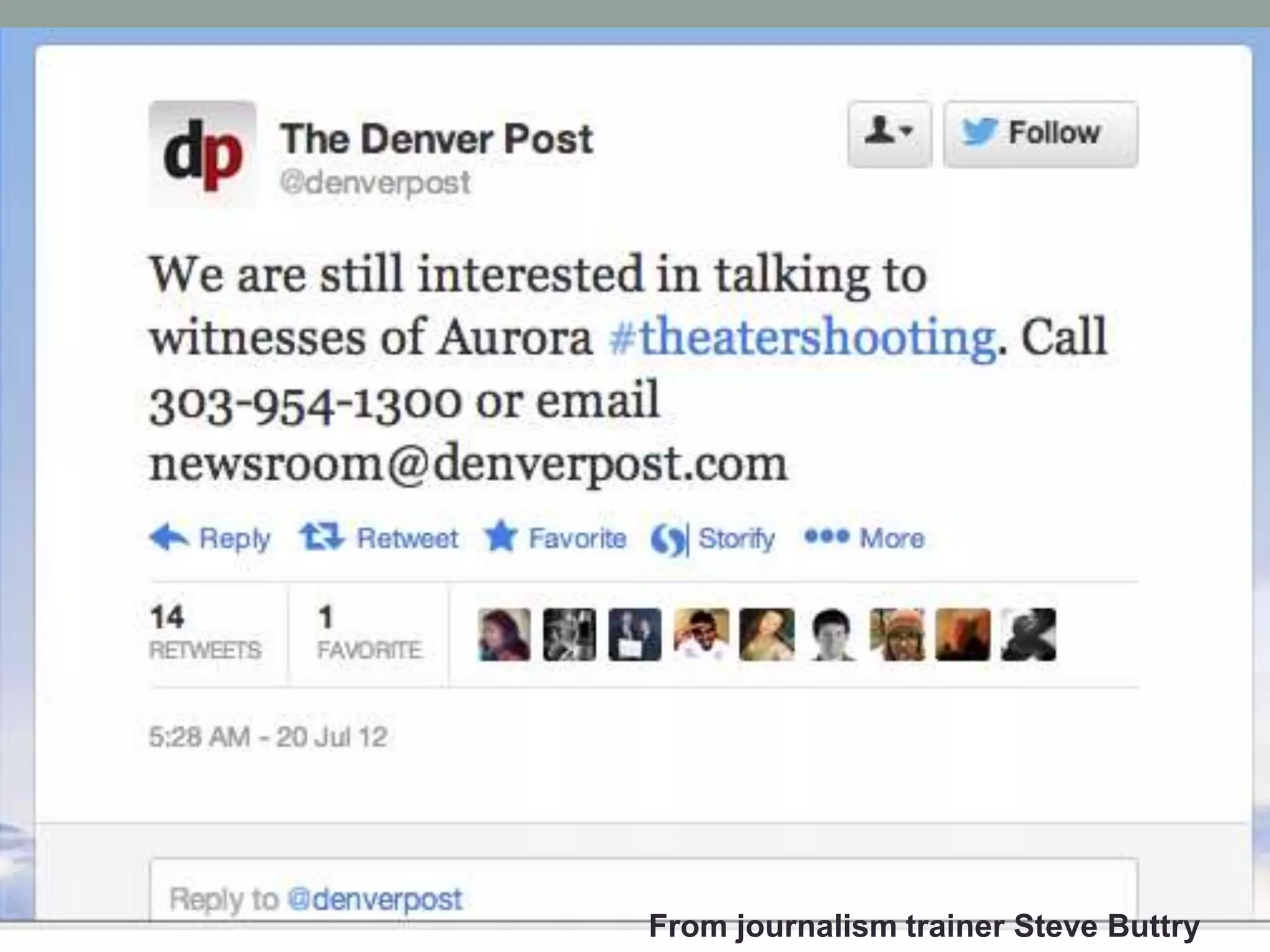
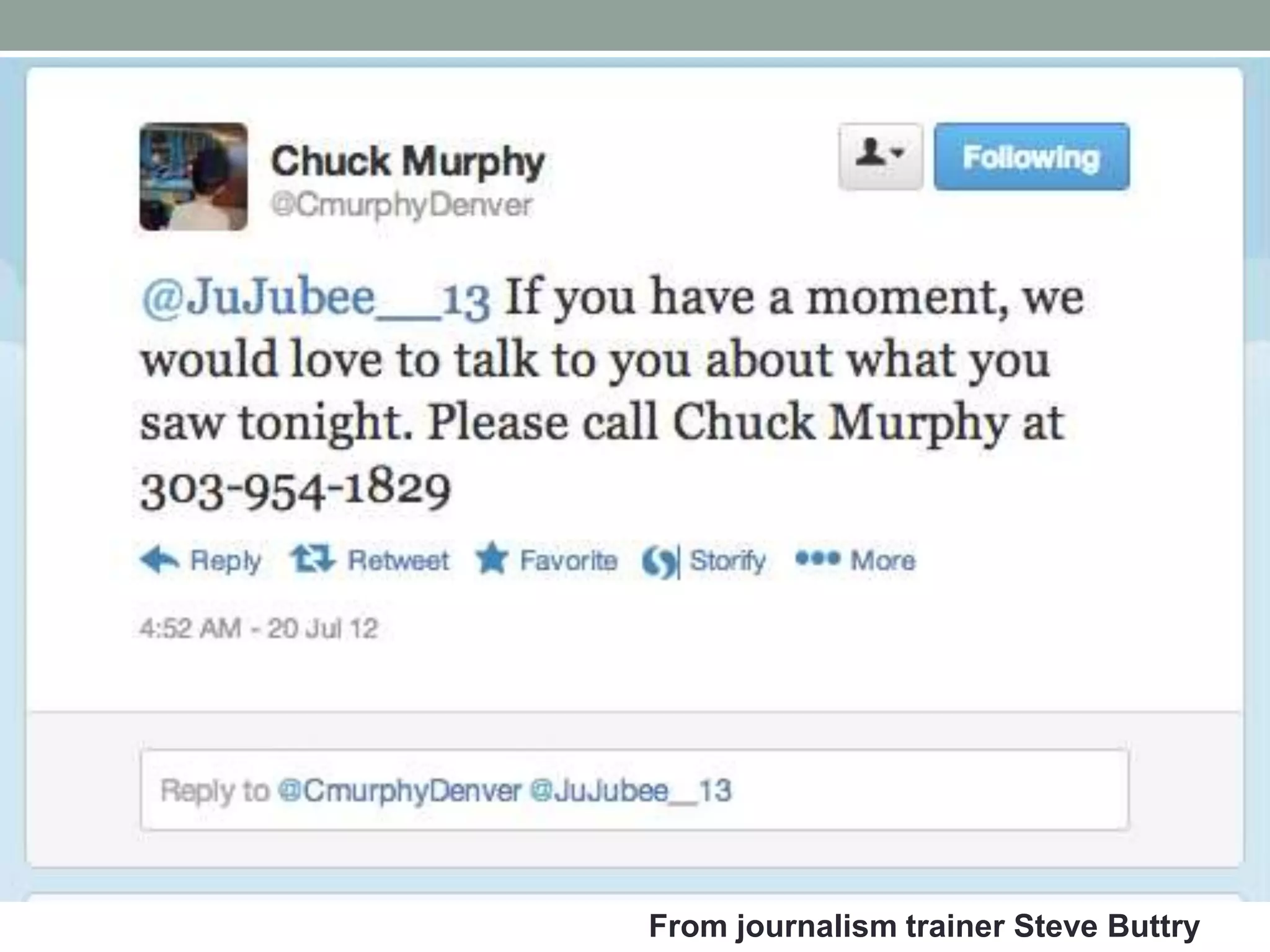
From journalism trainer Steve Buttry
LINK OR EMBED TO
HELP ATTRIBUTE
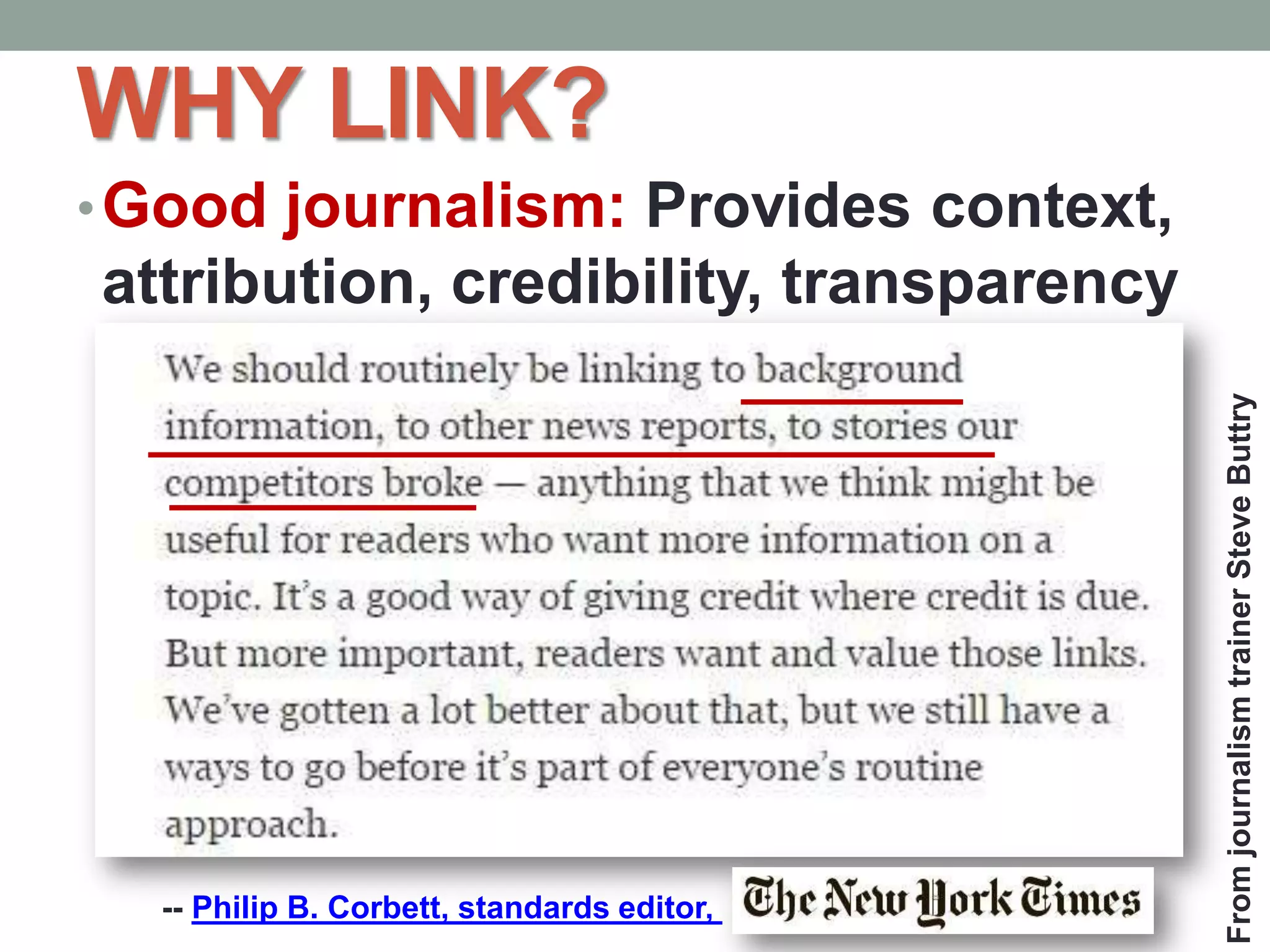
WHY LINK?
•Good journalism: Provides context,
attribution, credibility, transparency
FromjournalismtrainerSteveButtry
-- Philip B. Corbett, standards editor,
WHY LINK?
•Good business: Better search-
engine optimization (SEO) for better
search traffic
From journalism trainer Steve Buttry
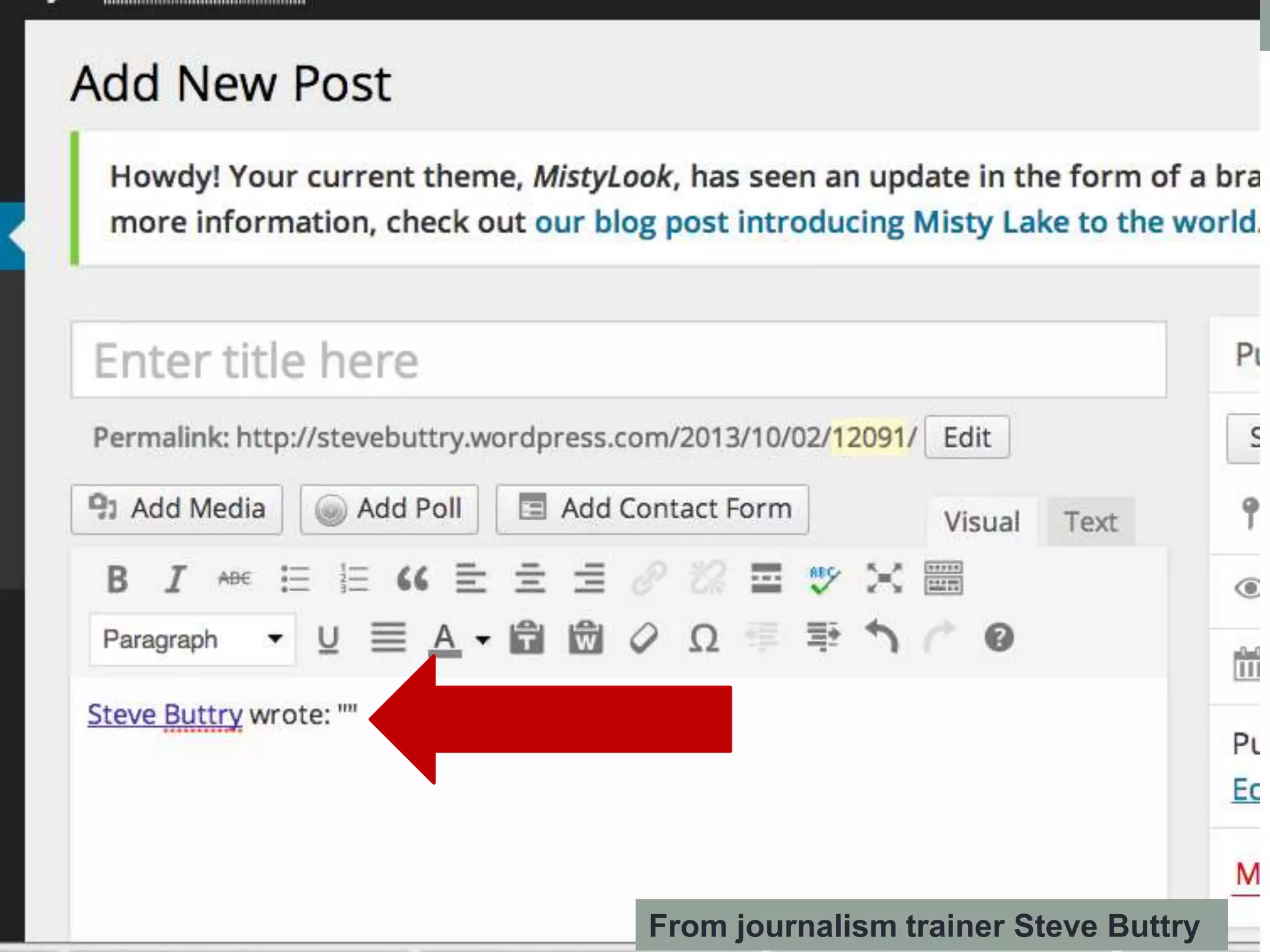
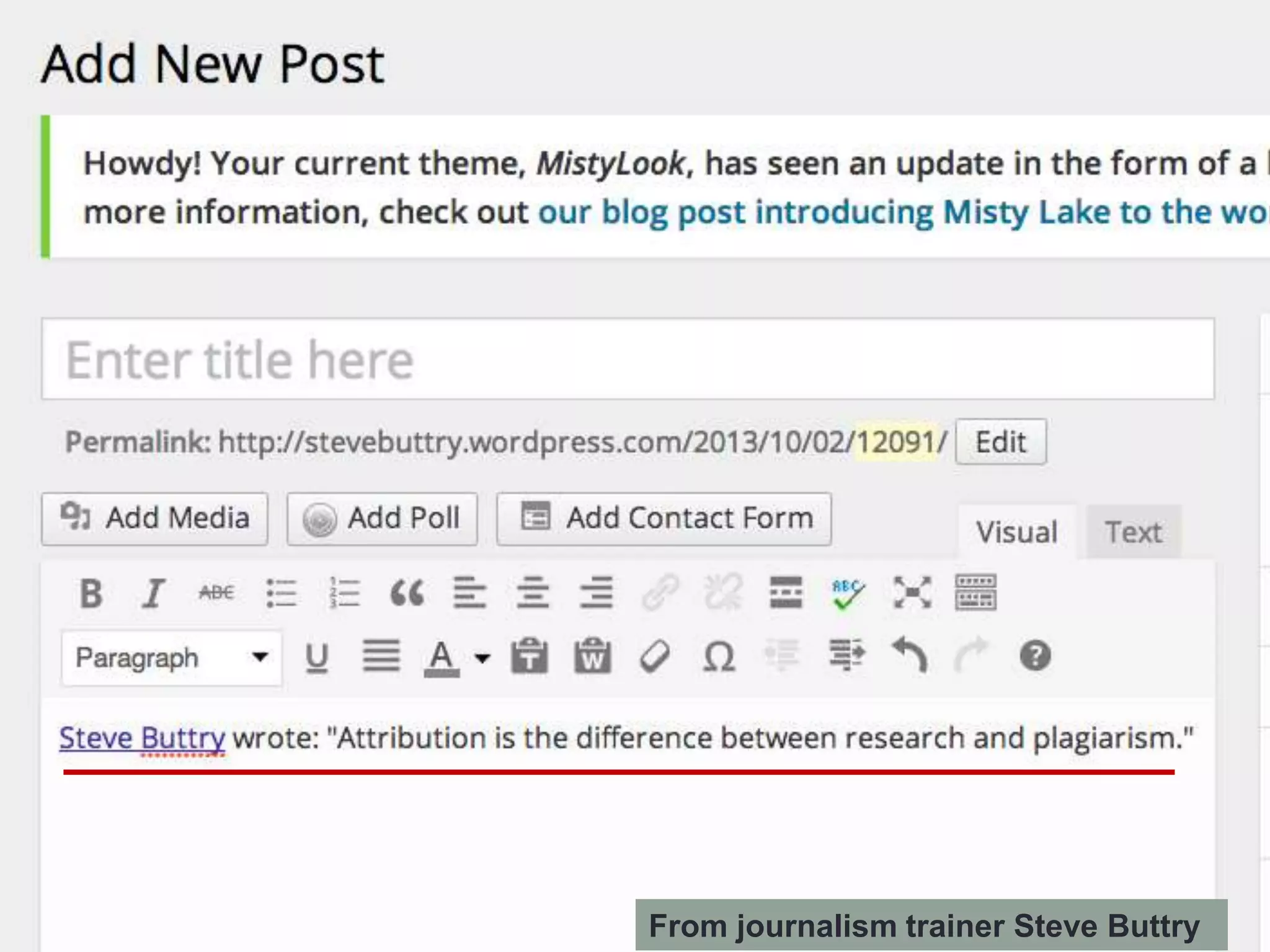
HOW TO LINK
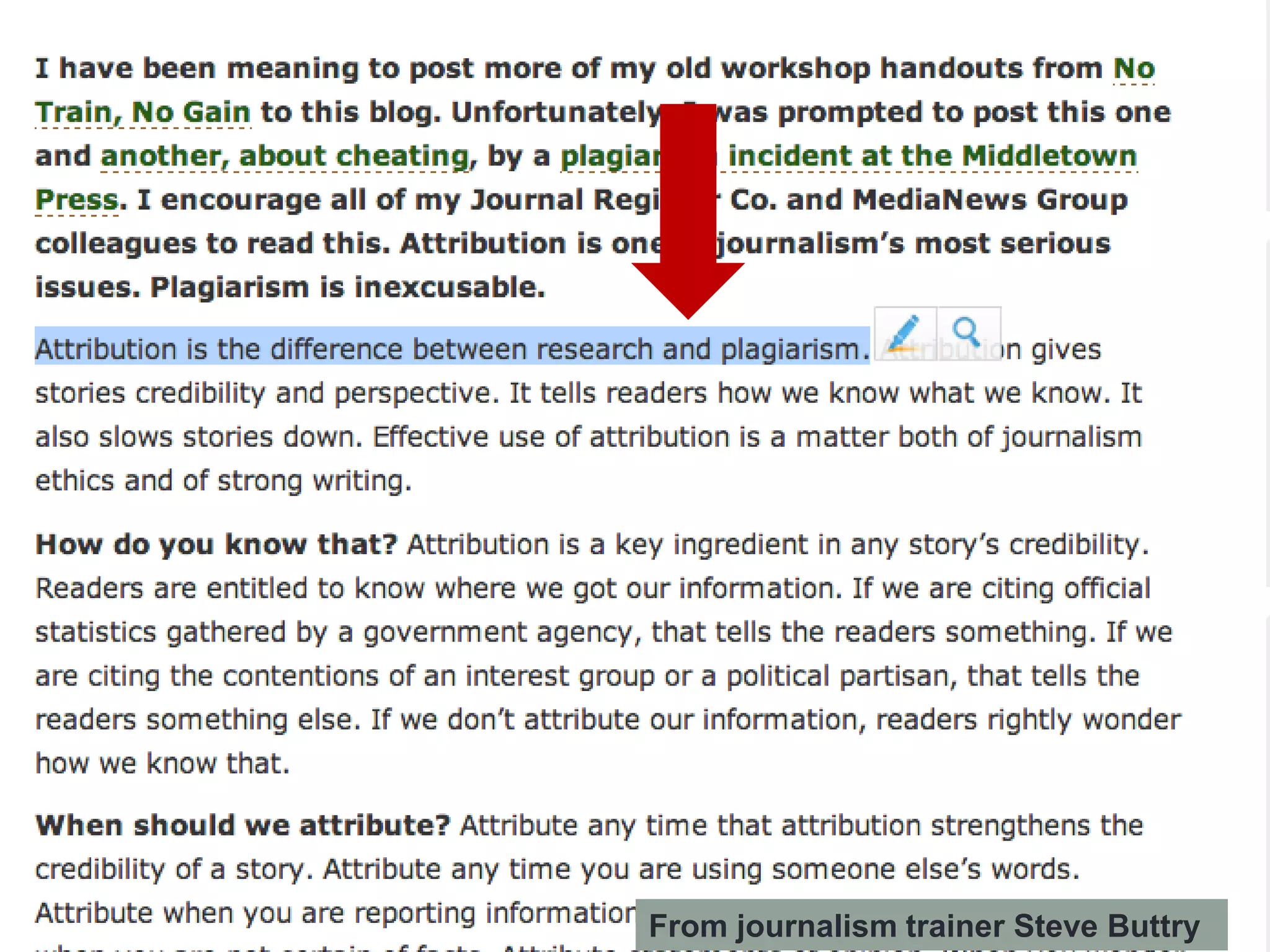
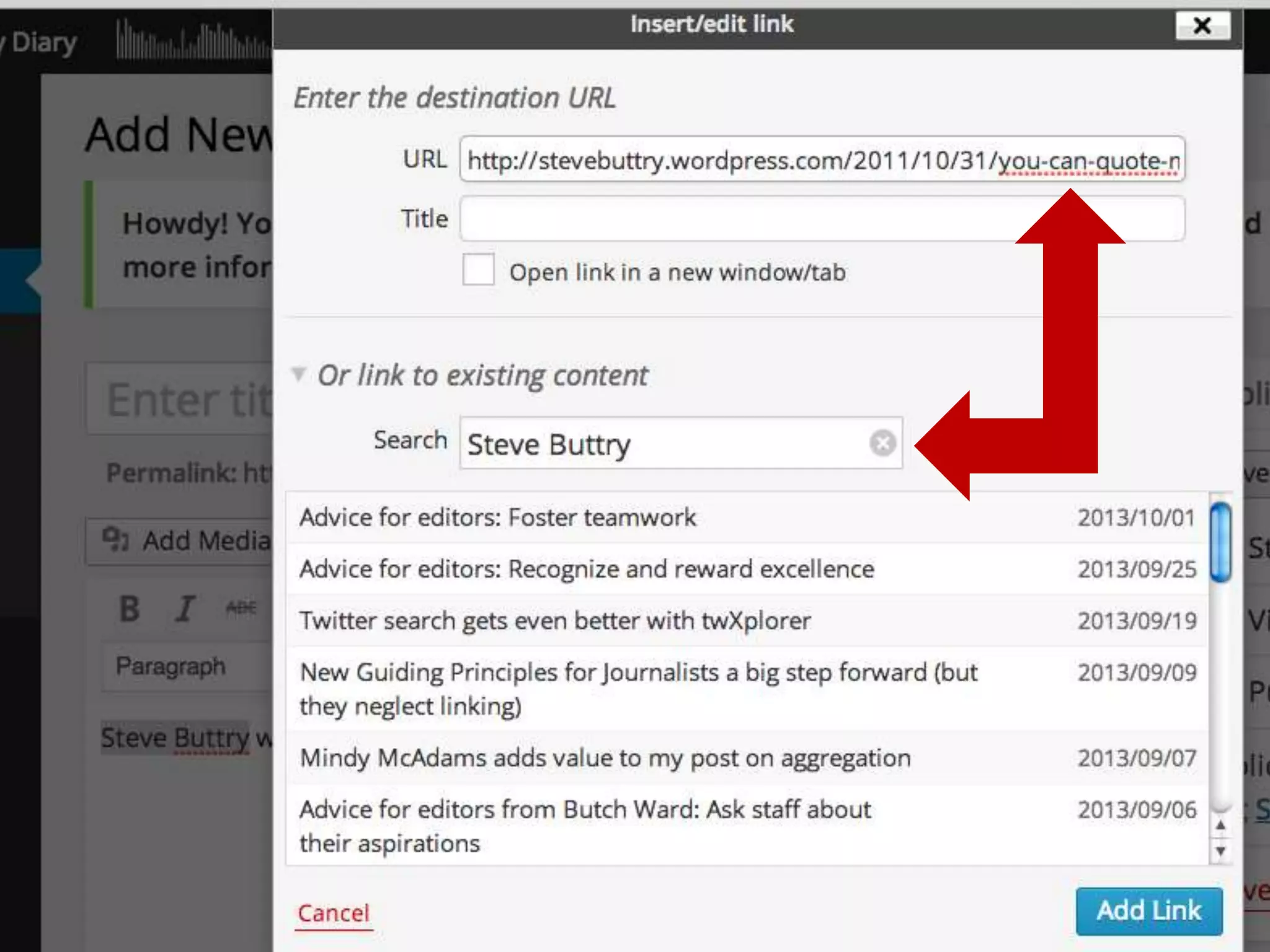
Cutting and pasting from digital
sources can ensure quoting
accurately. But to avoid plagiarism:
•Attribute & link before pasting
•Paste into quotation marks
From journalism trainer Steve Buttry
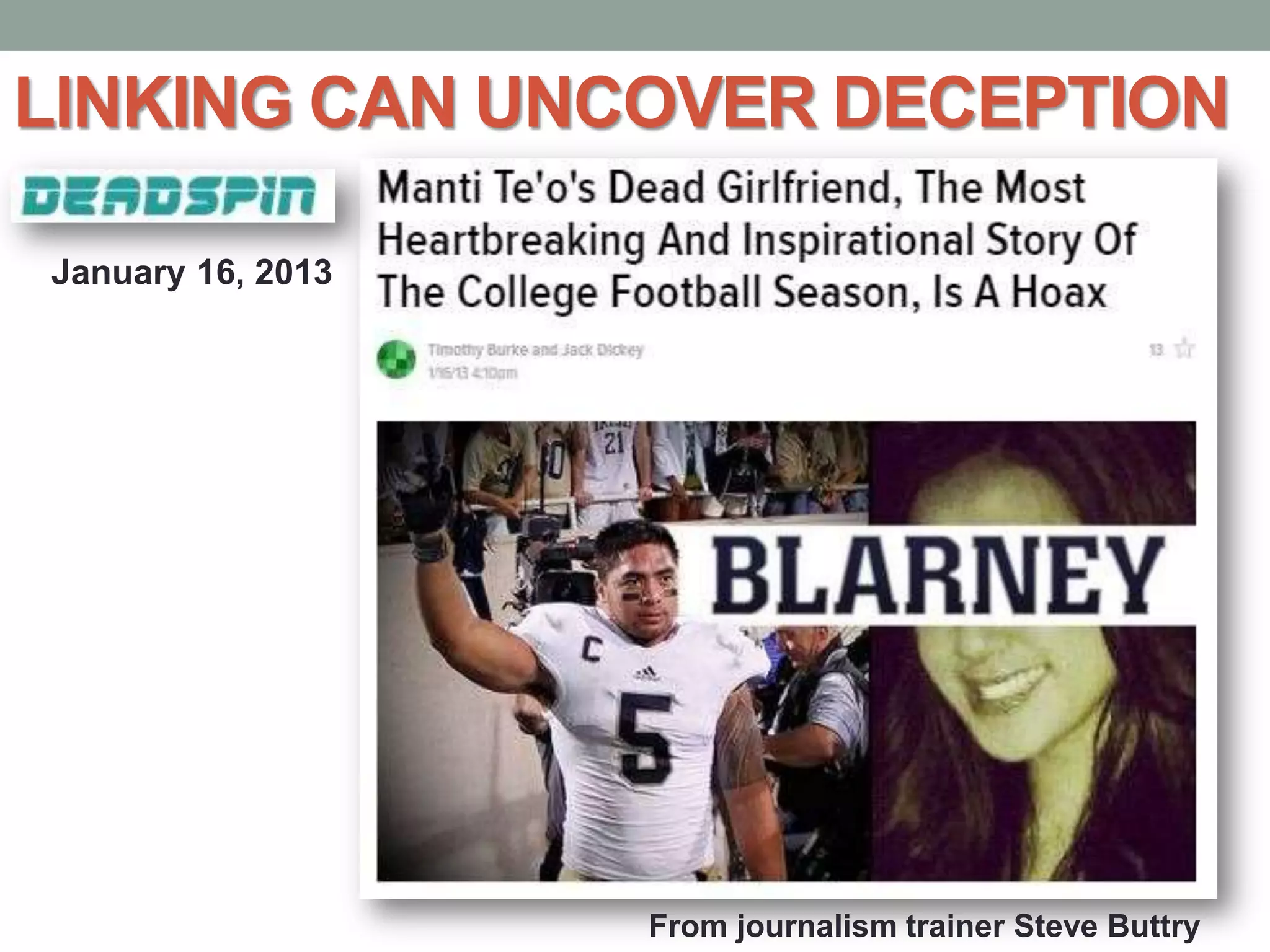
LINKING CAN UNCOVER DECEPTION
From journalism trainer Steve Buttry
January 16, 2013
LINKING CAN UNCOVER DECEPTION
Journalists covering the Manti Te’o’s
story of his dead girlfriend would have
exposed the hoax by seeking links to:
•Obituary
•Story or police report about accident
•Girlfriend’s activities at Stanford
(She had bogus social media profiles.)
From journalism trainer Steve Buttry
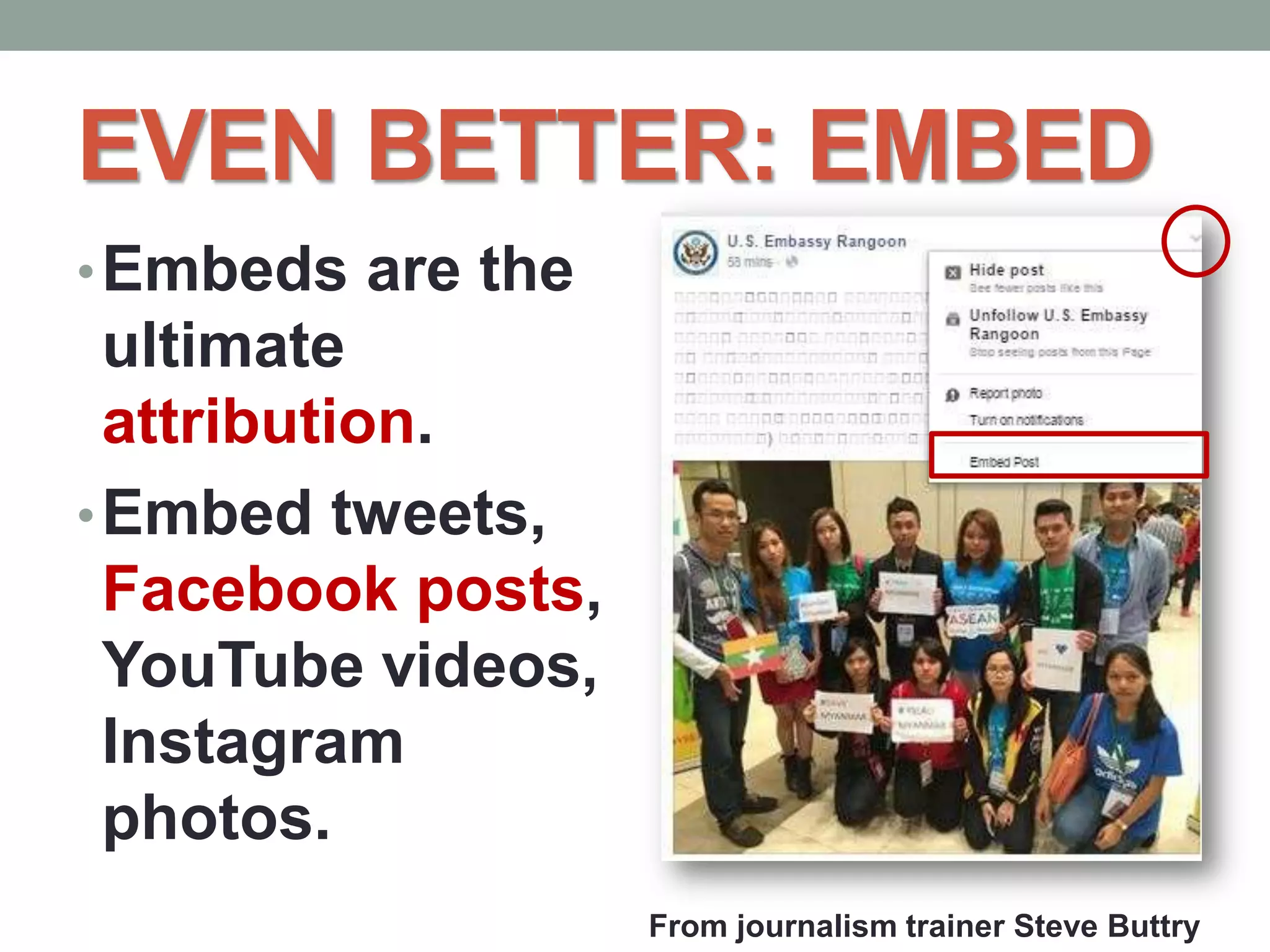
EVEN BETTER: EMBED
•Embeds are the
ultimate
attribution.
•Embed tweets,
Facebook posts,
YouTube videos,
Instagram
photos.
From journalism trainer Steve Buttry
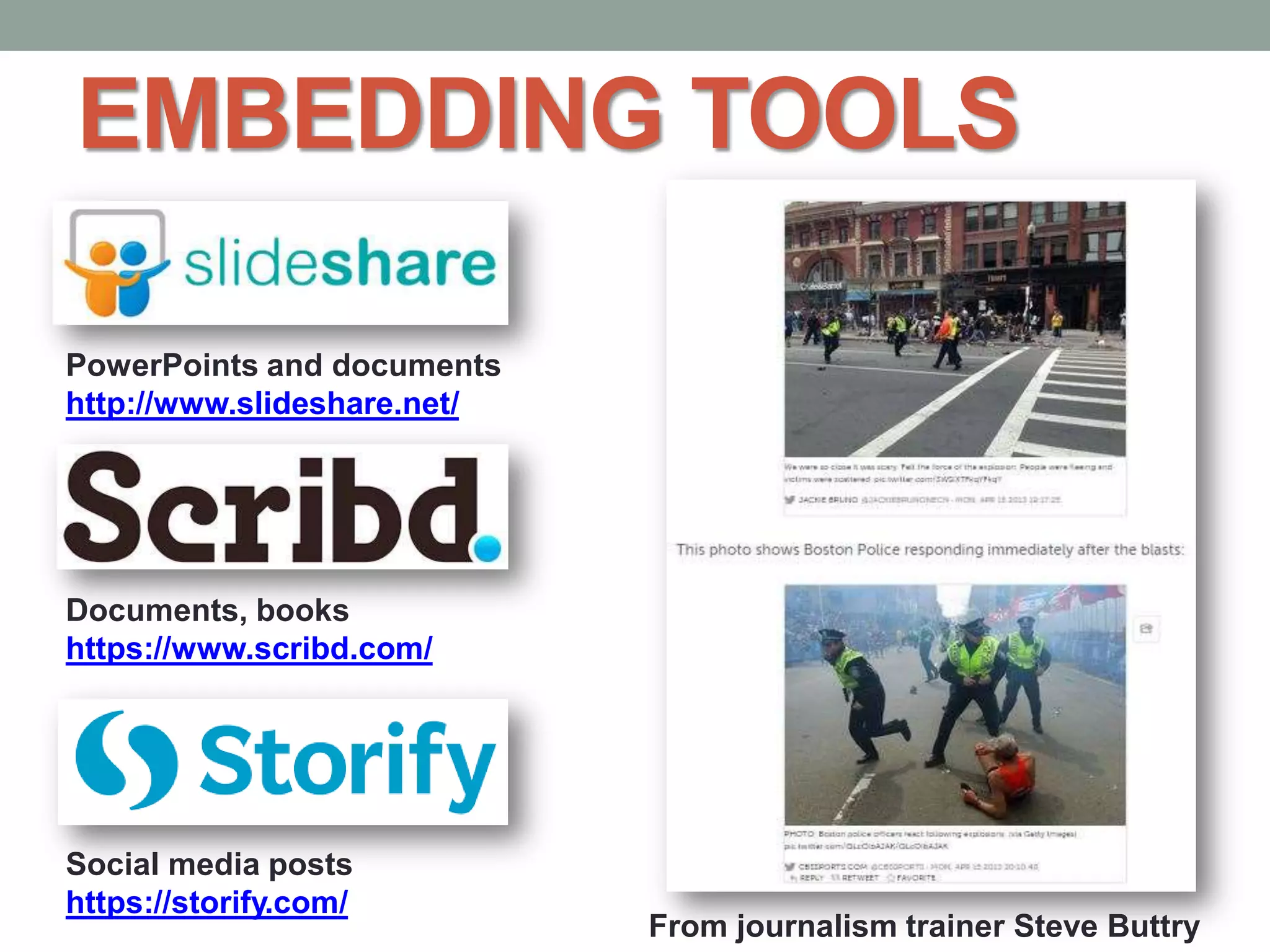
EMBEDDING TOOLS
From journalism trainer Steve Buttry
PowerPoints and documents
http://www.slideshare.net/
Documents, books
https://www.scribd.com/
Social media posts
https://storify.com/
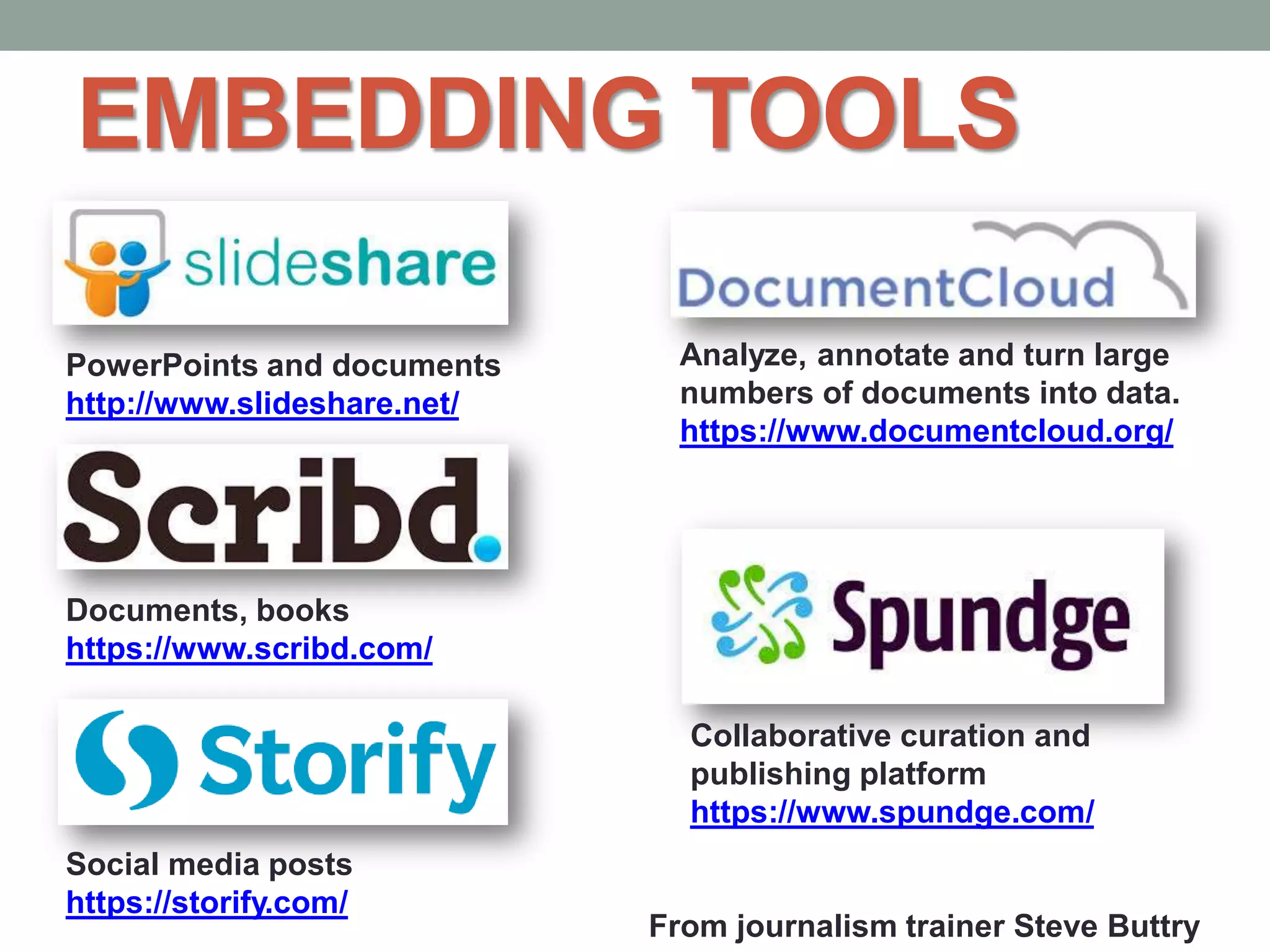
EMBEDDING TOOLS
From journalism trainer Steve Buttry
PowerPoints and documents
http://www.slideshare.net/
Documents, books
https://www.scribd.com/
Social media posts
https://storify.com/
Analyze, annotate and turn large
numbers of documents into data.
https://www.documentcloud.org/
Collaborative curation and
publishing platform
https://www.spundge.com/
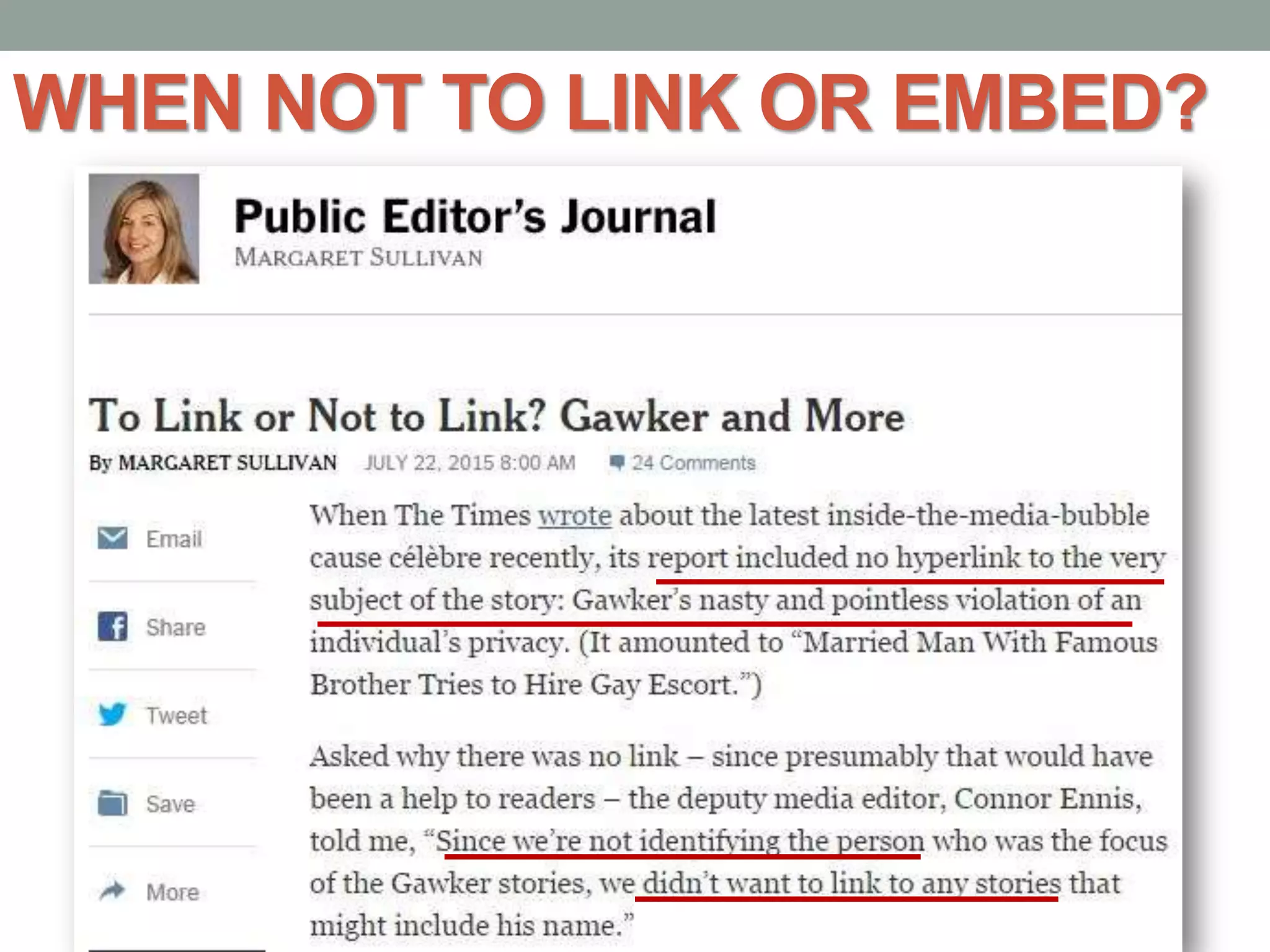
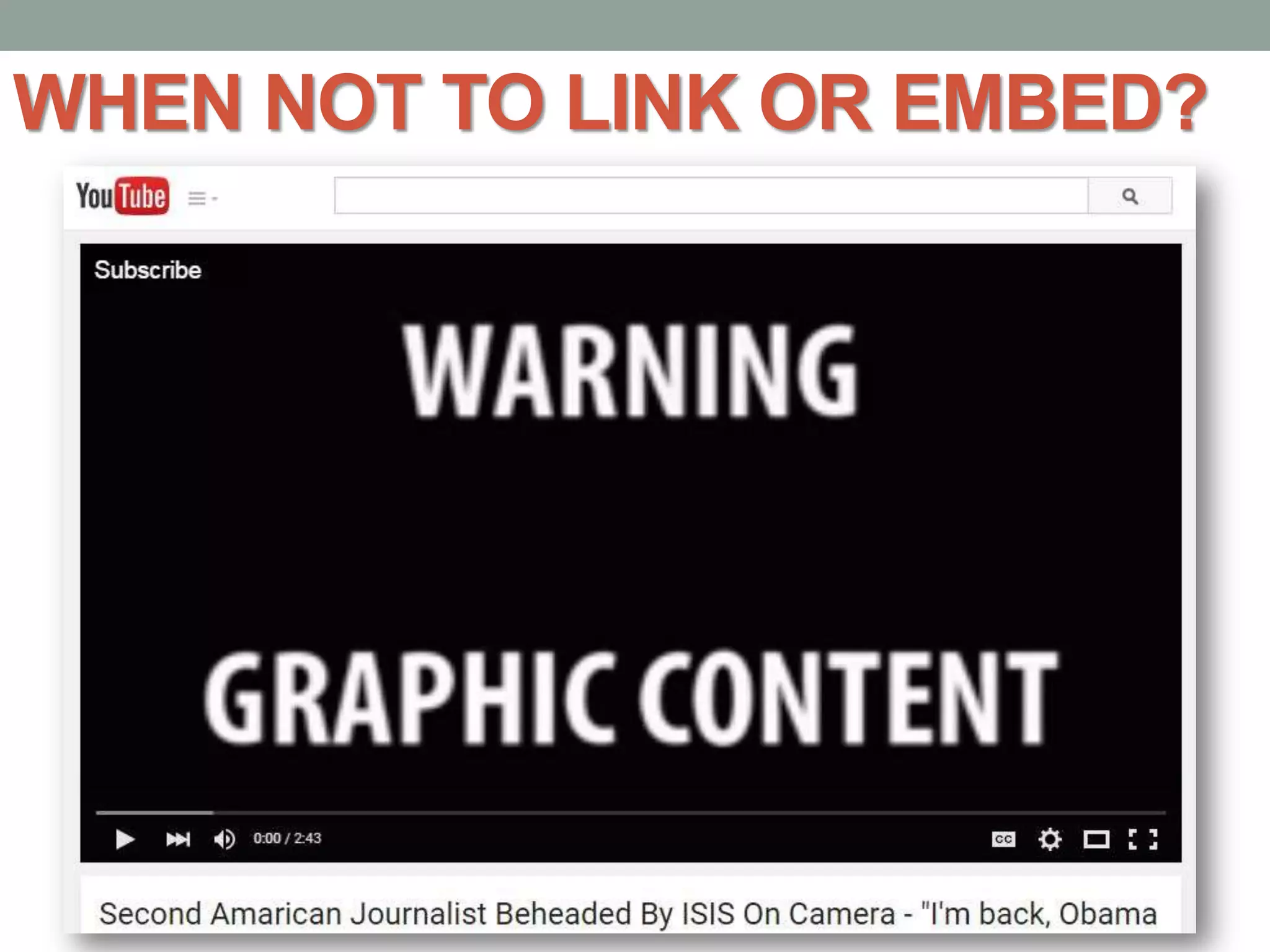
WHEN NOT TO LINK OR EMBED?
SOURCES
• “7 ways journalists can make better ethical decisions when
using Facebook,” Poynter.org, Nov. 25, 2014
• “How to Report on Quran Burning and Other Hate Speech,”
Poynter.org, Nov. 25, 2014
• “Covering and avoiding religious hate speech,”
ReligionLink.com, Dec. 27, 2014
• “From incitement to self-censorship: the media in the Kenyan
elections of 2007 and 2013,” FreeSpeechDebate.com
• “Regulating hate speech: lessons for Asia,”
FreeSpeechDebate.com
• “A Clash of Cultures: Hate Speech, Taboos, Blasphemy, and
the Role of News Media,” (PDF) A Report to the Center for
International Media Assistance, Oct. 3, 2013
SOURCES
• “To Link or Not to Link? Gawker and More,” Public Editor
Margaret Sullivan’s column, The New York Times, July 22,
2015
• “Hate-Speech: A Five-Point Test for Journalists,” (PDF)
EthicalJournalismNetwork.org
• “How to handle personal attacks on social media,”
Poynter.org, Nov. 25, 2014
• “Journalism Ethics: The Global Debate,” (PDF)
International Center for Journalists, 2009
• “Stirring up Hatred through Social Media,” Bangkok Post,
April 21, 2013
• “Coverage of Koran Case Stirs Questions on Media’s
Role,” The New York Times, Sept. 9, 2010
SOURCES
• “Digital Journalism Ethics,” presentation by Steve Buttry,
November 2013
• “Maximizing Your Social Media: Branding and
Journalism,” presentation by Mandy Jenkins, September
2014
• “Social Media Verification Tools,” presentation by Lauren
Klinger, ACES, March 2015
• “Use Your BS Detector when Verifying Social Media
Content,” CopyDesk.org, March 26, 2015

Chapter 18: Ethics Issues Specific to Digital Journalism - JNL-2105 - Journalism Ethics - Professor Linda Austin - National Management College - Yangon, Burma

  • 1.
    CHAPTER 18: ETHICS ISSUESSPECIFIC TO DIGITAL JOURNALISM • Verify information and visuals posted on social media. • Handle hate speech posted online. • Behave professionally on Facebook. • Link or embed to help attribute.
  • 2.
    VERIFY INFORMATION AND VISUALS FROM SOCIALMEDIA Verify statements, photos and videos.
  • 3.
    WOULD YOU REPORTTHIS? 7:02 p.m. Feb. 11, 2012
  • 4.
    WOULD YOU REPORTTHIS? 7:15 p.m. Feb. 11, 2012
  • 5.
    WOULD YOU REPORTTHIS? 7:30 p.m. Feb. 11, 2012
  • 6.
    WOULD YOU REPORTTHIS? 7:57 p.m. Feb. 11, 2012
  • 7.
    WHAT DO THEYHAVE IN COMMON? All have falsely been reported dead on Twitter. Verification
  • 8.
    SOCIAL MEDIA ANDNEWS “Now, conversations that might have occurred between a few individuals can be amplified exponentially to hundreds or thousands of people within minutes.” – Barb Palser, American Journalism Review ByMattHamm Verification
  • 9.
    SOCIAL MEDIA ANDNEWS “The ways in which people first hear information may have changed, but their reliance on reporters to separate fact from fiction and provide depth and context to the news has not.” – Barb Palser, American Journalism Review BySimonBerry Verification
  • 10.
  • 11.
  • 12.
    SOCIAL MEDIA =TIPS By Phil Dolby Two tracks for verification: 1. Source 2. Content
  • 13.
    SOURCE CHECKLIST • Whois this person? • Where does she work? • What social networks is she part of? What does she usually post about? • Who are her friends? • Why do I think she gave me this or shared this piece of content? • What does she have to gain from publishing or sharing this? • How can I contact her? -- From journalism trainer Lauren Klinger
  • 14.
    TOOLS TO HELPYOU Who is this person? • Check WhenDidIJoinTwitter.com -- From journalism trainer Lauren Klinger By Flickr user AJ Cann
  • 15.
  • 16.
  • 17.
    TOOLS TO HELPYOU Who is this person? • Check WhenDidIJoinTwitter.com • Check for a Facebook profile • Check Spokeo.com -- From journalism trainer Lauren Klinger By Flickr user AJ Cann
  • 18.
  • 19.
    TOOLS TO HELPYOU Who is this person? • Check WhenDidIJoinTwitter.com • Check for a Facebook profile • Check Spokeo.com • Check http://www.myanmarteldir .com.mm/white_pages/ -- From journalism trainer Lauren Klinger By Flickr user AJ Cann
  • 20.
  • 21.
    TOOLS TO HELPYOU Where does she work? • Check social media profiles • Check LinkedIn.com • Check the workplace website -- From journalism trainer Lauren Klinger
  • 22.
    CONTENT CHECKLIST • Wheredid this piece of content come from? • Where did I first see it? • Of what value is it to my audience? What is gained by publishing it or not publishing it? • Do I feel like this is too good to be true? • Does this seem credible or does it look altered? • Who else has this story or piece of content? -- From journalism trainer Lauren Klinger
  • 23.
    TOOLS TO HELPYOU • SocialMention.com • WolframAlpha.com • Topsy.com • Who.is -- From journalism trainer Lauren Klinger
  • 24.
    HOW TO USEWHO.IS
  • 25.
    TOOLS TO HELPYOU • SocialMention.com • WolframAlpha.com • Topsy.com • Who.is • Snopes.com • EXIF-viewer.com -- From journalism trainer Lauren Klinger
  • 26.
    HOW TO USEEXIF-viewer.com EXIF = exchangeable image file format 1. Right-click on image to get its URL. 2. Enter URL in search box. 3. Get back technical info on photo, including when it was taken.
  • 27.
  • 28.
  • 29.
    If your mothersays on social media that she loves you,… ByDinJimenez Verification
  • 30.
  • 31.
    CHECK Verification By Din Jim •HerTwitter timeline, bio, links •Her Facebook posts •Her followers and friends •Google her -- From journalism trainer Steve Buttry
  • 32.
    SITES TO TRACKPHOTOS https://images.google.com/ http://tineye.com/ Verification
  • 33.
  • 34.
    SITES TO TRACKPHOTOS Verification
  • 35.
    SITES TO TRACKPHOTOS Verification
  • 36.
  • 37.
  • 38.
  • 39.
    HANDLE HATE SPEECH ONLINE •How to handle hate speech in comments on your or your news organization’s Facebook page. • When to report on hate speech happening on social media.
  • 40.
    DEFINITION: HATE SPEECH “Advocacyof national, racial or religious hatred that constitutes incitement to discrimination, hostility or violence.” – Article 20 of the International Covenant on Civil and Political Rights “Peace will come once all Burmans die. Kill them all.” – a Kachin Facebook page, quoted by Myanmar journalist Michael Pan in “Regulating Hate Speech: Lessons for Asia,” at freespeechdebate.com
  • 41.
    HATE SPEECH ONYOUR OR YOUR NEWS OUTLET’S Enlist your followers to report hate speech to admin.
  • 42.
    HATE SPEECH ONYOUR OR YOUR NEWS OUTLET’S • Enlist your followers to report hate speech to admin. • Hide post • Unfollow • Report post or comment.
  • 43.
    HATE SPEECH ONYOUR OR YOUR NEWS OUTLET’S • Enlist your followers to report hate speech to admin. • Hide post • Unfollow • Report post or comment.
  • 44.
    HATE SPEECH: 5-POINTTEST 1. The position or status of the speaker 2. The reach of the speech 3. The objectives of the speech 4. The content and form of the speech 5. The economic, social and political climate http://ethicaljournalismnetwork.org/en/contents/hate-speech-a-five-point-test-for-journalists
  • 45.
    A CHECKLIST FORTOLERANCE 1. Do not sensationalize. Ask: It may be outrageous, but is it newsworthy? What is the intention of the speaker? What will be the impact of publication? Is there a danger of inflaming passions and incitement to violence? Is the speech fact-based, and have the claims been tested?
  • 46.
    A CHECKLIST FORTOLERANCE 2. Do not rush to publish. Ask: Have we avoided clichés and stereotypes? Have we asked all the relevant and necessary questions? Have we been sensitive to our audience? Have we been temperate in use of language? Do the pictures tell the story without resorting to violence and voyeurism? Have we used diverse sources and included the voices of relevant minorities? Does it meet standards set in editorial and ethical codes?
  • 47.
    A CHECKLIST FORTOLERANCE 3. Pause and reflect before publishing. Ask: Have we done good work? Are there any nagging doubts? Should I ask a colleague?
  • 48.
    RUMORS ON FACEBOOK From“Stirring up Hatred through Social Media,” Bangkok Post, April 21, 2013
  • 49.
    QUESTIONS TO DISCUSS •How do you verify the story? • If verified, whose voices do you include in the story to ensure balance?
  • 50.
    CASE STUDY: BUDDHISTBOYCOTT From “Stirring up Hatred through Social Media,” Bangkok Post, April 21, 2013 The speaker is Buddhist monk Ashin Issariya, who was arrested for his role in the 2007 ''Saffron Revolution.''
  • 51.
    QUESTIONS TO DISCUSS •If verified, should you report on the boycott? • If you do report on it, whose voices do you include in the story to ensure balance? • What’s the line between reporting news and simply furthering a group’s message and agenda? • How can journalists avoid being used to spread a hateful message to a wider audience? • What if the boycott call were made by a more prominent person such as Buddhist monk U Wira Thu?
  • 52.
    HOW TO REPORTON HATE SPEECH The media should take “care to report in context and in a factual and sensitive manner, while ensuring that acts of discrimination are brought to the attention of the public.” • -- Article 19’s Beginners’ guide to content restriction for Myanmar
  • 53.
    HOW TO REPORTON HATE SPEECH • Raise “awareness of the harm caused by discrimination.” • Report “on different groups or communities” and give “their members an opportunity to be heard.” -- Article 19’s Beginners’ guide to content restriction for Myanmar
  • 54.
    KEEP ASKING: “WHY?” “Hatespeech is driven by real grievances, and for it to be addressed in a meaningful way, such grievances must also be addressed.” – “From incitement to self-censorship: the media in the Kenyan elections of 2007 and 2013” on freespeechdebate.com
  • 55.
    KEEP ASKING: “WHY?” •“Taking too short a view of hate speech and only focusing on the symptom will ignore the root causes which are in issues such as land [ownership], youth unemployment and impunity,” argued Wendy Crandall of the Umati Project [which monitors hate speech in Kenya]. • “If these larger issues are addressed, constructively discussed and adequately tackled, then I think over time, hate speech may decrease.” – “From incitement to self-censorship: the media in the Kenyan elections of 2007 and 2013” on freespeechdebate.com
  • 56.
    BEHAVE PROFESSIONALLY ON FACEBOOK • Havea separate Facebook Page or enable the Follow feature on your Profile for public updates. • Set up Facebook lists to monitor people and organizations you cover and your competition. • Use callouts to find sources.
  • 57.
    YOU ARE AJOURNALIST 24/7 BySteveSnodgrass
  • 58.
    From Mandy Jenkinsof Storyful Could my posts affect my audience’s trust in me?
  • 59.
    JOURNALISTS ON FACEBOOK http://bit.ly/Facebookjournalists 1.Set up a Facebook Page or enable the Follow feature on your profile to allow for public updates. 2. Set up Facebook lists to monitor people and organizations you cover and your competition. 3. Use callouts to find sources.
  • 60.
    • One placeto manage everything • Control your privacy • Could mix personal/professional • Completely separate presence from profile • Completely public • Detailed analytics to see who visits Profiles Pages From Mandy Jenkins of Storyful
  • 61.
    •Turn on Subscriptions:Anyone can read your public posts •Set up a vanity url at facebook.com/username • Add your job history and a snappy bio to About section (and make it public) From Mandy Jenkins of Storyful
  • 62.
  • 63.
    From Mandy Jenkinsof Storyful
  • 64.
    From Mandy Jenkinsof Storyful
  • 65.
    From Mandy Jenkinsof Storyful
  • 66.
  • 67.
  • 68.
  • 69.
  • 70.
    LINK OR EMBEDTO HELP ATTRIBUTE
  • 71.
    WHY LINK? •Good journalism:Provides context, attribution, credibility, transparency FromjournalismtrainerSteveButtry -- Philip B. Corbett, standards editor,
  • 72.
    WHY LINK? •Good business:Better search- engine optimization (SEO) for better search traffic From journalism trainer Steve Buttry
  • 73.
    HOW TO LINK Cuttingand pasting from digital sources can ensure quoting accurately. But to avoid plagiarism: •Attribute & link before pasting •Paste into quotation marks From journalism trainer Steve Buttry
  • 74.
  • 76.
  • 77.
  • 78.
    LINKING CAN UNCOVERDECEPTION From journalism trainer Steve Buttry January 16, 2013
  • 79.
    LINKING CAN UNCOVERDECEPTION Journalists covering the Manti Te’o’s story of his dead girlfriend would have exposed the hoax by seeking links to: •Obituary •Story or police report about accident •Girlfriend’s activities at Stanford (She had bogus social media profiles.) From journalism trainer Steve Buttry
  • 80.
    EVEN BETTER: EMBED •Embedsare the ultimate attribution. •Embed tweets, Facebook posts, YouTube videos, Instagram photos. From journalism trainer Steve Buttry
  • 81.
    EMBEDDING TOOLS From journalismtrainer Steve Buttry PowerPoints and documents http://www.slideshare.net/ Documents, books https://www.scribd.com/ Social media posts https://storify.com/
  • 82.
    EMBEDDING TOOLS From journalismtrainer Steve Buttry PowerPoints and documents http://www.slideshare.net/ Documents, books https://www.scribd.com/ Social media posts https://storify.com/ Analyze, annotate and turn large numbers of documents into data. https://www.documentcloud.org/ Collaborative curation and publishing platform https://www.spundge.com/
  • 83.
    WHEN NOT TOLINK OR EMBED?
  • 84.
    WHEN NOT TOLINK OR EMBED?
  • 85.
    SOURCES • “7 waysjournalists can make better ethical decisions when using Facebook,” Poynter.org, Nov. 25, 2014 • “How to Report on Quran Burning and Other Hate Speech,” Poynter.org, Nov. 25, 2014 • “Covering and avoiding religious hate speech,” ReligionLink.com, Dec. 27, 2014 • “From incitement to self-censorship: the media in the Kenyan elections of 2007 and 2013,” FreeSpeechDebate.com • “Regulating hate speech: lessons for Asia,” FreeSpeechDebate.com • “A Clash of Cultures: Hate Speech, Taboos, Blasphemy, and the Role of News Media,” (PDF) A Report to the Center for International Media Assistance, Oct. 3, 2013
  • 86.
    SOURCES • “To Linkor Not to Link? Gawker and More,” Public Editor Margaret Sullivan’s column, The New York Times, July 22, 2015 • “Hate-Speech: A Five-Point Test for Journalists,” (PDF) EthicalJournalismNetwork.org • “How to handle personal attacks on social media,” Poynter.org, Nov. 25, 2014 • “Journalism Ethics: The Global Debate,” (PDF) International Center for Journalists, 2009 • “Stirring up Hatred through Social Media,” Bangkok Post, April 21, 2013 • “Coverage of Koran Case Stirs Questions on Media’s Role,” The New York Times, Sept. 9, 2010
  • 87.
    SOURCES • “Digital JournalismEthics,” presentation by Steve Buttry, November 2013 • “Maximizing Your Social Media: Branding and Journalism,” presentation by Mandy Jenkins, September 2014 • “Social Media Verification Tools,” presentation by Lauren Klinger, ACES, March 2015 • “Use Your BS Detector when Verifying Social Media Content,” CopyDesk.org, March 26, 2015