Using Evidence and Citing Sources
What is evidence? 
• Evidence = information that helps explain 
and prove your ideas 
• Types of evidence include the following: 
• Specific Examples 
• Facts 
• Statistics 
• Opinions from experts 
• Maps, charts, graphs
What are three ways to use evidence? 
• Quote it  place in quotation marks 
everything that comes 
directly from the text. 
• Paraphrase it restate the idea in 
your own words. 
• Cite it  give the source where you 
found your information 
http://www.grammar-quizzes.com/writing_plagiarism.html
Terms to know…
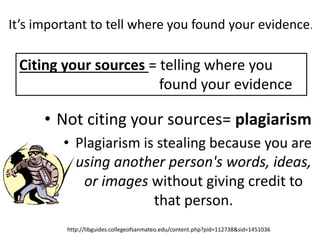
It’s important to tell where you found your evidence. 
Citing your sources = telling where you 
found your evidence 
• Not citing your sources= plagiarism 
• Plagiarism is stealing because you are 
using another person's words, ideas, 
or images without giving credit to 
that person. 
http://libguides.collegeofsanmateo.edu/content.php?pid=112738&sid=1451036
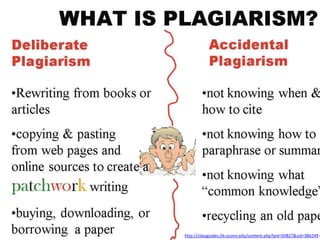
http://classguides.lib.uconn.edu/content.php?pid=50827&sid=386249 on
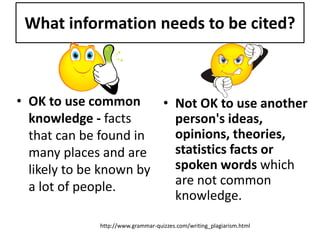
What information needs to be cited? 
• OK to use common 
knowledge - facts 
that can be found in 
many places and are 
likely to be known by 
a lot of people. 
• Not OK to use another 
person's ideas, 
opinions, theories, 
statistics facts or 
spoken words which 
are not common 
knowledge. 
http://www.grammar-quizzes.com/writing_plagiarism.html
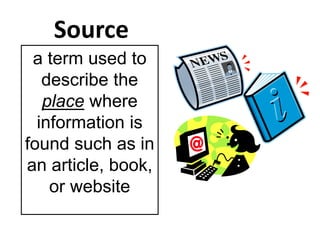
Source 
a term used to 
describe the 
place where 
information is 
found such as in 
an article, book, 
or website
• citation (noun) = information about a 
book or article such as the title, author, 
and date which someone can use to find 
the same book or article 
• to cite, citing (verb) = to tell where you 
found your evidence and information. 
• MLA style = a specific way to format 
citations and bibliographies used in 
English literature classes 
http://libguides.collegeofsanmateo.edu/content.php?pid=112738&sid=1451036
• common knowledge - facts that can be found 
in many places and are likely to be known by a 
lot of people.
What are In-Text Citations or 
Parenthetical Citations? 
An in-text citation identifies the source where you 
took a specific quotation, fact, idea, or opinion. 
In-text citations are also called parenthetical 
citations because they appear in parentheses. 
For Example: 
One author claims that “no one is concerned with 
this issue” (Jones 45).
In-Text Citation vs. Foot/Endnotes 
 In-text citations lead readers to specific 
works listed on the Works Cited page. 
 Footnotes and endnotes provide readers with 
the explanatory information: 
 Content notes offer additional comments, 
information, insight, etc., not provided in the text 
 Bibliographic notes provide information on 
additional sources or comments on other sources.
When do I use an in-text citation? 
1. You directly quote a source. 
2. You paraphrase a source (even if you change the word 
order and replace words with synonyms). 
3. You use an idea from a source. Because the idea is 
not originally yours, it belongs to the author(s) of the 
source and must be cited. 
4. You use information that is not common knowledge.
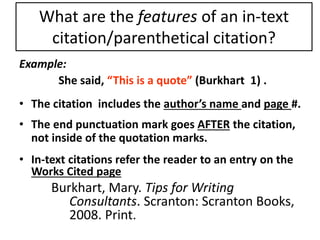
What are the features of an in-text 
citation/parenthetical citation? 
Example: 
She said, “This is a quote” (Burkhart 1) . 
• The citation includes the author’s name and page #. 
• The end punctuation mark goes AFTER the citation, 
not inside of the quotation marks. 
• In-text citations refer the reader to an entry on the 
Works Cited page 
Burkhart, Mary. Tips for Writing 
Consultants. Scranton: Scranton Books, 
2008. Print.
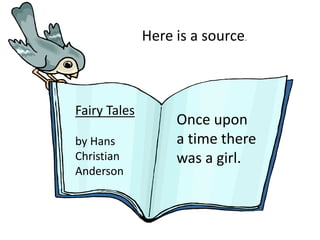
Fairy Tales 
by Hans 
Christian 
Anderson 
Here is a source. 
Once upon 
a time there 
was a girl.
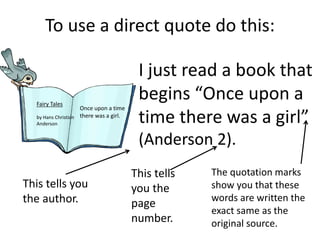
To use a direct quote do this: 
I just read a book that 
begins “Once upon a 
time there was a girl” 
(Anderson 2). 
Once upon a time 
there was a girl. 
Fairy Tales 
by Hans Christian 
Anderson 
This tells you 
the author. 
The quotation marks 
show you that these 
words are written the 
exact same as the 
original source. 
This tells 
you the 
page 
number.
What is a Work Cited page? 
• Also called a bibliography 
• Located at the end of your essay 
• Contains enough information 
that the reader can find the 
source you are citing.
Remember: 
• You can paraphrase your evidence or 
you can directly quote your 
evidence, but you must always tell 
where you found the information by 
giving an in-text citation. 
• Remember, telling where you found your 
information is called citing your sources.
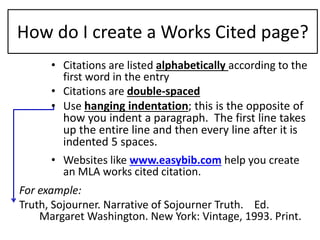
How do I create a Works Cited page? 
• Citations are listed alphabetically according to the 
first word in the entry 
• Citations are double-spaced 
• Use hanging indentation; this is the opposite of 
how you indent a paragraph. The first line takes 
up the entire line and then every line after it is 
indented 5 spaces. 
• Websites like www.easybib.com help you create 
an MLA works cited citation. 
For example: 
Truth, Sojourner. Narrative of Sojourner Truth. Ed. 
Margaret Washington. New York: Vintage, 1993. Print.
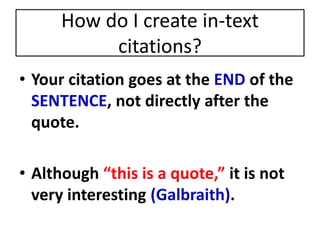
How do I create in-text 
citations? 
• Your citation goes at the END of the 
SENTENCE, not directly after the 
quote. 
• Although “this is a quote,” it is not 
very interesting (Galbraith).
What if my quote is really long? 
• Any quote OVER 4 typed lines needs to be in 
the following format: 
You will leave off the quote marks. You 
will also indent the whole thing into a 
block like you see here. You will place the 
citation outside the punctuation 
mark, which is different from regular 
citations. (Galbraith 1)
What if I am directly quoting a source, 
but need to change a word? 
• If you need to change a word inside of 
the quote, use [brackets]: 
• “We didn’t always live on Mango 
Street” (Cisneros 3). 
• “[Esperanza] didn’t always live on 
Mango Street” (Cisneros 3).
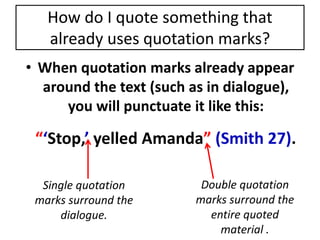
How do I quote something that 
already uses quotation marks? 
• When quotation marks already appear 
around the text (such as in dialogue), 
you will punctuate it like this: 
“‘Stop,’ yelled Amanda” (Smith 27). 
Single quotation 
marks surround the 
dialogue. 
Double quotation 
marks surround the 
entire quoted 
material .
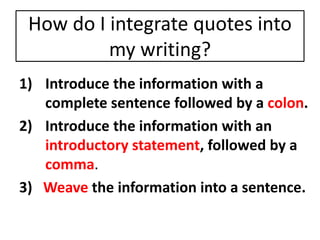
How do I integrate quotes into 
my writing? 
1) Introduce the information with a 
complete sentence followed by a colon. 
2) Introduce the information with an 
introductory statement, followed by a 
comma. 
3) Weave the information into a sentence.
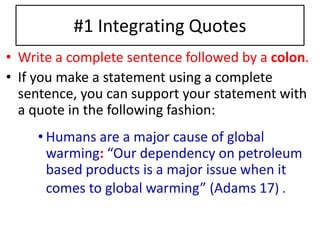
#1 Integrating Quotes 
• Write a complete sentence followed by a colon. 
• If you make a statement using a complete 
sentence, you can support your statement with 
a quote in the following fashion: 
• Humans are a major cause of global 
warming: “Our dependency on petroleum 
based products is a major issue when it 
comes to global warming” (Adams 17) .
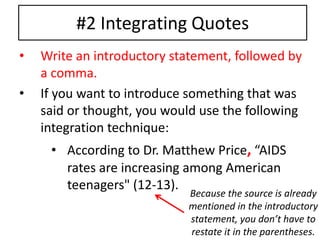
#2 Integrating Quotes 
• Write an introductory statement, followed by 
a comma. 
• If you want to introduce something that was 
said or thought, you would use the following 
integration technique: 
• According to Dr. Matthew Price, “AIDS 
rates are increasing among American 
teenagers" (12-13). 
Because the source is already 
mentioned in the introductory 
statement, you don’t have to 
restate it in the parentheses.
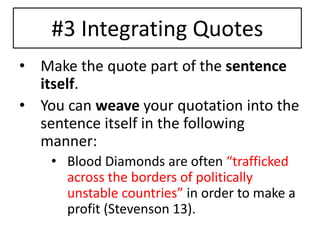
#3 Integrating Quotes 
• Make the quote part of the sentence 
itself. 
• You can weave your quotation into the 
sentence itself in the following 
manner: 
• Blood Diamonds are often “trafficked 
across the borders of politically 
unstable countries” in order to make a 
profit (Stevenson 13).
Practice 
• Turn to page 4 and practice citing your sources 
and embedding quotations into your writing. 
• When you finish, place this handout in the 
Notes section of your binder.
Citing evidence

Citing evidence

  • 1.
    Using Evidence andCiting Sources
  • 2.
    What is evidence? • Evidence = information that helps explain and prove your ideas • Types of evidence include the following: • Specific Examples • Facts • Statistics • Opinions from experts • Maps, charts, graphs
  • 3.
    What are threeways to use evidence? • Quote it  place in quotation marks everything that comes directly from the text. • Paraphrase it restate the idea in your own words. • Cite it  give the source where you found your information http://www.grammar-quizzes.com/writing_plagiarism.html
  • 4.
  • 5.
    It’s important totell where you found your evidence. Citing your sources = telling where you found your evidence • Not citing your sources= plagiarism • Plagiarism is stealing because you are using another person's words, ideas, or images without giving credit to that person. http://libguides.collegeofsanmateo.edu/content.php?pid=112738&sid=1451036
  • 6.
  • 7.
    What information needsto be cited? • OK to use common knowledge - facts that can be found in many places and are likely to be known by a lot of people. • Not OK to use another person's ideas, opinions, theories, statistics facts or spoken words which are not common knowledge. http://www.grammar-quizzes.com/writing_plagiarism.html
  • 9.
    Source a termused to describe the place where information is found such as in an article, book, or website
  • 10.
    • citation (noun)= information about a book or article such as the title, author, and date which someone can use to find the same book or article • to cite, citing (verb) = to tell where you found your evidence and information. • MLA style = a specific way to format citations and bibliographies used in English literature classes http://libguides.collegeofsanmateo.edu/content.php?pid=112738&sid=1451036
  • 11.
    • common knowledge- facts that can be found in many places and are likely to be known by a lot of people.
  • 12.
    What are In-TextCitations or Parenthetical Citations? An in-text citation identifies the source where you took a specific quotation, fact, idea, or opinion. In-text citations are also called parenthetical citations because they appear in parentheses. For Example: One author claims that “no one is concerned with this issue” (Jones 45).
  • 13.
    In-Text Citation vs.Foot/Endnotes  In-text citations lead readers to specific works listed on the Works Cited page.  Footnotes and endnotes provide readers with the explanatory information:  Content notes offer additional comments, information, insight, etc., not provided in the text  Bibliographic notes provide information on additional sources or comments on other sources.
  • 14.
    When do Iuse an in-text citation? 1. You directly quote a source. 2. You paraphrase a source (even if you change the word order and replace words with synonyms). 3. You use an idea from a source. Because the idea is not originally yours, it belongs to the author(s) of the source and must be cited. 4. You use information that is not common knowledge.
  • 15.
    What are thefeatures of an in-text citation/parenthetical citation? Example: She said, “This is a quote” (Burkhart 1) . • The citation includes the author’s name and page #. • The end punctuation mark goes AFTER the citation, not inside of the quotation marks. • In-text citations refer the reader to an entry on the Works Cited page Burkhart, Mary. Tips for Writing Consultants. Scranton: Scranton Books, 2008. Print.
  • 16.
    Fairy Tales byHans Christian Anderson Here is a source. Once upon a time there was a girl.
  • 17.
    To use adirect quote do this: I just read a book that begins “Once upon a time there was a girl” (Anderson 2). Once upon a time there was a girl. Fairy Tales by Hans Christian Anderson This tells you the author. The quotation marks show you that these words are written the exact same as the original source. This tells you the page number.
  • 18.
    What is aWork Cited page? • Also called a bibliography • Located at the end of your essay • Contains enough information that the reader can find the source you are citing.
  • 19.
    Remember: • Youcan paraphrase your evidence or you can directly quote your evidence, but you must always tell where you found the information by giving an in-text citation. • Remember, telling where you found your information is called citing your sources.
  • 20.
    How do Icreate a Works Cited page? • Citations are listed alphabetically according to the first word in the entry • Citations are double-spaced • Use hanging indentation; this is the opposite of how you indent a paragraph. The first line takes up the entire line and then every line after it is indented 5 spaces. • Websites like www.easybib.com help you create an MLA works cited citation. For example: Truth, Sojourner. Narrative of Sojourner Truth. Ed. Margaret Washington. New York: Vintage, 1993. Print.
  • 21.
    How do Icreate in-text citations? • Your citation goes at the END of the SENTENCE, not directly after the quote. • Although “this is a quote,” it is not very interesting (Galbraith).
  • 22.
    What if myquote is really long? • Any quote OVER 4 typed lines needs to be in the following format: You will leave off the quote marks. You will also indent the whole thing into a block like you see here. You will place the citation outside the punctuation mark, which is different from regular citations. (Galbraith 1)
  • 23.
    What if Iam directly quoting a source, but need to change a word? • If you need to change a word inside of the quote, use [brackets]: • “We didn’t always live on Mango Street” (Cisneros 3). • “[Esperanza] didn’t always live on Mango Street” (Cisneros 3).
  • 24.
    How do Iquote something that already uses quotation marks? • When quotation marks already appear around the text (such as in dialogue), you will punctuate it like this: “‘Stop,’ yelled Amanda” (Smith 27). Single quotation marks surround the dialogue. Double quotation marks surround the entire quoted material .
  • 25.
    How do Iintegrate quotes into my writing? 1) Introduce the information with a complete sentence followed by a colon. 2) Introduce the information with an introductory statement, followed by a comma. 3) Weave the information into a sentence.
  • 26.
    #1 Integrating Quotes • Write a complete sentence followed by a colon. • If you make a statement using a complete sentence, you can support your statement with a quote in the following fashion: • Humans are a major cause of global warming: “Our dependency on petroleum based products is a major issue when it comes to global warming” (Adams 17) .
  • 27.
    #2 Integrating Quotes • Write an introductory statement, followed by a comma. • If you want to introduce something that was said or thought, you would use the following integration technique: • According to Dr. Matthew Price, “AIDS rates are increasing among American teenagers" (12-13). Because the source is already mentioned in the introductory statement, you don’t have to restate it in the parentheses.
  • 28.
    #3 Integrating Quotes • Make the quote part of the sentence itself. • You can weave your quotation into the sentence itself in the following manner: • Blood Diamonds are often “trafficked across the borders of politically unstable countries” in order to make a profit (Stevenson 13).
  • 29.
    Practice • Turnto page 4 and practice citing your sources and embedding quotations into your writing. • When you finish, place this handout in the Notes section of your binder.