MLA 8th
Edition Documentation Style
1. Format of a Research Paper
Your word processor comes with default settings (margin, line height, paragraph spacing, and
typeface) that will likely need adjustment. For MLA style, you need:
1.1. Margin: 1-inch margins on all four sides on an A-4 size paper
1.2. Text Formatting:
 2.0 line height (i.e., double-spaced). Double space everything including the
preliminary information, title, body text and quotations, and the works cited list.
 no extra spacing after paragraphs
 12-point typeface (Times New Roman)
1.3. Heading and Title:
 You do not need a separate cover page for a research paper/term paper
 Flush to the left margin and type a) your name, b) Your instructor’s name, c) Course
code and course title, d) Date of submission
 Then write the title of your research paper. Put the title on the center margin. Do not
bold or italicize or underline your title.
1.4. Page Numbers:
In the top right of every page, use your word processor’s “Page Header” function to add your
surname (last name) followed by page number.
 Your instructor may ask you not to write the page number on the title/first page.
 A truly informative title will include the general topic, and your precise opinion on
that topic. (So, if you plan to compare Hamlet and Macbeth, your title should state
the unique point you want to make about Hamlet and Macbeth. Reuse part of your
thesis statement.)
This handout presumes you already know why you should cite your sources (to establish your
authority, to introduce persuasive evidence, to avoid plagiarism, etc.). The following
instructions focus on how you format the page for proper documentation.
To fully cite a source requires two stages. The first happens in the body of your paper (the
“In-text citation”) and the second happens on a separate page at the end of your paper i.e. on
the “Works Cited List”.
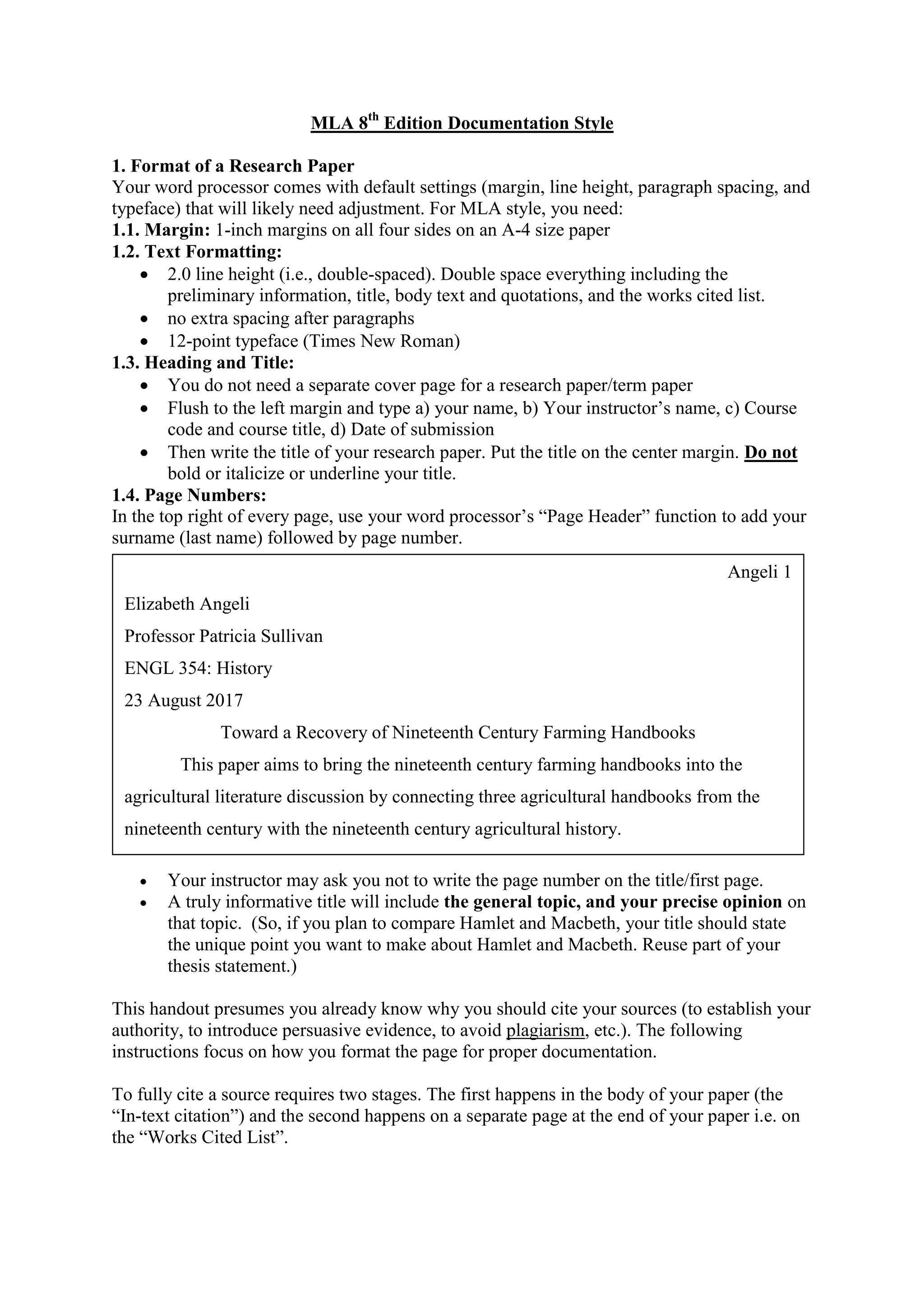
Angeli 1
Elizabeth Angeli
Professor Patricia Sullivan
ENGL 354: History
23 August 2017
Toward a Recovery of Nineteenth Century Farming Handbooks
This paper aims to bring the nineteenth century farming handbooks into the
agricultural literature discussion by connecting three agricultural handbooks from the
nineteenth century with the nineteenth century agricultural history.
2
2. Citations
2.1. In-text citations: Author-page style
MLA format follows the author-page method of in-text citation. This means that the author's
last name and the page number(s) from which the quotation or paraphrase is taken must
appear in the text, and a complete reference should appear on your Works Cited page. The
author's name may appear either in the sentence itself or in parentheses following the
quotation or paraphrase, but the page number(s) should always appear in the parentheses, not
in the text of your sentence. For example:
Wordsworth stated that Romantic poetry was marked by a "spontaneous overflow of
powerful feelings" (263).
Romantic poetry is characterized by the "spontaneous overflow of powerful feelings"
(Wordsworth 263).
Wordsworth extensively explored the role of emotion in the creative process (263).
Both citations in the examples above, (263) and (Wordsworth 263), tell readers that the
information in the sentence can be located on page 263 of a work by an author named
Wordsworth. If readers want more information about this source, they can turn to the Works
Cited page, where, under the name of Wordsworth, they would find the following
information:
Wordsworth, William. Lyrical Ballads. Oxford UP, 1967.
2.2. In-text citations for print sources by a corporate author
When a source has a corporate author, it is acceptable to use the name of the corporation
followed by the page number for the in-text citation. You should also use abbreviations (e.g.,
nat'l for national) where appropriate, so as to avoid interrupting the flow of reading with
overly long parenthetical citations.
2.3. In-text citations for print sources with no known author
When a source has no known author, use a shortened title of the work instead of an author
name. Place the title in quotation marks if it's a short work (such as an article) or italicize it if
it's a longer work (e.g. plays, books, television shows, entire Web sites) and provide a page
number.
We see so many global warming hotspots in North America likely because this region has
"more readily accessible cl~imatic data and more comprehensive programs to monitor and
study environmental change . . ." ("Impact of Global Warming" 6).
In this example, since the reader does not know the author of the article, an abbreviated title
of the article appears in the parenthetical citation which corresponds to the full name of the
article which appears first at the left-hand margin of its respective entry in the Works Cited.
Thus, the writer includes the title in quotation marks as the signal phrase in the parenthetical
citation in order to lead the reader directly to the source on the Works Cited page. The Works
Cited entry appears as follows:
"The Impact of Global Warming in North America." Global Warming: Early Signs. 1999.
http://www.climatehotmap.org/. Accessed 23 Mar. 2009.
3
We'll learn how to make a Works Cited page in a bit, but right now it's important to know
that parenthetical citations and Works Cited pages allow readers to know which sources you
consulted in writing your essay, so that they can either verify your interpretation of the
sources or use them in their own scholarly work.
2.4. Citing multiple works by the same author
If you cite more than one work by a particular author, include a shortened title for the
particular work from which you are quoting to distinguish it from the others. Put short titles
of books in italics and short titles of articles in quotation marks.
Citing two articles by the same author:
Lightenor has argued that computers are not useful tools for small children ("Too Soon" 38),
though he has acknowledged elsewhere that early exposure to computer games does lead to
better small motor skill development in a child's second and third year ("Hand-Eye
Development" 17).
Citing two books by the same author:
Murray states that writing is "a process" that "varies with our thinking style" (Write to
Learn 6). Additionally, Murray argues that the purpose of writing is to "carry ideas and
information from the mind of one person into the mind of another" (A Writer Teaches
Writing 3).
2.5. Citing indirect sources
Sometimes you may have to use an indirect source. An indirect source is a source cited in
another source. For such indirect quotations, use "qtd. in" to indicate the source you actually
consulted. For example:
Ravitch argues that high schools are pressured to act as "social service centers, and they don't
do that well" (qtd. in Weisman 259).
Note that, in most cases, a responsible researcher will attempt to find the original source,
rather than citing an indirect source.
2.6. Electronic sources
One online film critic stated that Fitzcarraldo "has become notorious for its near-failure and
many obstacles" (Taylor, “Fitzcarraldo”).
The Purdue OWL is accessed by millions of users every year. Its "MLA Formatting and Style
Guide" is one of the most popular resources (Russell et al.).
In the first example, the writer has chosen not to include the author name in-text; however,
two entries from the same author appear in the Works Cited. Thus, the writer includes both
the author’s last name and the article title in the parenthetical citation in order to lead the
reader to the appropriate entry on the Works Cited page (see below). In the second example,
“Russell et al.” in the parenthetical citation gives the reader an author name followed by the
abbreviation “et al.,” meaning, “and others,” for the article “MLA Formatting and Style
Guide.” Both corresponding Works Cited entries are as follows:
4
Taylor, Rumsey. "Fitzcarraldo." Slant, 13 Jun. 2003,
www.slantmagazine.com/film/review/fitzcarraldo/.
Russell, Tony, et al. "MLA Formatting and Style Guide." The Purdue OWL, 2 Aug. 2016,
owl.english.purdue.edu/owl/resource/747/01/.
2.7. Time-based media sources
When creating in-text citations for media that has a runtime, such as a movie or podcast,
include the range of hours, minutes and seconds you plan to reference, like so (00:02:15-
00:02:35).
3. Formatting Quotations
3.1. Short quotations
To indicate short quotations (fewer than four typed lines of prose or three lines of verse) in
your text, enclose the quotation within double quotation marks. Provide the author and
specific page citation (in the case of verse, provide line numbers) in the text, and include a
complete reference on the Works Cited page. Punctuation marks such as periods, commas,
and semicolons should appear after the parenthetical citation. Question marks and
exclamation points should appear within the quotation marks if they are a part of the quoted
passage but after the parenthetical citation if they are a part of your text.
For example, when quoting short passages of prose, use the following examples:
According to some, dreams express "profound aspects of personality" (Foulkes 184), though
others disagree.
According to Foulkes's study, dreams may express "profound aspects of personality" (184).
Is it possible that dreams may express "profound aspects of personality" (Foulkes 184)?
When short (fewer than three lines of verse) quotations from poetry, mark breaks in short
quotations of verse with a slash, ( / ), at the end of each line of verse (a space should precede
and follow the slash).
Cullen concludes, "Of all the things that happened there / That's all I remember" (11-12).
3.2. Long quotations
For quotations that are more than four lines of prose or three lines of verse, place quotations
in a free-standing block of text and omit quotation marks. Start the quotation on a new line,
with the entire quote indented ½ inch from the left margin; maintain double-spacing. Only
indent the first line of the quotation by an additional quarter inch if you are citing multiple
paragraphs. Your parenthetical citation should come after the closing punctuation mark.
When quoting verse, maintain original line breaks. (You should maintain double-spacing
throughout your essay.)
For example, when citing more than four lines of prose, use the following examples:
Nelly Dean treats Heathcliff poorly and dehumanizes him throughout her
narration: They entirely refused to have it in bed with them, or even in their
room, and I had no more sense, so, I put it on the landing of the stairs, hoping
it would be gone on the morrow. By chance, or else attracted by hearing his
voice, it crept to Mr. Earnshaw's door, and there he found it on quitting his
5
chamber. Inquiries were made as to how it got there; I was obliged to confess,
and in recompense for my cowardice and inhumanity was sent out of the
house. (Bronte 78)
When citing long sections (more than three lines) of poetry, keep formatting as close to the
original as possible.
In his poem "My Papa's Waltz," Theodore Roethke explores his childhood with his father:
The whiskey on your breath
Could make a small boy dizzy;
But I hung on like death:
Such waltzing was not easy.
We Romped until the pans
Slid from the kitchen shelf;
My mother's countenance
Could not unfrown itself. (quoted in Shrodes, p. 202)
When citing two or more paragraphs, use block quotation format, even if the passage from
the paragraphs is less than four lines. Indent the first line of each quoted paragraph an extra
quarter inch.
In "American Origins of the Writing-across-the-Curriculum Movement," David Russell
argues,
Writing has been an issue in American secondary and higher education since
papers and examinations came into wide use in the 1870s, eventually driving
out formal recitation and oral examination. . . .
From its birth in the late nineteenth century, progressive education has
wrestled with the conflict within industrial society between pressure to
increase specialization of knowledge and of professional work (upholding
disciplinary standards) and pressure to integrate more fully an ever-widening
number of citizens into intellectually meaningful activity within mass society
(promoting social equity). . . . (3)
3.3. Adding or omitting words in quotations
If you add a word or words in a quotation, you should put brackets around the words to
indicate that they are not part of the original text.
Jan Harold Brunvand, in an essay on urban legends, states, "some individuals [who retell
urban legends] make a point of learning every rumor or tale" (78).
If you omit a word or words from a quotation, you should indicate the deleted word or words
by using ellipsis marks, which are three periods ( . . . ) preceded and followed by a space. For
example:
In an essay on urban legends, Jan Harold Brunvand notes that "some individuals make a point
of learning every recent rumor or tale . . . and in a short time a lively exchange of details
occurs" (78).
6
Please note that brackets are not needed around ellipses unless adding brackets would clarify
your use of ellipses.
When omitting words from poetry quotations, use a standard three-period ellipses; however,
when omitting one or more full lines of poetry, space several periods to about the length of a
complete line in the poem:
These beauteous forms,
Through a long absence, have not been to me
As is a landscape to a blind man's eye:
. . . . . . . . . . . . . . . . . . . .
Felt in the blood, and felt along the heart;
And passing even into my purer mind,
With tranquil restoration . . . (22-24, 28-30)
4. Works Cited Page
4.1. Listing author names
Entries are listed alphabetically by the author's last name (or, for entire edited collections,
editor names). Author names are written last name first; middle names or middle initials
follow the first name:
Burke, Kenneth
Levy, David M.
Wallace, David Foster
Do not list titles (Dr., Sir, Saint, etc.) or degrees (PhD, MA, DDS, etc.) with names. A book
listing an author named "John Bigbrain, PhD" appears simply as "Bigbrain, John"; do,
however, include suffixes like "Jr." or "II." Putting it all together, a work by Dr. Martin
Luther King, Jr. would be cited as "King, Martin Luther, Jr." Here the suffix following the
first or middle name and a comma.
4.2. Capitalization and punctuation
 Capitalize each word in the titles of articles, books, etc, but do not capitalize articles
(the, an), prepositions, or conjunctions unless one is the first word of the title or
subtitle: Gone with the Wind, The Art of War, There Is Nothing Left to Lose.
 Use italics (instead of underlining) for titles of larger works (books, magazines) and
quotation marks for titles of shorter works (poems, articles)
4.3. Book with One Author
Gleick, James. Chaos: Making a New Science. Penguin, 1987.
4.4. Book with More than One Author
Gillespie, Paula, and Neal Lerner. The Allyn and Bacon Guide to Peer Tutoring. Allyn and
Bacon, 2000.
If there are three or more authors, list only the first author followed by the phrase et al. (Latin
for "and others") in place of the subsequent authors' names. (Note that there is a period after
“al” in “et al.” Also note that there is never a period after the “et” in “et al.”).
7
Wysocki, Anne Frances, et al. Writing New Media: Theory and Applications for Expanding
the Teaching of Composition. Utah State UP, 2004.
4.5. Two or More Books by the Same Author
List works alphabetically by title. (Remember to ignore articles like A, An, and The.) Provide
the author’s name in last name, first name format for the first entry only. For each subsequent
entry by the same author, use three hyphens and a period.
Palmer, William J. Dickens and New Historicism. St. Martin's, 1997.
---. The Films of the Eighties: A Social History. Southern Illinois UP, 1993.
4.6. Book by a Corporate Author or Organization
A corporate author may include a commission, a committee, a government agency, or a group
that does not identify individual members on the title page.
List the names of corporate authors in the place where an author’s name typically appears at
the beginning of the entry.
American Allergy Association. Allergies in Children. Random House, 1998.
When the author and publisher are the same, skip the author, and list the title first. Then, list
the corporate author only as the publisher.
Fair Housing—Fair Lending. Aspen Law & Business, 1985.
4.7. Book with No Author
List by title of the book. Incorporate these entries alphabetically just as you would with works
that include an author name. For example, the following entry might appear between entries
of works written by Dean, Shaun and Forsythe, Jonathan.
Encyclopedia of Indiana. Somerset, 1993.
Remember that for an in-text (parenthetical) citation of a book with no author, provide the
name of the work in the signal phrase and the page number in parentheses. You may also use
a shortened version of the title of the book accompanied by the page number.
4.8. A Translated Book
If you want to emphasize the work rather than the translator, cite as you would any other
book. Add “translated by” and follow with the name(s) of the translator(s).
Foucault, Michel. Madness and Civilization: A History of Insanity in the Age of Reason.
Translated by Richard Howard, Vintage-Random House, 1988.
4.9. Republished Book
Books may be republished due to popularity without becoming a new edition. New editions
are typically revisions of the original work. For books that originally appeared at an earlier
date and that have been republished at a later one, insert the original publication date before
the publication information.
For books that are new editions (i.e. different from the first or other editions of the book), see
An Edition of a Book below.
8
Butler, Judith. Gender Trouble. 1990. Routledge, 1999.
4.10. A Subsequent Edition
Cite the book as you normally would, but add the number of the edition after the title.
Crowley, Sharon, and Debra Hawhee. Ancient Rhetorics for Contemporary Students. 3rd ed.,
Pearson, 2004.
4.11. A Work Prepared by an Editor
Cite the book as you normally would, but add the editor after the title with the label, "Edited
by"
Bronte, Charlotte. Jane Eyre. Edited by Margaret Smith, Oxford UP, 1998.
4.12. Anthology or Collection (e.g. Collection of Essays)
To cite the entire anthology or collection, list by editor(s) followed by a comma and "editor"
or, for multiple editors, "editors." This sort of entry is somewhat rare. If you are citing a
particular piece within an anthology or collection (more common), see A Work in an
Anthology, Reference, or Collection below.
Hill, Charles A., and Marguerite Helmers, editors. Defining Visual Rhetorics. Lawrence
Erlbaum Associates, 2004.
4.13. A Work in an Anthology, Reference, or Collection
Works may include an essay in an edited collection or anthology, or a chapter of a book. The
basic form is for this sort of citation is as follows:
Harris, Muriel. "Talk to Me: Engaging Reluctant Writers." A Tutor's Guide: Helping Writers
One to One, edited by Ben Rafoth, Heinemann, 2000, pp. 24-34.
4.14. Poem or Short Story Examples:
Kincaid, Jamaica. "Girl." The Vintage Book of Contemporary American Short Stories, edited
by Tobias Wolff, Vintage, 1994, pp. 306-07.
4.15. Article in a Reference Book (e.g. Encyclopedias, Dictionaries)
"Ideology." The American Heritage Dictionary. 3rd ed., 1997.
4.16. A Multivolume Work
When citing only one volume of a multivolume work, include the volume number after the
work's title, or after the work's editor or translator.
Quintilian. Institutio Oratoria. Translated by H. E. Butler, vol. 2, Loeb-Harvard UP, 1980.
4.17. An Introduction, Preface, Foreword, or Afterword
When citing an introduction, a preface, a foreword, or an afterword, write the name of the
author(s) of the piece you are citing. Then give the name of the part being cited, which should
not be italicized or enclosed in quotation marks; in italics, provide the name of the work and
the name of the author of the introduction/preface/forward/afterward. Finish the citation with
the details of publication and page range.
9
Farrell, Thomas B. Introduction. Norms of Rhetorical Culture, by Farrell, Yale UP, 1993, pp.
1-13.
If the writer of the piece is different from the author of the complete work, then write the full
name of the principal work's author after the word "By." For example, if you were to cite
Hugh Dalziel Duncan’s introduction of Kenneth Burke’s book Permanence and Change, you
would write the entry as follows:
Duncan, Hugh Dalziel. Introduction. Permanence and Change: An Anatomy of Purpose, by
Kenneth Burke, 1935, 3rd ed., U of California P, 1984, pp. xiii-xliv.
4.18. A Pamphlet
Cite the title and publication information for the pamphlet just as you would a book without
an author. Pamphlets and promotional materials commonly feature corporate authors
(commissions, committees, or other groups that does not provide individual group member
names). If the pamphlet you are citing has no author, cite as directed below. If your pamphlet
has an author or a corporate author, put the name of the author (last name, first name format)
or corporate author in the place where the author name typically appears at the beginning of
the entry.
Women's Health: Problems of the Digestive System. American College of Obstetricians and
Gynecologists, 2006.
Your Rights Under California Welfare Programs. California Department of Social Services,
2007.
4.19. Dissertations and Master's Theses
Dissertations and master's theses may be used as sources whether published or not. Cite the
work as you would a book, but include the designation Dissertation (or MA/MS thesis)
followed by the degree-granting school and the year the degree was awarded.
If the dissertation is published, italicize the title and include the publication date.
Bile, Jeffrey. Ecology, Feminism, and a Revised Critical Rhetoric: Toward a Dialectical
Partnership. Dissertation, Ohio University, 2005.
If the work is not published, put the title in quotation marks and end with the date the degree
was awarded:
Stolley, Karl. "Toward a Conception of Religion as a Discursive Formation: Implications for
Postmodern Composition Theory." MA thesis, Purdue University, 2002.
4.20. Article in a Magazine
Cite by listing the article's author, putting the title of the article in quotations marks, and
italicizing the periodical title. Follow with the date of publication. Remember to abbreviate
the month. The basic format is as follows:
Poniewozik, James. "TV Makes a Too-Close Call." Time, 20 Nov. 2000, pp. 70-71.
4.21. Article in a Newspaper
10
Brubaker, Bill. "New Health Center Targets County's Uninsured Patients." Washington
Post, 24 May 2007, p. LZ01.
4.22. A Review
To cite a review, include the title of the review (if available), then the phrase, “Review of”
and provide the title of the work (in italics for books, plays, and films; in quotation marks for
articles, poems, and short stories). Finally, provide performance and/or publication
information.
Seitz, Matt Zoller. "Life in the Sprawling Suburbs, If You Can Really Call It Living." Review
of Radiant City, directed by Gary Burns and Jim Brown, New York Times, 30 May
2007, p. E1.
4.23. An Editorial & Letter to the Editor
Cite as you would any article in a periodical, but include the designators "Editorial" or
"Letter" to identify the type of work it is.
"Of Mines and Men." Editorial. Wall Street Journal, eastern edition, 24 Oct. 2003, p. A14.
Hamer, John. Letter. American Journalism Review, Dec. 2006/Jan. 2007, p. 7.
4.24. Anonymous Articles
Cite the article title first, and finish the citation as you would any other for that kind of
periodical.
"Business: Global Warming's Boom Town; Tourism in Greenland." The Economist, 26 May
2007, p. 82.
4.25. An Article in a Scholarly Journal
Author(s). "Title of Article." Title of Journal, Volume, Issue, Year, pages.
Duvall, John N. "The (Super)Marketplace of Images: Television as Unmediated Mediation in
DeLillo's White Noise." Arizona Quarterly, vol. 50, no. 3, 1994, pp. 127-53.
4.26. Citing a Web site
Editor, author, or compiler name (if available). Name of Site. Version number, Name of
institution/organization affiliated with the site (sponsor or publisher), date of resource
creation (if available), URL, DOI or permalink. Date of access (if applicable).
Felluga, Dino. Guide to Literary and Critical Theory. Purdue U, 28 Nov. 2003,
www.cla.purdue.edu/english/theory/. Accessed 10 May 2006.
4.27. A Page on a Web Site
For an individual page on a Web site, list the author or alias if known, followed by the
information covered above for entire Web sites. If the publisher is the same as the website
name, only list it once.
"Athlete's Foot - Topic Overview." WebMD, 25 Sept. 2014, www.webmd.com/skin-
problems-and-treatments/tc/athletes-foot-topic-overview.
11
Lundman, Susan. "How to Make Vegetarian Chili." eHow,
www.ehow.com/how_10727_make-vegetarian-chili.html. Accessed 6 July 2015.
4.28. An Image (Including a Painting, Sculpture, or Photograph)
Provide the artist's name, the work of art italicized, the date of creation, the institution and
city where the work is housed. Follow this initial entry with the name of the Website in
italics, and the date of access.
Klee, Paul. Twittering Machine. 1922. Museum of Modern Art, New York. The Artchive,
www.artchive.com/artchive/K/klee/twittering_machine.jpg.html. Accessed May 2006.
If the work is cited on the web only, then provide the name of the artist, the title of the work,
and then follow the citation format for a website. If the work is posted via a username, use
that username for the author.
Adams, Clifton R. “People relax beside a swimming pool at a country estate near Phoenix,
Arizona, 1928.” Found, National Geographic Creative, 2 June 2016,
natgeofound.tumblr.com/.
4.29. Article in an Online-only Scholarly Journal
MLA requires a page range for articles that appear in Scholarly Journals. If the journal you
are citing appears exclusively in an online format (i.e. there is no corresponding print
publication) that does not make use of page numbers, indicate the URL or other location
information.
Dolby, Nadine. “Research in Youth Culture and Policy: Current Conditions and Future
Directions.” Social Work and Society: The International Online-Only Journal, vol. 6,
no. 2, 2008, www.socwork.net/sws/article/view/60/362. Accessed 20 May 2009.
4.30. Article in an Online Scholarly Journal That Also Appears in Print
Cite articles in online scholarly journals that also appear in print as you would a scholarly
journal in print, including the page range of the article. Provide the URL and the date of
access.
Wheelis, Mark. "Investigating Disease Outbreaks Under a Protocol to the Biological and
Toxin Weapons Convention." Emerging Infectious Diseases, vol. 6, no. 6, 2000, pp.
595-600, wwwnc.cdc.gov/eid/article/6/6/00-0607_article. Accessed 8 Feb. 2009.
4.31. An Article from an Online Database (or Other Electronic Subscription Service)
Cite articles from online databases (e.g. LexisNexis, ProQuest, JSTOR, ScienceDirect) and
other subscription services as containers. Thus, provide the title of the database italicized
before the DOI or URL. If a DOI is not provided, use the URL instead. Provide the date of
access if you wish.
Langhamer, Claire. “Love and Courtship in Mid-Twentieth-Century England.” Historical
Journal, vol. 50, no. 1, 2007, pp. 173-96. ProQuest,
doi:10.1017/S0018246X06005966. Accessed 27 May 2009.
4.32. A YouTube Video
12
Video and audio sources need to be documented using the same basic guidelines for citing
print sources in MLA style. Include as much descriptive information as necessary to help
readers understand the type and nature of the source you are citing. If the author’s name is the
same as the uploader, only cite the author once. If the author is different from the uploaded,
cite the author’s name before the title.
“8 Hot Dog Gadgets put to the Test.” YouTube, uploaded by Crazy Russian Hacker, 6 June
2016, www.youtube.com/watch?v=WBlpjSEtELs.
McGonigal, Jane. “Gaming and Productivity.” YouTube, uploaded by Big Think, 3 July 2012,
www.youtube.com/watch?v=mkdzy9bWW3E.
4.33. Personal Interviews
Personal interviews refer to those interviews that you conduct yourself. List the interview by
the name of the interviewee. Include the descriptor Personal interview and the date of the
interview.
Smith, Jane. Personal interview. 19 May 2014.
4.34. Published Interviews (Print or Broadcast)
List the interview by the full name of the interviewee. If the name of the interview is part of a
larger work like a book, a television program, or a film series, place the title of the interview
in quotation marks. Place the title of the larger work in italics. If the interview appears as an
independent title, italicize it. For books, include the author or editor name after the book title.
Note: If the interview from which you quote does not feature a title, add the
descriptor, Interview by (unformatted) after the interviewee’s name and before the
interviewer’s name.
Gaitskill, Mary. Interview with Charles Bock. Mississippi Review, vol. 27, no. 3, 1999, pp.
129-50.
4.35. Online-only Published Interviews
List the interview by the name of the interviewee. If the interview has a title, place it in
quotation marks. Cite the remainder of the entry as you would other exclusive web content.
Place the name of the website in italics, give the publisher name (or sponsor), the publication
date, and the URL.
Note: If the interview from which you quote does not feature a title, add the
descriptor Interview by (unformatted) after the interviewee’s name and before the
interviewer’s name.
Zinkievich, Craig. Interview by Gareth Von Kallenbach. Skewed & Reviewed, 27 Apr. 2009,
www.arcgames.com/en/games/star-trek-online/news/detail/1056940-skewed-%2526-
reviewed-interviews-craig. Accessed 15 Mar. 2009.
4.36. Speeches, Lectures, or Other Oral Presentations (including Conference
Presentations)
Provide the speaker’s name. Then, give the title of the speech (if any) in quotation marks.
Follow with the title of the particular conference or meeting and then the name of the
organization. Name the venue and its city (if the name of the city is not listed in the venue’s
name). Use the descriptor that appropriately expresses the type of presentation (e.g., Address,
Lecture, Reading, Keynote Speech, Guest Lecture, Conference Presentation).
13
Stein, Bob. “Reading and Writing in the Digital Era.” Discovering Digital Dimensions,
Computers and Writing Conference, 23 May 2003, Union Club Hotel, West
Lafayette, IN. Keynote Address.
4.37. A Painting, Sculpture, or Photograph
Provide the artist's name, the title of the artwork in italics, the date of composition, and the
medium of the piece. Finally, provide the name of the institution that houses the artwork
followed by the location of the institution (if the location is not listed in the name of the
institution, e.g. The Art Institute of Chicago).
Goya, Francisco. The Family of Charles IV. 1800, oil on canvas, Museo del Prado, Madrid.
For photographic reproductions of artwork (e.g. images of artwork in a book), treat the book
or website as a container. Remember that for a second container, the title is listed first, before
the contributors. Cite the bibliographic information as above followed by the information for
the source in which the photograph appears, including page or reference numbers (plate,
figure, etc.).
Goya, Francisco. The Family of Charles IV. 1800, Museo del Prado, Madrid. Gardener's Art
Through the Ages, 10th
ed., by Richard G. Tansey and Fred S. Kleiner, Harcourt
Brace, p. 939.
4.38. A Song or Album
Music can be cited multiple ways. Mainly, this depends on the container that you accessed
the music from. Generally, citations begin with the artist name. They might also be listed by
composers or performers. Otherwise, list composer and performer information after the
album title. Put individual song titles in quotation marks. Album names are italicized. Provide
the name of the recording manufacturer followed by the publication date.
If information such as record label or name of album is unavailable from your source, do not
list that information.
Online Album
Beyoncé. “Pray You Catch Me.” Lemonade, Parkwood Entertainment,
2016, www.beyonce.com/album/lemonade-visual-album/.
CD
Nirvana. "Smells Like Teen Spirit." Nevermind, Geffen, 1991.
4.39. Films or Movies
List films by their title. Include the name of the director, the film studio or distributor, and the
release year. If relevant, list performer names after the director's name.
The Usual Suspects. Directed by Bryan Singer, performances by Kevin Spacey, Gabriel
Byrne, Chazz Palminteri, Stephen Baldwin, and Benecio del Toro, Polygram, 1995.
To emphasize specific performers or directors, begin the citation with the name of the desired
performer or director, followed by the appropriate title for that person.
Lucas, George, director. Star Wars Episode IV: A New Hope. Twentieth Century Fox, 1977.
14
4.52. Recorded Television Episodes
Cite recorded television episodes like films (see above). Begin with the episode name in
quotation marks. Follow with the series name in italics. When the title of the collection of
recordings is different than the original series (e.g., the show Friends is in DVD release under
the title Friends: The Complete Sixth Season), list the title that would help researchers to
locate the recording. Give the distributor name followed by the date of distribution.
"The One Where Chandler Can't Cry." Friends: The Complete Sixth Season, written by
Andrew Reich and Ted Cohen, directed by Kevin Bright, Warner Brothers, 2004.
4.53. Broadcast TV or Radio Program
Begin with the title of the episode in quotation marks. Provide the name of the series or
program in italics. Also include the network name, call letters of the station followed by the
date of broadcast and city.
"The Blessing Way." The X-Files. Fox, WXIA, Atlanta, 19 Jul. 1998.
4.54. Digital Files (PDFs, MP3s, JPEGs)
Determine the type of work to cite (e.g., article, image, sound recording) and cite
appropriately. End the entry with the name of the digital format (e.g., PDF, JPEG
file, Microsoft Word file, MP3). If the work does not follow traditional parameters for
citation, give the author’s name, the name of the work, the date of creation, and the location.
Smith, George. “Pax Americana: Strife in a Time of Peace.” 2005. Microsoft Word file.
Council of Writing Program Administrators, National Council of Teachers of English, and
National Writing Project. Framework for Success in Postsecondary Writing. CWPA,
NCTE, and NWP, 2011, wpacouncil.org/files/framework-for-success-postsecondary-
writing.pdf.
[Source: Prude Online Writing Lab. owl.english.purdue.edu/owl/section/2/11/
Please go through MLA Handbook 8th
edition for other details.]

Mla 8th edition

  • 1.
    MLA 8th Edition DocumentationStyle 1. Format of a Research Paper Your word processor comes with default settings (margin, line height, paragraph spacing, and typeface) that will likely need adjustment. For MLA style, you need: 1.1. Margin: 1-inch margins on all four sides on an A-4 size paper 1.2. Text Formatting:  2.0 line height (i.e., double-spaced). Double space everything including the preliminary information, title, body text and quotations, and the works cited list.  no extra spacing after paragraphs  12-point typeface (Times New Roman) 1.3. Heading and Title:  You do not need a separate cover page for a research paper/term paper  Flush to the left margin and type a) your name, b) Your instructor’s name, c) Course code and course title, d) Date of submission  Then write the title of your research paper. Put the title on the center margin. Do not bold or italicize or underline your title. 1.4. Page Numbers: In the top right of every page, use your word processor’s “Page Header” function to add your surname (last name) followed by page number.  Your instructor may ask you not to write the page number on the title/first page.  A truly informative title will include the general topic, and your precise opinion on that topic. (So, if you plan to compare Hamlet and Macbeth, your title should state the unique point you want to make about Hamlet and Macbeth. Reuse part of your thesis statement.) This handout presumes you already know why you should cite your sources (to establish your authority, to introduce persuasive evidence, to avoid plagiarism, etc.). The following instructions focus on how you format the page for proper documentation. To fully cite a source requires two stages. The first happens in the body of your paper (the “In-text citation”) and the second happens on a separate page at the end of your paper i.e. on the “Works Cited List”. Angeli 1 Elizabeth Angeli Professor Patricia Sullivan ENGL 354: History 23 August 2017 Toward a Recovery of Nineteenth Century Farming Handbooks This paper aims to bring the nineteenth century farming handbooks into the agricultural literature discussion by connecting three agricultural handbooks from the nineteenth century with the nineteenth century agricultural history.
  • 2.
    2 2. Citations 2.1. In-textcitations: Author-page style MLA format follows the author-page method of in-text citation. This means that the author's last name and the page number(s) from which the quotation or paraphrase is taken must appear in the text, and a complete reference should appear on your Works Cited page. The author's name may appear either in the sentence itself or in parentheses following the quotation or paraphrase, but the page number(s) should always appear in the parentheses, not in the text of your sentence. For example: Wordsworth stated that Romantic poetry was marked by a "spontaneous overflow of powerful feelings" (263). Romantic poetry is characterized by the "spontaneous overflow of powerful feelings" (Wordsworth 263). Wordsworth extensively explored the role of emotion in the creative process (263). Both citations in the examples above, (263) and (Wordsworth 263), tell readers that the information in the sentence can be located on page 263 of a work by an author named Wordsworth. If readers want more information about this source, they can turn to the Works Cited page, where, under the name of Wordsworth, they would find the following information: Wordsworth, William. Lyrical Ballads. Oxford UP, 1967. 2.2. In-text citations for print sources by a corporate author When a source has a corporate author, it is acceptable to use the name of the corporation followed by the page number for the in-text citation. You should also use abbreviations (e.g., nat'l for national) where appropriate, so as to avoid interrupting the flow of reading with overly long parenthetical citations. 2.3. In-text citations for print sources with no known author When a source has no known author, use a shortened title of the work instead of an author name. Place the title in quotation marks if it's a short work (such as an article) or italicize it if it's a longer work (e.g. plays, books, television shows, entire Web sites) and provide a page number. We see so many global warming hotspots in North America likely because this region has "more readily accessible cl~imatic data and more comprehensive programs to monitor and study environmental change . . ." ("Impact of Global Warming" 6). In this example, since the reader does not know the author of the article, an abbreviated title of the article appears in the parenthetical citation which corresponds to the full name of the article which appears first at the left-hand margin of its respective entry in the Works Cited. Thus, the writer includes the title in quotation marks as the signal phrase in the parenthetical citation in order to lead the reader directly to the source on the Works Cited page. The Works Cited entry appears as follows: "The Impact of Global Warming in North America." Global Warming: Early Signs. 1999. http://www.climatehotmap.org/. Accessed 23 Mar. 2009.
  • 3.
    3 We'll learn howto make a Works Cited page in a bit, but right now it's important to know that parenthetical citations and Works Cited pages allow readers to know which sources you consulted in writing your essay, so that they can either verify your interpretation of the sources or use them in their own scholarly work. 2.4. Citing multiple works by the same author If you cite more than one work by a particular author, include a shortened title for the particular work from which you are quoting to distinguish it from the others. Put short titles of books in italics and short titles of articles in quotation marks. Citing two articles by the same author: Lightenor has argued that computers are not useful tools for small children ("Too Soon" 38), though he has acknowledged elsewhere that early exposure to computer games does lead to better small motor skill development in a child's second and third year ("Hand-Eye Development" 17). Citing two books by the same author: Murray states that writing is "a process" that "varies with our thinking style" (Write to Learn 6). Additionally, Murray argues that the purpose of writing is to "carry ideas and information from the mind of one person into the mind of another" (A Writer Teaches Writing 3). 2.5. Citing indirect sources Sometimes you may have to use an indirect source. An indirect source is a source cited in another source. For such indirect quotations, use "qtd. in" to indicate the source you actually consulted. For example: Ravitch argues that high schools are pressured to act as "social service centers, and they don't do that well" (qtd. in Weisman 259). Note that, in most cases, a responsible researcher will attempt to find the original source, rather than citing an indirect source. 2.6. Electronic sources One online film critic stated that Fitzcarraldo "has become notorious for its near-failure and many obstacles" (Taylor, “Fitzcarraldo”). The Purdue OWL is accessed by millions of users every year. Its "MLA Formatting and Style Guide" is one of the most popular resources (Russell et al.). In the first example, the writer has chosen not to include the author name in-text; however, two entries from the same author appear in the Works Cited. Thus, the writer includes both the author’s last name and the article title in the parenthetical citation in order to lead the reader to the appropriate entry on the Works Cited page (see below). In the second example, “Russell et al.” in the parenthetical citation gives the reader an author name followed by the abbreviation “et al.,” meaning, “and others,” for the article “MLA Formatting and Style Guide.” Both corresponding Works Cited entries are as follows:
  • 4.
    4 Taylor, Rumsey. "Fitzcarraldo."Slant, 13 Jun. 2003, www.slantmagazine.com/film/review/fitzcarraldo/. Russell, Tony, et al. "MLA Formatting and Style Guide." The Purdue OWL, 2 Aug. 2016, owl.english.purdue.edu/owl/resource/747/01/. 2.7. Time-based media sources When creating in-text citations for media that has a runtime, such as a movie or podcast, include the range of hours, minutes and seconds you plan to reference, like so (00:02:15- 00:02:35). 3. Formatting Quotations 3.1. Short quotations To indicate short quotations (fewer than four typed lines of prose or three lines of verse) in your text, enclose the quotation within double quotation marks. Provide the author and specific page citation (in the case of verse, provide line numbers) in the text, and include a complete reference on the Works Cited page. Punctuation marks such as periods, commas, and semicolons should appear after the parenthetical citation. Question marks and exclamation points should appear within the quotation marks if they are a part of the quoted passage but after the parenthetical citation if they are a part of your text. For example, when quoting short passages of prose, use the following examples: According to some, dreams express "profound aspects of personality" (Foulkes 184), though others disagree. According to Foulkes's study, dreams may express "profound aspects of personality" (184). Is it possible that dreams may express "profound aspects of personality" (Foulkes 184)? When short (fewer than three lines of verse) quotations from poetry, mark breaks in short quotations of verse with a slash, ( / ), at the end of each line of verse (a space should precede and follow the slash). Cullen concludes, "Of all the things that happened there / That's all I remember" (11-12). 3.2. Long quotations For quotations that are more than four lines of prose or three lines of verse, place quotations in a free-standing block of text and omit quotation marks. Start the quotation on a new line, with the entire quote indented ½ inch from the left margin; maintain double-spacing. Only indent the first line of the quotation by an additional quarter inch if you are citing multiple paragraphs. Your parenthetical citation should come after the closing punctuation mark. When quoting verse, maintain original line breaks. (You should maintain double-spacing throughout your essay.) For example, when citing more than four lines of prose, use the following examples: Nelly Dean treats Heathcliff poorly and dehumanizes him throughout her narration: They entirely refused to have it in bed with them, or even in their room, and I had no more sense, so, I put it on the landing of the stairs, hoping it would be gone on the morrow. By chance, or else attracted by hearing his voice, it crept to Mr. Earnshaw's door, and there he found it on quitting his
  • 5.
    5 chamber. Inquiries weremade as to how it got there; I was obliged to confess, and in recompense for my cowardice and inhumanity was sent out of the house. (Bronte 78) When citing long sections (more than three lines) of poetry, keep formatting as close to the original as possible. In his poem "My Papa's Waltz," Theodore Roethke explores his childhood with his father: The whiskey on your breath Could make a small boy dizzy; But I hung on like death: Such waltzing was not easy. We Romped until the pans Slid from the kitchen shelf; My mother's countenance Could not unfrown itself. (quoted in Shrodes, p. 202) When citing two or more paragraphs, use block quotation format, even if the passage from the paragraphs is less than four lines. Indent the first line of each quoted paragraph an extra quarter inch. In "American Origins of the Writing-across-the-Curriculum Movement," David Russell argues, Writing has been an issue in American secondary and higher education since papers and examinations came into wide use in the 1870s, eventually driving out formal recitation and oral examination. . . . From its birth in the late nineteenth century, progressive education has wrestled with the conflict within industrial society between pressure to increase specialization of knowledge and of professional work (upholding disciplinary standards) and pressure to integrate more fully an ever-widening number of citizens into intellectually meaningful activity within mass society (promoting social equity). . . . (3) 3.3. Adding or omitting words in quotations If you add a word or words in a quotation, you should put brackets around the words to indicate that they are not part of the original text. Jan Harold Brunvand, in an essay on urban legends, states, "some individuals [who retell urban legends] make a point of learning every rumor or tale" (78). If you omit a word or words from a quotation, you should indicate the deleted word or words by using ellipsis marks, which are three periods ( . . . ) preceded and followed by a space. For example: In an essay on urban legends, Jan Harold Brunvand notes that "some individuals make a point of learning every recent rumor or tale . . . and in a short time a lively exchange of details occurs" (78).
  • 6.
    6 Please note thatbrackets are not needed around ellipses unless adding brackets would clarify your use of ellipses. When omitting words from poetry quotations, use a standard three-period ellipses; however, when omitting one or more full lines of poetry, space several periods to about the length of a complete line in the poem: These beauteous forms, Through a long absence, have not been to me As is a landscape to a blind man's eye: . . . . . . . . . . . . . . . . . . . . Felt in the blood, and felt along the heart; And passing even into my purer mind, With tranquil restoration . . . (22-24, 28-30) 4. Works Cited Page 4.1. Listing author names Entries are listed alphabetically by the author's last name (or, for entire edited collections, editor names). Author names are written last name first; middle names or middle initials follow the first name: Burke, Kenneth Levy, David M. Wallace, David Foster Do not list titles (Dr., Sir, Saint, etc.) or degrees (PhD, MA, DDS, etc.) with names. A book listing an author named "John Bigbrain, PhD" appears simply as "Bigbrain, John"; do, however, include suffixes like "Jr." or "II." Putting it all together, a work by Dr. Martin Luther King, Jr. would be cited as "King, Martin Luther, Jr." Here the suffix following the first or middle name and a comma. 4.2. Capitalization and punctuation  Capitalize each word in the titles of articles, books, etc, but do not capitalize articles (the, an), prepositions, or conjunctions unless one is the first word of the title or subtitle: Gone with the Wind, The Art of War, There Is Nothing Left to Lose.  Use italics (instead of underlining) for titles of larger works (books, magazines) and quotation marks for titles of shorter works (poems, articles) 4.3. Book with One Author Gleick, James. Chaos: Making a New Science. Penguin, 1987. 4.4. Book with More than One Author Gillespie, Paula, and Neal Lerner. The Allyn and Bacon Guide to Peer Tutoring. Allyn and Bacon, 2000. If there are three or more authors, list only the first author followed by the phrase et al. (Latin for "and others") in place of the subsequent authors' names. (Note that there is a period after “al” in “et al.” Also note that there is never a period after the “et” in “et al.”).
  • 7.
    7 Wysocki, Anne Frances,et al. Writing New Media: Theory and Applications for Expanding the Teaching of Composition. Utah State UP, 2004. 4.5. Two or More Books by the Same Author List works alphabetically by title. (Remember to ignore articles like A, An, and The.) Provide the author’s name in last name, first name format for the first entry only. For each subsequent entry by the same author, use three hyphens and a period. Palmer, William J. Dickens and New Historicism. St. Martin's, 1997. ---. The Films of the Eighties: A Social History. Southern Illinois UP, 1993. 4.6. Book by a Corporate Author or Organization A corporate author may include a commission, a committee, a government agency, or a group that does not identify individual members on the title page. List the names of corporate authors in the place where an author’s name typically appears at the beginning of the entry. American Allergy Association. Allergies in Children. Random House, 1998. When the author and publisher are the same, skip the author, and list the title first. Then, list the corporate author only as the publisher. Fair Housing—Fair Lending. Aspen Law & Business, 1985. 4.7. Book with No Author List by title of the book. Incorporate these entries alphabetically just as you would with works that include an author name. For example, the following entry might appear between entries of works written by Dean, Shaun and Forsythe, Jonathan. Encyclopedia of Indiana. Somerset, 1993. Remember that for an in-text (parenthetical) citation of a book with no author, provide the name of the work in the signal phrase and the page number in parentheses. You may also use a shortened version of the title of the book accompanied by the page number. 4.8. A Translated Book If you want to emphasize the work rather than the translator, cite as you would any other book. Add “translated by” and follow with the name(s) of the translator(s). Foucault, Michel. Madness and Civilization: A History of Insanity in the Age of Reason. Translated by Richard Howard, Vintage-Random House, 1988. 4.9. Republished Book Books may be republished due to popularity without becoming a new edition. New editions are typically revisions of the original work. For books that originally appeared at an earlier date and that have been republished at a later one, insert the original publication date before the publication information. For books that are new editions (i.e. different from the first or other editions of the book), see An Edition of a Book below.
  • 8.
    8 Butler, Judith. GenderTrouble. 1990. Routledge, 1999. 4.10. A Subsequent Edition Cite the book as you normally would, but add the number of the edition after the title. Crowley, Sharon, and Debra Hawhee. Ancient Rhetorics for Contemporary Students. 3rd ed., Pearson, 2004. 4.11. A Work Prepared by an Editor Cite the book as you normally would, but add the editor after the title with the label, "Edited by" Bronte, Charlotte. Jane Eyre. Edited by Margaret Smith, Oxford UP, 1998. 4.12. Anthology or Collection (e.g. Collection of Essays) To cite the entire anthology or collection, list by editor(s) followed by a comma and "editor" or, for multiple editors, "editors." This sort of entry is somewhat rare. If you are citing a particular piece within an anthology or collection (more common), see A Work in an Anthology, Reference, or Collection below. Hill, Charles A., and Marguerite Helmers, editors. Defining Visual Rhetorics. Lawrence Erlbaum Associates, 2004. 4.13. A Work in an Anthology, Reference, or Collection Works may include an essay in an edited collection or anthology, or a chapter of a book. The basic form is for this sort of citation is as follows: Harris, Muriel. "Talk to Me: Engaging Reluctant Writers." A Tutor's Guide: Helping Writers One to One, edited by Ben Rafoth, Heinemann, 2000, pp. 24-34. 4.14. Poem or Short Story Examples: Kincaid, Jamaica. "Girl." The Vintage Book of Contemporary American Short Stories, edited by Tobias Wolff, Vintage, 1994, pp. 306-07. 4.15. Article in a Reference Book (e.g. Encyclopedias, Dictionaries) "Ideology." The American Heritage Dictionary. 3rd ed., 1997. 4.16. A Multivolume Work When citing only one volume of a multivolume work, include the volume number after the work's title, or after the work's editor or translator. Quintilian. Institutio Oratoria. Translated by H. E. Butler, vol. 2, Loeb-Harvard UP, 1980. 4.17. An Introduction, Preface, Foreword, or Afterword When citing an introduction, a preface, a foreword, or an afterword, write the name of the author(s) of the piece you are citing. Then give the name of the part being cited, which should not be italicized or enclosed in quotation marks; in italics, provide the name of the work and the name of the author of the introduction/preface/forward/afterward. Finish the citation with the details of publication and page range.
  • 9.
    9 Farrell, Thomas B.Introduction. Norms of Rhetorical Culture, by Farrell, Yale UP, 1993, pp. 1-13. If the writer of the piece is different from the author of the complete work, then write the full name of the principal work's author after the word "By." For example, if you were to cite Hugh Dalziel Duncan’s introduction of Kenneth Burke’s book Permanence and Change, you would write the entry as follows: Duncan, Hugh Dalziel. Introduction. Permanence and Change: An Anatomy of Purpose, by Kenneth Burke, 1935, 3rd ed., U of California P, 1984, pp. xiii-xliv. 4.18. A Pamphlet Cite the title and publication information for the pamphlet just as you would a book without an author. Pamphlets and promotional materials commonly feature corporate authors (commissions, committees, or other groups that does not provide individual group member names). If the pamphlet you are citing has no author, cite as directed below. If your pamphlet has an author or a corporate author, put the name of the author (last name, first name format) or corporate author in the place where the author name typically appears at the beginning of the entry. Women's Health: Problems of the Digestive System. American College of Obstetricians and Gynecologists, 2006. Your Rights Under California Welfare Programs. California Department of Social Services, 2007. 4.19. Dissertations and Master's Theses Dissertations and master's theses may be used as sources whether published or not. Cite the work as you would a book, but include the designation Dissertation (or MA/MS thesis) followed by the degree-granting school and the year the degree was awarded. If the dissertation is published, italicize the title and include the publication date. Bile, Jeffrey. Ecology, Feminism, and a Revised Critical Rhetoric: Toward a Dialectical Partnership. Dissertation, Ohio University, 2005. If the work is not published, put the title in quotation marks and end with the date the degree was awarded: Stolley, Karl. "Toward a Conception of Religion as a Discursive Formation: Implications for Postmodern Composition Theory." MA thesis, Purdue University, 2002. 4.20. Article in a Magazine Cite by listing the article's author, putting the title of the article in quotations marks, and italicizing the periodical title. Follow with the date of publication. Remember to abbreviate the month. The basic format is as follows: Poniewozik, James. "TV Makes a Too-Close Call." Time, 20 Nov. 2000, pp. 70-71. 4.21. Article in a Newspaper
  • 10.
    10 Brubaker, Bill. "NewHealth Center Targets County's Uninsured Patients." Washington Post, 24 May 2007, p. LZ01. 4.22. A Review To cite a review, include the title of the review (if available), then the phrase, “Review of” and provide the title of the work (in italics for books, plays, and films; in quotation marks for articles, poems, and short stories). Finally, provide performance and/or publication information. Seitz, Matt Zoller. "Life in the Sprawling Suburbs, If You Can Really Call It Living." Review of Radiant City, directed by Gary Burns and Jim Brown, New York Times, 30 May 2007, p. E1. 4.23. An Editorial & Letter to the Editor Cite as you would any article in a periodical, but include the designators "Editorial" or "Letter" to identify the type of work it is. "Of Mines and Men." Editorial. Wall Street Journal, eastern edition, 24 Oct. 2003, p. A14. Hamer, John. Letter. American Journalism Review, Dec. 2006/Jan. 2007, p. 7. 4.24. Anonymous Articles Cite the article title first, and finish the citation as you would any other for that kind of periodical. "Business: Global Warming's Boom Town; Tourism in Greenland." The Economist, 26 May 2007, p. 82. 4.25. An Article in a Scholarly Journal Author(s). "Title of Article." Title of Journal, Volume, Issue, Year, pages. Duvall, John N. "The (Super)Marketplace of Images: Television as Unmediated Mediation in DeLillo's White Noise." Arizona Quarterly, vol. 50, no. 3, 1994, pp. 127-53. 4.26. Citing a Web site Editor, author, or compiler name (if available). Name of Site. Version number, Name of institution/organization affiliated with the site (sponsor or publisher), date of resource creation (if available), URL, DOI or permalink. Date of access (if applicable). Felluga, Dino. Guide to Literary and Critical Theory. Purdue U, 28 Nov. 2003, www.cla.purdue.edu/english/theory/. Accessed 10 May 2006. 4.27. A Page on a Web Site For an individual page on a Web site, list the author or alias if known, followed by the information covered above for entire Web sites. If the publisher is the same as the website name, only list it once. "Athlete's Foot - Topic Overview." WebMD, 25 Sept. 2014, www.webmd.com/skin- problems-and-treatments/tc/athletes-foot-topic-overview.
  • 11.
    11 Lundman, Susan. "Howto Make Vegetarian Chili." eHow, www.ehow.com/how_10727_make-vegetarian-chili.html. Accessed 6 July 2015. 4.28. An Image (Including a Painting, Sculpture, or Photograph) Provide the artist's name, the work of art italicized, the date of creation, the institution and city where the work is housed. Follow this initial entry with the name of the Website in italics, and the date of access. Klee, Paul. Twittering Machine. 1922. Museum of Modern Art, New York. The Artchive, www.artchive.com/artchive/K/klee/twittering_machine.jpg.html. Accessed May 2006. If the work is cited on the web only, then provide the name of the artist, the title of the work, and then follow the citation format for a website. If the work is posted via a username, use that username for the author. Adams, Clifton R. “People relax beside a swimming pool at a country estate near Phoenix, Arizona, 1928.” Found, National Geographic Creative, 2 June 2016, natgeofound.tumblr.com/. 4.29. Article in an Online-only Scholarly Journal MLA requires a page range for articles that appear in Scholarly Journals. If the journal you are citing appears exclusively in an online format (i.e. there is no corresponding print publication) that does not make use of page numbers, indicate the URL or other location information. Dolby, Nadine. “Research in Youth Culture and Policy: Current Conditions and Future Directions.” Social Work and Society: The International Online-Only Journal, vol. 6, no. 2, 2008, www.socwork.net/sws/article/view/60/362. Accessed 20 May 2009. 4.30. Article in an Online Scholarly Journal That Also Appears in Print Cite articles in online scholarly journals that also appear in print as you would a scholarly journal in print, including the page range of the article. Provide the URL and the date of access. Wheelis, Mark. "Investigating Disease Outbreaks Under a Protocol to the Biological and Toxin Weapons Convention." Emerging Infectious Diseases, vol. 6, no. 6, 2000, pp. 595-600, wwwnc.cdc.gov/eid/article/6/6/00-0607_article. Accessed 8 Feb. 2009. 4.31. An Article from an Online Database (or Other Electronic Subscription Service) Cite articles from online databases (e.g. LexisNexis, ProQuest, JSTOR, ScienceDirect) and other subscription services as containers. Thus, provide the title of the database italicized before the DOI or URL. If a DOI is not provided, use the URL instead. Provide the date of access if you wish. Langhamer, Claire. “Love and Courtship in Mid-Twentieth-Century England.” Historical Journal, vol. 50, no. 1, 2007, pp. 173-96. ProQuest, doi:10.1017/S0018246X06005966. Accessed 27 May 2009. 4.32. A YouTube Video
  • 12.
    12 Video and audiosources need to be documented using the same basic guidelines for citing print sources in MLA style. Include as much descriptive information as necessary to help readers understand the type and nature of the source you are citing. If the author’s name is the same as the uploader, only cite the author once. If the author is different from the uploaded, cite the author’s name before the title. “8 Hot Dog Gadgets put to the Test.” YouTube, uploaded by Crazy Russian Hacker, 6 June 2016, www.youtube.com/watch?v=WBlpjSEtELs. McGonigal, Jane. “Gaming and Productivity.” YouTube, uploaded by Big Think, 3 July 2012, www.youtube.com/watch?v=mkdzy9bWW3E. 4.33. Personal Interviews Personal interviews refer to those interviews that you conduct yourself. List the interview by the name of the interviewee. Include the descriptor Personal interview and the date of the interview. Smith, Jane. Personal interview. 19 May 2014. 4.34. Published Interviews (Print or Broadcast) List the interview by the full name of the interviewee. If the name of the interview is part of a larger work like a book, a television program, or a film series, place the title of the interview in quotation marks. Place the title of the larger work in italics. If the interview appears as an independent title, italicize it. For books, include the author or editor name after the book title. Note: If the interview from which you quote does not feature a title, add the descriptor, Interview by (unformatted) after the interviewee’s name and before the interviewer’s name. Gaitskill, Mary. Interview with Charles Bock. Mississippi Review, vol. 27, no. 3, 1999, pp. 129-50. 4.35. Online-only Published Interviews List the interview by the name of the interviewee. If the interview has a title, place it in quotation marks. Cite the remainder of the entry as you would other exclusive web content. Place the name of the website in italics, give the publisher name (or sponsor), the publication date, and the URL. Note: If the interview from which you quote does not feature a title, add the descriptor Interview by (unformatted) after the interviewee’s name and before the interviewer’s name. Zinkievich, Craig. Interview by Gareth Von Kallenbach. Skewed & Reviewed, 27 Apr. 2009, www.arcgames.com/en/games/star-trek-online/news/detail/1056940-skewed-%2526- reviewed-interviews-craig. Accessed 15 Mar. 2009. 4.36. Speeches, Lectures, or Other Oral Presentations (including Conference Presentations) Provide the speaker’s name. Then, give the title of the speech (if any) in quotation marks. Follow with the title of the particular conference or meeting and then the name of the organization. Name the venue and its city (if the name of the city is not listed in the venue’s name). Use the descriptor that appropriately expresses the type of presentation (e.g., Address, Lecture, Reading, Keynote Speech, Guest Lecture, Conference Presentation).
  • 13.
    13 Stein, Bob. “Readingand Writing in the Digital Era.” Discovering Digital Dimensions, Computers and Writing Conference, 23 May 2003, Union Club Hotel, West Lafayette, IN. Keynote Address. 4.37. A Painting, Sculpture, or Photograph Provide the artist's name, the title of the artwork in italics, the date of composition, and the medium of the piece. Finally, provide the name of the institution that houses the artwork followed by the location of the institution (if the location is not listed in the name of the institution, e.g. The Art Institute of Chicago). Goya, Francisco. The Family of Charles IV. 1800, oil on canvas, Museo del Prado, Madrid. For photographic reproductions of artwork (e.g. images of artwork in a book), treat the book or website as a container. Remember that for a second container, the title is listed first, before the contributors. Cite the bibliographic information as above followed by the information for the source in which the photograph appears, including page or reference numbers (plate, figure, etc.). Goya, Francisco. The Family of Charles IV. 1800, Museo del Prado, Madrid. Gardener's Art Through the Ages, 10th ed., by Richard G. Tansey and Fred S. Kleiner, Harcourt Brace, p. 939. 4.38. A Song or Album Music can be cited multiple ways. Mainly, this depends on the container that you accessed the music from. Generally, citations begin with the artist name. They might also be listed by composers or performers. Otherwise, list composer and performer information after the album title. Put individual song titles in quotation marks. Album names are italicized. Provide the name of the recording manufacturer followed by the publication date. If information such as record label or name of album is unavailable from your source, do not list that information. Online Album Beyoncé. “Pray You Catch Me.” Lemonade, Parkwood Entertainment, 2016, www.beyonce.com/album/lemonade-visual-album/. CD Nirvana. "Smells Like Teen Spirit." Nevermind, Geffen, 1991. 4.39. Films or Movies List films by their title. Include the name of the director, the film studio or distributor, and the release year. If relevant, list performer names after the director's name. The Usual Suspects. Directed by Bryan Singer, performances by Kevin Spacey, Gabriel Byrne, Chazz Palminteri, Stephen Baldwin, and Benecio del Toro, Polygram, 1995. To emphasize specific performers or directors, begin the citation with the name of the desired performer or director, followed by the appropriate title for that person. Lucas, George, director. Star Wars Episode IV: A New Hope. Twentieth Century Fox, 1977.
  • 14.
    14 4.52. Recorded TelevisionEpisodes Cite recorded television episodes like films (see above). Begin with the episode name in quotation marks. Follow with the series name in italics. When the title of the collection of recordings is different than the original series (e.g., the show Friends is in DVD release under the title Friends: The Complete Sixth Season), list the title that would help researchers to locate the recording. Give the distributor name followed by the date of distribution. "The One Where Chandler Can't Cry." Friends: The Complete Sixth Season, written by Andrew Reich and Ted Cohen, directed by Kevin Bright, Warner Brothers, 2004. 4.53. Broadcast TV or Radio Program Begin with the title of the episode in quotation marks. Provide the name of the series or program in italics. Also include the network name, call letters of the station followed by the date of broadcast and city. "The Blessing Way." The X-Files. Fox, WXIA, Atlanta, 19 Jul. 1998. 4.54. Digital Files (PDFs, MP3s, JPEGs) Determine the type of work to cite (e.g., article, image, sound recording) and cite appropriately. End the entry with the name of the digital format (e.g., PDF, JPEG file, Microsoft Word file, MP3). If the work does not follow traditional parameters for citation, give the author’s name, the name of the work, the date of creation, and the location. Smith, George. “Pax Americana: Strife in a Time of Peace.” 2005. Microsoft Word file. Council of Writing Program Administrators, National Council of Teachers of English, and National Writing Project. Framework for Success in Postsecondary Writing. CWPA, NCTE, and NWP, 2011, wpacouncil.org/files/framework-for-success-postsecondary- writing.pdf. [Source: Prude Online Writing Lab. owl.english.purdue.edu/owl/section/2/11/ Please go through MLA Handbook 8th edition for other details.]