Adapted from
the Purdue
Online Writing
Lab
for
Santa Ana College
MLA 8th Edition
Formatting
and
Style Guide:
In-Text Citations:
The Basics
 Understand the basic elements required to incorporate in-text
citations in an MLA documented research assignment
 Understand the relationship to and the importance of in-text
citations to a Works Cited page in a research assignment
 Know what information I should and should not cite
 Know the different ways that I can create in-text citations
 Know what plagiarism is and how to avoid it
 Search for information regarding MLA in-text citations by
using the OWL at Purdue
 Use Microsoft Word to create my own properly formatted MLA
paragraph, essay, and research paper
AFTER THIS WORKSHOP I WILL…
An in-text citation is a brief reference in your text that
indicates the source you consulted.
•It should direct readers to the entry in your works-cited list for that
source.
•It should provide the citation information without interrupting your
own text.
•In general, the in-text citation will be the author’s last name (or
abbreviated title) with a page number enclosed in parentheses.
In-Text Citations: the
Basics
Did you:
• Look at or speak to a source? (Google, website, professor, book,
magazine, YouTube, etc.)
– If you said “yes” to this question, you should include an in-text citation.
Ask yourself:
• Is this information something most people would know?
– If you answer “no” to this question, you should include an in-text
citation.
What Should I Cite?
When in doubt, CITE!
Broadly speaking, common knowledge refers to information that the average, educated
reader would accept as reliable without having to look it up. This includes:
•Information that most people know, such as Earth is the third planet from the sun or
that Barack Obama was the first American of mixed race to be elected president.
•Information shared by a cultural or national group, such as the names of famous
heroes or events in the nation’s history that are remembered and celebrated.
•However, what may be common knowledge in one culture, nation, academic
discipline, or peer group may not be common knowledge in another.
What is Common Knowledge?
When in doubt, CITE!
“What is Common Knowledge?” Academic Integrity at MIT: A Handbook for Students,
integrity.mit.edu/handbook/citing- your-sources/what-common-knowledge. Accessed 17 Aug. 2018.
• Summaries, paraphrases, and direct quotations require citations
within the text of your papers.
• Without including citations in these circumstances, students risk
plagiarism.
• Plagiarism is presenting the ideas or exact words from a source
as your own without proper citation.
• To avoid plagiarism, be sure to use the citation style required by
your professor.
Where Should I Cite?
• Information which is borrowed or quoted directly from a source
will require a signal phrase, a parenthetical, or both if the source
uses page numbers.
• A signal phrase is used to set up or lead into quoted or borrowed
information. Some examples include:
– The author notes “...”
– “…” writes the director, Howard Hughes.
– Witnesses claimed “…”
– Evidence in a study by Purdue University concludes “…”
How Should I Cite?
Signal Phrases and Parentheticals
• A parenthetical ends a sentence that contains borrowed information or direct
quotes.
• The type of source and information available indicate what will be included in
a parenthetical but will always correspond exactly with the first element listed
on the Works Cited page.
• Parentheticals include:
– Source’s author’s last name, if available
• (Twain)
– Source’s page number, if available
• (Twain 22)
– Source’s title if there is no known author
• (“Painting Fences: A Tall Tale”)
How Should I Cite?
Signal Phrases and Parentheticals
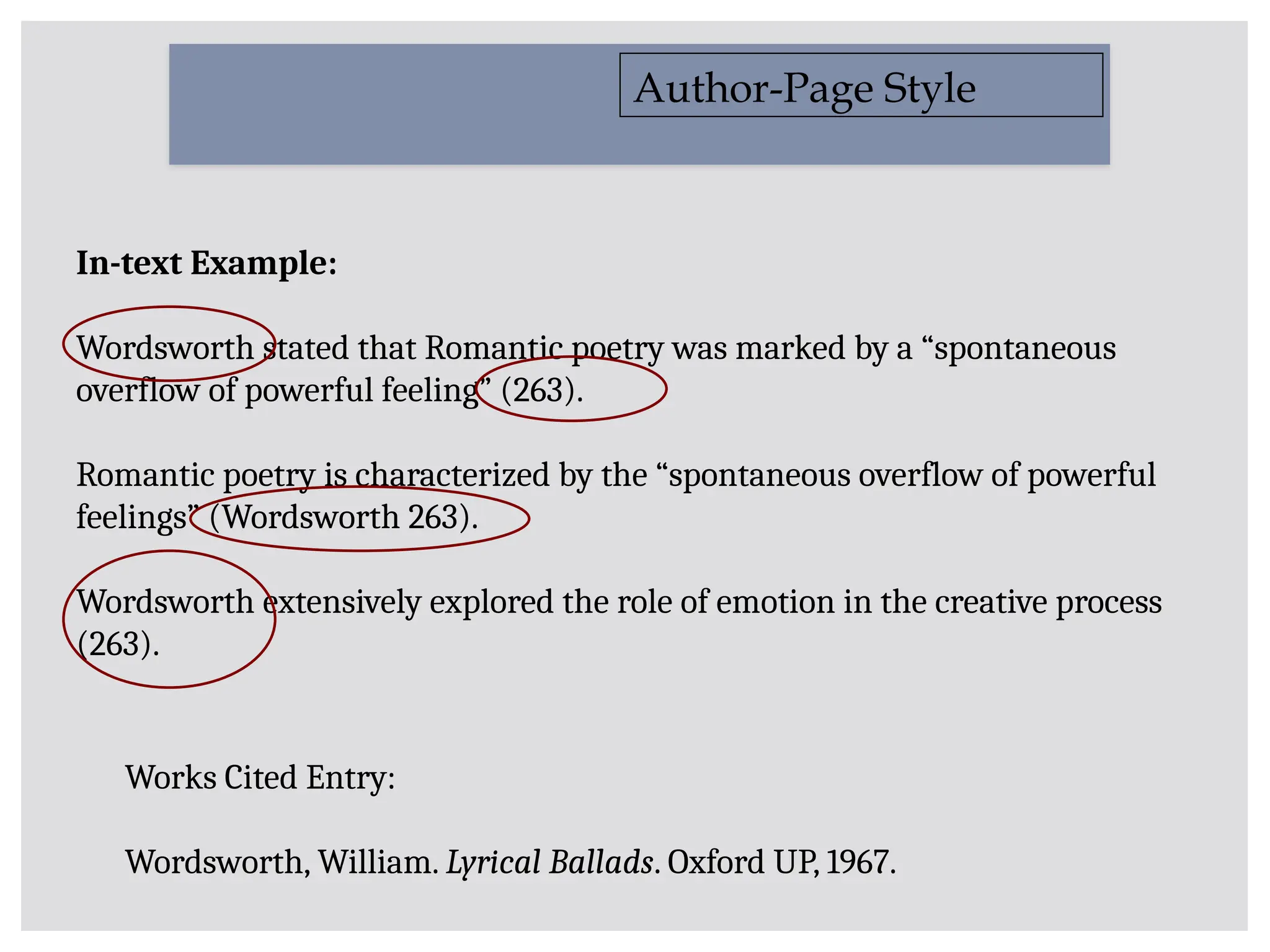
Works Cited Entry:
Wordsworth, William. Lyrical Ballads. Oxford UP, 1967.
Author-Page Style
In-text Example:
Wordsworth stated that Romantic poetry was marked by a “spontaneous
overflow of powerful feeling” (263).
Romantic poetry is characterized by the “spontaneous overflow of powerful
feelings” (Wordsworth 263).
Wordsworth extensively explored the role of emotion in the creative process
(263).
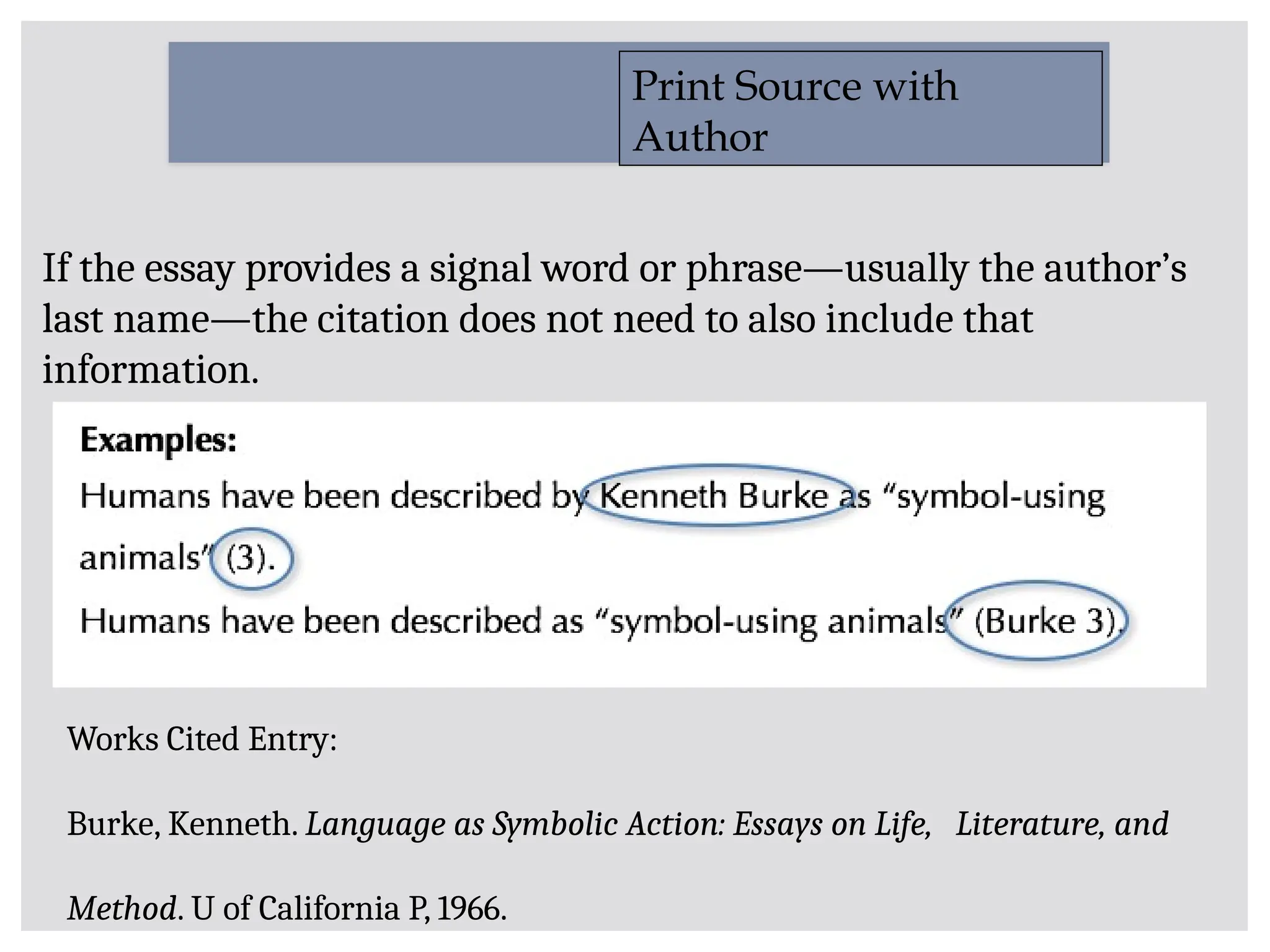
If the essay provides a signal word or phrase—usually the author’s
last name—the citation does not need to also include that
information.
Print Source with
Author
Works Cited Entry:
Burke, Kenneth. Language as Symbolic Action: Essays on Life, Literature, and
Method. U of California P, 1966.
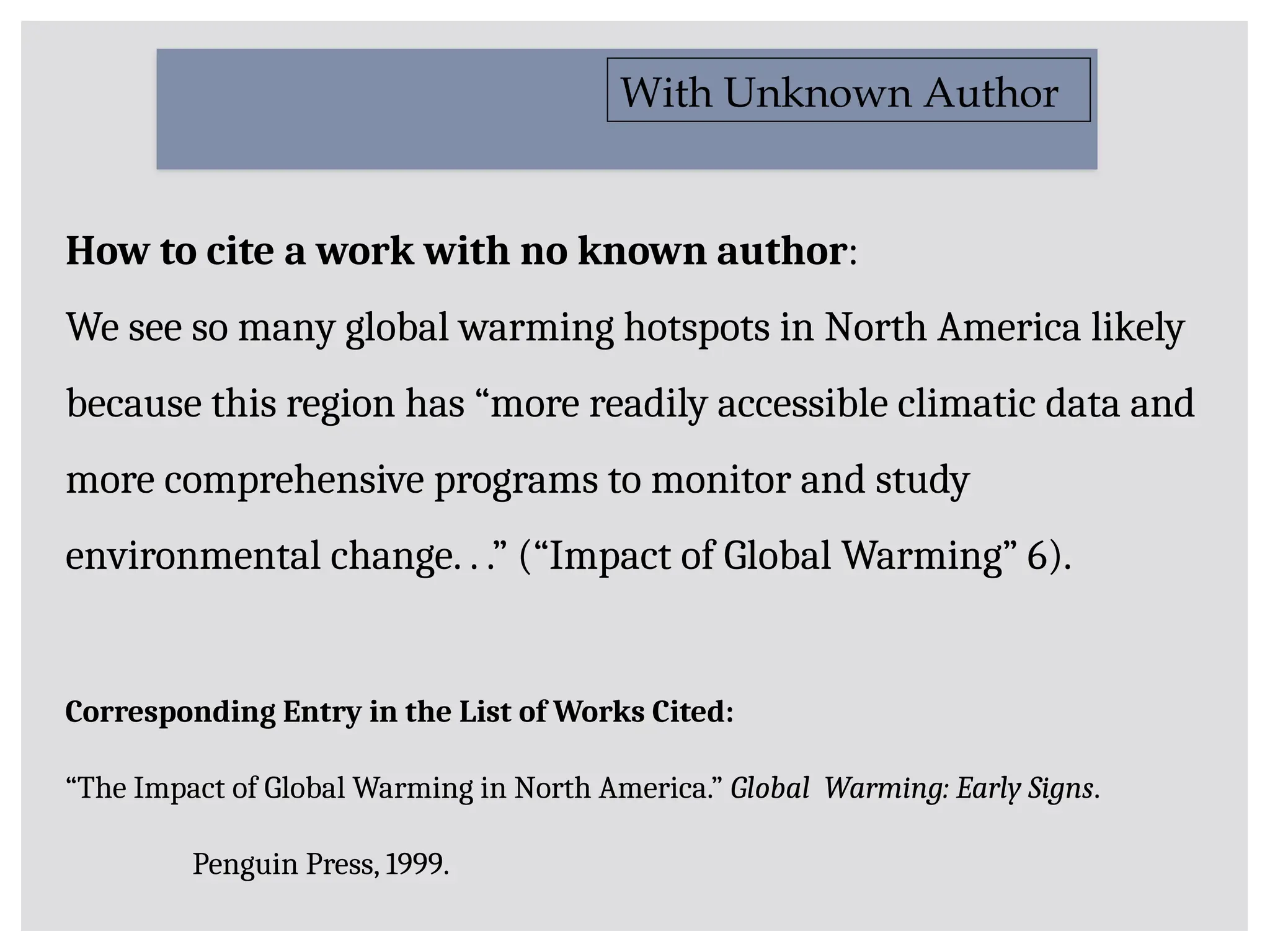
How to cite a work with no known author:
We see so many global warming hotspots in North America likely
because this region has “more readily accessible climatic data and
more comprehensive programs to monitor and study
environmental change. . .” (“Impact of Global Warming” 6).
With Unknown Author
Corresponding Entry in the List of Works Cited:
“The Impact of Global Warming in North America.” Global Warming: Early Signs.
Penguin Press, 1999.
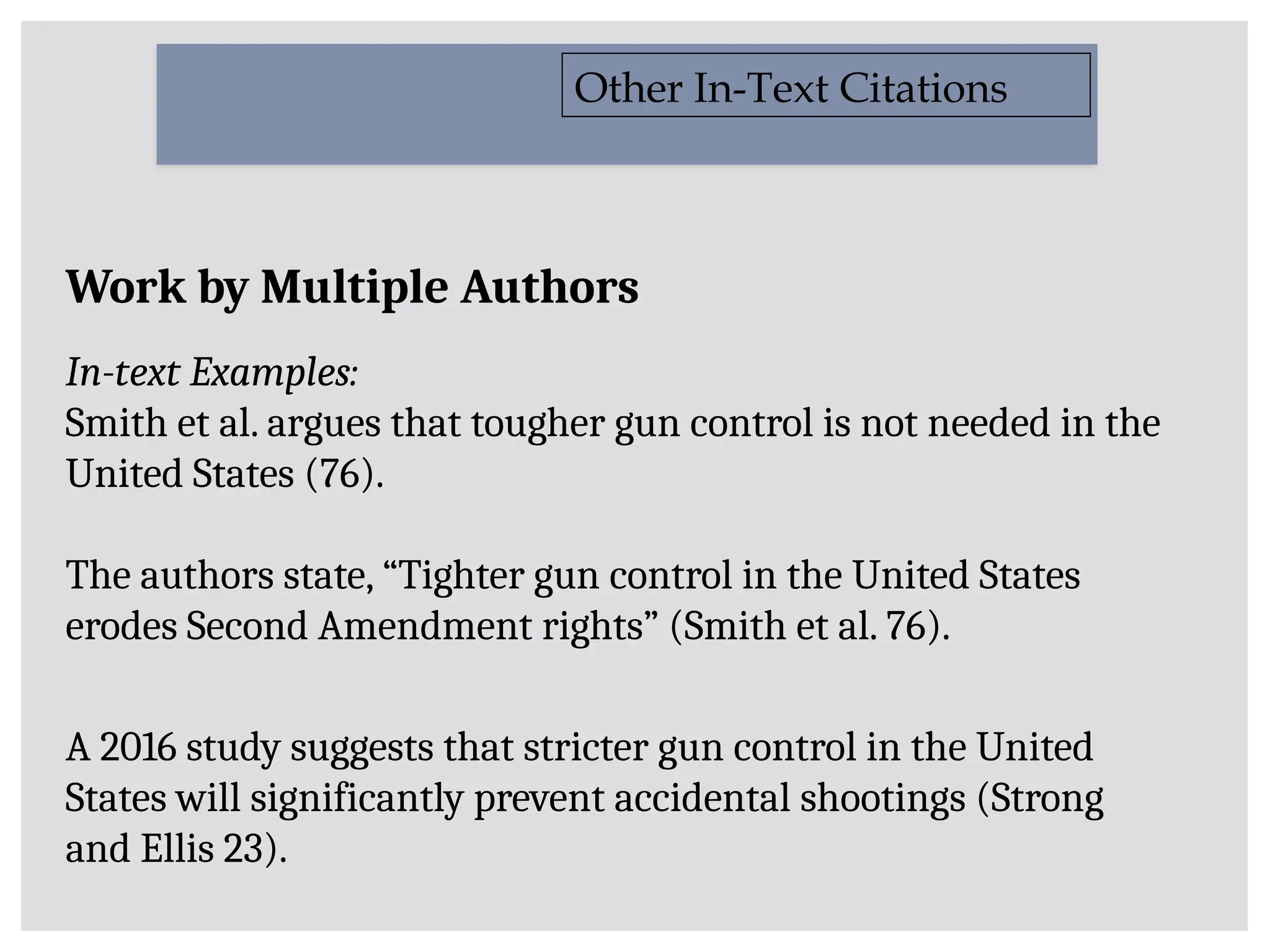
Work by Multiple Authors
In-text Examples:
Smith et al. argues that tougher gun control is not needed in the
United States (76).
The authors state, “Tighter gun control in the United States
erodes Second Amendment rights” (Smith et al. 76).
A 2016 study suggests that stricter gun control in the United
States will significantly prevent accidental shootings (Strong
and Ellis 23).
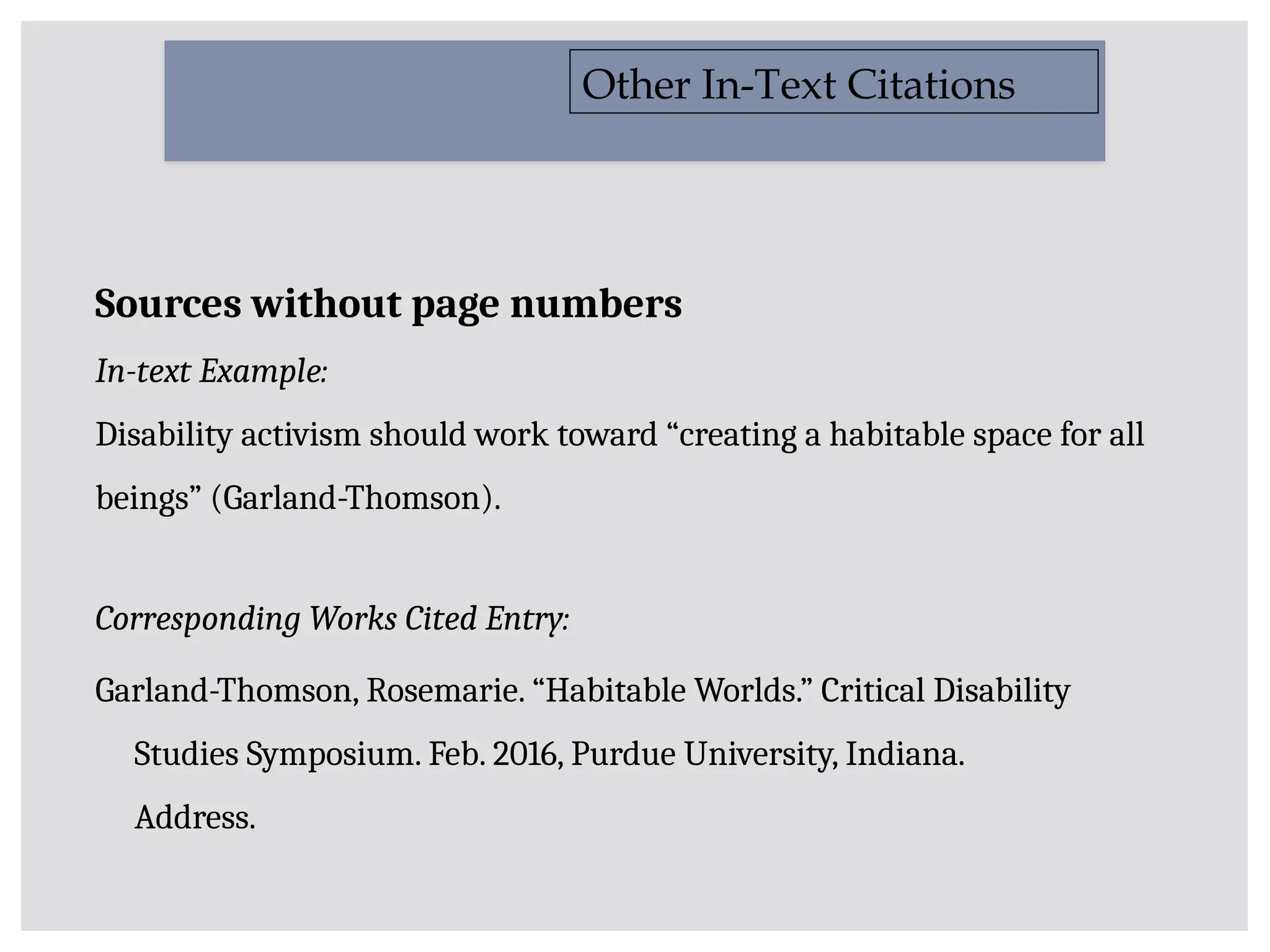
Other In-Text Citations
Sources without page numbers
In-text Example:
Disability activism should work toward “creating a habitable space for all
beings” (Garland-Thomson).
Corresponding Works Cited Entry:
Garland-Thomson, Rosemarie. “Habitable Worlds.” Critical Disability
Studies Symposium. Feb. 2016, Purdue University, Indiana.
Address.
Other In-Text Citations
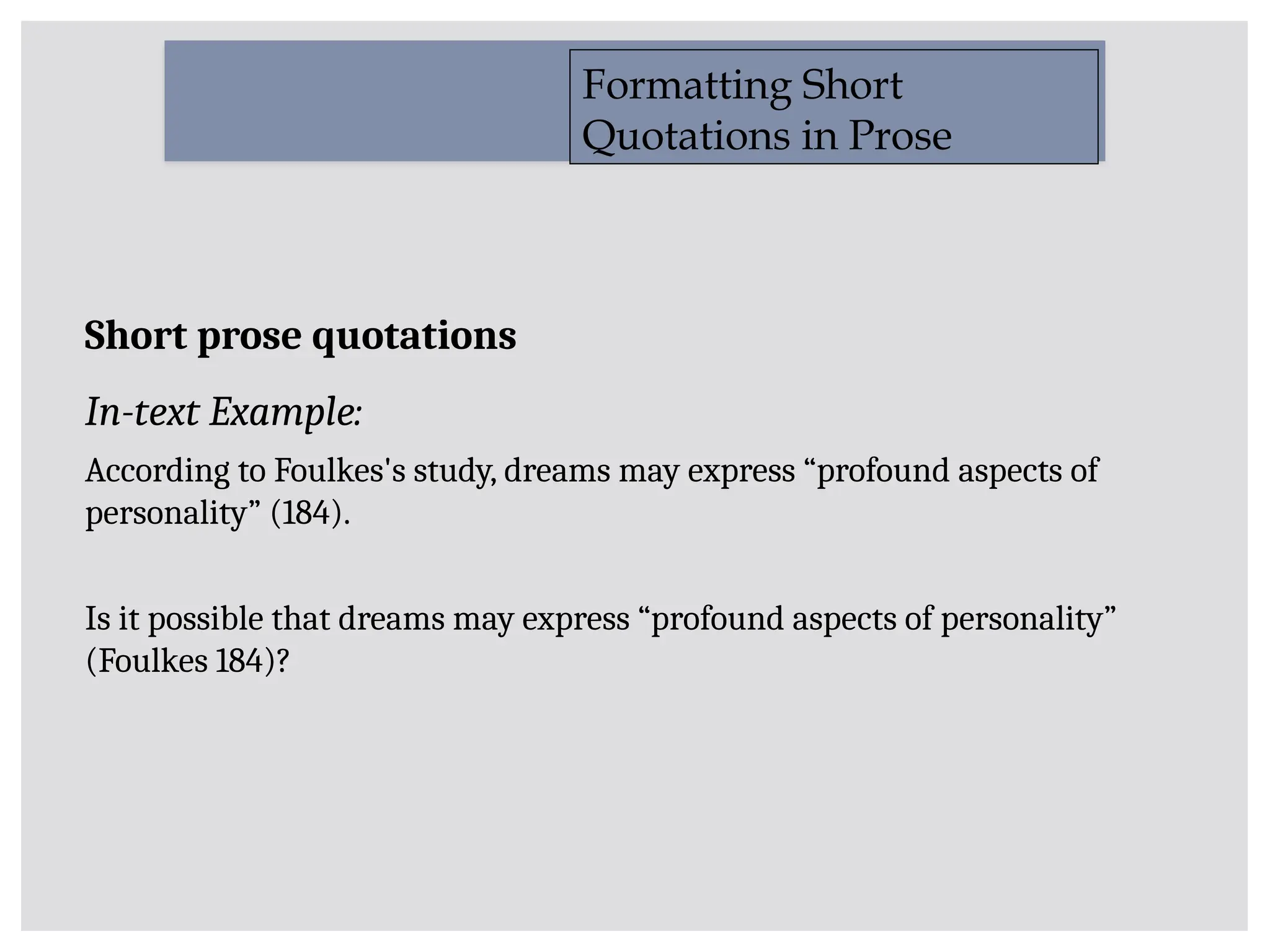
Short prose quotations
In-text Example:
According to Foulkes's study, dreams may express “profound aspects of
personality” (184).
Is it possible that dreams may express “profound aspects of personality”
(Foulkes 184)?
Formatting Short
Quotations in Prose
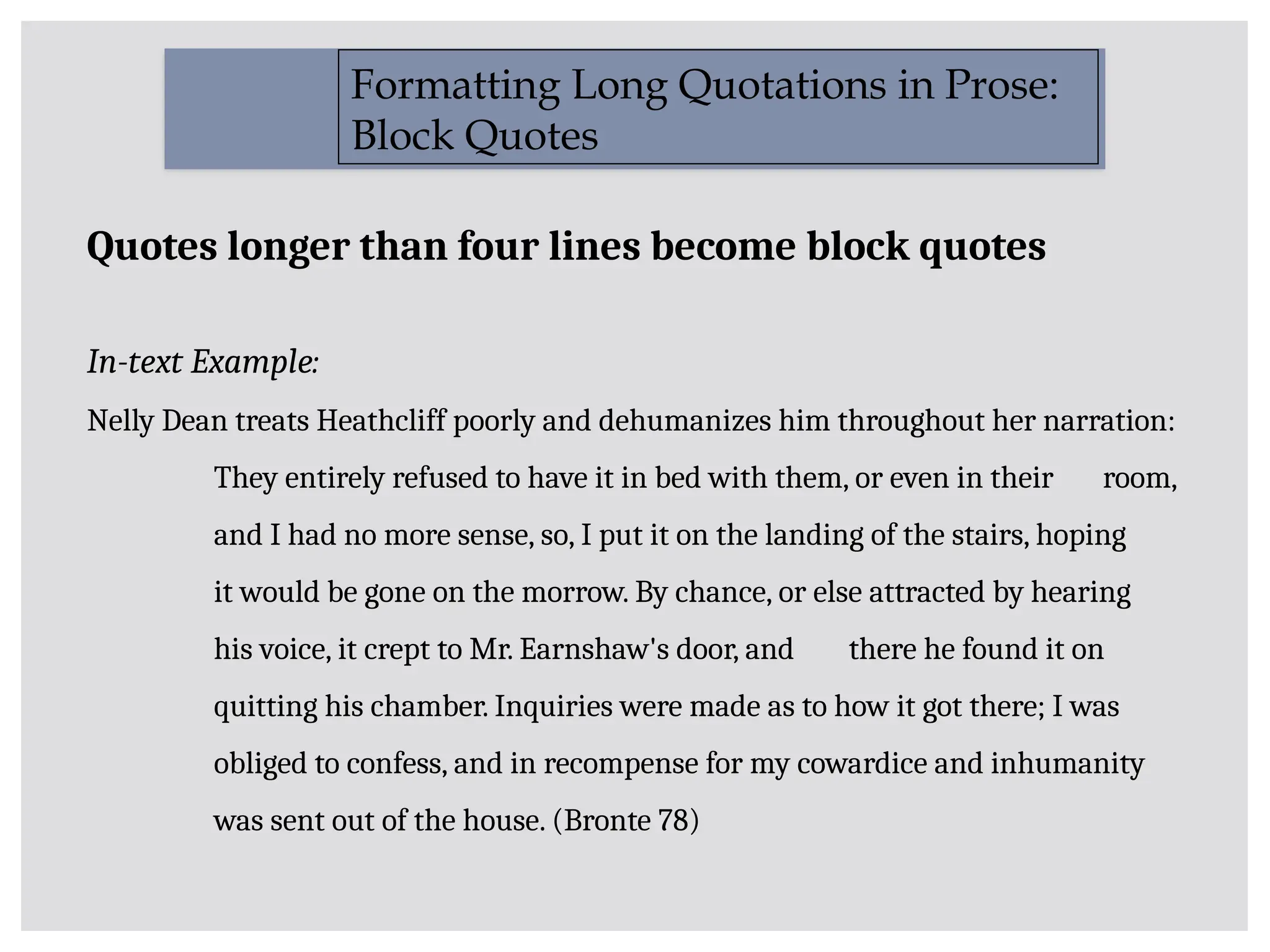
Quotes longer than four lines become block quotes
In-text Example:
Nelly Dean treats Heathcliff poorly and dehumanizes him throughout her narration:
They entirely refused to have it in bed with them, or even in their room,
and I had no more sense, so, I put it on the landing of the stairs, hoping
it would be gone on the morrow. By chance, or else attracted by hearing
his voice, it crept to Mr. Earnshaw's door, and there he found it on
quitting his chamber. Inquiries were made as to how it got there; I was
obliged to confess, and in recompense for my cowardice and inhumanity
was sent out of the house. (Bronte 78)
Formatting Long Quotations in Prose:
Block Quotes
Adding/Omitting Words
In-Text Example for Adding Words:
Jan Harold Brunvand, in an essay on urban legends, states,
“Some individuals [who retell urban legends] make a point
of learning every rumor or tale” (78).
In-Text Example for Omitting Words:
In an essay on urban legends, Jan Harlod Brunvand notes
that “some individuals make a point of learning every recent
rumor or tale. . . and in short time a lively exchange of
details occurs” (78).
 The best open (free) source with information about
MLA in-text citations is the Online Writing Lab from
Purdue University, more commonly known as OWL.
 Their website can be accessed through the url:
https://owl.purdue.edu/owl/purdue_owl.html
WHERE DO I GO TO REVIEW OR LEARN MORE?
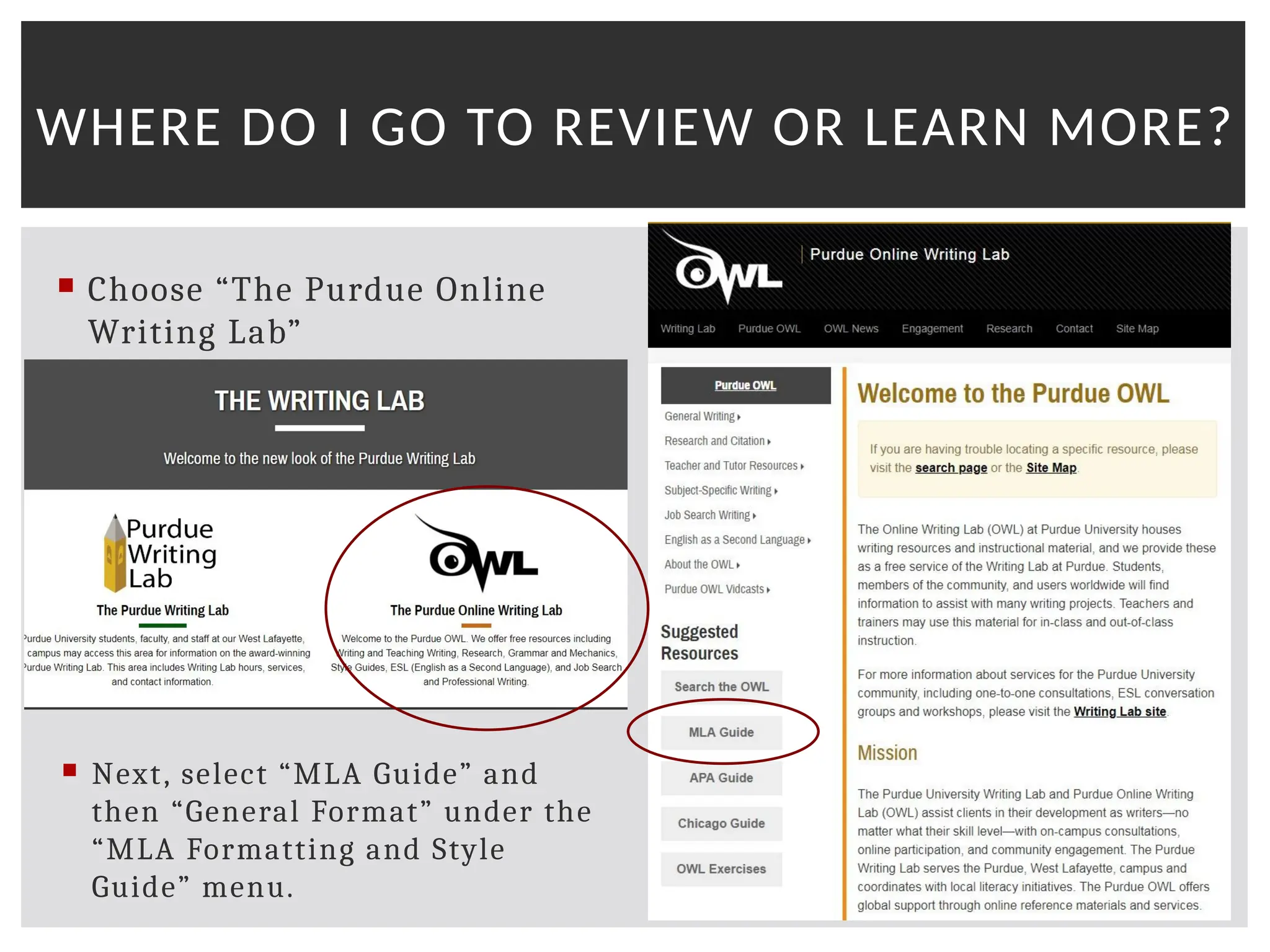
 Choose “The Purdue Online
Writing Lab”
 Next, select “MLA Guide” and
then “General Format” under the
“MLA Formatting and Style
Guide” menu.
WHERE DO I GO TO REVIEW OR LEARN MORE?
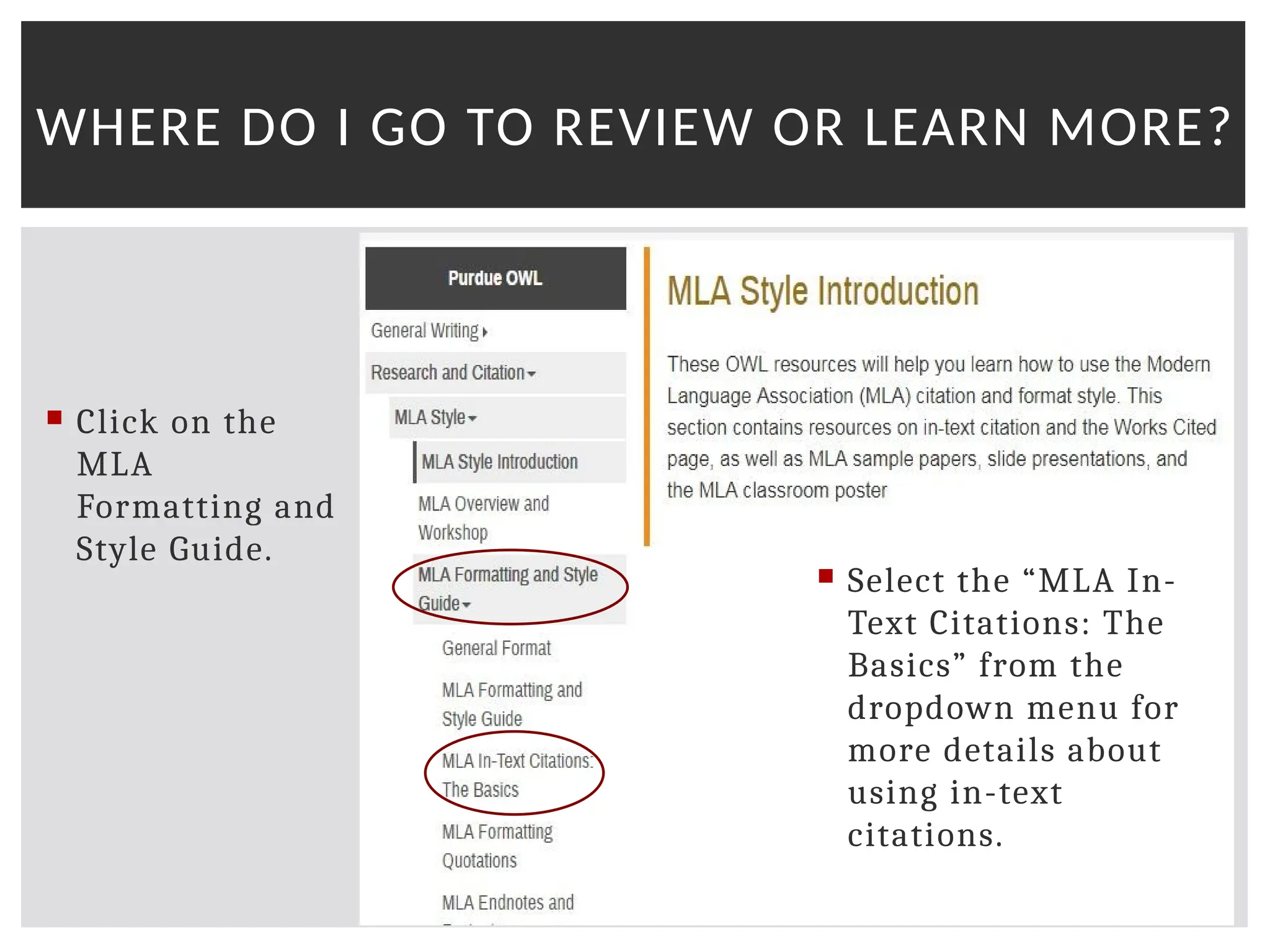
 Click on the
MLA
Formatting and
Style Guide.
 Select the “MLA In-
Text Citations: The
Basics” from the
dropdown menu for
more details about
using in-text
citations.
WHERE DO I GO TO REVIEW OR LEARN MORE?
 Understand the basic elements required to incorporate in-text
citations in an MLA documented research assignment
 Understand the relationship to and the importance of in-text
citations to a Works Cited page in a research assignment
 Know what information you should and should not cite
 Know the different ways that you can create in-text citations
 Know what plagiarism is and how to avoid it
 Can search for information regarding MLA in-text citations by
using the OWL at Purdue
 Can use Microsoft Word to create your own properly
formatted MLA paragraph, essay, and research paper.
NOW YOU…
“What is Common Knowledge?” Academic Integrity at MIT: A
Handbook for Students,
integrity.mit.edu/handbook/citing- your-sources/what-
common-knowledge. Accessed 17 Aug. 2018.
The Purdue OWL Family of Sites. The Writing Lab and OWL at
Purdue and Purdue U, 2008, owl.english.purdue.edu/owl.
Accessed 17 Aug. 2018.
WORKS CITED

MLA Workshop 061X- In-Text Citations.pptx

  • 1.
    Adapted from the Purdue OnlineWriting Lab for Santa Ana College MLA 8th Edition Formatting and Style Guide: In-Text Citations: The Basics
  • 2.
     Understand thebasic elements required to incorporate in-text citations in an MLA documented research assignment  Understand the relationship to and the importance of in-text citations to a Works Cited page in a research assignment  Know what information I should and should not cite  Know the different ways that I can create in-text citations  Know what plagiarism is and how to avoid it  Search for information regarding MLA in-text citations by using the OWL at Purdue  Use Microsoft Word to create my own properly formatted MLA paragraph, essay, and research paper AFTER THIS WORKSHOP I WILL…
  • 3.
    An in-text citationis a brief reference in your text that indicates the source you consulted. •It should direct readers to the entry in your works-cited list for that source. •It should provide the citation information without interrupting your own text. •In general, the in-text citation will be the author’s last name (or abbreviated title) with a page number enclosed in parentheses. In-Text Citations: the Basics
  • 4.
    Did you: • Lookat or speak to a source? (Google, website, professor, book, magazine, YouTube, etc.) – If you said “yes” to this question, you should include an in-text citation. Ask yourself: • Is this information something most people would know? – If you answer “no” to this question, you should include an in-text citation. What Should I Cite? When in doubt, CITE!
  • 5.
    Broadly speaking, commonknowledge refers to information that the average, educated reader would accept as reliable without having to look it up. This includes: •Information that most people know, such as Earth is the third planet from the sun or that Barack Obama was the first American of mixed race to be elected president. •Information shared by a cultural or national group, such as the names of famous heroes or events in the nation’s history that are remembered and celebrated. •However, what may be common knowledge in one culture, nation, academic discipline, or peer group may not be common knowledge in another. What is Common Knowledge? When in doubt, CITE! “What is Common Knowledge?” Academic Integrity at MIT: A Handbook for Students, integrity.mit.edu/handbook/citing- your-sources/what-common-knowledge. Accessed 17 Aug. 2018.
  • 6.
    • Summaries, paraphrases,and direct quotations require citations within the text of your papers. • Without including citations in these circumstances, students risk plagiarism. • Plagiarism is presenting the ideas or exact words from a source as your own without proper citation. • To avoid plagiarism, be sure to use the citation style required by your professor. Where Should I Cite?
  • 7.
    • Information whichis borrowed or quoted directly from a source will require a signal phrase, a parenthetical, or both if the source uses page numbers. • A signal phrase is used to set up or lead into quoted or borrowed information. Some examples include: – The author notes “...” – “…” writes the director, Howard Hughes. – Witnesses claimed “…” – Evidence in a study by Purdue University concludes “…” How Should I Cite? Signal Phrases and Parentheticals
  • 8.
    • A parentheticalends a sentence that contains borrowed information or direct quotes. • The type of source and information available indicate what will be included in a parenthetical but will always correspond exactly with the first element listed on the Works Cited page. • Parentheticals include: – Source’s author’s last name, if available • (Twain) – Source’s page number, if available • (Twain 22) – Source’s title if there is no known author • (“Painting Fences: A Tall Tale”) How Should I Cite? Signal Phrases and Parentheticals
  • 9.
    Works Cited Entry: Wordsworth,William. Lyrical Ballads. Oxford UP, 1967. Author-Page Style In-text Example: Wordsworth stated that Romantic poetry was marked by a “spontaneous overflow of powerful feeling” (263). Romantic poetry is characterized by the “spontaneous overflow of powerful feelings” (Wordsworth 263). Wordsworth extensively explored the role of emotion in the creative process (263).
  • 10.
    If the essayprovides a signal word or phrase—usually the author’s last name—the citation does not need to also include that information. Print Source with Author Works Cited Entry: Burke, Kenneth. Language as Symbolic Action: Essays on Life, Literature, and Method. U of California P, 1966.
  • 11.
    How to citea work with no known author: We see so many global warming hotspots in North America likely because this region has “more readily accessible climatic data and more comprehensive programs to monitor and study environmental change. . .” (“Impact of Global Warming” 6). With Unknown Author Corresponding Entry in the List of Works Cited: “The Impact of Global Warming in North America.” Global Warming: Early Signs. Penguin Press, 1999.
  • 12.
    Work by MultipleAuthors In-text Examples: Smith et al. argues that tougher gun control is not needed in the United States (76). The authors state, “Tighter gun control in the United States erodes Second Amendment rights” (Smith et al. 76). A 2016 study suggests that stricter gun control in the United States will significantly prevent accidental shootings (Strong and Ellis 23). Other In-Text Citations
  • 13.
    Sources without pagenumbers In-text Example: Disability activism should work toward “creating a habitable space for all beings” (Garland-Thomson). Corresponding Works Cited Entry: Garland-Thomson, Rosemarie. “Habitable Worlds.” Critical Disability Studies Symposium. Feb. 2016, Purdue University, Indiana. Address. Other In-Text Citations
  • 14.
    Short prose quotations In-textExample: According to Foulkes's study, dreams may express “profound aspects of personality” (184). Is it possible that dreams may express “profound aspects of personality” (Foulkes 184)? Formatting Short Quotations in Prose
  • 15.
    Quotes longer thanfour lines become block quotes In-text Example: Nelly Dean treats Heathcliff poorly and dehumanizes him throughout her narration: They entirely refused to have it in bed with them, or even in their room, and I had no more sense, so, I put it on the landing of the stairs, hoping it would be gone on the morrow. By chance, or else attracted by hearing his voice, it crept to Mr. Earnshaw's door, and there he found it on quitting his chamber. Inquiries were made as to how it got there; I was obliged to confess, and in recompense for my cowardice and inhumanity was sent out of the house. (Bronte 78) Formatting Long Quotations in Prose: Block Quotes
  • 16.
    Adding/Omitting Words In-Text Examplefor Adding Words: Jan Harold Brunvand, in an essay on urban legends, states, “Some individuals [who retell urban legends] make a point of learning every rumor or tale” (78). In-Text Example for Omitting Words: In an essay on urban legends, Jan Harlod Brunvand notes that “some individuals make a point of learning every recent rumor or tale. . . and in short time a lively exchange of details occurs” (78).
  • 17.
     The bestopen (free) source with information about MLA in-text citations is the Online Writing Lab from Purdue University, more commonly known as OWL.  Their website can be accessed through the url: https://owl.purdue.edu/owl/purdue_owl.html WHERE DO I GO TO REVIEW OR LEARN MORE?
  • 18.
     Choose “ThePurdue Online Writing Lab”  Next, select “MLA Guide” and then “General Format” under the “MLA Formatting and Style Guide” menu. WHERE DO I GO TO REVIEW OR LEARN MORE?
  • 19.
     Click onthe MLA Formatting and Style Guide.  Select the “MLA In- Text Citations: The Basics” from the dropdown menu for more details about using in-text citations. WHERE DO I GO TO REVIEW OR LEARN MORE?
  • 20.
     Understand thebasic elements required to incorporate in-text citations in an MLA documented research assignment  Understand the relationship to and the importance of in-text citations to a Works Cited page in a research assignment  Know what information you should and should not cite  Know the different ways that you can create in-text citations  Know what plagiarism is and how to avoid it  Can search for information regarding MLA in-text citations by using the OWL at Purdue  Can use Microsoft Word to create your own properly formatted MLA paragraph, essay, and research paper. NOW YOU…
  • 21.
    “What is CommonKnowledge?” Academic Integrity at MIT: A Handbook for Students, integrity.mit.edu/handbook/citing- your-sources/what- common-knowledge. Accessed 17 Aug. 2018. The Purdue OWL Family of Sites. The Writing Lab and OWL at Purdue and Purdue U, 2008, owl.english.purdue.edu/owl. Accessed 17 Aug. 2018. WORKS CITED

Editor's Notes

  • #3 Basic In-Text Citation Rules The source information in a parenthetical citation should direct readers to the source’s entry in the works-cited list. The in-text citation should be placed, if possible, where there is a natural pause in your text. If the citation refers to a direct quotation, it should be placed directly following the closing quotation mark. Any source information that you provide in-text must correspond to the source information on the works-cited page. More specifically, whatever signal word or phrase you provide to your readers in the text, must be the first thing that appears on the left-hand margin of the corresponding entry in the works-cited list (so the author’s last name or the title, usually, with no punctuation in between)
  • #5 Instructors are encouraged to take questions from students here in regards to what is or what is not common knowledge. You might begin this discussion with questions like, “What are some things that would be considered common knowledge in an English 101 class?” or “What are some things that would be considered common knowledge in an Biology 101 class?”
  • #6 Instructors should clarify what paraphrasing is; if students have changed the words in a quote they must cite the source from which they are paraphrasing.
  • #9 In-Text Citations: Author-Page Style MLA format follows the author-page method of in-text citation. This means that the author's last name and the page number(s) from which the quotation or paraphrase is taken must appear in the text, and a complete reference should appear in your works-cited page. The author's name may appear either in the sentence itself or in parentheses following the quotation or paraphrase, but the page number(s) should always appear in the parentheses, not in the text of your sentence. The both citations in the in-text examples on this slide, (263) and (Wordsworth 263), tell readers that the information in the sentence can be located on page 263 of a work by the author, William Wordsworth. If readers want more information about this source, they can turn to the works-cited list, where, under Wordsworth, they would find the information in the corresponding entry also shown on this slide.
  • #10 In-text Citations for Print Sources with Known Author For print sources like books, magazines, scholarly journal articles, and newspapers, provide a signal word or phrase (usually the author’s last name) and a page number. If you provide the signal word/phrase in the sentence, you do not need to include it in the parenthetical citation. These examples must correspond to an entry that begins with Burke, which will be the first thing that appears on the left-hand margin of an entry in the works-cited list (as noted in the corresponding entry on this slide). See comments from previous slide.
  • #11 In-text Citations for Print Sources with No Known Author When a source has no known author, use a shortened title of the work instead of an author name. Place the title in quotation marks if it's a short work (e.g. articles) or italicize it if it's a longer work (e.g. plays, books, television shows, entire websites) and provide a page number. In this example, since the reader does not know the author of the article, an abbreviated title of the article appears in the parenthetical citation which corresponds to the full name of the article which appears first at the left-hand margin of its respective entry in the works-cited list. Thus, the writer includes the title in quotation marks as the signal phrase in the parenthetical citation in order to lead the reader directly to the source on the works-cited page. See comments from previous slide.
  • #12 Citing a Work by Multiple Authors If the entry in the works-cited list begins with the names of two authors, include both last names in the in-text citation, connected by and. If the source has three or more authors, the entry in the works-cited list should begin with the first author’s name followed by et al. The in-text citation should follow suit.
  • #13 When a source has no page numbers or any other kind of part number, no number should be given in a parenthetical citation. Do not count unnumbered paragraphs, pauses, or other parts. This is an example of how to cite a direct quotation from an oral address.
  • #14 Short Quotations If a prose quotation runs no more than four lines and requires no special emphasis, put it in quotation marks and incorporate it into the text.. Provide the author and specific page citation in the text, and include a complete entry in the works-cited page. Punctuation marks such as periods, commas, and semicolons should appear after the parenthetical citation. Question marks and exclamation points should appear within the quotation marks if they are a part of the quoted passage but after the parenthetical citation if they are a part of your text.
  • #15 In quotations that are five or more lines of text, start the quotation on a new line, with the entire quote indented half an inch from the left margin; maintain double-spacing. Do not indent the first line an extra amount or add quotation marks not present in the original. Use a colon to introduce the quotation (unless your introductory wording does not require punctuation). Your parenthetical citation should come after the closing punctuation mark.
  • #16 Adding or Omitting Words In Quotations If you add a word or words in a quotation, you should put brackets around the words to indicate that they are not part of the original text. This is illustrated in the first example on this slide. If you omit a word or words from a quotation, you should indicate the deleted word or words by using ellipsis marks, which are three periods ( . . . ) preceded and followed by a space. Please note that brackets are not needed around ellipses unless adding brackets would clarify your use of ellipses. This is illustrated in the second example on this slide.