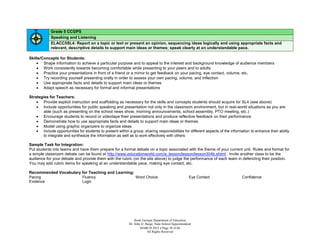
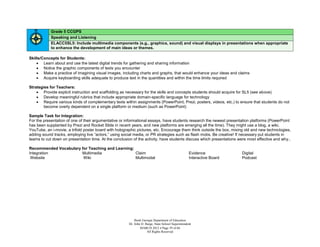
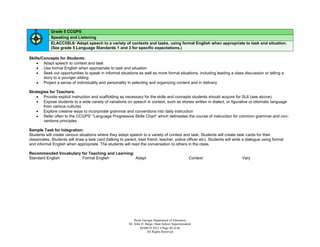
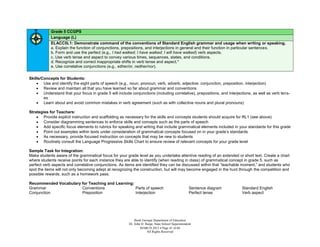
TEACHER GUIDANCE
FOR TEACHING THE COMMON CORE
GEORGIA PERFORMANCE STANDARDS


                                Grade Five


                                    Dr. John D. Barge, State School Superintendent
                                    “Making Education Work for All Georgians”
CCGPS TEACHER GUIDANCE:
                                                 Skills, concepts, strategies, tasks,
                                                    and recommended vocabulary


    Book Georgia Department of Education
Dr. John D. Barge, State School Superintendent
         MARCH 2012  Page 2 of 66
             All Rights Reserved
Grade 5 CCGPS
            Reading Literary (RL)
            ELACC5RL1: Quote accurately from a text when explaining what the text says explicitly and when drawing inferences from
            the text.

Skills/Concepts for Students:
     Read attentively for understanding
     Support all claims and inferences about a text with specific evidence
     Begin the practice of annotating texts as you read (annotating means keeping notes of important information)
     Paraphrase and summarize as necessary to aid comprehension
     Use quotations from the text in your essays and punctuate them properly

Strategies for Teachers:
     Provide explicit instruction and scaffolding as necessary for the skills and concepts students should acquire for RL1 (see above)
     Provide adequate opportunities for students to engage with challenging texts from multiple genres
     Model effective note-taking and annotation
     Require evidence for all claims, inferences, and theses about text
     Provide opportunities to practice quotation punctuation and expect direct quotation in essays

Sample Task for Integration:
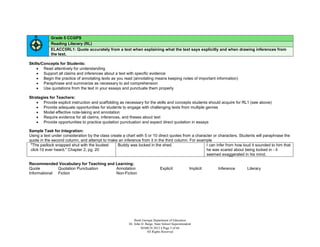
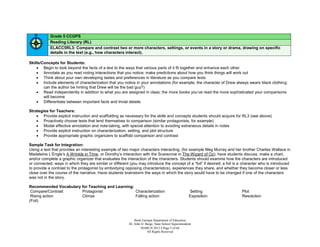
Using a text under consideration by the class create a chart with 5 or 10 direct quotes from a character or characters. Students will paraphrase the
quote in the second column, and attempt to make an inference from it in the third column. For example
 "The padlock snapped shut with the loudest       Buddy was locked in the shed.                      I can infer from how loud it sounded to him that
 click I'd ever heard." Chapter 2, pg. 20                                                            he was scared about being locked in - it
                                                                                                     seemed exaggerated in his mind.

Recommended Vocabulary for Teaching and Learning:
Quote         Quotation Punctuation     Annotation                             Explicit             Implicit   Inference    Literary
Informational Fiction                   Non-Fiction


                                                            Book Georgia Department of Education
                                                        Dr. John D. Barge, State School Superintendent
                                                                 MARCH 2012  Page 3 of 66
                                                                     All Rights Reserved
Grade 5 CCGPS
             Reading Literary (RL)
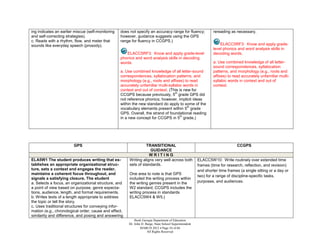
             ELACC5RL2: Determine a theme of a story, drama, or poem from details in the text, including how characters in a story or
             drama respond to challenges or how the speaker in a poem reflects upon a topic; summarize the text.

Skills/Concepts for Students:
     Read attentively for understanding
     Use strategies you have learned to attempt to identify the author’s purpose or theme in all important texts that you read (for example
        consider character at the beginning of a story, then identify the crisis or climax of the story, and consider in what ways the character
        has changed after that crisis)
     Practice this skill across all types of texts, including novels, plays, newspaper articles, poems, etc.
     Apply knowledge of the concept that theme refers to the overall lesson about life or the world that the author wishes to impart
     Practice summarizing what you have read without adding your own opinion to the summary
     Understand the difference between summary and paraphrase

Strategies for Teachers:
     Provide explicit instruction and scaffolding as necessary for the skills and concepts students should acquire for RL2 (see above)
     Provide explicit instruction on the concept of theme, main idea, and author’s purpose
     Model strategies for determining theme across various genres
     Include poetry and use strategies such as TPCASTT or SIFT (see internet if unfamiliar) to help explicate poetry and determine theme
     Provide students with opportunities to summarize and paraphrase, noting the difference in these two skills; scaffold students in removing
        their own subtle biases from summaries (for example, “Sally made a good decision in Chapter 3 to stay home from the party,” should be
        “Sally made the decision in Chapter 3 to stay home from the party).

Sample Task for Integration:
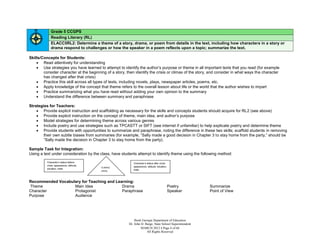
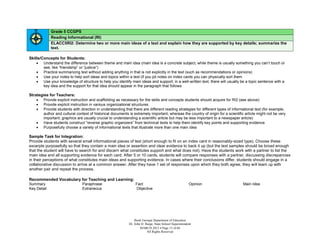
Using a text under consideration by the class, have students attempt to identify theme using the following method:

          Character’s status before                         Character’s status after crisis:
          crisis: appearance, attitude,                     appearance, attitude, situation,
                                          CLIMAX/
          situation, traits                                 traits
                                          CRISIS


Recommended Vocabulary for Teaching and Learning:
Theme              Main Idea               Drama                                               Poetry     Summarize
Character          Protagonist             Paraphrase                                          Speaker    Point of View
Purpose            Audience


                                                             Book Georgia Department of Education
                                                         Dr. John D. Barge, State School Superintendent
                                                                  MARCH 2012  Page 4 of 66
                                                                      All Rights Reserved
Grade 5 CCGPS
            Reading Literary (RL)
            ELACC5RL3: Compare and contrast two or more characters, settings, or events in a story or drama, drawing on specific
            details in the text (e.g., how characters interact).

Skills/Concepts for Students:
     Begin to look beyond the facts of a text to the ways that various parts of it fit together and enhance each other
     Annotate as you read noting interactions that you notice; make predictions about how you think things will work out
     Think about your own developing tastes and preferences in literature as you compare texts
     Include elements of characterization that you notice in your annotations (for example, the character of Drew always wears black clothing;
        can the author be hinting that Drew will be the bad guy?)
     Read independently in addition to what you are assigned in class; the more books you’ve read the more sophisticated your comparisons
        will become
     Differentiate between important facts and trivial details

Strategies for Teachers:
     Provide explicit instruction and scaffolding as necessary for the skills and concepts students should acquire for RL3 (see above)
     Proactively choose texts that lend themselves to comparison (similar protagonists, for example)
     Model effective annotation and note-taking, with special attention to avoiding extraneous details in notes
     Provide explicit instruction on characterization, setting, and plot structure
     Provide appropriate graphic organizers to scaffold comparison and contrast

Sample Task for Integration:
Using a text that provides an interesting example of two major characters interacting, (for example Meg Murray and her brother Charles Wallace in
Madeleine L’Engle’s A Wrinkle in Time, or Dorothy’s interaction with the Scarecrow in The Wizard of Oz), have students discuss, make a chart,
and/or complete a graphic organizer that evaluates the interaction of the characters. Students should examine how the characters are introduced
or connected, ways in which they are similar or different (you may introduce the concept of a “foil” if desired; a foil is a character who is introduced
to provide a contrast to the protagonist by embodying opposing characteristics), experiences they share, and whether they become closer or less
close over the course of the narrative. Have students brainstorm the ways in which the story would have to be changed if one of the characters
was not in the story.

Recommended Vocabulary for Teaching and Learning:
 Compare/Contrast      Protagonist                Characterization                                    Setting              Plot
 Rising action         Climax                     Falling action                                      Exposition           Resolution
(Foil)


                                                              Book Georgia Department of Education
                                                          Dr. John D. Barge, State School Superintendent
                                                                   MARCH 2012  Page 5 of 66
                                                                       All Rights Reserved
Grade 5 CCGPS
             Reading Literary (RL)
             ELACC5RL4: Determine the meaning of words and phrases as they are used in a text, including figurative language such as
             metaphors and similes.

Skills/Concepts for Students:
        Distinguish between literal and figurative speech
        Understand the difference between the denotations and connotations of words
        Use context clues, reference materials, knowledge of roots and prefixes, etc., to determine meaning of unknown words
        Think about the ways in which a text would be different if it used literal language instead of figurative
        Examine the word choices of an author and the types of figurative language and imagery he or she employs to try to determine the effect they are trying
         to create in their readers
        Always consider an author’s use of figurative language and imagery when writing essays evaluating literary texts

Strategies for Teachers:
       Provide explicit instruction and scaffolding as necessary for the skills and concepts students should acquire for RL4 (see above)
       Using texts under consideration by the class, identify examples of interesting vocabulary, figurative language, imagery, and sound devices
       Routinely discuss the denotations and connotations of words and explore why authors make certain choices
       Focus on the “why and how” instead of the “what” in language instruction; instead of focusing on simply identifying figurative language, explore with stu-
        dents why the author would make one choice of language over another and how that choice affects the reader’s experience
       Include poetry among the shorter texts in your literary text choices routinely

Sample Task for Integration:
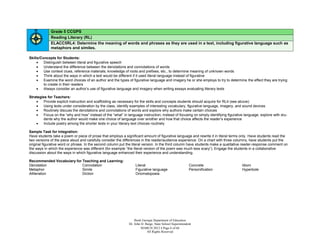
Have students take a poem or piece of prose that employs a significant amount of figurative language and rewrite it in literal terms only. Have students read the
two versions of the piece aloud and carefully consider the differences in the reader/audience experience. On a chart with three columns, have students put the
original figurative word or phrase. In the second column put the literal version. In the third column have students make a qualitative reader-response comment on
the ways in which the experience was different (for example “the literal version of the poem was much less scary”). Engage the students in a collaborative
discussion about the ways in which figurative language enhanced their experience and understanding.

Recommended Vocabulary for Teaching and Learning:
Denotation                 Connotation                            Literal                                 Concrete                   Idiom
Metaphor                   Simile                                 Figurative language                     Personification            Hyperbole
Alliteration               Diction                                Onomatopoeia


                                                                  Book Georgia Department of Education
                                                              Dr. John D. Barge, State School Superintendent
                                                                       MARCH 2012  Page 6 of 66
                                                                           All Rights Reserved
Grade 5 CCGPS
            Reading Literary (RL)
            ELACC5RL5: Explain how a series of chapters, scenes, or stanzas fits together to provide the overall structure of a particular
            story, drama, or poem.

Skills/Concepts for Students:
     Read a wide variety of texts so that you will be exposed to all sorts of text structures (scientific texts with abstract, methods procedures;
        plays with acts, scenes, and lines; novels with chapters; instructions with headings; etc.)
     Make a point to notice structural elements when you read and include structure in your notes
     Employ helpful structures in your own writing (for instance use an outline format or headings when helpful)
     Learn the terms associated with structure such as “scene” and “stanza”

Strategies for Teachers:
     Provide explicit instruction and scaffolding as necessary for the skills and concepts students should acquire for RL5 (see above)
     Engage students in understanding the component parts of a text by cutting
     Provide opportunities for students to read, write, and perform various dramas
     Provide opportunities for students to view dramatic literature performed either by a field trip or using a prerecorded option
     Read aloud different stories, dramas, and poems then discuss with students how chapters, scenes, or stanzas contribute to the flow of the
        literature selection

Sample Task for Integration:
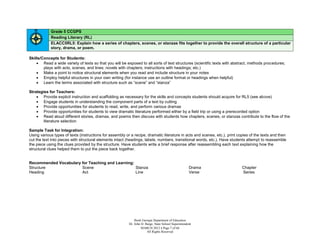
Using various types of texts (instructions for assembly or a recipe, dramatic literature in acts and scenes, etc.), print copies of the texts and then
cut the text into pieces with structural elements intact (headings, labels, numbers, transitional words, etc.). Have students attempt to reassemble
the piece using the clues provided by the structure. Have students write a brief response after reassembling each text explaining how the
structural clues helped them to put the piece back together.


Recommended Vocabulary for Teaching and Learning:
Structure              Scene                      Stanza                                              Drama                 Chapter
Heading                Act                        Line                                                Verse                 Series


                                                              Book Georgia Department of Education
                                                          Dr. John D. Barge, State School Superintendent
                                                                   MARCH 2012  Page 7 of 66
                                                                       All Rights Reserved
Grade 5 CCGPS
            Reading Literary (RL)
            ELACC5RL6: Describe how a narrator’s or speaker’s point of view influences how events are described.

Skills/Concepts for Students:
     Learn or review the differences in narrative voice (first person, third person, narrator)
     Understand the difference between narrative Point of View (as above) and point of view as in one’s biases or take on a situation (this
        standard can encompass both kinds of point of view)
     Compare texts told from differing points of view, noticing how it changes your experience of a text (for example, a book narrated in first
        person usually seems much more personal and immediate than one told by a narrator)
     Include narrative voice and point of view in the list of things you observe in your notes and annotations when reading
     Practice writing in different points of view

Strategies for Teachers:
     Provide explicit instruction and scaffolding as necessary for the skills and concepts students should acquire for RL6 (see above)
     Purposefully choose texts that illustrate a variety of narrative voices and points of view
     Provide explicit instruction in 1 and 3 person and omniscience in narration
                                       st      rd

     Explore illustrative examples of narrative voice (for example a compelling first person narrative as compared with a less-engaging third
        person narrative)
     Explain 2 person voice
                 nd

     Provide explicit instruction on the difference between narrative point of view and “viewpoint” or opinion

Sample Task for Integration:
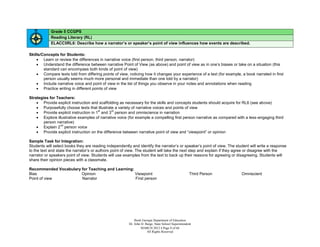
Students will select books they are reading independently and identify the narrator’s or speaker’s point of view. The student will write a response
to the text and state the narrator’s or authors point of view. The student will take the next step and explain if they agree or disagree with the
narrator or speakers point of view. Students will use examples from the text to back up their reasons for agreeing or disagreeing. Students will
share their opinion pieces with a classmate.

Recommended Vocabulary for Teaching and Learning:
Bias                   Opinion                    Viewpoint                                          Third Person        Omniscient
Point of view          Narrator                   First person


                                                             Book Georgia Department of Education
                                                         Dr. John D. Barge, State School Superintendent
                                                                  MARCH 2012  Page 8 of 66
                                                                      All Rights Reserved
Grade 5 CCGPS
            Reading Literary (RL)
            ELACC5RL7: Analyze how visual and multimedia elements contribute to the meaning, tone, or beauty of a text (e.g., graphic
            novel, multimedia presentation of fiction, folktale, myth, poem).

Skills/Concepts for Students:
     Watch movies based on books you have read, or to read the original text from which a movie you enjoyed was derived; note the differ-
        ences in the versions and think about why those changes might have been necessary or desirable
     Think about whether you prefer to get information through words, pictures, or through listening; use the knowledge of your preferences in
        your own academic life (for example in your note-taking - you can draw pictures when it is helpful in remembering something)
     Think about how and when illustrations are helpful; think about what kinds of images you prefer (Drawings? Paintings? Photos?)
     Multimedia components can include animation, sound effects, music, etc.; consider the ways in which all these elements make presenta-
        tions more fun

Strategies for Teachers:
     Provide explicit instruction and scaffolding as necessary for the skills and concepts students should acquire for RL7 (see above)
     Take students to see a film or staged production of a book they have read (or conduct a webquest or visit a website for same)
     Allow students to produce a film or stage production of their own, or to create a webquest or website
     Have students create illustrations in various artistic and digital media to accompany stories they have written or read
     Proactively make text choices that have beautiful illustrations, music, or other media elements connected to them

Sample Task for Integration:
Assign students (in groups of 3 or 4 for ease of presentation) a multimedia project to be compiled in PowerPoint. Step one will be the creation of 5
slides on an assigned topic. These slides should be words only. In the second version, allow students to add one element to each slide (animation,
one picture each, one sound, etc.) Share some of the presentations after each version (it is not necessary to share all of them every time). Allow
students 3 or 4 more passes at the slides to add media and interest. As you watch the increasingly interesting versions of the presentations,
engage the students in collaborative discussion about the quality of their experience as an audience. Examine how the addition of these elements
enhance their interest and understanding.

Recommended Vocabulary for Teaching and Learning:
Visual            Audio                 Graphic                                Multimedia                Digital           Tone


                                                            Book Georgia Department of Education
                                                        Dr. John D. Barge, State School Superintendent
                                                                 MARCH 2012  Page 9 of 66
                                                                     All Rights Reserved
Grade 5 CCGPS
            Reading Literary (RL)
            ELACC5RL8: (Not applicable to literature)

            ELACC5RL9: Compare and contrast stories in the same genre (e.g., mysteries and adventure stories) on their approaches to
            similar themes and topics.

Skills/Concepts for Students:
     Learn about all the different genres and sub-genres of text (mystery, adventure, biography, science fiction, etc.)
     Use the strategies you have learned to identify theme (for example looking at how the main character is changed by the events in the sto-
        ry) so that you can compare themes between different stories
     Read books on your own in addition to the ones assigned in class so you can learn more about your own taste and what you like to read
     Use your knowledge of setting, plot, characterization, and other elements of a story when you compare

Strategies for Teachers:
     Provide explicit instruction and scaffolding as necessary for the skills and concepts students should acquire for RL9 (see above)
     Expose students to works that particularly lend themselves to comparison (for example books with similar protagonists, or similar settings)
     Use the themes already inherent in the CCGPS unit frameworks to facilitate comparisons on theme
     Provide explicit instruction on identification of theme
     Engage students in writing individual accounts of a common event and discuss the differences in those accounts

Sample Task for Integration:
Choose a relevant topic or event about which your students could write a narrative (field day, a school celebration, a field trip). Alternatively, you
could stage an event (for example, have someone come into the room, do 3 jumping jacks, blow a whistle, recite a poem and leave). After the
event, ask students to write a descriptive narrative about what they saw or experienced. Have several students share their accounts aloud, noting
main points on chart paper. Engage students in a discussion about the differences in style (and even the differences in the facts) of each narrative.
How do they think the personality of each writer influenced their perception of events? Did their seat in the class or vantage point influence their
perception? What other factors can we consider in how a writer crafts his approach to a theme or topic?

Recommended Vocabulary for Teaching and Learning:
Genre                  Compare/Contrast           Theme                                              Topic


                                                             Book Georgia Department of Education
                                                         Dr. John D. Barge, State School Superintendent
                                                                 MARCH 2012  Page 10 of 66
                                                                      All Rights Reserved
Grade 5 CCGPS
           Reading Literary (RL)
           ELACC5RL10: By the end of the year, read and comprehend literature, including stories, dramas, and poetry, at the high end
           of the grades 4-5 text complexity band independently and proficiently.

Skills/Concepts for Students:
     Practice attentive reading of both assigned texts and independent text choices
     Read a wide variety of texts
     Take notes!
     Read within appropriate time frame for extended text
     Consider keeping a notebook of texts read with notes
     Self-monitor and self-correct when you read
     Read with a rhythm, flow, and meter that sounds like everyday speech (prosody)

Strategies for Teachers:
     Choose texts of appropriate complexity (see Common Core appendix B)
     Require reading through multiple modes: group, pairs, individual, in class, out of class, via digital mediums, etc.
     Provide scaffolding on difficult texts through commentary and interpretation, group discussion, complementary visual texts, and profession-
        al annotations as appropriate
     Require specific textual evidence for all claims and inferences about texts, even in informal discussion

Sample Task for Integration:
Conference with students to set personal reading goals, including a suggested reading list. Encourage students to keep a notebook that includes
notes and personal commentary on each text read over the course of the year. An extension of this activity can include students creating “book
cards” that give plot, setting, characters, author, publication details, personal review and summary of a text for major texts read or for favored
books.

Recommended Vocabulary for Teaching and Learning:
Literary Fiction         Informational            Non-Fiction                                 Summary         Evidence
Claim                    Plot                     Setting                                     Character       Inference


                                                            Book Georgia Department of Education
                                                        Dr. John D. Barge, State School Superintendent
                                                                MARCH 2012  Page 11 of 66
                                                                     All Rights Reserved
Grade 5 CCGPS
              Reading Informational (RI)
              ELACC5RI1: Quote accurately from a text when explaining what the text says explicitly and when drawing inferences from
              the text.

Skills/Concepts for Students:
        Practice attentive reading of texts
        Read a wide variety of texts on all kinds of different subjects
        Thing about how an author chooses to say something (is she angry? Is he funny?) and why they would use the methods they use for telling you some-
         thing along with thinking about the facts themselves
        Think carefully about evidence produced by an author (and notice when an author fails to produce evidence for a claim!); make a judgment about whether
         you think the evidence is strong or weak and why
        Use evidence from the text to support anything you say about a book
        Take notes!
        Distinguish between fact and opinion and between important facts and unimportant details

Strategies for Teachers:
        Provide explicit instruction and scaffolding as necessary for the skills and concepts students should acquire for RI1 (see above)
        Require textual evidence for all claims and inferences, even in informal class discussion
        Model the necessity of providing evidence for claims in circumstances other than textual analysis, for example in making decisions about a class party or
         field trip
        Require students to take notes, modeling appropriate procedures and content
        Have students quote, paraphrase, and summarize and explore the accuracy of their content
        Explain bias and note when bias appears in summary (a summary should not include “it was a good book about birds” it should only include the infor-
         mation about the birds!)
        Purposefully provide informational texts that challenge your readers

Sample Task for Integration:
Have students look at a few pieces of simple informational text, such as directions for putting together a model plane, instructions for a computer game, a recipe,
or a newspaper article. Have the students make a T-chart where they will put explicit information from the text on the left and related inferences on the right. For
example, if the recipe says that you must let the cake cool before you ice it, the inference is that the icing will melt and run on a hot cake. If the instructions for the
model say that you should avoid working in a closed room, the inference is that the fumes from the materials might be hazardous. Note at the end of this activity,
that the items on the left are the evidence for the inferences on the right.

Recommended Vocabulary for Teaching and Learning:
Informative/Expository             Fact                               Non-Fiction                            Explicit                       Opinion
Primary Source                     Summary                            Summary


                                                                     Book Georgia Department of Education
                                                                 Dr. John D. Barge, State School Superintendent
                                                                         MARCH 2012  Page 12 of 66
                                                                              All Rights Reserved
Grade 5 CCGPS
             Reading Informational (RI)
             ELACC5RI2: Determine two or more main ideas of a text and explain how they are supported by key details; summarize the
             text.

Skills/Concepts for Students:
     Understand the difference between theme and main idea (main idea is a concrete subject, while theme is usually something you can’t touch or
        see, like “friendship” or “justice”)
     Practice summarizing text without adding anything in that is not explicitly in the text (such as recommendations or opinions)
     Use your notes to help sort ideas and topics within a text (if you jot notes on index cards you can physically sort them
     Use your knowledge of structure to help you identify main ideas and support; in a well-written text, there will usually be a topic sentence with a
        key idea and the support for that idea should appear in the paragraph that follows

Strategies for Teachers:
     Provide explicit instruction and scaffolding as necessary for the skills and concepts students should acquire for RI2 (see above)
     Provide explicit instruction in various organizational structures
     Provide students with direction in understanding that there are different reading strategies for different types of informational text (for example,
        author and cultural context of historical documents is extremely important, whereas the country of origin for a scientific article might not be very
        important; graphics are usually crucial to understanding a scientific article but may be less important to a newspaper article)
     Have students construct “reverse graphic organizers” from technical texts to help them identify key points and supporting evidence
     Purposefully choose a variety of informational texts that illustrate more than one main idea

Sample Task for Integration:
Provide students with several small informational pieces of text (short enough to fit on an index card in reasonably-sized type). Choose these
excerpts purposefully so that they contain a main idea or assertion and clear evidence to back it up (but the text samples should be broad enough
that the student will have to search for and discern what constitutes support and what does not). Have the students work with a partner to list the
main idea and all supporting evidence for each card. After 5 or 10 cards, students will compare responses with a partner, discussing discrepancies
in their perceptions of what constitutes main ideas and supporting evidence. In cases where their conclusions differ, students should engage in a
collaborative discussion to arrive at a common answer. After they have 1 set of responses upon which they both agree, they will team up with
another pair and repeat the process.

Recommended Vocabulary for Teaching and Learning:
Summary                Paraphrase                 Fact                                                  Opinion                   Main Idea
Key Detail             Extraneous                 Objective


                                                                Book Georgia Department of Education
                                                            Dr. John D. Barge, State School Superintendent
                                                                    MARCH 2012  Page 13 of 66
                                                                         All Rights Reserved
Grade 5 CCGPS
            Reading Informational (RI)
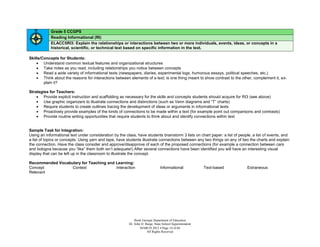
            ELACC5RI3: Explain the relationships or interactions between two or more individuals, events, ideas, or concepts in a
            historical, scientific, or technical text based on specific information in the text.

Skills/Concepts for Students:
     Understand common textual features and organizational structures
     Take notes as you read, including relationships you notice between concepts
     Read a wide variety of informational texts (newspapers, diaries, experimental logs, humorous essays, political speeches, etc.)
     Think about the reasons for interactions between elements of a text; is one thing meant to show contrast to the other, complement it, ex-
        plain it?

Strategies for Teachers:
     Provide explicit instruction and scaffolding as necessary for the skills and concepts students should acquire for RI3 (see above)
     Use graphic organizers to illustrate connections and distinctions (such as Venn diagrams and “T” charts)
     Require students to create outlines tracing the development of ideas or arguments in informational texts
     Proactively provide examples of the kinds of connections to be made within a text (for example point out comparisons and contrasts)
     Provide routine writing opportunities that require students to think about and identify connections within text


Sample Task for Integration:
Using an informational text under consideration by the class, have students brainstorm 3 lists on chart paper: a list of people, a list of events, and
a list of topics or concepts. Using yarn and tape, have students illustrate connections between any two things on any of two the charts and explain
the connection. Have the class consider and approve/disapprove of each of the proposed connections (for example a connection between cars
and bologna because you “like” them both isn’t adequate!) After several connections have been identified you will have an interesting visual
display that can be left up in the classroom to illustrate the concept.

Recommended Vocabulary for Teaching and Learning:
Concept           Context               Interaction                             Informational             Text-based         Extraneous
Relevant


                                                             Book Georgia Department of Education
                                                         Dr. John D. Barge, State School Superintendent
                                                                 MARCH 2012  Page 14 of 66
                                                                      All Rights Reserved
Grade 5 CCGPS
            Reading Informational (RI)
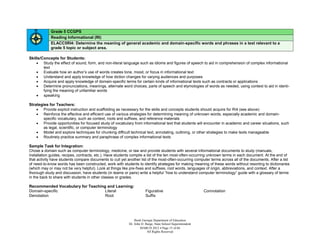
            ELACC5RI4: Determine the meaning of general academic and domain-specific words and phrases in a text relevant to a
            grade 5 topic or subject area.

Skills/Concepts for Students:
     Study the effect of sound, form, and non-literal language such as idioms and figures of speech to aid in comprehension of complex informational
        text
     Evaluate how an author’s use of words creates tone, mood, or focus in informational text
     Understand and apply knowledge of how diction changes for varying audiences and purposes
     Acquire and apply knowledge of domain-specific terms for certain kinds of informational texts such as contracts or applications
     Determine pronunciations, meanings, alternate word choices, parts of speech and etymologies of words as needed, using context to aid in identi-
        fying the meaning of unfamiliar words
     speaking

Strategies for Teachers:
     Provide explicit instruction and scaffolding as necessary for the skills and concepts students should acquire for RI4 (see above)
     Reinforce the effective and efficient use of various strategies for determining meaning of unknown words, especially academic and domain-
        specific vocabulary, such as context, roots and suffixes, and reference materials
     Provide opportunities for focused study of vocabulary from informational text that students will encounter in academic and career situations, such
        as legal, scientific, or computer terminology
     Model and explore techniques for chunking difficult technical text, annotating, outlining, or other strategies to make texts manageable
     Routinely practice summary and paraphrase of complex informational texts

Sample Task for Integration:
Chose a domain such as computer terminology, medicine, or law and provide students with several informational documents to study (manuals,
installation guides, recipes, contracts, etc.). Have students compile a list of the ten most-often-occurring unknown terms in each document. At the end of
that activity have students compare documents to cull yet another list of the most-often-occurring computer terms across all of the documents. After a list
of need-to-know words has been constructed, work with students to identify strategies for making meaning of these words without resorting to dictionaries
(which may or may not be very helpful). Look at things like pre-fixes and suffixes, root words, languages of origin, abbreviations, and context. After a
thorough study and discussion, have students (in teams or pairs) write a helpful “how to understand computer terminology” guide with a glossary of terms
in the back to share with students in other classes or grades.

Recommended Vocabulary for Teaching and Learning:
Domain-specific                    Literal                             Figurative                           Connotation
Denotation                         Root                                Suffix


                                                               Book Georgia Department of Education
                                                           Dr. John D. Barge, State School Superintendent
                                                                   MARCH 2012  Page 15 of 66
                                                                        All Rights Reserved
Grade 5 CCGPS
             Reading Informational (RI)
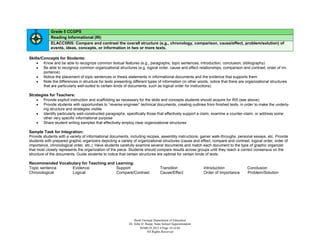
             ELACC5RI5: Compare and contrast the overall structure (e.g., chronology, comparison, cause/effect, problem/solution) of
             events, ideas, concepts, or information in two or more texts.

Skills/Concepts for Students:
     Know and be able to recognize common textual features (e.g., paragraphs, topic sentences, introduction, conclusion, bibliography)
     Be able to recognize common organizational structures (e.g. logical order, cause and effect relationships, comparison and contrast, order of im-
        portance)
     Notice the placement of topic sentences or thesis statements in informational documents and the evidence that supports them
     Note the differences in structure for texts presenting different types of information (in other words, notice that there are organizational structures
        that are particularly well-suited to certain kinds of documents, such as logical order for instructions)

Strategies for Teachers:
     Provide explicit instruction and scaffolding as necessary for the skills and concepts students should acquire for RI5 (see above)
     Provide students with opportunities to “reverse engineer” technical documents, creating outlines from finished texts, in order to make the underly-
        ing structure and strategies visible
     Identify particularly well-constructed paragraphs, specifically those that effectively support a claim, examine a counter-claim, or address some
        other very specific informational purpose
     Share student writing samples that effectively employ clear organizational structures

Sample Task for Integration:
Provide students with a variety of informational documents, including recipes, assembly instructions, gamer walk-throughs, personal essays, etc. Provide
students with prepared graphic organizers depicting a variety of organizational structures (cause and effect, compare and contrast, logical order, order of
importance, chronological order, etc.). Have students carefully examine several documents and match each document to the type of graphic organizer
that most closely represents the organization of the piece. Students should compare results across groups until they reach a correct consensus on the
structure of the documents. Guide students to notice that certain structures are optimal for certain kinds of texts.

Recommended Vocabulary for Teaching and Learning:
Topic sentence    Evidence              Support                                    Transition                Introduction           Conclusion
Chronological     Logical               Compare/Contrast                           Cause/Effect              Order of Importance    Problem/Solution


                                                                Book Georgia Department of Education
                                                            Dr. John D. Barge, State School Superintendent
                                                                    MARCH 2012  Page 16 of 66
                                                                         All Rights Reserved
Grade 5 CCGPS
            Reading Informational (RI)
            ELACC5RI6: Analyze multiple accounts of the same event or topic, noting important similarities and differences in the point
            of view they represent.

Skills/Concepts for Students:
     As you continue to learn more about informational texts such as newspapers, make it your practice to try to read about a topic from more
        than one source before forming an opinion about the information; you will find that accounts of the same event will vary a great deal on
        who is reporting
     Compare televised information to newsprint, magazines, and websites, noting the differences in presentation among formats
     Be alert for bias and learn about some of the strategies that people use to attempt to mislead their readers and viewers
     Begin to make judgments about which sources you find trustworthy

Strategies for Teachers:
     Provide explicit instruction and scaffolding as necessary for the skills and concepts students should acquire for RI6 (see above)
     Assign students the task of viewing nightly news and taking notes; students can watch multiple channels comparing coverage and acan
        also read newspapers together after viewing to compare paper vs. televised news
     Use historical texts that provide varying accounts of historical events to illustrate the fact that “history is written by the victors”
     Proactively choose texts within a thematic unit that illustrate the manipulation of point of view in informational texts

Sample Task for Integration:
Review the nightly news television schedule with your class. Assign students two local or national nightly news programs from two different
networks to view. Students will take notes on the major stories, then watch for those same topics in the second newscast. Students will attempt to
identify the differences in coverage, if any, of the topic between the two newscasts. Their findings will be reported in a brief compare/contrast
essay or in a graphic organizer/Venn diagram at instructor discretion. Compare newspapers from the same news cycle in class and make further
comparisons to between the written and visual reportage

Recommended Vocabulary for Teaching and Learning:
Topic                  Similarities/differences   Point of view                                     Bias               Spin
Journalism             Account                    Analysis
Summary


                                                            Book Georgia Department of Education
                                                        Dr. John D. Barge, State School Superintendent
                                                                MARCH 2012  Page 17 of 66
                                                                     All Rights Reserved
Grade 5 CCGPS
             Reading Informational (RI)
             ELACC5RI7: Draw on information from multiple print or digital sources, demonstrating the ability to locate an answer to a
             question quickly or to solve a problem efficiently.

Skills/Concepts for Students:
     Learn about computer programs and presentation platforms you can use in your academic work
     Become a responsible user of media, learning which types are reliable what which are best for various uses
     Learn the basics of sorting good websites from bad websites
     Don’t let the availability of the internet make you ineffective with print resources; maintain your media center skills

Strategies for Teachers:
     Provide explicit instruction and scaffolding as necessary for the skills and concepts students should acquire for RI7 (see above)
     Provide frequent opportunities for students to consume texts in various formats, including audio books, films, and websites, guiding collaborative
        discussions on the merits of each medium
     Require students to gather information from more than one type of source/media in research or analysis projects
     Encourage students to think about the impact of various mediums on the messages they receive; for example how print advertisements differ
        from television advertisements for the same product
     Have students conduct an inventory of the average amount of media consumed by their peers and which types of media most information comes
        from; students could also discuss the reliability of the most-often-consumed media outlets

Sample Task for Integration:
Engage students in a scavenger hunt in the media center in teams. Provide students with a list of several items of information to be located. Create the list
so that some information will only be available in print resources and others so that both inaccurate website and accurate websites will present themselves
in a web search. Have the students work in teams and race to find the answers.

Recommended Vocabulary for Teaching and Learning:
Media/Medium           Digital                    Film                                                  Print                   Journalism
Multimodal/multimedia  Wiki                       Blog                                                  PowerPoint              Prezi


                                                                Book Georgia Department of Education
                                                            Dr. John D. Barge, State School Superintendent
                                                                    MARCH 2012  Page 18 of 66
                                                                         All Rights Reserved
Grade 5 CCGPS
            Reading Informational (RI)
            ELACC5RI8: Explain how an author uses reasons and evidence to support particular points in a text, identifying which
            reasons and evidence supports which point(s).

Skills/Concepts for Students:
     When taking notes on texts that make a claim, organize your information in terms of claim and support
     Make it a practice to support all of your own claims, both in school and in life in general, with solid evidence
     Require evidence from people who want to persuade you!
     Be alert for nonsense arguments (such as you often see in commercials); these are called “logical fallacies” which means they might
        sound good on the surface, but they don’t make any logical sense

Strategies for Teachers:
     Provide explicit instruction and scaffolding as necessary for the skills and concepts students should acquire for RL1 (see above)
     Provide opportunities for students to examine sound logic as opposed to logical fallacies employed in texts and visual texts such as com-
        mercials or debates
     Require students to explore and understand the basic and most-frequently-used types of persuasive techniques, identifying them in de-
        bates, ads, and other texts and practicing constructing them as well
     Require students to produce valid evidence for claims in all texts and discussion, both formal and informal

Sample Task for Integration:
Provide students with a good argumentative essay that is cut into strips. Place the topic sentences for each paragraph onto a chart and have
students sift through the various other sentences of the essay, attempting to discern which sentences serve to support which points. Have
students conduct this exercise in teams and compare their results. Where results differ, have students work collaboratively to come to a
consensus about the most logical placement of support to topic.

Vocabulary for Teaching and Learning:
Claim                     Reasoning                        Evidence                                Support            Valid
Logic


                                                           Book Georgia Department of Education
                                                       Dr. John D. Barge, State School Superintendent
                                                               MARCH 2012  Page 19 of 66
                                                                    All Rights Reserved
Grade 5 CCGPS
            Reading Informational (RI)
            ELACC5RI9: Integrate information from several texts on the same topic in order to write or speak about the subject
            knowledgeably.

Skills/Concepts for Students:
     Read a wide variety of texts to build background knowledge
     Research topics that appeal to you independently; it’s neat to be an expert!
     Make it a habit to check multiple sources before arriving at a conclusion on a subject
     Do not rely only on the internet for your information

Strategies for Teachers:
     Provide explicit instruction and scaffolding as necessary for the skills and concepts students should acquire for RI9 (see above)
     Integrate short and extended research opportunities into your thematic units that require students to integrate information from multiple
        sources
     Provide writing opportunities that require students to synthesize information from multiple sources into a coherent thesis
     Discuss the verbiage of the standard with your students; explore the meaning of true “integration” of information

Sample Task for Integration:
                                              th
Choose a topic under consideration in the 5 grade social studies curriculum. Have students conduct an analysis of comparable excerpts from
various texts, including primary and secondary source documents, expressing differing points of view. Try to include a broad variety of view points,
including gender, social class, country of origin, etc. Advise students to compare historical and modern texts for perspective as well. Students
should write a response that includes not only the facts as seen through different eyes, but also the reasons why the student believes those facts
were perceived differently by different parties or purposefully misconstrued.

Recommended Vocabulary for Teaching and Learning:
Integrate         Synthesize            Topic                       Point of View                   Citation


                                                            Book Georgia Department of Education
                                                        Dr. John D. Barge, State School Superintendent
                                                                MARCH 2012  Page 20 of 66
                                                                     All Rights Reserved
Grade 5 CCGPS
            Reading Informational (RI)
            ELACC5RI10: By the end of the year, read and comprehend informational texts, including history/social studies, science,
            and technical texts, at the high end of the grades 4-5 text complexity band independently and proficiently.

Skills/Concepts for Students:
     Practice careful and attentive reading of both assigned texts and independent text choices
     Read a wide variety of texts, including a variety of styles, genres, literary periods, authors, perspectives, and subjects
     Take notes as you read
     Choose works from multiple genres, cultures, and historical periods
     Consider keeping a notebook of texts read with notes


Strategies for Teachers:
     Choose texts of appropriate complexity (see Common Core appendix B)
     Require reading through multiple modes: group, pairs, individual, in class, out of class, via digital mediums, etc.
     Provide scaffolding on difficult texts through commentary and interpretation, group discussion, complementary visual texts, and profes-
        sional annotations as appropriate
     Require specific textual evidence for all claims and inferences about texts, even in informal discussion

Sample Task for Integration:
Conference with students to set personal literacy goals appropriate to each individual, including a suggested reading list (this may include history,
social studies, and technical text) Encourage students to keep a notebook that includes notes and personal commentary on each text read over
the course of the year. Students visit the media center and select appropriate books for reading. After the reading has taken place students will
write about what they have read and share with the class. The students writing must include direct quotes from the text to support an opinion
about they have about the text. An extension of this could include students using technology to produce reviews of the books they have read and
present the reviews to the class.

Recommended Vocabulary for Teaching and Learning:
independently          proficiently                                       fluently                        complexity


                                                             Book Georgia Department of Education
                                                         Dr. John D. Barge, State School Superintendent
                                                                 MARCH 2012  Page 21 of 66
                                                                      All Rights Reserved
Grade 5 CCGPS
          Reading Foundational (RF)
          ELACCRF1and 2 not taught in grade

          ELACC5RF3: Know and apply grade-level phonics and word analysis skills in decoding words.
          a. Use combined knowledge of all letter-sound correspondences, syllabication patterns, and morphology (e.g., roots and affixes) to
          read accurately unfamiliar multi-syllabic words in context and out of context.

Skills/Concepts for Students:
     Apply knowledge of letter-sound correspondences, syllabication patterns, and morphology
     Use a range of cueing systems (e.g., phonics and context clues) to determine pronunciation and meaning
     Recognize roots and affixes

Strategies for Teachers:
     Provide explicit instruction and scaffolding as necessary for the skills and concepts students should acquire for RF3 (see above)
     Provide differentiated small group instruction as needed
     Provide additional opportunities for students to master these skills and concepts through the use of literacy centers
     Teach strategies for identifying multi-syllabic words (e.g., chunk words, break down words into smaller units, look for syllables, affixes, or
        phonograms)
     Engage students in fluency building and making word activities
     Engage students in using spelling logs or journals
     Provide word rings or spelling rings with multi-syllabic words for independent and filler time practice (line for dismissal and lunch line)
     Provide opportunities for students to practice using syllabication (reading words, spelling words, writing words)
     Include practice in reading texts that are written for students to use their knowledge of decoding words
     Include in the classroom interactive word walls
     Include activities for word games (e.g., scrabble)
     Include activities such as “Root of the Day” – display a root and students must tell as much information about the root as possible

Sample Task for Integration:
Provide students opportunities to read literature that contains multisyllabic words. Students will practice their decoding skills reading independently
and orally to a partner. Students will use text they are currently reading to identify multisyllabic words. Students will record these words in their
word journals. Students will write paragraphs containing multisyllabic words.

Recommended Vocabulary for Teaching and Learning:
affixes                multisyllabic words        morphology                                         roots


                                                             Book Georgia Department of Education
                                                         Dr. John D. Barge, State School Superintendent
                                                                 MARCH 2012  Page 22 of 66
                                                                      All Rights Reserved
Grade 5 CCGPS
            Reading Foundational (RF)
            ELACC5RF4: Read with sufficient accuracy and fluency to support comprehension.
         a. a. Read on-level text with purpose and understanding.
         b. b. Read on-level prose and poetry orally with accuracy, appropriate rate, and expression on successive
            readings.

Skills/Concepts for Students:
        Read on level text with purpose and understanding
                   c.
        Uses self-correction when subsequent reading indicates an earlier miscue (self-monitoring and self-correcting strategies)
        Read with rhythm, flow, and meter to sound like everyday speech (prosody)

Strategies for Teachers:
        Provide explicit instruction and scaffolding as necessary for the skills and concepts students should acquire for RI9 (see above)
        Provide differentiated small group instruction as needed
        Provide additional opportunities for students to master these skills and concepts through the use of literacy centers
        Guide students how to read for a purpose
        Engage students in opportunities to express understanding about what they have read ( graphic organizers, etc)
        Model fluent reading for students
        Allow students opportunities to listen to text read on tape, MP3, etc. to ensure what fluent reading sounds like
        Provide opportunities for students to read independently
        Provide students opportunities to engage in on-level text with purpose and understanding use multiple set of text for repeated reading
         practice
        Engage students in various fluency building activities (e.g., repeated reading, paired reading, plays, reader’s theatre, and choral reading
        Students keep reading fluency logs to graph rate and errors
        Teacher keeps running records of student reading fluency

Sample Task for Integration:
Have students rework a grade-level appropriate text into a Reader’s Theater presentation. Students will rehearse the dramatic presentation until it is polished
enough to present. Record the Reader’s Theater to share with students in lower grades.

Recommended Vocabulary for Teaching and Learning:
fluency                    purpose                                 understanding                           pitch                      accuracy
appropriate rate


                                                                   Book Georgia Department of Education
                                                               Dr. John D. Barge, State School Superintendent
                                                                       MARCH 2012  Page 23 of 66
                                                                            All Rights Reserved
Grade 5 CCGPS
            Reading Foundational (RF)
            ELACC5RF4: Read with sufficient accuracy and fluency to support comprehension.
            c. Use context to confirm or self-correct word recognition and understanding, rereading as necessary.

Skills/Concepts for Students:
     Use context clues when reading to aid with self-correcting and word recognition and understanding

Strategies for Teachers:
     Provide explicit instruction and scaffolding as necessary for the skills and concepts students should acquire for RF4 (see above)
     Provide differentiated small group instruction as needed
     Provide additional opportunities for students to master these skills and concepts through the use of literacy centers
     Model using context clues, sentence structure, and visual clues to confirm or self-correct

Sample Task for Integration:
The teacher will allow the class to read a preselected passage independently. After all students have had an opportunity to read the passage the
teacher will lead a discussion about how to use context to help determine the difficult words. The teacher will take suggestions from class
members for the strategies they use when reading an unfamiliar word in a text. Students will write the various strategies down in their reading logs
to aid in future reading. The students will have ongoing practice by continuing to confirm or self-correct their own independent reading.

Recommended Vocabulary for Teaching and Learning:
context clues          self-correct


                                                            Book Georgia Department of Education
                                                        Dr. John D. Barge, State School Superintendent
                                                                MARCH 2012  Page 24 of 66
                                                                     All Rights Reserved
Grade 5 CCGPS
             Writing (W)
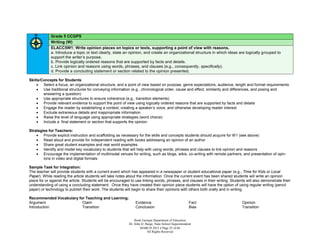
             ELACC5W1: Write opinion pieces on topics or texts, supporting a point of view with reasons.
             a. Introduce a topic or text clearly, state an opinion, and create an organizational structure in which ideas are logically grouped to
             support the writer’s purpose.
             b. Provide logically ordered reasons that are supported by facts and details.
             c. Link opinion and reasons using words, phrases, and clauses (e.g., consequently, specifically).
             d. Provide a concluding statement or section related to the opinion presented.

Skills/Concepts for Students:
     Select a focus, an organizational structure, and a point of view based on purpose, genre expectations, audience, length and format requirements
     Use traditional structures for conveying information (e.g., chronological order, cause and effect, similarity and differences, and posing and
        answering a question)
     Use appropriate structures to ensure coherence (e.g., transition elements)
     Provide relevant evidence to support the point of view using logically ordered reasons that are supported by facts and details
     Engage the reader by establishing a context, creating a speaker’s voice, and otherwise developing reader interest
     Exclude extraneous details and inappropriate information
     Raise the level of language using appropriate strategies (word choice)
     Include a final statement or section that supports the opinion

Strategies for Teachers:
     Provide explicit instruction and scaffolding as necessary for the skills and concepts students should acquire for W1 (see above)
     Read aloud and provide for independent reading with books addressing an opinion of an author
     Share great student examples and real world examples
     Identify and model key vocabulary to students that will help with using words, phrases and clauses to link opinion and reasons
     Encourage the implementation of multimodal venues for writing, such as blogs, wikis, co-writing with remote partners, and presentation of opin-
        ions in video and digital formats

Sample Task for Integration:
The teacher will provide students with a current event which has appeared in a newspaper or student educational paper (e.g., Time for Kids or Local
Paper). While reading the article students will take notes about the information. Once the current event has been shared students will write an opinion
piece for or against the article. Students will be encouraged to use linking words, phrases, and clauses in their writing. Students will also demonstrate their
understanding of using a concluding statement. Once they have created their opinion piece students will have the option of using regular writing (pencil
paper) or technology to publish their work. The students will begin to share their opinions with others both orally and in writing.

Recommended Vocabulary for Teaching and Learning:
Argument                 Claim                                  Evidence                                Fact                     Opinion
Introduction             Transition                             Conclusion                              Bias                     Transition


                                                                Book Georgia Department of Education
                                                            Dr. John D. Barge, State School Superintendent
                                                                    MARCH 2012  Page 25 of 66
                                                                         All Rights Reserved
Grade 5 CCGPS
              Writing (W)
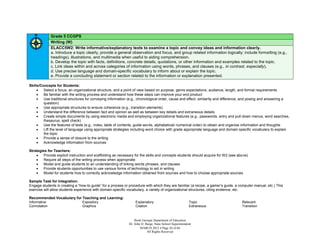
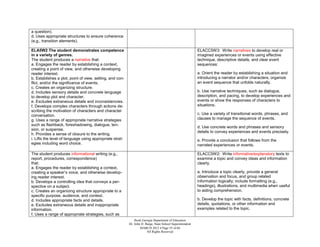
              ELACC5W2: Write informative/explanatory texts to examine a topic and convey ideas and information clearly.
              a. Introduce a topic clearly, provide a general observation and focus, and group related information logically; include formatting (e.g.,
              headings), illustrations, and multimedia when useful to aiding comprehension.
              b. Develop the topic with facts, definitions, concrete details, quotations, or other information and examples related to the topic.
              c. Link ideas within and across categories of information using words, phrases, and clauses (e.g., in contrast, especially).
              d. Use precise language and domain-specific vocabulary to inform about or explain the topic.
              e. Provide a concluding statement or section related to the information or explanation presented.

Skills/Concepts for Students:
        Select a focus, an organizational structure, and a point of view based on purpose, genre expectations, audience, length, and format requirements
        Be familiar with the writing process and understand how these steps can improve your end product
        Use traditional structures for conveying information (e.g., chronological order, cause and effect, similarity and difference, and posing and answering a
         question)
        Use appropriate structures to ensure coherence (e.g., transition elements)
        Understand the difference between fact and opinion as well as between key details and extraneous details
        Create simple documents by using electronic media and employing organizational features (e.g., passwords, entry and pull-down menus, word searches,
         thesaurus, spell check)
        Use the features of texts (e.g., index, table of contents, guide words, alphabetical/ numerical order) to obtain and organize information and thoughts
        Lift the level of language using appropriate strategies including word choice with grade appropriate language and domain specific vocabulary to explain
         the topic
        Provide a sense of closure to the writing
        Acknowledge information from sources

Strategies for Teachers:
       Provide explicit instruction and scaffolding as necessary for the skills and concepts students should acquire for W2 (see above)
       Require all steps of the writing process when appropriate
       Model and guide students to an understanding of linking words phrases, and clauses
       Provide students opportunities to use various forms of technology to aid in writing
       Model for students how to correctly acknowledge information obtained from sources and how to choose appropriate sources

Sample Task for Integration:
Engage students in creating a “how-to guide” for a process or procedure with which they are familiar (a recipe, a gamer’s guide, a computer manual, etc.) This
exercise will allow students experience with domain-specific vocabulary, a variety of organizational structures, citing evidence, etc.

Recommended Vocabulary for Teaching and Learning:
Informative                      Expository                       Explanatory                             Topic                     Relevant
Connotation                      Graphics                         Citation                                Extraneous                Transition


                                                                  Book Georgia Department of Education
                                                              Dr. John D. Barge, State School Superintendent
                                                                      MARCH 2012  Page 26 of 66
                                                                           All Rights Reserved
Grade 5 CCGPS
               Writing (W)
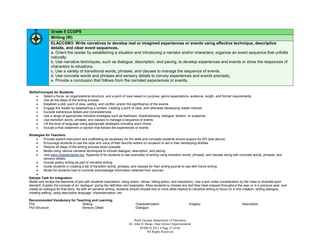
               ELACC5W3: Write narratives to develop real or imagined experiences or events using effective technique, descriptive
               details, and clear event sequences.
               a. Orient the reader by establishing a situation and introducing a narrator and/or characters; organize an event sequence that unfolds
               naturally.
               b. Use narrative techniques, such as dialogue, description, and pacing, to develop experiences and events or show the responses of
               characters to situations.
               c. Use a variety of transitional words, phrases, and clauses to manage the sequence of events.
               d. Use concrete words and phrases and sensory details to convey experiences and events precisely.
               e. Provide a conclusion that follows from the narrated experiences or events.

Skills/Concepts for Students:
        Select a focus, an organizational structure, and a point of view based on purpose, genre expectations, audience, length, and format requirements
        Use all the steps of the writing process
        Establish a plot, point of view, setting, and conflict, and/or the significance of the events
        Engage the reader by establishing a context, creating a point of view, and otherwise developing reader interest
        Exclude extraneous details and inconsistencies
        Use a range of appropriate narrative strategies such as flashback, foreshadowing, dialogue, tension, or suspense
        Use transition words, phrases, and clauses to manage a sequence of events
        Lift the level of language using appropriate strategies including word choice
        Include a final statement or section that follows the experiences or events

Strategies for Teachers:
         Provide explicit instruction and scaffolding as necessary for the skills and concepts students should acquire for W3 (see above)
         Encourage students to use the style and voice of their favorite writers on occasion to aid in their developing abilities
         Require all steps of the writing process when possible
         Model using various narrative techniques to include dialogue, description, and pacing
         Use www.corestandards.org Appendix B for students to see examples of writing using transition words, phrases, and clauses along with concrete words, phrases, and
          sensory details
         Include poetry writing as part of narrative writing
         Guide students in creating a list of transition words, phrases, and clauses for their writing journal to use with future writing
         Model for students how to correctly acknowledge information obtained from sources
     
Sample Task for Integration:
Model and review the elements of plot with students (exposition, rising action, climax, falling action, and exposition). Use a text under consideration by the class to illustrate each
element. Explain the concept of an “epilogue” giving the definition and examples. Allow students to choose any text they have enjoyed throughout the year or in a previous year, and
create an epilogue for that story. As with all narrative writing, students should choose one or more skills relative to narrative writing to focus on in this creation: writing dialogue,
creating setting, using descriptive language, characterization, etc.

Recommended Vocabulary for Teaching and Learning:
Plot                          Setting                                       Characterization                       Imagery                              Description
Plot Structure                Sensory Detail                                Dialogue


                                                                           Book Georgia Department of Education
                                                                       Dr. John D. Barge, State School Superintendent
                                                                               MARCH 2012  Page 27 of 66
                                                                                    All Rights Reserved
Grade 5 CCGPS
            Writing (W)
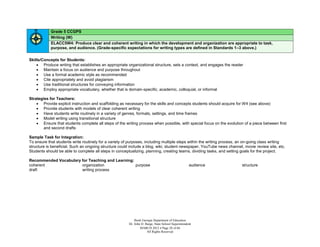
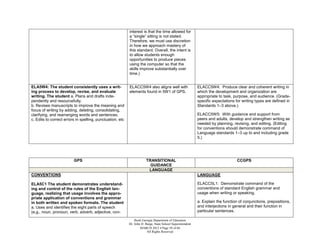
            ELACC5W4: Produce clear and coherent writing in which the development and organization are appropriate to task,
            purpose, and audience. (Grade-specific expectations for writing types are defined in Standards 1–3 above.)

Skills/Concepts for Students:
     Produce writing that establishes an appropriate organizational structure, sets a context, and engages the reader
     Maintain a focus on audience and purpose throughout
     Use a formal academic style as recommended
     Cite appropriately and avoid plagiarism
     Use traditional structures for conveying information
     Employ appropriate vocabulary, whether that is domain-specific, academic, colloquial, or informal

Strategies for Teachers:
     Provide explicit instruction and scaffolding as necessary for the skills and concepts students should acquire for W4 (see above)
     Provide students with models of clear coherent writing
     Have students write routinely in a variety of genres, formats, settings, and time frames
     Model writing using transitional structure
     Ensure that students complete all steps of the writing process when possible, with special focus on the evolution of a piece between first
        and second drafts

Sample Task for Integration:
To ensure that students write routinely for a variety of purposes, including multiple steps within the writing process, an on-going class writing
structure is beneficial. Such an ongoing structure could include a blog, wiki, student newspaper, YouTube news channel, movie review site, etc.
Students should be able to complete all steps in conceptualizing, planning, creating teams, dividing tasks, and setting goals for the project.

Recommended Vocabulary for Teaching and Learning:
coherent               organization               purpose                                           audience            structure
draft                  writing process


                                                            Book Georgia Department of Education
                                                        Dr. John D. Barge, State School Superintendent
                                                                MARCH 2012  Page 28 of 66
                                                                     All Rights Reserved
Grade 5 CCGPS
             Writing (W)
             ELACC5W5: With guidance and support from peers and adults, develop and strengthen writing as needed by planning,
             revising, and editing. (Editing for conventions should demonstrate command of Language Standards 1–3 up to and
             including grade 5.)

Skills/Concepts for Students:
     Plan and drafts independently and resourcefully
     Revise manuscripts to improve the focus of writing by adding, deleting, consolidating, clarifying, and rearranging words and sentences
     Edit to correct errors in spelling, punctuation etc.

Strategies for Teachers:
     Provide explicit instruction and scaffolding as necessary for the skills and concepts students should acquire for W5 (see above)
     Demonstrate different ways to plan and draft writing including using various graphic organizers, and writing planning sheets
     Provide students with sample papers to revise and edit for conventions
     Use multiple strategies to help students revise their writing, including conferences, peer editing, and technology
     In a collaborative discussion and using rubrics for reference, engage students in co-creating a peer review or editing worksheet, allowing
        the students to attempt to define which elements they should check in when editing (for example checking sentences for varied fluency)
     Occasionally require students to turn in both drafts of an essay, and/or include their pre-writing and brainstorming notes, making these in-
        tegral parts of the total grade

Sample Task for Integration:
Have students bring a first and second draft of an essay from their portfolios to a partner review session. Students will trade the sets of papers and each
partner will take notes on the items that were changed between drafts (for example: 1. Combined two simple sentences in paragraph one to make a
compound sentence. 2. Changed “walked “to “ambled” in paragraph 3, improving word choice). Students will then look at their reviewers list to get an
overview of the level of attention brought to the edit and revision process and will write a brief response about what they learned about their own writing
process from the exercise. An extension to this activity could include students creating an additional “final” draft of the paper making it even better.

Recommended Vocabulary for Teaching and Learning:

Writing Process                 Development                     Strategy                                Fluency                 Peer
Organization                    Planning                        Revising                                Editing                 Grammar
Brainstorm                      Conventions


                                                                Book Georgia Department of Education
                                                            Dr. John D. Barge, State School Superintendent
                                                                    MARCH 2012  Page 29 of 66
                                                                         All Rights Reserved
Grade 5 CCGPS
             Writing (W)
             ELACC5W6: With some guidance and support from adults, use technology, including the Internet, to produce and publish
             writing as well as to interact and collaborate with others; demonstrate sufficient command of keyboarding skills to type a
             minimum of two pages in a single sitting.

Skills/Concepts for Students:
With some guidance and support from adults:
        Use various reference materials (i.e., dictionary, thesaurus, encyclopedia, almanac, etc.)
        Use organizational features of printed text (i.e., citations, end notes, bibliographic references, appendices) to locate relevant information
        Use the features of texts (e.g., index, table of contents, guide words, alphabetical/ numerical order) to obtain and
         organize information and thoughts
        Create simple documents by using electronic media and employing organizational features (e.g., password, entry, and pull-down menus, word searches,
         thesaurus, and spell check)
        Demonstrate basic keyboarding skills and familiarity with computer terminology (e.g., software, memory, disk drive, hard drive)
        Use technology to interact and collaborate with others (e.g., email with other classes, age appropriate blogs, Skype, fax, chat)
        Type a minimum of two pages in a single setting
     
Strategies for Teachers:
        Provide explicit instruction and scaffolding as necessary for the skills and concepts students should acquire for W6 (see above)
        Guide students to be familiar with where to locate reference material both in print and electronically
        Demonstrate using organizational features and the features of text to aid in the writing process
        Demonstrate using various Internet sites for organizing information (e.g., online graphic organizers found at http://www.readwritethink.org/classroom-
         resources/student-interactives/ and http://www.themes.pppst.com/graphic-organizers.html )
        Demonstrate how to use technology to communicate and interact with others about writing (e.g., chat, email, faxing, using appropriate blogs, and Skype if
         available) , as well as how to use technology to produce writing
        Model for students how to correctly acknowledge information obtained from sources

Sample Task for Integration:
Using one of the many websites available for the purpose (such as Global Virtual Classroom, at http://www.virtualclassroom.org/ ), find a class of
students in another country with whom to collaborate on a project. The partnering sites offer suggestions for collaborative projects, which might
include a dramatic skit performed in tandem via Skype, a collaborative writing project, collaborative research, group read alouds, joint publications
of storybooks for kids, informational websites, etc.).

Recommended Vocabulary for Teaching and Learning:
Multimedia                 Digital                                Multimodal                              Internet                  Podcast
Website                    Wiki                                   Skype                                   Prezi                     Platform
Flipchart                  Interactive board                      Programming language                    Publish                   Blog


                                                                  Book Georgia Department of Education
                                                              Dr. John D. Barge, State School Superintendent
                                                                      MARCH 2012  Page 30 of 66
                                                                           All Rights Reserved
Grade 5 CCGPS
            Writing (W)
            ELACC5W7: Conduct short research projects that use several sources to build knowledge through investigation of different
            aspects of a topic.

Skills/Concepts for Students:
     Learn about and use the latest software for gathering and sharing information
     Acquire keyboarding skills adequate to produce text in the quantities and within the time limits required
     Give credit for works you use in your essays and avoid plagiarism
     Learn to differentiate between a reliable Internet site and an unreliable one
     Learn to navigate the web and the media center effectively, narrowing your searches appropriately
     Conduct independent research on topics of interest to you

Strategies for Teachers:
     Provide explicit instruction and scaffolding as necessary for the skills and concepts students should acquire for W7 (see above)
     Provide various resources for students to use to conduct research
     Provide students with graphic organizers or other organizational aids (print or electronic) for organizing their research
     Model for students how to correctly acknowledge information obtained from sources

Sample Task for Integration:
In a timed environment, give students a topic that is connected to the theme of your current unit. Give each student a supply of index cards (and
choose a topic on which information is available. The goal of this activity (which should be repeated at intervals) is simply to have students gather
meaningful and useful information efficiently and within a controlled time limit. Students should, of course, not be warned of the topic ahead of
time. Give each student a different topic (or at least provide several topics to the class) to avoid “sharing” and too few resources for too many
students. Require that the chosen resources come from at least 3 different mediums and formats. Students may save the card sets for future
research if desired.

Recommended Vocabulary for Teaching and Learning:
Research               Inquiry                                  Focused question                     Source              Citation
Annotation             Archive                                  Access                               Platform            Thesis
Hypothesis             Digital                                  Navigate                             Website             Valid
Reliable               Investigation


                                                             Book Georgia Department of Education
                                                         Dr. John D. Barge, State School Superintendent
                                                                 MARCH 2012  Page 31 of 66
                                                                      All Rights Reserved
Grade 5 CCGPS
            Writing (W)
            ELACC5W8: Recall relevant information from experiences or gather relevant information from print and digital sources;
            summarize or paraphrase information in notes and finished work, and provide a list of sources.

Skills/Concepts for Students:
     Use organizational features of printed and electronic text (e.g., citations, end notes, bibliographic references, appendices, bulletin boards,
        data bases, keyword searches, e-mail addresses) to locate relevant information
     Support judgments through references to the text, or other works, authors, or non-print media, or references to personal knowledge
     Include researched information in different types of products (e.g., compositions, multimedia presentations, graphic organizers, projects,
        etc.)
     Summarize and paraphrase information
     Acknowledge information from sources and cites references

Strategies for Teachers:
     Provide explicit instruction and scaffolding as necessary for the skills and concepts students should acquire for W8 (see above)
     Demonstrate how to use organizational features of printed and electronic texts to aid in creating writing
     Provide students with various print and digital resources to aid in the research
     Demonstrate how to use summarized and paraphrased information in writing
     Model for students how to correctly acknowledge information obtained from sources

Sample Task for Integration:
To integrate the idea of reporting on experiences as well as texts, have students create a journalistic presentation on a local event, such as a
recent football game or festival. If it is a school event, such as a celebration or pep rally, students will already have first-hand experience. If not,
you may want to provide a video tape of a local event. Have students take this first-hand account and synthesize it with coverage from local print
and television media or interviews with other attendees. The students will create a report based on what they’ve seen in televised journalism, then
film and view the presentations.

Recommended Vocabulary for Teaching and Learning:
relevant                 summarize                paraphrase                                          citations             end notes
bibliographic references appendices               graphic organizer                                   data bases            key word searches
compositions


                                                              Book Georgia Department of Education
                                                          Dr. John D. Barge, State School Superintendent
                                                                  MARCH 2012  Page 32 of 66
                                                                       All Rights Reserved
Grade 5 CCGPS
            Writing (W)
            ELACC5W9: Draw evidence from literary or informational texts to support analysis, reflection, and research.
            a. Apply grade 5 Reading Standards to literature (e.g., “Compare and contrast two or more characters, settings, or events in a story or
            a drama, drawing on specific details in the text [e.g., how characters interact+”).
            b. Apply grade 5 Reading Standards to informational texts (e.g., Explain how an author uses reasons and evidence to support
            particular points in a text, identifying which reasons and evidence supports which point[s]).

Skills/Concepts for Students:
     Make a judgment that is interpretive, evaluative, or reflective
     Compare and contrast two or more characters, settings or events in a story or drama
     Apply fifth grade reading standards to literary text when writing
     Develop interpretations that exhibit careful reading and demonstrate an understanding of the literary work
     Support judgments through references to the text, other works, authors, or non-print media, or references to personal knowledge
     Draw on specific details from the text

Strategies for Teachers:
     Provide explicit instruction and scaffolding as necessary for the skills and concepts students should acquire for W9 (see above)
     Engage students in opportunities to compare and contrast different characters, settings, or events in literature
     Engage students in opportunities to use informational texts to support the reasons an author gives to support a point
     Follow suggested curriculum guidelines for the production of argumentative and informational essays
     Encourage students to focus on how an author uses a strategy or literary element, or why he or she chooses one approach over another
     Require all claims, even trivial or seemingly self-evident claims, made about a text to be supported by cited evidence

Sample Task for Integration:
Pro-actively choose complementary novels or informational texts to be read in class (texts that you know will give students ample opportunities for
comparison and contrast of similar characters or themes). Have the students conduct an in-depth comparison and contrast of the novels and their
unique treatments of similar themes. Using specific evidence from the texts students will write about elements such as the narrative point of view,
the novel’s organizational structure, characterization, plot, and setting.

Recommended Vocabulary for Teaching and Learning:
compare                contrast                   interpret                                         evaluate            reflect
reference to text      graphic features           paragraphs                                        Notes/annotation


                                                            Book Georgia Department of Education
                                                        Dr. John D. Barge, State School Superintendent
                                                                MARCH 2012  Page 33 of 66
                                                                     All Rights Reserved
Grade 5 CCGPS
               Writing (W)
               ELACC5W10: Write routinely over extended time frames (time for research, reflection, and revision) and shorter time frames
               (a single sitting or a day or two) for a range of discipline-specific tasks, purposes, and audiences.

 Skills/Concepts for Students:
      Select a focus, an organizational structure, and a point of view based on purpose, genre expectations, audience, length, and format
         requirements
      Maintain a routine writing practice, both within the classroom and independently
      Read and study writers whose styles you enjoy and admire
      Practice maintaining focus on prolonged projects, writing or working a little each day on a larger project over time
      Write texts of a length appropriate to address the topic or tell the story
      Maintain a portfolio of your written work, not only for reflection but as a resource for ideas, work samples, etc.

 Strategies for Teachers:
      Provide explicit instruction and scaffolding as necessary for the skills and concepts students should acquire for W10 (see above)
      Demonstrate for students using organizational structure
      Provide frequent writing opportunities
      Provide extensive and specific feedback on as much student writing as possible
      Require students to maintain a record of their writing throughout the year in the form of a portfolio
      Model how to incorporate research, reflections, and revision into the writing process
      Vary the requirements for tasks to include computer generated and hand-written pieces, long and short pieces, research

 Sample Task for Integration
 See sample tasks provided for ELACC5W1 through ELACC5W9 for suggestions on implementation of routine, research, and the exploration of
 writing in grade 5.

 Recommended Vocabulary for Teaching and Learning:
Word choice                   Denotation                   Style                                  Voice              Figurative language
Conventions                   Connotation                  Organization                           Structure          Topic
Introduction                  Fluency                      Imagery                                Sensory detail     Fact
Opinion                       Evidence                     Detail                                 Extraneous


                                                            Book Georgia Department of Education
                                                        Dr. John D. Barge, State School Superintendent
                                                                MARCH 2012  Page 34 of 66
                                                                     All Rights Reserved
Grade 5 CCGPS
            Speaking and Listening (SL)
            ELACC5SL1: Engage effectively in a range of collaborative discussions (one-on-one, in groups, and teacher-led) with
            diverse partners on grade 5 topics and texts, building on others’ ideas and expressing their own clearly.
            a. Come to discussions prepared, having read or studied required material; explicitly draw on that preparation and other information
            known about the topic to explore ideas under discussion.
            b. Follow agreed-upon rules for discussions and carry out assigned roles.
            c. Pose and respond to specific questions by making comments that contribute to the discussion and elaborate on the remarks of
            others.
            d. Review the key ideas expressed and draw conclusions in light of information and knowledge gained from the discussions.

Skills/Concepts for Students:
     Participate in student-to-teacher, student-to-student, and group verbal interactions
     Give reasons in support of opinions expressed
     Research topic to be discussed and give reasons in support of opinions expressed
     Clarifies, illustrates, or expands on a response when asked to do so; asks classmates for similar expansions
     Ask relevant questions
     Respond to questions with appropriate information
     Respond appropriately to comments and questions

Strategies for Teachers:
     Provide explicit instruction and scaffolding as necessary for the skills and concepts students should acquire for SL1(see above)
     Model having a discussion and being respectful to others
     Invite visitors and other classes to participate in collaborative discussions
     Occasionally require preparation for collaborative discussion
     Allow students to create their own set of rituals and routines for discussion

Sample Task for Integration:
Arrange a day for a celebration or conference on a topic of student interest (Earth Day, the premier of a popular children’s movie, a holiday).
Students will be assigned elements on the topic on which to be prepared to share. Conduct a collaborative discussion modeled on the idea of an
academic conference on the subject, with students sitting round-table or panel style and sharing information. The session could be recorded, or a
class recorder(s) could take notes. You might arrange to have decorations or refreshments on the theme.

Recommended Vocabulary for Teaching and Learning:

 Brainstorm                    Discussion                    Presentation                               Collegial        Relevant
 Observation                   Evidence                      Explicit                                   Implicit         Collaborate
 Diverse                       Express                       Articulate                                 Tolerance        Alternative

                                                           Book Georgia Department of Education
                                                       Dr. John D. Barge, State School Superintendent
                                                               MARCH 2012  Page 35 of 66
                                                                    All Rights Reserved
Grade 5 CCGPS
            Speaking and Listening (SL)
            ELACC5SL2: Summarize a written text read aloud or information presented in diverse media and formats, including visually,
            quantitatively, and orally.

Skills/Concepts for Students:
     Acquire knowledge of elements of visual text, such as color or camera angle
     Be a careful consumer of many kinds of media (listen to podcasts, read blogs, post on wikis!)
     When reading for pleasure, listen to audio versions of the text; these can be entertaining, can help you model prosody in your own reading
        voice, and can help expose you to more texts than you might be able to read ordinarily
     Understand the difference between summary and paraphrase
     Employ knowledge of appropriate organizational structures for argument writing that include a focus for audience and purpose

Strategies for Teachers:
     Provide explicit instruction and scaffolding as necessary for the skills and concepts students should acquire for SL2 (see above)
     Teach summarizing strategies
     Provide students with opportunities to use diverse media
     Encourage students to think critically about media (for example how kids are portrayed, or stereotypes they notice)
     Have students conduct an inventory of the average amount of media consumed by their peers and which types of media most information
        comes from; students could also discuss the reliability of the most-often-consumed media outlets
    

Sample Task for Integration:
Split the class into 3 or 4 teams. You will assign all students a common research topic (tied to texts under consideration by the class), but each
team will only be allowed to conduct research in one medium (one team will use only websites, another will use only televised news or
documentaries, another only print sources, etc.) Have each team create a PowerPoint or Prezi presenting their findings. Have students take
careful notes on each presentation, noting the differences in information gathered from the different sources. After the presentations engage
students in a collaborative discussion on the ways in which the information was shaped and filtered by the medium through which it was retrieved.
Students may be required to write a brief analysis or response on their findings.

Recommended Vocabulary for Teaching and Learning:
 Podcast                Media                     Format                                            Visual Text        Summarize
 Paraphrase             Wiki                      Internet                                          Web


                                                           Book Georgia Department of Education
                                                       Dr. John D. Barge, State School Superintendent
                                                               MARCH 2012  Page 36 of 66
                                                                    All Rights Reserved
Grade 5 CCGPS
            Speaking and Listening
            ELACC5SL3: Summarize the points a speaker makes and explain how each claim is supported by reasons and evidence.

Skills/Concepts for Students:
     Summarize the points a speaker makes without including your own opinion
     Think about a speaker’s own opinions and try to notice when he or she is biased or not basing their content solely on facts
     Acquire knowledge of some of the ways in which speakers will sometimes try to fool us (in commercials for example) by using celebrities
        or distractions
     Consider the impact of visual elements like lights, make up, clothing, etc.

Strategies for Teachers:
     Provide explicit instruction and scaffolding as necessary for the skills and concepts students should acquire for SL3 (see above)
     Engage the students in using graphic organizers to summarize
     Model summarizing the claims made by the speaker or presenter and then explain how each claim is supported by evidence
     Provide students opportunities to listen to a speaker either in person or electronically

Sample Task for Integration:
Each year the President of the United States gives a “Back to School” speech. Have your students view the current speech at
http://www.whitehouse.gov/mediaresources/. Provide students with a graphic organizer to help them identify the President’s main points. Engage
them in a discussion, perhaps including several additional viewings, of whether any claims were made and whether or not those claims were
supported. What reasons did the president give for his or her assertions? As an extension of this activity, students will create their own speech
using information the President provided and their own reasons for the importance of having an education.

Recommended Vocabulary for Teaching and Learning:
Summarize              Claim                      Evidence                                          Support            Clarify
Reasons                Paraphrase                 Author’s Purpose                                  Bias


                                                            Book Georgia Department of Education
                                                        Dr. John D. Barge, State School Superintendent
                                                                MARCH 2012  Page 37 of 66
                                                                     All Rights Reserved
Grade 5 CCGPS
             Speaking and Listening
             ELACC5SL4: Report on a topic or text or present an opinion, sequencing ideas logically and using appropriate facts and
             relevant, descriptive details to support main ideas or themes; speak clearly at an understandable pace.

Skills/Concepts for Students:
     Shape information to achieve a particular purpose and to appeal to the interest and background knowledge of audience members
     Work consistently towards becoming comfortable while presenting to your peers and to adults
     Practice your presentations in front of a friend or a mirror to get feedback on your pacing, eye contact, volume, etc.
     Try recording yourself presenting orally in order to assess your own pacing, volume, and inflection
     Use appropriate facts and details to support main ideas or themes
     Adapt speech as necessary for formal and informal presentations

Strategies for Teachers:
     Provide explicit instruction and scaffolding as necessary for the skills and concepts students should acquire for SL4 (see above)
     Include opportunities for public speaking and presentation not only in the classroom environment, but in real-world situations as you are
        able (such as presenting on the school news show, morning announcements, school assembly, PTO meeting, etc.)
     Encourage students to record or videotape their presentations and produce reflective feedback on their performance
     Demonstrate how to use appropriate facts and details to support main ideas or themes
     Model using graphic organizers to organize ideas
     Include opportunities for students to present within a group, sharing responsibilities for different aspects of the information to enhance their ability
        to integrate and synthesize the information as well as to work effectively with others

Sample Task for Integration:
Put students into teams and have them prepare for a formal debate on a topic associated with the theme of your current unit. Rules and format for
a simple classroom debate can be found at http://www.educationworld.com/a_lesson/lesson/lesson304b.shtml . Invite another class to be the
audience for your debate and provide them with the rubric (on the site above) to judge the performance of each team in defending their position.
You may add rubric items for speaking at an understandable pace, making eye contact, etc.

Recommended Vocabulary for Teaching and Learning:
Pacing                 Fluency                    Word Choice                                           Eye Contact              Confidence
Evidence               Logic


                                                                Book Georgia Department of Education
                                                            Dr. John D. Barge, State School Superintendent
                                                                    MARCH 2012  Page 38 of 66
                                                                         All Rights Reserved
Grade 5 CCGPS
            Speaking and Listening
            ELACC5SL5: Include multimedia components (e.g., graphics, sound) and visual displays in presentations when appropriate
            to enhance the development of main ideas or themes.

Skills/Concepts for Students:
     Learn about and use the latest digital trends for gathering and sharing information
     Notice the graphic components of texts you encounter
     Make a practice of imagining visual images, including charts and graphs, that would enhance your ideas and claims
     Acquire keyboarding skills adequate to produce text in the quantities and within the time limits required

Strategies for Teachers:
     Provide explicit instruction and scaffolding as necessary for the skills and concepts students should acquire for SL5 (see above)
     Develop meaningful rubrics that include appropriate domain-specific language for technology
     Require various kinds of complementary texts within assignments (PowerPoint, Prezi, posters, videos, etc.) to ensure that students do not
        become overly dependent on a single platform or medium (such as PowerPoint)

Sample Task for Integration:
For the presentation of one of their argumentative or informational essays, have students research the newest presentation platforms (PowerPoint
has been supplanted by Prezi and Rocket Slide in recent years, and new platforms are emerging all the time). They might use a blog, a wiki,
YouTube, an i-movie, a trifold poster board with holographic pictures, etc. Encourage them think outside the box, mixing old and new technologies,
adding sound tracks, employing live “actors,” using social media, or PR strategies such as flash mobs. Be creative! If necessary put students in
teams to cut down on presentation time. At the conclusion of the activity, have students discuss which presentations were most effective and why..

Recommended Vocabulary for Teaching and Learning:
Integration            Multimedia                 Claim                                            Evidence            Digital
 Website                Wiki                      Multimodal                                       Interactive Board   Podcast


                                                           Book Georgia Department of Education
                                                       Dr. John D. Barge, State School Superintendent
                                                               MARCH 2012  Page 39 of 66
                                                                    All Rights Reserved
Grade 5 CCGPS
            Speaking and Listening
            ELACC5SL6: Adapt speech to a variety of contexts and tasks, using formal English when appropriate to task and situation.
            (See grade 5 Language Standards 1 and 3 for specific expectations.)

Skills/Concepts for Students:
     Adapt speech to context and task
     Use formal English when appropriate to task and situation
     Seek out opportunities to speak in informal situations as well as more formal situations, including leading a class discussion or telling a
        story to a younger sibling
     Project a sense of individuality and personality in selecting and organizing content and in delivery

Strategies for Teachers:
     Provide explicit instruction and scaffolding as necessary for the skills and concepts students should acquire for SL6 (see above)
     Expose students to a wide variety of variations on speech in context, such as stories written in dialect, or figurative or idiomatic language
        from various cultures
     Explore creative ways to incorporate grammar and conventions into daily instruction
     Refer often to the CCGPS’ “Language Progressive Skills Chart” which delineates the course of instruction for common grammar and con-
        ventions principles

Sample Task for Integration:
Students will create various situations where they adapt speech to a variety of context and task. Students will create task cards for their
classmates. Students will draw a task card (talking to parent, best friend, teacher, police officer etc). Students will write a dialogue using formal
and informal English when appropriate. The students will read the conversation to others in the class.

Recommended Vocabulary for Teaching and Learning:
Standard English       Formal English             Adapt                                               Context               Vary


                                                              Book Georgia Department of Education
                                                          Dr. John D. Barge, State School Superintendent
                                                                  MARCH 2012  Page 40 of 66
                                                                       All Rights Reserved
Grade 5 CCGPS
            Language (L)
            ELACC5L1: Demonstrate command of the conventions of Standard English grammar and usage when writing or speaking.
            a. Explain the function of conjunctions, prepositions, and interjections in general and their function in particular sentences.
            b. Form and use the perfect (e.g., I had walked; I have walked; I will have walked) verb aspects.
            c. Use verb tense and aspect to convey various times, sequences, states, and conditions.
            d. Recognize and correct inappropriate shifts in verb tense and aspect.*
            e. Use correlative conjunctions (e.g., either/or, neither/nor).

Skills/Concepts for Students:
     Use and identify the eight parts of speech (e.g., noun, pronoun, verb, adverb, adjective, conjunction, preposition, interjection)
     Review and maintain all that you have learned so far about grammar and conventions
     Understand that your focus in grade 5 will include conjunctions (including correlative), prepositions, and interjections, as well as verb tens-
        es
     Learn about and avoid common mistakes in verb agreement (such as with collective nouns and plural pronouns)

Strategies for Teachers:
     Provide explicit instruction and scaffolding as necessary for the skills and concepts students should acquire for RL1 (see above)
     Consider diagramming sentences to enforce skills and concepts such as the parts of speech
     Add specific focus elements to rubrics for speaking and writing that include grammatical elements included in your standards for this grade
     Point out examples within texts under consideration of grammatical concepts focused on in your grade’s standards
     As necessary, provide focused instruction on concepts that may be new to students
     Routinely consult the Language Progressive Skills Chart to ensure review of relevant concepts for your grade level

Sample Task for Integration:
Make students aware of the grammatical focus for your grade level as you undertake attentive reading of an extended or short text. Create a chart
where students receive points for each instance they are able to identify (when reading in class) of grammatical concept in grade 5, such as
perfect verb aspects and correlative conjunctions. As items are identified they can be discussed within that “teachable moment,” and students who
spot the items will not only becoming adept at recognizing the construction, but will may become engaged in the hunt through the competition and
possible rewards, such as a homework pass.

Recommended Vocabulary for Teaching and Learning:
Grammar                Conventions                Parts of speech                                    Sentence diagram    Standard English
Conjunction            Preposition                Interjection                                       Perfect tense       Verb aspect


                                                             Book Georgia Department of Education
                                                         Dr. John D. Barge, State School Superintendent
                                                                 MARCH 2012  Page 41 of 66
                                                                      All Rights Reserved
Grade 5 CCGPS
              Language (L)
              ELACC5L2: Demonstrate command of the conventions of Standard English capitalization, punctuation, and spelling when
              writing.
              a. Use punctuation to separate items in a series.*
              b. Use a comma to separate an introductory element from the rest of the sentence.
              c. Use a comma to set off the words yes and no (e.g., Yes, thank you), to set off a tag question from the rest of the sentence (e.g., It’s
              true, isn’t it?), and to indicate direct address (e.g., Is that you, Steve?).
              d. Use underlining, quotation marks, or italics to indicate titles of works.
              e. Spell grade-appropriate words correctly, consulting references as needed.


Skills/Concepts for Students:
        Review and maintain familiarity with rules and patterns of spelling in standard English
        Routinely consult reference materials for clarification when in doubt about a spelling
        Do not allow abbreviations common to digital media to adversely impact spelling in your formal writing
        Understand and apply the rules of spelling, capitalization, and comma usage
        In typing and when writing long hand try to be as neat as possible

Strategies for Teachers:
       Provide explicit instruction and scaffolding as necessary for the skills and concepts students should acquire for L2 (see above)
       Consult the CCGPS’ “Language Progressive Skills Chart” to plan continued instruction on key aspects of grammar and conventions
       Include explicit and implicit instruction on grade-level concepts such as comma usage - always in connection to a text under consideration (never in isola-
        tion)
       Insist upon legibility in student work
       Provide a rubric on occasion for written work that focuses specifically on legibility, grammar, and conventions in order to provide students with pointed
        feedback in these areas

Sample Task for Integration:
Engage students in a task that requires them to make a list of songs, movies, and/or books. This could be a list of songs on an MP3 player, a list of their favorite
things, a list of books that have been made into movies, etc. Students will write a paragraph listing these things and explaining their rationale for the list. Instead of
providing explicit instruction on commas, super-commas, and conventions for writing titles, provide access to resource materials and let the students know that
they will need to punctuate the papers correctly and let them know to pay particular attention to the titles in the work and the commas that separate the titles. Have
students compare results in small groups and edit their papers accordingly.

Recommended Vocabulary for Teaching and Learning:
Punctuation         Series                   Standard English                           Capitalization            Conventions                 Grammar
Reference           Introductory Element     Usage                                      Address


                                                                     Book Georgia Department of Education
                                                                 Dr. John D. Barge, State School Superintendent
                                                                         MARCH 2012  Page 42 of 66
                                                                              All Rights Reserved
Grade 5 CCGPS
           Language (L)
           ELACC5L3: Use knowledge of language and its conventions when writing, speaking, reading, or listening.
           a. Expand, combine, and reduce sentences for meaning, reader/listener interest, and style.*
           b. Compare and contrast the varieties of English (e.g., dialects, registers) used in stories, dramas, or poems.

Skills/Concepts for Students:
     Review what you have learned throughout school about grammar and conventions, including parts of speech and spelling rules
     Apply knowledge of literal and figurative language and the denotations and connotations of words when choosing diction in speaking and
        writing
     Check writing for over-use of simple sentences, combining or revising to achieve appropriate fluency and variation
     Be alert for the overuse of words such as any, all, always, never, very, etc.
     Expand, combine, and reduce sentences (e.g., adding or deleting modifiers, combining or revising sentences)

Strategies for Teachers:
     Provide explicit instruction and scaffolding as necessary for the skills and concepts students should acquire for L3 (see above)
     Model how to combine, expand, and reduce sentences for meaning, reader/listener interest, and style
     Proactively seek out examples of grammatical concepts under consideration in texts under consideration by the class
     Be sure to consult the Language Progressive Skills Chart within the CCGPS to identify grammar and mechanical skills to be continued in
        grade 6

Sample Task for Integration:
Have students examine the most recent essay in their portfolios to examine their sentence fluency habits. Provide a rubric that guides them in
things to check for. For example, begin by counting the number of sentences per paragraph. Notice whether any of these sentences can be
combined or reduced. Check for fragments and run-ons. Can the student identify the subject and verb in each sentence? How many adverbs
appear per paragraph, per sentence? How about adjectives? Create your rubric so that it focuses on the issues you want your students to notice.
Have them analyze their results and if desired, create a new and improved draft of the document.

Recommended Vocabulary for Teaching and Learning:
Simple                 Compound                   Complex                                          Run-on            Fragment
Conventions            Dialect


                                                           Book Georgia Department of Education
                                                       Dr. John D. Barge, State School Superintendent
                                                               MARCH 2012  Page 43 of 66
                                                                    All Rights Reserved
Grade 5 CCGPS
             Language (L)
             ELACC5L4: Determine or clarify the meaning of unknown and multiple-meaning words and phrases based on grade 5 reading
             and content, choosing flexibly from a range of strategies.
             a. Use context (e.g., cause/effect relationships and comparisons in text) as a clue to the meaning of a word or phrase.
             b. Use common, grade-appropriate Greek and Latin affixes and roots as clues to the meaning of a word (e.g., photograph,
             photosynthesis).
             c. Consult reference materials (e.g., dictionaries, glossaries, thesauruses), both print and digital, to find the pronunciation and
             determine or clarify the precise meaning of key words and phrases.

Skills/Concepts for Students:
     Use context as a clue to the meaning of a word or phrase
     Use cause/effect relationships and comparisons in text to determine word meaning
     Acquire new vocabulary not only in school texts, but from your environment, from others, and from independently read or viewed texts
     Make effective use of reference materials, including digital references

Strategies for Teachers:
     Provide explicit instruction and scaffolding as necessary for the skills and concepts students should acquire for L4 (see above)
     Model techniques for using context clues to understand the meaning of a word or phrase
     Encourage students to use their own resources to make an attempt at guessing the meaning of a new word before accessing reference
        materials
     Routinely list and explore new words introduced through class texts
     Point out roots and patterns in unfamiliar words
     Have a variety of reference materials on hand other than digital resources so that students gain a working knowledge of the use of dic-
        tionaries, glossaries, thesauruses, and appendices.
     Review the construction of dictionary entries to ensure that students understand each part

Sample Task for Integration:
Have students keep a log book of all unfamiliar words encountered, both within texts and in academic and technical contexts. Terms gleaned from
texts should be logged with text reference of text, author, title, and page. Encourage students to maintain this book beyond the school year,
logging words they particularly like or are intrigued by. Incentives for well-kept logs could include their allowance as reference when testing or
writing, or during a spelling bee.

Recommended Vocabulary for Teaching and Learning:
Definition                     Context                      Thesaurus                               Dictionary         Noun
Verb                           Adverb                       Adjective                               Interjection       Conjunction
Pronoun                        Article                      Word Pattern                            Pronunciation
                                                            Book Georgia Department of Education
                                                        Dr. John D. Barge, State School Superintendent
                                                                MARCH 2012  Page 44 of 66
                                                                     All Rights Reserved
Grade 5 CCGPS
          Language (L)
          ELACC5L5: Demonstrate understanding of figurative language, word relationships, and nuances in word meanings.
          a. Interpret figurative language, including similes and metaphors, in context.
          b. Recognize and explain the meaning of common idioms, adages, and proverbs.
          c. Use the relationship between particular words (e.g., synonyms, antonyms, homographs) to better understand each of the words.

Skills/Concepts for Students:
     Identify and analyze the effects within texts of various types of figurative language
     Understand the impact on text of literary elements such as imagery, diction, syntax, sensory detail
     Notice relationships between and among words, such as synonyms, antonyms, homophones
     Identify and analyze various sound devices (alliteration, assonance, consonance, onomatopoeia)
     Consider the connotations of various words when determining the author’s purpose in employing specific diction

Strategies for Teachers:
     Provide explicit instruction and scaffolding as necessary for the skills and concepts students should acquire for L5 (see above)
     Guide students in identifying various types of figurative language; provide contextual examples
     Choose texts rich in figurative and connotative language
     Provide opportunities for students to brainstorm out loud about the connotations of words to ensure that they are applying this concept
        correctly
     Require students to translate figurative expressions into concrete language and vice versa
     Practice exploring connotations of common vocabulary as well as newer vocabulary

Sample Task for Integration:
Students will examine the impact of figurative language on the tone of a text by comparing and contrasting a selection from the current extended
text under study as originally written and with figurative and connotative language removed. Access a selection from a text digitally (so that it can
be edited by the students). Alternatively, a poem that employs mostly figurative language can be used. Step one of the process will be for students
to identify each instance of figurative language or particularly connotative diction (they may work individually or in teams) within the text. The
second step of the process is for students to edit the piece so that it maintains grammatical integrity with the figurative and connotative language
removed, noticing the many ways in which the reader’s experience will change.

Recommended Vocabulary for Teaching and Learning:
Figurative             Literal                    Connotation                                        Denotation          Metaphor
Simile                 Personification            Hyperbole                                          Idiom               Homophone
Synonym                Antonym

                                                             Book Georgia Department of Education
                                                         Dr. John D. Barge, State School Superintendent
                                                                 MARCH 2012  Page 45 of 66
                                                                      All Rights Reserved
Grade 5 CCGPS
          Language (L)
          ELACC5L6: Acquire and use accurately grade-appropriate general academic and domain-specific vocabulary, including words
          and phrases that signal contrast, addition, and other logical relationships (e.g., however, although, nevertheless, similarly,
          moreover, in addition).

Skills/Concepts for Students:
     Proactively try to learn as many new words as you can when you are reading; try keeping a journal of the ones you like
     Try using new words in your conversations and in your writing
     Exhibit knowledge of the foundations of grammar, consistently using correct noun/verb agreement, providing correct antecedents for
        pronouns, and placing modifiers correctly
     Read a variety of texts and incorporate new words and phrases into oral and written language

Strategies for Teachers:
     Provide explicit instruction and scaffolding as necessary for the skills and concepts students should acquire for L6 (see above)
     Expose students to a wide variety of words, both formal and informal, incorporating some kind of explicit vocabulary instruction into
        lessons whenever possible
     Explore creative ways to incorporate grammar and conventions into daily instruction
     Refer to the CCGPS “Language Progressive Skills Chart” which delineates the course of instruction for common grammar and conven-
        tions principles

Sample Task for Integration:
Have students keep a record of new words or words they particularly like. Words that are collected by the class can be used for extra credit when
students creatively include them into existing assignments. Use the words yourself in conversation and in assignments.

Recommended Vocabulary for Teaching and Learning:
Context                Vocabulary                 Prefix                                           Suffix              Root
Academic               Domain-specific


                                                           Book Georgia Department of Education
                                                       Dr. John D. Barge, State School Superintendent
                                                               MARCH 2012  Page 46 of 66
                                                                    All Rights Reserved
GPS to CCGPS:
                              A comparison of GPS and CCGPS rigor,
                             texts, terminology, expectations, and tasks


    Book Georgia Department of Education
Dr. John D. Barge, State School Superintendent
        MARCH 2012  Page 47 of 66
             All Rights Reserved
Overview
The following pages contain a comparison of items from the CCGPS and the GPS. This section is not meant to serve as the definitive guide to
each of the CCGPS standards; that is provided in the previous section, entitled “Guidance,” along with skills, concepts, tasks, and strategies. In
this section you will find a side-by-side alignment that will highlight changes in focus or vocabulary and will alert you to standards that have been
subsumed, changed, moved, or otherwise significantly altered. Where it is necessary, you will find instructional guidance to ensure that all the
standards are thoroughly covered throughout the transition period for all students, including students who fall into grades between levels of a
transitioning standard. For all grades, the concept of a “Domain” of skills has been replaced by the term “Strand.”

                               GPS Domain                                              CCGPS Strand
                               Reading                                                 Reading
                               Reading Across the Curriculum                           Literature
                                                                                       Informational
                                                                                       Foundational (Grades K-5)
                               Writing                                                 Writing
                               Listening, Speaking, and Viewing                        Speaking and Listening
                               Conventions (Grades 3-12)                               Language


On the following pages, skills that have an identical or extremely well-aligned match in scope and focus are highlighted in red between the two
sets of standards. In all cases the GPS will appear in the left column and the CCGPS will appear on the right. For clarity, corresponding standards
may appear more than once (if they correspond to more than one standard in the complementary set) or they may (rarely) appear out of order for
ease of reference. Additional information explaining correspondences or a lack of correspondence is highlighted in blue. The icons         and
appear in the text to alert the user to standards that are new to CCGPS, or will not reappear in their original GPS form in the new standards.

In all cases both sets of standards are primarily sorted by Strand/Domain and may be identified in their original order by referencing the coding of
the standard (ELAKR1 or ELACCKRF1 for example). For the GPS, standards are coded with ELA, followed by the Grade, then the Domain (R for
reading for example) then the number of the standard in order within the Domain. CCGPS similarly begins with ELA, followed by “CC” for Common
Core, then the grade level, followed by the Strand (RF for Reading, Foundational for example), and finally the number of the standard.


                                                             Book Georgia Department of Education
                                                         Dr. John D. Barge, State School Superintendent
                                                                 MARCH 2012  Page 48 of 66
                                                                      All Rights Reserved
GPS                                             TRANSITIONAL                                          CCGPS
                                                                        GUIDANCE
                                                                         GRADE 5
                                                                       READING
LITERARY TEXT                                        CCGPS provides a more succinct division              LITERARY TEXT
                                                     between the skills of comprehension, separating
                                                     the standards into two divisions - one for “RL,”     ELACC5RL1: Quote accurately from a text
ELA5R1 The student demonstrates com-                 Reading Literary, and another for “RI,” Reading      when explaining what the text says
prehension and shows evidence of a war-              Informational. Transitional guidance will be         explicitly and when drawing inferences
ranted and responsible explanation of a              provided below to correspond to areas of red in      from the text.
variety of literary and informational texts.         either GPS on the LEFT or CCGPS on the
For literary texts, the student identifies the       RIGHT.                                               ELACC5RL2: Determine a theme of a
characteristics of various genres                                                                         story, drama, or poem from details in the
and produces evidence of reading that:                                             th
                                                     Transition guidance for 5 grade recommends           text, including how characters in a story or
a. Identifies and analyzes the elements of set-      that the GPS noted in red on the left remain in      drama respond to challenges or how the
ting, characterization, and conflict in plot.        place during year one, 2012-13, due to the weak      speaker in a poem reflects upon a topic;
b. Identifies and analyzes the structural ele-       alignment with CCGPS or due to these                 summarize the text.
ments particular to dramatic literature              standards moving to other grades. This will
(e.g., scenes, acts, cast of characters, stage                           th
                                                     ensure that rising 5 graders receive the             ELACC5RL3: Compare and contrast two
directions) in the plays read, viewed, written,      instruction necessary within these elements.         or more characters, settings, or events in a
and performed.                                                                                            story or drama, drawing on specific details
c. Identifies and analyzes the similarities and                                                           in the text (e.g., how characters interact).
differences between a narrative text and its film
or play version.                                                                                          ELACC5RL4: Determine the meaning of
d. Relates a literary work to information about                                                           words and phrases as they are used in a
its setting (historically or culturally).                                                                 text, including figurative language such as
e. Identifies imagery, figurative language (e.g.,                                                         metaphors and similes.
personification, metaphor, simile, hyperbole),
                                                                                                          ELACC5RL5: Explain how a series of
rhythm, or flow when responding to literature.
                                                                                                          chapters, scenes, or stanzas fits together
f. Identifies and analyzes the author’s use of
                                                                                                          to provide the overall structure of a
dialogue and description.
                                                                                                          particular story, drama, or poem.
g. Applies knowledge of the concept that
theme refers to the message about life and the                                                            ELACC5RL6: Describe how a narrator’s or
world that the author wants us to understand                                                              speaker’s point of view influences how
whether implied or stated.                                                                                events are described.
h. Responds to and analyzes the effects of
sound, figurative language, and graphics in                                                               ELACC5RL7: Analyze how visual and
order to uncover meaning in poetry.                                                                       multimedia elements contribute to the
            i. Sound (e.g., alliteration, onomato-                                                        meaning, tone, or beauty of a text (e.g.,
poeia, rhyme scheme)                                                                                      graphic novel, multimedia presentation of
                                                             Book Georgia Department of Education
                                                         Dr. John D. Barge, State School Superintendent
                                                                 MARCH 2012  Page 49 of 66
                                                                      All Rights Reserved
ii. Figurative language (e.g., personi-                                                           fiction, folktale, myth, poem).
fication, metaphor, simile, hyperbole)
             iii. Graphics (i.e., capital letters, line                                                        ELACC5RL8: (Not applicable to literature)
length, stanzas).
i. Makes judgments and inferences about set-                                                                        ELACC5RL9: Compare and contrast
ting, characters, and events and supports them                 ELACC5RL9: Compare and contrast stories
                                                          in the same genre (e.g., mysteries and adventure     stories in the same genre (e.g., mysteries
with elaborating and convincing evidence from                                                                  and adventure stories) on their approaches
the text.                                                 stories) on their approaches to similar themes
                                                          and topics. (The most similar alignment for this     to similar themes and topics.
j. Identifies similarities and differences between                                                    th
the characters or events and theme in a literary          new CCGPS as compared to GPS was a 7
                                                          grade GPS reading standard. This is new for 5
                                                                                                          th   ELACC5RL10: By the end of the year,
work and the actual experiences in an author’s                                                                 read and comprehend literature, including
life.                                                     grade.)
                                                                                                               stories, dramas, and poetry, at the high
k. Identifies common structures and stylistic                                                                  end of the grades 4-5 text complexity band
elements (e.g., hyperbole, refrain, simile) in                                                                 independently and proficiently.
traditional literature.


INFORMATIONAL TEXT                                                                                             INFORMATIONAL TEXT
                                                                                        th
ELA5R1 For informational texts, the student               Transition guidance for 5 grade recommends           ELACC5RI1: Quote accurately from a text
reads and comprehends in order to                         that the GPS noted in red on the left remain in      when explaining what the text says
develop understanding and expertise and pro-              place during year one, 2012-13, due to the weak      explicitly and when drawing inferences
duces evidence of reading that:                           alignment with CCGPS or due to these                 from the text.
a. Locates facts that answer the reader’s ques-           standards moving to other grades. This will
                                                                              th
tions.                                                    ensure that rising 5 graders receive the             ELACC5RI2: Determine two or more main
b. Identifies and uses knowledge of common                instruction necessary within these elements          ideas of a text and explain how they are
textual features (e.g., paragraphs, topic sen-                                                                 supported by key details; summarize the
tences, concluding sentences, glossary).                                                                       text.
c. Identifies and uses knowledge of common
graphic features (e.g., charts, maps, dia-                    ELACC5RI3: Explain the relationships or               ELACC5RI3: Explain the relationships
grams, captions, and illustrations).                      interactions between two or more individuals,        or interactions between two or more
d. Identifies and uses knowledge of common                events, ideas, or concepts in a historical,          individuals, events, ideas, or concepts in a
organizational structures (e.g., chronological            scientific, or technical text based on specific      historical, scientific, or technical text based
order, logical order, cause and effect, classifi-         information in the text. (There is some alignment    on specific information in the text.
                                                                  Book Georgia Department of Education
                                                              Dr. John D. Barge, State School Superintendent
                                                                      MARCH 2012  Page 50 of 66
                                                                           All Rights Reserved
th
cation schemes).                                  to this new CCGPS standard within 5 grade;           ELACC5RI4: Determine the meaning of
e. Distinguishes cause from effect in context.    however, a somewhat stronger correlation lies        general academic and domain-specific
                                                                         th
f. Identifies and analyzes main ideas, support-   within an element in 6 grade GPS. Therefore,         words and phrases in a text relevant to a
                                                                                                th
ing ideas, and supporting details.                this standard is considered new content for 5        grade 5 topic or subject area.
g. Makes perceptive and well-developed con-       grade. Please also note that this standard deeply
nections.                                         connects content from history, science, and          ELACC5RI5: Compare and contrast the
                                                                               th
h. Relates new information to prior knowledge     technical texts relevant to 5 grade content          overall structure (e.g., chronology,
and experience and makes connections              literacy.)                                           comparison, cause/effect,
to related topics or information.                                                                      problem/solution) of events, ideas,
                                                                                                       concepts, or information in two or more
                                                                                                       texts.

                                                                                                           ELACC5RI6: Analyze multiple
                                                      ELACC5RI6: Analyze multiple accounts of          accounts of the same event or topic, noting
                                                  the same event or topic, noting important            important similarities and differences in the
                                                  similarities and differences in the point of view    point of view they represent.
                                                                                           th
                                                  they represent. (This new CCGPS in 5 grade
                                                  somewhat aligns to 5R1g; however, the                ELACC5RI7: Draw on information from
                                                  alignment is weak. Note that in order to achieve     multiple print or digital sources,
                                                  the intent of the standard, guidance recommends      demonstrating the ability to locate an
                                                                                              th
                                                  that students access events relevant to 5 grade      answer to a question quickly or to solve a
                                                  social studies, for example, and read not only       problem efficiently.
                                                  one account of an historical event, but also read
                                                  another account of the same event. This will
                                                                                                           ELACC5RI8: Explain how an author
                                                  ensure that the point of view of the writer of the
                                                                                                       uses reasons and evidence to support
                                                  information will be analyzed. Note the use of
                                                                                                       particular points in a text, identifying which
                                                  “multiple” events. Don’t just stop at the analysis
                                                                                                       reasons and evidence supports which
                                                  of only two accounts of the same event. This
                                                  allows a strong connection to social studies         point(s).
                                                              th
                                                  topics in 5 grade and the connection to
                                                  informational reading these standards promote.)          ELACC5RI9: Integrate information
                                                                                                       from several texts on the same topic in
                                                                                                       order to write or speak about the subject
                                                      ELACC5RI8: Explain how an author uses
                                                                                                       knowledgeably.
                                                  reasons and evidence to support particular
                                                  points in a text, identifying which reasons and      ELACC5RI10: By the end of the year, read
                                                  evidence supports which point(s). (Previously,       and comprehend informational texts,
                                                  GPS initially placed an emphasis on identifying      including history/social studies, science,
                                                                                          th
                                                  evidence to support an argument in 7 grade.          and technical texts, at the high end of the
                                                  This identification of argument ties the reading     grades 4-5 text complexity band
                                                          Book Georgia Department of Education
                                                      Dr. John D. Barge, State School Superintendent
                                                              MARCH 2012  Page 51 of 66
                                                                   All Rights Reserved
directly to the writing standards within CCGPS.)     independently and proficiently.

                                                        ELACC5RI9: Integrate information from
                                                   several texts on the same topic in order to write
                                                   or speak about the subject knowledgeably. (GPS
                                                   began the focus of text integration and
                                                                       th
                                                   information in the 6 grade with the Reading
                                                   across the Curriculum standards. This is new for
                                                     th
                                                   5 grade.)


    ELA5R2 The student consistently reads              ELA5R2 does not align with Common Core.
at least twenty-five books or book equiva-         Instead of focusing on a consistent goal involving
lents (approximately 1,000,000 words) each         a set number of words or number of texts,
year. The materials should include tradi-          Common Core focuses on two distinct sets of
tional and contemporary literature (both           reading standards which promote and dictate
fiction and non-fiction) as well as maga-          reading in all genres. Likewise, Common Core
zines, newspapers, textbooks, and elec-            distinctly places an emphasis not on the number
tronic material. Such reading should repre-        of books a student reads but rather on the
sent a diverse collection of material from at      complexity of text appropriate for that particular
least three different literary forms and from      grade level. This standard does not exist in
at least five different writers.                   CCGPS. Guidance recommends omission for
                                                   transition year one and beyond.
VOCABULARY                                         Common Core GPS has placed all of the                VOCABULARY
                                                   vocabulary connections within the Language
ELA5R3 The student understands and ac-             strand. GPS placed vocabulary standards in the       ELACC5L4: Determine or clarify the
quires new vocabulary and uses it correctly        reading domain. Note the cross-alignment to the      meaning of unknown and multiple-meaning
in reading and writing. The student                “L” standards in Common Core on the right.           words and phrases based on grade 5
a. Reads a variety of texts and incorporates                                                            reading and content, choosing flexibly from
                                                                                 th
new words into oral and written language.          Transition guidance for 5 grade recommends           a range of strategies.
b. Determines the meaning of unfamiliar words      that the GPS noted in red on the left remain in
using context clues (e.g., definition, example).   place during year one, 2012-13, due to the weak      a. Use context (e.g., cause/effect
c. Determines the meaning of unfamiliar words      alignment with CCGPS or due to these                 relationships and comparisons in text) as a
using knowledge of common roots, suffixes,         standards moving to other grades. This will          clue to the meaning of a word or phrase.
                                                                       th
and prefixes.                                      ensure that rising 5 graders receive the
d. Determines pronunciations, meanings, al-        instruction necessary within these elements.              b. Use common, grade-appropriate
ternate word choices, and parts of speech of                                                            Greek and Latin affixes and roots as clues
words using dictionaries and thesauruses.                                                               to the meaning of a word (e.g., photograph,
e. Identifies the meaning of common prefixes          b. Use common, grade-appropriate Greek
                                                   and Latin affixes and roots as clues to the          photosynthesis).
(e.g., un-, re-, dis-).
                                                           Book Georgia Department of Education
                                                       Dr. John D. Barge, State School Superintendent
                                                               MARCH 2012  Page 52 of 66
                                                                    All Rights Reserved
f. Identifies the meaning of common idioms       meaning of a word (e.g., photograph,                 c. Consult reference materials (e.g.,
and figurative phrases.                          photosynthesis). (GPS currently places an            dictionaries, glossaries, thesauruses), both
                                                                                         th
g. Identifies playful uses of language (e.g.,    emphasis on Greek and Latin affixes in 6 grade.      print and digital, to find the pronunciation
puns, jokes, palindromes).                       Part of the new CCGPS standard does reference        and determine or clarify the precise
                                                            th
h. Recognizes and uses words with multiple       previous 5 grade GPS; however, some of it is         meaning of key words and phrases.
meanings (e.g., sentence, school, hard) and      new content.)
determines which meaning is intended from                                                             ELACC5L5: Demonstrate understanding
the context of the sentence.                                                                          of figurative language, word relationships,
i. Identifies and applies the meaning of the                                                          and nuances in word meanings.
terms antonym, synonym, and homophone.
                                                                                                      a. Interpret figurative language, including
                                                                                                      similes and metaphors, in context.

                                                                                                      b. Recognize and explain the meaning of
                                                                                                      common idioms, adages, and proverbs.

                                                                                                      c. Use the relationship between particular
                                                                                                      words (e.g., synonyms, antonyms,
                                                                                                      homographs) to better understand each of
                                                                                                      the words.

                                                                                                      ELACC5L6: Acquire and use accurately
                                                                                                      grade-appropriate general academic and
                                                                                                      domain-specific vocabulary, including
                                                                                                      words and phrases that signal contrast,
                                                                                                      addition, and other logical relationships
                                                                                                      (e.g., however, although, nevertheless,
                                                                                                      similarly, moreover, in addition).

FLUENCY                                          CCGPS includes a strand referenced “RF” for          FLUENCY
                                                 Reading Foundational. Within GPS, all
ELA5R4 The student reads aloud, accurate-        foundational skills, comprehension, vocabulary,      ELACC5RF4: Read with sufficient
ly (in the range of 95%), familiar material in   etc., were included in the Reading domain.           accuracy and fluency to support
a variety of genres, in a way that makes         Overall, with the exception of the 95% range for     comprehension.
meaning clear to listeners.                      accuracy, the fluency is a good match between        a. Read on-level text with purpose and
The student                                      both sets of standards.                              understanding.
a. Uses letter-sound knowledge to decode writ-                                                        b. Read on-level prose and poetry orally
ten English and uses a range of cueing sys-          ELA5R4 The student reads aloud,                  with accuracy, appropriate rate, and
tems (e.g., phonics and context clues) to de-    accurately (in the range of 95%), familiar           expression on successive readings.
termine pronunciation and meaning.               material in a variety of genres, in a way that       c. Use context to confirm or self-correct
b. Uses self-correction when subsequent read-    makes meaning clear to listeners. (CCGPS             word recognition and understanding,
                                                         Book Georgia Department of Education
                                                     Dr. John D. Barge, State School Superintendent
                                                             MARCH 2012  Page 53 of 66
                                                                  All Rights Reserved
ing indicates an earlier miscue (self-monitoring   does not specify an accuracy range for fluency;               rereading as necessary.
and self-correcting strategies).                   however, guidance suggests using the GPS
c. Reads with a rhythm, flow, and meter that       range for fluency in CCGPS.)
sounds like everyday speech (prosody).                                                                               ELACC5RF3: Know and apply grade-
                                                                                                                 level phonics and word analysis skills in
                                                      ELACC5RF3: Know and apply grade-level                      decoding words.
                                                   phonics and word analysis skills in decoding
                                                   words.                                                        a. Use combined knowledge of all letter-
                                                                                                                 sound correspondences, syllabication
                                                   a. Use combined knowledge of all letter-sound                 patterns, and morphology (e.g., roots and
                                                   correspondences, syllabication patterns, and                  affixes) to read accurately unfamiliar multi-
                                                   morphology (e.g., roots and affixes) to read                  syllabic words in context and out of
                                                   accurately unfamiliar multi-syllabic words in                 context.
                                                   context and out of context. (This is new for
                                                                                   th
                                                   CCGPS because previously, 5 grade GPS did
                                                   not reference phonics; however, implicit ideas
                                                   within the new standard do apply to some of the
                                                                                          th
                                                   vocabulary elements present within 5 grade
                                                   GPS. Overall, the strand of foundational reading
                                                                                      th
                                                   in a new concept for CCGPS in 5 grade.)


                        GPS                                       TRANSITIONAL                                                 CCGPS
                                                                    GUIDANCE
                                                                    WRITING
ELA5W1 The student produces writing that es-            Writing aligns very well across both            ELACC5W10: Write routinely over extended time
tablishes an appropriate organizational struc-          sets of standards.                              frames (time for research, reflection, and revision)
ture, sets a context and engages the reader,                                                            and shorter time frames (a single sitting or a day or
maintains a coherent focus throughout, and              One area to note is that GPS
                                                                                                        two) for a range of discipline-specific tasks,
signals a satisfying closure. The student               included the writing process within
a. Selects a focus, an organizational structure, and    the writing genres present in the               purposes, and audiences.
a point of view based on purpose, genre expecta-        W2 standard; CCGPS includes the
tions, audience, length, and format requirements.       writing process in standards
b. Writes texts of a length appropriate to address      ELACC5W4 & W5.)
the topic or tell the story.
c. Uses traditional structures for conveying infor-
mation (e.g., chronological order, cause and effect,
similarity and difference, and posing and answering
                                                           Book Georgia Department of Education
                                                       Dr. John D. Barge, State School Superintendent
                                                               MARCH 2012  Page 54 of 66
                                                                    All Rights Reserved
a question).
d. Uses appropriate structures to ensure coherence
(e.g., transition elements).

ELA5W2 The student demonstrates competence                                                                 ELACC5W3: Write narratives to develop real or
in a variety of genres.                                                                                    imagined experiences or events using effective
The student produces a narrative that:                                                                     technique, descriptive details, and clear event
a. Engages the reader by establishing a context,                                                           sequences:
creating a point of view, and otherwise developing
reader interest.                                                                                           a. Orient the reader by establishing a situation and
b. Establishes a plot, point of view, setting, and con-                                                    introducing a narrator and/or characters; organize
flict, and/or the significance of events.                                                                  an event sequence that unfolds naturally.
c. Creates an organizing structure.
d. Includes sensory details and concrete language                                                          b. Use narrative techniques, such as dialogue,
to develop plot and character.                                                                             description, and pacing, to develop experiences and
e. Excludes extraneous details and inconsistencies.                                                        events or show the responses of characters to
f. Develops complex characters through actions de-                                                         situations.
scribing the motivation of characters and character
conversation.                                                                                              c. Use a variety of transitional words, phrases, and
g. Uses a range of appropriate narrative strategies                                                        clauses to manage the sequence of events.
such as flashback, foreshadowing, dialogue, ten-
                                                                                                           d. Use concrete words and phrases and sensory
sion, or suspense.
                                                                                                           details to convey experiences and events precisely.
h. Provides a sense of closure to the writing.
i. Lifts the level of language using appropriate strat-                                                    e. Provide a conclusion that follows from the
egies including word choice.                                                                               narrated experiences or events.

The student produces informational writing (e.g.,                                                          ELACC5W2: Write informative/explanatory texts to
report, procedures, correspondence)                                                                        examine a topic and convey ideas and information
that:                                                                                                      clearly.
a. Engages the reader by establishing a context,
creating a speaker’s voice, and otherwise develop-                                                         a. Introduce a topic clearly, provide a general
ing reader interest.                                                                                       observation and focus, and group related
b. Develops a controlling idea that conveys a per-                                                         information logically; include formatting (e.g.,
spective on a subject.                                                                                     headings), illustrations, and multimedia when useful
c. Creates an organizing structure appropriate to a                                                        to aiding comprehension.
specific purpose, audience, and context.
d. Includes appropriate facts and details.                                                                 b. Develop the topic with facts, definitions, concrete
e. Excludes extraneous details and inappropriate                                                           details, quotations, or other information and
information.                                                                                               examples related to the topic.
f. Uses a range of appropriate strategies, such as
                                                              Book Georgia Department of Education
                                                          Dr. John D. Barge, State School Superintendent
                                                                  MARCH 2012  Page 55 of 66
                                                                       All Rights Reserved
providing facts and details, describing or analyzing                                                       c. Link ideas within and across categories of
the subject, and narrating a relevant anecdote.                                                            information using words, phrases, and clauses (e.g.,
g. Draws from more than one source of information                                                          in contrast, especially).
such as speakers, books, newspapers, and online
materials.                                                                                                 d. Use precise language and domain-specific
h. Provides a sense of closure to the writing.                                                             vocabulary to inform about or explain the topic.
i. Lifts the level of language using appropriate strat-
egies including word choice.                                                                               e. Provide a concluding statement or section related
                                                                                                           to the information or explanation presented.


The student produces a response to literature that:       CCGPS does not designate a                       ELACC5W9: Draw evidence from literary or
a. Engages the reader by establishing a context,          standard for “response to                        informational texts to support analysis, reflection,
creating a speaker’s voice, and otherwise develop-        literature” as was found in GPS.                 and research.
ing reader interest.                                      On the other hand, responding to
b. Advances a judgment that is interpretive, evalua-      literature may be a component of                 a. Apply grade 5 Reading standards to literature
tive, or reflective.                                      not only ELACC5W9a but also of                   (e.g., “Compare and contrast two or more
c. Supports judgments through references to the           ELACC5W1, W2, and W3 due to                      characters, settings, or events in a story or a drama,
text, other works, authors, or non-print media, or        the nature of elements b & c of the              drawing on specific details in the text [e.g., how
references to personal knowledge.                         response to literature standard.                 characters interact]”).
d. Develops interpretations that exhibit careful read-    Essentially, all reading and writing
ing and demonstrate an understanding of the literary      are connected within the new                     b. Apply grade 5 Reading standards to informational
work.                                                     standards, and elements b & c                    texts (e.g., ―Explain how an author uses reasons
e. Excludes extraneous details and inappropriate          strongly support the connections                 and evidence to support particular points in a text,
information.                                              that a student must make when                    identifying which reasons and evidence supports
f. Provides a sense of closure to the writing.            forming an argument in support of                which point[s]).
g. Lifts the level of language using appropriate          an opinion or providing
strategies including word choice.                         information.

The student produces a persuasive essay that:                                                              ELACC5W1: Write opinion pieces on topics or
a. Engages the reader by establishing a context,                                                           texts, supporting a point of view with reasons.
creating a speaker’s voice, and otherwise develop-
ing reader interest.                                                                                       a. Introduce a topic or text clearly, state an opinion,
b. States a clear position in support of a proposal.                                                       and create an organizational structure in which
c. Supports a position with relevant evidence.                                                             ideas are logically grouped to support the writer’s
d. Creates an organizing structure appropriate to a                                                        purpose.
specific purpose, audience, and context.
e. Addresses reader concerns.                                                                              b. Provide logically ordered reasons that are
f. Excludes extraneous details and inappropriate                                                           supported by facts and details.
information.
                                                                                                           c. Link opinion and reasons using words, phrases,
                                                              Book Georgia Department of Education
                                                          Dr. John D. Barge, State School Superintendent
                                                                  MARCH 2012  Page 56 of 66
                                                                       All Rights Reserved
g. Provides a sense of closure to the writing.                                                            and clauses (e.g., consequently, specifically).
h. Raises the level of language using appropriate
strategies (word choice).                                                                                 d. Provide a concluding statement or section related
                                                                                                          to the opinion presented.


ELA5W3 The student uses research and tech-
nology to support writing. The student                        ELACC5W6: With some                             ELACC5W6: With some guidance and support
a. Acknowledges information from sources.                guidance and support from adults,                from adults, use technology, including the Internet,
b. Uses organizational features of printed text (i.e.,   use technology, including the                    to produce and publish writing as well as to interact
citations, end notes, bibliographic references, ap-      Internet, to produce and publish                 and collaborate with others; demonstrate sufficient
pendices) to locate relevant information.                writing as well as to interact and               command of keyboarding skills to type a minimum
c. Uses various reference materials (i.e., dictionary,   collaborate with others;                         of two pages in a single sitting.
thesaurus, encyclopedia, electronic information,         demonstrate sufficient command of
                                                         keyboarding skills to type a                     ELACC5W7: Conduct short research projects that
almanac, atlas, magazines, newspapers) as aids to
                                                         minimum of two pages in a single                 use several sources to build knowledge through
writing.
                                                         sitting. (While both GPS and                     investigation of different aspects of a topic.
d. Uses the features of texts (e.g., index, table of
contents, guide words, alphabetical/ numerical or-       CCGPS provide standards
                                                         referencing keyboarding skills,                  ELACC5W8: Recall relevant information from
der) to obtain and organize information and                                                               experiences or gather relevant information from
thoughts.                                                CCGPS goes a bit further in that
                                                         the standard ties use of the                     print and digital sources; summarize or paraphrase
e. Demonstrates basic keyboarding skills and famil-                                                       information in notes and finished work, and provide
iarity with computer terminology (e.g., software,        keyboard and writing in
                                                         conjunction with the amount of                   a list of sources.
memory, disk drive, hard drive).
f. Creates simple documents by using electronic          writing produced in a single sitting.
                                                         The two page minimum                             ELACC5W9: Draw evidence from literary or
media and employing organizational features (e.g.,                                                        informational texts to support analysis, reflection,
passwords, entry and pull-down menus, word               requirement is a good goal to
                                                         have, but keep in mind that                      and research.
searches, thesaurus, spell check).
g. Uses a thesaurus to identify alternative word         students may struggle with being
                                                                                                          a. Apply grade 5 Reading standards to literature
choices and meanings.                                    able to produce two pages in a
                                                                                                          (e.g., “Compare and contrast two or more
                                                         single sitting. If the goal is to
                                                                                                          characters, settings, or events in a story or a drama,
                                                         ensure that this is mastered before
                                                                                                          drawing on specific details in the text [e.g., how
                                                         the end of the year, students will
                                                                                                          characters interact]”).
                                                         be equipped to handle the
                                                         additional page added in the sixth               b. Apply grade 5 Reading standards to informational
                                                         grade CCGPS. Remember, the                       texts (e.g., ―Explain how an author uses reasons
                                                         key is not to TEACH keyboarding                  and evidence to support particular points in a text,
                                                         but that students will USE the                   identifying which reasons and evidence supports
                                                         keyboard in an efficient enough                  which point[s]).
                                                         manner so as to be able to
                                                         produce a minimum of two pages
                                                         in a single sitting. Another note of
                                                             Book Georgia Department of Education
                                                         Dr. John D. Barge, State School Superintendent
                                                                 MARCH 2012  Page 57 of 66
                                                                      All Rights Reserved
interest is that the time allowed for
                                                           a “single” sitting is not stated.
                                                           Therefore, we must use discretion
                                                           in how we approach mastery of
                                                           this standard. Overall, the intent is
                                                           to allow students enough
                                                           opportunities to produce pieces
                                                           using the computer so that the
                                                           skills improve substantially over
                                                           time.)


ELA5W4: The student consistently uses a writ-              ELACC5W4 also aligns well with                   ELACC5W4: Produce clear and coherent writing in
ing process to develop, revise, and evaluate               elements found in 5W1 of GPS.                    which the development and organization are
writing. The student a. Plans and drafts inde-                                                              appropriate to task, purpose, and audience. (Grade-
pendently and resourcefully.                                                                                specific expectations for writing types are defined in
b. Revises manuscripts to improve the meaning and                                                           Standards 1–3 above.)
focus of writing by adding, deleting, consolidating,
clarifying, and rearranging words and sentences.                                                            ELACC5W5: With guidance and support from
c. Edits to correct errors in spelling, punctuation, etc                                                    peers and adults, develop and strengthen writing as
                                                                                                            needed by planning, revising, and editing. (Editing
                                                                                                            for conventions should demonstrate command of
                                                                                                            Language standards 1–3 up to and including grade
                                                                                                            5.)


                         GPS                                           TRANSITIONAL                                                CCGPS
                                                                         GUIDANCE
                                                                        LANGUAGE
CONVENTIONS                                                                                                 LANGUAGE

ELA5C1 The student demonstrates understand-                                                                 ELACC5L1: Demonstrate command of the
ing and control of the rules of the English lan-                                                            conventions of standard English grammar and
guage, realizing that usage involves the appro-                                                             usage when writing or speaking.
priate application of conventions and grammar
in both written and spoken formats. The student                                                             a. Explain the function of conjunctions, prepositions,
a. Uses and identifies the eight parts of speech                                                            and interjections in general and their function in
(e.g., noun, pronoun, verb, adverb, adjective, con-                                                         particular sentences.

                                                               Book Georgia Department of Education
                                                           Dr. John D. Barge, State School Superintendent
                                                                   MARCH 2012  Page 58 of 66
                                                                        All Rights Reserved
junction, preposition, interjection).
b. Expands or reduces sentences (e.g., adding or             b. Form and use the perfect                     b. Form and use the perfect (e.g., I had walked;
deleting modifiers, combining                           (e.g., I had walked; I have walked;              I have walked; I will have walked) verb aspects.
or revising sentences).                                 I will have walked) verb aspects.
c. Uses and identifies verb phrases and verb tens-      (GPS references using and
                                                                                                             c. Use verb tense and aspect to convey various
es.                                                     identifying verb phrases and verb
                                                                                                         times, sequences, states, and conditions.
d. Recognizes that a word performs different func-      tenses; however, CCGPS refers to
tions according to its position in the sentence.        forming and using perfect tense.
e. Varies the sentence structure by kind (declara-      This was not taught explicitly in                    d. Recognize and correct inappropriate shifts in
                                                                      th
tive, interrogative, imperative, and exclamatory sen-   GPS until 7 grade. This will be                  verb tense and aspect.*
                                                                   th
tences and functional fragments), order, and com-       new for 5 graders, and guidance
plexity (simple, compound, complex, and com-            recommends that it remain a part
                                                                            th th
                                                        of instruction for 6 -8 graders as                   e. Use correlative conjunctions (e.g., either/or,
pound-complex).                                                                                          neither/nor).
f. Uses and identifies correct mechanics (e.g., apos-   well during transition year one.)
trophes, quotation marks,                                                                                ELACC5L2: Demonstrate command of the
comma use in compound sentences, paragraph                  c. Use verb tense and aspect                 conventions of standard English capitalization,
indentations) and correct sentence structure (e.g.,     to convey various times,                         punctuation, and spelling when writing.
elimination of sentence fragments and run-ons).         sequences, states, and conditions.
g. Uses additional knowledge of correct mechanics                         th
                                                        (This is new for 5 grade. Like
(e.g., apostrophes, quotation marks, comma use in                                                            a. Use punctuation to separate items in a
                                                        tense, aspect is a way that verbs
compound sentences, paragraph indentations), cor-                                                        series.*
                                                        represent time. Aspect refers to
rect sentence structure (e.g., elimination of frag-     how the time is viewed in which the
ments and run-ons), and correct Standard English        action of the verb occurs. There                    b. Use a comma to separate an introductory
spelling (e.g., commonly used homophones) when          are three: simple, perfect, and                  element from the rest of the sentence.
writing, revising, and editing.                         progressive.)
                                                                                                              c. Use a comma to set off the words yes and no
                                                              d. Recognize and correct
                                                                                                         (e.g., Yes, thank you), to set off a tag question from
                                                        inappropriate shifts in verb tense
                                                                                        th               the rest of the sentence (e.g., It’s true, isn’t it?), and
                                                        and aspect.* (This is new for 5
                                                                                                         to indicate direct address (e.g., Is that you, Steve?).
                                                        grade. Looking at shifts in verb
                                                        tenses and aspects was not a part
                                                        of explicit GPS standards or                         d. Use underlining, quotation marks, or italics to
                                                        elements. Please note that the                   indicate titles of works.
                                                        asterisk denotes a skill on the
                                                        Language Progression Chart. This                 e. Spell grade-appropriate words correctly,
                                                        means that this skill continues to               consulting references as needed.
                                                        be referenced not only in the grade
                                                        where it appears but also in the                 Knowledge of Language
                                                        grades that follow. If a progressive
                                                        skill becomes subsumed by a more                 ELACC5L3: Use knowledge of language and its
                                                            Book Georgia Department of Education
                                                        Dr. John D. Barge, State School Superintendent
                                                                MARCH 2012  Page 59 of 66
                                                                     All Rights Reserved
rigorous skill, it is noted on the               conventions when writing, speaking, reading, or
chart. The chart can be found on                 listening.
the last page of this document.)
                                                 a. Expand, combine, and reduce sentences for
                                                 meaning, reader/listener interest, and style.*
    e. Use correlative conjunctions
(e.g., either/or, neither/nor). (This
              th
is new for 5 grade CCGPS.                            b. Compare and contrast the varieties of English
Previously, correlative conjunctions             (e.g., dialects, registers) used in stories, dramas, or
           th
were in 6 grade GPS. Guidance                    poems.
recommends that this be taught in
grade 6 as well during transition
year one.)

     a. Use punctuation to separate
items in a series.* (GPS explicitly
references using commas to
                                st
separate items in a series in 1
grade. Even though students have
been exposed to this standard, it is
now a new part of CCGPS. Note
that it is also marked by an
asterisk, meaning that it will
continue as a focus skill in grades
            th
beyond 5 until it becomes
subsumed by a more rigorous
skill.)

     b. Use a comma to separate
an introductory element from the
rest of the sentence. (This is new
     th
for 5 grade. It was previously in
 th
6 grade. Guidance recommends
                           th
that it also be taught in 6 grade
during transition year one.)

   c. Use a comma to set off the
words yes and no (e.g., Yes, thank
you), to set off a tag question from
    Book Georgia Department of Education
Dr. John D. Barge, State School Superintendent
        MARCH 2012  Page 60 of 66
             All Rights Reserved
the rest of the sentence (e.g., It’s
true, isn’t it?), and to indicate direct
address (e.g., Is that you, Steve?).
                    th
(This is new for 5 grade. It was a
                th
standard in 6 grade GPS.
Guidance recommends that it be
             th
taught in 6 grade as well during
transition year one.)

     d. Use underlining, quotation
marks, or italics to indicate titles of
works. (Essentially, this is
                       th
somewhat new for 5 grade due to
the explicit nature of the standard.
This knowledge may have been
inherent in mastery of writing
standard 3 in GPS due to the
explicit reference of sources;
however, there were no standards
stating the use of underlining,
quotation marks, or italics in titles.)

     b. Compare and contrast the
varieties of English (e.g., dialects,
registers) used in stories, dramas,
or poems. (This is new to CCGPS.
It does not align with anything in
GPS across all grade levels.)


    Book Georgia Department of Education
Dr. John D. Barge, State School Superintendent
        MARCH 2012  Page 61 of 66
             All Rights Reserved
GPS                                        TRANSITIONAL                                                  CCGPS
                                                                      GUIDANCE
                                                            SPEAKING AND LISTENING
LISTENING, SPEAKING, AND VIEWING                         The domain of Listening,                         SPEAKING AND LISTENING
                                                         Speaking, and Viewing within GPS
ELA5LSV1 The student participates in student-            and the strand of Speaking and                   ELACC5SL1: Engage effectively in a range of
to-teacher, student-to-student,                          Listening in CCGPS align very                    collaborative discussions (one-on-one, in groups,
and group verbal interactions. The student               well. Guidance has not noted any                 and teacher-led) with diverse partners on grade 5
a. Initiates new topics in addition to responding to     areas where CCGPS denotes new                    topics and texts, building on others’ ideas and
adult-initiated topics.                                  standards for this strand. It is                 expressing their own clearly.
b. Asks relevant questions.                              important, however, to incorporate
c. Responds to questions with appropriate infor-         the mastery of these standards to                a. Come to discussions prepared, having read or
mation.                                                  opportunities tied to reading and                studied required material; explicitly draw on that
d. Uses language cues to indicate different levels of    writing within the classroom.                    preparation and other information known about the
certainty or hypothesizing                                                                                topic to explore ideas under discussion.
(e.g., “What if. . .”; “Very likely. . .”; “I’m unsure
whether. . .”).                                                                                           b. Follow agreed-upon rules for discussions and
e. Confirms understanding by paraphrasing the                                                             carry out assigned roles.
adult’s directions or suggestions.
                                                                                                          c. Pose and respond to specific questions by
f. Displays appropriate turn-taking behaviors.
                                                                                                          making comments that contribute to the discussion
g. Actively solicits another person’s comments or
                                                                                                          and elaborate on the remarks of others.
opinions.
h. Offers own opinion forcefully without domineer-                                                        d. Review the key ideas expressed and draw
ing.                                                                                                      conclusions in light of information and knowledge
i. Responds appropriately to comments and ques-                                                           gained from the discussions.
tions.
j. Volunteers contributions and responds when di-                                                         ELACC5SL2: Summarize a written text read aloud
rectly solicited by teacher or discussion leader.                                                         or information presented in diverse media and
k. Gives reasons in support of opinions expressed.                                                        formats, including visually, quantitatively, and orally.
l. Clarifies, illustrates, or expands on a response
when asked to do so; asks classmates for similar                                                          ELACC5SL3: Summarize the points a speaker
expansions.                                                                                               makes and explain how each claim is supported by
ELA5LSV2 The student listens to and views var-                                                            reasons and evidence.
ious forms of text and media in
order to gather and share information, persuade                                                           ELACC5SL4: Report on a topic or text or present
others, and express and understand ideas.                                                                 an opinion, sequencing ideas logically and using
                                                             Book Georgia Department of Education
                                                         Dr. John D. Barge, State School Superintendent
                                                                 MARCH 2012  Page 62 of 66
                                                                      All Rights Reserved
When responding to visual and oral texts and media                                                         appropriate facts and relevant, descriptive details to
(e.g., television, radio, film                                                                             support main ideas or themes; speak clearly at an
productions, and electronic media), the student:                                                           understandable pace.
a. Demonstrates an awareness of the presence of
the media in the daily lives of                                                                            ELACC5SL5: Include multimedia components (e.g.,
most people.                                                                                               graphics, sound) and visual displays in
b. Evaluates the role of the media in focusing atten-                                                      presentations when appropriate to enhance the
tion and in forming an opinion.                                                                            development of main ideas or themes.
c. Judges the extent to which media provide a
source of entertainment as well as a source of in-                                                         ELACC5SL6: Adapt speech to a variety of contexts
formation.                                                                                                 and tasks, using formal English when appropriate to
When delivering or responding to presentations, the                                                        task and situation. (See grade 5 Language
student:                                                                                                   standards 1 and 3 for specific expectations.)
a. Shapes information to achieve a particular pur-
pose and to appeal to the interests and background
knowledge of audience members.
b. Uses notes, multimedia, or other memory aids to
structure the presentation.
c. Engages the audience with appropriate verbal
cues and eye contact.
d. Projects a sense of individuality and personality in
selecting and organizing content and in delivery.
e. Shapes content and organization according to
criteria for importance and impact rather than ac-
cording to availability of information in resource ma-
terials.
f. Uses technology or other memory aids to struc-
ture the presentation.


                                                              Book Georgia Department of Education
                                                          Dr. John D. Barge, State School Superintendent
                                                                  MARCH 2012  Page 63 of 66
                                                                       All Rights Reserved
STANDARDS ABSENT FROM GRADE 5                                                                       RATIONALE
                                                                                                                                                       th
ELA5R1 The student demonstrates comprehension and shows ev-                        The standards listed on the left are not necessarily absent from 5
idence of a warranted and responsible explanation of a variety of                  grade meaning that instruction is not necessary; quite contrary, these
                                                                                                                 th                                       th
literary and informational texts.                                                  standards represent the 5 grade GPS which were not explicit in 5
For literary texts, the student identifies the characteristics of various          grade Common Core. Perhaps these standards moved to earlier grades
                                                                                                                         th
genres and produces evidence of reading that:                                      or perhaps they moved beyond 5 grade (unlikely). The rationale
a.Identifies and analyzes the elements of setting, characterization, and           behind listing them here is to make the guidance recommendations
conflict in plot.                                                                  explicit regarding the need to continue to include these standards
e. Identifies imagery, figurative language (e.g., personification, meta-           during year one implementation. Perhaps an element from GPS is listed
phor, simile, hyperbole), rhythm, or flow when responding to literature.           because it included information not explicit in CCGPS. The overall
                                                                                                                                            th
f. Identifies and analyzes the author’s use of dialogue and description.           intent of including this list is to ensure that 2012-13 5 graders will not
h. Responds to and analyzes the effects of sound, figurative language,             miss necessary content.
and graphics in order to uncover meaning in poetry.
       ii. Figurative language (e.g., personification, metaphor, simile, hy-
perbole)
j. Identifies similarities and differences between the characters or
events and theme in a literary work and the actual experiences in an
author’s life.
k. Identifies common structures and stylistic elements (e.g., hyperbole,
refrain, simile) in traditional literature.

For informational texts, the student reads and comprehends in order to
develop understanding and expertise and produces evidence of reading
that:
b. Identifies and uses knowledge of common textual features (e.g., par-
agraphs, topic sentences, concluding sentences, glossary).
c. Identifies and uses knowledge of common graphic features (e.g.,
charts, maps, diagrams, captions, and illustrations).
e. Distinguishes cause from effect in context.
ELA5R2 The student consistently reads at least twenty-five books or                ELA5R2 does not align with Common Core. Instead of focusing on a
book equivalents (approximately 1,000,000 words) each year. The                    consistent goal involving a set number of words or number of texts,
materials should include traditional and contemporary literature (both             Common Core focuses on two distinct sets of reading standards which
fiction and non-fiction) as well as magazines, newspapers, textbooks,              promote and dictate reading in all genres. Likewise, Common Core
and electronic material. Such reading should represent a diverse                   distinctly places an emphasis not on the number of books a student
collection of material from at least three different literary forms and from       reads but rather on the complexity of text appropriate for that particular
at least five different writers.                                                   grade level. This standard does not exist in CCGPS. Guidance
                                                                                   recommends omission for transition year one and beyond.

VOCABULARY NEW TO GRADE 5                                                          RATIONALE
Inference                                                                          Inference means that students are required to create new ideas implied
                                                               Book Georgia Department of Education
                                                           Dr. John D. Barge, State School Superintendent
                                                                   MARCH 2012  Page 64 of 66
                                                                        All Rights Reserved
by the text but not explicitly stated. The word “interpretation” appears in
                                                     GPS with a similar connotation in many instances.
Word Choice                                          GPS often uses the word “diction” whereas CCGPS will most often use
                                                     “word choice.” These terms are interchangeable.
Objective Summary                                    GPS required students to complete whatever steps were necessary to
                                                     “support understanding” without specifically referring to objective
                                                     summary. While the term objective summary is new, the skill is not.
Aspect                                               Aspect refers to how the time is viewed in which the action of the verb
                                                     occurs.
Informative/explanatory                              Formerly referred to as “expository” writing in GPS. These terms are
                                                     interchangeable.
                                                     Non-fiction texts are referred to as Informational Texts in CCGPS
Literary                                             Fiction texts are referred to as Literary Texts in CCGPS
Domain-specific vocabulary                           GPS discussed content and technical vocabulary where CCGPS uses
                                                     the term domain-specific vocabulary.
Formal style                                         Formal style in CCGPS refers to adherence to established manuscript
                                                     styles such as APA and MLA, but also to an appropriately mature and
                                                     academic tone and word choice when required.
Closing statement                                    Formerly referred to as closure in GPS


                                 Book Georgia Department of Education
                             Dr. John D. Barge, State School Superintendent
                                     MARCH 2012  Page 65 of 66
                                          All Rights Reserved
LANGUAGE PROGRESSIVE SKILLS CHART GRADES K-12

                                               STANDARD                                                                                          GRADES
                                                                                                                       K             1   2   3     4      5    6      7         8   9-10    11-12
ELACCKL5b. Relate frequently occurring words to their antonyms (also synonyms/homographs in
progression).                                                                                                                                           Subsumed by ELACC5L5c
ELACC1L2c. Use commas in dates and to separate single words in a series.                                                                                Subsumed by ELACC5L2a
ELACC1L1i. Use frequently occurring prepositions.                                                                                                 Subsumed by ELACC4L1e
ELACC1L1g. Use frequently occurring conjunctions. ELACC3L1h. Use coordinating and subordinating
conjunctions. ELACC5L1e. Use correlative conjunctions (e.g., either/or, neither/nor).
ELACC3L1a. Explain the function of nouns, pronouns, verbs, adjectives, and adverbs in general and their
functions in particular sentences. ELACC5L1a. Explain the function of conjunctions, prepositions, and
interjections in general and their function in particular sentences.
ELACC3L1f. Ensure subject-verb and pronoun-antecedent agreement.
ELACC3L3a. Choose words and phrases for effect.
EKACC4L1e. Form and use prepositional phrases.
ELACC4L1f. Produce complete sentences, recognizing and correcting inappropriate fragments and run-ons.
ELACC4L1g. Correctly use frequently confused words (e.g., to/too/two; there/their).
ELACC4L3a. Choose words and phrases to convey ideas precisely.                                                                                                      Subsumed by ELACC7L3a
ELACC4L3b. Choose punctuation for effect.
ELACC5L1d. Recognize and correct inappropriate shifts in verb tense.
ELACC5L2a. Use punctuation to separate items in a series (use of commas continues with added complexity
throughout the standards).
ELACC5L5c. Use the relationship between particular words (e.g., synonyms, antonyms, homographs) to
better understand each of the words.
ELACC6L1c. Recognize and correct inappropriate shifts in pronoun number and person.
ELACC6L1d. Recognize and correct vague pronouns (i.e., ones with unclear or ambiguous antecedents).
ELACC6L1e. Recognize variations from standard English in their own and others’ writing and speaking, and
identify and use strategies to improve expression in conventional language.
ELACC6L3a. Vary sentence patterns for meaning, reader/listener interest, and style (varying sentence
patterns continues with added rigor throughout the standards).
ELACC6L3b. Maintain consistency in style and tone.
ELACC7L1c. Place phrases and clauses within a sentence, recognizing and correcting misplaced and
dangling modifiers.
ELACC7L3a. Choose language that expresses ideas precisely and concisely, recognizing and eliminating
wordiness and redundancy.
ELACC8L1d. Recognize and correct inappropriate shifts in verb voice and mood.
ELACC9–10L1a. Use parallel structure.
L11-12L3a. Vary syntax for effect, consulting references (e.g., Tufte’s Artful Sentences) for guidance as
needed; apply an understanding of syntax to the study of complex texts when reading.
          * Darkened boxes indicate grades in which the standard should be taught.


                                                                                        Book Georgia Department of Education
                                                                                    Dr. John D. Barge, State School Superintendent
                                                                                            MARCH 2012  Page 66 of 66
                                                                                                 All Rights Reserved

Gr. 5 Teacher Guidance

  • 1.
    TEACHER GUIDANCE FOR TEACHINGTHE COMMON CORE GEORGIA PERFORMANCE STANDARDS Grade Five Dr. John D. Barge, State School Superintendent “Making Education Work for All Georgians”
  • 2.
    CCGPS TEACHER GUIDANCE: Skills, concepts, strategies, tasks, and recommended vocabulary Book Georgia Department of Education Dr. John D. Barge, State School Superintendent MARCH 2012  Page 2 of 66 All Rights Reserved
  • 3.
    Grade 5 CCGPS Reading Literary (RL) ELACC5RL1: Quote accurately from a text when explaining what the text says explicitly and when drawing inferences from the text. Skills/Concepts for Students:  Read attentively for understanding  Support all claims and inferences about a text with specific evidence  Begin the practice of annotating texts as you read (annotating means keeping notes of important information)  Paraphrase and summarize as necessary to aid comprehension  Use quotations from the text in your essays and punctuate them properly Strategies for Teachers:  Provide explicit instruction and scaffolding as necessary for the skills and concepts students should acquire for RL1 (see above)  Provide adequate opportunities for students to engage with challenging texts from multiple genres  Model effective note-taking and annotation  Require evidence for all claims, inferences, and theses about text  Provide opportunities to practice quotation punctuation and expect direct quotation in essays Sample Task for Integration: Using a text under consideration by the class create a chart with 5 or 10 direct quotes from a character or characters. Students will paraphrase the quote in the second column, and attempt to make an inference from it in the third column. For example "The padlock snapped shut with the loudest Buddy was locked in the shed. I can infer from how loud it sounded to him that click I'd ever heard." Chapter 2, pg. 20 he was scared about being locked in - it seemed exaggerated in his mind. Recommended Vocabulary for Teaching and Learning: Quote Quotation Punctuation Annotation Explicit Implicit Inference Literary Informational Fiction Non-Fiction Book Georgia Department of Education Dr. John D. Barge, State School Superintendent MARCH 2012  Page 3 of 66 All Rights Reserved
  • 4.
    Grade 5 CCGPS Reading Literary (RL) ELACC5RL2: Determine a theme of a story, drama, or poem from details in the text, including how characters in a story or drama respond to challenges or how the speaker in a poem reflects upon a topic; summarize the text. Skills/Concepts for Students:  Read attentively for understanding  Use strategies you have learned to attempt to identify the author’s purpose or theme in all important texts that you read (for example consider character at the beginning of a story, then identify the crisis or climax of the story, and consider in what ways the character has changed after that crisis)  Practice this skill across all types of texts, including novels, plays, newspaper articles, poems, etc.  Apply knowledge of the concept that theme refers to the overall lesson about life or the world that the author wishes to impart  Practice summarizing what you have read without adding your own opinion to the summary  Understand the difference between summary and paraphrase Strategies for Teachers:  Provide explicit instruction and scaffolding as necessary for the skills and concepts students should acquire for RL2 (see above)  Provide explicit instruction on the concept of theme, main idea, and author’s purpose  Model strategies for determining theme across various genres  Include poetry and use strategies such as TPCASTT or SIFT (see internet if unfamiliar) to help explicate poetry and determine theme  Provide students with opportunities to summarize and paraphrase, noting the difference in these two skills; scaffold students in removing their own subtle biases from summaries (for example, “Sally made a good decision in Chapter 3 to stay home from the party,” should be “Sally made the decision in Chapter 3 to stay home from the party). Sample Task for Integration: Using a text under consideration by the class, have students attempt to identify theme using the following method: Character’s status before Character’s status after crisis: crisis: appearance, attitude, appearance, attitude, situation, CLIMAX/ situation, traits traits CRISIS Recommended Vocabulary for Teaching and Learning: Theme Main Idea Drama Poetry Summarize Character Protagonist Paraphrase Speaker Point of View Purpose Audience Book Georgia Department of Education Dr. John D. Barge, State School Superintendent MARCH 2012  Page 4 of 66 All Rights Reserved
  • 5.
    Grade 5 CCGPS Reading Literary (RL) ELACC5RL3: Compare and contrast two or more characters, settings, or events in a story or drama, drawing on specific details in the text (e.g., how characters interact). Skills/Concepts for Students:  Begin to look beyond the facts of a text to the ways that various parts of it fit together and enhance each other  Annotate as you read noting interactions that you notice; make predictions about how you think things will work out  Think about your own developing tastes and preferences in literature as you compare texts  Include elements of characterization that you notice in your annotations (for example, the character of Drew always wears black clothing; can the author be hinting that Drew will be the bad guy?)  Read independently in addition to what you are assigned in class; the more books you’ve read the more sophisticated your comparisons will become  Differentiate between important facts and trivial details Strategies for Teachers:  Provide explicit instruction and scaffolding as necessary for the skills and concepts students should acquire for RL3 (see above)  Proactively choose texts that lend themselves to comparison (similar protagonists, for example)  Model effective annotation and note-taking, with special attention to avoiding extraneous details in notes  Provide explicit instruction on characterization, setting, and plot structure  Provide appropriate graphic organizers to scaffold comparison and contrast Sample Task for Integration: Using a text that provides an interesting example of two major characters interacting, (for example Meg Murray and her brother Charles Wallace in Madeleine L’Engle’s A Wrinkle in Time, or Dorothy’s interaction with the Scarecrow in The Wizard of Oz), have students discuss, make a chart, and/or complete a graphic organizer that evaluates the interaction of the characters. Students should examine how the characters are introduced or connected, ways in which they are similar or different (you may introduce the concept of a “foil” if desired; a foil is a character who is introduced to provide a contrast to the protagonist by embodying opposing characteristics), experiences they share, and whether they become closer or less close over the course of the narrative. Have students brainstorm the ways in which the story would have to be changed if one of the characters was not in the story. Recommended Vocabulary for Teaching and Learning: Compare/Contrast Protagonist Characterization Setting Plot Rising action Climax Falling action Exposition Resolution (Foil) Book Georgia Department of Education Dr. John D. Barge, State School Superintendent MARCH 2012  Page 5 of 66 All Rights Reserved
  • 6.
    Grade 5 CCGPS Reading Literary (RL) ELACC5RL4: Determine the meaning of words and phrases as they are used in a text, including figurative language such as metaphors and similes. Skills/Concepts for Students:  Distinguish between literal and figurative speech  Understand the difference between the denotations and connotations of words  Use context clues, reference materials, knowledge of roots and prefixes, etc., to determine meaning of unknown words  Think about the ways in which a text would be different if it used literal language instead of figurative  Examine the word choices of an author and the types of figurative language and imagery he or she employs to try to determine the effect they are trying to create in their readers  Always consider an author’s use of figurative language and imagery when writing essays evaluating literary texts Strategies for Teachers:  Provide explicit instruction and scaffolding as necessary for the skills and concepts students should acquire for RL4 (see above)  Using texts under consideration by the class, identify examples of interesting vocabulary, figurative language, imagery, and sound devices  Routinely discuss the denotations and connotations of words and explore why authors make certain choices  Focus on the “why and how” instead of the “what” in language instruction; instead of focusing on simply identifying figurative language, explore with stu- dents why the author would make one choice of language over another and how that choice affects the reader’s experience  Include poetry among the shorter texts in your literary text choices routinely Sample Task for Integration: Have students take a poem or piece of prose that employs a significant amount of figurative language and rewrite it in literal terms only. Have students read the two versions of the piece aloud and carefully consider the differences in the reader/audience experience. On a chart with three columns, have students put the original figurative word or phrase. In the second column put the literal version. In the third column have students make a qualitative reader-response comment on the ways in which the experience was different (for example “the literal version of the poem was much less scary”). Engage the students in a collaborative discussion about the ways in which figurative language enhanced their experience and understanding. Recommended Vocabulary for Teaching and Learning: Denotation Connotation Literal Concrete Idiom Metaphor Simile Figurative language Personification Hyperbole Alliteration Diction Onomatopoeia Book Georgia Department of Education Dr. John D. Barge, State School Superintendent MARCH 2012  Page 6 of 66 All Rights Reserved
  • 7.
    Grade 5 CCGPS Reading Literary (RL) ELACC5RL5: Explain how a series of chapters, scenes, or stanzas fits together to provide the overall structure of a particular story, drama, or poem. Skills/Concepts for Students:  Read a wide variety of texts so that you will be exposed to all sorts of text structures (scientific texts with abstract, methods procedures; plays with acts, scenes, and lines; novels with chapters; instructions with headings; etc.)  Make a point to notice structural elements when you read and include structure in your notes  Employ helpful structures in your own writing (for instance use an outline format or headings when helpful)  Learn the terms associated with structure such as “scene” and “stanza” Strategies for Teachers:  Provide explicit instruction and scaffolding as necessary for the skills and concepts students should acquire for RL5 (see above)  Engage students in understanding the component parts of a text by cutting  Provide opportunities for students to read, write, and perform various dramas  Provide opportunities for students to view dramatic literature performed either by a field trip or using a prerecorded option  Read aloud different stories, dramas, and poems then discuss with students how chapters, scenes, or stanzas contribute to the flow of the literature selection Sample Task for Integration: Using various types of texts (instructions for assembly or a recipe, dramatic literature in acts and scenes, etc.), print copies of the texts and then cut the text into pieces with structural elements intact (headings, labels, numbers, transitional words, etc.). Have students attempt to reassemble the piece using the clues provided by the structure. Have students write a brief response after reassembling each text explaining how the structural clues helped them to put the piece back together. Recommended Vocabulary for Teaching and Learning: Structure Scene Stanza Drama Chapter Heading Act Line Verse Series Book Georgia Department of Education Dr. John D. Barge, State School Superintendent MARCH 2012  Page 7 of 66 All Rights Reserved
  • 8.
    Grade 5 CCGPS Reading Literary (RL) ELACC5RL6: Describe how a narrator’s or speaker’s point of view influences how events are described. Skills/Concepts for Students:  Learn or review the differences in narrative voice (first person, third person, narrator)  Understand the difference between narrative Point of View (as above) and point of view as in one’s biases or take on a situation (this standard can encompass both kinds of point of view)  Compare texts told from differing points of view, noticing how it changes your experience of a text (for example, a book narrated in first person usually seems much more personal and immediate than one told by a narrator)  Include narrative voice and point of view in the list of things you observe in your notes and annotations when reading  Practice writing in different points of view Strategies for Teachers:  Provide explicit instruction and scaffolding as necessary for the skills and concepts students should acquire for RL6 (see above)  Purposefully choose texts that illustrate a variety of narrative voices and points of view  Provide explicit instruction in 1 and 3 person and omniscience in narration st rd  Explore illustrative examples of narrative voice (for example a compelling first person narrative as compared with a less-engaging third person narrative)  Explain 2 person voice nd  Provide explicit instruction on the difference between narrative point of view and “viewpoint” or opinion Sample Task for Integration: Students will select books they are reading independently and identify the narrator’s or speaker’s point of view. The student will write a response to the text and state the narrator’s or authors point of view. The student will take the next step and explain if they agree or disagree with the narrator or speakers point of view. Students will use examples from the text to back up their reasons for agreeing or disagreeing. Students will share their opinion pieces with a classmate. Recommended Vocabulary for Teaching and Learning: Bias Opinion Viewpoint Third Person Omniscient Point of view Narrator First person Book Georgia Department of Education Dr. John D. Barge, State School Superintendent MARCH 2012  Page 8 of 66 All Rights Reserved
  • 9.
    Grade 5 CCGPS Reading Literary (RL) ELACC5RL7: Analyze how visual and multimedia elements contribute to the meaning, tone, or beauty of a text (e.g., graphic novel, multimedia presentation of fiction, folktale, myth, poem). Skills/Concepts for Students:  Watch movies based on books you have read, or to read the original text from which a movie you enjoyed was derived; note the differ- ences in the versions and think about why those changes might have been necessary or desirable  Think about whether you prefer to get information through words, pictures, or through listening; use the knowledge of your preferences in your own academic life (for example in your note-taking - you can draw pictures when it is helpful in remembering something)  Think about how and when illustrations are helpful; think about what kinds of images you prefer (Drawings? Paintings? Photos?)  Multimedia components can include animation, sound effects, music, etc.; consider the ways in which all these elements make presenta- tions more fun Strategies for Teachers:  Provide explicit instruction and scaffolding as necessary for the skills and concepts students should acquire for RL7 (see above)  Take students to see a film or staged production of a book they have read (or conduct a webquest or visit a website for same)  Allow students to produce a film or stage production of their own, or to create a webquest or website  Have students create illustrations in various artistic and digital media to accompany stories they have written or read  Proactively make text choices that have beautiful illustrations, music, or other media elements connected to them Sample Task for Integration: Assign students (in groups of 3 or 4 for ease of presentation) a multimedia project to be compiled in PowerPoint. Step one will be the creation of 5 slides on an assigned topic. These slides should be words only. In the second version, allow students to add one element to each slide (animation, one picture each, one sound, etc.) Share some of the presentations after each version (it is not necessary to share all of them every time). Allow students 3 or 4 more passes at the slides to add media and interest. As you watch the increasingly interesting versions of the presentations, engage the students in collaborative discussion about the quality of their experience as an audience. Examine how the addition of these elements enhance their interest and understanding. Recommended Vocabulary for Teaching and Learning: Visual Audio Graphic Multimedia Digital Tone Book Georgia Department of Education Dr. John D. Barge, State School Superintendent MARCH 2012  Page 9 of 66 All Rights Reserved
  • 10.
    Grade 5 CCGPS Reading Literary (RL) ELACC5RL8: (Not applicable to literature) ELACC5RL9: Compare and contrast stories in the same genre (e.g., mysteries and adventure stories) on their approaches to similar themes and topics. Skills/Concepts for Students:  Learn about all the different genres and sub-genres of text (mystery, adventure, biography, science fiction, etc.)  Use the strategies you have learned to identify theme (for example looking at how the main character is changed by the events in the sto- ry) so that you can compare themes between different stories  Read books on your own in addition to the ones assigned in class so you can learn more about your own taste and what you like to read  Use your knowledge of setting, plot, characterization, and other elements of a story when you compare Strategies for Teachers:  Provide explicit instruction and scaffolding as necessary for the skills and concepts students should acquire for RL9 (see above)  Expose students to works that particularly lend themselves to comparison (for example books with similar protagonists, or similar settings)  Use the themes already inherent in the CCGPS unit frameworks to facilitate comparisons on theme  Provide explicit instruction on identification of theme  Engage students in writing individual accounts of a common event and discuss the differences in those accounts Sample Task for Integration: Choose a relevant topic or event about which your students could write a narrative (field day, a school celebration, a field trip). Alternatively, you could stage an event (for example, have someone come into the room, do 3 jumping jacks, blow a whistle, recite a poem and leave). After the event, ask students to write a descriptive narrative about what they saw or experienced. Have several students share their accounts aloud, noting main points on chart paper. Engage students in a discussion about the differences in style (and even the differences in the facts) of each narrative. How do they think the personality of each writer influenced their perception of events? Did their seat in the class or vantage point influence their perception? What other factors can we consider in how a writer crafts his approach to a theme or topic? Recommended Vocabulary for Teaching and Learning: Genre Compare/Contrast Theme Topic Book Georgia Department of Education Dr. John D. Barge, State School Superintendent MARCH 2012  Page 10 of 66 All Rights Reserved
  • 11.
    Grade 5 CCGPS Reading Literary (RL) ELACC5RL10: By the end of the year, read and comprehend literature, including stories, dramas, and poetry, at the high end of the grades 4-5 text complexity band independently and proficiently. Skills/Concepts for Students:  Practice attentive reading of both assigned texts and independent text choices  Read a wide variety of texts  Take notes!  Read within appropriate time frame for extended text  Consider keeping a notebook of texts read with notes  Self-monitor and self-correct when you read  Read with a rhythm, flow, and meter that sounds like everyday speech (prosody) Strategies for Teachers:  Choose texts of appropriate complexity (see Common Core appendix B)  Require reading through multiple modes: group, pairs, individual, in class, out of class, via digital mediums, etc.  Provide scaffolding on difficult texts through commentary and interpretation, group discussion, complementary visual texts, and profession- al annotations as appropriate  Require specific textual evidence for all claims and inferences about texts, even in informal discussion Sample Task for Integration: Conference with students to set personal reading goals, including a suggested reading list. Encourage students to keep a notebook that includes notes and personal commentary on each text read over the course of the year. An extension of this activity can include students creating “book cards” that give plot, setting, characters, author, publication details, personal review and summary of a text for major texts read or for favored books. Recommended Vocabulary for Teaching and Learning: Literary Fiction Informational Non-Fiction Summary Evidence Claim Plot Setting Character Inference Book Georgia Department of Education Dr. John D. Barge, State School Superintendent MARCH 2012  Page 11 of 66 All Rights Reserved
  • 12.
    Grade 5 CCGPS Reading Informational (RI) ELACC5RI1: Quote accurately from a text when explaining what the text says explicitly and when drawing inferences from the text. Skills/Concepts for Students:  Practice attentive reading of texts  Read a wide variety of texts on all kinds of different subjects  Thing about how an author chooses to say something (is she angry? Is he funny?) and why they would use the methods they use for telling you some- thing along with thinking about the facts themselves  Think carefully about evidence produced by an author (and notice when an author fails to produce evidence for a claim!); make a judgment about whether you think the evidence is strong or weak and why  Use evidence from the text to support anything you say about a book  Take notes!  Distinguish between fact and opinion and between important facts and unimportant details Strategies for Teachers:  Provide explicit instruction and scaffolding as necessary for the skills and concepts students should acquire for RI1 (see above)  Require textual evidence for all claims and inferences, even in informal class discussion  Model the necessity of providing evidence for claims in circumstances other than textual analysis, for example in making decisions about a class party or field trip  Require students to take notes, modeling appropriate procedures and content  Have students quote, paraphrase, and summarize and explore the accuracy of their content  Explain bias and note when bias appears in summary (a summary should not include “it was a good book about birds” it should only include the infor- mation about the birds!)  Purposefully provide informational texts that challenge your readers Sample Task for Integration: Have students look at a few pieces of simple informational text, such as directions for putting together a model plane, instructions for a computer game, a recipe, or a newspaper article. Have the students make a T-chart where they will put explicit information from the text on the left and related inferences on the right. For example, if the recipe says that you must let the cake cool before you ice it, the inference is that the icing will melt and run on a hot cake. If the instructions for the model say that you should avoid working in a closed room, the inference is that the fumes from the materials might be hazardous. Note at the end of this activity, that the items on the left are the evidence for the inferences on the right. Recommended Vocabulary for Teaching and Learning: Informative/Expository Fact Non-Fiction Explicit Opinion Primary Source Summary Summary Book Georgia Department of Education Dr. John D. Barge, State School Superintendent MARCH 2012  Page 12 of 66 All Rights Reserved
  • 13.
    Grade 5 CCGPS Reading Informational (RI) ELACC5RI2: Determine two or more main ideas of a text and explain how they are supported by key details; summarize the text. Skills/Concepts for Students:  Understand the difference between theme and main idea (main idea is a concrete subject, while theme is usually something you can’t touch or see, like “friendship” or “justice”)  Practice summarizing text without adding anything in that is not explicitly in the text (such as recommendations or opinions)  Use your notes to help sort ideas and topics within a text (if you jot notes on index cards you can physically sort them  Use your knowledge of structure to help you identify main ideas and support; in a well-written text, there will usually be a topic sentence with a key idea and the support for that idea should appear in the paragraph that follows Strategies for Teachers:  Provide explicit instruction and scaffolding as necessary for the skills and concepts students should acquire for RI2 (see above)  Provide explicit instruction in various organizational structures  Provide students with direction in understanding that there are different reading strategies for different types of informational text (for example, author and cultural context of historical documents is extremely important, whereas the country of origin for a scientific article might not be very important; graphics are usually crucial to understanding a scientific article but may be less important to a newspaper article)  Have students construct “reverse graphic organizers” from technical texts to help them identify key points and supporting evidence  Purposefully choose a variety of informational texts that illustrate more than one main idea Sample Task for Integration: Provide students with several small informational pieces of text (short enough to fit on an index card in reasonably-sized type). Choose these excerpts purposefully so that they contain a main idea or assertion and clear evidence to back it up (but the text samples should be broad enough that the student will have to search for and discern what constitutes support and what does not). Have the students work with a partner to list the main idea and all supporting evidence for each card. After 5 or 10 cards, students will compare responses with a partner, discussing discrepancies in their perceptions of what constitutes main ideas and supporting evidence. In cases where their conclusions differ, students should engage in a collaborative discussion to arrive at a common answer. After they have 1 set of responses upon which they both agree, they will team up with another pair and repeat the process. Recommended Vocabulary for Teaching and Learning: Summary Paraphrase Fact Opinion Main Idea Key Detail Extraneous Objective Book Georgia Department of Education Dr. John D. Barge, State School Superintendent MARCH 2012  Page 13 of 66 All Rights Reserved
  • 14.
    Grade 5 CCGPS Reading Informational (RI) ELACC5RI3: Explain the relationships or interactions between two or more individuals, events, ideas, or concepts in a historical, scientific, or technical text based on specific information in the text. Skills/Concepts for Students:  Understand common textual features and organizational structures  Take notes as you read, including relationships you notice between concepts  Read a wide variety of informational texts (newspapers, diaries, experimental logs, humorous essays, political speeches, etc.)  Think about the reasons for interactions between elements of a text; is one thing meant to show contrast to the other, complement it, ex- plain it? Strategies for Teachers:  Provide explicit instruction and scaffolding as necessary for the skills and concepts students should acquire for RI3 (see above)  Use graphic organizers to illustrate connections and distinctions (such as Venn diagrams and “T” charts)  Require students to create outlines tracing the development of ideas or arguments in informational texts  Proactively provide examples of the kinds of connections to be made within a text (for example point out comparisons and contrasts)  Provide routine writing opportunities that require students to think about and identify connections within text Sample Task for Integration: Using an informational text under consideration by the class, have students brainstorm 3 lists on chart paper: a list of people, a list of events, and a list of topics or concepts. Using yarn and tape, have students illustrate connections between any two things on any of two the charts and explain the connection. Have the class consider and approve/disapprove of each of the proposed connections (for example a connection between cars and bologna because you “like” them both isn’t adequate!) After several connections have been identified you will have an interesting visual display that can be left up in the classroom to illustrate the concept. Recommended Vocabulary for Teaching and Learning: Concept Context Interaction Informational Text-based Extraneous Relevant Book Georgia Department of Education Dr. John D. Barge, State School Superintendent MARCH 2012  Page 14 of 66 All Rights Reserved
  • 15.
    Grade 5 CCGPS Reading Informational (RI) ELACC5RI4: Determine the meaning of general academic and domain-specific words and phrases in a text relevant to a grade 5 topic or subject area. Skills/Concepts for Students:  Study the effect of sound, form, and non-literal language such as idioms and figures of speech to aid in comprehension of complex informational text  Evaluate how an author’s use of words creates tone, mood, or focus in informational text  Understand and apply knowledge of how diction changes for varying audiences and purposes  Acquire and apply knowledge of domain-specific terms for certain kinds of informational texts such as contracts or applications  Determine pronunciations, meanings, alternate word choices, parts of speech and etymologies of words as needed, using context to aid in identi- fying the meaning of unfamiliar words  speaking Strategies for Teachers:  Provide explicit instruction and scaffolding as necessary for the skills and concepts students should acquire for RI4 (see above)  Reinforce the effective and efficient use of various strategies for determining meaning of unknown words, especially academic and domain- specific vocabulary, such as context, roots and suffixes, and reference materials  Provide opportunities for focused study of vocabulary from informational text that students will encounter in academic and career situations, such as legal, scientific, or computer terminology  Model and explore techniques for chunking difficult technical text, annotating, outlining, or other strategies to make texts manageable  Routinely practice summary and paraphrase of complex informational texts Sample Task for Integration: Chose a domain such as computer terminology, medicine, or law and provide students with several informational documents to study (manuals, installation guides, recipes, contracts, etc.). Have students compile a list of the ten most-often-occurring unknown terms in each document. At the end of that activity have students compare documents to cull yet another list of the most-often-occurring computer terms across all of the documents. After a list of need-to-know words has been constructed, work with students to identify strategies for making meaning of these words without resorting to dictionaries (which may or may not be very helpful). Look at things like pre-fixes and suffixes, root words, languages of origin, abbreviations, and context. After a thorough study and discussion, have students (in teams or pairs) write a helpful “how to understand computer terminology” guide with a glossary of terms in the back to share with students in other classes or grades. Recommended Vocabulary for Teaching and Learning: Domain-specific Literal Figurative Connotation Denotation Root Suffix Book Georgia Department of Education Dr. John D. Barge, State School Superintendent MARCH 2012  Page 15 of 66 All Rights Reserved
  • 16.
    Grade 5 CCGPS Reading Informational (RI) ELACC5RI5: Compare and contrast the overall structure (e.g., chronology, comparison, cause/effect, problem/solution) of events, ideas, concepts, or information in two or more texts. Skills/Concepts for Students:  Know and be able to recognize common textual features (e.g., paragraphs, topic sentences, introduction, conclusion, bibliography)  Be able to recognize common organizational structures (e.g. logical order, cause and effect relationships, comparison and contrast, order of im- portance)  Notice the placement of topic sentences or thesis statements in informational documents and the evidence that supports them  Note the differences in structure for texts presenting different types of information (in other words, notice that there are organizational structures that are particularly well-suited to certain kinds of documents, such as logical order for instructions) Strategies for Teachers:  Provide explicit instruction and scaffolding as necessary for the skills and concepts students should acquire for RI5 (see above)  Provide students with opportunities to “reverse engineer” technical documents, creating outlines from finished texts, in order to make the underly- ing structure and strategies visible  Identify particularly well-constructed paragraphs, specifically those that effectively support a claim, examine a counter-claim, or address some other very specific informational purpose  Share student writing samples that effectively employ clear organizational structures Sample Task for Integration: Provide students with a variety of informational documents, including recipes, assembly instructions, gamer walk-throughs, personal essays, etc. Provide students with prepared graphic organizers depicting a variety of organizational structures (cause and effect, compare and contrast, logical order, order of importance, chronological order, etc.). Have students carefully examine several documents and match each document to the type of graphic organizer that most closely represents the organization of the piece. Students should compare results across groups until they reach a correct consensus on the structure of the documents. Guide students to notice that certain structures are optimal for certain kinds of texts. Recommended Vocabulary for Teaching and Learning: Topic sentence Evidence Support Transition Introduction Conclusion Chronological Logical Compare/Contrast Cause/Effect Order of Importance Problem/Solution Book Georgia Department of Education Dr. John D. Barge, State School Superintendent MARCH 2012  Page 16 of 66 All Rights Reserved
  • 17.
    Grade 5 CCGPS Reading Informational (RI) ELACC5RI6: Analyze multiple accounts of the same event or topic, noting important similarities and differences in the point of view they represent. Skills/Concepts for Students:  As you continue to learn more about informational texts such as newspapers, make it your practice to try to read about a topic from more than one source before forming an opinion about the information; you will find that accounts of the same event will vary a great deal on who is reporting  Compare televised information to newsprint, magazines, and websites, noting the differences in presentation among formats  Be alert for bias and learn about some of the strategies that people use to attempt to mislead their readers and viewers  Begin to make judgments about which sources you find trustworthy Strategies for Teachers:  Provide explicit instruction and scaffolding as necessary for the skills and concepts students should acquire for RI6 (see above)  Assign students the task of viewing nightly news and taking notes; students can watch multiple channels comparing coverage and acan also read newspapers together after viewing to compare paper vs. televised news  Use historical texts that provide varying accounts of historical events to illustrate the fact that “history is written by the victors”  Proactively choose texts within a thematic unit that illustrate the manipulation of point of view in informational texts Sample Task for Integration: Review the nightly news television schedule with your class. Assign students two local or national nightly news programs from two different networks to view. Students will take notes on the major stories, then watch for those same topics in the second newscast. Students will attempt to identify the differences in coverage, if any, of the topic between the two newscasts. Their findings will be reported in a brief compare/contrast essay or in a graphic organizer/Venn diagram at instructor discretion. Compare newspapers from the same news cycle in class and make further comparisons to between the written and visual reportage Recommended Vocabulary for Teaching and Learning: Topic Similarities/differences Point of view Bias Spin Journalism Account Analysis Summary Book Georgia Department of Education Dr. John D. Barge, State School Superintendent MARCH 2012  Page 17 of 66 All Rights Reserved
  • 18.
    Grade 5 CCGPS Reading Informational (RI) ELACC5RI7: Draw on information from multiple print or digital sources, demonstrating the ability to locate an answer to a question quickly or to solve a problem efficiently. Skills/Concepts for Students:  Learn about computer programs and presentation platforms you can use in your academic work  Become a responsible user of media, learning which types are reliable what which are best for various uses  Learn the basics of sorting good websites from bad websites  Don’t let the availability of the internet make you ineffective with print resources; maintain your media center skills Strategies for Teachers:  Provide explicit instruction and scaffolding as necessary for the skills and concepts students should acquire for RI7 (see above)  Provide frequent opportunities for students to consume texts in various formats, including audio books, films, and websites, guiding collaborative discussions on the merits of each medium  Require students to gather information from more than one type of source/media in research or analysis projects  Encourage students to think about the impact of various mediums on the messages they receive; for example how print advertisements differ from television advertisements for the same product  Have students conduct an inventory of the average amount of media consumed by their peers and which types of media most information comes from; students could also discuss the reliability of the most-often-consumed media outlets Sample Task for Integration: Engage students in a scavenger hunt in the media center in teams. Provide students with a list of several items of information to be located. Create the list so that some information will only be available in print resources and others so that both inaccurate website and accurate websites will present themselves in a web search. Have the students work in teams and race to find the answers. Recommended Vocabulary for Teaching and Learning: Media/Medium Digital Film Print Journalism Multimodal/multimedia Wiki Blog PowerPoint Prezi Book Georgia Department of Education Dr. John D. Barge, State School Superintendent MARCH 2012  Page 18 of 66 All Rights Reserved
  • 19.
    Grade 5 CCGPS Reading Informational (RI) ELACC5RI8: Explain how an author uses reasons and evidence to support particular points in a text, identifying which reasons and evidence supports which point(s). Skills/Concepts for Students:  When taking notes on texts that make a claim, organize your information in terms of claim and support  Make it a practice to support all of your own claims, both in school and in life in general, with solid evidence  Require evidence from people who want to persuade you!  Be alert for nonsense arguments (such as you often see in commercials); these are called “logical fallacies” which means they might sound good on the surface, but they don’t make any logical sense Strategies for Teachers:  Provide explicit instruction and scaffolding as necessary for the skills and concepts students should acquire for RL1 (see above)  Provide opportunities for students to examine sound logic as opposed to logical fallacies employed in texts and visual texts such as com- mercials or debates  Require students to explore and understand the basic and most-frequently-used types of persuasive techniques, identifying them in de- bates, ads, and other texts and practicing constructing them as well  Require students to produce valid evidence for claims in all texts and discussion, both formal and informal Sample Task for Integration: Provide students with a good argumentative essay that is cut into strips. Place the topic sentences for each paragraph onto a chart and have students sift through the various other sentences of the essay, attempting to discern which sentences serve to support which points. Have students conduct this exercise in teams and compare their results. Where results differ, have students work collaboratively to come to a consensus about the most logical placement of support to topic. Vocabulary for Teaching and Learning: Claim Reasoning Evidence Support Valid Logic Book Georgia Department of Education Dr. John D. Barge, State School Superintendent MARCH 2012  Page 19 of 66 All Rights Reserved
  • 20.
    Grade 5 CCGPS Reading Informational (RI) ELACC5RI9: Integrate information from several texts on the same topic in order to write or speak about the subject knowledgeably. Skills/Concepts for Students:  Read a wide variety of texts to build background knowledge  Research topics that appeal to you independently; it’s neat to be an expert!  Make it a habit to check multiple sources before arriving at a conclusion on a subject  Do not rely only on the internet for your information Strategies for Teachers:  Provide explicit instruction and scaffolding as necessary for the skills and concepts students should acquire for RI9 (see above)  Integrate short and extended research opportunities into your thematic units that require students to integrate information from multiple sources  Provide writing opportunities that require students to synthesize information from multiple sources into a coherent thesis  Discuss the verbiage of the standard with your students; explore the meaning of true “integration” of information Sample Task for Integration: th Choose a topic under consideration in the 5 grade social studies curriculum. Have students conduct an analysis of comparable excerpts from various texts, including primary and secondary source documents, expressing differing points of view. Try to include a broad variety of view points, including gender, social class, country of origin, etc. Advise students to compare historical and modern texts for perspective as well. Students should write a response that includes not only the facts as seen through different eyes, but also the reasons why the student believes those facts were perceived differently by different parties or purposefully misconstrued. Recommended Vocabulary for Teaching and Learning: Integrate Synthesize Topic Point of View Citation Book Georgia Department of Education Dr. John D. Barge, State School Superintendent MARCH 2012  Page 20 of 66 All Rights Reserved
  • 21.
    Grade 5 CCGPS Reading Informational (RI) ELACC5RI10: By the end of the year, read and comprehend informational texts, including history/social studies, science, and technical texts, at the high end of the grades 4-5 text complexity band independently and proficiently. Skills/Concepts for Students:  Practice careful and attentive reading of both assigned texts and independent text choices  Read a wide variety of texts, including a variety of styles, genres, literary periods, authors, perspectives, and subjects  Take notes as you read  Choose works from multiple genres, cultures, and historical periods  Consider keeping a notebook of texts read with notes Strategies for Teachers:  Choose texts of appropriate complexity (see Common Core appendix B)  Require reading through multiple modes: group, pairs, individual, in class, out of class, via digital mediums, etc.  Provide scaffolding on difficult texts through commentary and interpretation, group discussion, complementary visual texts, and profes- sional annotations as appropriate  Require specific textual evidence for all claims and inferences about texts, even in informal discussion Sample Task for Integration: Conference with students to set personal literacy goals appropriate to each individual, including a suggested reading list (this may include history, social studies, and technical text) Encourage students to keep a notebook that includes notes and personal commentary on each text read over the course of the year. Students visit the media center and select appropriate books for reading. After the reading has taken place students will write about what they have read and share with the class. The students writing must include direct quotes from the text to support an opinion about they have about the text. An extension of this could include students using technology to produce reviews of the books they have read and present the reviews to the class. Recommended Vocabulary for Teaching and Learning: independently proficiently fluently complexity Book Georgia Department of Education Dr. John D. Barge, State School Superintendent MARCH 2012  Page 21 of 66 All Rights Reserved
  • 22.
    Grade 5 CCGPS Reading Foundational (RF) ELACCRF1and 2 not taught in grade ELACC5RF3: Know and apply grade-level phonics and word analysis skills in decoding words. a. Use combined knowledge of all letter-sound correspondences, syllabication patterns, and morphology (e.g., roots and affixes) to read accurately unfamiliar multi-syllabic words in context and out of context. Skills/Concepts for Students:  Apply knowledge of letter-sound correspondences, syllabication patterns, and morphology  Use a range of cueing systems (e.g., phonics and context clues) to determine pronunciation and meaning  Recognize roots and affixes Strategies for Teachers:  Provide explicit instruction and scaffolding as necessary for the skills and concepts students should acquire for RF3 (see above)  Provide differentiated small group instruction as needed  Provide additional opportunities for students to master these skills and concepts through the use of literacy centers  Teach strategies for identifying multi-syllabic words (e.g., chunk words, break down words into smaller units, look for syllables, affixes, or phonograms)  Engage students in fluency building and making word activities  Engage students in using spelling logs or journals  Provide word rings or spelling rings with multi-syllabic words for independent and filler time practice (line for dismissal and lunch line)  Provide opportunities for students to practice using syllabication (reading words, spelling words, writing words)  Include practice in reading texts that are written for students to use their knowledge of decoding words  Include in the classroom interactive word walls  Include activities for word games (e.g., scrabble)  Include activities such as “Root of the Day” – display a root and students must tell as much information about the root as possible Sample Task for Integration: Provide students opportunities to read literature that contains multisyllabic words. Students will practice their decoding skills reading independently and orally to a partner. Students will use text they are currently reading to identify multisyllabic words. Students will record these words in their word journals. Students will write paragraphs containing multisyllabic words. Recommended Vocabulary for Teaching and Learning: affixes multisyllabic words morphology roots Book Georgia Department of Education Dr. John D. Barge, State School Superintendent MARCH 2012  Page 22 of 66 All Rights Reserved
  • 23.
    Grade 5 CCGPS Reading Foundational (RF) ELACC5RF4: Read with sufficient accuracy and fluency to support comprehension. a. a. Read on-level text with purpose and understanding. b. b. Read on-level prose and poetry orally with accuracy, appropriate rate, and expression on successive readings. Skills/Concepts for Students:  Read on level text with purpose and understanding c.  Uses self-correction when subsequent reading indicates an earlier miscue (self-monitoring and self-correcting strategies)  Read with rhythm, flow, and meter to sound like everyday speech (prosody) Strategies for Teachers:  Provide explicit instruction and scaffolding as necessary for the skills and concepts students should acquire for RI9 (see above)  Provide differentiated small group instruction as needed  Provide additional opportunities for students to master these skills and concepts through the use of literacy centers  Guide students how to read for a purpose  Engage students in opportunities to express understanding about what they have read ( graphic organizers, etc)  Model fluent reading for students  Allow students opportunities to listen to text read on tape, MP3, etc. to ensure what fluent reading sounds like  Provide opportunities for students to read independently  Provide students opportunities to engage in on-level text with purpose and understanding use multiple set of text for repeated reading practice  Engage students in various fluency building activities (e.g., repeated reading, paired reading, plays, reader’s theatre, and choral reading  Students keep reading fluency logs to graph rate and errors  Teacher keeps running records of student reading fluency Sample Task for Integration: Have students rework a grade-level appropriate text into a Reader’s Theater presentation. Students will rehearse the dramatic presentation until it is polished enough to present. Record the Reader’s Theater to share with students in lower grades. Recommended Vocabulary for Teaching and Learning: fluency purpose understanding pitch accuracy appropriate rate Book Georgia Department of Education Dr. John D. Barge, State School Superintendent MARCH 2012  Page 23 of 66 All Rights Reserved
  • 24.
    Grade 5 CCGPS Reading Foundational (RF) ELACC5RF4: Read with sufficient accuracy and fluency to support comprehension. c. Use context to confirm or self-correct word recognition and understanding, rereading as necessary. Skills/Concepts for Students:  Use context clues when reading to aid with self-correcting and word recognition and understanding Strategies for Teachers:  Provide explicit instruction and scaffolding as necessary for the skills and concepts students should acquire for RF4 (see above)  Provide differentiated small group instruction as needed  Provide additional opportunities for students to master these skills and concepts through the use of literacy centers  Model using context clues, sentence structure, and visual clues to confirm or self-correct Sample Task for Integration: The teacher will allow the class to read a preselected passage independently. After all students have had an opportunity to read the passage the teacher will lead a discussion about how to use context to help determine the difficult words. The teacher will take suggestions from class members for the strategies they use when reading an unfamiliar word in a text. Students will write the various strategies down in their reading logs to aid in future reading. The students will have ongoing practice by continuing to confirm or self-correct their own independent reading. Recommended Vocabulary for Teaching and Learning: context clues self-correct Book Georgia Department of Education Dr. John D. Barge, State School Superintendent MARCH 2012  Page 24 of 66 All Rights Reserved
  • 25.
    Grade 5 CCGPS Writing (W) ELACC5W1: Write opinion pieces on topics or texts, supporting a point of view with reasons. a. Introduce a topic or text clearly, state an opinion, and create an organizational structure in which ideas are logically grouped to support the writer’s purpose. b. Provide logically ordered reasons that are supported by facts and details. c. Link opinion and reasons using words, phrases, and clauses (e.g., consequently, specifically). d. Provide a concluding statement or section related to the opinion presented. Skills/Concepts for Students:  Select a focus, an organizational structure, and a point of view based on purpose, genre expectations, audience, length and format requirements  Use traditional structures for conveying information (e.g., chronological order, cause and effect, similarity and differences, and posing and answering a question)  Use appropriate structures to ensure coherence (e.g., transition elements)  Provide relevant evidence to support the point of view using logically ordered reasons that are supported by facts and details  Engage the reader by establishing a context, creating a speaker’s voice, and otherwise developing reader interest  Exclude extraneous details and inappropriate information  Raise the level of language using appropriate strategies (word choice)  Include a final statement or section that supports the opinion Strategies for Teachers:  Provide explicit instruction and scaffolding as necessary for the skills and concepts students should acquire for W1 (see above)  Read aloud and provide for independent reading with books addressing an opinion of an author  Share great student examples and real world examples  Identify and model key vocabulary to students that will help with using words, phrases and clauses to link opinion and reasons  Encourage the implementation of multimodal venues for writing, such as blogs, wikis, co-writing with remote partners, and presentation of opin- ions in video and digital formats Sample Task for Integration: The teacher will provide students with a current event which has appeared in a newspaper or student educational paper (e.g., Time for Kids or Local Paper). While reading the article students will take notes about the information. Once the current event has been shared students will write an opinion piece for or against the article. Students will be encouraged to use linking words, phrases, and clauses in their writing. Students will also demonstrate their understanding of using a concluding statement. Once they have created their opinion piece students will have the option of using regular writing (pencil paper) or technology to publish their work. The students will begin to share their opinions with others both orally and in writing. Recommended Vocabulary for Teaching and Learning: Argument Claim Evidence Fact Opinion Introduction Transition Conclusion Bias Transition Book Georgia Department of Education Dr. John D. Barge, State School Superintendent MARCH 2012  Page 25 of 66 All Rights Reserved
  • 26.
    Grade 5 CCGPS Writing (W) ELACC5W2: Write informative/explanatory texts to examine a topic and convey ideas and information clearly. a. Introduce a topic clearly, provide a general observation and focus, and group related information logically; include formatting (e.g., headings), illustrations, and multimedia when useful to aiding comprehension. b. Develop the topic with facts, definitions, concrete details, quotations, or other information and examples related to the topic. c. Link ideas within and across categories of information using words, phrases, and clauses (e.g., in contrast, especially). d. Use precise language and domain-specific vocabulary to inform about or explain the topic. e. Provide a concluding statement or section related to the information or explanation presented. Skills/Concepts for Students:  Select a focus, an organizational structure, and a point of view based on purpose, genre expectations, audience, length, and format requirements  Be familiar with the writing process and understand how these steps can improve your end product  Use traditional structures for conveying information (e.g., chronological order, cause and effect, similarity and difference, and posing and answering a question)  Use appropriate structures to ensure coherence (e.g., transition elements)  Understand the difference between fact and opinion as well as between key details and extraneous details  Create simple documents by using electronic media and employing organizational features (e.g., passwords, entry and pull-down menus, word searches, thesaurus, spell check)  Use the features of texts (e.g., index, table of contents, guide words, alphabetical/ numerical order) to obtain and organize information and thoughts  Lift the level of language using appropriate strategies including word choice with grade appropriate language and domain specific vocabulary to explain the topic  Provide a sense of closure to the writing  Acknowledge information from sources Strategies for Teachers:  Provide explicit instruction and scaffolding as necessary for the skills and concepts students should acquire for W2 (see above)  Require all steps of the writing process when appropriate  Model and guide students to an understanding of linking words phrases, and clauses  Provide students opportunities to use various forms of technology to aid in writing  Model for students how to correctly acknowledge information obtained from sources and how to choose appropriate sources Sample Task for Integration: Engage students in creating a “how-to guide” for a process or procedure with which they are familiar (a recipe, a gamer’s guide, a computer manual, etc.) This exercise will allow students experience with domain-specific vocabulary, a variety of organizational structures, citing evidence, etc. Recommended Vocabulary for Teaching and Learning: Informative Expository Explanatory Topic Relevant Connotation Graphics Citation Extraneous Transition Book Georgia Department of Education Dr. John D. Barge, State School Superintendent MARCH 2012  Page 26 of 66 All Rights Reserved
  • 27.
    Grade 5 CCGPS Writing (W) ELACC5W3: Write narratives to develop real or imagined experiences or events using effective technique, descriptive details, and clear event sequences. a. Orient the reader by establishing a situation and introducing a narrator and/or characters; organize an event sequence that unfolds naturally. b. Use narrative techniques, such as dialogue, description, and pacing, to develop experiences and events or show the responses of characters to situations. c. Use a variety of transitional words, phrases, and clauses to manage the sequence of events. d. Use concrete words and phrases and sensory details to convey experiences and events precisely. e. Provide a conclusion that follows from the narrated experiences or events. Skills/Concepts for Students:  Select a focus, an organizational structure, and a point of view based on purpose, genre expectations, audience, length, and format requirements  Use all the steps of the writing process  Establish a plot, point of view, setting, and conflict, and/or the significance of the events  Engage the reader by establishing a context, creating a point of view, and otherwise developing reader interest  Exclude extraneous details and inconsistencies  Use a range of appropriate narrative strategies such as flashback, foreshadowing, dialogue, tension, or suspense  Use transition words, phrases, and clauses to manage a sequence of events  Lift the level of language using appropriate strategies including word choice  Include a final statement or section that follows the experiences or events Strategies for Teachers:  Provide explicit instruction and scaffolding as necessary for the skills and concepts students should acquire for W3 (see above)  Encourage students to use the style and voice of their favorite writers on occasion to aid in their developing abilities  Require all steps of the writing process when possible  Model using various narrative techniques to include dialogue, description, and pacing  Use www.corestandards.org Appendix B for students to see examples of writing using transition words, phrases, and clauses along with concrete words, phrases, and sensory details  Include poetry writing as part of narrative writing  Guide students in creating a list of transition words, phrases, and clauses for their writing journal to use with future writing  Model for students how to correctly acknowledge information obtained from sources  Sample Task for Integration: Model and review the elements of plot with students (exposition, rising action, climax, falling action, and exposition). Use a text under consideration by the class to illustrate each element. Explain the concept of an “epilogue” giving the definition and examples. Allow students to choose any text they have enjoyed throughout the year or in a previous year, and create an epilogue for that story. As with all narrative writing, students should choose one or more skills relative to narrative writing to focus on in this creation: writing dialogue, creating setting, using descriptive language, characterization, etc. Recommended Vocabulary for Teaching and Learning: Plot Setting Characterization Imagery Description Plot Structure Sensory Detail Dialogue Book Georgia Department of Education Dr. John D. Barge, State School Superintendent MARCH 2012  Page 27 of 66 All Rights Reserved
  • 28.
    Grade 5 CCGPS Writing (W) ELACC5W4: Produce clear and coherent writing in which the development and organization are appropriate to task, purpose, and audience. (Grade-specific expectations for writing types are defined in Standards 1–3 above.) Skills/Concepts for Students:  Produce writing that establishes an appropriate organizational structure, sets a context, and engages the reader  Maintain a focus on audience and purpose throughout  Use a formal academic style as recommended  Cite appropriately and avoid plagiarism  Use traditional structures for conveying information  Employ appropriate vocabulary, whether that is domain-specific, academic, colloquial, or informal Strategies for Teachers:  Provide explicit instruction and scaffolding as necessary for the skills and concepts students should acquire for W4 (see above)  Provide students with models of clear coherent writing  Have students write routinely in a variety of genres, formats, settings, and time frames  Model writing using transitional structure  Ensure that students complete all steps of the writing process when possible, with special focus on the evolution of a piece between first and second drafts Sample Task for Integration: To ensure that students write routinely for a variety of purposes, including multiple steps within the writing process, an on-going class writing structure is beneficial. Such an ongoing structure could include a blog, wiki, student newspaper, YouTube news channel, movie review site, etc. Students should be able to complete all steps in conceptualizing, planning, creating teams, dividing tasks, and setting goals for the project. Recommended Vocabulary for Teaching and Learning: coherent organization purpose audience structure draft writing process Book Georgia Department of Education Dr. John D. Barge, State School Superintendent MARCH 2012  Page 28 of 66 All Rights Reserved
  • 29.
    Grade 5 CCGPS Writing (W) ELACC5W5: With guidance and support from peers and adults, develop and strengthen writing as needed by planning, revising, and editing. (Editing for conventions should demonstrate command of Language Standards 1–3 up to and including grade 5.) Skills/Concepts for Students:  Plan and drafts independently and resourcefully  Revise manuscripts to improve the focus of writing by adding, deleting, consolidating, clarifying, and rearranging words and sentences  Edit to correct errors in spelling, punctuation etc. Strategies for Teachers:  Provide explicit instruction and scaffolding as necessary for the skills and concepts students should acquire for W5 (see above)  Demonstrate different ways to plan and draft writing including using various graphic organizers, and writing planning sheets  Provide students with sample papers to revise and edit for conventions  Use multiple strategies to help students revise their writing, including conferences, peer editing, and technology  In a collaborative discussion and using rubrics for reference, engage students in co-creating a peer review or editing worksheet, allowing the students to attempt to define which elements they should check in when editing (for example checking sentences for varied fluency)  Occasionally require students to turn in both drafts of an essay, and/or include their pre-writing and brainstorming notes, making these in- tegral parts of the total grade Sample Task for Integration: Have students bring a first and second draft of an essay from their portfolios to a partner review session. Students will trade the sets of papers and each partner will take notes on the items that were changed between drafts (for example: 1. Combined two simple sentences in paragraph one to make a compound sentence. 2. Changed “walked “to “ambled” in paragraph 3, improving word choice). Students will then look at their reviewers list to get an overview of the level of attention brought to the edit and revision process and will write a brief response about what they learned about their own writing process from the exercise. An extension to this activity could include students creating an additional “final” draft of the paper making it even better. Recommended Vocabulary for Teaching and Learning: Writing Process Development Strategy Fluency Peer Organization Planning Revising Editing Grammar Brainstorm Conventions Book Georgia Department of Education Dr. John D. Barge, State School Superintendent MARCH 2012  Page 29 of 66 All Rights Reserved
  • 30.
    Grade 5 CCGPS Writing (W) ELACC5W6: With some guidance and support from adults, use technology, including the Internet, to produce and publish writing as well as to interact and collaborate with others; demonstrate sufficient command of keyboarding skills to type a minimum of two pages in a single sitting. Skills/Concepts for Students: With some guidance and support from adults:  Use various reference materials (i.e., dictionary, thesaurus, encyclopedia, almanac, etc.)  Use organizational features of printed text (i.e., citations, end notes, bibliographic references, appendices) to locate relevant information  Use the features of texts (e.g., index, table of contents, guide words, alphabetical/ numerical order) to obtain and organize information and thoughts  Create simple documents by using electronic media and employing organizational features (e.g., password, entry, and pull-down menus, word searches, thesaurus, and spell check)  Demonstrate basic keyboarding skills and familiarity with computer terminology (e.g., software, memory, disk drive, hard drive)  Use technology to interact and collaborate with others (e.g., email with other classes, age appropriate blogs, Skype, fax, chat)  Type a minimum of two pages in a single setting  Strategies for Teachers:  Provide explicit instruction and scaffolding as necessary for the skills and concepts students should acquire for W6 (see above)  Guide students to be familiar with where to locate reference material both in print and electronically  Demonstrate using organizational features and the features of text to aid in the writing process  Demonstrate using various Internet sites for organizing information (e.g., online graphic organizers found at http://www.readwritethink.org/classroom- resources/student-interactives/ and http://www.themes.pppst.com/graphic-organizers.html )  Demonstrate how to use technology to communicate and interact with others about writing (e.g., chat, email, faxing, using appropriate blogs, and Skype if available) , as well as how to use technology to produce writing  Model for students how to correctly acknowledge information obtained from sources Sample Task for Integration: Using one of the many websites available for the purpose (such as Global Virtual Classroom, at http://www.virtualclassroom.org/ ), find a class of students in another country with whom to collaborate on a project. The partnering sites offer suggestions for collaborative projects, which might include a dramatic skit performed in tandem via Skype, a collaborative writing project, collaborative research, group read alouds, joint publications of storybooks for kids, informational websites, etc.). Recommended Vocabulary for Teaching and Learning: Multimedia Digital Multimodal Internet Podcast Website Wiki Skype Prezi Platform Flipchart Interactive board Programming language Publish Blog Book Georgia Department of Education Dr. John D. Barge, State School Superintendent MARCH 2012  Page 30 of 66 All Rights Reserved
  • 31.
    Grade 5 CCGPS Writing (W) ELACC5W7: Conduct short research projects that use several sources to build knowledge through investigation of different aspects of a topic. Skills/Concepts for Students:  Learn about and use the latest software for gathering and sharing information  Acquire keyboarding skills adequate to produce text in the quantities and within the time limits required  Give credit for works you use in your essays and avoid plagiarism  Learn to differentiate between a reliable Internet site and an unreliable one  Learn to navigate the web and the media center effectively, narrowing your searches appropriately  Conduct independent research on topics of interest to you Strategies for Teachers:  Provide explicit instruction and scaffolding as necessary for the skills and concepts students should acquire for W7 (see above)  Provide various resources for students to use to conduct research  Provide students with graphic organizers or other organizational aids (print or electronic) for organizing their research  Model for students how to correctly acknowledge information obtained from sources Sample Task for Integration: In a timed environment, give students a topic that is connected to the theme of your current unit. Give each student a supply of index cards (and choose a topic on which information is available. The goal of this activity (which should be repeated at intervals) is simply to have students gather meaningful and useful information efficiently and within a controlled time limit. Students should, of course, not be warned of the topic ahead of time. Give each student a different topic (or at least provide several topics to the class) to avoid “sharing” and too few resources for too many students. Require that the chosen resources come from at least 3 different mediums and formats. Students may save the card sets for future research if desired. Recommended Vocabulary for Teaching and Learning: Research Inquiry Focused question Source Citation Annotation Archive Access Platform Thesis Hypothesis Digital Navigate Website Valid Reliable Investigation Book Georgia Department of Education Dr. John D. Barge, State School Superintendent MARCH 2012  Page 31 of 66 All Rights Reserved
  • 32.
    Grade 5 CCGPS Writing (W) ELACC5W8: Recall relevant information from experiences or gather relevant information from print and digital sources; summarize or paraphrase information in notes and finished work, and provide a list of sources. Skills/Concepts for Students:  Use organizational features of printed and electronic text (e.g., citations, end notes, bibliographic references, appendices, bulletin boards, data bases, keyword searches, e-mail addresses) to locate relevant information  Support judgments through references to the text, or other works, authors, or non-print media, or references to personal knowledge  Include researched information in different types of products (e.g., compositions, multimedia presentations, graphic organizers, projects, etc.)  Summarize and paraphrase information  Acknowledge information from sources and cites references Strategies for Teachers:  Provide explicit instruction and scaffolding as necessary for the skills and concepts students should acquire for W8 (see above)  Demonstrate how to use organizational features of printed and electronic texts to aid in creating writing  Provide students with various print and digital resources to aid in the research  Demonstrate how to use summarized and paraphrased information in writing  Model for students how to correctly acknowledge information obtained from sources Sample Task for Integration: To integrate the idea of reporting on experiences as well as texts, have students create a journalistic presentation on a local event, such as a recent football game or festival. If it is a school event, such as a celebration or pep rally, students will already have first-hand experience. If not, you may want to provide a video tape of a local event. Have students take this first-hand account and synthesize it with coverage from local print and television media or interviews with other attendees. The students will create a report based on what they’ve seen in televised journalism, then film and view the presentations. Recommended Vocabulary for Teaching and Learning: relevant summarize paraphrase citations end notes bibliographic references appendices graphic organizer data bases key word searches compositions Book Georgia Department of Education Dr. John D. Barge, State School Superintendent MARCH 2012  Page 32 of 66 All Rights Reserved
  • 33.
    Grade 5 CCGPS Writing (W) ELACC5W9: Draw evidence from literary or informational texts to support analysis, reflection, and research. a. Apply grade 5 Reading Standards to literature (e.g., “Compare and contrast two or more characters, settings, or events in a story or a drama, drawing on specific details in the text [e.g., how characters interact+”). b. Apply grade 5 Reading Standards to informational texts (e.g., Explain how an author uses reasons and evidence to support particular points in a text, identifying which reasons and evidence supports which point[s]). Skills/Concepts for Students:  Make a judgment that is interpretive, evaluative, or reflective  Compare and contrast two or more characters, settings or events in a story or drama  Apply fifth grade reading standards to literary text when writing  Develop interpretations that exhibit careful reading and demonstrate an understanding of the literary work  Support judgments through references to the text, other works, authors, or non-print media, or references to personal knowledge  Draw on specific details from the text Strategies for Teachers:  Provide explicit instruction and scaffolding as necessary for the skills and concepts students should acquire for W9 (see above)  Engage students in opportunities to compare and contrast different characters, settings, or events in literature  Engage students in opportunities to use informational texts to support the reasons an author gives to support a point  Follow suggested curriculum guidelines for the production of argumentative and informational essays  Encourage students to focus on how an author uses a strategy or literary element, or why he or she chooses one approach over another  Require all claims, even trivial or seemingly self-evident claims, made about a text to be supported by cited evidence Sample Task for Integration: Pro-actively choose complementary novels or informational texts to be read in class (texts that you know will give students ample opportunities for comparison and contrast of similar characters or themes). Have the students conduct an in-depth comparison and contrast of the novels and their unique treatments of similar themes. Using specific evidence from the texts students will write about elements such as the narrative point of view, the novel’s organizational structure, characterization, plot, and setting. Recommended Vocabulary for Teaching and Learning: compare contrast interpret evaluate reflect reference to text graphic features paragraphs Notes/annotation Book Georgia Department of Education Dr. John D. Barge, State School Superintendent MARCH 2012  Page 33 of 66 All Rights Reserved
  • 34.
    Grade 5 CCGPS Writing (W) ELACC5W10: Write routinely over extended time frames (time for research, reflection, and revision) and shorter time frames (a single sitting or a day or two) for a range of discipline-specific tasks, purposes, and audiences. Skills/Concepts for Students:  Select a focus, an organizational structure, and a point of view based on purpose, genre expectations, audience, length, and format requirements  Maintain a routine writing practice, both within the classroom and independently  Read and study writers whose styles you enjoy and admire  Practice maintaining focus on prolonged projects, writing or working a little each day on a larger project over time  Write texts of a length appropriate to address the topic or tell the story  Maintain a portfolio of your written work, not only for reflection but as a resource for ideas, work samples, etc. Strategies for Teachers:  Provide explicit instruction and scaffolding as necessary for the skills and concepts students should acquire for W10 (see above)  Demonstrate for students using organizational structure  Provide frequent writing opportunities  Provide extensive and specific feedback on as much student writing as possible  Require students to maintain a record of their writing throughout the year in the form of a portfolio  Model how to incorporate research, reflections, and revision into the writing process  Vary the requirements for tasks to include computer generated and hand-written pieces, long and short pieces, research Sample Task for Integration See sample tasks provided for ELACC5W1 through ELACC5W9 for suggestions on implementation of routine, research, and the exploration of writing in grade 5. Recommended Vocabulary for Teaching and Learning: Word choice Denotation Style Voice Figurative language Conventions Connotation Organization Structure Topic Introduction Fluency Imagery Sensory detail Fact Opinion Evidence Detail Extraneous Book Georgia Department of Education Dr. John D. Barge, State School Superintendent MARCH 2012  Page 34 of 66 All Rights Reserved
  • 35.
    Grade 5 CCGPS Speaking and Listening (SL) ELACC5SL1: Engage effectively in a range of collaborative discussions (one-on-one, in groups, and teacher-led) with diverse partners on grade 5 topics and texts, building on others’ ideas and expressing their own clearly. a. Come to discussions prepared, having read or studied required material; explicitly draw on that preparation and other information known about the topic to explore ideas under discussion. b. Follow agreed-upon rules for discussions and carry out assigned roles. c. Pose and respond to specific questions by making comments that contribute to the discussion and elaborate on the remarks of others. d. Review the key ideas expressed and draw conclusions in light of information and knowledge gained from the discussions. Skills/Concepts for Students:  Participate in student-to-teacher, student-to-student, and group verbal interactions  Give reasons in support of opinions expressed  Research topic to be discussed and give reasons in support of opinions expressed  Clarifies, illustrates, or expands on a response when asked to do so; asks classmates for similar expansions  Ask relevant questions  Respond to questions with appropriate information  Respond appropriately to comments and questions Strategies for Teachers:  Provide explicit instruction and scaffolding as necessary for the skills and concepts students should acquire for SL1(see above)  Model having a discussion and being respectful to others  Invite visitors and other classes to participate in collaborative discussions  Occasionally require preparation for collaborative discussion  Allow students to create their own set of rituals and routines for discussion Sample Task for Integration: Arrange a day for a celebration or conference on a topic of student interest (Earth Day, the premier of a popular children’s movie, a holiday). Students will be assigned elements on the topic on which to be prepared to share. Conduct a collaborative discussion modeled on the idea of an academic conference on the subject, with students sitting round-table or panel style and sharing information. The session could be recorded, or a class recorder(s) could take notes. You might arrange to have decorations or refreshments on the theme. Recommended Vocabulary for Teaching and Learning: Brainstorm Discussion Presentation Collegial Relevant Observation Evidence Explicit Implicit Collaborate Diverse Express Articulate Tolerance Alternative Book Georgia Department of Education Dr. John D. Barge, State School Superintendent MARCH 2012  Page 35 of 66 All Rights Reserved
  • 36.
    Grade 5 CCGPS Speaking and Listening (SL) ELACC5SL2: Summarize a written text read aloud or information presented in diverse media and formats, including visually, quantitatively, and orally. Skills/Concepts for Students:  Acquire knowledge of elements of visual text, such as color or camera angle  Be a careful consumer of many kinds of media (listen to podcasts, read blogs, post on wikis!)  When reading for pleasure, listen to audio versions of the text; these can be entertaining, can help you model prosody in your own reading voice, and can help expose you to more texts than you might be able to read ordinarily  Understand the difference between summary and paraphrase  Employ knowledge of appropriate organizational structures for argument writing that include a focus for audience and purpose Strategies for Teachers:  Provide explicit instruction and scaffolding as necessary for the skills and concepts students should acquire for SL2 (see above)  Teach summarizing strategies  Provide students with opportunities to use diverse media  Encourage students to think critically about media (for example how kids are portrayed, or stereotypes they notice)  Have students conduct an inventory of the average amount of media consumed by their peers and which types of media most information comes from; students could also discuss the reliability of the most-often-consumed media outlets  Sample Task for Integration: Split the class into 3 or 4 teams. You will assign all students a common research topic (tied to texts under consideration by the class), but each team will only be allowed to conduct research in one medium (one team will use only websites, another will use only televised news or documentaries, another only print sources, etc.) Have each team create a PowerPoint or Prezi presenting their findings. Have students take careful notes on each presentation, noting the differences in information gathered from the different sources. After the presentations engage students in a collaborative discussion on the ways in which the information was shaped and filtered by the medium through which it was retrieved. Students may be required to write a brief analysis or response on their findings. Recommended Vocabulary for Teaching and Learning: Podcast Media Format Visual Text Summarize Paraphrase Wiki Internet Web Book Georgia Department of Education Dr. John D. Barge, State School Superintendent MARCH 2012  Page 36 of 66 All Rights Reserved
  • 37.
    Grade 5 CCGPS Speaking and Listening ELACC5SL3: Summarize the points a speaker makes and explain how each claim is supported by reasons and evidence. Skills/Concepts for Students:  Summarize the points a speaker makes without including your own opinion  Think about a speaker’s own opinions and try to notice when he or she is biased or not basing their content solely on facts  Acquire knowledge of some of the ways in which speakers will sometimes try to fool us (in commercials for example) by using celebrities or distractions  Consider the impact of visual elements like lights, make up, clothing, etc. Strategies for Teachers:  Provide explicit instruction and scaffolding as necessary for the skills and concepts students should acquire for SL3 (see above)  Engage the students in using graphic organizers to summarize  Model summarizing the claims made by the speaker or presenter and then explain how each claim is supported by evidence  Provide students opportunities to listen to a speaker either in person or electronically Sample Task for Integration: Each year the President of the United States gives a “Back to School” speech. Have your students view the current speech at http://www.whitehouse.gov/mediaresources/. Provide students with a graphic organizer to help them identify the President’s main points. Engage them in a discussion, perhaps including several additional viewings, of whether any claims were made and whether or not those claims were supported. What reasons did the president give for his or her assertions? As an extension of this activity, students will create their own speech using information the President provided and their own reasons for the importance of having an education. Recommended Vocabulary for Teaching and Learning: Summarize Claim Evidence Support Clarify Reasons Paraphrase Author’s Purpose Bias Book Georgia Department of Education Dr. John D. Barge, State School Superintendent MARCH 2012  Page 37 of 66 All Rights Reserved
  • 38.
    Grade 5 CCGPS Speaking and Listening ELACC5SL4: Report on a topic or text or present an opinion, sequencing ideas logically and using appropriate facts and relevant, descriptive details to support main ideas or themes; speak clearly at an understandable pace. Skills/Concepts for Students:  Shape information to achieve a particular purpose and to appeal to the interest and background knowledge of audience members  Work consistently towards becoming comfortable while presenting to your peers and to adults  Practice your presentations in front of a friend or a mirror to get feedback on your pacing, eye contact, volume, etc.  Try recording yourself presenting orally in order to assess your own pacing, volume, and inflection  Use appropriate facts and details to support main ideas or themes  Adapt speech as necessary for formal and informal presentations Strategies for Teachers:  Provide explicit instruction and scaffolding as necessary for the skills and concepts students should acquire for SL4 (see above)  Include opportunities for public speaking and presentation not only in the classroom environment, but in real-world situations as you are able (such as presenting on the school news show, morning announcements, school assembly, PTO meeting, etc.)  Encourage students to record or videotape their presentations and produce reflective feedback on their performance  Demonstrate how to use appropriate facts and details to support main ideas or themes  Model using graphic organizers to organize ideas  Include opportunities for students to present within a group, sharing responsibilities for different aspects of the information to enhance their ability to integrate and synthesize the information as well as to work effectively with others Sample Task for Integration: Put students into teams and have them prepare for a formal debate on a topic associated with the theme of your current unit. Rules and format for a simple classroom debate can be found at http://www.educationworld.com/a_lesson/lesson/lesson304b.shtml . Invite another class to be the audience for your debate and provide them with the rubric (on the site above) to judge the performance of each team in defending their position. You may add rubric items for speaking at an understandable pace, making eye contact, etc. Recommended Vocabulary for Teaching and Learning: Pacing Fluency Word Choice Eye Contact Confidence Evidence Logic Book Georgia Department of Education Dr. John D. Barge, State School Superintendent MARCH 2012  Page 38 of 66 All Rights Reserved
  • 39.
    Grade 5 CCGPS Speaking and Listening ELACC5SL5: Include multimedia components (e.g., graphics, sound) and visual displays in presentations when appropriate to enhance the development of main ideas or themes. Skills/Concepts for Students:  Learn about and use the latest digital trends for gathering and sharing information  Notice the graphic components of texts you encounter  Make a practice of imagining visual images, including charts and graphs, that would enhance your ideas and claims  Acquire keyboarding skills adequate to produce text in the quantities and within the time limits required Strategies for Teachers:  Provide explicit instruction and scaffolding as necessary for the skills and concepts students should acquire for SL5 (see above)  Develop meaningful rubrics that include appropriate domain-specific language for technology  Require various kinds of complementary texts within assignments (PowerPoint, Prezi, posters, videos, etc.) to ensure that students do not become overly dependent on a single platform or medium (such as PowerPoint) Sample Task for Integration: For the presentation of one of their argumentative or informational essays, have students research the newest presentation platforms (PowerPoint has been supplanted by Prezi and Rocket Slide in recent years, and new platforms are emerging all the time). They might use a blog, a wiki, YouTube, an i-movie, a trifold poster board with holographic pictures, etc. Encourage them think outside the box, mixing old and new technologies, adding sound tracks, employing live “actors,” using social media, or PR strategies such as flash mobs. Be creative! If necessary put students in teams to cut down on presentation time. At the conclusion of the activity, have students discuss which presentations were most effective and why.. Recommended Vocabulary for Teaching and Learning: Integration Multimedia Claim Evidence Digital Website Wiki Multimodal Interactive Board Podcast Book Georgia Department of Education Dr. John D. Barge, State School Superintendent MARCH 2012  Page 39 of 66 All Rights Reserved
  • 40.
    Grade 5 CCGPS Speaking and Listening ELACC5SL6: Adapt speech to a variety of contexts and tasks, using formal English when appropriate to task and situation. (See grade 5 Language Standards 1 and 3 for specific expectations.) Skills/Concepts for Students:  Adapt speech to context and task  Use formal English when appropriate to task and situation  Seek out opportunities to speak in informal situations as well as more formal situations, including leading a class discussion or telling a story to a younger sibling  Project a sense of individuality and personality in selecting and organizing content and in delivery Strategies for Teachers:  Provide explicit instruction and scaffolding as necessary for the skills and concepts students should acquire for SL6 (see above)  Expose students to a wide variety of variations on speech in context, such as stories written in dialect, or figurative or idiomatic language from various cultures  Explore creative ways to incorporate grammar and conventions into daily instruction  Refer often to the CCGPS’ “Language Progressive Skills Chart” which delineates the course of instruction for common grammar and con- ventions principles Sample Task for Integration: Students will create various situations where they adapt speech to a variety of context and task. Students will create task cards for their classmates. Students will draw a task card (talking to parent, best friend, teacher, police officer etc). Students will write a dialogue using formal and informal English when appropriate. The students will read the conversation to others in the class. Recommended Vocabulary for Teaching and Learning: Standard English Formal English Adapt Context Vary Book Georgia Department of Education Dr. John D. Barge, State School Superintendent MARCH 2012  Page 40 of 66 All Rights Reserved
  • 41.
    Grade 5 CCGPS Language (L) ELACC5L1: Demonstrate command of the conventions of Standard English grammar and usage when writing or speaking. a. Explain the function of conjunctions, prepositions, and interjections in general and their function in particular sentences. b. Form and use the perfect (e.g., I had walked; I have walked; I will have walked) verb aspects. c. Use verb tense and aspect to convey various times, sequences, states, and conditions. d. Recognize and correct inappropriate shifts in verb tense and aspect.* e. Use correlative conjunctions (e.g., either/or, neither/nor). Skills/Concepts for Students:  Use and identify the eight parts of speech (e.g., noun, pronoun, verb, adverb, adjective, conjunction, preposition, interjection)  Review and maintain all that you have learned so far about grammar and conventions  Understand that your focus in grade 5 will include conjunctions (including correlative), prepositions, and interjections, as well as verb tens- es  Learn about and avoid common mistakes in verb agreement (such as with collective nouns and plural pronouns) Strategies for Teachers:  Provide explicit instruction and scaffolding as necessary for the skills and concepts students should acquire for RL1 (see above)  Consider diagramming sentences to enforce skills and concepts such as the parts of speech  Add specific focus elements to rubrics for speaking and writing that include grammatical elements included in your standards for this grade  Point out examples within texts under consideration of grammatical concepts focused on in your grade’s standards  As necessary, provide focused instruction on concepts that may be new to students  Routinely consult the Language Progressive Skills Chart to ensure review of relevant concepts for your grade level Sample Task for Integration: Make students aware of the grammatical focus for your grade level as you undertake attentive reading of an extended or short text. Create a chart where students receive points for each instance they are able to identify (when reading in class) of grammatical concept in grade 5, such as perfect verb aspects and correlative conjunctions. As items are identified they can be discussed within that “teachable moment,” and students who spot the items will not only becoming adept at recognizing the construction, but will may become engaged in the hunt through the competition and possible rewards, such as a homework pass. Recommended Vocabulary for Teaching and Learning: Grammar Conventions Parts of speech Sentence diagram Standard English Conjunction Preposition Interjection Perfect tense Verb aspect Book Georgia Department of Education Dr. John D. Barge, State School Superintendent MARCH 2012  Page 41 of 66 All Rights Reserved
  • 42.
    Grade 5 CCGPS Language (L) ELACC5L2: Demonstrate command of the conventions of Standard English capitalization, punctuation, and spelling when writing. a. Use punctuation to separate items in a series.* b. Use a comma to separate an introductory element from the rest of the sentence. c. Use a comma to set off the words yes and no (e.g., Yes, thank you), to set off a tag question from the rest of the sentence (e.g., It’s true, isn’t it?), and to indicate direct address (e.g., Is that you, Steve?). d. Use underlining, quotation marks, or italics to indicate titles of works. e. Spell grade-appropriate words correctly, consulting references as needed. Skills/Concepts for Students:  Review and maintain familiarity with rules and patterns of spelling in standard English  Routinely consult reference materials for clarification when in doubt about a spelling  Do not allow abbreviations common to digital media to adversely impact spelling in your formal writing  Understand and apply the rules of spelling, capitalization, and comma usage  In typing and when writing long hand try to be as neat as possible Strategies for Teachers:  Provide explicit instruction and scaffolding as necessary for the skills and concepts students should acquire for L2 (see above)  Consult the CCGPS’ “Language Progressive Skills Chart” to plan continued instruction on key aspects of grammar and conventions  Include explicit and implicit instruction on grade-level concepts such as comma usage - always in connection to a text under consideration (never in isola- tion)  Insist upon legibility in student work  Provide a rubric on occasion for written work that focuses specifically on legibility, grammar, and conventions in order to provide students with pointed feedback in these areas Sample Task for Integration: Engage students in a task that requires them to make a list of songs, movies, and/or books. This could be a list of songs on an MP3 player, a list of their favorite things, a list of books that have been made into movies, etc. Students will write a paragraph listing these things and explaining their rationale for the list. Instead of providing explicit instruction on commas, super-commas, and conventions for writing titles, provide access to resource materials and let the students know that they will need to punctuate the papers correctly and let them know to pay particular attention to the titles in the work and the commas that separate the titles. Have students compare results in small groups and edit their papers accordingly. Recommended Vocabulary for Teaching and Learning: Punctuation Series Standard English Capitalization Conventions Grammar Reference Introductory Element Usage Address Book Georgia Department of Education Dr. John D. Barge, State School Superintendent MARCH 2012  Page 42 of 66 All Rights Reserved
  • 43.
    Grade 5 CCGPS Language (L) ELACC5L3: Use knowledge of language and its conventions when writing, speaking, reading, or listening. a. Expand, combine, and reduce sentences for meaning, reader/listener interest, and style.* b. Compare and contrast the varieties of English (e.g., dialects, registers) used in stories, dramas, or poems. Skills/Concepts for Students:  Review what you have learned throughout school about grammar and conventions, including parts of speech and spelling rules  Apply knowledge of literal and figurative language and the denotations and connotations of words when choosing diction in speaking and writing  Check writing for over-use of simple sentences, combining or revising to achieve appropriate fluency and variation  Be alert for the overuse of words such as any, all, always, never, very, etc.  Expand, combine, and reduce sentences (e.g., adding or deleting modifiers, combining or revising sentences) Strategies for Teachers:  Provide explicit instruction and scaffolding as necessary for the skills and concepts students should acquire for L3 (see above)  Model how to combine, expand, and reduce sentences for meaning, reader/listener interest, and style  Proactively seek out examples of grammatical concepts under consideration in texts under consideration by the class  Be sure to consult the Language Progressive Skills Chart within the CCGPS to identify grammar and mechanical skills to be continued in grade 6 Sample Task for Integration: Have students examine the most recent essay in their portfolios to examine their sentence fluency habits. Provide a rubric that guides them in things to check for. For example, begin by counting the number of sentences per paragraph. Notice whether any of these sentences can be combined or reduced. Check for fragments and run-ons. Can the student identify the subject and verb in each sentence? How many adverbs appear per paragraph, per sentence? How about adjectives? Create your rubric so that it focuses on the issues you want your students to notice. Have them analyze their results and if desired, create a new and improved draft of the document. Recommended Vocabulary for Teaching and Learning: Simple Compound Complex Run-on Fragment Conventions Dialect Book Georgia Department of Education Dr. John D. Barge, State School Superintendent MARCH 2012  Page 43 of 66 All Rights Reserved
  • 44.
    Grade 5 CCGPS Language (L) ELACC5L4: Determine or clarify the meaning of unknown and multiple-meaning words and phrases based on grade 5 reading and content, choosing flexibly from a range of strategies. a. Use context (e.g., cause/effect relationships and comparisons in text) as a clue to the meaning of a word or phrase. b. Use common, grade-appropriate Greek and Latin affixes and roots as clues to the meaning of a word (e.g., photograph, photosynthesis). c. Consult reference materials (e.g., dictionaries, glossaries, thesauruses), both print and digital, to find the pronunciation and determine or clarify the precise meaning of key words and phrases. Skills/Concepts for Students:  Use context as a clue to the meaning of a word or phrase  Use cause/effect relationships and comparisons in text to determine word meaning  Acquire new vocabulary not only in school texts, but from your environment, from others, and from independently read or viewed texts  Make effective use of reference materials, including digital references Strategies for Teachers:  Provide explicit instruction and scaffolding as necessary for the skills and concepts students should acquire for L4 (see above)  Model techniques for using context clues to understand the meaning of a word or phrase  Encourage students to use their own resources to make an attempt at guessing the meaning of a new word before accessing reference materials  Routinely list and explore new words introduced through class texts  Point out roots and patterns in unfamiliar words  Have a variety of reference materials on hand other than digital resources so that students gain a working knowledge of the use of dic- tionaries, glossaries, thesauruses, and appendices.  Review the construction of dictionary entries to ensure that students understand each part Sample Task for Integration: Have students keep a log book of all unfamiliar words encountered, both within texts and in academic and technical contexts. Terms gleaned from texts should be logged with text reference of text, author, title, and page. Encourage students to maintain this book beyond the school year, logging words they particularly like or are intrigued by. Incentives for well-kept logs could include their allowance as reference when testing or writing, or during a spelling bee. Recommended Vocabulary for Teaching and Learning: Definition Context Thesaurus Dictionary Noun Verb Adverb Adjective Interjection Conjunction Pronoun Article Word Pattern Pronunciation Book Georgia Department of Education Dr. John D. Barge, State School Superintendent MARCH 2012  Page 44 of 66 All Rights Reserved
  • 45.
    Grade 5 CCGPS Language (L) ELACC5L5: Demonstrate understanding of figurative language, word relationships, and nuances in word meanings. a. Interpret figurative language, including similes and metaphors, in context. b. Recognize and explain the meaning of common idioms, adages, and proverbs. c. Use the relationship between particular words (e.g., synonyms, antonyms, homographs) to better understand each of the words. Skills/Concepts for Students:  Identify and analyze the effects within texts of various types of figurative language  Understand the impact on text of literary elements such as imagery, diction, syntax, sensory detail  Notice relationships between and among words, such as synonyms, antonyms, homophones  Identify and analyze various sound devices (alliteration, assonance, consonance, onomatopoeia)  Consider the connotations of various words when determining the author’s purpose in employing specific diction Strategies for Teachers:  Provide explicit instruction and scaffolding as necessary for the skills and concepts students should acquire for L5 (see above)  Guide students in identifying various types of figurative language; provide contextual examples  Choose texts rich in figurative and connotative language  Provide opportunities for students to brainstorm out loud about the connotations of words to ensure that they are applying this concept correctly  Require students to translate figurative expressions into concrete language and vice versa  Practice exploring connotations of common vocabulary as well as newer vocabulary Sample Task for Integration: Students will examine the impact of figurative language on the tone of a text by comparing and contrasting a selection from the current extended text under study as originally written and with figurative and connotative language removed. Access a selection from a text digitally (so that it can be edited by the students). Alternatively, a poem that employs mostly figurative language can be used. Step one of the process will be for students to identify each instance of figurative language or particularly connotative diction (they may work individually or in teams) within the text. The second step of the process is for students to edit the piece so that it maintains grammatical integrity with the figurative and connotative language removed, noticing the many ways in which the reader’s experience will change. Recommended Vocabulary for Teaching and Learning: Figurative Literal Connotation Denotation Metaphor Simile Personification Hyperbole Idiom Homophone Synonym Antonym Book Georgia Department of Education Dr. John D. Barge, State School Superintendent MARCH 2012  Page 45 of 66 All Rights Reserved
  • 46.
    Grade 5 CCGPS Language (L) ELACC5L6: Acquire and use accurately grade-appropriate general academic and domain-specific vocabulary, including words and phrases that signal contrast, addition, and other logical relationships (e.g., however, although, nevertheless, similarly, moreover, in addition). Skills/Concepts for Students:  Proactively try to learn as many new words as you can when you are reading; try keeping a journal of the ones you like  Try using new words in your conversations and in your writing  Exhibit knowledge of the foundations of grammar, consistently using correct noun/verb agreement, providing correct antecedents for pronouns, and placing modifiers correctly  Read a variety of texts and incorporate new words and phrases into oral and written language Strategies for Teachers:  Provide explicit instruction and scaffolding as necessary for the skills and concepts students should acquire for L6 (see above)  Expose students to a wide variety of words, both formal and informal, incorporating some kind of explicit vocabulary instruction into lessons whenever possible  Explore creative ways to incorporate grammar and conventions into daily instruction  Refer to the CCGPS “Language Progressive Skills Chart” which delineates the course of instruction for common grammar and conven- tions principles Sample Task for Integration: Have students keep a record of new words or words they particularly like. Words that are collected by the class can be used for extra credit when students creatively include them into existing assignments. Use the words yourself in conversation and in assignments. Recommended Vocabulary for Teaching and Learning: Context Vocabulary Prefix Suffix Root Academic Domain-specific Book Georgia Department of Education Dr. John D. Barge, State School Superintendent MARCH 2012  Page 46 of 66 All Rights Reserved
  • 47.
    GPS to CCGPS: A comparison of GPS and CCGPS rigor, texts, terminology, expectations, and tasks Book Georgia Department of Education Dr. John D. Barge, State School Superintendent MARCH 2012  Page 47 of 66 All Rights Reserved
  • 48.
    Overview The following pagescontain a comparison of items from the CCGPS and the GPS. This section is not meant to serve as the definitive guide to each of the CCGPS standards; that is provided in the previous section, entitled “Guidance,” along with skills, concepts, tasks, and strategies. In this section you will find a side-by-side alignment that will highlight changes in focus or vocabulary and will alert you to standards that have been subsumed, changed, moved, or otherwise significantly altered. Where it is necessary, you will find instructional guidance to ensure that all the standards are thoroughly covered throughout the transition period for all students, including students who fall into grades between levels of a transitioning standard. For all grades, the concept of a “Domain” of skills has been replaced by the term “Strand.” GPS Domain CCGPS Strand Reading Reading Reading Across the Curriculum Literature Informational Foundational (Grades K-5) Writing Writing Listening, Speaking, and Viewing Speaking and Listening Conventions (Grades 3-12) Language On the following pages, skills that have an identical or extremely well-aligned match in scope and focus are highlighted in red between the two sets of standards. In all cases the GPS will appear in the left column and the CCGPS will appear on the right. For clarity, corresponding standards may appear more than once (if they correspond to more than one standard in the complementary set) or they may (rarely) appear out of order for ease of reference. Additional information explaining correspondences or a lack of correspondence is highlighted in blue. The icons and appear in the text to alert the user to standards that are new to CCGPS, or will not reappear in their original GPS form in the new standards. In all cases both sets of standards are primarily sorted by Strand/Domain and may be identified in their original order by referencing the coding of the standard (ELAKR1 or ELACCKRF1 for example). For the GPS, standards are coded with ELA, followed by the Grade, then the Domain (R for reading for example) then the number of the standard in order within the Domain. CCGPS similarly begins with ELA, followed by “CC” for Common Core, then the grade level, followed by the Strand (RF for Reading, Foundational for example), and finally the number of the standard. Book Georgia Department of Education Dr. John D. Barge, State School Superintendent MARCH 2012  Page 48 of 66 All Rights Reserved
  • 49.
    GPS TRANSITIONAL CCGPS GUIDANCE GRADE 5 READING LITERARY TEXT CCGPS provides a more succinct division LITERARY TEXT between the skills of comprehension, separating the standards into two divisions - one for “RL,” ELACC5RL1: Quote accurately from a text ELA5R1 The student demonstrates com- Reading Literary, and another for “RI,” Reading when explaining what the text says prehension and shows evidence of a war- Informational. Transitional guidance will be explicitly and when drawing inferences ranted and responsible explanation of a provided below to correspond to areas of red in from the text. variety of literary and informational texts. either GPS on the LEFT or CCGPS on the For literary texts, the student identifies the RIGHT. ELACC5RL2: Determine a theme of a characteristics of various genres story, drama, or poem from details in the and produces evidence of reading that: th Transition guidance for 5 grade recommends text, including how characters in a story or a. Identifies and analyzes the elements of set- that the GPS noted in red on the left remain in drama respond to challenges or how the ting, characterization, and conflict in plot. place during year one, 2012-13, due to the weak speaker in a poem reflects upon a topic; b. Identifies and analyzes the structural ele- alignment with CCGPS or due to these summarize the text. ments particular to dramatic literature standards moving to other grades. This will (e.g., scenes, acts, cast of characters, stage th ensure that rising 5 graders receive the ELACC5RL3: Compare and contrast two directions) in the plays read, viewed, written, instruction necessary within these elements. or more characters, settings, or events in a and performed. story or drama, drawing on specific details c. Identifies and analyzes the similarities and in the text (e.g., how characters interact). differences between a narrative text and its film or play version. ELACC5RL4: Determine the meaning of d. Relates a literary work to information about words and phrases as they are used in a its setting (historically or culturally). text, including figurative language such as e. Identifies imagery, figurative language (e.g., metaphors and similes. personification, metaphor, simile, hyperbole), ELACC5RL5: Explain how a series of rhythm, or flow when responding to literature. chapters, scenes, or stanzas fits together f. Identifies and analyzes the author’s use of to provide the overall structure of a dialogue and description. particular story, drama, or poem. g. Applies knowledge of the concept that theme refers to the message about life and the ELACC5RL6: Describe how a narrator’s or world that the author wants us to understand speaker’s point of view influences how whether implied or stated. events are described. h. Responds to and analyzes the effects of sound, figurative language, and graphics in ELACC5RL7: Analyze how visual and order to uncover meaning in poetry. multimedia elements contribute to the i. Sound (e.g., alliteration, onomato- meaning, tone, or beauty of a text (e.g., poeia, rhyme scheme) graphic novel, multimedia presentation of Book Georgia Department of Education Dr. John D. Barge, State School Superintendent MARCH 2012  Page 49 of 66 All Rights Reserved
  • 50.
    ii. Figurative language(e.g., personi- fiction, folktale, myth, poem). fication, metaphor, simile, hyperbole) iii. Graphics (i.e., capital letters, line ELACC5RL8: (Not applicable to literature) length, stanzas). i. Makes judgments and inferences about set- ELACC5RL9: Compare and contrast ting, characters, and events and supports them ELACC5RL9: Compare and contrast stories in the same genre (e.g., mysteries and adventure stories in the same genre (e.g., mysteries with elaborating and convincing evidence from and adventure stories) on their approaches the text. stories) on their approaches to similar themes and topics. (The most similar alignment for this to similar themes and topics. j. Identifies similarities and differences between th the characters or events and theme in a literary new CCGPS as compared to GPS was a 7 grade GPS reading standard. This is new for 5 th ELACC5RL10: By the end of the year, work and the actual experiences in an author’s read and comprehend literature, including life. grade.) stories, dramas, and poetry, at the high k. Identifies common structures and stylistic end of the grades 4-5 text complexity band elements (e.g., hyperbole, refrain, simile) in independently and proficiently. traditional literature. INFORMATIONAL TEXT INFORMATIONAL TEXT th ELA5R1 For informational texts, the student Transition guidance for 5 grade recommends ELACC5RI1: Quote accurately from a text reads and comprehends in order to that the GPS noted in red on the left remain in when explaining what the text says develop understanding and expertise and pro- place during year one, 2012-13, due to the weak explicitly and when drawing inferences duces evidence of reading that: alignment with CCGPS or due to these from the text. a. Locates facts that answer the reader’s ques- standards moving to other grades. This will th tions. ensure that rising 5 graders receive the ELACC5RI2: Determine two or more main b. Identifies and uses knowledge of common instruction necessary within these elements ideas of a text and explain how they are textual features (e.g., paragraphs, topic sen- supported by key details; summarize the tences, concluding sentences, glossary). text. c. Identifies and uses knowledge of common graphic features (e.g., charts, maps, dia- ELACC5RI3: Explain the relationships or ELACC5RI3: Explain the relationships grams, captions, and illustrations). interactions between two or more individuals, or interactions between two or more d. Identifies and uses knowledge of common events, ideas, or concepts in a historical, individuals, events, ideas, or concepts in a organizational structures (e.g., chronological scientific, or technical text based on specific historical, scientific, or technical text based order, logical order, cause and effect, classifi- information in the text. (There is some alignment on specific information in the text. Book Georgia Department of Education Dr. John D. Barge, State School Superintendent MARCH 2012  Page 50 of 66 All Rights Reserved
  • 51.
    th cation schemes). to this new CCGPS standard within 5 grade; ELACC5RI4: Determine the meaning of e. Distinguishes cause from effect in context. however, a somewhat stronger correlation lies general academic and domain-specific th f. Identifies and analyzes main ideas, support- within an element in 6 grade GPS. Therefore, words and phrases in a text relevant to a th ing ideas, and supporting details. this standard is considered new content for 5 grade 5 topic or subject area. g. Makes perceptive and well-developed con- grade. Please also note that this standard deeply nections. connects content from history, science, and ELACC5RI5: Compare and contrast the th h. Relates new information to prior knowledge technical texts relevant to 5 grade content overall structure (e.g., chronology, and experience and makes connections literacy.) comparison, cause/effect, to related topics or information. problem/solution) of events, ideas, concepts, or information in two or more texts. ELACC5RI6: Analyze multiple ELACC5RI6: Analyze multiple accounts of accounts of the same event or topic, noting the same event or topic, noting important important similarities and differences in the similarities and differences in the point of view point of view they represent. th they represent. (This new CCGPS in 5 grade somewhat aligns to 5R1g; however, the ELACC5RI7: Draw on information from alignment is weak. Note that in order to achieve multiple print or digital sources, the intent of the standard, guidance recommends demonstrating the ability to locate an th that students access events relevant to 5 grade answer to a question quickly or to solve a social studies, for example, and read not only problem efficiently. one account of an historical event, but also read another account of the same event. This will ELACC5RI8: Explain how an author ensure that the point of view of the writer of the uses reasons and evidence to support information will be analyzed. Note the use of particular points in a text, identifying which “multiple” events. Don’t just stop at the analysis reasons and evidence supports which of only two accounts of the same event. This allows a strong connection to social studies point(s). th topics in 5 grade and the connection to informational reading these standards promote.) ELACC5RI9: Integrate information from several texts on the same topic in order to write or speak about the subject ELACC5RI8: Explain how an author uses knowledgeably. reasons and evidence to support particular points in a text, identifying which reasons and ELACC5RI10: By the end of the year, read evidence supports which point(s). (Previously, and comprehend informational texts, GPS initially placed an emphasis on identifying including history/social studies, science, th evidence to support an argument in 7 grade. and technical texts, at the high end of the This identification of argument ties the reading grades 4-5 text complexity band Book Georgia Department of Education Dr. John D. Barge, State School Superintendent MARCH 2012  Page 51 of 66 All Rights Reserved
  • 52.
    directly to thewriting standards within CCGPS.) independently and proficiently. ELACC5RI9: Integrate information from several texts on the same topic in order to write or speak about the subject knowledgeably. (GPS began the focus of text integration and th information in the 6 grade with the Reading across the Curriculum standards. This is new for th 5 grade.) ELA5R2 The student consistently reads ELA5R2 does not align with Common Core. at least twenty-five books or book equiva- Instead of focusing on a consistent goal involving lents (approximately 1,000,000 words) each a set number of words or number of texts, year. The materials should include tradi- Common Core focuses on two distinct sets of tional and contemporary literature (both reading standards which promote and dictate fiction and non-fiction) as well as maga- reading in all genres. Likewise, Common Core zines, newspapers, textbooks, and elec- distinctly places an emphasis not on the number tronic material. Such reading should repre- of books a student reads but rather on the sent a diverse collection of material from at complexity of text appropriate for that particular least three different literary forms and from grade level. This standard does not exist in at least five different writers. CCGPS. Guidance recommends omission for transition year one and beyond. VOCABULARY Common Core GPS has placed all of the VOCABULARY vocabulary connections within the Language ELA5R3 The student understands and ac- strand. GPS placed vocabulary standards in the ELACC5L4: Determine or clarify the quires new vocabulary and uses it correctly reading domain. Note the cross-alignment to the meaning of unknown and multiple-meaning in reading and writing. The student “L” standards in Common Core on the right. words and phrases based on grade 5 a. Reads a variety of texts and incorporates reading and content, choosing flexibly from th new words into oral and written language. Transition guidance for 5 grade recommends a range of strategies. b. Determines the meaning of unfamiliar words that the GPS noted in red on the left remain in using context clues (e.g., definition, example). place during year one, 2012-13, due to the weak a. Use context (e.g., cause/effect c. Determines the meaning of unfamiliar words alignment with CCGPS or due to these relationships and comparisons in text) as a using knowledge of common roots, suffixes, standards moving to other grades. This will clue to the meaning of a word or phrase. th and prefixes. ensure that rising 5 graders receive the d. Determines pronunciations, meanings, al- instruction necessary within these elements. b. Use common, grade-appropriate ternate word choices, and parts of speech of Greek and Latin affixes and roots as clues words using dictionaries and thesauruses. to the meaning of a word (e.g., photograph, e. Identifies the meaning of common prefixes b. Use common, grade-appropriate Greek and Latin affixes and roots as clues to the photosynthesis). (e.g., un-, re-, dis-). Book Georgia Department of Education Dr. John D. Barge, State School Superintendent MARCH 2012  Page 52 of 66 All Rights Reserved
  • 53.
    f. Identifies themeaning of common idioms meaning of a word (e.g., photograph, c. Consult reference materials (e.g., and figurative phrases. photosynthesis). (GPS currently places an dictionaries, glossaries, thesauruses), both th g. Identifies playful uses of language (e.g., emphasis on Greek and Latin affixes in 6 grade. print and digital, to find the pronunciation puns, jokes, palindromes). Part of the new CCGPS standard does reference and determine or clarify the precise th h. Recognizes and uses words with multiple previous 5 grade GPS; however, some of it is meaning of key words and phrases. meanings (e.g., sentence, school, hard) and new content.) determines which meaning is intended from ELACC5L5: Demonstrate understanding the context of the sentence. of figurative language, word relationships, i. Identifies and applies the meaning of the and nuances in word meanings. terms antonym, synonym, and homophone. a. Interpret figurative language, including similes and metaphors, in context. b. Recognize and explain the meaning of common idioms, adages, and proverbs. c. Use the relationship between particular words (e.g., synonyms, antonyms, homographs) to better understand each of the words. ELACC5L6: Acquire and use accurately grade-appropriate general academic and domain-specific vocabulary, including words and phrases that signal contrast, addition, and other logical relationships (e.g., however, although, nevertheless, similarly, moreover, in addition). FLUENCY CCGPS includes a strand referenced “RF” for FLUENCY Reading Foundational. Within GPS, all ELA5R4 The student reads aloud, accurate- foundational skills, comprehension, vocabulary, ELACC5RF4: Read with sufficient ly (in the range of 95%), familiar material in etc., were included in the Reading domain. accuracy and fluency to support a variety of genres, in a way that makes Overall, with the exception of the 95% range for comprehension. meaning clear to listeners. accuracy, the fluency is a good match between a. Read on-level text with purpose and The student both sets of standards. understanding. a. Uses letter-sound knowledge to decode writ- b. Read on-level prose and poetry orally ten English and uses a range of cueing sys- ELA5R4 The student reads aloud, with accuracy, appropriate rate, and tems (e.g., phonics and context clues) to de- accurately (in the range of 95%), familiar expression on successive readings. termine pronunciation and meaning. material in a variety of genres, in a way that c. Use context to confirm or self-correct b. Uses self-correction when subsequent read- makes meaning clear to listeners. (CCGPS word recognition and understanding, Book Georgia Department of Education Dr. John D. Barge, State School Superintendent MARCH 2012  Page 53 of 66 All Rights Reserved
  • 54.
    ing indicates anearlier miscue (self-monitoring does not specify an accuracy range for fluency; rereading as necessary. and self-correcting strategies). however, guidance suggests using the GPS c. Reads with a rhythm, flow, and meter that range for fluency in CCGPS.) sounds like everyday speech (prosody). ELACC5RF3: Know and apply grade- level phonics and word analysis skills in ELACC5RF3: Know and apply grade-level decoding words. phonics and word analysis skills in decoding words. a. Use combined knowledge of all letter- sound correspondences, syllabication a. Use combined knowledge of all letter-sound patterns, and morphology (e.g., roots and correspondences, syllabication patterns, and affixes) to read accurately unfamiliar multi- morphology (e.g., roots and affixes) to read syllabic words in context and out of accurately unfamiliar multi-syllabic words in context. context and out of context. (This is new for th CCGPS because previously, 5 grade GPS did not reference phonics; however, implicit ideas within the new standard do apply to some of the th vocabulary elements present within 5 grade GPS. Overall, the strand of foundational reading th in a new concept for CCGPS in 5 grade.) GPS TRANSITIONAL CCGPS GUIDANCE WRITING ELA5W1 The student produces writing that es- Writing aligns very well across both ELACC5W10: Write routinely over extended time tablishes an appropriate organizational struc- sets of standards. frames (time for research, reflection, and revision) ture, sets a context and engages the reader, and shorter time frames (a single sitting or a day or maintains a coherent focus throughout, and One area to note is that GPS two) for a range of discipline-specific tasks, signals a satisfying closure. The student included the writing process within a. Selects a focus, an organizational structure, and the writing genres present in the purposes, and audiences. a point of view based on purpose, genre expecta- W2 standard; CCGPS includes the tions, audience, length, and format requirements. writing process in standards b. Writes texts of a length appropriate to address ELACC5W4 & W5.) the topic or tell the story. c. Uses traditional structures for conveying infor- mation (e.g., chronological order, cause and effect, similarity and difference, and posing and answering Book Georgia Department of Education Dr. John D. Barge, State School Superintendent MARCH 2012  Page 54 of 66 All Rights Reserved
  • 55.
    a question). d. Usesappropriate structures to ensure coherence (e.g., transition elements). ELA5W2 The student demonstrates competence ELACC5W3: Write narratives to develop real or in a variety of genres. imagined experiences or events using effective The student produces a narrative that: technique, descriptive details, and clear event a. Engages the reader by establishing a context, sequences: creating a point of view, and otherwise developing reader interest. a. Orient the reader by establishing a situation and b. Establishes a plot, point of view, setting, and con- introducing a narrator and/or characters; organize flict, and/or the significance of events. an event sequence that unfolds naturally. c. Creates an organizing structure. d. Includes sensory details and concrete language b. Use narrative techniques, such as dialogue, to develop plot and character. description, and pacing, to develop experiences and e. Excludes extraneous details and inconsistencies. events or show the responses of characters to f. Develops complex characters through actions de- situations. scribing the motivation of characters and character conversation. c. Use a variety of transitional words, phrases, and g. Uses a range of appropriate narrative strategies clauses to manage the sequence of events. such as flashback, foreshadowing, dialogue, ten- d. Use concrete words and phrases and sensory sion, or suspense. details to convey experiences and events precisely. h. Provides a sense of closure to the writing. i. Lifts the level of language using appropriate strat- e. Provide a conclusion that follows from the egies including word choice. narrated experiences or events. The student produces informational writing (e.g., ELACC5W2: Write informative/explanatory texts to report, procedures, correspondence) examine a topic and convey ideas and information that: clearly. a. Engages the reader by establishing a context, creating a speaker’s voice, and otherwise develop- a. Introduce a topic clearly, provide a general ing reader interest. observation and focus, and group related b. Develops a controlling idea that conveys a per- information logically; include formatting (e.g., spective on a subject. headings), illustrations, and multimedia when useful c. Creates an organizing structure appropriate to a to aiding comprehension. specific purpose, audience, and context. d. Includes appropriate facts and details. b. Develop the topic with facts, definitions, concrete e. Excludes extraneous details and inappropriate details, quotations, or other information and information. examples related to the topic. f. Uses a range of appropriate strategies, such as Book Georgia Department of Education Dr. John D. Barge, State School Superintendent MARCH 2012  Page 55 of 66 All Rights Reserved
  • 56.
    providing facts anddetails, describing or analyzing c. Link ideas within and across categories of the subject, and narrating a relevant anecdote. information using words, phrases, and clauses (e.g., g. Draws from more than one source of information in contrast, especially). such as speakers, books, newspapers, and online materials. d. Use precise language and domain-specific h. Provides a sense of closure to the writing. vocabulary to inform about or explain the topic. i. Lifts the level of language using appropriate strat- egies including word choice. e. Provide a concluding statement or section related to the information or explanation presented. The student produces a response to literature that: CCGPS does not designate a ELACC5W9: Draw evidence from literary or a. Engages the reader by establishing a context, standard for “response to informational texts to support analysis, reflection, creating a speaker’s voice, and otherwise develop- literature” as was found in GPS. and research. ing reader interest. On the other hand, responding to b. Advances a judgment that is interpretive, evalua- literature may be a component of a. Apply grade 5 Reading standards to literature tive, or reflective. not only ELACC5W9a but also of (e.g., “Compare and contrast two or more c. Supports judgments through references to the ELACC5W1, W2, and W3 due to characters, settings, or events in a story or a drama, text, other works, authors, or non-print media, or the nature of elements b & c of the drawing on specific details in the text [e.g., how references to personal knowledge. response to literature standard. characters interact]”). d. Develops interpretations that exhibit careful read- Essentially, all reading and writing ing and demonstrate an understanding of the literary are connected within the new b. Apply grade 5 Reading standards to informational work. standards, and elements b & c texts (e.g., ―Explain how an author uses reasons e. Excludes extraneous details and inappropriate strongly support the connections and evidence to support particular points in a text, information. that a student must make when identifying which reasons and evidence supports f. Provides a sense of closure to the writing. forming an argument in support of which point[s]). g. Lifts the level of language using appropriate an opinion or providing strategies including word choice. information. The student produces a persuasive essay that: ELACC5W1: Write opinion pieces on topics or a. Engages the reader by establishing a context, texts, supporting a point of view with reasons. creating a speaker’s voice, and otherwise develop- ing reader interest. a. Introduce a topic or text clearly, state an opinion, b. States a clear position in support of a proposal. and create an organizational structure in which c. Supports a position with relevant evidence. ideas are logically grouped to support the writer’s d. Creates an organizing structure appropriate to a purpose. specific purpose, audience, and context. e. Addresses reader concerns. b. Provide logically ordered reasons that are f. Excludes extraneous details and inappropriate supported by facts and details. information. c. Link opinion and reasons using words, phrases, Book Georgia Department of Education Dr. John D. Barge, State School Superintendent MARCH 2012  Page 56 of 66 All Rights Reserved
  • 57.
    g. Provides asense of closure to the writing. and clauses (e.g., consequently, specifically). h. Raises the level of language using appropriate strategies (word choice). d. Provide a concluding statement or section related to the opinion presented. ELA5W3 The student uses research and tech- nology to support writing. The student ELACC5W6: With some ELACC5W6: With some guidance and support a. Acknowledges information from sources. guidance and support from adults, from adults, use technology, including the Internet, b. Uses organizational features of printed text (i.e., use technology, including the to produce and publish writing as well as to interact citations, end notes, bibliographic references, ap- Internet, to produce and publish and collaborate with others; demonstrate sufficient pendices) to locate relevant information. writing as well as to interact and command of keyboarding skills to type a minimum c. Uses various reference materials (i.e., dictionary, collaborate with others; of two pages in a single sitting. thesaurus, encyclopedia, electronic information, demonstrate sufficient command of keyboarding skills to type a ELACC5W7: Conduct short research projects that almanac, atlas, magazines, newspapers) as aids to minimum of two pages in a single use several sources to build knowledge through writing. sitting. (While both GPS and investigation of different aspects of a topic. d. Uses the features of texts (e.g., index, table of contents, guide words, alphabetical/ numerical or- CCGPS provide standards referencing keyboarding skills, ELACC5W8: Recall relevant information from der) to obtain and organize information and experiences or gather relevant information from thoughts. CCGPS goes a bit further in that the standard ties use of the print and digital sources; summarize or paraphrase e. Demonstrates basic keyboarding skills and famil- information in notes and finished work, and provide iarity with computer terminology (e.g., software, keyboard and writing in conjunction with the amount of a list of sources. memory, disk drive, hard drive). f. Creates simple documents by using electronic writing produced in a single sitting. The two page minimum ELACC5W9: Draw evidence from literary or media and employing organizational features (e.g., informational texts to support analysis, reflection, passwords, entry and pull-down menus, word requirement is a good goal to have, but keep in mind that and research. searches, thesaurus, spell check). g. Uses a thesaurus to identify alternative word students may struggle with being a. Apply grade 5 Reading standards to literature choices and meanings. able to produce two pages in a (e.g., “Compare and contrast two or more single sitting. If the goal is to characters, settings, or events in a story or a drama, ensure that this is mastered before drawing on specific details in the text [e.g., how the end of the year, students will characters interact]”). be equipped to handle the additional page added in the sixth b. Apply grade 5 Reading standards to informational grade CCGPS. Remember, the texts (e.g., ―Explain how an author uses reasons key is not to TEACH keyboarding and evidence to support particular points in a text, but that students will USE the identifying which reasons and evidence supports keyboard in an efficient enough which point[s]). manner so as to be able to produce a minimum of two pages in a single sitting. Another note of Book Georgia Department of Education Dr. John D. Barge, State School Superintendent MARCH 2012  Page 57 of 66 All Rights Reserved
  • 58.
    interest is thatthe time allowed for a “single” sitting is not stated. Therefore, we must use discretion in how we approach mastery of this standard. Overall, the intent is to allow students enough opportunities to produce pieces using the computer so that the skills improve substantially over time.) ELA5W4: The student consistently uses a writ- ELACC5W4 also aligns well with ELACC5W4: Produce clear and coherent writing in ing process to develop, revise, and evaluate elements found in 5W1 of GPS. which the development and organization are writing. The student a. Plans and drafts inde- appropriate to task, purpose, and audience. (Grade- pendently and resourcefully. specific expectations for writing types are defined in b. Revises manuscripts to improve the meaning and Standards 1–3 above.) focus of writing by adding, deleting, consolidating, clarifying, and rearranging words and sentences. ELACC5W5: With guidance and support from c. Edits to correct errors in spelling, punctuation, etc peers and adults, develop and strengthen writing as needed by planning, revising, and editing. (Editing for conventions should demonstrate command of Language standards 1–3 up to and including grade 5.) GPS TRANSITIONAL CCGPS GUIDANCE LANGUAGE CONVENTIONS LANGUAGE ELA5C1 The student demonstrates understand- ELACC5L1: Demonstrate command of the ing and control of the rules of the English lan- conventions of standard English grammar and guage, realizing that usage involves the appro- usage when writing or speaking. priate application of conventions and grammar in both written and spoken formats. The student a. Explain the function of conjunctions, prepositions, a. Uses and identifies the eight parts of speech and interjections in general and their function in (e.g., noun, pronoun, verb, adverb, adjective, con- particular sentences. Book Georgia Department of Education Dr. John D. Barge, State School Superintendent MARCH 2012  Page 58 of 66 All Rights Reserved
  • 59.
    junction, preposition, interjection). b.Expands or reduces sentences (e.g., adding or b. Form and use the perfect b. Form and use the perfect (e.g., I had walked; deleting modifiers, combining (e.g., I had walked; I have walked; I have walked; I will have walked) verb aspects. or revising sentences). I will have walked) verb aspects. c. Uses and identifies verb phrases and verb tens- (GPS references using and c. Use verb tense and aspect to convey various es. identifying verb phrases and verb times, sequences, states, and conditions. d. Recognizes that a word performs different func- tenses; however, CCGPS refers to tions according to its position in the sentence. forming and using perfect tense. e. Varies the sentence structure by kind (declara- This was not taught explicitly in d. Recognize and correct inappropriate shifts in th tive, interrogative, imperative, and exclamatory sen- GPS until 7 grade. This will be verb tense and aspect.* th tences and functional fragments), order, and com- new for 5 graders, and guidance plexity (simple, compound, complex, and com- recommends that it remain a part th th of instruction for 6 -8 graders as e. Use correlative conjunctions (e.g., either/or, pound-complex). neither/nor). f. Uses and identifies correct mechanics (e.g., apos- well during transition year one.) trophes, quotation marks, ELACC5L2: Demonstrate command of the comma use in compound sentences, paragraph c. Use verb tense and aspect conventions of standard English capitalization, indentations) and correct sentence structure (e.g., to convey various times, punctuation, and spelling when writing. elimination of sentence fragments and run-ons). sequences, states, and conditions. g. Uses additional knowledge of correct mechanics th (This is new for 5 grade. Like (e.g., apostrophes, quotation marks, comma use in a. Use punctuation to separate items in a tense, aspect is a way that verbs compound sentences, paragraph indentations), cor- series.* represent time. Aspect refers to rect sentence structure (e.g., elimination of frag- how the time is viewed in which the ments and run-ons), and correct Standard English action of the verb occurs. There b. Use a comma to separate an introductory spelling (e.g., commonly used homophones) when are three: simple, perfect, and element from the rest of the sentence. writing, revising, and editing. progressive.) c. Use a comma to set off the words yes and no d. Recognize and correct (e.g., Yes, thank you), to set off a tag question from inappropriate shifts in verb tense th the rest of the sentence (e.g., It’s true, isn’t it?), and and aspect.* (This is new for 5 to indicate direct address (e.g., Is that you, Steve?). grade. Looking at shifts in verb tenses and aspects was not a part of explicit GPS standards or d. Use underlining, quotation marks, or italics to elements. Please note that the indicate titles of works. asterisk denotes a skill on the Language Progression Chart. This e. Spell grade-appropriate words correctly, means that this skill continues to consulting references as needed. be referenced not only in the grade where it appears but also in the Knowledge of Language grades that follow. If a progressive skill becomes subsumed by a more ELACC5L3: Use knowledge of language and its Book Georgia Department of Education Dr. John D. Barge, State School Superintendent MARCH 2012  Page 59 of 66 All Rights Reserved
  • 60.
    rigorous skill, itis noted on the conventions when writing, speaking, reading, or chart. The chart can be found on listening. the last page of this document.) a. Expand, combine, and reduce sentences for meaning, reader/listener interest, and style.* e. Use correlative conjunctions (e.g., either/or, neither/nor). (This th is new for 5 grade CCGPS. b. Compare and contrast the varieties of English Previously, correlative conjunctions (e.g., dialects, registers) used in stories, dramas, or th were in 6 grade GPS. Guidance poems. recommends that this be taught in grade 6 as well during transition year one.) a. Use punctuation to separate items in a series.* (GPS explicitly references using commas to st separate items in a series in 1 grade. Even though students have been exposed to this standard, it is now a new part of CCGPS. Note that it is also marked by an asterisk, meaning that it will continue as a focus skill in grades th beyond 5 until it becomes subsumed by a more rigorous skill.) b. Use a comma to separate an introductory element from the rest of the sentence. (This is new th for 5 grade. It was previously in th 6 grade. Guidance recommends th that it also be taught in 6 grade during transition year one.) c. Use a comma to set off the words yes and no (e.g., Yes, thank you), to set off a tag question from Book Georgia Department of Education Dr. John D. Barge, State School Superintendent MARCH 2012  Page 60 of 66 All Rights Reserved
  • 61.
    the rest ofthe sentence (e.g., It’s true, isn’t it?), and to indicate direct address (e.g., Is that you, Steve?). th (This is new for 5 grade. It was a th standard in 6 grade GPS. Guidance recommends that it be th taught in 6 grade as well during transition year one.) d. Use underlining, quotation marks, or italics to indicate titles of works. (Essentially, this is th somewhat new for 5 grade due to the explicit nature of the standard. This knowledge may have been inherent in mastery of writing standard 3 in GPS due to the explicit reference of sources; however, there were no standards stating the use of underlining, quotation marks, or italics in titles.) b. Compare and contrast the varieties of English (e.g., dialects, registers) used in stories, dramas, or poems. (This is new to CCGPS. It does not align with anything in GPS across all grade levels.) Book Georgia Department of Education Dr. John D. Barge, State School Superintendent MARCH 2012  Page 61 of 66 All Rights Reserved
  • 62.
    GPS TRANSITIONAL CCGPS GUIDANCE SPEAKING AND LISTENING LISTENING, SPEAKING, AND VIEWING The domain of Listening, SPEAKING AND LISTENING Speaking, and Viewing within GPS ELA5LSV1 The student participates in student- and the strand of Speaking and ELACC5SL1: Engage effectively in a range of to-teacher, student-to-student, Listening in CCGPS align very collaborative discussions (one-on-one, in groups, and group verbal interactions. The student well. Guidance has not noted any and teacher-led) with diverse partners on grade 5 a. Initiates new topics in addition to responding to areas where CCGPS denotes new topics and texts, building on others’ ideas and adult-initiated topics. standards for this strand. It is expressing their own clearly. b. Asks relevant questions. important, however, to incorporate c. Responds to questions with appropriate infor- the mastery of these standards to a. Come to discussions prepared, having read or mation. opportunities tied to reading and studied required material; explicitly draw on that d. Uses language cues to indicate different levels of writing within the classroom. preparation and other information known about the certainty or hypothesizing topic to explore ideas under discussion. (e.g., “What if. . .”; “Very likely. . .”; “I’m unsure whether. . .”). b. Follow agreed-upon rules for discussions and e. Confirms understanding by paraphrasing the carry out assigned roles. adult’s directions or suggestions. c. Pose and respond to specific questions by f. Displays appropriate turn-taking behaviors. making comments that contribute to the discussion g. Actively solicits another person’s comments or and elaborate on the remarks of others. opinions. h. Offers own opinion forcefully without domineer- d. Review the key ideas expressed and draw ing. conclusions in light of information and knowledge i. Responds appropriately to comments and ques- gained from the discussions. tions. j. Volunteers contributions and responds when di- ELACC5SL2: Summarize a written text read aloud rectly solicited by teacher or discussion leader. or information presented in diverse media and k. Gives reasons in support of opinions expressed. formats, including visually, quantitatively, and orally. l. Clarifies, illustrates, or expands on a response when asked to do so; asks classmates for similar ELACC5SL3: Summarize the points a speaker expansions. makes and explain how each claim is supported by ELA5LSV2 The student listens to and views var- reasons and evidence. ious forms of text and media in order to gather and share information, persuade ELACC5SL4: Report on a topic or text or present others, and express and understand ideas. an opinion, sequencing ideas logically and using Book Georgia Department of Education Dr. John D. Barge, State School Superintendent MARCH 2012  Page 62 of 66 All Rights Reserved
  • 63.
    When responding tovisual and oral texts and media appropriate facts and relevant, descriptive details to (e.g., television, radio, film support main ideas or themes; speak clearly at an productions, and electronic media), the student: understandable pace. a. Demonstrates an awareness of the presence of the media in the daily lives of ELACC5SL5: Include multimedia components (e.g., most people. graphics, sound) and visual displays in b. Evaluates the role of the media in focusing atten- presentations when appropriate to enhance the tion and in forming an opinion. development of main ideas or themes. c. Judges the extent to which media provide a source of entertainment as well as a source of in- ELACC5SL6: Adapt speech to a variety of contexts formation. and tasks, using formal English when appropriate to When delivering or responding to presentations, the task and situation. (See grade 5 Language student: standards 1 and 3 for specific expectations.) a. Shapes information to achieve a particular pur- pose and to appeal to the interests and background knowledge of audience members. b. Uses notes, multimedia, or other memory aids to structure the presentation. c. Engages the audience with appropriate verbal cues and eye contact. d. Projects a sense of individuality and personality in selecting and organizing content and in delivery. e. Shapes content and organization according to criteria for importance and impact rather than ac- cording to availability of information in resource ma- terials. f. Uses technology or other memory aids to struc- ture the presentation. Book Georgia Department of Education Dr. John D. Barge, State School Superintendent MARCH 2012  Page 63 of 66 All Rights Reserved
  • 64.
    STANDARDS ABSENT FROMGRADE 5 RATIONALE th ELA5R1 The student demonstrates comprehension and shows ev- The standards listed on the left are not necessarily absent from 5 idence of a warranted and responsible explanation of a variety of grade meaning that instruction is not necessary; quite contrary, these th th literary and informational texts. standards represent the 5 grade GPS which were not explicit in 5 For literary texts, the student identifies the characteristics of various grade Common Core. Perhaps these standards moved to earlier grades th genres and produces evidence of reading that: or perhaps they moved beyond 5 grade (unlikely). The rationale a.Identifies and analyzes the elements of setting, characterization, and behind listing them here is to make the guidance recommendations conflict in plot. explicit regarding the need to continue to include these standards e. Identifies imagery, figurative language (e.g., personification, meta- during year one implementation. Perhaps an element from GPS is listed phor, simile, hyperbole), rhythm, or flow when responding to literature. because it included information not explicit in CCGPS. The overall th f. Identifies and analyzes the author’s use of dialogue and description. intent of including this list is to ensure that 2012-13 5 graders will not h. Responds to and analyzes the effects of sound, figurative language, miss necessary content. and graphics in order to uncover meaning in poetry. ii. Figurative language (e.g., personification, metaphor, simile, hy- perbole) j. Identifies similarities and differences between the characters or events and theme in a literary work and the actual experiences in an author’s life. k. Identifies common structures and stylistic elements (e.g., hyperbole, refrain, simile) in traditional literature. For informational texts, the student reads and comprehends in order to develop understanding and expertise and produces evidence of reading that: b. Identifies and uses knowledge of common textual features (e.g., par- agraphs, topic sentences, concluding sentences, glossary). c. Identifies and uses knowledge of common graphic features (e.g., charts, maps, diagrams, captions, and illustrations). e. Distinguishes cause from effect in context. ELA5R2 The student consistently reads at least twenty-five books or ELA5R2 does not align with Common Core. Instead of focusing on a book equivalents (approximately 1,000,000 words) each year. The consistent goal involving a set number of words or number of texts, materials should include traditional and contemporary literature (both Common Core focuses on two distinct sets of reading standards which fiction and non-fiction) as well as magazines, newspapers, textbooks, promote and dictate reading in all genres. Likewise, Common Core and electronic material. Such reading should represent a diverse distinctly places an emphasis not on the number of books a student collection of material from at least three different literary forms and from reads but rather on the complexity of text appropriate for that particular at least five different writers. grade level. This standard does not exist in CCGPS. Guidance recommends omission for transition year one and beyond. VOCABULARY NEW TO GRADE 5 RATIONALE Inference Inference means that students are required to create new ideas implied Book Georgia Department of Education Dr. John D. Barge, State School Superintendent MARCH 2012  Page 64 of 66 All Rights Reserved
  • 65.
    by the textbut not explicitly stated. The word “interpretation” appears in GPS with a similar connotation in many instances. Word Choice GPS often uses the word “diction” whereas CCGPS will most often use “word choice.” These terms are interchangeable. Objective Summary GPS required students to complete whatever steps were necessary to “support understanding” without specifically referring to objective summary. While the term objective summary is new, the skill is not. Aspect Aspect refers to how the time is viewed in which the action of the verb occurs. Informative/explanatory Formerly referred to as “expository” writing in GPS. These terms are interchangeable. Non-fiction texts are referred to as Informational Texts in CCGPS Literary Fiction texts are referred to as Literary Texts in CCGPS Domain-specific vocabulary GPS discussed content and technical vocabulary where CCGPS uses the term domain-specific vocabulary. Formal style Formal style in CCGPS refers to adherence to established manuscript styles such as APA and MLA, but also to an appropriately mature and academic tone and word choice when required. Closing statement Formerly referred to as closure in GPS Book Georgia Department of Education Dr. John D. Barge, State School Superintendent MARCH 2012  Page 65 of 66 All Rights Reserved
  • 66.
    LANGUAGE PROGRESSIVE SKILLSCHART GRADES K-12 STANDARD GRADES K 1 2 3 4 5 6 7 8 9-10 11-12 ELACCKL5b. Relate frequently occurring words to their antonyms (also synonyms/homographs in progression). Subsumed by ELACC5L5c ELACC1L2c. Use commas in dates and to separate single words in a series. Subsumed by ELACC5L2a ELACC1L1i. Use frequently occurring prepositions. Subsumed by ELACC4L1e ELACC1L1g. Use frequently occurring conjunctions. ELACC3L1h. Use coordinating and subordinating conjunctions. ELACC5L1e. Use correlative conjunctions (e.g., either/or, neither/nor). ELACC3L1a. Explain the function of nouns, pronouns, verbs, adjectives, and adverbs in general and their functions in particular sentences. ELACC5L1a. Explain the function of conjunctions, prepositions, and interjections in general and their function in particular sentences. ELACC3L1f. Ensure subject-verb and pronoun-antecedent agreement. ELACC3L3a. Choose words and phrases for effect. EKACC4L1e. Form and use prepositional phrases. ELACC4L1f. Produce complete sentences, recognizing and correcting inappropriate fragments and run-ons. ELACC4L1g. Correctly use frequently confused words (e.g., to/too/two; there/their). ELACC4L3a. Choose words and phrases to convey ideas precisely. Subsumed by ELACC7L3a ELACC4L3b. Choose punctuation for effect. ELACC5L1d. Recognize and correct inappropriate shifts in verb tense. ELACC5L2a. Use punctuation to separate items in a series (use of commas continues with added complexity throughout the standards). ELACC5L5c. Use the relationship between particular words (e.g., synonyms, antonyms, homographs) to better understand each of the words. ELACC6L1c. Recognize and correct inappropriate shifts in pronoun number and person. ELACC6L1d. Recognize and correct vague pronouns (i.e., ones with unclear or ambiguous antecedents). ELACC6L1e. Recognize variations from standard English in their own and others’ writing and speaking, and identify and use strategies to improve expression in conventional language. ELACC6L3a. Vary sentence patterns for meaning, reader/listener interest, and style (varying sentence patterns continues with added rigor throughout the standards). ELACC6L3b. Maintain consistency in style and tone. ELACC7L1c. Place phrases and clauses within a sentence, recognizing and correcting misplaced and dangling modifiers. ELACC7L3a. Choose language that expresses ideas precisely and concisely, recognizing and eliminating wordiness and redundancy. ELACC8L1d. Recognize and correct inappropriate shifts in verb voice and mood. ELACC9–10L1a. Use parallel structure. L11-12L3a. Vary syntax for effect, consulting references (e.g., Tufte’s Artful Sentences) for guidance as needed; apply an understanding of syntax to the study of complex texts when reading. * Darkened boxes indicate grades in which the standard should be taught. Book Georgia Department of Education Dr. John D. Barge, State School Superintendent MARCH 2012  Page 66 of 66 All Rights Reserved