WRITING THE
LITERARY ANALYSIS
How to avoid F’s and impress
Mrs. Singer
Analyze:
examine methodically and in detail the
constitution or structure of (something,
especially information), typically for
purposes of explanation and interpretation.
• Methodically- in an organized and logical way
• Explanation- giving details and overview
• Interpretation- your own conclusion based on the
information
An analysis explains what a work of
literature means, and how it means
it.
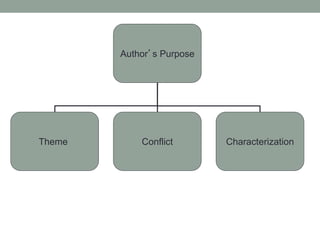
An Author’s Purpose
• When writing a literary analysis, you can go
beyond the basic literary elements and apply
them to other issues/categories.
(psychology, politics, history, etc.)
A literary analysis should focus on
one or a combination of the
following elements to convey your
investigation of the author’s
purpose.
Author’s Purpose
Theme Conflict Characterization
How is a literary analysis
an argument?
• When writing a literary analysis, you will focus on
specific attribute(s) of the text(s).
• An attribute can be the theme, characterization,
conflict, or a literary device.
• When discussing these attributes, you will want to
make sure that you are making a specific, arguable
point (thesis) about these attributes.
• You will defend this point with reasons and
evidence drawn from the text. (Much like a lawyer!)
Our Literary Analysis
•We will write a paper that focuses on
one internal conflict that Marji
experiences in “Persepolis”
• (I will hand these out when we start writing)
•For example,
•Truth vs. Lies
Thesis Statement
• Your thesis should explain how Marji changes or learns
something about herself/life through the struggle with this
conflict.
• For example,
• Through her struggle with truth versus lies, Marjane learns that she
must go beyond simply what a person, group, or government says to
think critically and make her own decisions about what to believe
• Marjane’s struggle with truth and lies parallels the journey that all of
Iran must go through as they come to understand the truth behind their
government’s actions.
• Your paper should explore/give examples of at least the 3 most
important events/times that Marji struggles with the conflict.
• Remember- you must PROVE that your thesis is correct by
giving examples and evidence that back you up!
The Format
of the Introduction
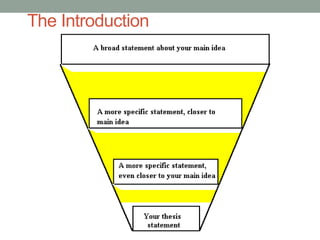
• The introduction begins with a broad
statement about the main idea. This
statement might suggest background or the
general category to which the thesis idea
belongs.
• The next sentences are more specific,
moving closer to the actual thesis of the
essay.
• The final sentence of an introduction often
contains a fairly specific version of the
main idea; it is the thesis statement.
The introductory paragraph must include:
•A general statement about the theme
•The title and author of the story
•A brief summary of the story
•A clear thesis statement
The Introduction
Writing the Introduction
• Sentence 1: The general statement
• Is a general topic sentence
• Introduces the topic of the essay
• Captures the reader’s attention through a
quote, observation, definition, or
anecdote
• Sentences 2-4: The summary sentences
• Includes the title and author
• Brief summary and relevant background
information of novel or short story
• Sentences 5(-6)
• Contains the thesis statement and proofs
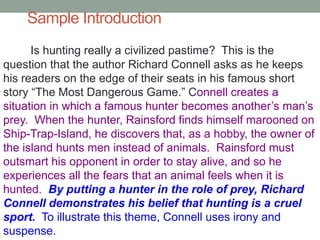
Sample Introduction
Is hunting really a civilized pastime? This is the
question that the author Richard Connell asks as he keeps
his readers on the edge of their seats in his famous short
story “The Most Dangerous Game.” Connell creates a
situation in which a famous hunter becomes another’s man’s
prey. When the hunter, Rainsford finds himself marooned on
Ship-Trap-Island, he discovers that, as a hobby, the owner of
the island hunts men instead of animals. Rainsford must
outsmart his opponent in order to stay alive, and so he
experiences all the fears that an animal feels when it is
hunted. By putting a hunter in the role of prey, Richard
Connell demonstrates his belief that hunting is a cruel
sport. To illustrate this theme, Connell uses irony and
suspense.
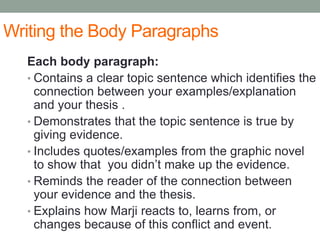
Writing the Body Paragraphs
Each body paragraph:
• Contains a clear topic sentence which identifies the
connection between your examples/explanation
and your thesis .
• Demonstrates that the topic sentence is true by
giving evidence.
• Includes quotes/examples from the graphic novel
to show that you didn’t make up the evidence.
• Reminds the reader of the connection between
your evidence and the thesis.
• Explains how Marji reacts to, learns from, or
changes because of this conflict and event.
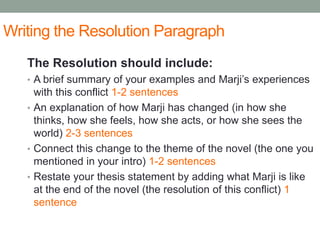
Writing the Resolution Paragraph
The Resolution should include:
• A brief summary of your examples and Marji’s experiences
with this conflict 1-2 sentences
• An explanation of how Marji has changed (in how she
thinks, how she feels, how she acts, or how she sees the
world) 2-3 sentences
• Connect this change to the theme of the novel (the one you
mentioned in your intro) 1-2 sentences
• Restate your thesis statement by adding what Marji is like
at the end of the novel (the resolution of this conflict) 1
sentence
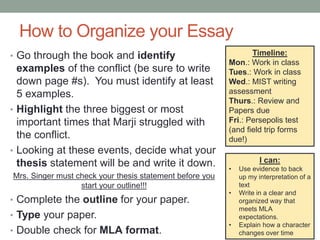
How to Organize your Essay
• Go through the book and identify
examples of the conflict (be sure to write
down page #s). You must identify at least
5 examples.
• Highlight the three biggest or most
important times that Marji struggled with
the conflict.
• Looking at these events, decide what your
thesis statement will be and write it down.
Mrs. Singer must check your thesis statement before you
start your outline!!!
• Complete the outline for your paper.
• Type your paper.
• Double check for MLA format.
Timeline:
Mon.: Work in class
Tues.: Work in class
Wed.: MIST writing
assessment
Thurs.: Review and
Papers due
Fri.: Persepolis test
(and field trip forms
due!)
I can:
• Use evidence to back
up my interpretation of a
text
• Write in a clear and
organized way that
meets MLA
expectations.
• Explain how a character
changes over time
Literary analysis paper persepolis

Literary analysis paper persepolis

  • 1.
    WRITING THE LITERARY ANALYSIS Howto avoid F’s and impress Mrs. Singer
  • 2.
    Analyze: examine methodically andin detail the constitution or structure of (something, especially information), typically for purposes of explanation and interpretation. • Methodically- in an organized and logical way • Explanation- giving details and overview • Interpretation- your own conclusion based on the information
  • 3.
    An analysis explainswhat a work of literature means, and how it means it.
  • 4.
    An Author’s Purpose •When writing a literary analysis, you can go beyond the basic literary elements and apply them to other issues/categories. (psychology, politics, history, etc.)
  • 5.
    A literary analysisshould focus on one or a combination of the following elements to convey your investigation of the author’s purpose.
  • 6.
  • 7.
    How is aliterary analysis an argument? • When writing a literary analysis, you will focus on specific attribute(s) of the text(s). • An attribute can be the theme, characterization, conflict, or a literary device. • When discussing these attributes, you will want to make sure that you are making a specific, arguable point (thesis) about these attributes. • You will defend this point with reasons and evidence drawn from the text. (Much like a lawyer!)
  • 8.
    Our Literary Analysis •Wewill write a paper that focuses on one internal conflict that Marji experiences in “Persepolis” • (I will hand these out when we start writing) •For example, •Truth vs. Lies
  • 9.
    Thesis Statement • Yourthesis should explain how Marji changes or learns something about herself/life through the struggle with this conflict. • For example, • Through her struggle with truth versus lies, Marjane learns that she must go beyond simply what a person, group, or government says to think critically and make her own decisions about what to believe • Marjane’s struggle with truth and lies parallels the journey that all of Iran must go through as they come to understand the truth behind their government’s actions. • Your paper should explore/give examples of at least the 3 most important events/times that Marji struggles with the conflict. • Remember- you must PROVE that your thesis is correct by giving examples and evidence that back you up!
  • 10.
    The Format of theIntroduction • The introduction begins with a broad statement about the main idea. This statement might suggest background or the general category to which the thesis idea belongs. • The next sentences are more specific, moving closer to the actual thesis of the essay. • The final sentence of an introduction often contains a fairly specific version of the main idea; it is the thesis statement.
  • 11.
    The introductory paragraphmust include: •A general statement about the theme •The title and author of the story •A brief summary of the story •A clear thesis statement
  • 12.
  • 13.
    Writing the Introduction •Sentence 1: The general statement • Is a general topic sentence • Introduces the topic of the essay • Captures the reader’s attention through a quote, observation, definition, or anecdote • Sentences 2-4: The summary sentences • Includes the title and author • Brief summary and relevant background information of novel or short story • Sentences 5(-6) • Contains the thesis statement and proofs
  • 14.
    Sample Introduction Is huntingreally a civilized pastime? This is the question that the author Richard Connell asks as he keeps his readers on the edge of their seats in his famous short story “The Most Dangerous Game.” Connell creates a situation in which a famous hunter becomes another’s man’s prey. When the hunter, Rainsford finds himself marooned on Ship-Trap-Island, he discovers that, as a hobby, the owner of the island hunts men instead of animals. Rainsford must outsmart his opponent in order to stay alive, and so he experiences all the fears that an animal feels when it is hunted. By putting a hunter in the role of prey, Richard Connell demonstrates his belief that hunting is a cruel sport. To illustrate this theme, Connell uses irony and suspense.
  • 15.
    Writing the BodyParagraphs Each body paragraph: • Contains a clear topic sentence which identifies the connection between your examples/explanation and your thesis . • Demonstrates that the topic sentence is true by giving evidence. • Includes quotes/examples from the graphic novel to show that you didn’t make up the evidence. • Reminds the reader of the connection between your evidence and the thesis. • Explains how Marji reacts to, learns from, or changes because of this conflict and event.
  • 16.
    Writing the ResolutionParagraph The Resolution should include: • A brief summary of your examples and Marji’s experiences with this conflict 1-2 sentences • An explanation of how Marji has changed (in how she thinks, how she feels, how she acts, or how she sees the world) 2-3 sentences • Connect this change to the theme of the novel (the one you mentioned in your intro) 1-2 sentences • Restate your thesis statement by adding what Marji is like at the end of the novel (the resolution of this conflict) 1 sentence
  • 17.
    How to Organizeyour Essay • Go through the book and identify examples of the conflict (be sure to write down page #s). You must identify at least 5 examples. • Highlight the three biggest or most important times that Marji struggled with the conflict. • Looking at these events, decide what your thesis statement will be and write it down. Mrs. Singer must check your thesis statement before you start your outline!!! • Complete the outline for your paper. • Type your paper. • Double check for MLA format. Timeline: Mon.: Work in class Tues.: Work in class Wed.: MIST writing assessment Thurs.: Review and Papers due Fri.: Persepolis test (and field trip forms due!) I can: • Use evidence to back up my interpretation of a text • Write in a clear and organized way that meets MLA expectations. • Explain how a character changes over time