
Rivers Waterfalls, Plunge pools & gorges By Sam & Callum   (FEHS Geog Students 2009-11)
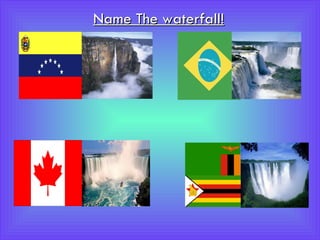
Name The waterfall! Angel Falls Niagara Falls Victoria Falls Iguaçu Falls
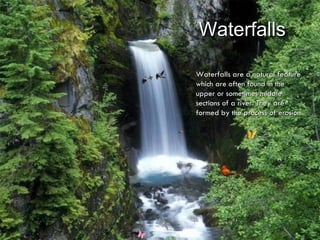
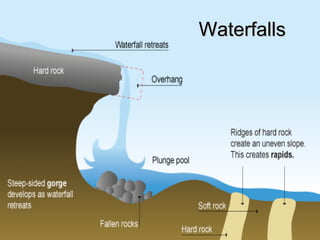
Waterfalls Waterfalls are a natural feature which are often found in the upper or sometimes middle sections of a river. They are formed by the process of erosion.
Waterfalls
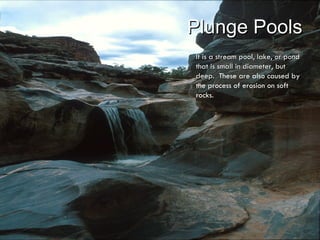
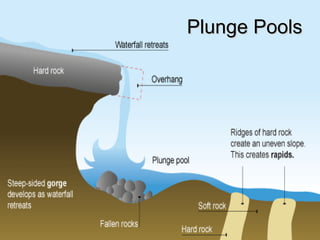
Plunge Pools It is a stream pool, lake, or pond that is small in diameter, but deep.   These are also caused by the process of erosion on soft rocks.
Plunge Pools
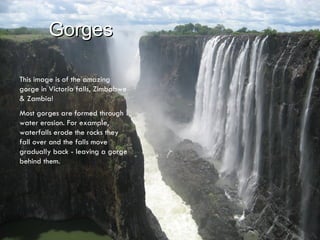
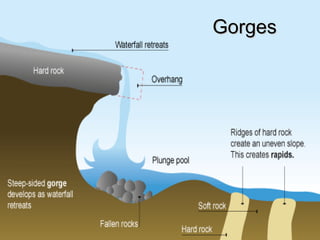
Gorges This image is of the amazing gorge in Victoria falls, Zimbabwe & Zambia!  Most gorges are formed through water erosion. For example, waterfalls erode the rocks they fall over and the falls move gradually back - leaving a gorge behind them.
Gorges
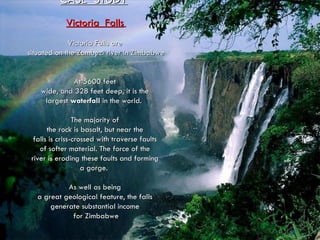
CASE  STUDY      Victoria  Falls   Victoria Falls are  situated on the Zambezi river in Zimbabwe.   At 5600 feet  wide, and 328 feet deep, it is the  largest  waterfall  in the world.   The majority of  the rock is basalt, but near the  falls is criss-crossed with traverse faults  of softer material. The force of the  river is eroding these faults and forming  a gorge.   As well as being  a great geological feature, the falls  generate substantial income  for Zimbabwe
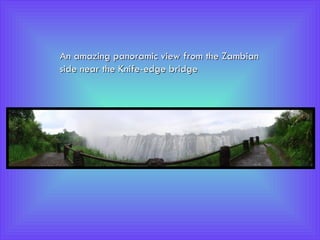
An amazing  panoramic view from the Zambian side near the Knife-edge bridge
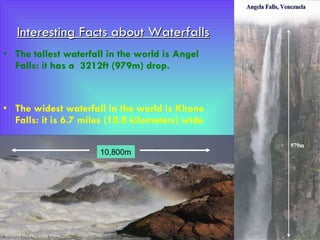
Interesting Facts about Waterfalls The tallest waterfall in the world is Angel Falls: it has a  3212ft (979m) drop. The widest waterfall in the world is Khone Falls: it is 6.7 miles (10.8 kilometers) wide  There are 10 types of  waterfalls: block, cascade, cataract, fan, horsetail, plunge, punchbowl, segmented, tiered and multi-step. 10,800m
Plenary Q) What process causes Waterfalls, Plunge Pools and Gorges to form? A) Erosion Q) What section of a river are waterfalls generally found? Upper, Middle or Lower? A) Usually Upper but can be found in Middle Q) And finally, why does a waterfall gradually retreat? (Explanation) A) As the process of erosion continues to act upon the rocks and the turbulent water at the bottom of the plunge pool erodes the cliff, an overhang is created, as these become too heavy they break off and fall so the waterfall gradually retreats upstream, this is what causes long gorges such as the one in Victoria Falls
Thank you for watching,

Waterfalls

  • 1.
    Rivers Waterfalls, Plungepools & gorges By Sam & Callum (FEHS Geog Students 2009-11)
  • 2.
    Name The waterfall!Angel Falls Niagara Falls Victoria Falls Iguaçu Falls
  • 3.
    Waterfalls Waterfalls area natural feature which are often found in the upper or sometimes middle sections of a river. They are formed by the process of erosion.
  • 4.
  • 5.
    Plunge Pools Itis a stream pool, lake, or pond that is small in diameter, but deep. These are also caused by the process of erosion on soft rocks.
  • 6.
  • 7.
    Gorges This imageis of the amazing gorge in Victoria falls, Zimbabwe & Zambia! Most gorges are formed through water erosion. For example, waterfalls erode the rocks they fall over and the falls move gradually back - leaving a gorge behind them.
  • 8.
  • 9.
    CASE  STUDY     Victoria  Falls Victoria Falls are  situated on the Zambezi river in Zimbabwe.   At 5600 feet  wide, and 328 feet deep, it is the  largest  waterfall  in the world.   The majority of  the rock is basalt, but near the  falls is criss-crossed with traverse faults  of softer material. The force of the  river is eroding these faults and forming  a gorge.   As well as being  a great geological feature, the falls  generate substantial income  for Zimbabwe
  • 10.
    An amazing panoramic view from the Zambian side near the Knife-edge bridge
  • 11.
    Interesting Facts aboutWaterfalls The tallest waterfall in the world is Angel Falls: it has a 3212ft (979m) drop. The widest waterfall in the world is Khone Falls: it is 6.7 miles (10.8 kilometers) wide There are 10 types of waterfalls: block, cascade, cataract, fan, horsetail, plunge, punchbowl, segmented, tiered and multi-step. 10,800m
  • 12.
    Plenary Q) Whatprocess causes Waterfalls, Plunge Pools and Gorges to form? A) Erosion Q) What section of a river are waterfalls generally found? Upper, Middle or Lower? A) Usually Upper but can be found in Middle Q) And finally, why does a waterfall gradually retreat? (Explanation) A) As the process of erosion continues to act upon the rocks and the turbulent water at the bottom of the plunge pool erodes the cliff, an overhang is created, as these become too heavy they break off and fall so the waterfall gradually retreats upstream, this is what causes long gorges such as the one in Victoria Falls
  • 13.
    Thank you forwatching,