Waterfalls
Glenn brookes
Ryan hogg
Jack forman
Introduction
Waterfalls are found mainly in the upper
stages of a river; they form a gorge when
hard rock is located above soft rock and
over time erosion takes its cause.
Example – angel falls,
Venezuela
One of the world’s most renowned waterfalls is that of
Angel Falls, Venezuela in South America. It is the world’s
highest free-falling waterfall coming in at just under
1000m at 979m. It is situated in the river Churún; the
name of the waterfall is so that in the native language it
literally means THUNDER! It is located way out in the
wilderness of Venezuela and getting there is not an easy
task, involving a long flight from the town of Caracas and
a trek to the top.
The process of a waterfall
Stage 1 - undercutting
The undercutting of the waterfall is a simple
process, it involves the rocks coming down
from the waterfall; these then cut back into
the soft rock at the base of the waterfall
eroding it away – this is what is known as
undercutting.
Stage 2 – overhang collapses
This is connected to the first phase of a
waterfall; continuous undercutting means
that the hard rock that is found above the
soft rock becomes un-supported so it just
falls away moving the waterfall further
back up the valley.
Stage 3 – plungepool
develops
The plungepool is found at the base of a
waterfall; this is created again through a
process of erosion; it is made by the sheer
force of boulders falling from the waterfall
and ‘plunging’ into the water below;
eroding away the bed of the river.
Stage 4 – waterfall
retreats back upstream
This is linked to stage 2 of the process in the
way that the main reason behind this is the
fact that undercutting makes the overhang
collapse thus moving the waterfall further
back up the valley.
Stage 5 – steep, gorge-like
valleys
The valleys that waterfalls are found in
become steep due to the fact that the
undercutting erodes at an angle making
the valley become fairly steep.
V-shaped
Valleys
What is a V-shaped valley?
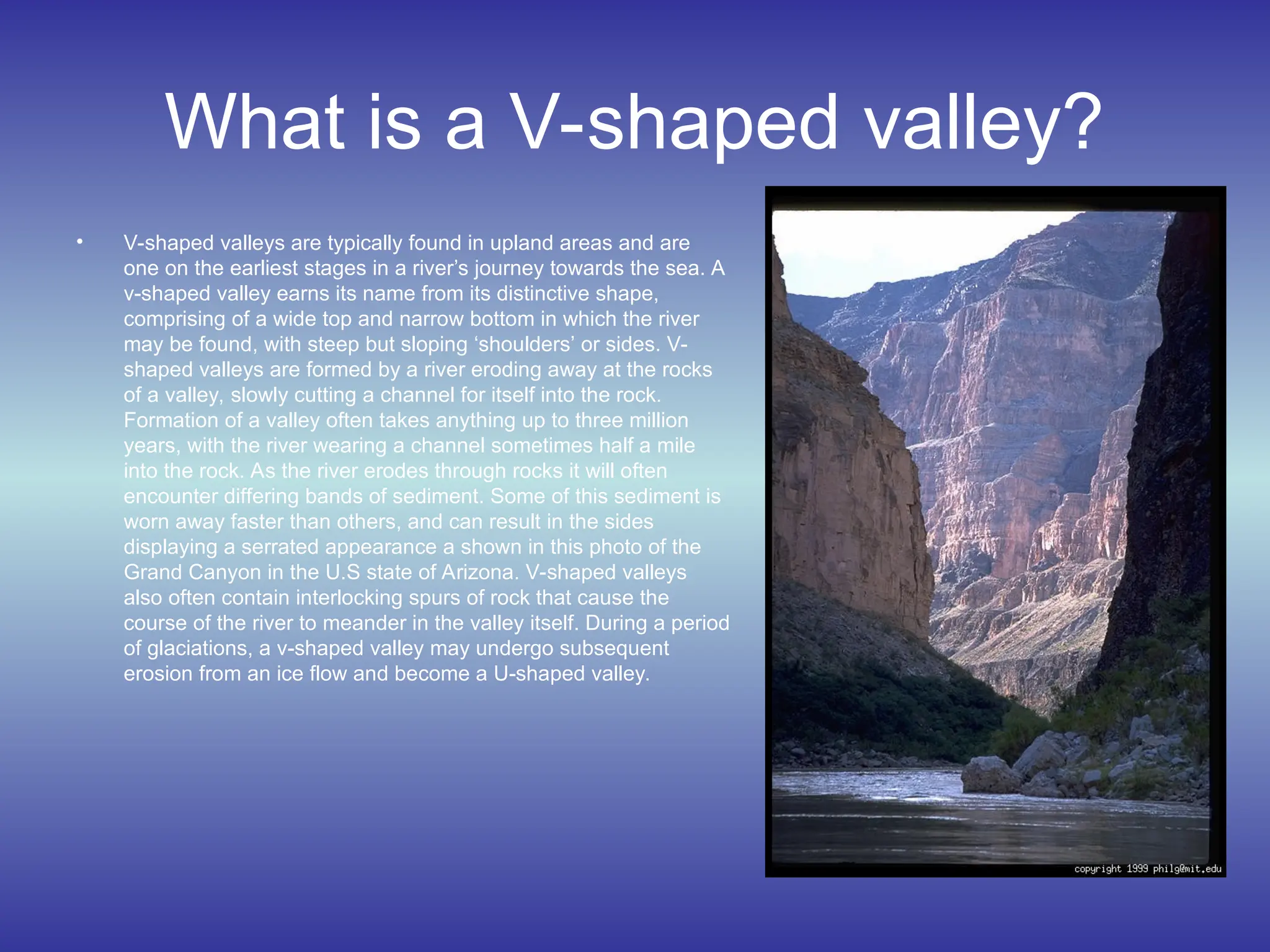
• V-shaped valleys are typically found in upland areas and are
one on the earliest stages in a river’s journey towards the sea. A
v-shaped valley earns its name from its distinctive shape,
comprising of a wide top and narrow bottom in which the river
may be found, with steep but sloping ‘shoulders’ or sides. V-
shaped valleys are formed by a river eroding away at the rocks
of a valley, slowly cutting a channel for itself into the rock.
Formation of a valley often takes anything up to three million
years, with the river wearing a channel sometimes half a mile
into the rock. As the river erodes through rocks it will often
encounter differing bands of sediment. Some of this sediment is
worn away faster than others, and can result in the sides
displaying a serrated appearance a shown in this photo of the
Grand Canyon in the U.S state of Arizona. V-shaped valleys
also often contain interlocking spurs of rock that cause the
course of the river to meander in the valley itself. During a period
of glaciations, a v-shaped valley may undergo subsequent
erosion from an ice flow and become a U-shaped valley.
Some Pictures of V-shaped Valleys
Rapids
How are Rapids formed?
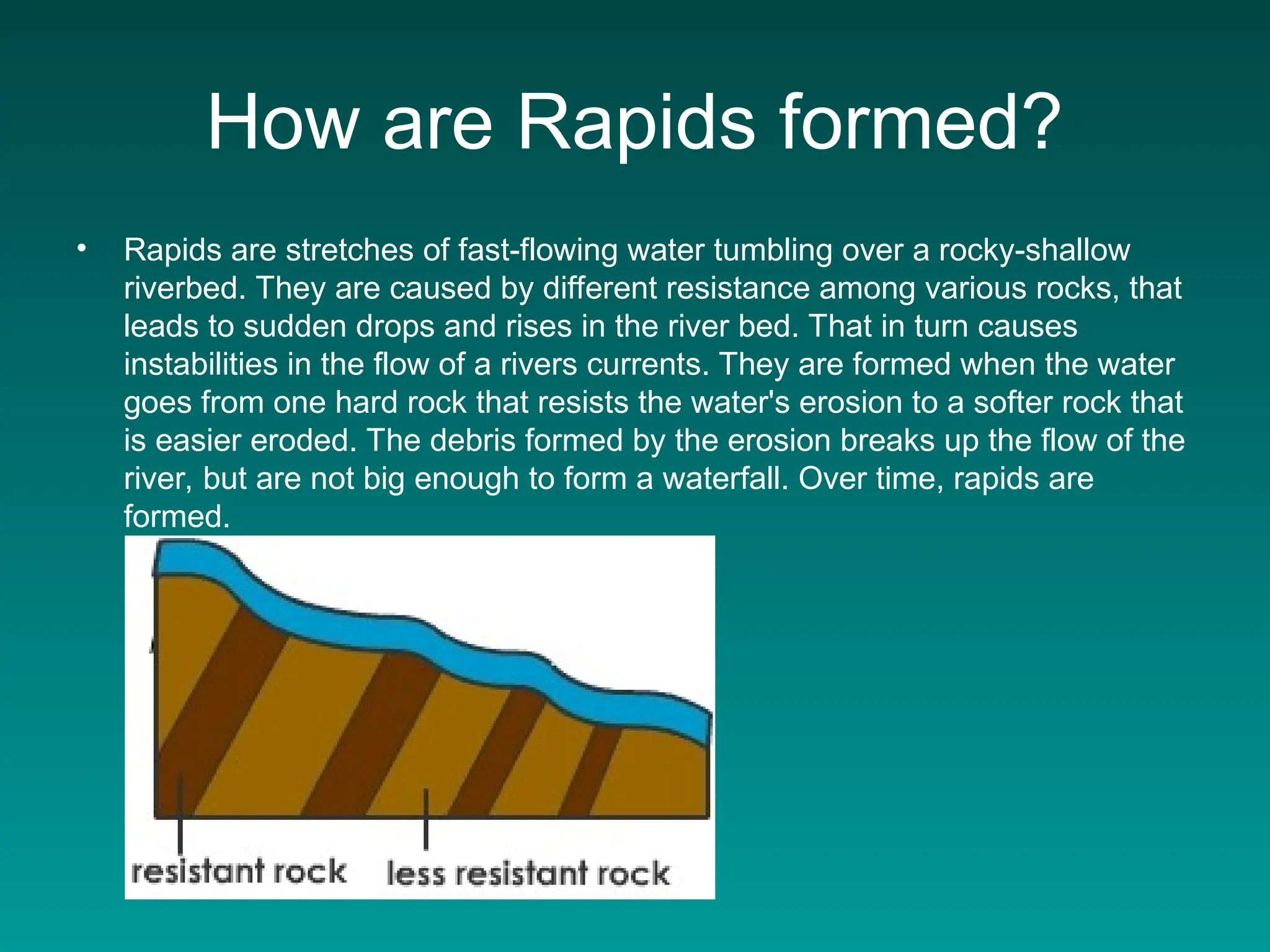
• Rapids are stretches of fast-flowing water tumbling over a rocky-shallow
riverbed. They are caused by different resistance among various rocks, that
leads to sudden drops and rises in the river bed. That in turn causes
instabilities in the flow of a rivers currents. They are formed when the water
goes from one hard rock that resists the water's erosion to a softer rock that
is easier eroded. The debris formed by the erosion breaks up the flow of the
river, but are not big enough to form a waterfall. Over time, rapids are
formed.
Interlocking Spurs
How they’re created
Interlocking spurs
Occur in the top part of a river course in upland
areas. The water cannot erode the hard
rock as easily as soft rock, so eventually the
course of the river reflects this and ridges
are produced when a river twists and turns
around obstacles of harder rock on its
downward path. The ridges interlock in a
zipper like the teeth of the zip.
Case Study: R. Dane
This is the R. Dane nr Macclesfield in
Cheshire, near the Peak District
National Park. The Rivers source
is in the Pennine Hills, starting in a
peat bog. The physical of the
geography of the area gives ideal
conditions for a river to start, with
the bogs retaining water when it
rains, but allowing it’s slow release
over time.
The image opposite shows an
interlocking spurs (Small letter ‘S’)
Source:
http://www.nwlg.org/pages/resources/geog/hydro_c
ycle/dane/d_map.htm

Waterfalls & Rapids 2.ppt Waterfalls & Rapids 2.ppt

  • 1.
  • 2.
    Introduction Waterfalls are foundmainly in the upper stages of a river; they form a gorge when hard rock is located above soft rock and over time erosion takes its cause.
  • 3.
    Example – angelfalls, Venezuela One of the world’s most renowned waterfalls is that of Angel Falls, Venezuela in South America. It is the world’s highest free-falling waterfall coming in at just under 1000m at 979m. It is situated in the river Churún; the name of the waterfall is so that in the native language it literally means THUNDER! It is located way out in the wilderness of Venezuela and getting there is not an easy task, involving a long flight from the town of Caracas and a trek to the top.
  • 4.
    The process ofa waterfall
  • 5.
    Stage 1 -undercutting The undercutting of the waterfall is a simple process, it involves the rocks coming down from the waterfall; these then cut back into the soft rock at the base of the waterfall eroding it away – this is what is known as undercutting.
  • 6.
    Stage 2 –overhang collapses This is connected to the first phase of a waterfall; continuous undercutting means that the hard rock that is found above the soft rock becomes un-supported so it just falls away moving the waterfall further back up the valley.
  • 7.
    Stage 3 –plungepool develops The plungepool is found at the base of a waterfall; this is created again through a process of erosion; it is made by the sheer force of boulders falling from the waterfall and ‘plunging’ into the water below; eroding away the bed of the river.
  • 8.
    Stage 4 –waterfall retreats back upstream This is linked to stage 2 of the process in the way that the main reason behind this is the fact that undercutting makes the overhang collapse thus moving the waterfall further back up the valley.
  • 9.
    Stage 5 –steep, gorge-like valleys The valleys that waterfalls are found in become steep due to the fact that the undercutting erodes at an angle making the valley become fairly steep.
  • 10.
  • 11.
    What is aV-shaped valley? • V-shaped valleys are typically found in upland areas and are one on the earliest stages in a river’s journey towards the sea. A v-shaped valley earns its name from its distinctive shape, comprising of a wide top and narrow bottom in which the river may be found, with steep but sloping ‘shoulders’ or sides. V- shaped valleys are formed by a river eroding away at the rocks of a valley, slowly cutting a channel for itself into the rock. Formation of a valley often takes anything up to three million years, with the river wearing a channel sometimes half a mile into the rock. As the river erodes through rocks it will often encounter differing bands of sediment. Some of this sediment is worn away faster than others, and can result in the sides displaying a serrated appearance a shown in this photo of the Grand Canyon in the U.S state of Arizona. V-shaped valleys also often contain interlocking spurs of rock that cause the course of the river to meander in the valley itself. During a period of glaciations, a v-shaped valley may undergo subsequent erosion from an ice flow and become a U-shaped valley.
  • 12.
    Some Pictures ofV-shaped Valleys
  • 14.
  • 15.
    How are Rapidsformed? • Rapids are stretches of fast-flowing water tumbling over a rocky-shallow riverbed. They are caused by different resistance among various rocks, that leads to sudden drops and rises in the river bed. That in turn causes instabilities in the flow of a rivers currents. They are formed when the water goes from one hard rock that resists the water's erosion to a softer rock that is easier eroded. The debris formed by the erosion breaks up the flow of the river, but are not big enough to form a waterfall. Over time, rapids are formed.
  • 16.
  • 17.
    How they’re created Interlockingspurs Occur in the top part of a river course in upland areas. The water cannot erode the hard rock as easily as soft rock, so eventually the course of the river reflects this and ridges are produced when a river twists and turns around obstacles of harder rock on its downward path. The ridges interlock in a zipper like the teeth of the zip.
  • 18.
    Case Study: R.Dane This is the R. Dane nr Macclesfield in Cheshire, near the Peak District National Park. The Rivers source is in the Pennine Hills, starting in a peat bog. The physical of the geography of the area gives ideal conditions for a river to start, with the bogs retaining water when it rains, but allowing it’s slow release over time. The image opposite shows an interlocking spurs (Small letter ‘S’) Source: http://www.nwlg.org/pages/resources/geog/hydro_c ycle/dane/d_map.htm