MAJOR WATERFALLS IN
THE WORLD
DONEBY,
ARJUN .P
CLASS :8C
SCHOOL :KENDRIYA VIDYALAYA
SAP
 Anyone who’s seen a waterfall up close
will agree that their majesty is almost
indescribable. If even a small fall can
inspire these feelings, imagine what it’s
like to look at the world’s largest
waterfall.
 These are the 10 biggest falls [by width]
on the planet, based on their width, rather
than height or volume. Each one is
wonderful in its own way.
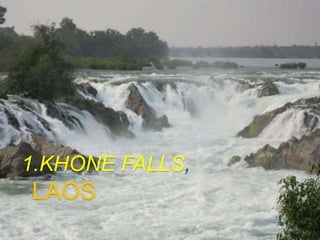
1.KHONE FALLS,
LAOS
Khone Falls
 Khone Falls is the largest waterfall in the world. At
35,376 feet wide, it’s almost twice the width of it
next largest competitor.
 The Khone Falls is a waterfall located
in Champasak Province on the Mekong River in
southern Laos, near the border with Cambodia .
The falls are characterised by thousands of islands
and countless waterways, giving the area its
name Si Phan Don or 'The 4,000 islands'.
 The highest falls reach to 21 metres (69 ft); the
succession of rapids stretch 9.7 km (6.0 mi) of the
river's length. The average discharge of the
cataract is nearly 11,000 m3/s, though the highest
volume on record was reached at over 49,000 m3/s
.
2.SALTO PARA,
VENEZUELA
Salto Para
 Salto Para, or Para Falls, is an 18,400-foot wide
waterfall on the Rio Caura in the Bolivar region of
Venezuela. These half-moon shaped falls are
formed where two parts of the river come together
and drop down almost 200 feet, each side of a
lush, green jungle island.
 The yearly precipitation range (3.300 l/) determines
the heavy amount of water transported by this river.
Halfway along the river course are the PARA
FALLS, the most abundant in Venezuela.
3.CHUTES KONGOU,
GABON
Chutes Kongou
 Also known as Kongou Falls, Chutes Kongou
measures 10,500 feet wide, making it the world’s
third largest existing waterfall. It’s part of the Ivindo
River in Gabon, and is roughly 185 feet tall.
Amongst the most powerful waterfalls in the world,
roughly 31,800 cubic feet of water flow down it
each second.
 These falls are truly a sight to behold, nestled
amongst dense, equatorial rainforests. Kongou
Falls is located within the Ivindo National Park,
which was set up to protect the biodiversity of the
Ivindo River
4.CATARATAS DEL
IGUAZO,
BRAZIL
Cataratas del Iguazo
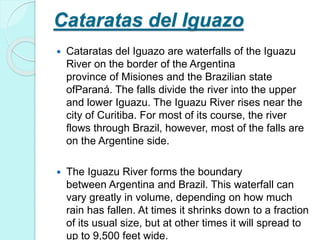
 Cataratas del Iguazo are waterfalls of the Iguazu
River on the border of the Argentina
province of Misiones and the Brazilian state
ofParaná. The falls divide the river into the upper
and lower Iguazu. The Iguazu River rises near the
city of Curitiba. For most of its course, the river
flows through Brazil, however, most of the falls are
on the Argentine side.
 The Iguazu River forms the boundary
between Argentina and Brazil. This waterfall can
vary greatly in volume, depending on how much
rain has fallen. At times it shrinks down to a fraction
of its usual size, but at other times it will spread to
up to 9,500 feet wide.
5.SALTOS DEL MOCON,
ARGENTINA
Saltos del Mocono
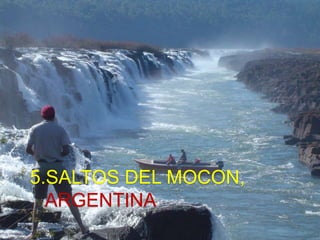
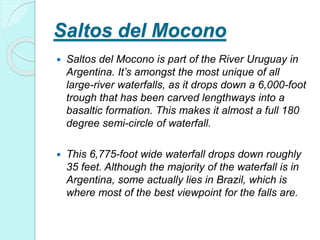
 Saltos del Mocono is part of the River Uruguay in
Argentina. It’s amongst the most unique of all
large-river waterfalls, as it drops down a 6,000-foot
trough that has been carved lengthways into a
basaltic formation. This makes it almost a full 180
degree semi-circle of waterfall.
 This 6,775-foot wide waterfall drops down roughly
35 feet. Although the majority of the waterfall is in
Argentina, some actually lies in Brazil, which is
where most of the best viewpoint for the falls are.
6.VERMILION FALLS
MINNESOTA
Vermilion Falls
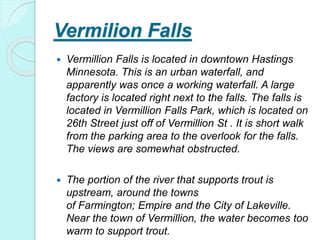
 Vermillion Falls is located in downtown Hastings
Minnesota. This is an urban waterfall, and
apparently was once a working waterfall. A large
factory is located right next to the falls. The falls is
located in Vermillion Falls Park, which is located on
26th Street just off of Vermillion St . It is short walk
from the parking area to the overlook for the falls.
The views are somewhat obstructed.
 The portion of the river that supports trout is
upstream, around the towns
of Farmington; Empire and the City of Lakeville.
Near the town of Vermillion, the water becomes too
warm to support trout.
7.VICTORIA FALLS,
ZIMBABWE
Victoria Falls
 Victoria Falls is a 5,600-foot wide waterfall located
on Zambezi River in Zimbabwe. The river falls
roughly 344 feet into a gorge made up of lateral
volcanic dikes, which were formed as the river
eroded the rock and soil of its bed.
 As the water falls into the gorge, mist and spray
rises up, more than 100 feet higher than the top of
the falls, giving the appearance that smoke is rising
out of a deep hole in the earth. This is where it gets
its traditional name, Mosi-oa-Tunya, which
translates to “the smoke that thunders.” The river is
divided into four segments by two islands, resulting
in four distinct falls, each of which has its own
name: .
8.CHUTES WAGENIA,
CONGO
Chutes Wagenia
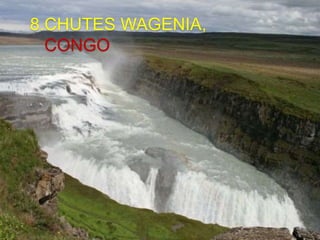
 Chutes Wagenia is more commonly known as
Kisangani Falls or Stanley Falls, the former of
which is accurate, but less often used, and the
latter of which stems from British colonial . It
stretches 4,500 feet, across the whole of the width
of the Lualaba River, in the Democratic Republic of
the Congo. Despite its width, it’s not an extremely
visually impressive waterfall, only dropping 30 feet
in total, with the highest single fall dropping just 15
feet.
 At the bottom of the rapids, the Lualaba becomes
the Congo River. The seven cataracts have a total
drop of 61 m (200 ft). The two major cataracts are
the first below Ubundu, forming a narrow and
9.NIAGARA FALLS,
UNITED STATES OF
AMERICA
Niagara Falls
• Located on the Niagara River, which drains Lake
Erie into Lake Ontario, the combined falls form
the highest flow rate of any waterfall in the world, with a
vertical drop of more than 165 feet (50 m). Horseshoe
Falls is the most powerful waterfall in North America, as
measured by vertical height and also by flow rate. The
falls are located 17 miles (27 km) north-northwest
of Buffalo.
• Niagara Falls were formed when glaciers receded at the
end of the Wisconsin glaciation , and water from the
newly formed Great Lakes carved a path through
the Niagara Escarpment en route to the Atlantic Ocean.
While not exceptionally high, the Niagara Falls are very
wide. More than six million cubic feet (168,000 m3) of
water falls over the crest line every minute in high
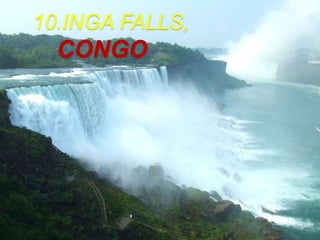
10.INGA FALLS,
CONGO
Inga Falls
 Inga Falls is a rapids 40 km from Matadi in
the Democratic Republic of the Congo where
the Congo River drops 96 m (315 ft) over the
course of 15 km (9 mi).
 Inga Falls form a part of a larger group of rapids -
Livingstone Falls and are located closer to the
lower part of these falls. Falls have formed in a
sharp bend of Congo River where the width of river
fluctuates from more than 4 km to mere 260 m. At
median discharge of 42,476 m³/s it is arguably the
largest waterfall in the world,although Inga Falls is
not a true waterfall. Its maximum recorded volume
is 70,793 m³/s .

Major waterfall in the world

  • 1.
    MAJOR WATERFALLS IN THEWORLD DONEBY, ARJUN .P CLASS :8C SCHOOL :KENDRIYA VIDYALAYA SAP
  • 2.
     Anyone who’sseen a waterfall up close will agree that their majesty is almost indescribable. If even a small fall can inspire these feelings, imagine what it’s like to look at the world’s largest waterfall.  These are the 10 biggest falls [by width] on the planet, based on their width, rather than height or volume. Each one is wonderful in its own way.
  • 3.
  • 4.
    Khone Falls  KhoneFalls is the largest waterfall in the world. At 35,376 feet wide, it’s almost twice the width of it next largest competitor.  The Khone Falls is a waterfall located in Champasak Province on the Mekong River in southern Laos, near the border with Cambodia . The falls are characterised by thousands of islands and countless waterways, giving the area its name Si Phan Don or 'The 4,000 islands'.  The highest falls reach to 21 metres (69 ft); the succession of rapids stretch 9.7 km (6.0 mi) of the river's length. The average discharge of the cataract is nearly 11,000 m3/s, though the highest volume on record was reached at over 49,000 m3/s .
  • 5.
  • 6.
    Salto Para  SaltoPara, or Para Falls, is an 18,400-foot wide waterfall on the Rio Caura in the Bolivar region of Venezuela. These half-moon shaped falls are formed where two parts of the river come together and drop down almost 200 feet, each side of a lush, green jungle island.  The yearly precipitation range (3.300 l/) determines the heavy amount of water transported by this river. Halfway along the river course are the PARA FALLS, the most abundant in Venezuela.
  • 7.
  • 8.
    Chutes Kongou  Alsoknown as Kongou Falls, Chutes Kongou measures 10,500 feet wide, making it the world’s third largest existing waterfall. It’s part of the Ivindo River in Gabon, and is roughly 185 feet tall. Amongst the most powerful waterfalls in the world, roughly 31,800 cubic feet of water flow down it each second.  These falls are truly a sight to behold, nestled amongst dense, equatorial rainforests. Kongou Falls is located within the Ivindo National Park, which was set up to protect the biodiversity of the Ivindo River
  • 9.
  • 10.
    Cataratas del Iguazo Cataratas del Iguazo are waterfalls of the Iguazu River on the border of the Argentina province of Misiones and the Brazilian state ofParaná. The falls divide the river into the upper and lower Iguazu. The Iguazu River rises near the city of Curitiba. For most of its course, the river flows through Brazil, however, most of the falls are on the Argentine side.  The Iguazu River forms the boundary between Argentina and Brazil. This waterfall can vary greatly in volume, depending on how much rain has fallen. At times it shrinks down to a fraction of its usual size, but at other times it will spread to up to 9,500 feet wide.
  • 11.
  • 12.
    Saltos del Mocono Saltos del Mocono is part of the River Uruguay in Argentina. It’s amongst the most unique of all large-river waterfalls, as it drops down a 6,000-foot trough that has been carved lengthways into a basaltic formation. This makes it almost a full 180 degree semi-circle of waterfall.  This 6,775-foot wide waterfall drops down roughly 35 feet. Although the majority of the waterfall is in Argentina, some actually lies in Brazil, which is where most of the best viewpoint for the falls are.
  • 13.
  • 14.
    Vermilion Falls  VermillionFalls is located in downtown Hastings Minnesota. This is an urban waterfall, and apparently was once a working waterfall. A large factory is located right next to the falls. The falls is located in Vermillion Falls Park, which is located on 26th Street just off of Vermillion St . It is short walk from the parking area to the overlook for the falls. The views are somewhat obstructed.  The portion of the river that supports trout is upstream, around the towns of Farmington; Empire and the City of Lakeville. Near the town of Vermillion, the water becomes too warm to support trout.
  • 15.
  • 16.
    Victoria Falls  VictoriaFalls is a 5,600-foot wide waterfall located on Zambezi River in Zimbabwe. The river falls roughly 344 feet into a gorge made up of lateral volcanic dikes, which were formed as the river eroded the rock and soil of its bed.  As the water falls into the gorge, mist and spray rises up, more than 100 feet higher than the top of the falls, giving the appearance that smoke is rising out of a deep hole in the earth. This is where it gets its traditional name, Mosi-oa-Tunya, which translates to “the smoke that thunders.” The river is divided into four segments by two islands, resulting in four distinct falls, each of which has its own name: .
  • 17.
  • 18.
    Chutes Wagenia  ChutesWagenia is more commonly known as Kisangani Falls or Stanley Falls, the former of which is accurate, but less often used, and the latter of which stems from British colonial . It stretches 4,500 feet, across the whole of the width of the Lualaba River, in the Democratic Republic of the Congo. Despite its width, it’s not an extremely visually impressive waterfall, only dropping 30 feet in total, with the highest single fall dropping just 15 feet.  At the bottom of the rapids, the Lualaba becomes the Congo River. The seven cataracts have a total drop of 61 m (200 ft). The two major cataracts are the first below Ubundu, forming a narrow and
  • 19.
  • 20.
    Niagara Falls • Locatedon the Niagara River, which drains Lake Erie into Lake Ontario, the combined falls form the highest flow rate of any waterfall in the world, with a vertical drop of more than 165 feet (50 m). Horseshoe Falls is the most powerful waterfall in North America, as measured by vertical height and also by flow rate. The falls are located 17 miles (27 km) north-northwest of Buffalo. • Niagara Falls were formed when glaciers receded at the end of the Wisconsin glaciation , and water from the newly formed Great Lakes carved a path through the Niagara Escarpment en route to the Atlantic Ocean. While not exceptionally high, the Niagara Falls are very wide. More than six million cubic feet (168,000 m3) of water falls over the crest line every minute in high
  • 21.
  • 22.
    Inga Falls  IngaFalls is a rapids 40 km from Matadi in the Democratic Republic of the Congo where the Congo River drops 96 m (315 ft) over the course of 15 km (9 mi).  Inga Falls form a part of a larger group of rapids - Livingstone Falls and are located closer to the lower part of these falls. Falls have formed in a sharp bend of Congo River where the width of river fluctuates from more than 4 km to mere 260 m. At median discharge of 42,476 m³/s it is arguably the largest waterfall in the world,although Inga Falls is not a true waterfall. Its maximum recorded volume is 70,793 m³/s .