
ION PAIR CHROMATOGRAPHY 
1st semister – seminar 
M-Pharm (Pharmaceutics Dept) 
Under the guidance of 
Dr. (Mr.) M.T.MOHITE 
(Dept of Pharmaceutics)
ION-PAIR CHROMATOGRAPHY 
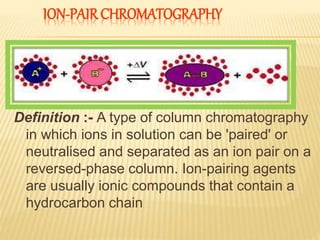
Definition :- A type of column chromatography 
in which ions in solution can be 'paired' or 
neutralised and separated as an ion pair on a 
reversed-phase column. Ion-pairing agents 
are usually ionic compounds that contain a 
hydrocarbon chain
ION-PAIR CHROMATOGRAPHY 
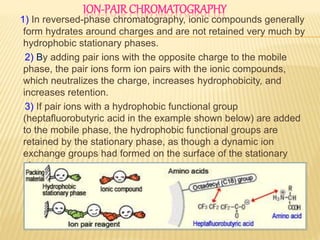
1) In reversed-phase chromatography, ionic compounds generally 
form hydrates around charges and are not retained very much by 
hydrophobic stationary phases. 
2) By adding pair ions with the opposite charge to the mobile 
phase, the pair ions form ion pairs with the ionic compounds, 
which neutralizes the charge, increases hydrophobicity, and 
increases retention. 
3) If pair ions with a hydrophobic functional group 
(heptafluorobutyric acid in the example shown below) are added 
to the mobile phase, the hydrophobic functional groups are 
retained by the stationary phase, as though a dynamic ion 
exchange groups had formed on the surface of the stationary 
phase.
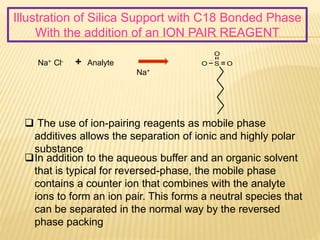
Illustration of Silica Support with C18 Bonded Phase 
With the addition of an ION PAIR REAGENT 
Na+ Cl- + Analyte 
Na+ 
O 
O S 
O 
 The use of ion-pairing reagents as mobile phase 
additives allows the separation of ionic and highly polar 
substance 
In addition to the aqueous buffer and an organic solvent 
that is typical for reversed-phase, the mobile phase 
contains a counter ion that combines with the analyte 
ions to form an ion pair. This forms a neutral species that 
can be separated in the normal way by the reversed 
phase packing
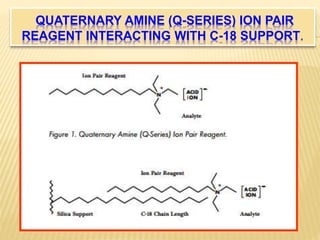
QUATERNARY AMINE (Q-SERIES) ION PAIR 
REAGENT INTERACTING WITH C-18 SUPPORT.
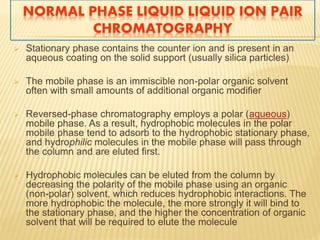
NORMAL PHASE LIQUID LIQUID ION PAIR 
CHROMATOGRAPHY 
 Stationary phase contains the counter ion and is present in an 
aqueous coating on the solid support (usually silica particles) 
 The mobile phase is an immiscible non-polar organic solvent 
often with small amounts of additional organic modifier 
 Reversed-phase chromatography employs a polar (aqueous) 
mobile phase. As a result, hydrophobic molecules in the polar 
mobile phase tend to adsorb to the hydrophobic stationary phase, 
and hydrophilic molecules in the mobile phase will pass through 
the column and are eluted first. 
 Hydrophobic molecules can be eluted from the column by 
decreasing the polarity of the mobile phase using an organic 
(non-polar) solvent, which reduces hydrophobic interactions. The 
more hydrophobic the molecule, the more strongly it will bind to 
the stationary phase, and the higher the concentration of organic 
solvent that will be required to elute the molecule
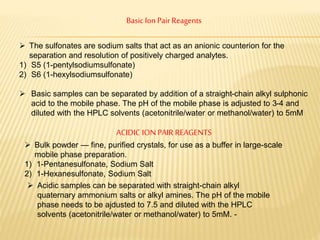
Basic Ion Pair Reagents 
 The sulfonates are sodium salts that act as an anionic counterion for the 
separation and resolution of positively charged analytes. 
1) S5 (1-pentylsodiumsulfonate) 
2) S6 (1-hexylsodiumsulfonate) 
 Basic samples can be separated by addition of a straight-chain alkyl sulphonic 
acid to the mobile phase. The pH of the mobile phase is adjusted to 3-4 and 
diluted with the HPLC solvents (acetonitrile/water or methanol/water) to 5mM 
ACIDIC ION PAIR REAGENTS 
 Bulk powder — fine, purified crystals, for use as a buffer in large-scale 
mobile phase preparation. 
1) 1-Pentanesulfonate, Sodium Salt 
2) 1-Hexanesulfonate, Sodium Salt 
 Acidic samples can be separated with straight-chain alkyl 
quaternary ammonium salts or alkyl amines. The pH of the mobile 
phase needs to be ajdusted to 7.5 and diluted with the HPLC 
solvents (acetonitrile/water or methanol/water) to 5mM. -
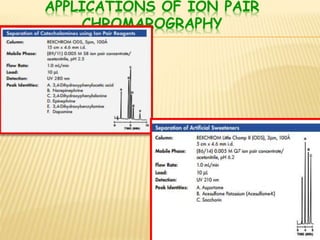
APPLICATIONS OF ION PAIR 
CHROMAROGRAPHY
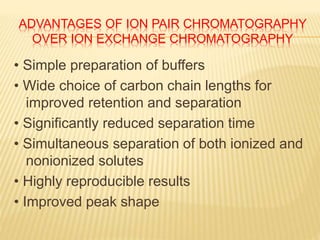
ADVANTAGES OF ION PAIR CHROMATOGRAPHY 
OVER ION EXCHANGE CHROMATOGRAPHY 
• Simple preparation of buffers 
• Wide choice of carbon chain lengths for 
improved retention and separation 
• Significantly reduced separation time 
• Simultaneous separation of both ionized and 
nonionized solutes 
• Highly reproducible results 
• Improved peak shape
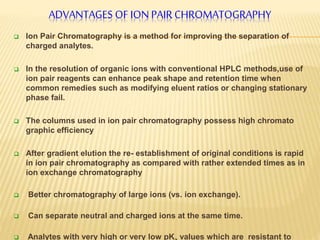
ADVANTAGES OF ION PAIR CHROMATOGRAPHY 
 Ion Pair Chromatography is a method for improving the separation of 
charged analytes. 
 In the resolution of organic ions with conventional HPLC methods,use of 
ion pair reagents can enhance peak shape and retention time when 
common remedies such as modifying eluent ratios or changing stationary 
phase fail. 
 The columns used in ion pair chromatography possess high chromato 
graphic efficiency 
 After gradient elution the re- establishment of original conditions is rapid 
in ion pair chromatography as compared with rather extended times as in 
ion exchange chromatography 
 Better chromatography of large ions (vs. ion exchange). 
 Can separate neutral and charged ions at the same time. 
 Analytes with very high or very low pKa values which are resistant to
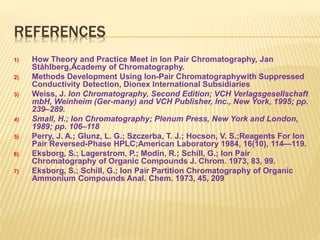
REFERENCES 
1) How Theory and Practice Meet in Ion Pair Chromatography, Jan 
Ståhlberg,Academy of Chromatography. 
2) Methods Development Using Ion-Pair Chromatographywith Suppressed 
Conductivity Detection, Dionex International Subsidiaries 
3) Weiss, J. Ion Chromatography, Second Edition; VCH Verlagsgesellschaft 
mbH, Weinheim (Ger-many) and VCH Publisher, Inc., New York, 1995; pp. 
239–289. 
4) Small, H.; Ion Chromatography; Plenum Press, New York and London, 
1989; pp. 106–118 
5) Perry, J. A.; Glunz, L. G.; Szczerba, T. J.; Hocson, V. S.;Reagents For Ion 
Pair Reversed-Phase HPLC;American Laboratory 1984, 16(10), 114—119. 
6) Eksborg, S.; Lagerstrom, P.; Modin, R.; Schill, G.; Ion Pair 
Chromatography of Organic Compounds J. Chrom. 1973, 83, 99. 
7) Eksborg, S.; Schill, G.; Ion Pair Partition Chromatography of Organic 
Ammonium Compounds Anal. Chem. 1973, 45, 209
Ion pair chromatography final

Ion pair chromatography final

  • 1.
    ION PAIR CHROMATOGRAPHY 1st semister – seminar M-Pharm (Pharmaceutics Dept) Under the guidance of Dr. (Mr.) M.T.MOHITE (Dept of Pharmaceutics)
  • 2.
    ION-PAIR CHROMATOGRAPHY Definition:- A type of column chromatography in which ions in solution can be 'paired' or neutralised and separated as an ion pair on a reversed-phase column. Ion-pairing agents are usually ionic compounds that contain a hydrocarbon chain
  • 3.
    ION-PAIR CHROMATOGRAPHY 1)In reversed-phase chromatography, ionic compounds generally form hydrates around charges and are not retained very much by hydrophobic stationary phases. 2) By adding pair ions with the opposite charge to the mobile phase, the pair ions form ion pairs with the ionic compounds, which neutralizes the charge, increases hydrophobicity, and increases retention. 3) If pair ions with a hydrophobic functional group (heptafluorobutyric acid in the example shown below) are added to the mobile phase, the hydrophobic functional groups are retained by the stationary phase, as though a dynamic ion exchange groups had formed on the surface of the stationary phase.
  • 4.
    Illustration of SilicaSupport with C18 Bonded Phase With the addition of an ION PAIR REAGENT Na+ Cl- + Analyte Na+ O O S O  The use of ion-pairing reagents as mobile phase additives allows the separation of ionic and highly polar substance In addition to the aqueous buffer and an organic solvent that is typical for reversed-phase, the mobile phase contains a counter ion that combines with the analyte ions to form an ion pair. This forms a neutral species that can be separated in the normal way by the reversed phase packing
  • 5.
    QUATERNARY AMINE (Q-SERIES)ION PAIR REAGENT INTERACTING WITH C-18 SUPPORT.
  • 6.
    NORMAL PHASE LIQUIDLIQUID ION PAIR CHROMATOGRAPHY  Stationary phase contains the counter ion and is present in an aqueous coating on the solid support (usually silica particles)  The mobile phase is an immiscible non-polar organic solvent often with small amounts of additional organic modifier  Reversed-phase chromatography employs a polar (aqueous) mobile phase. As a result, hydrophobic molecules in the polar mobile phase tend to adsorb to the hydrophobic stationary phase, and hydrophilic molecules in the mobile phase will pass through the column and are eluted first.  Hydrophobic molecules can be eluted from the column by decreasing the polarity of the mobile phase using an organic (non-polar) solvent, which reduces hydrophobic interactions. The more hydrophobic the molecule, the more strongly it will bind to the stationary phase, and the higher the concentration of organic solvent that will be required to elute the molecule
  • 7.
    Basic Ion PairReagents  The sulfonates are sodium salts that act as an anionic counterion for the separation and resolution of positively charged analytes. 1) S5 (1-pentylsodiumsulfonate) 2) S6 (1-hexylsodiumsulfonate)  Basic samples can be separated by addition of a straight-chain alkyl sulphonic acid to the mobile phase. The pH of the mobile phase is adjusted to 3-4 and diluted with the HPLC solvents (acetonitrile/water or methanol/water) to 5mM ACIDIC ION PAIR REAGENTS  Bulk powder — fine, purified crystals, for use as a buffer in large-scale mobile phase preparation. 1) 1-Pentanesulfonate, Sodium Salt 2) 1-Hexanesulfonate, Sodium Salt  Acidic samples can be separated with straight-chain alkyl quaternary ammonium salts or alkyl amines. The pH of the mobile phase needs to be ajdusted to 7.5 and diluted with the HPLC solvents (acetonitrile/water or methanol/water) to 5mM. -
  • 8.
    APPLICATIONS OF IONPAIR CHROMAROGRAPHY
  • 9.
    ADVANTAGES OF IONPAIR CHROMATOGRAPHY OVER ION EXCHANGE CHROMATOGRAPHY • Simple preparation of buffers • Wide choice of carbon chain lengths for improved retention and separation • Significantly reduced separation time • Simultaneous separation of both ionized and nonionized solutes • Highly reproducible results • Improved peak shape
  • 10.
    ADVANTAGES OF IONPAIR CHROMATOGRAPHY  Ion Pair Chromatography is a method for improving the separation of charged analytes.  In the resolution of organic ions with conventional HPLC methods,use of ion pair reagents can enhance peak shape and retention time when common remedies such as modifying eluent ratios or changing stationary phase fail.  The columns used in ion pair chromatography possess high chromato graphic efficiency  After gradient elution the re- establishment of original conditions is rapid in ion pair chromatography as compared with rather extended times as in ion exchange chromatography  Better chromatography of large ions (vs. ion exchange).  Can separate neutral and charged ions at the same time.  Analytes with very high or very low pKa values which are resistant to
  • 11.
    REFERENCES 1) HowTheory and Practice Meet in Ion Pair Chromatography, Jan Ståhlberg,Academy of Chromatography. 2) Methods Development Using Ion-Pair Chromatographywith Suppressed Conductivity Detection, Dionex International Subsidiaries 3) Weiss, J. Ion Chromatography, Second Edition; VCH Verlagsgesellschaft mbH, Weinheim (Ger-many) and VCH Publisher, Inc., New York, 1995; pp. 239–289. 4) Small, H.; Ion Chromatography; Plenum Press, New York and London, 1989; pp. 106–118 5) Perry, J. A.; Glunz, L. G.; Szczerba, T. J.; Hocson, V. S.;Reagents For Ion Pair Reversed-Phase HPLC;American Laboratory 1984, 16(10), 114—119. 6) Eksborg, S.; Lagerstrom, P.; Modin, R.; Schill, G.; Ion Pair Chromatography of Organic Compounds J. Chrom. 1973, 83, 99. 7) Eksborg, S.; Schill, G.; Ion Pair Partition Chromatography of Organic Ammonium Compounds Anal. Chem. 1973, 45, 209