

By , 
Mi s s . SNEHAL K. DHOBALE 
1 ST Year M-Pharm 
De pt of PHARMACEUTICS 
Padm. Dr . D.Y.Pat i l Col l e ge of 
Pharmac y , Akur di , Pune .
Probiotic Encapsulation Technology 
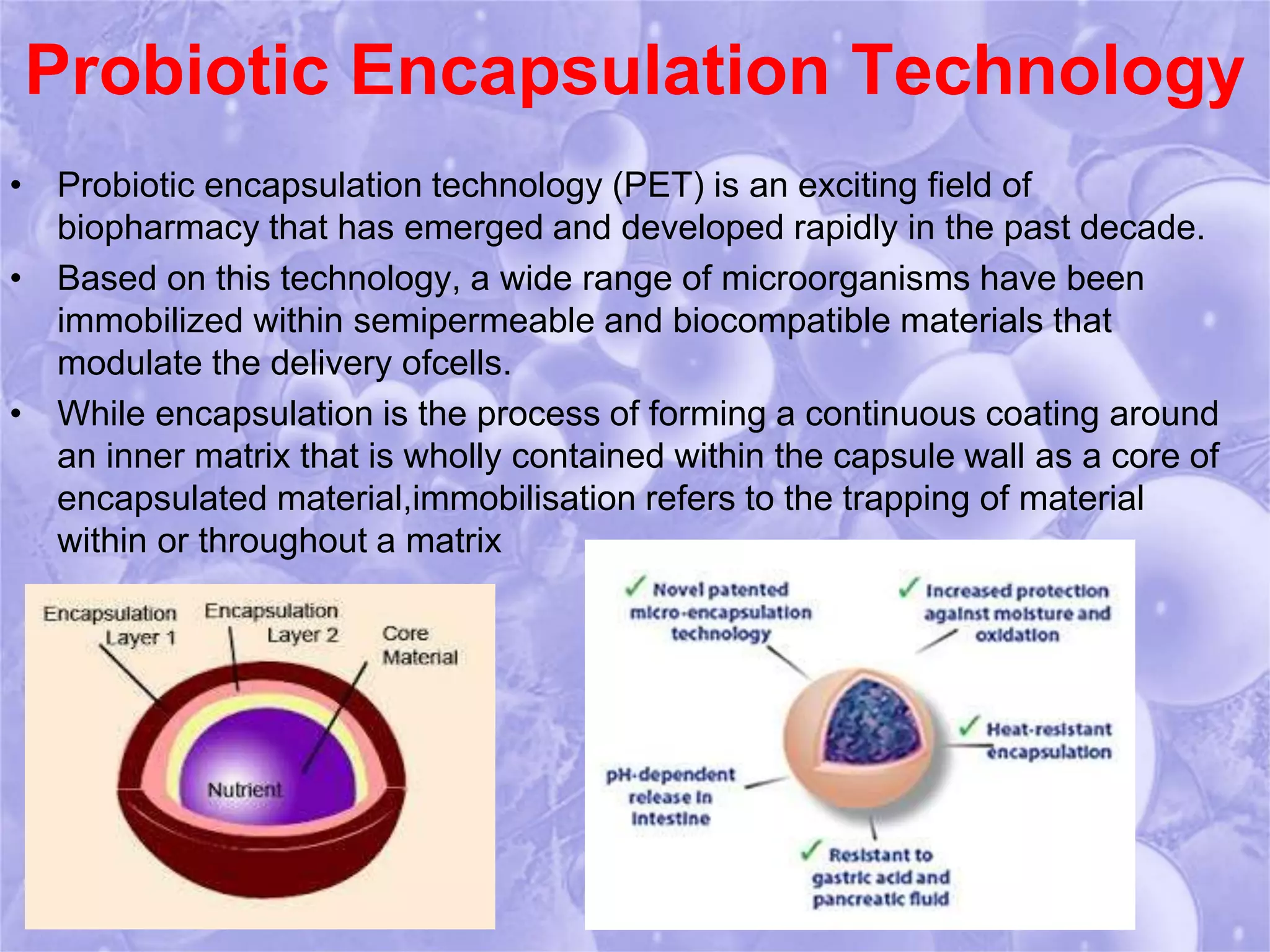
• Probiotic encapsulation technology (PET) is an exciting field of 
biopharmacy that has emerged and developed rapidly in the past decade. 
• Based on this technology, a wide range of microorganisms have been 
immobilized within semipermeable and biocompatible materials that 
modulate the delivery ofcells. 
• While encapsulation is the process of forming a continuous coating around 
an inner matrix that is wholly contained within the capsule wall as a core of 
encapsulated material,immobilisation refers to the trapping of material 
within or throughout a matrix
Co-extrusion processes 
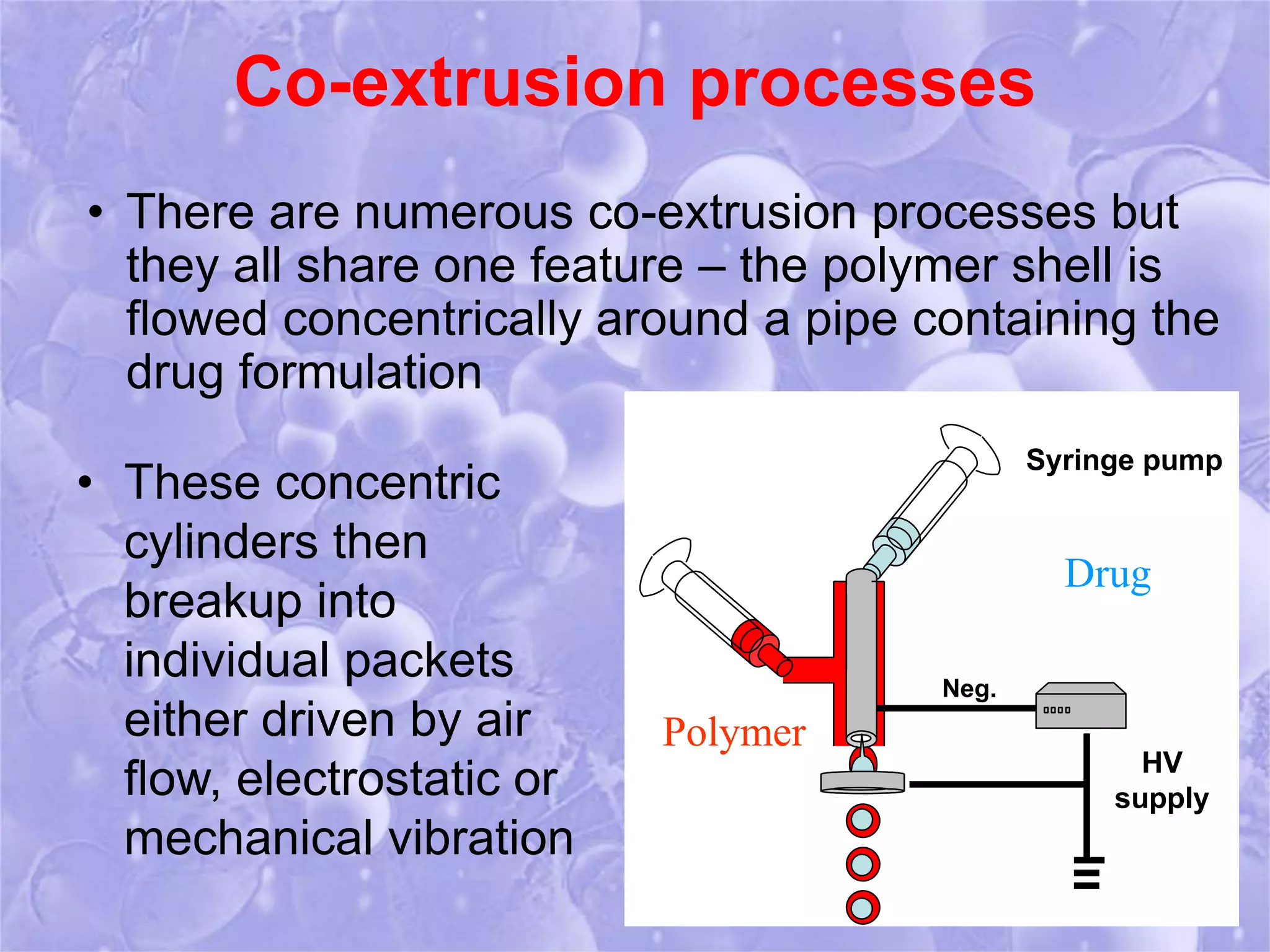
• There are numerous co-extrusion processes but 
they all share one feature – the polymer shell is 
flowed concentrically around a pipe containing the 
drug formulation 
• These concentric 
cylinders then 
breakup into 
individual packets 
either driven by air 
flow, electrostatic or 
mechanical vibration 
Syringe pump 
HV 
supply 
Neg. 
Drug 
Polymer
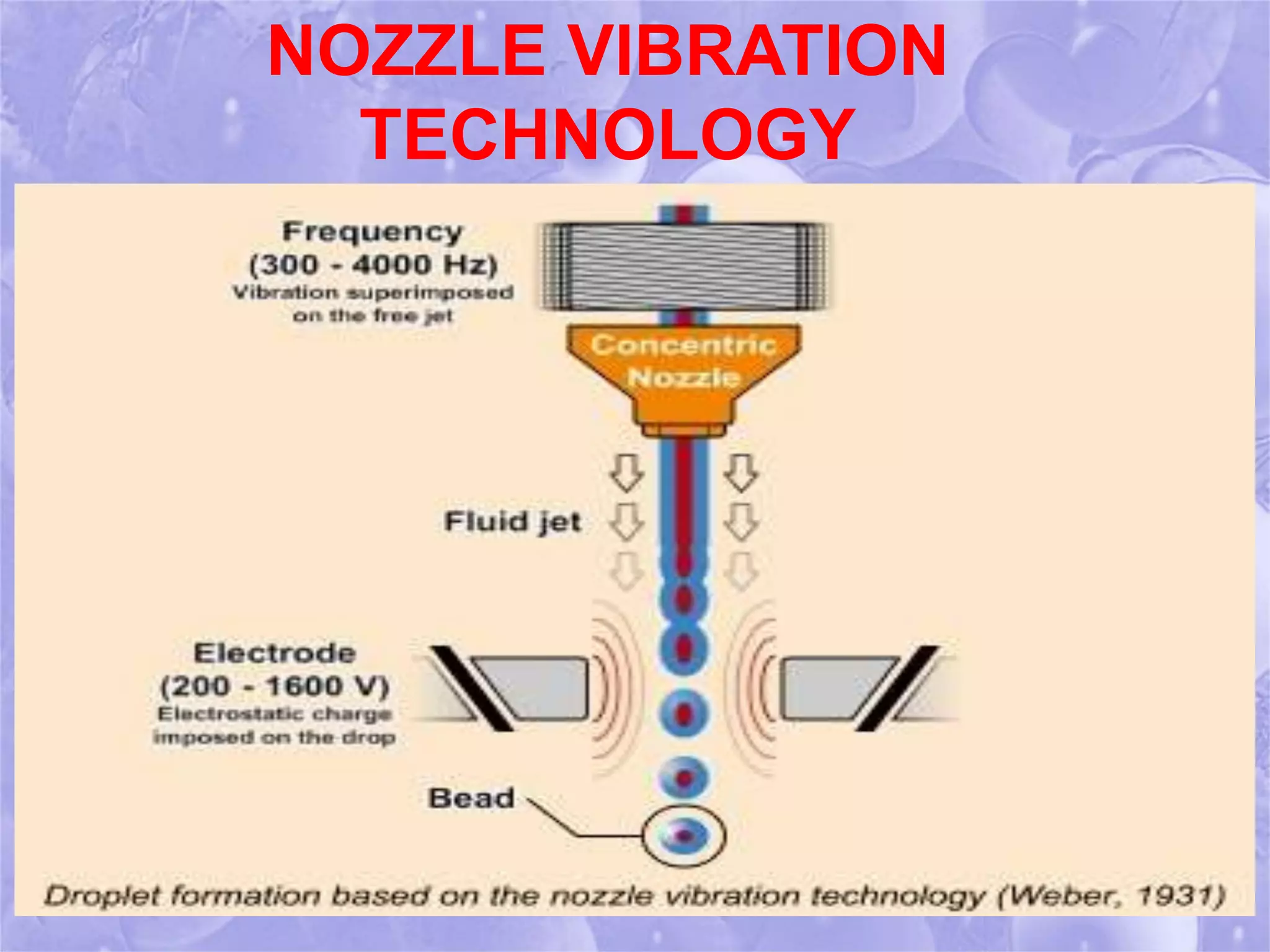
NOZZLE VIBRATION 
TECHNOLOGY
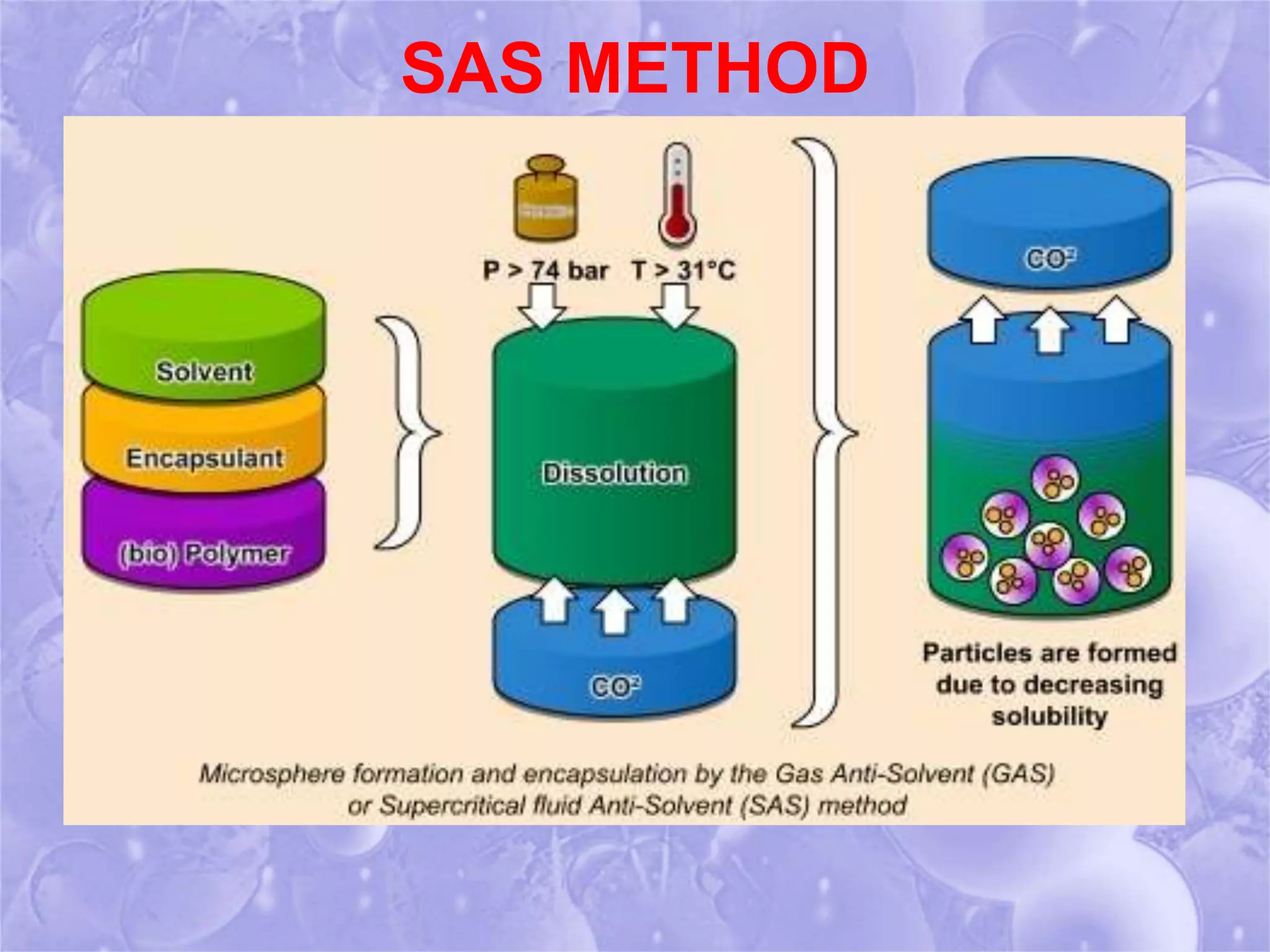
SAS METHOD
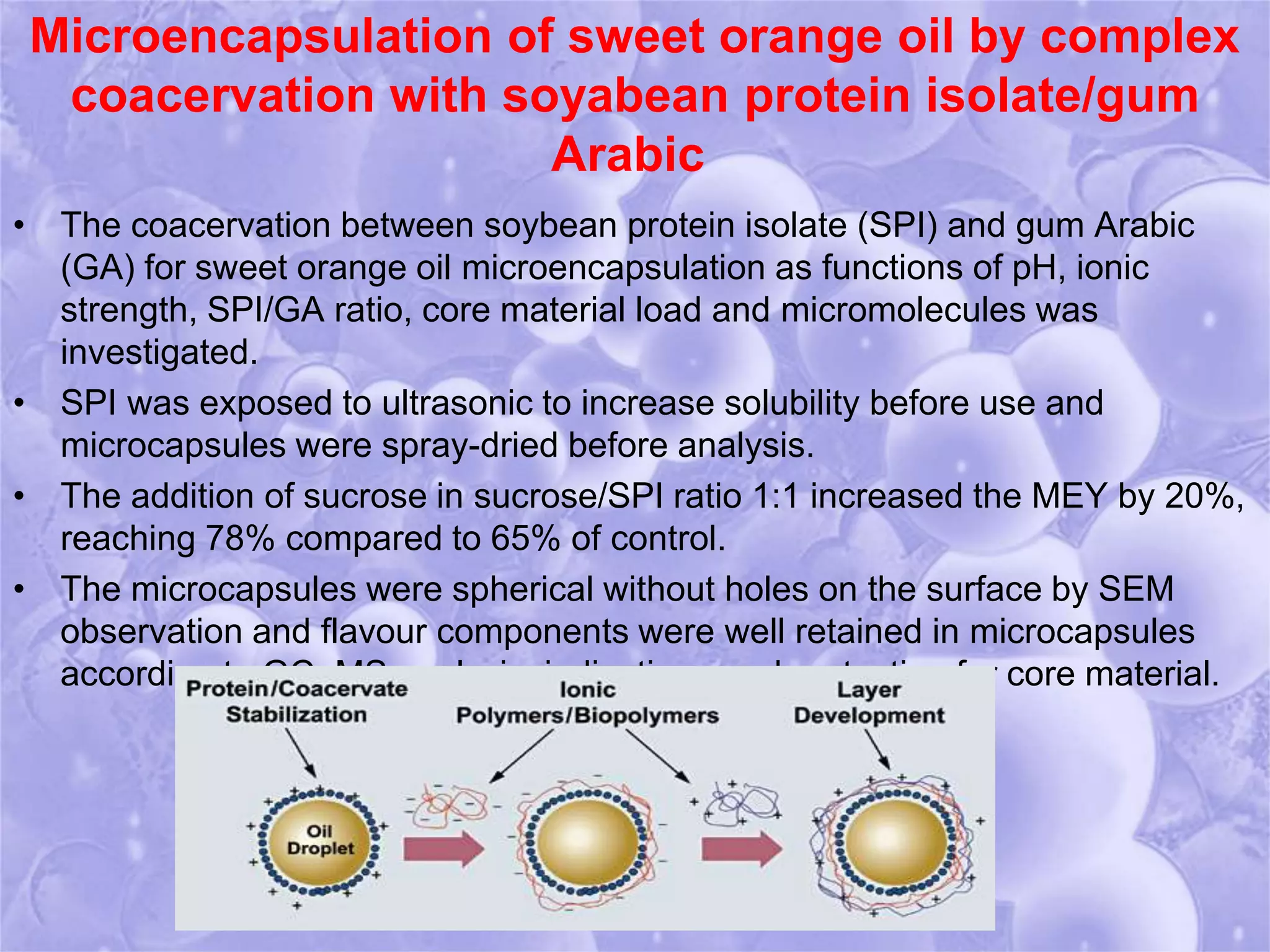
Microencapsulation of sweet orange oil by complex 
coacervation with soyabean protein isolate/gum 
Arabic 
• The coacervation between soybean protein isolate (SPI) and gum Arabic 
(GA) for sweet orange oil microencapsulation as functions of pH, ionic 
strength, SPI/GA ratio, core material load and micromolecules was 
investigated. 
• SPI was exposed to ultrasonic to increase solubility before use and 
microcapsules were spray-dried before analysis. 
• The addition of sucrose in sucrose/SPI ratio 1:1 increased the MEY by 20%, 
reaching 78% compared to 65% of control. 
• The microcapsules were spherical without holes on the surface by SEM 
observation and flavour components were well retained in microcapsules 
according to GC–MS analysis, indicating good protection for core material.
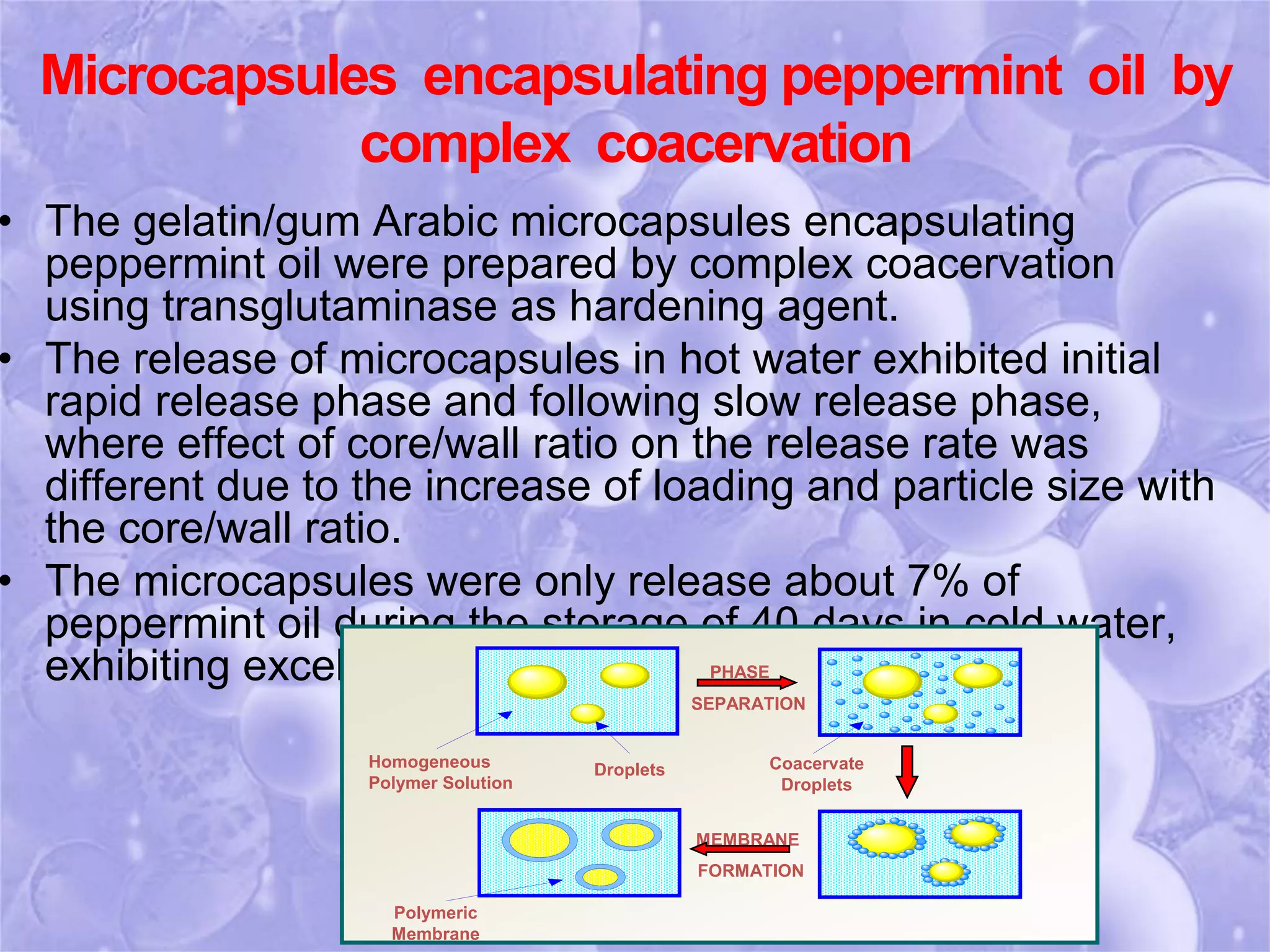
Microcapsules encapsulating peppermint oil by 
complex coacervation 
• The gelatin/gum Arabic microcapsules encapsulating 
peppermint oil were prepared by complex coacervation 
using transglutaminase as hardening agent. 
• The release of microcapsules in hot water exhibited initial 
rapid release phase and following slow release phase, 
where effect of core/wall ratio on the release rate was 
different due to the increase of loading and particle size with 
the core/wall ratio. 
• The microcapsules were only release about 7% of 
peppermint oil during the storage of 40 days in cold water, 
exhibiting excellent storage stability. 
Homogeneous Droplets 
Polymer Solution 
Polymeric 
Membrane 
PHASE 
SEPARATION 
Coacervate 
Droplets 
MEMBRANE 
FORMATION
Microencapsulation of propolis extract by 
complex coacervation 
• The propolis has potential to be a natural food additive. 
However, its application is limited, because it is alcohol-soluble 
and has strong flavour. 
• The aim of this study was to encapsulate propolis extract by 
complex coacervation using isolated soy protein and pectin as 
encapsulant agents. 
• The coacervation was studied as a function of pH (5.0, 4.5, 4.0 
and 3.5) and the concentration of encapsulants and core (2.5 
and 5.0 g/100 mL). 
• It was possible to encapsulate propolis extract by complex 
coacervation and to obtain it in the form of powder, alcohol-free, 
stable, with antioxidant property, antimicrobial activity 
against Staphylococcus aureus and with the possibility of 
controlled release in foods.
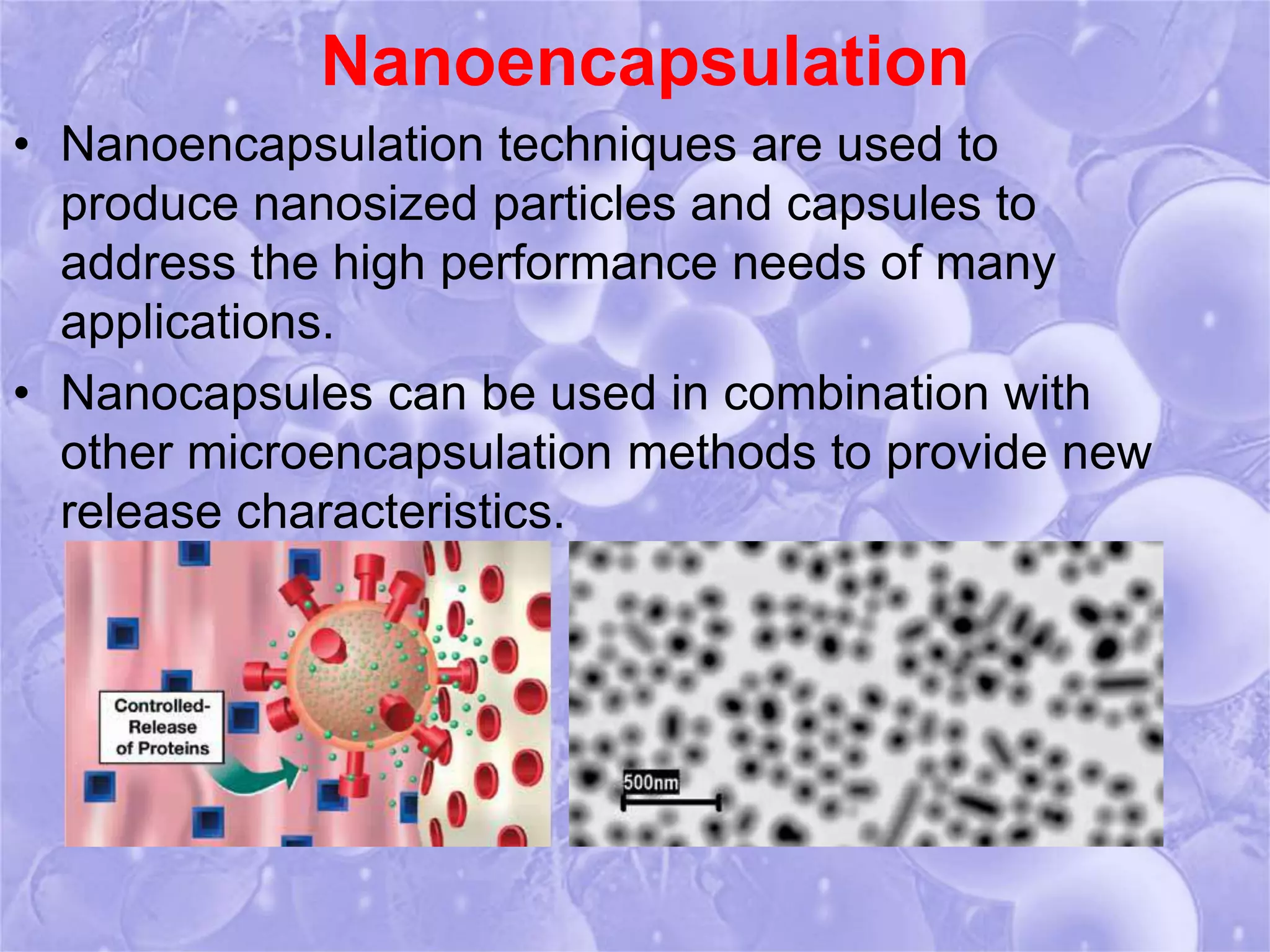
Nanoencapsulation 
• Nanoencapsulation techniques are used to 
produce nanosized particles and capsules to 
address the high performance needs of many 
applications. 
• Nanocapsules can be used in combination with 
other microencapsulation methods to provide new 
release characteristics.
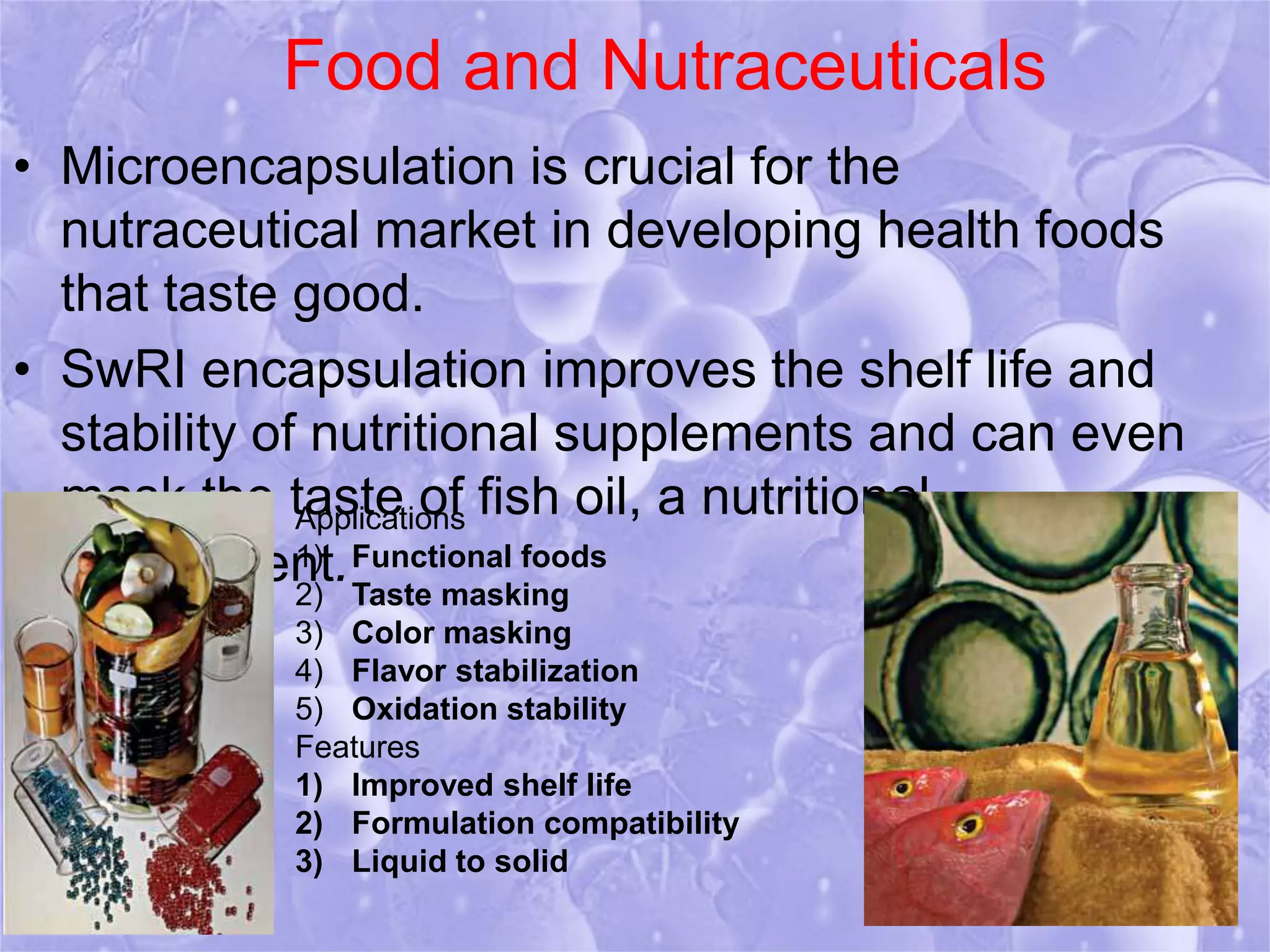
Food and Nutraceuticals 
• Microencapsulation is crucial for the 
nutraceutical market in developing health foods 
that taste good. 
• SwRI encapsulation improves the shelf life and 
stability of nutritional supplements and can even 
mask the taste of fish oil, a nutritional 
supplement. 
Applications 
1) Functional foods 
2) Taste masking 
3) Color masking 
4) Flavor stabilization 
5) Oxidation stability 
Features 
1) Improved shelf life 
2) Formulation compatibility 
3) Liquid to solid
REFERENCES 
1) Harlan, S., Hall, 1977. Encapsulated Food 
Ingredients,Encapsulated Food Ingredients. 
Symposium IFT Meeting Philadelphia. 
2) Champagne, C.P., C. Lacroix and I. Sodini-Gallot, 
1994 Immobilized cell technologies for the dairy 
industry Crit. Rev. Biochem., 14: 109-134. 
3) Shahidi, F. and X.Q. Han, 1993. Encapsulation of 
food ingredients. Crit. Rev. Food Sci. Nutr., 33: 501- 
547. 
4) Shah, N.P. 2001. Functional foods from probiotics 
and prebiotics. Food Technol. 55: 46-53. 
5) Sudarshan, N.R., Hover, D.G., and Knorr,D. 1992. 
Food Biotechnol. 6: 257-272. 
6) Kailasapathy, K. Encapsulation technologies for 
functional foods and nutraceutical product 
development. CAB Rev. 2009, 6, 1–19.
Snehal  term paper- advances in microencapsulation techniques

Snehal term paper- advances in microencapsulation techniques

  • 1.
    By , Mis s . SNEHAL K. DHOBALE 1 ST Year M-Pharm De pt of PHARMACEUTICS Padm. Dr . D.Y.Pat i l Col l e ge of Pharmac y , Akur di , Pune .
  • 2.
    Probiotic Encapsulation Technology • Probiotic encapsulation technology (PET) is an exciting field of biopharmacy that has emerged and developed rapidly in the past decade. • Based on this technology, a wide range of microorganisms have been immobilized within semipermeable and biocompatible materials that modulate the delivery ofcells. • While encapsulation is the process of forming a continuous coating around an inner matrix that is wholly contained within the capsule wall as a core of encapsulated material,immobilisation refers to the trapping of material within or throughout a matrix
  • 3.
    Co-extrusion processes •There are numerous co-extrusion processes but they all share one feature – the polymer shell is flowed concentrically around a pipe containing the drug formulation • These concentric cylinders then breakup into individual packets either driven by air flow, electrostatic or mechanical vibration Syringe pump HV supply Neg. Drug Polymer
  • 4.
  • 5.
  • 6.
    Microencapsulation of sweetorange oil by complex coacervation with soyabean protein isolate/gum Arabic • The coacervation between soybean protein isolate (SPI) and gum Arabic (GA) for sweet orange oil microencapsulation as functions of pH, ionic strength, SPI/GA ratio, core material load and micromolecules was investigated. • SPI was exposed to ultrasonic to increase solubility before use and microcapsules were spray-dried before analysis. • The addition of sucrose in sucrose/SPI ratio 1:1 increased the MEY by 20%, reaching 78% compared to 65% of control. • The microcapsules were spherical without holes on the surface by SEM observation and flavour components were well retained in microcapsules according to GC–MS analysis, indicating good protection for core material.
  • 7.
    Microcapsules encapsulating peppermintoil by complex coacervation • The gelatin/gum Arabic microcapsules encapsulating peppermint oil were prepared by complex coacervation using transglutaminase as hardening agent. • The release of microcapsules in hot water exhibited initial rapid release phase and following slow release phase, where effect of core/wall ratio on the release rate was different due to the increase of loading and particle size with the core/wall ratio. • The microcapsules were only release about 7% of peppermint oil during the storage of 40 days in cold water, exhibiting excellent storage stability. Homogeneous Droplets Polymer Solution Polymeric Membrane PHASE SEPARATION Coacervate Droplets MEMBRANE FORMATION
  • 8.
    Microencapsulation of propolisextract by complex coacervation • The propolis has potential to be a natural food additive. However, its application is limited, because it is alcohol-soluble and has strong flavour. • The aim of this study was to encapsulate propolis extract by complex coacervation using isolated soy protein and pectin as encapsulant agents. • The coacervation was studied as a function of pH (5.0, 4.5, 4.0 and 3.5) and the concentration of encapsulants and core (2.5 and 5.0 g/100 mL). • It was possible to encapsulate propolis extract by complex coacervation and to obtain it in the form of powder, alcohol-free, stable, with antioxidant property, antimicrobial activity against Staphylococcus aureus and with the possibility of controlled release in foods.
  • 9.
    Nanoencapsulation • Nanoencapsulationtechniques are used to produce nanosized particles and capsules to address the high performance needs of many applications. • Nanocapsules can be used in combination with other microencapsulation methods to provide new release characteristics.
  • 10.
    Food and Nutraceuticals • Microencapsulation is crucial for the nutraceutical market in developing health foods that taste good. • SwRI encapsulation improves the shelf life and stability of nutritional supplements and can even mask the taste of fish oil, a nutritional supplement. Applications 1) Functional foods 2) Taste masking 3) Color masking 4) Flavor stabilization 5) Oxidation stability Features 1) Improved shelf life 2) Formulation compatibility 3) Liquid to solid
  • 11.
    REFERENCES 1) Harlan,S., Hall, 1977. Encapsulated Food Ingredients,Encapsulated Food Ingredients. Symposium IFT Meeting Philadelphia. 2) Champagne, C.P., C. Lacroix and I. Sodini-Gallot, 1994 Immobilized cell technologies for the dairy industry Crit. Rev. Biochem., 14: 109-134. 3) Shahidi, F. and X.Q. Han, 1993. Encapsulation of food ingredients. Crit. Rev. Food Sci. Nutr., 33: 501- 547. 4) Shah, N.P. 2001. Functional foods from probiotics and prebiotics. Food Technol. 55: 46-53. 5) Sudarshan, N.R., Hover, D.G., and Knorr,D. 1992. Food Biotechnol. 6: 257-272. 6) Kailasapathy, K. Encapsulation technologies for functional foods and nutraceutical product development. CAB Rev. 2009, 6, 1–19.