PRESENTER: TUBA NAFEES
CHROMATOGRAPHY
&
IT’S TYPES
1
CHROMATOGRAPHY
Chromatography is a technique that separates
components of a mixture
• The Russian botanist Mikhail Tsvet coined the term
chromatography in 1906.
• Archer Martin and Richard Synge during the 1940s and
1950s, established the principles and basic techniques
of partition chromatography, and their work
encouraged the rapid development of several
chromatographic methods
2
CHROMATOGRAPHIC TERMS
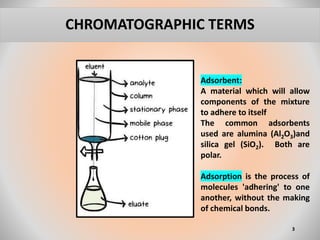
Adsorbent:
A material which will allow
components of the mixture
to adhere to itself
The common adsorbents
used are alumina (Al2O3)and
silica gel (SiO2). Both are
polar.
Adsorption is the process of
molecules 'adhering' to one
another, without the making
of chemical bonds.
3
PRINCIPLE OF
CHROMATOGRAPHY
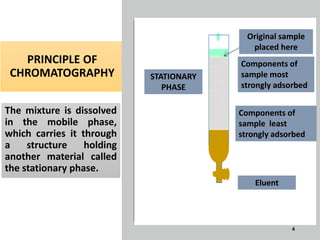
The mixture is dissolved
in the mobile phase,
which carries it through
a structure holding
another material called
the stationary phase.
Components of
sample most
strongly adsorbed
Components of
sample least
strongly adsorbed
Eluent
STATIONARY
PHASE
Original sample
placed here
4
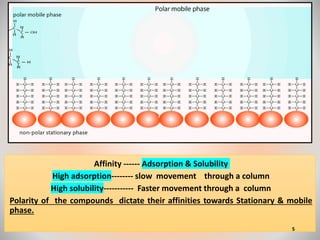
Affinity ------ Adsorption & Solubility
High adsorption-------- slow movement through a column
High solubility----------- Faster movement through a column
Polarity of the compounds dictate their affinities towards Stationary & mobile
phase.
5
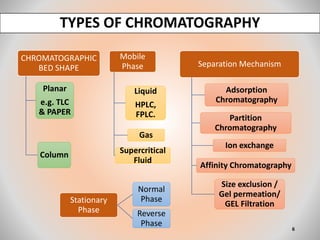
TYPES OF CHROMATOGRAPHY
CHROMATOGRAPHIC
BED SHAPE
Planar
e.g. TLC
& PAPER
Column
Mobile
Phase
Liquid
HPLC,
FPLC.
Gas
Supercritical
Fluid
Separation Mechanism
Ion exchange
Size exclusion /
Gel permeation/
GEL Filtration
Adsorption
Chromatography
Partition
Chromatography
Affinity Chromatography
Stationary
Phase
Normal
Phase
Reverse
Phase
6
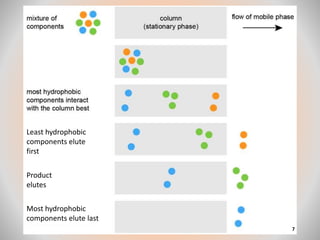
Least hydrophobic
components elute
first
Most hydrophobic
components elute last
Product
elutes
7
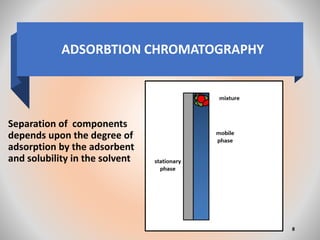
ADSORBTION CHROMATOGRAPHY
Separation of components
depends upon the degree of
adsorption by the adsorbent
and solubility in the solvent
8
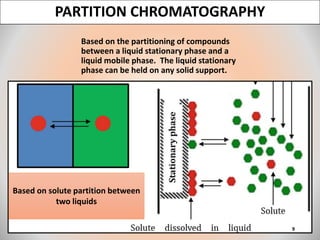
PARTITION CHROMATOGRAPHY
Based on the partitioning of compounds
between a liquid stationary phase and a
liquid mobile phase. The liquid stationary
phase can be held on any solid support.
Based on solute partition between
two liquids
9
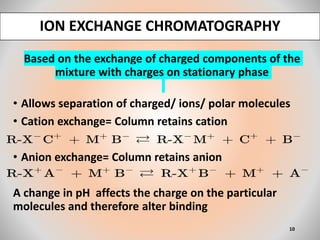
Based on the exchange of charged components of the
mixture with charges on stationary phase
• Allows separation of charged/ ions/ polar molecules
• Cation exchange= Column retains cation
• Anion exchange= Column retains anion
A change in pH affects the charge on the particular
molecules and therefore alter binding
ION EXCHANGE CHROMATOGRAPHY
10
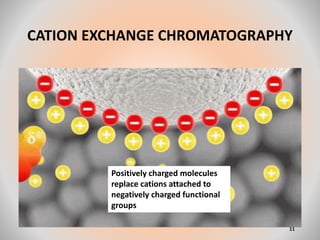
CATION EXCHANGE CHROMATOGRAPHY
11
Positively charged molecules
replace cations attached to
negatively charged functional
groups
List of ion exchangers used in IE Chromatography
S. No ION EXCHANGERS Functional group
1
DEAE Cellulose (Anion
exchanger)
DEAE (Diethylaminoethyl)
2
QAE Sephadex (Anion
exchanger)
QAE (Quaternary
aminoethyl)
3
Q Sepharose (Anion
exchanger)
Q (Quaternary ammonium)
4
CM- Cellulose (Cation
exchanger)
CM (Carboxymethyl)
5
SP Sepharose (Cation
exchanger)
SP (Sulfopropyl)
6
SOURCE S (Cation
exchanger)
S (Methyl sulfate)
12
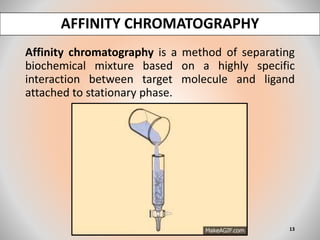
Affinity chromatography is a method of separating
biochemical mixture based on a highly specific
interaction between target molecule and ligand
attached to stationary phase.
AFFINITY CHROMATOGRAPHY
13
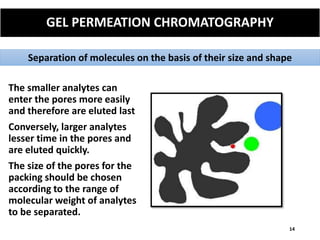
GEL PERMEATION CHROMATOGRAPHY
The smaller analytes can
enter the pores more easily
and therefore are eluted last
Conversely, larger analytes
lesser time in the pores and
are eluted quickly.
The size of the pores for the
packing should be chosen
according to the range of
molecular weight of analytes
to be separated.
Separation of molecules on the basis of their size and shape
14
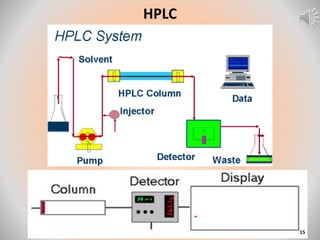
HPLC
15
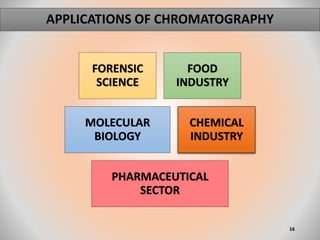
APPLICATIONS OF CHROMATOGRAPHY
FORENSIC
SCIENCE
FOOD
INDUSTRY
MOLECULAR
BIOLOGY
CHEMICAL
INDUSTRY
PHARMACEUTICAL
SECTOR
16
17
PICTURES CREDITS
• https://microbenotes.com/chromatography-principle-types-and-
applications/
• http://www.dynamicscience.com.au/tester/solutions1/chemistry/analyt
ical%20chem/columnchromatography.htm
• https://chembam.com/techniques/chromatography/
• https://link.springer.com/chapter/10.1007/978-981-15-1547-7_11
• https://en.wikipedia.org/wiki/Gel_permeation_chromatography
• https://makeagif.com/gif/affinity-chromatography-protein-seperation-
OkCLDs
• https://gfycat.com/joyousvictoriouslabradorretriever
• https://www.researchgate.net/figure/Representation-of-a-HPLC-
system-with-mobile-phase-solvent-The-system-is-connected-to-
a_fig5_306375471
• http://faculty.sdmiramar.edu/fgarces/LabMatters/Instruments/HPLC/HP
LC.htm
18
REFERENCES
https://en.wikipedia.org/wiki/Ion_chromatography
https://chromatography.conferenceseries.com/events-list/applications-of-
chromatography
https://www.brainkart.com/article/Column-chromatography--Types,-Principle_27838/
http://www.biologydiscussion.com/biochemistry/chromatography-techniques/top-12-
types-of-chromatographic-techniques-biochemistry/12730
http://library.umac.mo/ebooks/b28050630.pdf
https://www.ncbi.nlm.nih.gov/pmc/articles/PMC5206469/
Kumar. P. (2018). Fundamentals and Techniques of Biophysics and Molecular Biology. New
Delhi: Pathfinder Publication. p. 7. ISBN 978-93-80473-15-4.
https://microbenotes.com/chromatography-principle-types-and-applications/
https://byjus.com/chemistry/column-chromatography/
https://www.google.com/amp/s/www.azolifesciences.com/amp/article/Life-Science-
Applications-of-Chromatography.aspx
19

Chromatography and its types