#6 breeding 
“lemato”
Seed 
School 
Breeding 
Techniques 
Tim Peters Trick 
Resources 
#6 Outcome
“All our major food crops were 
originally developed by 
amateurs. Until recently, all 
gardeners and farmers saved 
their own seed; all gardeners 
and farmers were automatically 
amateur plant breeders -- and 
amateur plant breeding was the 
only kind of plant breeding there 
was.” Carol Deppe
basic plant breeding 
• selection/evaluation 
• inbreeding (fixing genes) 
• making F1 hybrids 
• using F2 hybrids 
• outcrossing 
• backcrossing 
• recurrent backcrossing 
• new mutations 
• wide crosses 
1Breed Your Own Vegetable Varieties, Carol Deppe, Little, Brown and Company, 1993
selection
inbreeding, fixing genes 
Y y 
YY Yy yy 
YY YY Yy yy yy 
“To develop an inbred line, just self-pollinate a few plants for 
two to four generations. Then maintain the lines normally.” 
Breed Your Own Vegetable Varieties, Carol Deppe, Little, Brown and Company, 1993
Making F1 hybrids 
Y Y 
y 
y 
Y y 
Y y 
Y y Y y 
Genotype = 4 - Y y 
Phenotype = 4 - yellow 
Introduction to Genetic Analysis. 4th Ed. 1989. Suzuki, Griffiths, Miller, and Lewontin. W.H. Feeman and Co. Chapt. 2.
Use F2’s 
Y y 
Y 
y 
Y y 
YY 
Y y y y 
Genotype = 1 YY : 2 Y y : 1 y y 
Phenotype = 3 yellow : 1 green
outcrossing 
The majority of lines selected are likely to be retained. 
Mass selection can effect improvement in land varieties. 
The basis of improvement in less developed agricultural areas. 
Residue remaining after discarding the obviously unproductive or 
defective lines retains the best features of the original variety. 
Principles of Plant Breeding, Allard, 1st Edition, 1960.
backcrossing 
Cross your selected F2 with the parent. If you do this over and 
over with the “recurrent” parent, this is called recurrent 
backcrossing. 
Recurrent backcrossing is useful only with dominant genes. 
This is useful especially when you want one trait from a given 
variety and want the rest of the traits to be identical to your 
established variety. 
Once you find what you want in an F2, backcrossing allows 
you to eliminate nearly all of the genes of the other variety 
except the ones you are specifically selecting for in each 
generation. 
1Breed Your Own Vegetable Varieties, Carol Deppe, Little, Brown and Company, 1993
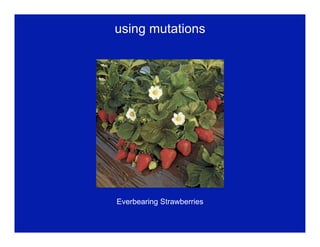
using mutations 
Everbearing Strawberries
wide crosses 
Matt’s Wild Cherry Tomato
basic breeding example 
do the cross 
raise a few F1’s 
raise 20 or more F2’s 
if you find what you want, self-pollinate. select. repeat. 
evaluate F4’s, F5’s, F6’s 
rogue where necessary 
if you don’t find what you want, use what you have learned. 
try a different cross 
raise more F2’s 
evaluate F3’s, F4’s, etc. 
1Breed Your Own Vegetable Varieties, Carol Deppe, Little, Brown and Company, 1993
tim peters trick 
1Breed Your Own Vegetable Varieties, Carol Deppe, Little, Brown and Company, 1993
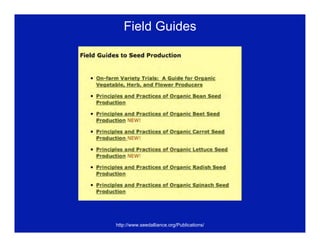
Field Guides 
http://www.seedalliance.org/Publications/
Field Guides 
http://www.seedalliance.org/Publications/
Field Guides 
http://www.seedalliance.org/Publications/
Seed Production Guides 
http://campus.extension.org/course/view.php?id=377
Seed 
School 
Breeding 
Techniques 
Tim Peters Trick 
Resources 
#6 Outcome

Breeding Techniques for Vegetables

  • 1.
  • 2.
    Seed School Breeding Techniques Tim Peters Trick Resources #6 Outcome
  • 3.
    “All our majorfood crops were originally developed by amateurs. Until recently, all gardeners and farmers saved their own seed; all gardeners and farmers were automatically amateur plant breeders -- and amateur plant breeding was the only kind of plant breeding there was.” Carol Deppe
  • 4.
    basic plant breeding • selection/evaluation • inbreeding (fixing genes) • making F1 hybrids • using F2 hybrids • outcrossing • backcrossing • recurrent backcrossing • new mutations • wide crosses 1Breed Your Own Vegetable Varieties, Carol Deppe, Little, Brown and Company, 1993
  • 5.
  • 6.
    inbreeding, fixing genes Y y YY Yy yy YY YY Yy yy yy “To develop an inbred line, just self-pollinate a few plants for two to four generations. Then maintain the lines normally.” Breed Your Own Vegetable Varieties, Carol Deppe, Little, Brown and Company, 1993
  • 7.
    Making F1 hybrids Y Y y y Y y Y y Y y Y y Genotype = 4 - Y y Phenotype = 4 - yellow Introduction to Genetic Analysis. 4th Ed. 1989. Suzuki, Griffiths, Miller, and Lewontin. W.H. Feeman and Co. Chapt. 2.
  • 8.
    Use F2’s Yy Y y Y y YY Y y y y Genotype = 1 YY : 2 Y y : 1 y y Phenotype = 3 yellow : 1 green
  • 9.
    outcrossing The majorityof lines selected are likely to be retained. Mass selection can effect improvement in land varieties. The basis of improvement in less developed agricultural areas. Residue remaining after discarding the obviously unproductive or defective lines retains the best features of the original variety. Principles of Plant Breeding, Allard, 1st Edition, 1960.
  • 10.
    backcrossing Cross yourselected F2 with the parent. If you do this over and over with the “recurrent” parent, this is called recurrent backcrossing. Recurrent backcrossing is useful only with dominant genes. This is useful especially when you want one trait from a given variety and want the rest of the traits to be identical to your established variety. Once you find what you want in an F2, backcrossing allows you to eliminate nearly all of the genes of the other variety except the ones you are specifically selecting for in each generation. 1Breed Your Own Vegetable Varieties, Carol Deppe, Little, Brown and Company, 1993
  • 11.
  • 12.
    wide crosses Matt’sWild Cherry Tomato
  • 13.
    basic breeding example do the cross raise a few F1’s raise 20 or more F2’s if you find what you want, self-pollinate. select. repeat. evaluate F4’s, F5’s, F6’s rogue where necessary if you don’t find what you want, use what you have learned. try a different cross raise more F2’s evaluate F3’s, F4’s, etc. 1Breed Your Own Vegetable Varieties, Carol Deppe, Little, Brown and Company, 1993
  • 14.
    tim peters trick 1Breed Your Own Vegetable Varieties, Carol Deppe, Little, Brown and Company, 1993
  • 15.
  • 16.
  • 17.
  • 18.
    Seed Production Guides http://campus.extension.org/course/view.php?id=377
  • 19.
    Seed School Breeding Techniques Tim Peters Trick Resources #6 Outcome