Seed Production System In
India
Submitted by:-
Ukani jatin
M.Sc. (Agri.) Student,
Seed Production System In India
• The Indian seed programme largely adheres to
the limited generations’ system for seed
multiplication in a phased manner.
• The system recognizes three generations
namely breeder, foundation and certified seeds
and provides adequate safeguards for quality
assurance in the seed multiplication chain to
maintain the purity of the variety as it flows from
the breeder to the farmer.
Breeder Seed
• Breeder seed is the progeny of nucleus seed of a variety and is
produced by the originating breeder or by a sponsored breeder.
• Breeder seed production is the mandate of the Indian Council of
Agricultural Research (ICAR) and is being undertaken with the
help of;
– ICAR Research Institutions, National Research Centres and
All India Coordinated Research Project of different crops;
– State Agricultural Universities (SAUs)
– Sponsored breeders recognized by selected State Seed
Corporations,
– Non-Governmental Organizations.
– National Seeds Corporation (NSC)
– State Farms Corporation of India (SFCI),
– State Seeds Corporation (SSCs),
– Krishi Vigyan Kendras (KVKs) etc.
• The indents from various seeds producing agencies are collected by
the State Departments of Agriculture and submitted to the
Department of Agriculture and Cooperation (DAC), Ministry of
Agriculture, Government of India,
• Which is turn compiles the whole information crop wise and sends it
to the Project Coordinator/Project Director of the respective crops in
ICAR for final allocation of production responsibility to different
SAUs/ICAR institutions.
• The allocation of responsibility for production of breeder seed is
discussed in the workshop in respect of the particular crop and is
made to various centres as per the facilities and capabilities available
at the centres and the availability of nucleus seed of a particular
variety.
• It may be noted that indents are compiled and forwarded to ICAR at
least 18 months in advance.
• To make the programme systematic, and for proper evaluation of the
breeder seed production programme, monitoring terms have been
constituted and reporting proforma have been devised.
• The monitoring terms consist of breeder of the variety, the concerned
Project Director or his nominee, representative of NSC.
• The production of breeder seed is reviewed every year by ICAR-DAC
in the annual seed review meeting.
Procedure
Reporting
• The actual production of breeder seed by different
centres is intimated to DAC by ICAR.
• On receipt of information from ICAR, the available
breeder seed is allocated to all the indenters in an
equitable manner.
• In the case of varieties which are relevant only to a
particular State, the indents for breeder seed are placed
by the concerned Director of Agriculture with the
SAUs/ICAR institutions located in the State.
• The breeder seed produced is lifted directly by the
Director of Agriculture or foundation seed producing
agencies authorized by him.
Foundation Seed
• Foundation seed is the progeny of breeder seed and is
required to be produced from breeder seed or from
foundation seed which can be clearly traced to breeder
seed.
• The responsibility for production of foundation seed has
been entrusted to the NSC, SFCI, State Seeds
Corporation, State Departments of Agriculture and
private seed producers, who have the necessary
infrastructure facilities.
• Foundation seed is required to meet the standards of
seed certification prescribed in the Indian Minimum
Seeds Certification Standards, both at the field and
laboratory testing.
Certified Seed
• Certified seed is the progeny of foundation seed
and must meet the standards of seed
certification prescribed in the Indian Minimum
Seeds Certification Standards, 1988.
• In case of self pollinated crops, certified seeds
can also be produced from certified seeds
provided it does not go beyond three
generations from foundation seed stage-I.
Production
• The production and distribution of quality/certified seeds is
primarily the responsibility of the State Governments.
• Certified seed production is organized through State Seed
Corporation, Departmental Agricultural Farms, Cooperatives
etc.
• The distribution of seeds is undertaken through a number of
channels i.e. departmental outlets at block and village level,
cooperatives, outlets of seed corporations, private dealers etc.
• The efforts of the State Governments are being supplemented
by NSC and SFCI which produce varieties of national
importance.
• NSC markets its seeds through its own marketing network and
also through its dealer network.
• SFCI markets its seeds mainly through the State Departments
of Agriculture and the State Seed Corporations.
• The production of certified seed by NSC and State Seed
Corporations is mainly organized through contract growing
arrangements with progressive farmers.
• SFCI undertakes seed production on its own farms.
• The requirement of certified/quality seeds is assessed by
State Governments on the basis of the area sown under
different crop varieties, area covered by hybrid and self-
pollinated varieties as well as the seed replacement rate
achieved.
• The availability of seed is ascertained by the State
Departments of Agriculture on the basis of the
production of seed in government farms and production
of seeds by State Seeds Corporations and other
agencies.
• The Government of India periodically assesses the
requirement and availability of seeds through detailed
interaction with State Governments and seed producing
agencies in the bi-annual Zonal Seed Review Meetings
and the National Kharif and Rabi Conferences.
• The Department of Agriculture and Cooperation
facilitates tie-up arrangements with seed producing
agencies to ensure that the requirement of seeds is met
to the maximum extent possible.
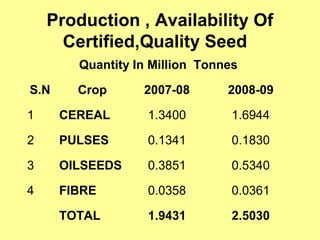
Production , Availability Of
Certified,Quality Seed
Quantity In Million Tonnes
S.N Crop 2007-08 2008-09
1 CEREAL 1.3400 1.6944
2 PULSES 0.1341 0.1830
3 OILSEEDS 0.3851 0.5340
4 FIBRE 0.0358 0.0361
TOTAL 1.9431 2.5030
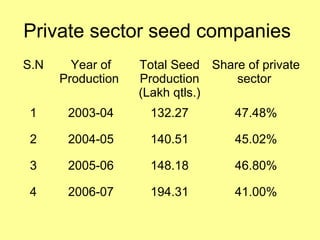
Private sector seed companies
S.N Year of
Production
Total Seed
Production
(Lakh qtls.)
Share of private
sector
1 2003-04 132.27 47.48%
2 2004-05 140.51 45.02%
3 2005-06 148.18 46.80%
4 2006-07 194.31 41.00%
Seed Certification System in
India
• In general, seed certification is a process
designed to maintain and make available to the
general public continuous supply of high quality
seeds and propagating materials of notified
kinds and varieties of crops, so grown and
distributed to ensure the physical identity and
genetic purity.
• Seed certification is a legally sanctioned system
for quality control of seed multiplication and
production.
History of Seed Certification
• In India the field evaluation of the seed crop and its
certification started with the establishment of National Seeds
Corporation in 1963.
• A legal status was given to seed certification with the
enactment of first Indian Seed Act in the year 1966 and
formulation of Seed Rules in 1968.
• The Seed Act of 1966 provided the required impetus for the
establishment of official Seed Certification Agencies by the
States.
• Maharashtra was the first State to establish an official Seed
Certifications Agency during 1970 as a part of the Department
of Agriculture,
• Karnataka was the first State to establish the Seed
Certification Agency as an autonomous body during 1974.
• At present 22 States in the country have their own Seed
Certification Agencies established under the Seed Act, 1966.
Objective of Seed Certification
• The main objective of the Seed Certification is to ensure
the acceptable standards of seed viability, vigour, purity
and seed health.
• A well organized seed certification should help in
accomplishing the following three primary objectives
 The systematic increase of superior varieties
 The identification of new varieties and their rapid
increase under appropriate
and generally accepted names.
 Provision for continuous supply of comparable material
by careful maintenance
IMPORTANCE OF CERTIFIED
SEED
• getting clean seed
• getting varietal purity
• getting guaranteed quality assurance
• getting access to new opportunities
• getting new genetics
• getting substance behind your word
• getting a better deal on crop insurance
• getting maximum use of other inputs
• getting access to premium markets
• getting traceability
Eligibility requirements for
certification
• Any variety to become eligible for seed
certification should meet the following
requirement
General requirements
• Should be a notified variety under Section-5 of the
Indian Seed Act, 1966.
• Should be in the production chain and its pedigree
should be traceable
Field standards
• Field standards include the selection of site, isolation
requirements, spacing, planting ratio, border rows etc
Specific
Requirements• Presence of off-types in any seed crop, pollen-
shedders in Sorghum, Bajra, Sunflower etc., Shedding
tassels in maize crosses, disease affected plants,
objectionable weed plants etc., should be within the
maximum permissible levels for certification.
Seed Standards
•The use of foundation seed to produce certified seed
should be procured from authentic source
Seed Certification Agencies
• Seed Certification agency should be an autonomous body.
• Seed Certification Agency should not involve itself in the
production and marketing of seeds.
• The Seed Certification Standards and procedures adapted by
seed certification agency should be uniform, throughout the
country.
• Seed Certification Agency should have close linkage with the
technical and other related institutions.
• Its long-term objective should be to operate on no-profit no-
loss basis.
• Adequate staff trained in seed certification should be
maintained by the Certification Agency.
• It should have provision for creating adequate facilities for
ensuring timely and through inspections.
• It should serve the interests of seed producers and
farmers/users.
Phases of Seed Certification
• Verification of seed source, class and other requirements
of the seed used for raising the seed crop
• Receipt and scrutiny of application.
• Inspection of the seed crop in the field to verify its
conformity to the prescribed field standards
• Supervision at post-harvest stages including processing
and packing.
• Drawing of samples and arranging for analysis to verify
conformity to the seed standards
• Grant of certificate, issue of certification tags, labelling,
sealing etc.
Receipt and scrutiny of application
• Any person, who wants to produce certified seed, shall
register his name with the concerned Assistant Director of
Seed Certification.
• There are 3 seasons under certification viz., kharif (June-
September), rabi (October-January) and summer (February-
May).
• The applicant shall submit two copies of the application to
the Assistant Director of Seed Certification 10 days before
the commencement of the season or atleast at the time of
registration of sowing report.
• On the receipt of application, the Assistant Director of Seed
Certification will verify the time limit, variety, eligibility and its
source, the class mentioned, remittance of fee etc.,
Sowing report
• The seed producer who wants to produce
certified seeds shall apply to the Assistant
Director of Seed Certification in the
prescribed sowing report form in
quadruplicate with prescribed certification
fees along with other documents such as
tags to establish the seed source.
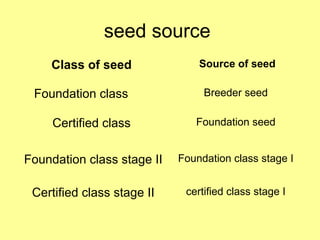
seed source
Class of seed Source of seed
Foundation class Breeder seed
Certified class Foundation seed
Foundation class stage II Foundation class stage I
Certified class stage II certified class stage I
Verification of seed source
• During first inspection of seed farm the
seed certification officer will verify whether
the seed used to raise the crop is from an
approved source.
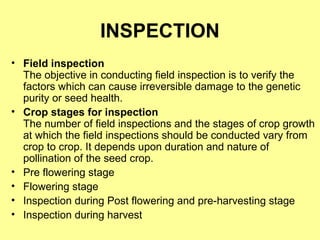
INSPECTION
• Field inspection
The objective in conducting field inspection is to verify the
factors which can cause irreversible damage to the genetic
purity or seed health.
• Crop stages for inspection
The number of field inspections and the stages of crop growth
at which the field inspections should be conducted vary from
crop to crop. It depends upon duration and nature of
pollination of the seed crop.
• Pre flowering stage
• Flowering stage
• Inspection during Post flowering and pre-harvesting stage
• Inspection during harvest
• Assessment of seed crop yield
It is necessary to avoid malpractices at the final stage during
harvest operation. The seed certification officer is expected
to fix the appropriate seed yield.
• Liable for rejection report
If the seed crop fails to meet with any one factor as per the
standards, Liable for rejection report I prepared and the
signature of the producer is obtained and sent to Deputy
Director of Agriculture (Seed Certification) within 24 hours.
• Re-inspection
For the factors which can be removed without hampering
the seed quality, the producer can apply for re-inspection to
the concerned Deputy Director of Agriculture Seed
Certification within 7 days from the date of first inspection
order. For re-inspection half of the inspection charge is
collected.
Post harvest supervision of seed
crop
• The post harvest inspection of a seed crop
covers the operations carried out at the
threshing floor, transport of the raw seed
produce to the processing plant, pre-
cleaning, grading, seed treatment,
bagging and post processing storage of
the seed lot.
Seed Sampling and testing
• Seed samples are also drawn separately from
the seed lots of hybrid cotton, hybrid brinjal etc.,
for the purpose of conducting genetic purity test
and sent to Director of Seed Certification from
Assistant Director of Seed Certification.
• Seed lots possessing prescribed minimum seed
standards are only tagged. Certification tags can
be purchased from the Office of Assistant
Director of Seed Certification.
Labelling, tagging, sealing and
grant of certificate
• Certified seed should be tagged within 2
months from the date of test. A validity
period of 9 months is given for the certified
seed lots.
• If the seed lots are not sold or used within
the validity period, then there is a
procedure for validation i.e. extension of
validity to already certified seeds seed
lots.
Validation
• It is nothing but extension of validity period to the expired
seed lots.
• For validation of seed lots application should be sent to
Deputy Director of Seed Certification in a prescribed
Performa.
• Validation fee should be remitted in the office of Assistant
Director of Seed Certification after obtaining the permission
for the same from the Deputy Director of Seed Certification.
• Within 10 days from the date of remittance of validation
charges, validation work will be commenced by the
concerned Seed Certification Officers and samples will be
drawn and sent to the Seed Testing Laboratory
• The seed lots possessing prescribed seed standards will be
given an extension and validity period for 6 months from the
date of test.