Crop Production Technology (1+1)
Production Technology
of
Mentha arvensis
Submitted to
Dr. Biswapati Sinha, Assistant Professor,
The Neotia University
Submitted by
Souvik Roy
B.Sc. Agriculture Student
(Mentha arvensis)
Family:-
Lamiaceae; labiatae
Origin:-
Mediterranean regions
Producing Country:-
India, Brazil, Paraguay, USA
Producing State in India:-
Uttar Pradesh & Punjab
Local Name:-
Name Language
Putiha Sanskrit
Mint English
Pudina Hindi & Kanada
Pudina Tamil
Peppermint
USA Morocco
Argentina Australia
France USSR
Czechoslovakia Bulgaria
Hungary Italy
Switzerland some Europe
countries
Japanese mint
Brazil Paraguay
China Argentina
Japan Thailand
Angola India
Spearmint
USA
Growing Zone:-
International
Mentha piperita (Peppermint) USDA zones 3
through 11
Mentha piperita citrata (Orange mint) USDA zones 4
through 11.
Mentha suaveoloens (Apple mint) USDA zones 5
through 11.
Mentha suaveolens variegata (Pineapple mint) USDA zones 6
through 11.
Soil:-
Medium to fertile deep soil, rich in humus is ideal for the
cultivation of mint.
Mint prefers a rich soil with
a slightly acidic pH between
6.5 and 7.0.
If the soil is somewhat lean,
top dress yearly with organic
matter and apply an organic
fertilizer mid-season after
shearing.
The soil should have a good
water-holding capacity but water-logging should be
avoided.
INDIA
BARABANKI
REGION
Baragaon
region
Temperature:-
Open, sunny situations without excessive rains during the
growing period are congenial for the good growth and
development of the oil.
VARIETY CLIMATIC CONDITION
JAPANESE MINT All tropical and subtropical areas
under irrigation.
PEPPERMINT AND SPEARMINT Ideal yield is obtained only in
humid and temperate conditions.
BERGAMOT MINT Temperate as well as subtropical
area.
Vegetative growth 20⁰C - 25⁰C
Ideal growing
temperatures
warm sunny days 25°C
cool nights 15°C
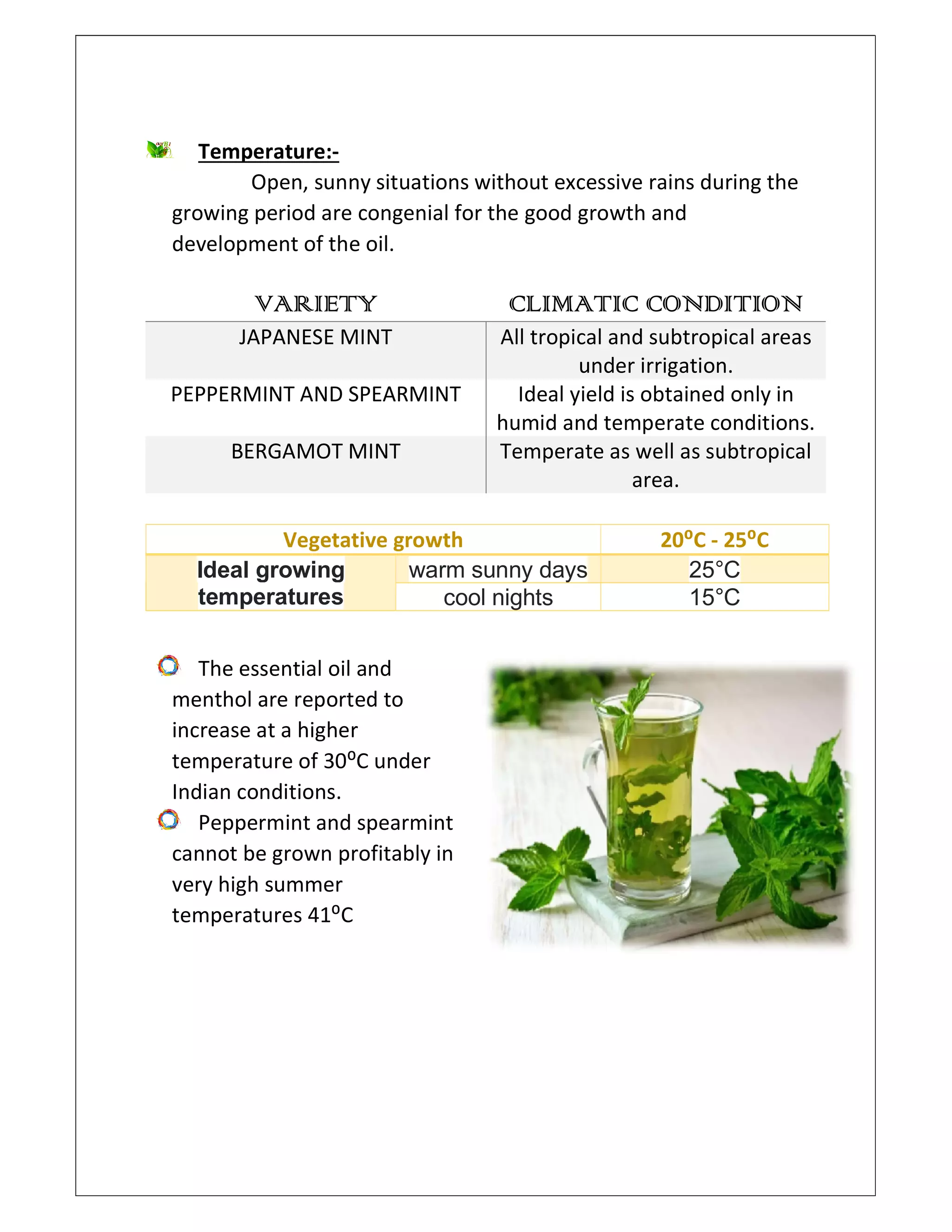
The essential oil and
menthol are reported to
increase at a higher
temperature of 30⁰C under
Indian conditions.
Peppermint and spearmint
cannot be grown profitably in
very high summer
temperatures 41⁰C
Classification:-
KINGDOM PLANTAE
DIVISION Magnoliophyta
CLASS Magnoliopsida
ORDER Lamiales
Lamiaceae
FAMILY Lamiaceae
GENUS Mentha
SPECIES arvensis,
Spicata,
Piperita,
Citrata
Variety:-
Variety
Japanese mint Himalaya (MAS0-1)
Kalka (Hyb-77)
Shivalik
(selection from Chinese cultivar)
Ec-41911
(selection from Russian
germplasm)
Peppermint Kukrail
Spearmint MSS-1
MESS-5
Punjab spearmint-1
MAS-1
Gomti
Kosi
Saksham
Kushal
Land Preparation:-
Mints require thoroughly ploughed, harrowed, fine soil. All the
stubble of weeds should be removed before the crop is planted.
Manuring may be done at the time of land preparation by adding
FYM @ 25 to 30 t/ha. Green manuring may also be done before
the mint is planted. Sun-hemp (Crotalaria juncea L.) is an ideal
green manure crop. Mints are planted on flat land or ridges.
Hence, flat beds of convenient sizes or ridges are made according
to the spacing recommended.
Method of Sowing:-
To sow the seeds outdoors, place them on top of
well-worked soil,
Then sprinkle a fine layer
of vermiculite on top of
them.
If you are sowing directly
into the garden, consider
placing a row cover over
the seeds until they
sprout.
Transplant into the garden or container when they
have at least 2 sets of true leaves.
Sowing Time (Season):-
In the plains, planting is done during the winter months, whereas in
temperate climates, planting is done in autumn or spring from the
last week of December to the first week of March or from the first
week of January to the third week of February. Late planting always
gives poor yield.
Fertilizer & Its Management:-
Mint responds very well to a heavy application of nitrogenous
fertilizers. The increase in herbage by the application of
phosphorus is not as remarkable as in case of nitrogen.
NAME DOSE PURPOSE
NITROGENOUS
FERTILIZERS
.
@ 80-120 kg P and K
at 50 kg P2O5 and
40 kg K2O/ha
It is required for a
good crop of mint
160 kg N/ha Increase in M.arvensia
125 kg N/ha Increased fresh
herbage and essential
oil-yield in M.piperate
100-120 kg N/ha Producing the
optimum herb and oil-
yield in M.citrata
under Pantnagar
conditions.
BORON AND
ZINC
FERTILIZERS
Increased yields of
herb, menthol content
and essential oil
content in peppermint
ZN
FERTILIZERS
20 kg/ha While planting the
crop response is
maximum.
SULPHUR
FERTILIZERS
Calcium
sulphate
20
kg/ha
increase the herb
and oil-yield in
M.spicata(experiments
conducted at the
CIMAP, Lucknow)
ammonium
sulphate
elemental
sulphur
Split application:
A split application of 75 kg N/ha in combination with P at 60 kg
P2O5/ ha is recommended under Kodaikanal conditions.
In M.spicata, the maximum herb-yield is obtained with the
application of 100-120 kg N/ha. Nitrogen may be applied in three
split doses at 1, ½-2 and 3 months after planting and the third
dose after the first harvest of the crop.
Weeds & Its Management:-
Hence, mints require weeding and hoeing at regular intervals in
the early stages of crop growth. One hand-weeding is required
after the first harvest.
Irrigation:-
The water requirement of mint is very high.
Depending upon the soil and climatic conditions, the crop
is irrigated 6-9 times before the first monsoon.
The crop requires three irrigations after the monsoons
during the following seasons
September
October
November
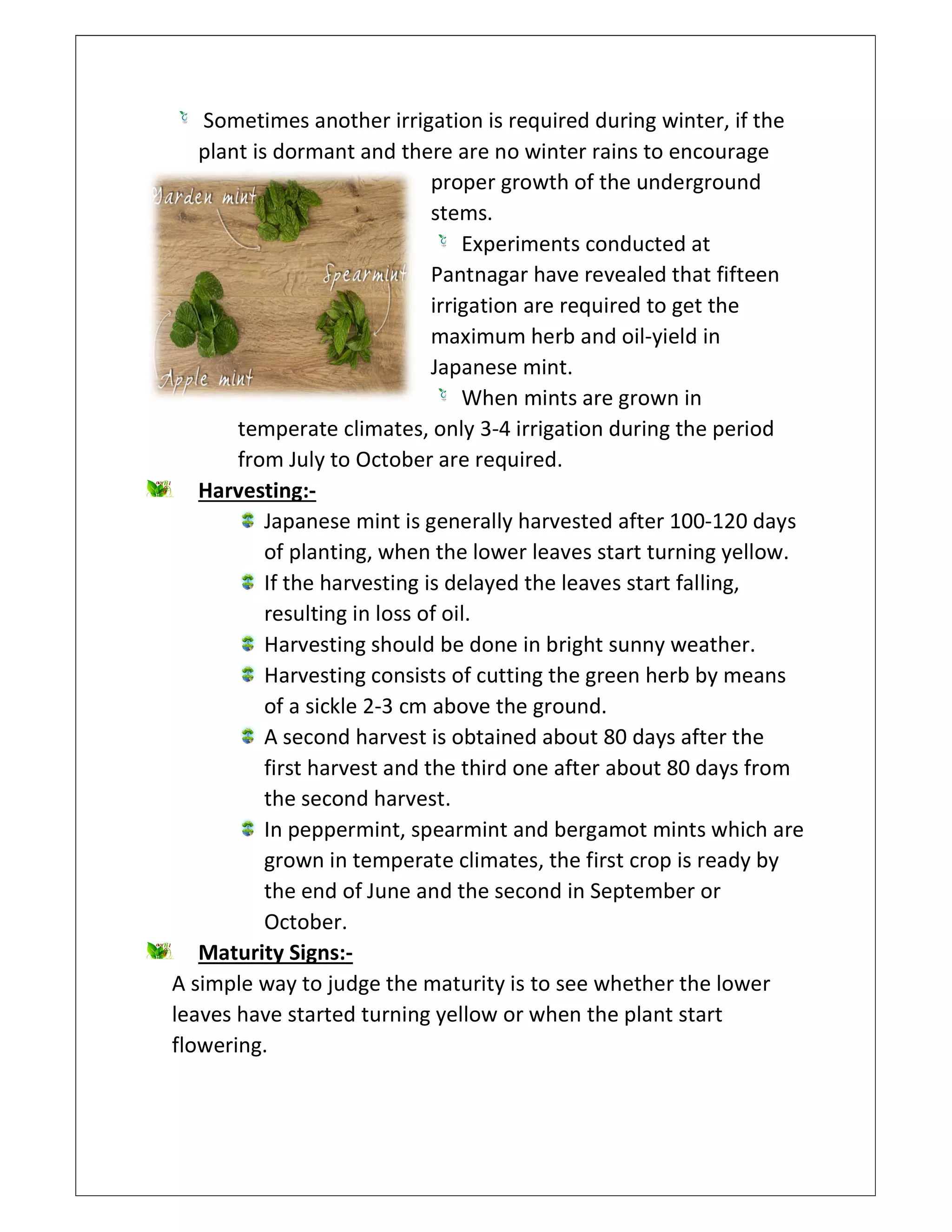
Sometimes another irrigation is required during winter, if the
plant is dormant and there are no winter rains to encourage
proper growth of the underground
stems.
Experiments conducted at
Pantnagar have revealed that fifteen
irrigation are required to get the
maximum herb and oil-yield in
Japanese mint.
When mints are grown in
temperate climates, only 3-4 irrigation during the period
from July to October are required.
Harvesting:-
Japanese mint is generally harvested after 100-120 days
of planting, when the lower leaves start turning yellow.
If the harvesting is delayed the leaves start falling,
resulting in loss of oil.
Harvesting should be done in bright sunny weather.
Harvesting consists of cutting the green herb by means
of a sickle 2-3 cm above the ground.
A second harvest is obtained about 80 days after the
first harvest and the third one after about 80 days from
the second harvest.
In peppermint, spearmint and bergamot mints which are
grown in temperate climates, the first crop is ready by
the end of June and the second in September or
October.
Maturity Signs:-
A simple way to judge the maturity is to see whether the lower
leaves have started turning yellow or when the plant start
flowering.
Yield:-
A good crop of Japanese mint can give as high a yield as 48
t/ha of fresh herb.
The average yield of mints from three cuttings is 20-25
t/ha.
The fresh herb contains 0.4% oil.
Storage:-
Mint herbage should be shade dried for about a day
before it is distilled.
Care should be taken so that decomposition of the
herbage does not initiate during the drying process.
There would be some reduction in oil yield if wilted
herbage crop is stored for a longer period of 2-3 days
.
Post-harvest Technology:-
Storage of Herbage :
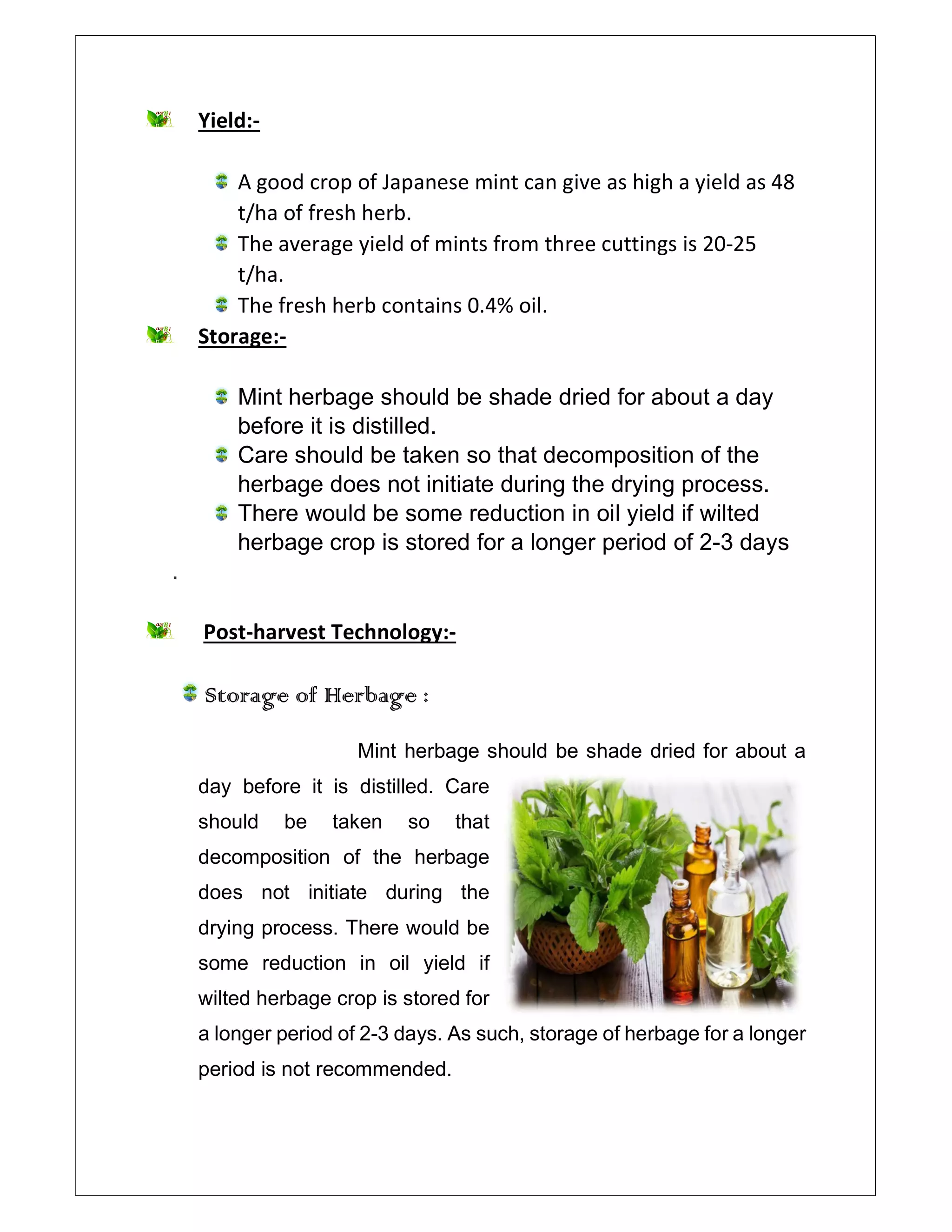
Mint herbage should be shade dried for about a
day before it is distilled. Care
should be taken so that
decomposition of the herbage
does not initiate during the
drying process. There would be
some reduction in oil yield if
wilted herbage crop is stored for
a longer period of 2-3 days. As such, storage of herbage for a longer
period is not recommended.
Distillation :
The recovery of oil from the herb is 0.5-0.8%. Oil
is obtained through steam distillation. The oil is of golden yellow
colour, containing not less than 75% menthol. The duration of steam
distillation is 2-2.5 hours for complete recovery of the oil. About 80%
of the oil is received in the receiver in about one hour’s time. The oil
that is received later is richer in menthol.
The fresh or semi dried herbage is placed in a tank and
treated with passing steam under pressure. The steam that comes
out of the tank is then passed through a condenser. The condenser
receiving the steam, carrying the oil extracted from the herbage in
the tank is kept constantly cool by circulating cold-water over/around
it. The condensed oil and water mixture is collected in a receiver.
Since the water and oil have different densities, oil floats on the
surface of the water in the receiver. The oil is skimmed off and
collected.
Purification of Oil :
The oil that is skimmed off must be cleaned of traces of
water that it may carry. For this
purpose, a separator funnel is
used. Treating with anhydrous
sodium sulphate and decanting
removes any remnant moisture
in the oil. The whole process is
highly critical. Steam
rectification process may be
applied in case the colour of the oil changes due to rusting.
Storage & Packing of Oil :
PVC drums of good quality (20-200l capacity) and galvanized iron
(GI) drums or aluminium containers are suitable for short and long term
storage respectively. The containers should be kept in cool and dark
place.

Production technology of Mentha

  • 1.
    Crop Production Technology(1+1) Production Technology of Mentha arvensis Submitted to Dr. Biswapati Sinha, Assistant Professor, The Neotia University Submitted by Souvik Roy B.Sc. Agriculture Student
  • 2.
    (Mentha arvensis) Family:- Lamiaceae; labiatae Origin:- Mediterraneanregions Producing Country:- India, Brazil, Paraguay, USA Producing State in India:- Uttar Pradesh & Punjab Local Name:- Name Language Putiha Sanskrit Mint English Pudina Hindi & Kanada Pudina Tamil Peppermint USA Morocco Argentina Australia France USSR Czechoslovakia Bulgaria Hungary Italy Switzerland some Europe countries Japanese mint Brazil Paraguay China Argentina Japan Thailand Angola India Spearmint USA
  • 3.
    Growing Zone:- International Mentha piperita(Peppermint) USDA zones 3 through 11 Mentha piperita citrata (Orange mint) USDA zones 4 through 11. Mentha suaveoloens (Apple mint) USDA zones 5 through 11. Mentha suaveolens variegata (Pineapple mint) USDA zones 6 through 11. Soil:- Medium to fertile deep soil, rich in humus is ideal for the cultivation of mint. Mint prefers a rich soil with a slightly acidic pH between 6.5 and 7.0. If the soil is somewhat lean, top dress yearly with organic matter and apply an organic fertilizer mid-season after shearing. The soil should have a good water-holding capacity but water-logging should be avoided. INDIA BARABANKI REGION Baragaon region
  • 4.
    Temperature:- Open, sunny situationswithout excessive rains during the growing period are congenial for the good growth and development of the oil. VARIETY CLIMATIC CONDITION JAPANESE MINT All tropical and subtropical areas under irrigation. PEPPERMINT AND SPEARMINT Ideal yield is obtained only in humid and temperate conditions. BERGAMOT MINT Temperate as well as subtropical area. Vegetative growth 20⁰C - 25⁰C Ideal growing temperatures warm sunny days 25°C cool nights 15°C The essential oil and menthol are reported to increase at a higher temperature of 30⁰C under Indian conditions. Peppermint and spearmint cannot be grown profitably in very high summer temperatures 41⁰C
  • 5.
    Classification:- KINGDOM PLANTAE DIVISION Magnoliophyta CLASSMagnoliopsida ORDER Lamiales Lamiaceae FAMILY Lamiaceae GENUS Mentha SPECIES arvensis, Spicata, Piperita, Citrata Variety:- Variety Japanese mint Himalaya (MAS0-1) Kalka (Hyb-77) Shivalik (selection from Chinese cultivar) Ec-41911 (selection from Russian germplasm) Peppermint Kukrail Spearmint MSS-1 MESS-5 Punjab spearmint-1
  • 6.
    MAS-1 Gomti Kosi Saksham Kushal Land Preparation:- Mints requirethoroughly ploughed, harrowed, fine soil. All the stubble of weeds should be removed before the crop is planted. Manuring may be done at the time of land preparation by adding FYM @ 25 to 30 t/ha. Green manuring may also be done before the mint is planted. Sun-hemp (Crotalaria juncea L.) is an ideal green manure crop. Mints are planted on flat land or ridges. Hence, flat beds of convenient sizes or ridges are made according to the spacing recommended. Method of Sowing:- To sow the seeds outdoors, place them on top of well-worked soil, Then sprinkle a fine layer of vermiculite on top of them. If you are sowing directly into the garden, consider placing a row cover over the seeds until they sprout. Transplant into the garden or container when they have at least 2 sets of true leaves.
  • 7.
    Sowing Time (Season):- Inthe plains, planting is done during the winter months, whereas in temperate climates, planting is done in autumn or spring from the last week of December to the first week of March or from the first week of January to the third week of February. Late planting always gives poor yield. Fertilizer & Its Management:- Mint responds very well to a heavy application of nitrogenous fertilizers. The increase in herbage by the application of phosphorus is not as remarkable as in case of nitrogen. NAME DOSE PURPOSE NITROGENOUS FERTILIZERS . @ 80-120 kg P and K at 50 kg P2O5 and 40 kg K2O/ha It is required for a good crop of mint 160 kg N/ha Increase in M.arvensia 125 kg N/ha Increased fresh herbage and essential oil-yield in M.piperate 100-120 kg N/ha Producing the optimum herb and oil- yield in M.citrata under Pantnagar conditions. BORON AND ZINC FERTILIZERS Increased yields of herb, menthol content and essential oil content in peppermint
  • 8.
    ZN FERTILIZERS 20 kg/ha Whileplanting the crop response is maximum. SULPHUR FERTILIZERS Calcium sulphate 20 kg/ha increase the herb and oil-yield in M.spicata(experiments conducted at the CIMAP, Lucknow) ammonium sulphate elemental sulphur Split application: A split application of 75 kg N/ha in combination with P at 60 kg P2O5/ ha is recommended under Kodaikanal conditions. In M.spicata, the maximum herb-yield is obtained with the application of 100-120 kg N/ha. Nitrogen may be applied in three split doses at 1, ½-2 and 3 months after planting and the third dose after the first harvest of the crop. Weeds & Its Management:- Hence, mints require weeding and hoeing at regular intervals in the early stages of crop growth. One hand-weeding is required after the first harvest.
  • 9.
    Irrigation:- The water requirementof mint is very high. Depending upon the soil and climatic conditions, the crop is irrigated 6-9 times before the first monsoon. The crop requires three irrigations after the monsoons during the following seasons September October November
  • 10.
    Sometimes another irrigationis required during winter, if the plant is dormant and there are no winter rains to encourage proper growth of the underground stems. Experiments conducted at Pantnagar have revealed that fifteen irrigation are required to get the maximum herb and oil-yield in Japanese mint. When mints are grown in temperate climates, only 3-4 irrigation during the period from July to October are required. Harvesting:- Japanese mint is generally harvested after 100-120 days of planting, when the lower leaves start turning yellow. If the harvesting is delayed the leaves start falling, resulting in loss of oil. Harvesting should be done in bright sunny weather. Harvesting consists of cutting the green herb by means of a sickle 2-3 cm above the ground. A second harvest is obtained about 80 days after the first harvest and the third one after about 80 days from the second harvest. In peppermint, spearmint and bergamot mints which are grown in temperate climates, the first crop is ready by the end of June and the second in September or October. Maturity Signs:- A simple way to judge the maturity is to see whether the lower leaves have started turning yellow or when the plant start flowering.
  • 11.
    Yield:- A good cropof Japanese mint can give as high a yield as 48 t/ha of fresh herb. The average yield of mints from three cuttings is 20-25 t/ha. The fresh herb contains 0.4% oil. Storage:- Mint herbage should be shade dried for about a day before it is distilled. Care should be taken so that decomposition of the herbage does not initiate during the drying process. There would be some reduction in oil yield if wilted herbage crop is stored for a longer period of 2-3 days . Post-harvest Technology:- Storage of Herbage : Mint herbage should be shade dried for about a day before it is distilled. Care should be taken so that decomposition of the herbage does not initiate during the drying process. There would be some reduction in oil yield if wilted herbage crop is stored for a longer period of 2-3 days. As such, storage of herbage for a longer period is not recommended.
  • 12.
    Distillation : The recoveryof oil from the herb is 0.5-0.8%. Oil is obtained through steam distillation. The oil is of golden yellow colour, containing not less than 75% menthol. The duration of steam distillation is 2-2.5 hours for complete recovery of the oil. About 80% of the oil is received in the receiver in about one hour’s time. The oil that is received later is richer in menthol. The fresh or semi dried herbage is placed in a tank and treated with passing steam under pressure. The steam that comes out of the tank is then passed through a condenser. The condenser receiving the steam, carrying the oil extracted from the herbage in the tank is kept constantly cool by circulating cold-water over/around it. The condensed oil and water mixture is collected in a receiver. Since the water and oil have different densities, oil floats on the surface of the water in the receiver. The oil is skimmed off and collected.
  • 13.
    Purification of Oil: The oil that is skimmed off must be cleaned of traces of water that it may carry. For this purpose, a separator funnel is used. Treating with anhydrous sodium sulphate and decanting removes any remnant moisture in the oil. The whole process is highly critical. Steam rectification process may be applied in case the colour of the oil changes due to rusting. Storage & Packing of Oil : PVC drums of good quality (20-200l capacity) and galvanized iron (GI) drums or aluminium containers are suitable for short and long term storage respectively. The containers should be kept in cool and dark place.