Biotechnology - GeneralDefinition
The application of technology to improve
a biological organism
Biotechnology - Detailed Definition
The application of the technology to improve
the biological function of an organism
by adding genes from another organisms
3.
Plant Biotechnology
The fieldof plant biotechnology is concerned with
developing ways to improve the production of plants
in order to supply the world’s needs for food, fiber
and fuel. In addition, plants provide us with many
pharmaceuticals and industrial compounds. As our
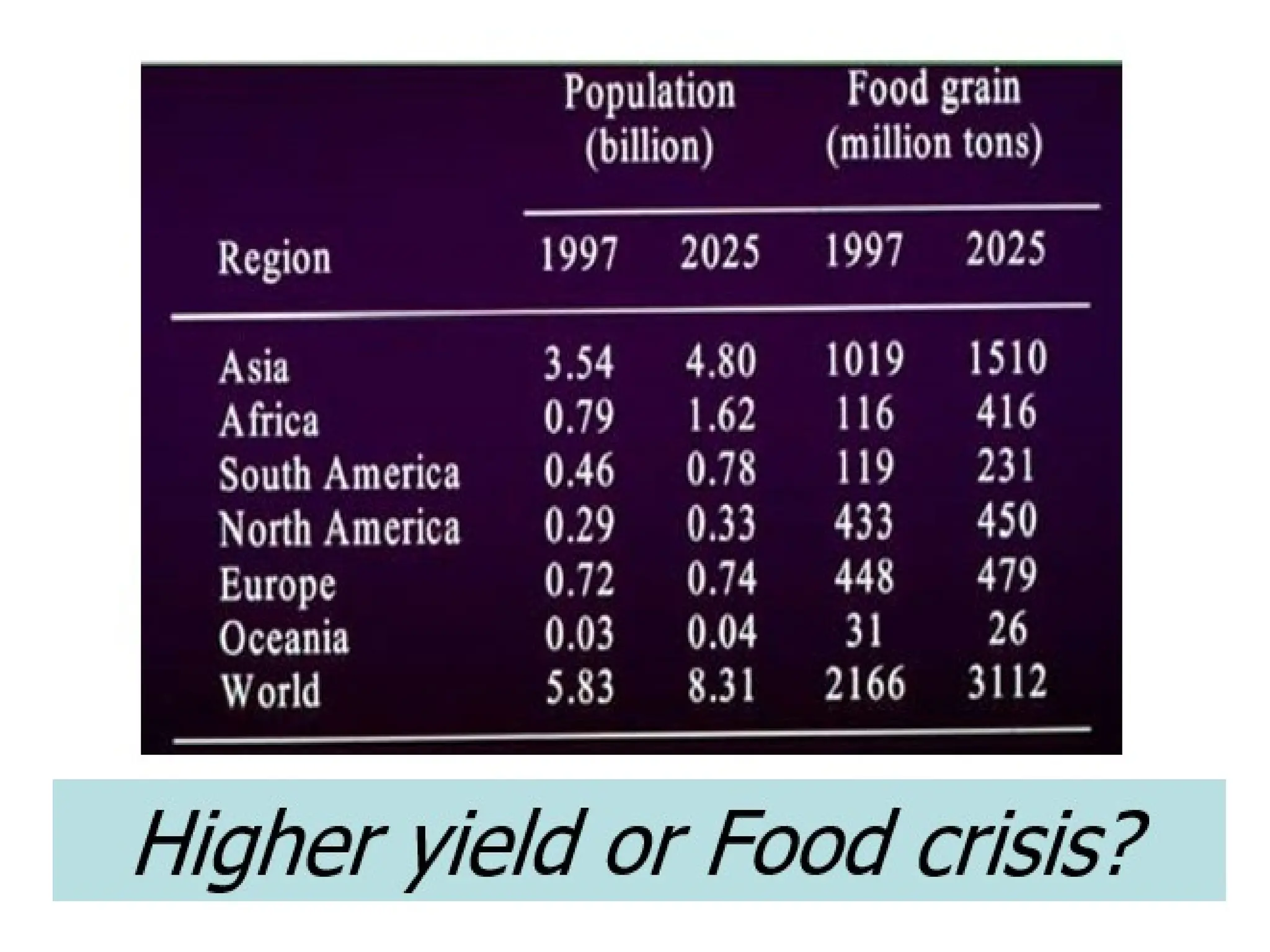
population grows, our needs also grow. To increase
the quantity of crop production as well as to produce
specific characteristics in plants, biotechnologists are
using selective gene techniques.
Genetic Variation
The creationof new alleles and the mixing of
alleles through recombination give rise to
genetic variation which is one of the forces
behind evolution. Natural selection favours one
phenotype over another and these phenotypes
are conditioned by one or more alleles. Genetic
variation is fundamental for selection, by which
progress in plant breeding can be made.
8.
Plant Breeding
• Whatis it?
– Is the science and art of improving crop plants through the study
and application of genetics, agronomy, statistics, plant pathology,
entomology, and other related sciences.
10.
Steps in domestication
(i)moved seeds from their native habitat and
planted them in areas to which they were
perhaps not as well adapted;
(ii) removed certain natural selection pressures
by growing the plants in a cultivated field;
(iii) applied artificial selection pressures by
choosing characteristics that would not
necessarily have been beneficial for the plants
under natural conditions.
11.
Effects of domestication
•Cultivation also creates selection pressure,
resulting in changes in allele frequency,
gradations within and between species,
fixation of major genes, and improvement of
quantitative traits.
12.
How many speciesdomesticated?
• More than 1000 species
• 100–200 are now major components of the human diet
• The 15 most important examples can be divided into the
following four groups:
• 1. Cereals: rice, wheat, maize, sorghum (jawar), barley
(Jao).
• 2. Roots and stems: sugarbeet, sugarcane, potato, yam,
cassava.
• 3. Legumes: bean, soybean, groundnut.
• 4. Fruits: coconut, banana.
21.
Selection
In 1859 Darwinproposed in The Origin of Species that
natural selection is the mechanism of evolution. Darwin’s
thesis was that the adaptation of populations to their
environments resulted from natural selection and that if
this process continued for long enough, it would ultimately
lead to the origin of new species. Darwin’s ‘Theory of
Evolution through Natural Selection’ hypothesized that
plants change gradually by natural selection operating on
variable populations and was the outstanding discovery of
the 19th century with direct relevance to plant breeding
22.
Hybridization
(1733–1806)
By understanding thereproductive capacities of
plants, plant breeders can manipulate these
crosses to produce fertile offspring which carry
traits from both parents. Crossing has been very
valuable to plant breeders, because it allows
some measure of control over the phenotype of
a plant. Nearly all modern plant breeding
involves some use of hybridization
26.
Mendel laws ofinheritance
(1865)
• Law of segregation
• Law of independent assortment
27.
Breeding types andpolyploidy
Other historical developments in plant breeding
include, pedigree breeding, backcross breeding
(Harlan and Pope, 1922) and mutation breeding
(Stadler, 1928). Natural and artificial polyploids also
offered new possibilities for plant breeding. Blakeslee
and Avery (1937) demonstrated the usefulness of
colchicine in the induction of chromosome doubling
and polyploidy, enabling plant breeders to combine
entire chromosome sets of two or more species to
evolve new crop plants
28.
Genetic diversity andgermplasm
conservation
• In situ conservation
• Ex situ conservation
29.
Biodiversity
• Biodiversity isthe – Degree of variation of life forms.
• It refers to the – variety and variability among all
groups of living organisms and the ecosystem
complexes in which they occur.
• In the convention of biological diversity (1992)
biodiversity has been defined as the variability
among living from all sources including terrestrial,
marine and other ecosystems and the ecological
complexes of which they are a part.
30.
Why to conserve
biodiversity?
•The enormous value of biodiversity due to
their genetic, commercial, medical, aesthetic
importance and ecological importance
emphasizes the need to conserve biodiversity.
31.
Conservation
• Conservation isan ethic of resource use,
allocation and protection.
• Its primary focus is upon maintaining the
health of the natural world its fisheries,
habitats and biological diversity.
• Secondary focus is on material conservation
and energy conservation.
32.
Ex situ conservation:
Exsitu conservation is a technique of
conservation of biological diversity
outside its natural habitats, targeting all
levels of biodiversity such as genetic,
species, and ecosystems.
In situ conservation
•In situ conservation is the on site
conservation or conservation of natural
resources in the natural populations of plants
such as forest genetic resources in natural
population of the tree species.
• It is the process of conserving an endangered
specie of plant or an animal in its natural
habitat.
35.
In situ conservation
•It can be done either by protecting or cleaning
up the habitat itself or by defending the
species from the predators
• It is also the conservation of agricultural
biodiversity in agro-ecosystem
Thus,
“Conservation of habitats, species
& ecosystem where they naturally occur”
36.
Methods of insitu conservation
• In situ conservation is usually done by
following methods:
1. National parks
2. Biosphere reserves
3. Wild sanctuaries
Principles of BreedingMaize
• Three Main Principles
– Inbreeding
– Hybridization
– Heterosis
39.
Inbreeding
• Main Goals
–Increase the homozygosity at all or specific loci in the
plant genome
– Produce a plant which breeds true
– Produce uniform plants
40.
Hybridization of Maize
•Hybridization occurs when inbred parents are mated
(cross pollinated)
• Creates a heterozygous individual
• Benefits
– Increased heterosis (vigor) in F1 generation
41.
Heterosis (Hybrid Vigor)
•Heterosis occurs when two homozygous
individuals are cross pollinated.
– This causes all loci to become heterozygous
– The increased heterozygosity causes increased plant
vigor
• Benefits of Increased Vigor
– Increased yield
– Better standability
– Better germination
– Overall better plant performance
Selfing
• Selfing isthe process of
pollinating a plant with its own
pollen
• Benefits
– Increased homozygosity
– Plants which breed true from
generation to generation
– Decreased Segregation
• Disadvantages
– Many generations of selfing lead
to inbreeding depression
44.
Crossing and TestCrossing
• Crossing is useful when trying to create
hybrid seed.
– Ex. By crossing “Inbred A x Inbred a” you would
obtain an F1 hybrid Aa
– Crossing is used to produce the hybrid seed
farmers use to plant in the spring
• Test Crossing is useful to test general
combining ability of an individual
– Ex. Inbred A is x to a tester which has a diverse
selection of genotypes
45.
Backcrossing
• Backcrossing isa method which
is used to improve a trait which
a plant is deficient in.
• Method
– A hybrid plant which has the trait
of interest is crossed with one of
its parents
– The offspring are then crossed
back to the parent, thus increasing
the frequency of the trait.
46.
The concept ofallelic and
genotypic frequencies
• For a gene with n alleles, there are n(n + 1)/2
possible genotypes
47.
Hardy–Weinberg equilibrium (HWE)
Apopulation is in equilibrium if the allele and
genotypic frequencies are constant from
generation to generation.
53.
Genetic engineering andgene transfer
• DNA structure
• Restriction Enzyme
• Agrobacterium mediated transformation
• Bt cotton
54.
Breeding efforts inthe public and private
sectors
Two centres, International Rice Research
Institute (IRRI), Philippines, and Centro
Internacional de Mejoramiento de Maiz y Trigo
(CIMMYT), Mexico, established in the 1960s,
made phenomenal contributions to food
production by developing shorter and higher
yielding rice, wheat and maize cultivars.
55.
• Consultative Groupon International
Agricultural Research (CGIAR) was established
in 1971.
56.
Conclusion
• Plant breedingis a complicated but beneficial
process.
• There are many processes involved which are
used in the development of new varieties.
• Remember if it wasn’t for plant breeding we
wouldn’t have such high yielding crops
#2 The general definition is very broad. Many individuals prefer this definition because they can claim processes such as plant breeding or mutagenesis are actually biotechnology. The detailed definition points to the fact that a foreign gene needs to be inserted for a product to be considered a biotech product. Plant breeding is not biotechnology.
#38 Inbreeding cereals Cereals, such as wheat, rice, barley, and oats that are self-pollinating and are usually cultivated as pure lines.