5/16/2020 1
Distant Hybridization in Fruit Crops
Credit Seminar On
Sanjay K S
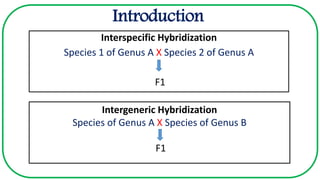
Introduction
Interspecific Hybridization
Species 1 of Genus A X Species 2 of Genus A
F1
Intergeneric Hybridization
Species of Genus A X Species of Genus B
F1
History
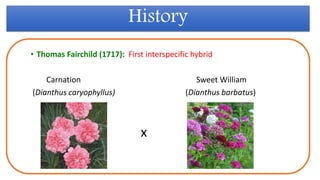
• Thomas Fairchild (1717): First interspecific hybrid
Carnation Sweet William
(Dianthus caryophyllus) (Dianthus barbatus)
x
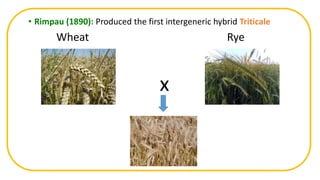
• Rimpau (1890): Produced the first intergeneric hybrid Triticale
Wheat Rye
x
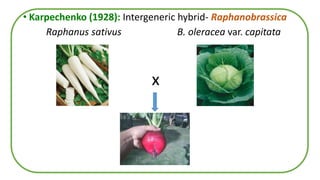
• Karpechenko (1928): Intergeneric hybrid- Raphanobrassica
Raphanus sativus B. oleracea var. capitata
X
x
Main features of Distant hybridizatiton
 It is used when the desirable character is not found within the species
of a crop
 It is an effective method of transferring desirable gene into cultivated
plants from their related cultivated or wild species.
 It gives rise to three types of crosses viz. a) fully fertile, b) Partially
fertile and c) Fully sterile in different crop species.
 It leads to Introgression which refers to transfer of some genes from
one species into genome of another species.
 F1 hybrid between two genus are always sterile. The fertility has to be
restored by doubling of chromosome through colchicine treatment.
Types of crosses obtained during distant hybridization
• Fully fertile crosses: Between species that have complete chromosomal
homology. Chromosome in such hybrids have normal pairing at meiosis.
E.g., Mango, citrus
• Partially fertile crosses: Between species which differ in chromosome
number but have some chromosome in common. In such situation , F1
plants are partially fertile and partially sterile.
• Fully sterile crosses: Between species which do not have chromosomal
homology. Such hybrids can be made self fertile by doubling the
chromosomes.
Problems associated with wide crosses
• Cross Incompatibility
• Hybrid Inviability
• Hybrid Sterility
• Hybrid Breakdown
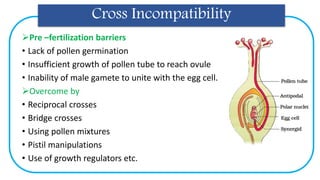
Cross Incompatibility
Pre –fertilization barriers
• Lack of pollen germination
• Insufficient growth of pollen tube to reach ovule
• Inability of male gamete to unite with the egg cell.
Overcome by
• Reciprocal crosses
• Bridge crosses
• Using pollen mixtures
• Pistil manipulations
• Use of growth regulators etc.
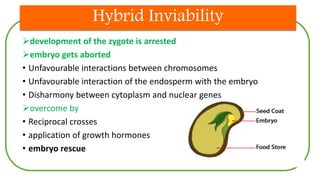
Hybrid Inviability
development of the zygote is arrested
embryo gets aborted
• Unfavourable interactions between chromosomes
• Unfavourable interaction of the endosperm with the embryo
• Disharmony between cytoplasm and nuclear genes
overcome by
• Reciprocal crosses
• application of growth hormones
• embryo rescue
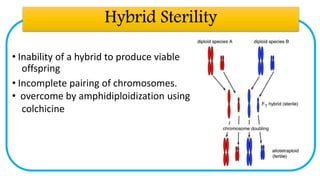
Hybrid Sterility
• Inability of a hybrid to produce viable
offspring
• Incomplete pairing of chromosomes.
• overcome by amphidiploidization using
colchicine
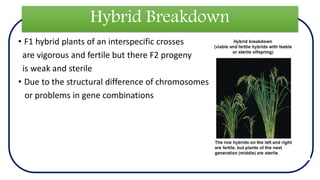
Hybrid Breakdown
• F1 hybrid plants of an interspecific crosses
are vigorous and fertile but there F2 progeny
is weak and sterile
• Due to the structural difference of chromosomes
or problems in gene combinations
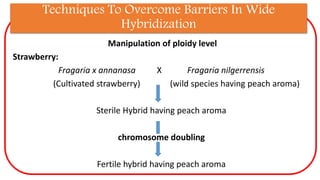
Techniques To Overcome Barriers In Wide
Hybridization
Manipulation of ploidy level
Strawberry:
Fragaria x annanasa X Fragaria nilgerrensis
(Cultivated strawberry) (wild species having peach aroma)
Sterile Hybrid having peach aroma
chromosome doubling
Fertile hybrid having peach aroma
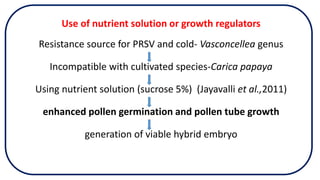
Use of nutrient solution or growth regulators
Resistance source for PRSV and cold- Vasconcellea genus
Incompatible with cultivated species-Carica papaya
Using nutrient solution (sucrose 5%) (Jayavalli et al.,2011)
enhanced pollen germination and pollen tube growth
generation of viable hybrid embryo
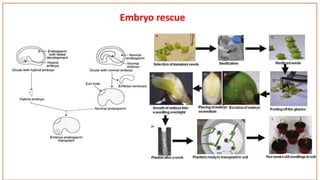
Embryo rescue
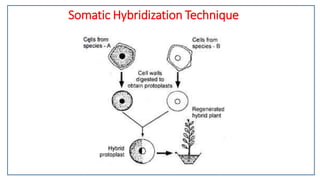
Somatic Hybridization Technique
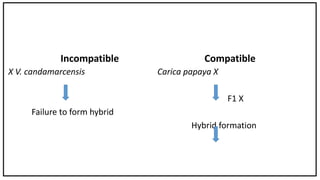
Incompatible
X V. candamarcensis
Failure to form hybrid
Compatible
Carica papaya X
F1 X
Hybrid formation
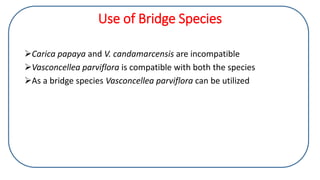
Carica papaya and V. candamarcensis are incompatible
Vasconcellea parviflora is compatible with both the species
As a bridge species Vasconcellea parviflora can be utilized
Use of Bridge Species
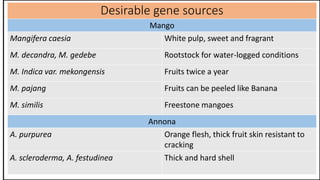
Desirable gene sources
Mango
Mangifera caesia White pulp, sweet and fragrant
M. decandra, M. gedebe Rootstock for water-logged conditions
M. Indica var. mekongensis Fruits twice a year
M. pajang Fruits can be peeled like Banana
M. similis Freestone mangoes
Annona
A. purpurea Orange flesh, thick fruit skin resistant to
cracking
A. scleroderma, A. festudinea Thick and hard shell
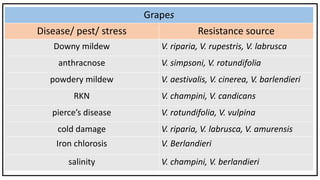
Grapes
Disease/ pest/ stress Resistance source
Downy mildew V. riparia, V. rupestris, V. labrusca
anthracnose V. simpsoni, V. rotundifolia
powdery mildew V. aestivalis, V. cinerea, V. barlendieri
RKN V. champini, V. candicans
pierce’s disease V. rotundifolia, V. vulpina
cold damage V. riparia, V. labrusca, V. amurensis
Iron chlorosis V. Berlandieri
salinity V. champini, V. berlandieri
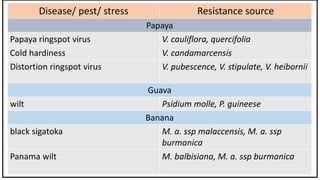
Disease/ pest/ stress Resistance source
Papaya
Papaya ringspot virus V. cauliflora, quercifolia
Cold hardiness V. candamarcensis
Distortion ringspot virus V. pubescence, V. stipulate, V. heibornii
Guava
wilt Psidium molle, P. guineese
Banana
black sigatoka M. a. ssp malaccensis, M. a. ssp
burmanica
Panama wilt M. balbisiana, M. a. ssp burmanica
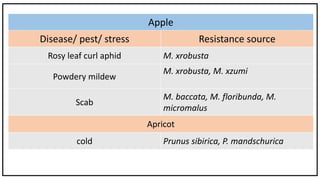
Apple
Disease/ pest/ stress Resistance source
Rosy leaf curl aphid M. xrobusta
Powdery mildew
M. xrobusta, M. xzumi
Scab
M. baccata, M. floribunda, M.
micromalus
Apricot
cold Prunus sibirica, P. mandschurica
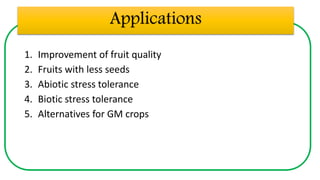
Applications
1. Improvement of fruit quality
2. Fruits with less seeds
3. Abiotic stress tolerance
4. Biotic stress tolerance
5. Alternatives for GM crops
Case Studies
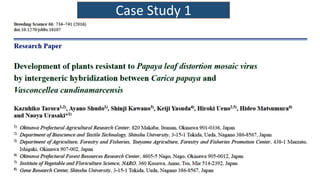
Case Study 1
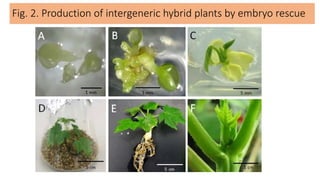
Fig. 2. Production of intergeneric hybrid plants by embryo rescue
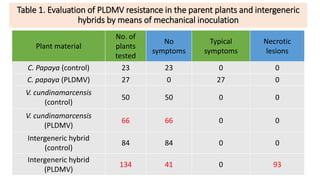
Table 1. Evaluation of PLDMV resistance in the parent plants and intergeneric
hybrids by means of mechanical inoculation
Plant material
No. of
plants
tested
No
symptoms
Typical
symptoms
Necrotic
lesions
C. Papaya (control) 23 23 0 0
C. papaya (PLDMV) 27 0 27 0
V. cundinamarcensis
(control)
50 50 0 0
V. cundinamarcensis
(PLDMV)
66 66 0 0
Intergeneric hybrid
(control)
84 84 0 0
Intergeneric hybrid
(PLDMV)
134 41 0 93
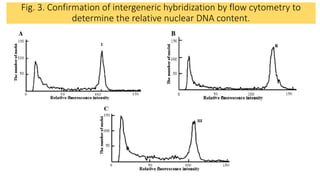
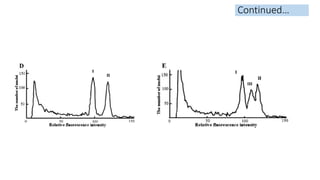
Fig. 3. Confirmation of intergeneric hybridization by flow cytometry to
determine the relative nuclear DNA content.
Continued…
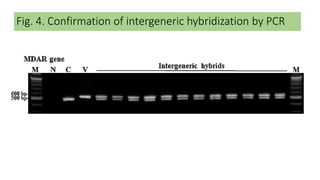
Fig. 4. Confirmation of intergeneric hybridization by PCR
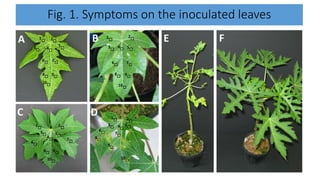
Fig. 1. Symptoms on the inoculated leaves
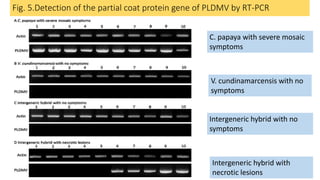
Fig. 5.Detection of the partial coat protein gene of PLDMV by RT-PCR
C. papaya with severe mosaic
symptoms
V. cundinamarcensis with no
symptoms
Intergeneric hybrid with no
symptoms
Intergeneric hybrid with
necrotic lesions
Case study 2
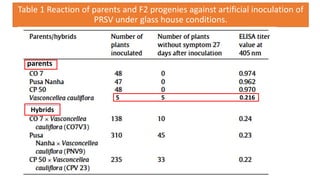
Table 1 Reaction of parents and F2 progenies against artificial inoculation of
PRSV under glass house conditions.
parents
Hybrids
5 5 0.216
Case study 3
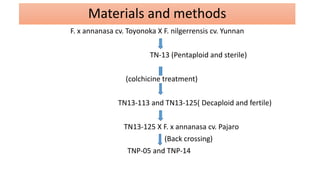
Materials and methods
F. x annanasa cv. Toyonoka X F. nilgerrensis cv. Yunnan
TN-13 (Pentaploid and sterile)
(colchicine treatment)
TN13-113 and TN13-125( Decaploid and fertile)
TN13-125 X F. x annanasa cv. Pajaro
(Back crossing)
TNP-05 and TNP-14
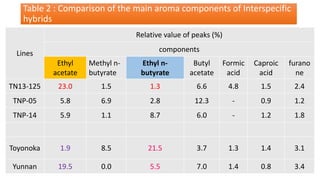
Lines
Relative value of peaks (%)
components
Ethyl
acetate
Methyl n-
butyrate
Ethyl n-
butyrate
Butyl
acetate
Formic
acid
Caproic
acid
furano
ne
TN13-125 23.0 1.5 1.3 6.6 4.8 1.5 2.4
TNP-05 5.8 6.9 2.8 12.3 - 0.9 1.2
TNP-14 5.9 1.1 8.7 6.0 - 1.2 1.8
Toyonoka 1.9 8.5 21.5 3.7 1.3 1.4 3.1
Yunnan 19.5 0.0 5.5 7.0 1.4 0.8 3.4
Table 2 : Comparison of the main aroma components of Interspecific
hybrids
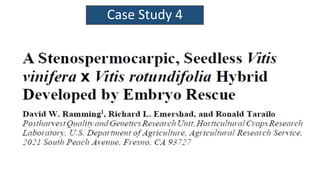
Case Study 4
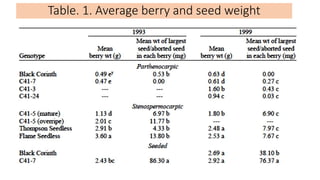
Table. 1. Average berry and seed weight
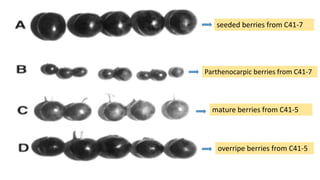
seeded berries from C41-7
Parthenocarpic berries from C41-7
mature berries from C41-5
overripe berries from C41-5
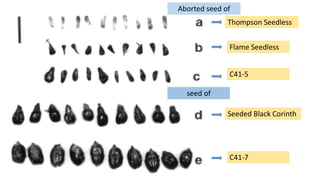
Aborted seed of
Thompson Seedless
Flame Seedless
C41-5
Seeded Black Corinth
C41-7
seed of
Case Study 5
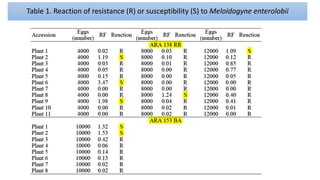
Table 1. Reaction of resistance (R) or susceptibility (S) to Meloidogyne enterolobii
•
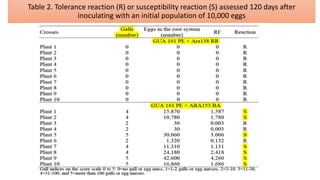
Table 2. Tolerance reaction (R) or susceptibility reaction (S) assessed 120 days after
inoculating with an initial population of 10,000 eggs
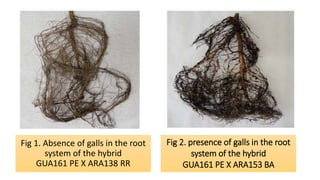
Fig 1. Absence of galls in the root
system of the hybrid
GUA161 PE X ARA138 RR
Fig 2. presence of galls in the root
system of the hybrid
GUA161 PE X ARA153 BA
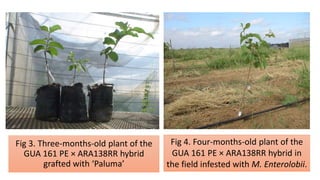
Fig 3. Three-months-old plant of the
GUA 161 PE × ARA138RR hybrid
grafted with ‘Paluma’
Fig 4. Four-months-old plant of the
GUA 161 PE × ARA138RR hybrid in
the field infested with M. Enterolobii.
CONCLUSION
Varieties 1. Resistant to destructive pest and disease
2. Tolerant to abiotic stress
3. With improved quality fruits
Increase in germplasm resources which can be utilized to cross with
different varieties in different combinations
Alternatives for GM crops
Rootstock breeding is needed
Need to develop improved methods of crossing and overcoming
barriers
Need to work on wild species to identify genes of interest
THANK YOU ALL

Distant Hybridization in Fruit Crops

  • 1.
    5/16/2020 1 Distant Hybridizationin Fruit Crops Credit Seminar On Sanjay K S
  • 2.
    Introduction Interspecific Hybridization Species 1of Genus A X Species 2 of Genus A F1 Intergeneric Hybridization Species of Genus A X Species of Genus B F1
  • 3.
    History • Thomas Fairchild(1717): First interspecific hybrid Carnation Sweet William (Dianthus caryophyllus) (Dianthus barbatus) x
  • 4.
    • Rimpau (1890):Produced the first intergeneric hybrid Triticale Wheat Rye x
  • 5.
    • Karpechenko (1928):Intergeneric hybrid- Raphanobrassica Raphanus sativus B. oleracea var. capitata X x
  • 6.
    Main features ofDistant hybridizatiton  It is used when the desirable character is not found within the species of a crop  It is an effective method of transferring desirable gene into cultivated plants from their related cultivated or wild species.  It gives rise to three types of crosses viz. a) fully fertile, b) Partially fertile and c) Fully sterile in different crop species.  It leads to Introgression which refers to transfer of some genes from one species into genome of another species.  F1 hybrid between two genus are always sterile. The fertility has to be restored by doubling of chromosome through colchicine treatment.
  • 7.
    Types of crossesobtained during distant hybridization • Fully fertile crosses: Between species that have complete chromosomal homology. Chromosome in such hybrids have normal pairing at meiosis. E.g., Mango, citrus • Partially fertile crosses: Between species which differ in chromosome number but have some chromosome in common. In such situation , F1 plants are partially fertile and partially sterile. • Fully sterile crosses: Between species which do not have chromosomal homology. Such hybrids can be made self fertile by doubling the chromosomes.
  • 8.
    Problems associated withwide crosses • Cross Incompatibility • Hybrid Inviability • Hybrid Sterility • Hybrid Breakdown
  • 9.
    Cross Incompatibility Pre –fertilizationbarriers • Lack of pollen germination • Insufficient growth of pollen tube to reach ovule • Inability of male gamete to unite with the egg cell. Overcome by • Reciprocal crosses • Bridge crosses • Using pollen mixtures • Pistil manipulations • Use of growth regulators etc.
  • 10.
    Hybrid Inviability development ofthe zygote is arrested embryo gets aborted • Unfavourable interactions between chromosomes • Unfavourable interaction of the endosperm with the embryo • Disharmony between cytoplasm and nuclear genes overcome by • Reciprocal crosses • application of growth hormones • embryo rescue
  • 11.
    Hybrid Sterility • Inabilityof a hybrid to produce viable offspring • Incomplete pairing of chromosomes. • overcome by amphidiploidization using colchicine
  • 12.
    Hybrid Breakdown • F1hybrid plants of an interspecific crosses are vigorous and fertile but there F2 progeny is weak and sterile • Due to the structural difference of chromosomes or problems in gene combinations
  • 13.
    Techniques To OvercomeBarriers In Wide Hybridization Manipulation of ploidy level Strawberry: Fragaria x annanasa X Fragaria nilgerrensis (Cultivated strawberry) (wild species having peach aroma) Sterile Hybrid having peach aroma chromosome doubling Fertile hybrid having peach aroma
  • 14.
    Use of nutrientsolution or growth regulators Resistance source for PRSV and cold- Vasconcellea genus Incompatible with cultivated species-Carica papaya Using nutrient solution (sucrose 5%) (Jayavalli et al.,2011) enhanced pollen germination and pollen tube growth generation of viable hybrid embryo
  • 15.
  • 16.
  • 17.
    Incompatible X V. candamarcensis Failureto form hybrid Compatible Carica papaya X F1 X Hybrid formation
  • 18.
    Carica papaya andV. candamarcensis are incompatible Vasconcellea parviflora is compatible with both the species As a bridge species Vasconcellea parviflora can be utilized Use of Bridge Species
  • 19.
    Desirable gene sources Mango Mangiferacaesia White pulp, sweet and fragrant M. decandra, M. gedebe Rootstock for water-logged conditions M. Indica var. mekongensis Fruits twice a year M. pajang Fruits can be peeled like Banana M. similis Freestone mangoes Annona A. purpurea Orange flesh, thick fruit skin resistant to cracking A. scleroderma, A. festudinea Thick and hard shell
  • 20.
    Grapes Disease/ pest/ stressResistance source Downy mildew V. riparia, V. rupestris, V. labrusca anthracnose V. simpsoni, V. rotundifolia powdery mildew V. aestivalis, V. cinerea, V. barlendieri RKN V. champini, V. candicans pierce’s disease V. rotundifolia, V. vulpina cold damage V. riparia, V. labrusca, V. amurensis Iron chlorosis V. Berlandieri salinity V. champini, V. berlandieri
  • 21.
    Disease/ pest/ stressResistance source Papaya Papaya ringspot virus V. cauliflora, quercifolia Cold hardiness V. candamarcensis Distortion ringspot virus V. pubescence, V. stipulate, V. heibornii Guava wilt Psidium molle, P. guineese Banana black sigatoka M. a. ssp malaccensis, M. a. ssp burmanica Panama wilt M. balbisiana, M. a. ssp burmanica
  • 22.
    Apple Disease/ pest/ stressResistance source Rosy leaf curl aphid M. xrobusta Powdery mildew M. xrobusta, M. xzumi Scab M. baccata, M. floribunda, M. micromalus Apricot cold Prunus sibirica, P. mandschurica
  • 23.
    Applications 1. Improvement offruit quality 2. Fruits with less seeds 3. Abiotic stress tolerance 4. Biotic stress tolerance 5. Alternatives for GM crops
  • 24.
  • 25.
  • 26.
    Fig. 2. Productionof intergeneric hybrid plants by embryo rescue
  • 27.
    Table 1. Evaluationof PLDMV resistance in the parent plants and intergeneric hybrids by means of mechanical inoculation Plant material No. of plants tested No symptoms Typical symptoms Necrotic lesions C. Papaya (control) 23 23 0 0 C. papaya (PLDMV) 27 0 27 0 V. cundinamarcensis (control) 50 50 0 0 V. cundinamarcensis (PLDMV) 66 66 0 0 Intergeneric hybrid (control) 84 84 0 0 Intergeneric hybrid (PLDMV) 134 41 0 93
  • 28.
    Fig. 3. Confirmationof intergeneric hybridization by flow cytometry to determine the relative nuclear DNA content.
  • 29.
  • 30.
    Fig. 4. Confirmationof intergeneric hybridization by PCR
  • 31.
    Fig. 1. Symptomson the inoculated leaves
  • 32.
    Fig. 5.Detection ofthe partial coat protein gene of PLDMV by RT-PCR C. papaya with severe mosaic symptoms V. cundinamarcensis with no symptoms Intergeneric hybrid with no symptoms Intergeneric hybrid with necrotic lesions
  • 33.
  • 34.
    Table 1 Reactionof parents and F2 progenies against artificial inoculation of PRSV under glass house conditions. parents Hybrids 5 5 0.216
  • 35.
  • 36.
    Materials and methods F.x annanasa cv. Toyonoka X F. nilgerrensis cv. Yunnan TN-13 (Pentaploid and sterile) (colchicine treatment) TN13-113 and TN13-125( Decaploid and fertile) TN13-125 X F. x annanasa cv. Pajaro (Back crossing) TNP-05 and TNP-14
  • 37.
    Lines Relative value ofpeaks (%) components Ethyl acetate Methyl n- butyrate Ethyl n- butyrate Butyl acetate Formic acid Caproic acid furano ne TN13-125 23.0 1.5 1.3 6.6 4.8 1.5 2.4 TNP-05 5.8 6.9 2.8 12.3 - 0.9 1.2 TNP-14 5.9 1.1 8.7 6.0 - 1.2 1.8 Toyonoka 1.9 8.5 21.5 3.7 1.3 1.4 3.1 Yunnan 19.5 0.0 5.5 7.0 1.4 0.8 3.4 Table 2 : Comparison of the main aroma components of Interspecific hybrids
  • 38.
  • 40.
    Table. 1. Averageberry and seed weight
  • 41.
    seeded berries fromC41-7 Parthenocarpic berries from C41-7 mature berries from C41-5 overripe berries from C41-5
  • 42.
    Aborted seed of ThompsonSeedless Flame Seedless C41-5 Seeded Black Corinth C41-7 seed of
  • 43.
  • 44.
    Table 1. Reactionof resistance (R) or susceptibility (S) to Meloidogyne enterolobii •
  • 45.
    Table 2. Tolerancereaction (R) or susceptibility reaction (S) assessed 120 days after inoculating with an initial population of 10,000 eggs
  • 46.
    Fig 1. Absenceof galls in the root system of the hybrid GUA161 PE X ARA138 RR Fig 2. presence of galls in the root system of the hybrid GUA161 PE X ARA153 BA
  • 47.
    Fig 3. Three-months-oldplant of the GUA 161 PE × ARA138RR hybrid grafted with ‘Paluma’ Fig 4. Four-months-old plant of the GUA 161 PE × ARA138RR hybrid in the field infested with M. Enterolobii.
  • 48.
    CONCLUSION Varieties 1. Resistantto destructive pest and disease 2. Tolerant to abiotic stress 3. With improved quality fruits Increase in germplasm resources which can be utilized to cross with different varieties in different combinations Alternatives for GM crops Rootstock breeding is needed Need to develop improved methods of crossing and overcoming barriers Need to work on wild species to identify genes of interest
  • 49.