“Water Fuel”
via
Zero-Point Energy
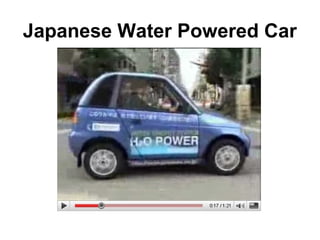
Japanese Water Powered Car
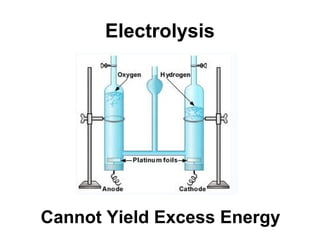
Electrolysis
Cannot Yield Excess Energy
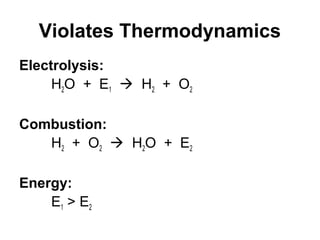
Violates Thermodynamics
Electrolysis:
H2O + E1  H2 + O2
Combustion:
H2 + O2  H2O + E2
Energy:
E1 > E2
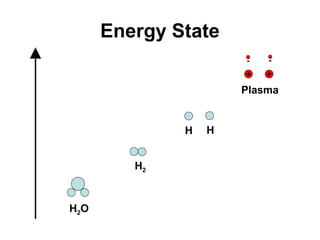
Energy State
+ +
- -
H2O
H2
H H
Plasma
What is the energy source?
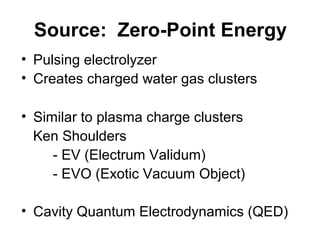
Source: Zero-Point Energy
• Pulsing electrolyzer
• Creates charged water gas clusters
• Similar to plasma charge clusters
Ken Shoulders
- EV (Electrum Validum)
- EVO (Exotic Vacuum Object)
• Cavity Quantum Electrodynamics (QED)
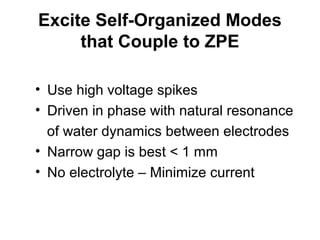
Excite Self-Organized Modes
that Couple to ZPE
• Use high voltage spikes
• Driven in phase with natural resonance
of water dynamics between electrodes
• Narrow gap is best < 1 mm
• No electrolyte – Minimize current
Names for the Gas
• Brown’s Gas
• Stoichiometric Mixture H2 and O2
• HHO Gas (Atomic hydrogen, oxygen)
• Hydroxy
• Charged Water Gas Clusters
Goal
• Minimize input power
• Maximize gas production
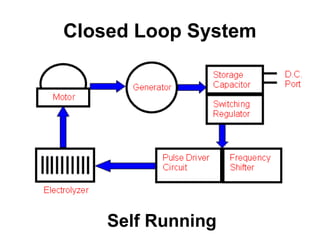
Closed Loop System
Self Running
How can water clusters capture
zero-point energy?
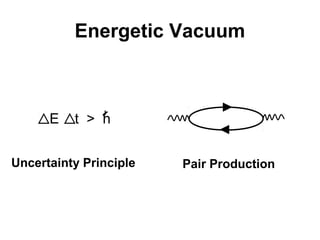
Energetic Vacuum
E t > h
Uncertainty Principle Pair Production
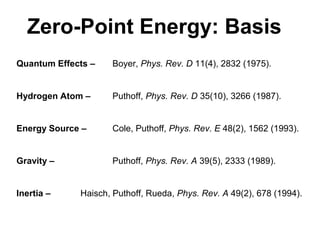
Quantum Effects – Boyer, Phys. Rev. D 11(4), 2832 (1975).
Hydrogen Atom – Puthoff, Phys. Rev. D 35(10), 3266 (1987).
Energy Source – Cole, Puthoff, Phys. Rev. E 48(2), 1562 (1993).
Gravity – Puthoff, Phys. Rev. A 39(5), 2333 (1989).
Inertia – Haisch, Puthoff, Rueda, Phys. Rev. A 49(2), 678 (1994).
Zero-Point Energy: Basis
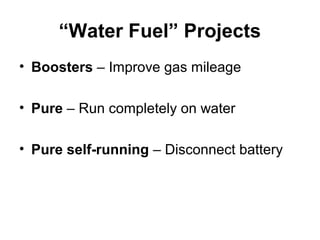
“Water Fuel” Projects
• Boosters – Improve gas mileage
• Pure – Run completely on water
• Pure self-running – Disconnect battery
Pure “Water Fuel” Projects
Run Completely on Water
Summary
Summary
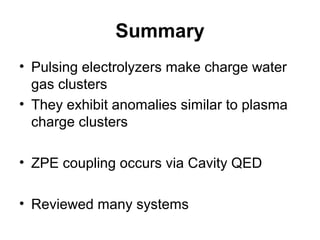
• Pulsing electrolyzers make charge water
gas clusters
• They exhibit anomalies similar to plasma
charge clusters
• ZPE coupling occurs via Cavity QED
• Reviewed many systems

Zero point energy