H2-O2 FUEL CELLS
FUEL CELLS
An electrical cell that can be continuously fed with a fuel so that the electrical power
output is sustained indefinitely.
They convert hydrogen, or hydrogen-containing fuels, directly into electrical energy
plus heat through the electrochemical reaction of hydrogen and oxygen into water.
The process is that of electrolysis in reverse.
Overall reaction: 2 H2(gas) + O2(gas) → 2 H2O + energy
Fuel cells
Because hydrogen and oxygen gases are electrochemically converted into water, fuel
cells have many advantages over heat engines.
These include:
1. High efficiency
2. Virtually silent operation and
3. If hydrogen is the fuel, there are no pollutant emissions.
4. If the hydrogen is produced from renewable energy sources, then the electrical
power produced can be truly sustainable.
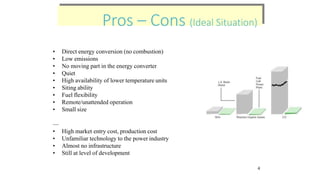
Pros – Cons (Ideal Situation)
• Direct energy conversion (no combustion)
• Low emissions
• No moving part in the energy converter
• Quiet
• High availability of lower temperature units
• Siting ability
• Fuel flexibility
• Remote/unattended operation
• Small size
—
• High market entry cost, production cost
• Unfamiliar technology to the power industry
• Almost no infrastructure
• Still at level of development
4
Fuel Cells
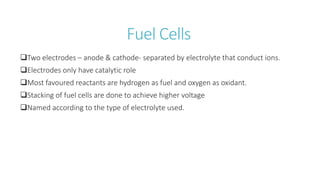
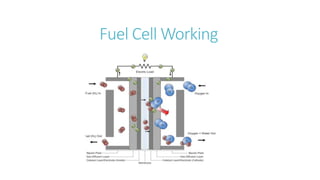
Two electrodes – anode & cathode- separated by electrolyte that conduct ions.
Electrodes only have catalytic role
Most favoured reactants are hydrogen as fuel and oxygen as oxidant.
Stacking of fuel cells are done to achieve higher voltage
Named according to the type of electrolyte used.
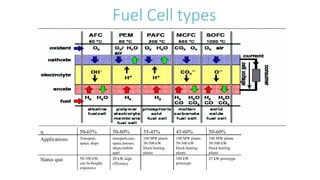
Fuel Cell types
η 50-65% 50-80% 35-45% 45-60% 50-60%
Applications Transport,
space, ships
transport,cars,
space,houses,
ships,mobile
appl.
100 MW plants
50-500 kW
block heating
plants
100 MW plants
50-500 kW
block heating
plants
100 MW plants
50-500 kW
block heating
plants
Status quo 50-100 kW,
can be bought,
expensive
20 kW, high
efficiency
100 kW
prototype
25 kW prototype
Fuel Cell Working
Working of Fuel Cell
The reaction between hydrogen and oxygen can be used to generate electricity via a fuel
cell.
Such a cell was used in the Apollo space programme and it served two different purposes –
It was used as a fuel source as well as a source of drinking water.
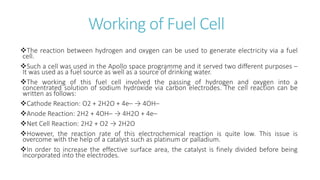
The working of this fuel cell involved the passing of hydrogen and oxygen into a
concentrated solution of sodium hydroxide via carbon electrodes. The cell reaction can be
written as follows:
Cathode Reaction: O2 + 2H2O + 4e– → 4OH–
Anode Reaction: 2H2 + 4OH– → 4H2O + 4e–
Net Cell Reaction: 2H2 + O2 → 2H2O
However, the reaction rate of this electrochemical reaction is quite low. This issue is
overcome with the help of a catalyst such as platinum or palladium.
In order to increase the effective surface area, the catalyst is finely divided before being
incorporated into the electrodes.
Applications of fuel cell
Fuel cell technology has a wide range of applications. Currently, heavy research is being
conducted in order to manufacture a cost-efficient automobile which is powered by a fuel
cell. A few applications of this technology are listed below.
•Fuel cell electric vehicles, or FCEVs, use clean fuels and are therefore more eco-friendly than
internal combustion engine-based vehicles.
•They have been used to power many space expeditions including the Apollo space program.
•Generally, the by products produced from these cells are heat and water.
•The portability of some fuel cells is extremely useful in some military applications.
•These electrochemical cells can also be used to power several electronic devices.
•Fuel cells are also used as primary or backup sources of electricity in many remote areas.

Fuel Cells.pptx

  • 1.
  • 2.
    FUEL CELLS An electricalcell that can be continuously fed with a fuel so that the electrical power output is sustained indefinitely. They convert hydrogen, or hydrogen-containing fuels, directly into electrical energy plus heat through the electrochemical reaction of hydrogen and oxygen into water. The process is that of electrolysis in reverse. Overall reaction: 2 H2(gas) + O2(gas) → 2 H2O + energy
  • 3.
    Fuel cells Because hydrogenand oxygen gases are electrochemically converted into water, fuel cells have many advantages over heat engines. These include: 1. High efficiency 2. Virtually silent operation and 3. If hydrogen is the fuel, there are no pollutant emissions. 4. If the hydrogen is produced from renewable energy sources, then the electrical power produced can be truly sustainable.
  • 4.
    Pros – Cons(Ideal Situation) Pros – Cons (Ideal Situation) • Direct energy conversion (no combustion) • Low emissions • No moving part in the energy converter • Quiet • High availability of lower temperature units • Siting ability • Fuel flexibility • Remote/unattended operation • Small size — • High market entry cost, production cost • Unfamiliar technology to the power industry • Almost no infrastructure • Still at level of development 4
  • 5.
    Fuel Cells Two electrodes– anode & cathode- separated by electrolyte that conduct ions. Electrodes only have catalytic role Most favoured reactants are hydrogen as fuel and oxygen as oxidant. Stacking of fuel cells are done to achieve higher voltage Named according to the type of electrolyte used.
  • 6.
    Fuel Cell types η50-65% 50-80% 35-45% 45-60% 50-60% Applications Transport, space, ships transport,cars, space,houses, ships,mobile appl. 100 MW plants 50-500 kW block heating plants 100 MW plants 50-500 kW block heating plants 100 MW plants 50-500 kW block heating plants Status quo 50-100 kW, can be bought, expensive 20 kW, high efficiency 100 kW prototype 25 kW prototype
  • 7.
  • 8.
    Working of FuelCell The reaction between hydrogen and oxygen can be used to generate electricity via a fuel cell. Such a cell was used in the Apollo space programme and it served two different purposes – It was used as a fuel source as well as a source of drinking water. The working of this fuel cell involved the passing of hydrogen and oxygen into a concentrated solution of sodium hydroxide via carbon electrodes. The cell reaction can be written as follows: Cathode Reaction: O2 + 2H2O + 4e– → 4OH– Anode Reaction: 2H2 + 4OH– → 4H2O + 4e– Net Cell Reaction: 2H2 + O2 → 2H2O However, the reaction rate of this electrochemical reaction is quite low. This issue is overcome with the help of a catalyst such as platinum or palladium. In order to increase the effective surface area, the catalyst is finely divided before being incorporated into the electrodes.
  • 9.
    Applications of fuelcell Fuel cell technology has a wide range of applications. Currently, heavy research is being conducted in order to manufacture a cost-efficient automobile which is powered by a fuel cell. A few applications of this technology are listed below. •Fuel cell electric vehicles, or FCEVs, use clean fuels and are therefore more eco-friendly than internal combustion engine-based vehicles. •They have been used to power many space expeditions including the Apollo space program. •Generally, the by products produced from these cells are heat and water. •The portability of some fuel cells is extremely useful in some military applications. •These electrochemical cells can also be used to power several electronic devices. •Fuel cells are also used as primary or backup sources of electricity in many remote areas.