Zero Energy Buildings:
Building a Sustainable Future
Chen Jia, Shubham Duttagupta, Martin Heinrich, Ankit Khanna,
Yeo Boon Khee


MT 5009 Analyzing Hi-Technology Opportunities
Class project
The definition of a Zero Energy Building

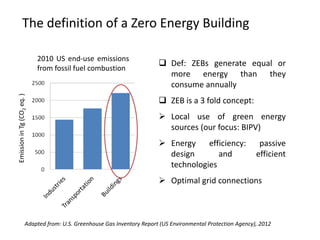
                            2010 US end-use emissions
                                                                     Def: ZEBs generate equal or
                            from fossil fuel combustion
                                                                      more energy than they
                                                                      consume annually
Emission in Tg (CO2 eq. )


                                                                     ZEB is a 3 fold concept:
                                                                     Local use of green energy
                                                                      sources (our focus: BIPV)
                                                                     Energy    efficiency:               passive
                                                                      design       and                   efficient
                                                                      technologies
                                                                     Optimal grid connections


                  Adapted from: U.S. Greenhouse Gas Inventory Report (US Environmental Protection Agency), 2012
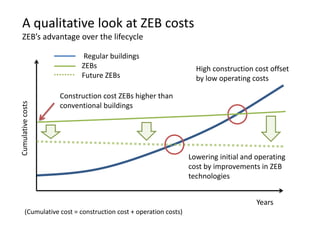
A qualitative look at ZEB costs
  ZEB’s advantage over the lifecycle

                          Regular buildings
                          ZEBs                                     High construction cost offset
                          Future ZEBs                              by low operating costs

                   Construction cost ZEBs higher than
Cumulative costs


                   conventional buildings


                                              Conventional


                                                                 Lowering initial and operating
                                                                 cost by improvements in ZEB
                                                                 technologies


                                                                                      Years
       (Cumulative cost = construction cost + operation costs)
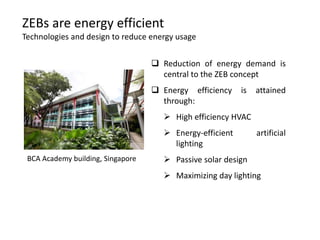
ZEBs are energy efficient
Technologies and design to reduce energy usage


                                    Reduction of energy demand is
                                     central to the ZEB concept
                                    Energy efficiency    is   attained
                                     through:
                                      High efficiency HVAC
                                      Energy-efficient        artificial
                                       lighting
 BCA Academy building, Singapore      Passive solar design
                                      Maximizing day lighting
Photovoltaics: Technology and
         Integration
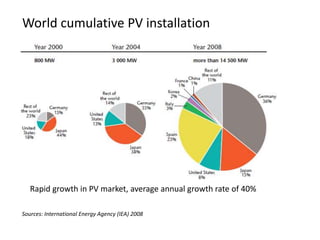
World cumulative PV installation


   Rapid growth in PV market, average annual growth rate of 40%

Sources: International Energy Agency (IEA) 2008
Grid parity in Singapore
a scenario under the assumption of net metering

                                       0.40
                                                                                                                  +5%/a
                                       0.35
Electricity costs/prices in [S$/kWh]


                                                     PV cost
                                       0.30
                                       0.25                                                                           0%/a
                                                    Utility price                                                 -7%/a
                                       0.20
                                       0.15                                                                       -13%/a
                                       0.10
                                       0.05
                                       0.00
                                           2011 2012 2013 2014 2015 2016 2017 2018 2019 2020
                                                                Calendar year
                                                                                Source: Luther et. al., ICMAT, 2011
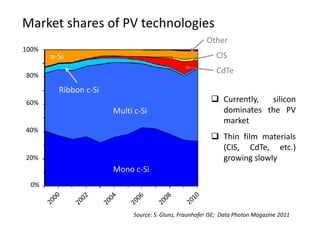
Market shares of PV technologies
                                                        Other
100%
       a-Si                                                 ClS

80%
                                                            CdTe

         Ribbon c-Si
60%                                                        Currently, silicon
                       Multi c-Si                           dominates the PV
                                                            market
40%
                                                           Thin film materials
                                                            (CIS, CdTe, etc.)
20%                                                         growing slowly
                       Mono c-Si
  0%


                             Source: S. Glunz, Fraunhofer ISE; Data Photon Magazine 2011
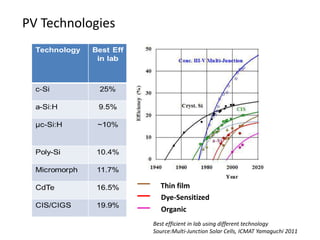
PV Technologies


                    Thin film
                    Dye-Sensitized
                    Organic
                  Best efficient in lab using different technology
                  Source:Multi-Junction Solar Cells, ICMAT Yamaguchi 2011
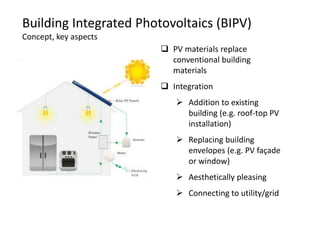
Building Integrated Photovoltaics (BIPV)
Concept, key aspects
                         PV materials replace
                          conventional building
                          materials
                         Integration
                            Addition to existing
                             building (e.g. roof-top PV
                             installation)
                            Replacing building
                             envelopes (e.g. PV façade
                             or window)
                            Aesthetically pleasing
                            Connecting to utility/grid
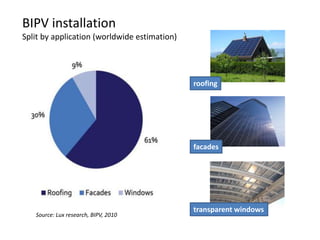
BIPV installation
Split by application (worldwide estimation)


                                              roofing


                                              facades


                                              transparent windows
   Source: Lux research, BIPV, 2010
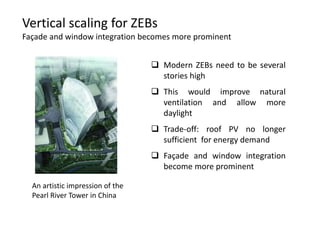
Vertical scaling for ZEBs
Façade and window integration becomes more prominent


                                   Modern ZEBs need to be several
                                    stories high
                                   This would improve natural
                                    ventilation and allow more
                                    daylight
                                   Trade-off: roof PV no longer
                                    sufficient for energy demand
                                   Façade and window integration
                                    become more prominent

  An artistic impression of the
  Pearl River Tower in China
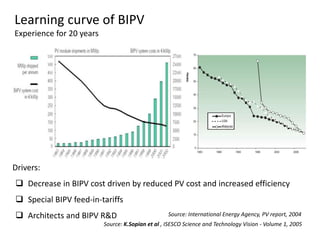
Learning curve of BIPV
Experience for 20 years


Drivers:
 Decrease in BIPV cost driven by reduced PV cost and increased efficiency
 Special BIPV feed-in-tariffs
 Architects and BIPV R&D                          Source: International Energy Agency, PV report, 2004
                          Source: K.Sopian et al , ISESCO Science and Technology Vision - Volume 1, 2005
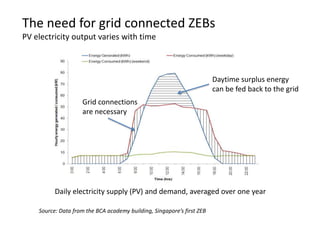
The need for grid connected ZEBs
PV electricity output varies with time


                                                                        Daytime surplus energy
                                                                        can be fed back to the grid
                    Grid connections
                    are necessary


          Daily electricity supply (PV) and demand, averaged over one year

    Source: Data from the BCA academy building, Singapore’s first ZEB
Energy efficient technologies for
            buildings
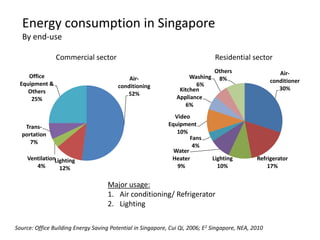
Energy consumption in Singapore
  By end-use

                Commercial sector                                               Residential sector
                                                                               Others                    Air-
    Office                                   Air-                    Washing    8%
 Equipment &                                                                                          conditioner
                                         conditioning                  6%
    Others                                                       Kitchen                                 30%
                                            52%
     25%                                                        Appliance
                                                                   6%
                                                               Video
   Trans-                                                    Equipment
  portation                                                     10%
                                                                     Fans
     7%
                                                                      4%
                                                               Water
    VentilationLighting                                       Heater           Lighting         Refrigerator
       4%        12%                                            9%               10%                17%


                                     Major usage:
                                     1. Air conditioning/ Refrigerator
                                     2. Lighting

Source: Office Building Energy Saving Potential in Singapore, Cui Qi, 2006; E2 Singapore, NEA, 2010
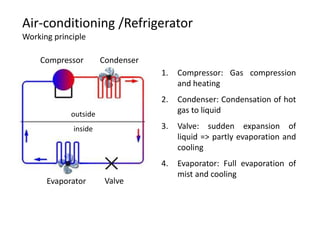
Air-conditioning /Refrigerator
Working principle

    Compressor         Condenser
                                   1.   Compressor: Gas compression
                                        and heating
                                   2.   Condenser: Condensation of hot
             outside                    gas to liquid

             inside                3.   Valve: sudden expansion of
                                        liquid => partly evaporation and
                                        cooling
                                   4.   Evaporator: Full evaporation of
                                        mist and cooling
      Evaporator        Valve
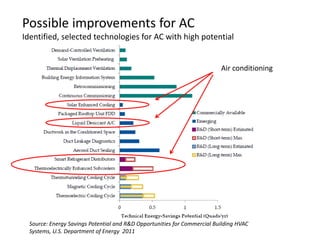
Possible improvements for AC
Identified, selected technologies for AC with high potential


                                                                          Air conditioning


  Source: Energy Savings Potential and R&D Opportunities for Commercial Building HVAC
  Systems, U.S. Department of Energy 2011
Improvements for air-conditioning
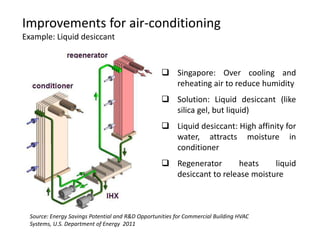
Example: Liquid desiccant


                                                    Singapore: Over cooling and
                                                     reheating air to reduce humidity
                                                    Solution: Liquid desiccant (like
                                                     silica gel, but liquid)
                                                    Liquid desiccant: High affinity for
                                                     water, attracts moisture in
                                                     conditioner
                                                    Regenerator       heats    liquid
                                                     desiccant to release moisture


  Source: Energy Savings Potential and R&D Opportunities for Commercial Building HVAC
  Systems, U.S. Department of Energy 2011
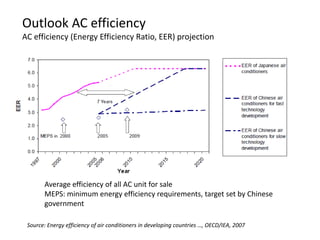
Outlook AC efficiency
AC efficiency (Energy Efficiency Ratio, EER) projection


       Average efficiency of all AC unit for sale
       MEPS: minimum energy efficiency requirements, target set by Chinese
       government

 Source: Energy efficiency of air conditioners in developing countries …, OECD/IEA, 2007
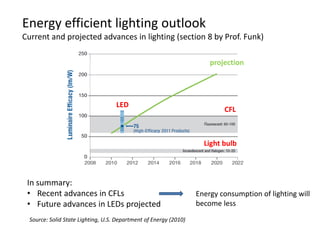
Energy efficient lighting outlook
Current and projected advances in lighting (section 8 by Prof. Funk)

                                                                       projection


                                    LED
                                                                           CFL


                                                                     Light bulb


 In summary:
 • Recent advances in CFLs                                         Energy consumption of lighting will
 • Future advances in LEDs projected                               become less
  Source: Solid State Lighting, U.S. Department of Energy (2010)
Passive design
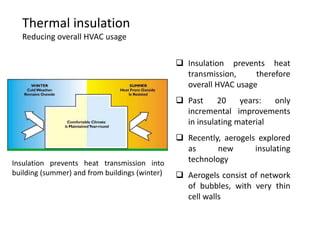
Thermal insulation
   Reducing overall HVAC usage

                                                 Insulation prevents heat
                                                  transmission,     therefore
                                                  overall HVAC usage
                                                 Past     20    years:  only
                                                  incremental improvements
                                                  in insulating material
                                                 Recently, aerogels explored
                                                  as      new       insulating
Insulation prevents heat transmission into        technology
building (summer) and from buildings (winter)    Aerogels consist of network
                                                  of bubbles, with very thin
                                                  cell walls
Aerogels cost and performance
Commercially available building insulation materials

          Insulating Material                  Thermal conductance           Cost per ft3 (US$)
                                                    [W/m²·K]
            Polystrene Foam                               0.20                     8.04
                Rock Wool                                 0.36                     1.64
               Fiber Glass                                0.32                     1.63
                 Cellulose                                0.29                     1.81
           Pure Silica Aerogel                            0.05                     2500
  Clay Polymer Aerogel (Aeroclay)                         0.05                       8

   Aerogels commercially available and used mainly in clothing and for
    scientific applications (because of higher costs)
   New startup Aeroclay (2010) is commercializing cheap aerogels made
    of clay; scale up from R&D to manufacturing underway

    Source: Evacuated Panels Utilizing Clay-Polymer Aerogel Composites for
    Improved Housing Insulation, Dalton et. al., 2010
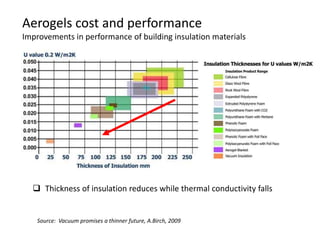
Aerogels cost and performance
Improvements in performance of building insulation materials


   Thickness of insulation reduces while thermal conductivity falls


    Source: Vacuum promises a thinner future, A.Birch, 2009
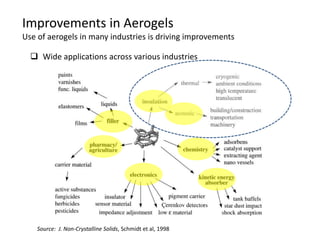
Improvements in Aerogels
Use of aerogels in many industries is driving improvements

   Wide applications across various industries


    Source: J. Non-Crystalline Solids, Schmidt et al, 1998
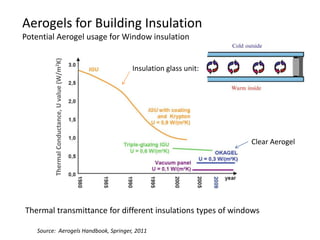
Aerogels for Building Insulation
Potential Aerogel usage for Window insulation

          Thermal Conductance, U value (W/m2K)
                                                 Insulation glass unit:


                                                                          Clear Aerogel


Thermal transmittance for different insulations types of windows

    Source: Aerogels Handbook, Springer, 2011
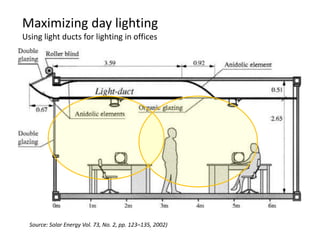
Maximizing day lighting
Using light ducts for lighting in offices


  Source: Solar Energy Vol. 73, No. 2, pp. 123–135, 2002)
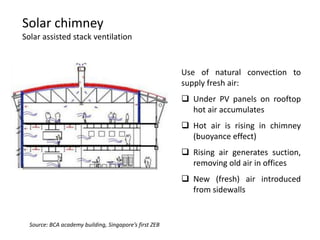
Solar chimney
Solar assisted stack ventilation


                                                        Use of natural convection to
                                                        supply fresh air:
                                                         Under PV panels on rooftop
                                                          hot air accumulates
                                                         Hot air is rising in chimney
                                                          (buoyance effect)
                                                         Rising air generates suction,
                                                          removing old air in offices
                                                         New (fresh) air introduced
                                                          from sidewalls


  Source: BCA academy building, Singapore’s first ZEB
ZEB: State of the art and outlook
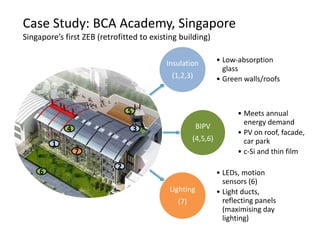
Case Study: BCA Academy, Singapore
Singapore’s first ZEB (retrofitted to existing building)

                                          Insulation          • Low-absorption
                                                                glass
                                            (1,2,3)           • Green walls/roofs


                                5                                   • Meets annual
                                                                      energy demand
             4                      3                 BIPV
                                                                    • PV on roof, facade,
                                                    (4,5,6)           car park
        1
                 7                                                  • c-Si and thin film
                            2
    6                                                         • LEDs, motion
                                                                sensors (6)
                                           Lighting           • Light ducts,
                                              (7)               reflecting panels
                                                                (maximising day
                                                                lighting)
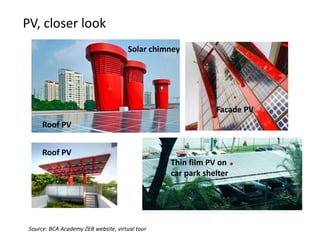
PV, closer look
                                      Solar chimney


                                                             Facade PV
      Roof PV


      Roof PV
                                                 Thin film PV on
                                                 car park shelter


 Source: BCA Academy ZEB website, virtual tour
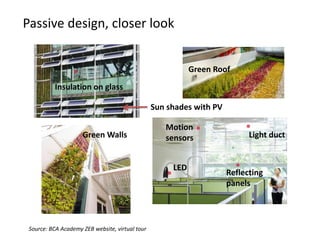
Passive design, closer look


                                                            Green Roof
          Insulation on glass

                                                 Sun shades with PV

                                                    Motion
                     Green Walls                    sensors                 Light duct


                                                      LED
                                                                      Reflecting
                                                                      panels


 Source: BCA Academy ZEB website, virtual tour
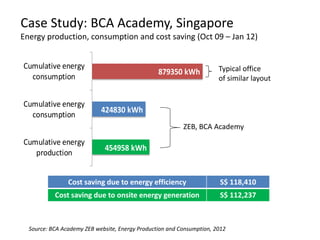
Case Study: BCA Academy, Singapore
Energy production, consumption and cost saving (Oct 09 – Jan 12)


Cumulative energy                                                      Typical office
                                                 879350 kWh
  consumption                                                          of similar layout


Cumulative energy
                            424830 kWh
  consumption
                                                          ZEB, BCA Academy
Cumulative energy
                             454958 kWh
   production


                Cost saving due to energy efficiency                   S$ 118,410
           Cost saving due to onsite energy generation                 S$ 112,237


  Source: BCA Academy ZEB website, Energy Production and Consumption, 2012
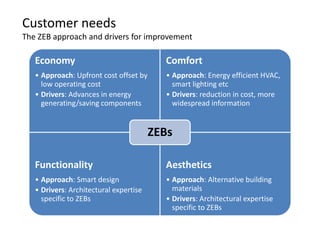
Customer needs
The ZEB approach and drivers for improvement

   Economy                                Comfort
   • Approach: Upfront cost offset by     • Approach: Energy efficient HVAC,
     low operating cost                     smart lighting etc
   • Drivers: Advances in energy          • Drivers: reduction in cost, more
     generating/saving components           widespread information


                                        ZEBs

   Functionality                          Aesthetics
   • Approach: Smart design               • Approach: Alternative building
   • Drivers: Architectural expertise       materials
     specific to ZEBs                     • Drivers: Architectural expertise
                                            specific to ZEBs
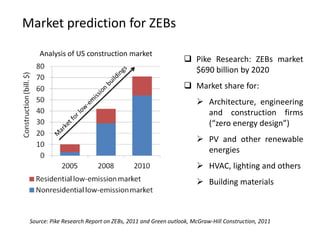
Market prediction for ZEBs

    Analysis of US construction market
                                                            Pike Research: ZEBs market
                                                             $690 billion by 2020
                                                            Market share for:
                                                                 Architecture, engineering
                                                                  and construction firms
                                                                  (“zero energy design”)
                                                                 PV and other renewable
                                                                  energies
                                                                 HVAC, lighting and others
                                                                 Building materials


 Source: Pike Research Report on ZEBs, 2011 and Green outlook, McGraw-Hill Construction, 2011
Thank you for your attention

Zero Energy Buildings

  • 1.
    Zero Energy Buildings: Buildinga Sustainable Future Chen Jia, Shubham Duttagupta, Martin Heinrich, Ankit Khanna, Yeo Boon Khee MT 5009 Analyzing Hi-Technology Opportunities Class project
  • 2.
    The definition ofa Zero Energy Building 2010 US end-use emissions  Def: ZEBs generate equal or from fossil fuel combustion more energy than they consume annually Emission in Tg (CO2 eq. )  ZEB is a 3 fold concept:  Local use of green energy sources (our focus: BIPV)  Energy efficiency: passive design and efficient technologies  Optimal grid connections Adapted from: U.S. Greenhouse Gas Inventory Report (US Environmental Protection Agency), 2012
  • 3.
    A qualitative lookat ZEB costs ZEB’s advantage over the lifecycle Regular buildings ZEBs High construction cost offset Future ZEBs by low operating costs Construction cost ZEBs higher than Cumulative costs conventional buildings Conventional Lowering initial and operating cost by improvements in ZEB technologies Years (Cumulative cost = construction cost + operation costs)
  • 4.
    ZEBs are energyefficient Technologies and design to reduce energy usage  Reduction of energy demand is central to the ZEB concept  Energy efficiency is attained through:  High efficiency HVAC  Energy-efficient artificial lighting BCA Academy building, Singapore  Passive solar design  Maximizing day lighting
  • 5.
  • 6.
    World cumulative PVinstallation Rapid growth in PV market, average annual growth rate of 40% Sources: International Energy Agency (IEA) 2008
  • 7.
    Grid parity inSingapore a scenario under the assumption of net metering 0.40 +5%/a 0.35 Electricity costs/prices in [S$/kWh] PV cost 0.30 0.25 0%/a Utility price -7%/a 0.20 0.15 -13%/a 0.10 0.05 0.00 2011 2012 2013 2014 2015 2016 2017 2018 2019 2020 Calendar year Source: Luther et. al., ICMAT, 2011
  • 8.
    Market shares ofPV technologies Other 100% a-Si ClS 80% CdTe Ribbon c-Si 60%  Currently, silicon Multi c-Si dominates the PV market 40%  Thin film materials (CIS, CdTe, etc.) 20% growing slowly Mono c-Si 0% Source: S. Glunz, Fraunhofer ISE; Data Photon Magazine 2011
  • 9.
    PV Technologies Thin film Dye-Sensitized Organic Best efficient in lab using different technology Source:Multi-Junction Solar Cells, ICMAT Yamaguchi 2011
  • 10.
    Building Integrated Photovoltaics(BIPV) Concept, key aspects  PV materials replace conventional building materials  Integration  Addition to existing building (e.g. roof-top PV installation)  Replacing building envelopes (e.g. PV façade or window)  Aesthetically pleasing  Connecting to utility/grid
  • 11.
    BIPV installation Split byapplication (worldwide estimation) roofing facades transparent windows Source: Lux research, BIPV, 2010
  • 12.
    Vertical scaling forZEBs Façade and window integration becomes more prominent  Modern ZEBs need to be several stories high  This would improve natural ventilation and allow more daylight  Trade-off: roof PV no longer sufficient for energy demand  Façade and window integration become more prominent An artistic impression of the Pearl River Tower in China
  • 13.
    Learning curve ofBIPV Experience for 20 years Drivers:  Decrease in BIPV cost driven by reduced PV cost and increased efficiency  Special BIPV feed-in-tariffs  Architects and BIPV R&D Source: International Energy Agency, PV report, 2004 Source: K.Sopian et al , ISESCO Science and Technology Vision - Volume 1, 2005
  • 14.
    The need forgrid connected ZEBs PV electricity output varies with time Daytime surplus energy can be fed back to the grid Grid connections are necessary Daily electricity supply (PV) and demand, averaged over one year Source: Data from the BCA academy building, Singapore’s first ZEB
  • 15.
  • 16.
    Energy consumption inSingapore By end-use Commercial sector Residential sector Others Air- Office Air- Washing 8% Equipment & conditioner conditioning 6% Others Kitchen 30% 52% 25% Appliance 6% Video Trans- Equipment portation 10% Fans 7% 4% Water VentilationLighting Heater Lighting Refrigerator 4% 12% 9% 10% 17% Major usage: 1. Air conditioning/ Refrigerator 2. Lighting Source: Office Building Energy Saving Potential in Singapore, Cui Qi, 2006; E2 Singapore, NEA, 2010
  • 17.
    Air-conditioning /Refrigerator Working principle Compressor Condenser 1. Compressor: Gas compression and heating 2. Condenser: Condensation of hot outside gas to liquid inside 3. Valve: sudden expansion of liquid => partly evaporation and cooling 4. Evaporator: Full evaporation of mist and cooling Evaporator Valve
  • 18.
    Possible improvements forAC Identified, selected technologies for AC with high potential Air conditioning Source: Energy Savings Potential and R&D Opportunities for Commercial Building HVAC Systems, U.S. Department of Energy 2011
  • 19.
    Improvements for air-conditioning Example:Liquid desiccant  Singapore: Over cooling and reheating air to reduce humidity  Solution: Liquid desiccant (like silica gel, but liquid)  Liquid desiccant: High affinity for water, attracts moisture in conditioner  Regenerator heats liquid desiccant to release moisture Source: Energy Savings Potential and R&D Opportunities for Commercial Building HVAC Systems, U.S. Department of Energy 2011
  • 20.
    Outlook AC efficiency ACefficiency (Energy Efficiency Ratio, EER) projection Average efficiency of all AC unit for sale MEPS: minimum energy efficiency requirements, target set by Chinese government Source: Energy efficiency of air conditioners in developing countries …, OECD/IEA, 2007
  • 21.
    Energy efficient lightingoutlook Current and projected advances in lighting (section 8 by Prof. Funk) projection LED CFL Light bulb In summary: • Recent advances in CFLs Energy consumption of lighting will • Future advances in LEDs projected become less Source: Solid State Lighting, U.S. Department of Energy (2010)
  • 22.
  • 23.
    Thermal insulation Reducing overall HVAC usage  Insulation prevents heat transmission, therefore overall HVAC usage  Past 20 years: only incremental improvements in insulating material  Recently, aerogels explored as new insulating Insulation prevents heat transmission into technology building (summer) and from buildings (winter)  Aerogels consist of network of bubbles, with very thin cell walls
  • 24.
    Aerogels cost andperformance Commercially available building insulation materials Insulating Material Thermal conductance Cost per ft3 (US$) [W/m²·K] Polystrene Foam 0.20 8.04 Rock Wool 0.36 1.64 Fiber Glass 0.32 1.63 Cellulose 0.29 1.81 Pure Silica Aerogel 0.05 2500 Clay Polymer Aerogel (Aeroclay) 0.05 8  Aerogels commercially available and used mainly in clothing and for scientific applications (because of higher costs)  New startup Aeroclay (2010) is commercializing cheap aerogels made of clay; scale up from R&D to manufacturing underway Source: Evacuated Panels Utilizing Clay-Polymer Aerogel Composites for Improved Housing Insulation, Dalton et. al., 2010
  • 25.
    Aerogels cost andperformance Improvements in performance of building insulation materials  Thickness of insulation reduces while thermal conductivity falls Source: Vacuum promises a thinner future, A.Birch, 2009
  • 26.
    Improvements in Aerogels Useof aerogels in many industries is driving improvements  Wide applications across various industries Source: J. Non-Crystalline Solids, Schmidt et al, 1998
  • 27.
    Aerogels for BuildingInsulation Potential Aerogel usage for Window insulation Thermal Conductance, U value (W/m2K) Insulation glass unit: Clear Aerogel Thermal transmittance for different insulations types of windows Source: Aerogels Handbook, Springer, 2011
  • 28.
    Maximizing day lighting Usinglight ducts for lighting in offices Source: Solar Energy Vol. 73, No. 2, pp. 123–135, 2002)
  • 29.
    Solar chimney Solar assistedstack ventilation Use of natural convection to supply fresh air:  Under PV panels on rooftop hot air accumulates  Hot air is rising in chimney (buoyance effect)  Rising air generates suction, removing old air in offices  New (fresh) air introduced from sidewalls Source: BCA academy building, Singapore’s first ZEB
  • 30.
    ZEB: State ofthe art and outlook
  • 31.
    Case Study: BCAAcademy, Singapore Singapore’s first ZEB (retrofitted to existing building) Insulation • Low-absorption glass (1,2,3) • Green walls/roofs 5 • Meets annual energy demand 4 3 BIPV • PV on roof, facade, (4,5,6) car park 1 7 • c-Si and thin film 2 6 • LEDs, motion sensors (6) Lighting • Light ducts, (7) reflecting panels (maximising day lighting)
  • 32.
    PV, closer look Solar chimney Facade PV Roof PV Roof PV Thin film PV on car park shelter Source: BCA Academy ZEB website, virtual tour
  • 33.
    Passive design, closerlook Green Roof Insulation on glass Sun shades with PV Motion Green Walls sensors Light duct LED Reflecting panels Source: BCA Academy ZEB website, virtual tour
  • 34.
    Case Study: BCAAcademy, Singapore Energy production, consumption and cost saving (Oct 09 – Jan 12) Cumulative energy Typical office 879350 kWh consumption of similar layout Cumulative energy 424830 kWh consumption ZEB, BCA Academy Cumulative energy 454958 kWh production Cost saving due to energy efficiency S$ 118,410 Cost saving due to onsite energy generation S$ 112,237 Source: BCA Academy ZEB website, Energy Production and Consumption, 2012
  • 35.
    Customer needs The ZEBapproach and drivers for improvement Economy Comfort • Approach: Upfront cost offset by • Approach: Energy efficient HVAC, low operating cost smart lighting etc • Drivers: Advances in energy • Drivers: reduction in cost, more generating/saving components widespread information ZEBs Functionality Aesthetics • Approach: Smart design • Approach: Alternative building • Drivers: Architectural expertise materials specific to ZEBs • Drivers: Architectural expertise specific to ZEBs
  • 36.
    Market prediction forZEBs Analysis of US construction market  Pike Research: ZEBs market $690 billion by 2020  Market share for:  Architecture, engineering and construction firms (“zero energy design”)  PV and other renewable energies  HVAC, lighting and others  Building materials Source: Pike Research Report on ZEBs, 2011 and Green outlook, McGraw-Hill Construction, 2011
  • 37.
    Thank you foryour attention