Renewable Energy &
Bio Diversity
                           Harsha Yadav,
                             Co-Founder,
                          EfficientCarbon
             harsha@efficientcarbon.com
                www.efficientcarbon.com
About EfficientCarbon
      •   Company offering services in:
           – Carbon Management Advisory
           – Sustainability Strategy Development and Reporting
           – Solar and Renewable Energy Market Advisory

      •   Experience in working with Large and SME clients
          in Cement, Leather, Steel and Auto Industries .

      •   Engineers and management graduates from
          institutions like IIT-R, BITS-Pilani, and IFMR with
          work experience in companies like Godrej,
          Infosys, Titan Industries and Deloitte Management
          Consulting.

      •   Supported by certified experts in this domain with
          an average experience of 23 years in the areas of
          Sustainability, Water Management, Energy
          Efficiency, Renewable Energy and Bio Diversity.
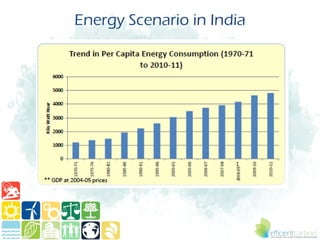
Energy Scenario in India
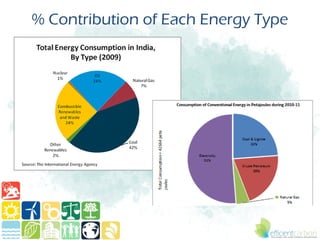
% Contribution of Each Energy Type
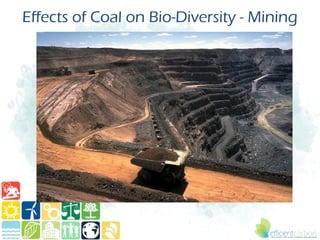
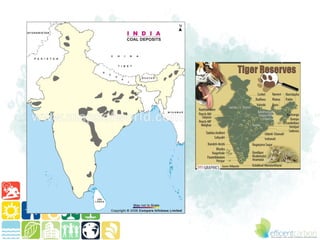
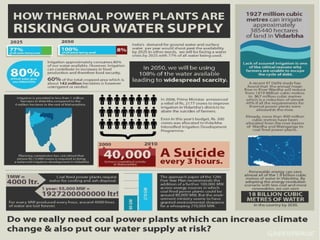
Effects of Coal on Bio-Diversity - Mining
But can we replace Coal
       completely?

Possible, but not yet!
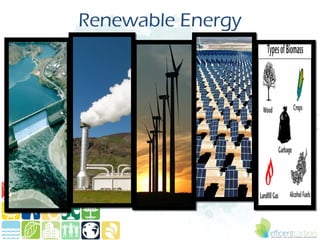
Renewable Energy
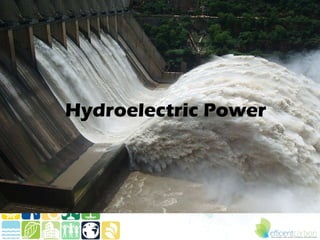
Hydroelectric Power
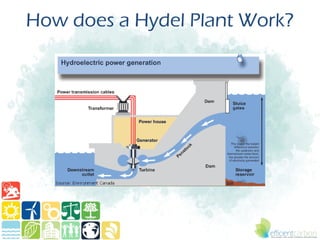
How does a Hydel Plant Work?
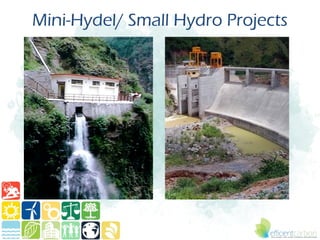
Mini-Hydel/ Small Hydro Projects
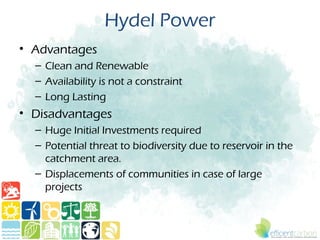
Hydel Power
• Advantages
  – Clean and Renewable
  – Availability is not a constraint
  – Long Lasting
• Disadvantages
  – Huge Initial Investments required
  – Potential threat to biodiversity due to reservoir in the
    catchment area.
  – Displacements of communities in case of large
    projects
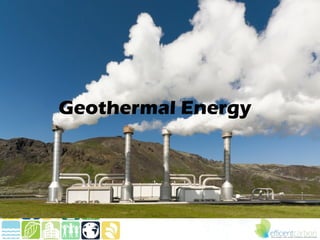
Geothermal Energy
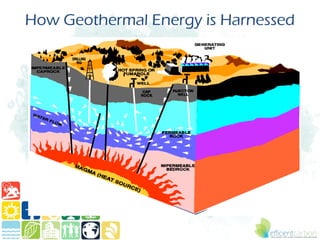
How Geothermal Energy is Harnessed
Assessment
• Advantages
  – Lifetime availability of heat from the Earth
  – Relatively simple process and easy to set-up


• Disadvantages
  – Cannot be set up at all the places as
    compared to Solar / Wind or Biomass
• In India, only areas near Himalayas are rich
  sources of Geothermal energy.
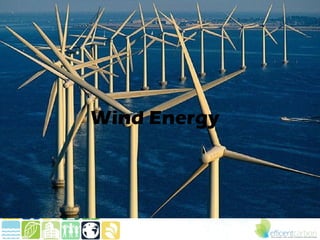
Wind Energy
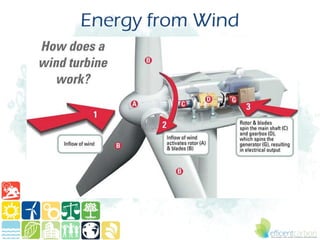
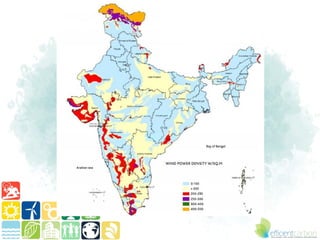
Energy from Wind
Assessment
• Advantages
  – Clean, easily available
  – Cost effective on a large scale


• Disadvantages
  – Availability of Wind power on all days
  – Efficiency of the turbine and distribution
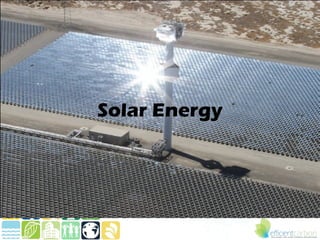
Solar Energy
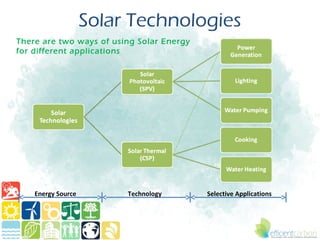
Solar Technologies
There are two ways of using Solar Energy
for different applications


    Energy Source        Technology        Selective Applications
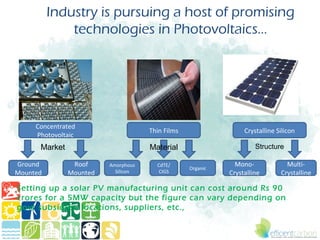
Industry is pursuing a host of promising
              technologies in Photovoltaics...


     Concentrated
                                     Thin Films                  Crystalline Silicon
     Photovoltaic
      Market                         Material                        Structure

Ground          Roof     Amorphous     CdTE/                  Mono-             Multi-
                                                  Organic
Mounted        Mounted     Silicon      CIGS                Crystalline       Crystalline

Setting up a solar PV manufacturing unit can cost around Rs 90
crores for a 5MW capacity but the figure can vary depending on
govt subsidies, locations, suppliers, etc.,
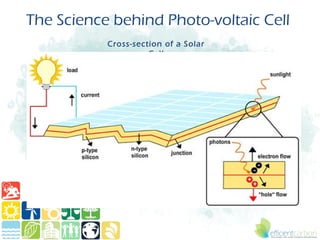
The Science behind Photo-voltaic Cell
           Cross-section of a Solar
                     Cell
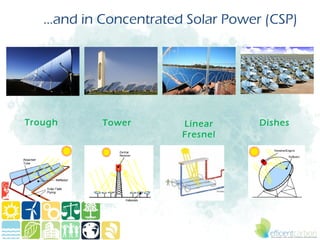
...and in Concentrated Solar Power (CSP)


Trough      Tower       Linear       Dishes
                        Fresnel
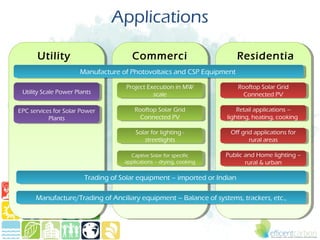
Applications

       Utility                        Commerci                       Residentia
                                            al
                      Manufacture of Photovoltaics and CSP Equipment
                      Manufacture of Photovoltaics and CSP Equipment      l
                                     Project Execution in MW
                                      Project Execution in MW             Rooftop Solar Grid
                                                                           Rooftop Solar Grid
 Utility Scale Power Plants
  Utility Scale Power Plants                   scale                        Connected PV
                                                scale                        Connected PV

EPC services for Solar Power
 EPC services for Solar Power           Rooftop Solar Grid
                                         Rooftop Solar Grid                Retail applications ––
                                                                            Retail applications
           Plants
            Plants                        Connected PV
                                           Connected PV               lighting, heating, cooking
                                                                        lighting, heating, cooking

                                        Solar for lighting - -
                                         Solar for lighting            Off grid applications for
                                                                        Off grid applications for
                                           streetlights
                                            streetlights                      rural areas
                                                                               rural areas

                                      Captive Solar for specific
                                       Captive Solar for specific     Public and Home lighting ––
                                                                       Public and Home lighting
                                    applications –– drying, cooking
                                     applications drying, cooking            rural & urban
                                                                              rural & urban

                        Trading of Solar equipment – imported or Indian
                         Trading of Solar equipment – imported or Indian

      Manufacture/Trading of Anciliary equipment – Balance of systems, trackers, etc.,
      Manufacture/Trading of Anciliary equipment – Balance of systems, trackers, etc.,
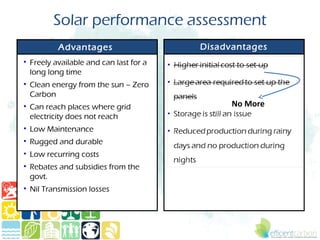
Solar performance assessment
          Advantages                    Disadvantages
• Freely available and can last for a
  long long time
• Clean energy from the sun – Zero
  Carbon
• Can reach places where grid                 No More
  electricity does not reach
• Low Maintenance
• Rugged and durable
• Low recurring costs
• Rebates and subsidies from the
  govt.
• Nil Transmission losses
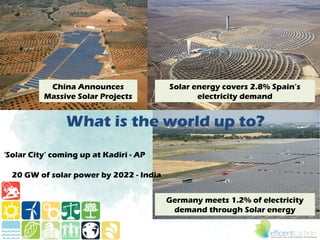
China Announces               Solar energy covers 2.8% Spain’s
          Massive Solar Projects                electricity demand


                What is the world up to?
‘Solar City’ coming up at Kadiri - AP

  20 GW of solar power by 2022 - India


                                         Germany meets 1.2% of electricity
                                          demand through Solar energy
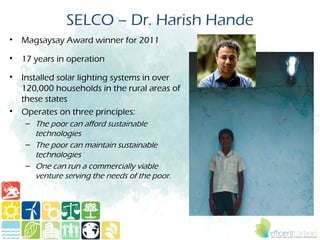
SELCO – Dr. Harish Hande
• Magsaysay Award winner for 2011

• 17 years in operation

• Installed solar lighting systems in over
  120,000 households in the rural areas of
  these states
• Operates on three principles: 
   – The poor can afford sustainable
     technologies
   – The poor can maintain sustainable
     technologies
   – One can run a commercially viable
     venture serving the needs of the poor. 
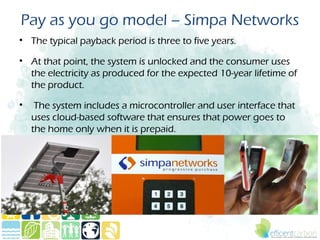
Pay as you go model – Simpa Networks
• The typical payback period is three to five years.

• At that point, the system is unlocked and the consumer uses
  the electricity as produced for the expected 10-year lifetime of
  the product.

•    The system includes a microcontroller and user interface that
    uses cloud-based software that ensures that power goes to
    the home only when it is prepaid.
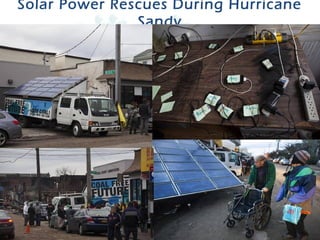
Solar Power Rescues During Hurricane
               Sandy
BioMass / Waste To Energy


               www.efficientcarbon.com
                Phone: +91 9000345588
            gogreen@efficientcarbon.com
         © efficientcarbon, All rights reserved
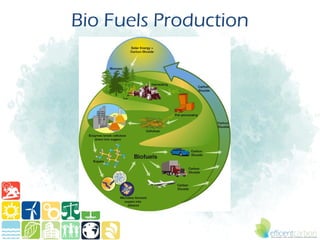
Bio Fuels Production
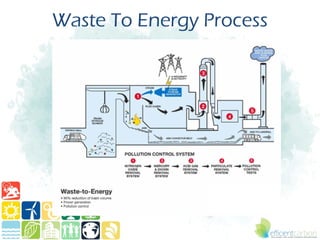
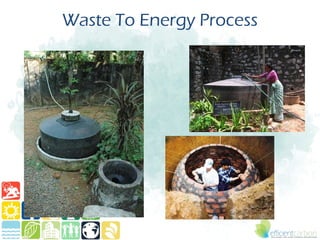
Waste To Energy Process
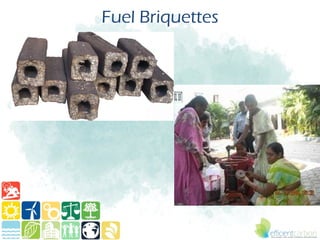
Fuel Briquettes
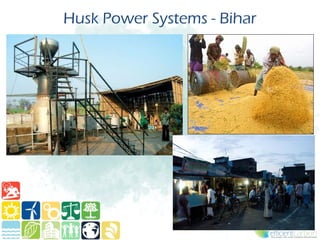
Husk Power Systems - Bihar
Assessment
• Advantages
  – Low Risk
  – Raw Material always available
  – Reduces waste and reuses it for electricity generation
    – double the advantage


• Disadvantage
  – Educating people on segregation difficult
  – Technology efficiencies still evolving
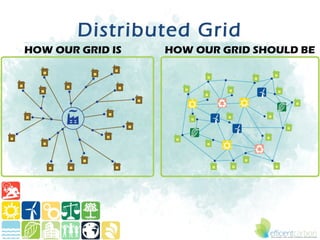
Distributed Grid
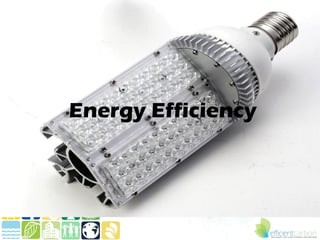
Energy Efficiency
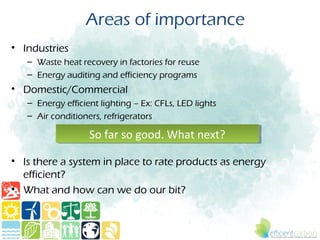
Areas of importance
• Industries
   – Waste heat recovery in factories for reuse
   – Energy auditing and efficiency programs
• Domestic/Commercial
   – Energy efficient lighting – Ex: CFLs, LED lights
   – Air conditioners, refrigerators

                   So far so good. What next?
                   So far so good. What next?

• Is there a system in place to rate products as energy
  efficient?
• What and how can we do our bit?
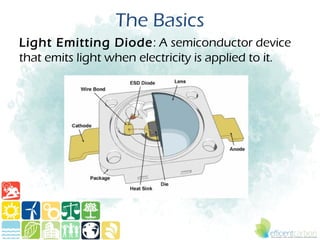
The Basics
Light Emitting Diode: A semiconductor device
that emits light when electricity is applied to it.
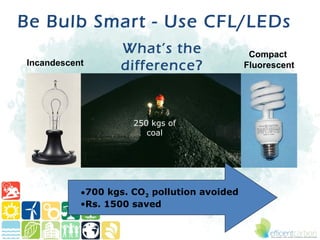
Be Bulb Smart - Use CFL/LEDs
                  What’s the                  Compact
Incandescent      difference?                Fluorescent


                     250 kgs of
                        coal


           •700 kgs. CO2 pollution avoided
           •Rs. 1500 saved
What can you do to help
 solve the problem?
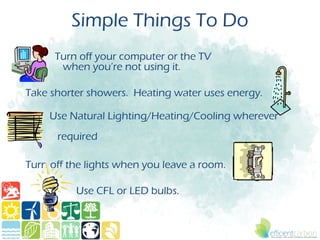
Simple Things To Do
      Turn off your computer or the TV
       when you’re not using it.

Take shorter showers. Heating water uses energy.

     Use Natural Lighting/Heating/Cooling wherever
      required

Turn off the lights when you leave a room.

          Use CFL or LED bulbs.
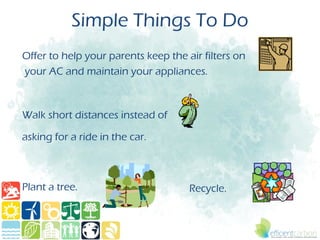
Simple Things To Do
Offer to help your parents keep the air filters on
your AC and maintain your appliances.


Walk short distances instead of

asking for a ride in the car.


Plant a tree.                        Recycle.
"Sustainability is not only absolutely necessary considering the
situation our planet is in, we as companies are also overdue to
take responsibility. We can't wait for governments. Companies
have to lead the way…

                                      - Jochen Zeitz, CEO, Puma
Corp.


                                    Thank You

Renewable Energy, Energy Efficiency and Bio Diversity

  • 1.
    Renewable Energy & BioDiversity Harsha Yadav, Co-Founder, EfficientCarbon harsha@efficientcarbon.com www.efficientcarbon.com
  • 2.
    About EfficientCarbon • Company offering services in: – Carbon Management Advisory – Sustainability Strategy Development and Reporting – Solar and Renewable Energy Market Advisory • Experience in working with Large and SME clients in Cement, Leather, Steel and Auto Industries . • Engineers and management graduates from institutions like IIT-R, BITS-Pilani, and IFMR with work experience in companies like Godrej, Infosys, Titan Industries and Deloitte Management Consulting. • Supported by certified experts in this domain with an average experience of 23 years in the areas of Sustainability, Water Management, Energy Efficiency, Renewable Energy and Bio Diversity.
  • 3.
  • 4.
    % Contribution ofEach Energy Type
  • 5.
    Effects of Coalon Bio-Diversity - Mining
  • 10.
    But can wereplace Coal completely? Possible, but not yet!
  • 11.
  • 12.
  • 13.
    How does aHydel Plant Work?
  • 14.
  • 15.
    Hydel Power • Advantages – Clean and Renewable – Availability is not a constraint – Long Lasting • Disadvantages – Huge Initial Investments required – Potential threat to biodiversity due to reservoir in the catchment area. – Displacements of communities in case of large projects
  • 16.
  • 17.
  • 18.
    Assessment • Advantages – Lifetime availability of heat from the Earth – Relatively simple process and easy to set-up • Disadvantages – Cannot be set up at all the places as compared to Solar / Wind or Biomass • In India, only areas near Himalayas are rich sources of Geothermal energy.
  • 19.
  • 20.
  • 22.
    Assessment • Advantages – Clean, easily available – Cost effective on a large scale • Disadvantages – Availability of Wind power on all days – Efficiency of the turbine and distribution
  • 23.
  • 24.
    Solar Technologies There aretwo ways of using Solar Energy for different applications Energy Source Technology Selective Applications
  • 25.
    Industry is pursuinga host of promising technologies in Photovoltaics... Concentrated Thin Films Crystalline Silicon Photovoltaic Market Material Structure Ground Roof Amorphous CdTE/ Mono- Multi- Organic Mounted Mounted Silicon CIGS Crystalline Crystalline Setting up a solar PV manufacturing unit can cost around Rs 90 crores for a 5MW capacity but the figure can vary depending on govt subsidies, locations, suppliers, etc.,
  • 26.
    The Science behindPhoto-voltaic Cell Cross-section of a Solar Cell
  • 27.
    ...and in ConcentratedSolar Power (CSP) Trough Tower Linear Dishes Fresnel
  • 28.
    Applications Utility Commerci Residentia al Manufacture of Photovoltaics and CSP Equipment Manufacture of Photovoltaics and CSP Equipment l Project Execution in MW Project Execution in MW Rooftop Solar Grid Rooftop Solar Grid Utility Scale Power Plants Utility Scale Power Plants scale Connected PV scale Connected PV EPC services for Solar Power EPC services for Solar Power Rooftop Solar Grid Rooftop Solar Grid Retail applications –– Retail applications Plants Plants Connected PV Connected PV lighting, heating, cooking lighting, heating, cooking Solar for lighting - - Solar for lighting Off grid applications for Off grid applications for streetlights streetlights rural areas rural areas Captive Solar for specific Captive Solar for specific Public and Home lighting –– Public and Home lighting applications –– drying, cooking applications drying, cooking rural & urban rural & urban Trading of Solar equipment – imported or Indian Trading of Solar equipment – imported or Indian Manufacture/Trading of Anciliary equipment – Balance of systems, trackers, etc., Manufacture/Trading of Anciliary equipment – Balance of systems, trackers, etc.,
  • 29.
    Solar performance assessment Advantages Disadvantages • Freely available and can last for a long long time • Clean energy from the sun – Zero Carbon • Can reach places where grid No More electricity does not reach • Low Maintenance • Rugged and durable • Low recurring costs • Rebates and subsidies from the govt. • Nil Transmission losses
  • 30.
    China Announces Solar energy covers 2.8% Spain’s Massive Solar Projects electricity demand What is the world up to? ‘Solar City’ coming up at Kadiri - AP 20 GW of solar power by 2022 - India Germany meets 1.2% of electricity demand through Solar energy
  • 31.
    SELCO – Dr.Harish Hande • Magsaysay Award winner for 2011 • 17 years in operation • Installed solar lighting systems in over 120,000 households in the rural areas of these states • Operates on three principles:  – The poor can afford sustainable technologies – The poor can maintain sustainable technologies – One can run a commercially viable venture serving the needs of the poor. 
  • 32.
    Pay as yougo model – Simpa Networks • The typical payback period is three to five years. • At that point, the system is unlocked and the consumer uses the electricity as produced for the expected 10-year lifetime of the product. • The system includes a microcontroller and user interface that uses cloud-based software that ensures that power goes to the home only when it is prepaid.
  • 33.
    Solar Power RescuesDuring Hurricane Sandy
  • 34.
    BioMass / WasteTo Energy www.efficientcarbon.com Phone: +91 9000345588 gogreen@efficientcarbon.com © efficientcarbon, All rights reserved
  • 35.
  • 36.
  • 37.
  • 38.
  • 39.
  • 40.
    Assessment • Advantages – Low Risk – Raw Material always available – Reduces waste and reuses it for electricity generation – double the advantage • Disadvantage – Educating people on segregation difficult – Technology efficiencies still evolving
  • 41.
  • 42.
  • 43.
    Areas of importance •Industries – Waste heat recovery in factories for reuse – Energy auditing and efficiency programs • Domestic/Commercial – Energy efficient lighting – Ex: CFLs, LED lights – Air conditioners, refrigerators So far so good. What next? So far so good. What next? • Is there a system in place to rate products as energy efficient? • What and how can we do our bit?
  • 44.
    The Basics Light EmittingDiode: A semiconductor device that emits light when electricity is applied to it.
  • 45.
    Be Bulb Smart- Use CFL/LEDs What’s the Compact Incandescent difference? Fluorescent 250 kgs of coal •700 kgs. CO2 pollution avoided •Rs. 1500 saved
  • 47.
    What can youdo to help solve the problem?
  • 48.
    Simple Things ToDo Turn off your computer or the TV when you’re not using it. Take shorter showers. Heating water uses energy. Use Natural Lighting/Heating/Cooling wherever required Turn off the lights when you leave a room. Use CFL or LED bulbs.
  • 49.
    Simple Things ToDo Offer to help your parents keep the air filters on your AC and maintain your appliances. Walk short distances instead of asking for a ride in the car. Plant a tree. Recycle.
  • 50.
    "Sustainability is notonly absolutely necessary considering the situation our planet is in, we as companies are also overdue to take responsibility. We can't wait for governments. Companies have to lead the way… - Jochen Zeitz, CEO, Puma Corp. Thank You

Editor's Notes

  • #45 LED - A pn junction semiconductor device that emits incoherent optical radiation when forward biased. The optical emission may be in the ultraviolet, visible, or infrared wavelength regions. Gold wire bond Definition: A light-emitting diode , usually called an LED (/ɛl.iː.ˈdiː/)[1], is a semiconductor diode that emits incoherent narrow-spectrum light when electrically biased in the forward direction of the p-n junction, as in the common LED circuit. Definition: A light-emitting diode , usually called an LED (/ɛl.iː.ˈdiː/)[1], is a semiconductor diode that emits incoherent narrow-spectrum light when electrically biased in the forward direction of the p-n junction, as in the common LED circuit. Like a normal diode, the LED consists of a chip of semiconducting material impregnated, or doped , with impurities to create a p-n junction . As in other diodes, current flows easily from the p-side, or anode, to the n-side, or cathode, but not in the reverse direction. Charge-carriers—electrons and holes—flow into the junction from electrodes with different voltages. When an electron meets a hole, it falls into a lower energy level, and releases energy in the form of a photon. The wavelength of the light emitted, and therefore its color, depends on the band gap energy of the materials forming the p-n junction . In silicon or germanium diodes, the electrons and holes recombine by a non-radiative transition which produces no optical emission, because these are indirect band gap materials. The materials used for the LED have a direct band gap with energies corresponding to near-infrared, visible or near-ultraviolet light. LED development began with infrared and red devices made with gallium arsenide. Advances in materials science have made possible the production of devices with ever-shorter wavelengths, producing light in a variety of colors.