
SUSTAINABLE BUILDING
MATERIALS
WHAT IS SUSTAINABLE BUILDING ?
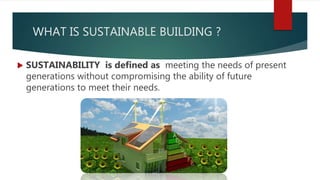
 SUSTAINABILITY is defined as meeting the needs of present
generations without compromising the ability of future
generations to meet their needs.
Sustainable building or Green building refers to the
structure which are both :
• environmentally responsible and
• resource-efficient throughout a building’s life cycle.
Sustainable building design involves balance between
• Home building and
• Sustainable environment
OBJECTIVES OF GREEN BUILDING:
 Common objectives of green building is to :
 Low impact :minimize impact on natural environment
 Energy efficient: reduced energy usage and water usage
 Healthy: protect occupant’s health and increase productivity
 Minimize waste: designed and constructed in a manner that minimizes
waste, pollution and environmental degradation.
GOALS OF SUSTAINABLE BUILDINGS
 There are a number of motives for building green, including environmental,
economic, and social benefits.
 It often emphasizes taking advantage of Renewable resources:
for example:
• Using sunlight as passive solar , active solar and photovoltaic equipments.
• Using plants and tress through green roofs, rain gardens etc.
• Reduction of rain-water run-off.
PRINCIPLES OF SUSTAINABLE BUILDING:
 STRUCTURAL EFFECIENCY: to minimize the environment
impact associated with all life-cycles.
 ENERGY EFFECIENCY :to reduce the operating energy use.
 WATER EFFECIENCY: reducing water consumption and
protecting water quality.
 MATERIAL EFFECIENCY: materials should be
renewable,recycleable and environment-friendly.
WHAT IS A SUSTAINABLE MATERIAL ?
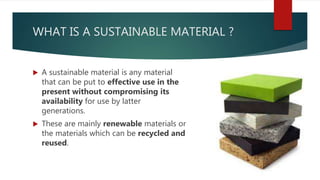
 A sustainable material is any material
that can be put to effective use in the
present without compromising its
availability for use by latter
generations.
 These are mainly renewable materials or
the materials which can be recycled and
reused.
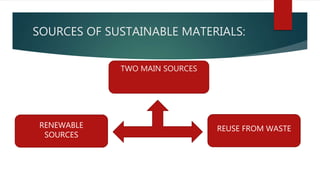
SOURCES OF SUSTAINABLE MATERIALS:
TWO MAIN SOURCES
RENEWABLE
SOURCES
REUSE FROM WASTE
TYPES OF SUSTAINABLE MATERIALS:
MATERIALS FROM RENEWABLE
SOURCES
 Materials significantly of plant
origin.
 Can be obtained from renewable
sources like solar energy, wind
energy, bio-gas etc.
 E.g.: wood, natural fibers, polymers
etc.
REUSE FROM WASTE
PRODUCTS AS RAW
MATERIALS
 They are typically the products of
recycled matter.
 Materials that can be dismantled and
reused again.
 E.g.: old plumbings, doors, crushed
glass, wood chips etc.
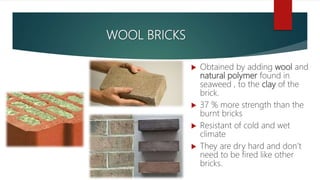
WOOL BRICKS
 Obtained by adding wool and
natural polymer found in
seaweed , to the clay of the
brick.
 37 % more strength than the
burnt bricks
 Resistant of cold and wet
climate
 They are dry hard and don’t
need to be fired like other
bricks.
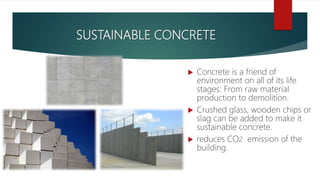
SUSTAINABLE CONCRETE
 Concrete is a friend of
environment on all of its life
stages: From raw material
production to demolition.
 Crushed glass, wooden chips or
slag can be added to make it
sustainable concrete.
 reduces CO2 emission of the
building.
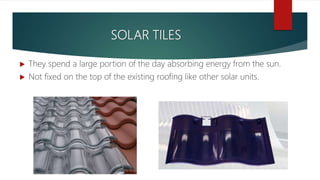
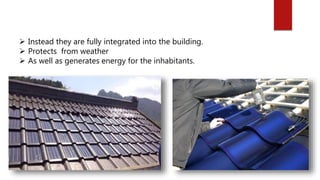
SOLAR TILES
 They spend a large portion of the day absorbing energy from the sun.
 Not fixed on the top of the existing roofing like other solar units.
 Instead they are fully integrated into the building.
 Protects from weather
 As well as generates energy for the inhabitants.
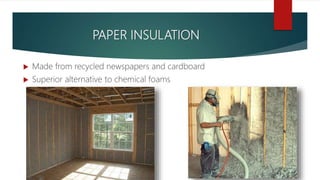
PAPER INSULATION
 Made from recycled newspapers and cardboard
 Superior alternative to chemical foams
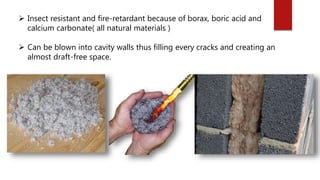
 Insect resistant and fire-retardant because of borax, boric acid and
calcium carbonate( all natural materials )
 Can be blown into cavity walls thus filling every cracks and creating an
almost draft-free space.
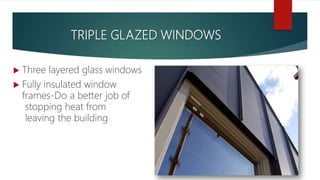
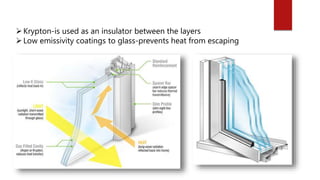
TRIPLE GLAZED WINDOWS
 Three layered glass windows
 Fully insulated window
frames-Do a better job of
stopping heat from
leaving the building
Krypton-is used as an insulator between the layers
Low emissivity coatings to glass-prevents heat from escaping
MERITS AND DEMERITS OF
SUSTAINABLE BUILDINGS
MERITS
 Efficient technologies
 Easier maintenance
 Improved indoor air quality
 Energy and water efficient
 Improved health
 Water conservation
DEMERITS
 Initial cost is high
 Availability of materials
 Need more time for
construction
 Need more skilled labors
Sustainable building materials

Sustainable building materials

  • 1.
  • 2.
    WHAT IS SUSTAINABLEBUILDING ?  SUSTAINABILITY is defined as meeting the needs of present generations without compromising the ability of future generations to meet their needs.
  • 3.
    Sustainable building orGreen building refers to the structure which are both : • environmentally responsible and • resource-efficient throughout a building’s life cycle. Sustainable building design involves balance between • Home building and • Sustainable environment
  • 4.
    OBJECTIVES OF GREENBUILDING:  Common objectives of green building is to :  Low impact :minimize impact on natural environment  Energy efficient: reduced energy usage and water usage  Healthy: protect occupant’s health and increase productivity  Minimize waste: designed and constructed in a manner that minimizes waste, pollution and environmental degradation.
  • 5.
    GOALS OF SUSTAINABLEBUILDINGS  There are a number of motives for building green, including environmental, economic, and social benefits.  It often emphasizes taking advantage of Renewable resources: for example: • Using sunlight as passive solar , active solar and photovoltaic equipments. • Using plants and tress through green roofs, rain gardens etc. • Reduction of rain-water run-off.
  • 6.
    PRINCIPLES OF SUSTAINABLEBUILDING:  STRUCTURAL EFFECIENCY: to minimize the environment impact associated with all life-cycles.  ENERGY EFFECIENCY :to reduce the operating energy use.  WATER EFFECIENCY: reducing water consumption and protecting water quality.  MATERIAL EFFECIENCY: materials should be renewable,recycleable and environment-friendly.
  • 7.
    WHAT IS ASUSTAINABLE MATERIAL ?  A sustainable material is any material that can be put to effective use in the present without compromising its availability for use by latter generations.  These are mainly renewable materials or the materials which can be recycled and reused.
  • 8.
    SOURCES OF SUSTAINABLEMATERIALS: TWO MAIN SOURCES RENEWABLE SOURCES REUSE FROM WASTE
  • 9.
    TYPES OF SUSTAINABLEMATERIALS: MATERIALS FROM RENEWABLE SOURCES  Materials significantly of plant origin.  Can be obtained from renewable sources like solar energy, wind energy, bio-gas etc.  E.g.: wood, natural fibers, polymers etc. REUSE FROM WASTE PRODUCTS AS RAW MATERIALS  They are typically the products of recycled matter.  Materials that can be dismantled and reused again.  E.g.: old plumbings, doors, crushed glass, wood chips etc.
  • 10.
    WOOL BRICKS  Obtainedby adding wool and natural polymer found in seaweed , to the clay of the brick.  37 % more strength than the burnt bricks  Resistant of cold and wet climate  They are dry hard and don’t need to be fired like other bricks.
  • 11.
    SUSTAINABLE CONCRETE  Concreteis a friend of environment on all of its life stages: From raw material production to demolition.  Crushed glass, wooden chips or slag can be added to make it sustainable concrete.  reduces CO2 emission of the building.
  • 12.
    SOLAR TILES  Theyspend a large portion of the day absorbing energy from the sun.  Not fixed on the top of the existing roofing like other solar units.
  • 13.
     Instead theyare fully integrated into the building.  Protects from weather  As well as generates energy for the inhabitants.
  • 14.
    PAPER INSULATION  Madefrom recycled newspapers and cardboard  Superior alternative to chemical foams
  • 15.
     Insect resistantand fire-retardant because of borax, boric acid and calcium carbonate( all natural materials )  Can be blown into cavity walls thus filling every cracks and creating an almost draft-free space.
  • 16.
    TRIPLE GLAZED WINDOWS Three layered glass windows  Fully insulated window frames-Do a better job of stopping heat from leaving the building
  • 17.
    Krypton-is used asan insulator between the layers Low emissivity coatings to glass-prevents heat from escaping
  • 18.
    MERITS AND DEMERITSOF SUSTAINABLE BUILDINGS MERITS  Efficient technologies  Easier maintenance  Improved indoor air quality  Energy and water efficient  Improved health  Water conservation DEMERITS  Initial cost is high  Availability of materials  Need more time for construction  Need more skilled labors