Disaster nursing
PRESENTED
BY:
MR.TUSHAR
KEDAR
ASS.
LECTURER
Topics
1. Meaning of Disaster Nursing
2. Definition of Disaster
3. Types of Disaster
4. Principal of disaster
management
5. Disaster Management
6. Role of Nurses in Disaster
Nursing
7. International Agencies assist for
Disaster
Nursin
g
DISASTER ALPHABETICALLY
MEANS..
D- DESTRUCTION
I- INCIDENTS
S- SUFFERINGS
A- ADMINISTRATIVE, FINANCIAL
FAILURES
S- SENTIMENTS
T- TRAGIDIES
E- ERRUPTION OF COMMUNICABLE
DISEASES
R-RESEACH PROGRAMME AND ITS
IMPLEMENTATION
Definition of
Disaster
“An occurrence, either natural or
manmade
that causes human suffering and
creates
human needs that victims cannot
alleviate
without assistance.
-
The
American Red
Cross.
TYPES OF DISASTER
Natural disaster
Tornados Blizzards
Hurricanes Floods
Volcanic eruption
Earth quacks
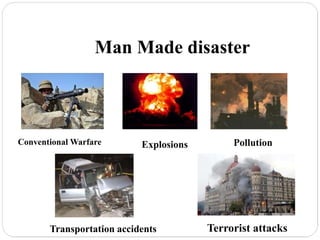
Man Made disaster
Conventional Warfare Pollution
Explosions
Terrorist attacks
Transportation accidents
1.Natural
disaster:
Hurricanes
Tornados
Tsuna
mi
Drough
t
Floods
Mudslid
es
Earth
quacks
Blizzards
Volcanic
eruption
Communicable
Cyclones
diseases
epidemics
Man made
disaster
Conventional
Warfare
Explosions
Toxic materials
Civil unrest (riots)
Transportation
accidents
Fires
Pollution
Terrorist
attacks
PHASES OF
DISASTER-
There are mainly three phases of
disaster-
PRE-IMPACT PHASE-
It is the initial phase of disaster. Prior to
the actual
occurrence a warning is given at the sign
of the first
possible danger to the community.
IMPACT
PHASE-
It occurs when the disaster actually
happens. It is the
time of enduring hardships or injury and of
trying to
survive. This is the time when the
individuals help
neighbours and families at the scene a time
of ‘ holding
on’ until help arrives. This phase may last
for several
minutes for example- [after an earthquake,
plane crash,
POST IMPACT
PHASE-
Recovery begins during the emergency phase
and ends with
both the return of normal community order and
functioning. This phase can event last for
life time for
example- victims of atomic bombing of
Hiroshima.
Principles of Disaster
Management
1) prevent the occurrence of disaster
whenever
possible.
•
•
•
•
2) provide first aid to the
injured
3) provide definitive medical
care
4) disaster management is the
responsibility of all
sphere of government
5) disaster management should use
resources that exist
for day-to-day purpose
6) individual are responsible for their own
safety
7) disaster management planning should
focus on large
scale events.
8) disaster management planning should not
recognize
the different between incident and disaster.
Disaster
Management
There are Three fundamental aspects of Disaster
Management
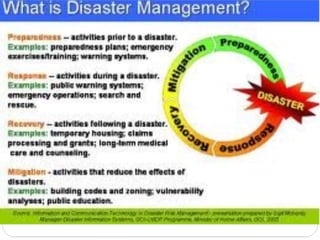
1. Preparedness phase
2. Response phase
3. Recovery phase
4. Prevention /Mitigation
phase
1. Disaster Preparedness Phase
Activities prior to a disaster
It is an on going multi sectoral activity
Example :
Preparedness plans
Emergency exercise
Training
Warning symptoms
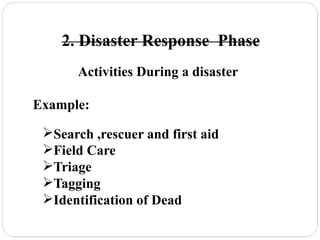
2. Disaster Response Phase
Activities During a disaster
Example:
Search ,rescuer and first aid
Field Care
Triage
Tagging
Identification of Dead
Search ,rescuer and first aid :
•The most immediate helps comes from the
uninjured persons
Field Care:
•Most injured person converge spontaneously
to health facilities.
•Bed availability and surgical services should
be Maximised.
•Provision makes for food and shelter.
Triage:
•It is an Rapidly classifying the injured on the basis of their
injuries.
•Triage is the only approach that can provide maximum
benefit to the greatest number of injured in a major
disaster situation.
•Triage colour coding system:
1. Red colour - Indicates High Priority treatment
and transport
2. Yellow colour -Medium priority
3. Green colour -Ambulatory patients
4. Black colour -Dead patients
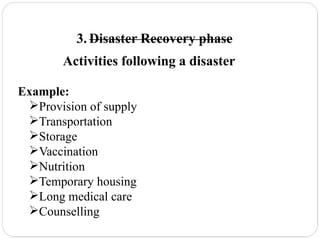
3. Disaster Recovery phase
Activities following a disaster
Example:
Provision of supply
Transportation
Storage
Vaccination
Nutrition
Temporary housing
Long medical care
Counselling
4. Prevention /Mitigation phase
Activities that reduces the effects of disaster
Examples:
Improved building codes
Reduction and protection of vulnerable population
Public education
Flood mitigation works
The Nursing Role in Disaster
Management
Assess the Community Diagnose Community Disaster Threats
ROLE OF
NURSE
Evaluate Effectiveness of Disaster Plan Community Disaster Planning
Implementation Disaster Plan
The Nursing Role
in
Disaster
Management
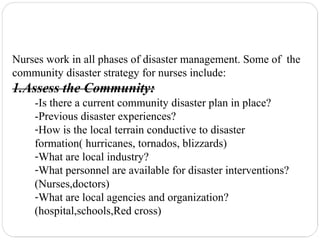
Nurses work in all phases of disaster management. Some of the
community disaster strategy for nurses include:
1.Assess the Community:
-Is there a current community disaster plan in place?
-Previous disaster experiences?
-How is the local terrain conductive to disaster
formation( hurricanes, tornados, blizzards)
-
-
What are local industry?
What personnel are available for disaster interventions?
(Nurses,doctors)
-What are local agencies and organization?
(hospital,schools,Red cross)
2.Diagnose Community Disaster Threats:
•Determine actual and potential disaster
threats.(eg. toxic waste,explosions,road
accidents,hurricanes,
tornandos,floods,earthquicks)
3.Community Disaster Planning:
•Develop a disaster plan to prevent or deal with
identified disaster threats.
•Identify a local community communicable
system.
•Set up of an emergency medical systems and
chain for activation.
4.Impliment Disaster plan:
Focus on primary prevention activities to prevent
occurrence of man made disaster.
Practice using equipments, obtaining and distributing
supplies.
5.Evaluate effectiveness of Disaster plan:
Critically evaluate all aspects of disaster plan and
practical drills for speed, effectiveness, gaps and revision.
Evaluate the disaster impact on community and
surrounding regions.
Evaluate response of personnel involved in disaster relief
efforts.
INTERNATIONAL AGENCIES
1.World health organisation(WHO.)
2.UNICEF
3.World Food programme (WFP.)
4.United Nation office for the co-ordination of
Humanitarian affairs.
5.Food and agriculture organisation (FAO.)
6.Organisation of America State (OAS.)
7.Cambridge Disaster Emergency Response Agency.
8.Co-operative for American Relief
Everywhere(CARE)
9.International committee of Red Cross.
10.International council of Voluntary agency.
THANK
YOU

disaster nursing guidenotes for reference only

  • 1.
  • 2.
    Topics 1. Meaning ofDisaster Nursing 2. Definition of Disaster 3. Types of Disaster 4. Principal of disaster management 5. Disaster Management 6. Role of Nurses in Disaster Nursing 7. International Agencies assist for Disaster Nursin g
  • 3.
    DISASTER ALPHABETICALLY MEANS.. D- DESTRUCTION I-INCIDENTS S- SUFFERINGS A- ADMINISTRATIVE, FINANCIAL FAILURES S- SENTIMENTS T- TRAGIDIES E- ERRUPTION OF COMMUNICABLE DISEASES R-RESEACH PROGRAMME AND ITS IMPLEMENTATION
  • 4.
    Definition of Disaster “An occurrence,either natural or manmade that causes human suffering and creates human needs that victims cannot alleviate without assistance. - The American Red Cross.
  • 5.
    TYPES OF DISASTER Naturaldisaster Tornados Blizzards Hurricanes Floods Volcanic eruption Earth quacks
  • 6.
    Man Made disaster ConventionalWarfare Pollution Explosions Terrorist attacks Transportation accidents
  • 7.
  • 8.
    Man made disaster Conventional Warfare Explosions Toxic materials Civilunrest (riots) Transportation accidents Fires Pollution Terrorist attacks
  • 9.
    PHASES OF DISASTER- There aremainly three phases of disaster- PRE-IMPACT PHASE- It is the initial phase of disaster. Prior to the actual occurrence a warning is given at the sign of the first possible danger to the community.
  • 10.
    IMPACT PHASE- It occurs whenthe disaster actually happens. It is the time of enduring hardships or injury and of trying to survive. This is the time when the individuals help neighbours and families at the scene a time of ‘ holding on’ until help arrives. This phase may last for several minutes for example- [after an earthquake, plane crash,
  • 11.
    POST IMPACT PHASE- Recovery beginsduring the emergency phase and ends with both the return of normal community order and functioning. This phase can event last for life time for example- victims of atomic bombing of Hiroshima.
  • 12.
    Principles of Disaster Management 1)prevent the occurrence of disaster whenever possible. • • • • 2) provide first aid to the injured 3) provide definitive medical care 4) disaster management is the responsibility of all sphere of government
  • 13.
    5) disaster managementshould use resources that exist for day-to-day purpose 6) individual are responsible for their own safety 7) disaster management planning should focus on large scale events. 8) disaster management planning should not recognize the different between incident and disaster.
  • 14.
    Disaster Management There are Threefundamental aspects of Disaster Management 1. Preparedness phase 2. Response phase 3. Recovery phase 4. Prevention /Mitigation phase
  • 16.
    1. Disaster PreparednessPhase Activities prior to a disaster It is an on going multi sectoral activity Example : Preparedness plans Emergency exercise Training Warning symptoms
  • 17.
    2. Disaster ResponsePhase Activities During a disaster Example: Search ,rescuer and first aid Field Care Triage Tagging Identification of Dead
  • 18.
    Search ,rescuer andfirst aid : •The most immediate helps comes from the uninjured persons Field Care: •Most injured person converge spontaneously to health facilities. •Bed availability and surgical services should be Maximised. •Provision makes for food and shelter.
  • 19.
    Triage: •It is anRapidly classifying the injured on the basis of their injuries. •Triage is the only approach that can provide maximum benefit to the greatest number of injured in a major disaster situation. •Triage colour coding system: 1. Red colour - Indicates High Priority treatment and transport 2. Yellow colour -Medium priority 3. Green colour -Ambulatory patients 4. Black colour -Dead patients
  • 20.
    3. Disaster Recoveryphase Activities following a disaster Example: Provision of supply Transportation Storage Vaccination Nutrition Temporary housing Long medical care Counselling
  • 21.
    4. Prevention /Mitigationphase Activities that reduces the effects of disaster Examples: Improved building codes Reduction and protection of vulnerable population Public education Flood mitigation works
  • 22.
    The Nursing Rolein Disaster Management Assess the Community Diagnose Community Disaster Threats ROLE OF NURSE Evaluate Effectiveness of Disaster Plan Community Disaster Planning Implementation Disaster Plan
  • 23.
    The Nursing Role in Disaster Management Nurseswork in all phases of disaster management. Some of the community disaster strategy for nurses include: 1.Assess the Community: -Is there a current community disaster plan in place? -Previous disaster experiences? -How is the local terrain conductive to disaster formation( hurricanes, tornados, blizzards) - - What are local industry? What personnel are available for disaster interventions? (Nurses,doctors) -What are local agencies and organization? (hospital,schools,Red cross)
  • 24.
    2.Diagnose Community DisasterThreats: •Determine actual and potential disaster threats.(eg. toxic waste,explosions,road accidents,hurricanes, tornandos,floods,earthquicks) 3.Community Disaster Planning: •Develop a disaster plan to prevent or deal with identified disaster threats. •Identify a local community communicable system. •Set up of an emergency medical systems and chain for activation.
  • 25.
    4.Impliment Disaster plan: Focuson primary prevention activities to prevent occurrence of man made disaster. Practice using equipments, obtaining and distributing supplies. 5.Evaluate effectiveness of Disaster plan: Critically evaluate all aspects of disaster plan and practical drills for speed, effectiveness, gaps and revision. Evaluate the disaster impact on community and surrounding regions. Evaluate response of personnel involved in disaster relief efforts.
  • 26.
    INTERNATIONAL AGENCIES 1.World healthorganisation(WHO.) 2.UNICEF 3.World Food programme (WFP.) 4.United Nation office for the co-ordination of Humanitarian affairs. 5.Food and agriculture organisation (FAO.) 6.Organisation of America State (OAS.) 7.Cambridge Disaster Emergency Response Agency. 8.Co-operative for American Relief Everywhere(CARE) 9.International committee of Red Cross. 10.International council of Voluntary agency.
  • 27.